1786: David Nelson, but not William Horbord

This date in 1786 offers us the fine legal salami-slicing of how to stanch a race war with a noose.

Our salami’s name is David Nelson, a furloughed veteran of the Queen’s Rangers in the late American Revolution relocated to the environs of Fredericton, New Brunswick.

There, he and a fellow veteran named William Horbord or Horboard shot dead a native Maliseet for stealing their hog.

This brought neighboring peoples to a deadly tense standoff. The Maliseet demanded justice for their victim; white Canadians demanded … well, the right to shoot Maliseet without fear of their own neck.

Nelson and Horbord went right on trial, but how to finesse the situation?

According to an exhibit that unfortunately seems to have vanished from the Virtual Museum of Canada, natives “camped out around the presiding Judge Kingsclear’s home.” That must have got his commute off to an awkward start each day.

So a Solomonic compromise obtained: after the two were duly convicted and doomed to hang, Nelson, the principal offender, was measured for his coffin … while Horbord, deemed less culpable, received a pardon.

Now that’s gallows diplomacy.

On this day..

1826: Janissaries during the Auspicious Incident

We have received from Constantinople the following further particulars of the revolt of the Janissaries: —

“June 16, 3 o’clock p.m.

“The Sultan was at his summer palace of Bschektash. The Aga Pacha, and the Pacha commanding on the Asiatic bank of the Bosphorus, repaired to Constantinople with their troops: 8,000 topschis, or artillery, also went thither. At length, his Sublimity being resolved to quell the rebellion, caused the standard of the Prophet to be displayed, and proclamations to be made in all the quarters of the city, that all men of honour — that is to say, true believers — had immediately to rally round this standard. The Ulemas met in the Seraglio. The appearance of the Snadgiak Sherif caused some hesitation among the rebels; their numbers were reduced by desertion, while, on the other hand, all the people hastened to assemble round the sacred standard. The energy of the Aga Pacha did the rest; he has crushed the rebles with grape-shot, burnt their barracks in the Ahnudan, and pursued them without mercy.

“The Grand Vizier is in the Court of the Mosque of Sultan Achmet, in the Hippodrome, with the Sandgiak Sherif still displayed; the chiefs of the corps of the Ulemas are met there in council; the Sultan is at the Seraglio, with the great men of the empire. Every moment persons are brought into the Hippodrome, and executed on the spot. Above 100 Oustas have already suffered this fate. This morning all the gates of Constantinople, except one, are shut or guarded by topschis and citizens. The remainder of the rebels have taken refuge in some khans built of stone, where they are invested, and where, to all appearance, famine will soon deliver them to the mercy of the Aga Pacha.

–London Times, July 15, 1826 (translating July 11 reports published in the French papers)

This date in 1826 finds Constantinople in the midst of what history will remember as the Auspicious Incident — an attempted revolt by the Ottoman Empire’s elite Janissary corps that was not at all auspicious for the Janissaries.

This centuries-old slave infantry,* a sort of Ottoman Praetorian Guard as well as the sultan’s elite military presence in the empire’s hinterlands, had evolved by this stage of decadence into a vampire squid on the face of the Porte.**

Jealous of their material privileges and political prerogatives even as the dawn of industry and conscript armies undermined their combat utility, the Janissaries had become much more trouble than they were worth.†

They had “begun to present a serious threat to the Empire,” wrote Lord Kinross in Ottoman Centuries. “On the battlefield they were gaining a reputation among the modern foreign armies for ineptitude and even cowardice under arms … In the capital … they came to be a dominant power and a focus of sedition.”

Kinross wrote that about the Janissaries of the early 17th century, in the reign of Osman II. (Osman tried to curtail the troop’s power, and was executed by his bodyguards for his trouble.)

A couple of centuries on from that moment, and the Janissaries are still skulking about the Seraglio, still keeping their supposed masters in mortal terror, still arbitrating the succession.

The current ruler, Mahmud II, had been fortunate in his own youth to survive the Janissaries’ political intrusion and reach the throne.

For a generation, Mahmud had waited and readied himself for the opportunity to sweep this piece off the chessboard. This would be a most Auspicious Incident indeed.

Kinross and many other historians suspect that Mahmud intentionally baited the Janissaries to revolt in 1826, but whether or not that is so, they did revolt — in response to a decree reorganizing the corps.

Mahmud was ready for them. He repelled the Janissary mutiny on June 15, and as described by our third-hand correspondent above, proceeded to slaughter them without mercy: under artillery barrage in the barracks they retreated to, or by the summary execution of all who surrendered — not just on this date, but throughout the Incident and extending to the further reaches of the empire where Mahmud’s agents carried his decree abolishing the Janissaries forever.

* Culled from children taken from non-Muslim families and raised as Islamic converts.

** Not unlike the actual Praetorian Guard.

† There’s a competing historiography contending (pdf) that, contrary to the corrupt-backwards-military-caste story, it was the Janissaries’ economic and social links that brought on their destruction: they became the entity representing the autonomous Ottoman classes, such as artisans and guilds, who had the most to lose from the elites’ state modernization project.

On this day..

1857: Twelve blown from cannons in British Punjab

An account from the February 15, 1862 Harper’s Weekly of a very messy spectacle orchestrated to maintain British control of Punjab.

Another execution of a similar nature took place on the 13th of June, at Ferozepore. All the available troops and public establishments were convened to witness the scene. Some of the mutineers were to be hung, and around the gallows, erected during the night previous, the soldiers were drawn up. The mutineers were then brought into the centre, and the proceedings of the general Court-Martial was read. Upon being informed that if they would become Queen’s evidence they would be reprieved, twelve of the criminals accepted the offer and were marched to the rear. Two were taken to the gallows. They ascended the ladder with firm steps, and to the last moment betrayed no emotion of fear.

The remaining ten were now led away to the artillery guns, and while their irons were being struck off some cried, “Do not sacrifice the innocent for the guilty!” Two others rejoined, “Hold your sniveling: die men and not cowards — you defended your religion, why then do you crave your lives? Sahibs! they are not Sahibs, they are dogs!” Others then began to upbraid their commanding officer. The wretched beings were quickly fastened to the muzzles of ten guns, charged with blank cartridge.

The commanding officer directed port-fires to be lit. “Ready!” “Fire!” and the drama was played out. An eye-witness says: “The scene and stench were overpowering. I felt myself terribly convulsed, and could observe that the numerous native spectators were awe-stricken — that they not only trembled like aspen-leaves, but also changed into unnatural hues. Precaution was not taken to remove the sponge-and-load men from the muzzles of the guns; the consequence was that they were greatly bespattered with blood, and one man in particular received a stunning blow from a shivered arm!“


A lengthier account, no less riveting and we suppose more accurate on account of its primary sourcing, is to be found in this memoir or the British campaign against the Sepoy rebellion.

June 13 The morning of June 13 was fixed upon for the execution. A gallows was erected on the plain to the north side of the fort, facing the native bazaars, and at a distance of some 300 yards. On this two sepoys were to be hanged, and at the same time their comrades in mutiny were to be blown away from guns.

We paraded at daylight every man off duty, and, with the band playing, marched to the place of execution, and drew up in line near the gallows and opposite the native quarter.

Shortly after our arrival the European Light Field Battery, of six guns, appeared on the scene, forming up on our left flank, and about twenty yards in front of the Light Company.

The morning was close and sultry, not a cloud in the sky, and not a breath of wind stirring; and I confess I felt sick with a suffocating sense of horror when I reflected on the terrible sight I was about to witness.

Soon the fourteen mutineers, under a strong escort of our men with fixed bayonets, were seen moving from the fort. They advanced over the plain at our rear, and drew up to the left front of, and at right angles to, the battery of artillery.

I was standing at the extreme right of the line with the Grenadier Company, and some distance from the guns; but I had provided myself with a pair of strong glasses, and therefore saw all that followed clearly and distinctly.

There was no unnecessary delay in the accomplishment of the tragedy. Two of the wretched creatures were marched off to the gallows, and placed with ropes round their necks on a raised platform under the beam.

The order was given for the guns to be loaded, and quick as thought the European artillerymen placed a quarter charge of powder in each piece. The guns were 9-pounders, the muzzles standing about 3 feet from the ground.

During these awful preparations, I watched at intervals the faces of the condemned men, but could detect no traces of fear or agitation in their demeanour. The twelve stood two deep, six in front and six in the rear, calm and undismayed, without uttering a word.

An officer came forward, and, by the Brigadier’s order, read the sentence of the court-martial, and at its conclusion the six men in front, under escort, walked towards the battery.

There was a death-like silence over the scene at this time, and, overcome with horror, my heart seemed almost to cease beating.

Arrived at the guns, the culprits were handed over to the artillerymen, who, ready prepared with strong ropes in their hands, seized their victims. Each of these, standing erect, was bound to a cannon and tightly secured, with the small of the back covering the muzzle. And then all at once the silence which reigned around was broken by the oaths and yells of those about to die. These sounds were not uttered by men afraid of death, for they showed the most stoical indifference, but were the long-suppressed utterances of dying souls, who, in the bitterness of their hearts, cursed those who had been instrumental in condemning them to this shameful end. They one and all poured out maledictions on our heads; and in their language, one most rich in expletives, they exhausted the whole vocabulary.

Meanwhile the gunners stood with lighted port-fires, waiting for the
word of command to fire the guns and launch the sepoys into eternity.

These were still yelling and raining abuse, some even looking over their shoulders and watching without emotion the port-fires, about to be applied to the touch-holes, when the word “Fire!” sounded from the officer in command, and part of the tragedy was at an end.

A thick cloud of smoke issued from the muzzles of the cannons, through which were distinctly seen by several of us the black heads of the victims, thrown many feet into the air.

While this tragic drama was enacting, the two sepoys to be hanged were turned off the platform.

The artillerymen again loaded the guns, the six remaining prisoners, cursing like their comrades, were bound to them, another discharge, and then an execution, the like of which I hope never to see again, was completed.

All this time a sickening, offensive smell pervaded the air, a stench which only those who have been present at scenes such as these can realize — the pungent odour of burnt human flesh.

The artillerymen had neglected putting up back-boards to their guns, so that, horrible to relate, at each discharge the recoil threw back pieces of burning flesh, bespattering the men and covering them with blood and calcined remains.

A large concourse of natives from the bazaars and city had assembled in front of the houses, facing the guns at a distance, as I said before, of some 300 yards, to watch the execution. At the second discharge of the cannon, and on looking before me, I noticed the ground torn up and earth thrown a slight distance into the air more than 200 paces away. Almost at the same time there was a commotion among the throng in front, some running to and fro, while others ran off in the direction of the houses. I called the attention of an officer who was standing by my side to this strange and unaccountable phenomenon, and said, half joking: “Surely the scattered limbs of the sepoys have not been carried so far?”

He agreed with me that such was impossible; but how to account for the sight we had seen was quite beyond our comprehension.

The drama came to an end about six o’clock, and as is usual, even after a funeral or a military execution, the band struck up an air, and we marched back to barracks, hoping soon to drive from our minds the recollection of the awful scenes we had witnessed.

Two or three hours after our return news arrived that one native had been killed and two wounded among the crowd which had stood in our front, spectators of the recent execution. How this happened has never been explained. At this time a “cantonment guard” was mounted, consisting of a company of European infantry, half a troop of the 10th Light Cavalry, and four guns, and two of these guns loaded with grape were kept ready during the night, the horses being harnessed, etc. Half the cavalry also was held in readiness, saddled; in fact, every precaution was taken to meet an attack.

As far as I can recollect, there were but two executions by blowing away from guns on any large scale by us during the Mutiny; one of them that at Ferozepore.

On this day..

1904: Mart Vowell, aged Civil War veteran

On this date in 1904, a 61-year-old veteran of the U.S. Civil War was hanged for murder at Paragould, Ark.

“Hanging Day 1904”: this is apparently a photo either from Vowell’s execution, or the July 9, 1904 hanging at Paragould of Nathan H. Brewer

Mart Vowell, the hanged man, was anomalously the former city marshall of Rector, Arkansas — and his victim the town troublemaker, whom Vowell had previously arrested.

(Vowell fought in the Confederate army under Nathan Bedford Forrest. If it’s the same Mart Vowell described in this Reconstruction-era report, he apparently stuck around in Tennessee after the fighting stop and followed Forrest into the Ku Klux Klan.)

Even the grand jury summoned to indict the killer had to be dismissed after repeatedly returning only second-degree charges.

This case cries out for primary research beyond the scope of this blog’s daily deadlines further to the motivations of the characters involved, but the bottom line is that Vowell hanged before a highly sympathetic crowd — calling “Good-bye, Mart!” as he “died game” — in Paragould, Ark.

Arkansas Governor Jeff(erson) Davis — named after, but not related to, the Confederate president* — was himself hanged in effigy the next day for his refusal to spare Vowell in the face of thousands of petitioners. Davis being an open advocate of lynching (“without apology to any tribunal on the face of the earth”) we suppose the populist governor could hardly have been sore about a little mannequin, however “carefully prepared.”

* Given the famous characters evoked by name, we need to note that our day’s principal, Mart, was actually named Martin Van Buren Powell, which would presumably make him a namesake of abolitionist former U.S. President Martin Van Buren.

On this day..

1868: Kondo Isami, Shinsengumi

On this date in 1868, Shinsengumi commander Kondo Isami was beheaded at Itabashi as the civil war between the Tokugawa Shogunate and the rising Meiji government that would replace it unfolded.

A commoner raised to samurai, Kondo is famous for commanding the Shinsengumi, a sort of shogunate paramilitary renowned for hunting pro-imperial samurai.

This, of course, was ultimately a nonstarter, notwithstanding the Shinsengumi’s flair for dramatic success.

Kondo had little power to reverse the Tokugawa Shogunate’s deteriorating position even though his skill earned him progressively higher appointments in its service.

In the event, however, our principal lost the Battle of Koshu-Katsunuma, and was captured shortly thereafter.

From there, nature took its course.

He was brought in a cage to Itabashi, near Yedo, where he was beheaded. His head was put in spirits and sent to Kioto, where it was exposed in the dry bed of the Kamogawa near the fourth bridge. This most shameful of all punishments was inflicted upon Kondo Isami because, as chief adviser of his lord, the prince of Aidru, he had made himself especially hateful to the southern clans. (Source)
As a result, Kondo wouldn’t be around to say “I told you so” when the victorious Meiji scrapped their samurai-friendly xenophobia and replaced their former supporters in the warrior caste with a modernized army.

But he and his doomed band of upwardly-mobile swordsmen in romantic service of a historical dead-end are still with us. Shinsengumi adventures and Kondo Isami characters remain a staple of popular culture.

[flv:https://www.executedtoday.com/video/Shinsengumi_trailer.flv 440 330]

On this day..

1691: Jacob Leisler, “a Walloon who has sett at the head of the Rable”

On this date in 1691, Jacob Leisler was executed in New York, a New World casualty of the Glorious Revolution back in the mother country.

In an era when transatlantic communication moved at the speed of a galleon, the 1688 overthrow of England’s Stuart monarchy initiated an agonizing period of political uncertainty in Albion’s far-flung American provinces.

And to the question of who was really in charge were appended the many local political issues of the colonies — religious, economic, political.

One of the empire’s dominant fault political fault lines in the foregoing years had been the succession to follow England’s last Catholic monarch, James II. For Calvinists whose dynastic champion was the House of Orange, the marriage of their guy William III to James’s daughter raised the prospect of an eventual claim on the English throne. Those hopes seemed dashed when James fathered a son, to the elation of Catholics who now aspired to a lasting Catholic line.

When word reached New York, still a majority-Dutch city thanks to its original mother country, of the ascent of that their countryman William III and England’s Protestant establishment had forcibly disinherited the infant prince and his dad, it did not take long for local Dutch factions to run off the former King James’s plenipotentiaries. (An irony, since New York was named for that very same now-deposed King James: he’d been the Duke of York when it was seized for the Dutch in the 1660s.)

That ex-monarch’s brief reign had seen the establishment of a much-resented Dominion of New England, welding together everything from New Jersey to Maine into a super-colony whose high-handed boss was arrested by a Boston mob. (He sailed for England.) That gentleman’s lieutenant, in New York, likewise absconded as his own authority crumbled … a sort of American Glorious Revolution shadowing the one across the pond.

The Frankfurt-born Leisler was a colonial mercantile magnate, one of the 17th century’s wealthiest New Yorkers, notable for his Orangist sympathies and Calvinist religious inclination. It was to this important private citizen (who was also a militia captain) that de facto executive power fell in the New York colony — and it was indeed the New York colony specifically, since the reassertion of local prerogatives and pre-1685 administrative units had been one of the immediate consequences of the shakeout in America.


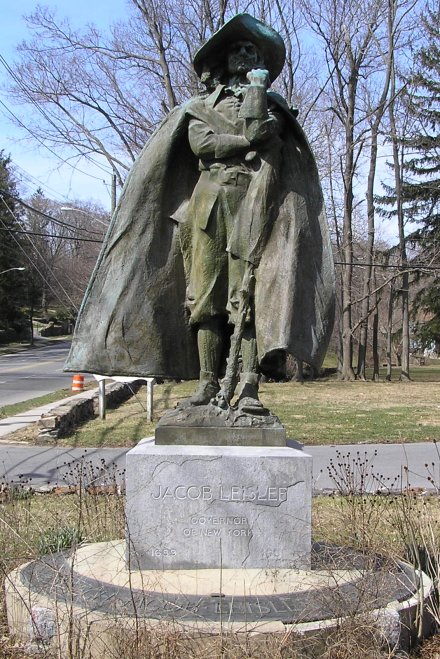
Statue of Jacob Leisler in New Rochelle, N.Y. — which Leisler helped create as a settlement for refugee Huguenots.

And once in the saddle, the Dutch Calvinist Leisler essentially ran a populist administration against the colonial oligarchy, which replied by vilifying him as a “usurper” and “rebel”.

Internal politics in New York and its neighbors during those months make fascinating reading.* Quakers and Catholics aligned against Protestants. Albany aligned against New York, until Leisler brought the former to heel. Clergy chose up sides. Leisler summoned a sort of proto-continental congress of colonial representatives (all the way to the West Indies) to hash out their situation.

And what was that situation? There had been a revolution, after all, and there was no agreed-upon representative of the royal authority present in New York. An assembly of militia leaders had asked Leisler to assume leadership, so was he really outside his rights to treat as his the London dispatches addressed to “such as, for the time being, take care for preserving the public peace and administering the law in New York”?

It’s a moment whose ferment of democratic energy can be read to presage the next century’s (proper) revolution.

Yet it was also not a revolution in the Cromwellian, world-turned-upside-down sense. For the English polity, and certainly for the conduct it preferred in its frontier possessions, continuity was the order of the day. Even in England herself, William and Mary were more than pleased to govern with Tories who could see their way to releasing their fealty to the Stuarts.

There was an empire to run, after all.

From that standpoint, Leisler’s anti-oligarchical policies and fractious disputes with other colonial elites were a bad business. There’s no sense in letting France make inroads because your governors are bickering over predestination or some such.

So formally, the realm’s new rulers continued all non-Catholic personnel in their posts. With the Dominion governors ejected, it was just a matter of dispatching fresh executives to take over. It’s just that this process required months … during which Leisler was managing New York the way he figured it ought to be managed, and his enemies were consequently painting him as a rebel.

Leisler pronounced himself, this whole time, anxious to submit his authority to the new governor upon the production of proper credentials. If he was surprised that the new monarchs tendered appointees of the very same factions recently expelled,** Leisler showed it only in his exactitude for procedure: because of a logistical cock-up, an aide to the new colonial governor arrived first, and when Leisler refused to hand over his fort without the royal warrant, a tense standoff ensued. It was resolved when the real governor, Henry Sloughter of ominous name, finally showed up.

Sloughter had his “predecessor” immediately arrested, along with others of his circle and harshly tried for treason and murder by a court stacked with anti-Leisler political enemies.†

Ultimately Leisler was condemned to die along with his secretary and son-in-law Jacob Milborne, but even Sloughter was loath to enforce the sentence. The story goes that Leisler’s most implacable foes had to get Sloughter drunk to put his signature on the death-warrant. (Sloughter died a couple of months later himself, for maximum operatic effect.)

On Saturday morning, May 16, 1691, the largest crowd ever gathered in New York City stood, rain soaked and weeping, all eyes fixed as a limp body was cut from the gallows and placed on the block. With a clean blow, the executioner’s ax cut off the head of the “halfe dead” Jacob Leisler — loyal lieutenant governor or rebel tyrant, depending on one’s point of view. Amid the “shrieks of the people,” fainting women (some “taken in labour”), and tumultuous jostling for “pieces of his garments” and strands of his hair, as “for a martyr,” the newly arrived and unfortunately named royal governor, Henry Sloughter, worried that his decision to execute Leisler might not, after all, end the “diseases and troubles of this Government.” Indeed, for years afterward New Yorkers bitterly divided over Leisler and the 1689 uprising that, in the wake of England’s Glorious Revolution, had led to his assumption of power in the provincial government.

-David Voorhees, who elsewhere contends that these divisions “continue to inform American politics to the present day.”*

A few years later, a more Leisler-friendly Parliament restored the dead man’s estate to his heirs, a sort of implicit admission that the whole head-chopping thing might have been a bit much.

This character figures to bear more historical consideration than he has heretofore enjoyed; further to that end, there’s a Jacob Leisler Papers Project devoted to marshaling at New York University the primary documents connected with Leisler.

* See, for instance, David Voorhees in “‘to assert our Right before it be quite lost’: The Leisler Rebellion in the Delaware River Valley” in Pennsylvania History, Winter 1997 — and, Voorhees again in “The ‘fervent Zeale’ of Jacob Leisler,” The William and Mary Quarterly, July 1994.

** Literally so: Francis Nicholson, whom Leisler ousted from New York, tried to get himself appointed governor; he was instead sent to Virginia and continued in royal service in the colonies for decades to come.

† e.g., Joseph Dudley, one of Leisler’s judges, whose penchant for authoritarian justice has been noted elsewhere in these pages.

On this day..

1976: Lt. Col. Bukar Dimka and six coup confederates

On this date in 1976, Nigeria executed the leading spirit of an abortive Nigerian coup was shot for the “abortive” part of that coup.

That February 13, Bukar Dimka had taken to the airwaves to announce the assassination of Nigeria’s incumbent military strongman, Murtala Mohammed.*

Good morning fellow Nigerians.

This is Lt. Colonel B. Dimka of the Nigerian Army calling. I bring you good tidings. Murtala Muhammed’s deficiency has been detected. His government is now overthrown by the young revolutionaries. All the 19 military governors have no powers over the states they now govern. The states affairs will be run by military brigade commanders until further notice.

…

Any acts of looting or raids will be death. Everyone should be calm. Please stay by your radio for further announcements. All borders, air and sea ports are closed until futher notice. Curfew is imposed from 6am to 6pm. Thank you. We are all together.

-From Romancing the Gun: The Press as Promoter of Military Rule

They were not all together.

Mohammed’s second-in-command, Olusegun Obasanjo, instantly quashed the putsch and served notice that assassinating the head of state would not be welcome on his watch.**

A large body of coup conspirators were publicly executed within a month; the Nigerian Defense Minister was among them.

Dimka himself managed to remain at large for most of that month, so he wasn’t among that crop. Instead, Obasanjo had the pleasure of announcing Dimka’s execution separately, along with that of

a former state governor, Joseph Gomwalk … “two of the principal actors” in the coup.

–New York Times, May 16, 1976

The coup was thought to have aimed at restoring the guy Mohammed deposed, Yakubu Gowon, who was luckily in exile in England and therefore escaped a similarly grim fate.

Years later, he received an official pardon; Gowon is still alive, one of Nigeria’s elder political statesmen.

* When next in Lagos to transfer several million in oil wealth from a secret bank account, be sure to visit Mohammed’s bullet-ridden Mercedes.

** Obasanjo handed power to a democratic government in 1979; that government was itself later toppled by the military, but Obasanjo eventually served as Nigeria’s elected president from 1999 to 2007.

On this day..

1766: Thomas Arthur de Lally-Tollendal, undiplomatic

On this date in 1766, a refugee noble with more honor than sense lost his head in Paris.

Thomas Arthur, comte de Lally, baron de Tollendal — more efficiently known as Lally, or as Lally-Tollendal, though he’s not to be confused in this with his son, a French Revolution bit player — entered this world in County Galway, the child of a minor lord.

Since said lord hewed to the Jacobite party favoring restoration of the Stuarts to the English throne, the family found itself relocated with the exiled Pretender to a continental power whose spiritual and temporal interests were similarly inimical to the Hanoverian king.

Our man landed himself, like a proper retainer of his adoptive liege, a gig in the French army in which capacity he actually served at the Jacobites’ last doomed British hurrah, the 1746 Battle of Falkirk.

But his problems came from his Bourbon service much further afield — in India.

There, his expeditionary force suffered reversal after reversal at the hands of the hated Brits, even then in the process of appending India to their dominions.

Our general’s military misadventures were compounded by impolitic high-handedness towards his officers and men, and to the locals whose alliances he needed. He was, in the main, a man ill-suited to the job entrusted to him. As the Memoirs of Sanson remark, “his temper, his obstinacy, and especially his contempt for all means of action except brutal strength, were destined to lead him into mistakes in a position demanding more knowledge of politics than science of war. Sixteen years before Lally-Tollendal’s appointment, Dupleix, with scanty forces, at enmity with the Company, receiving neither help nor subsidies from the mother country, had held in check English power in the Indian peninsula by mere diplomatic proficiency. Lally knew how to conquer; but he was incapable of studying and detecting the secrets of Dupleix’s policy.”

By the time the bad news that established all this hit France, the subcontinent was pretty much Britain’s to command — just another piece of the imperial butt-kicking France suffered in the Seven Years’ War.

And Lally’s enemies were holding him personally responsible as a potential traitor. After all, he was conveniently now in English custody.

Incensed at having his honor impugned, Lally unwisely obtained English parole to return to repel these charges. He proved no more diplomatic with the barristers than he had been with the Hindus:

he was so convinced of his own innocence that he was imprudent enough to impeach the officers who had served under his orders, together with the administrators of the colony. He charged them with such violence that his death and condemnation became indispensable for their justification … When the accused appeared before his judges, he was no more able to control his temper than when he was in India … answering, fuming, retorting, stigmatising the cowardice of some, the cupidity of others, and hinting that the only guilty party was the powerless Government.

Just the sort of vindication liable to appeal more to posterity than to said government. Louis XV, another man unequal to his position, was by this autumn of his reign plumbing the nadir of his unpopularity; for the officer who had risked his life in battle under French colors throughout adulthood, Louis calculated more profit in severity (or expedience) than in clemency. Hey, it had worked for the English.

And really, for a Stuart adherent, sacrificial execution was kind of an apt fate.

We guess it worked.

“The people were pleased with all that made his punishment ignominious: the cart, the handcuffs, and the gag,” recorded aristocrat-of-letters Madame du Deffand (Source) “He was a great rascal, and besides he was very disagreeable.”

Thomas Carlyle, in his The French Revolution, spared in Lally’s defense a few sentences of delicious invective for the rotting regime that did him in.

The Parlement of Paris may count itself an unloved body; mean, not magnanimous, on the political side. Were the King weak, always (as now) has his Parlement barked, cur-like at his heels; with what popular cry there might be. Were he strong, it barked before his face; hunting for him as his alert beagle. An unjust Body; where foul influences have more than once worked shameful perversion of judgment. Does not, in these very days, the blood of murdered Lally cry aloud for vengeance? Baited, circumvented, driven mad like the snared lion, Valour had to sink extinguished under vindictive Chicane. Behold him, that hapless Lally, his wild dark soul looking through his wild dark face; trailed on the ignominious death-hurdle; the voice of his despair choked by a wooden gag! The wild fire-soul that has known only peril and toil; and, for threescore years, has buffeted against Fate’s obstruction and men’s perfidy, like genius and courage amid poltroonery, dishonesty and commonplace; faithfully enduring and endeavouring,–O Parlement of Paris, dost thou reward it with a gibbet and a gag?

There’s a public-domain 19th century lecture on our man’s adventurous career here. And there’s a monument back home near Tuam, Ireland.

On this day..

1972: Deniz Gezmis, Yusuf Aslan, and Huseyin Inan, Turkish revolutionaries

On this date in 1972, three Turkish youths hanged at Ankara Central Prison for attempting to “overthrow the constitutional order.”

Deniz Gezmis

“The three urban guerrillas,” reported the New York Times the next day, “stood on chairs placed on a platform as the nooses were placed around their necks. They asked for and were given the right to kick the chairs out from under themselves.”

Deniz Gezmis, the best-known of them, was a 1960s student radical who eventually helped found the People’s Liberation Army of Turkey (THKO) and received guerrilla training in Syria from Palestinian terrorists.

As Turkey made the turn into the 1970s, left-right violence made the country all but ungovernable.

Gezmis and his comrades got in on the action by kidnapping four U.S. radar technicians for ransom in March 1971, leading Turkish journalist Abdi Ipekci to declare that “it is necessary to halt this anarchy which is pushing our country to a dark and bloody future.”*

The Turkish armed forces were right on the case, and just days later intervened with a bloodless military coup.

The servicemen were released unharmed … but there was a bloodbath waiting for others on account of THKO.

An army-backed conservative government started shuttering left-wing papers, banning left-wing organizations, and eventually imposed outright martial law.

Our principals became the first hanged under that regime, but scores of others** were also tried for their lives for revolutionary activities. Since the young socialists had robbed banks and taken hostages but never actually killed anyone, their actual executions were controversial within the government itself … and ultimately undertaken on the unseemly “three for three” body count equivalence to the Prime Minister and two aides who had hanged when Turkey last had a leftist coup government.

In the streets, paramilitary violence continued.

During the trials of Gezmis and other radicals, Israeli ambassador Efraim Elrom, a Polish emigre who had interrogated Adolf Eichmann, was kidnapped and murdered in Istanbul by THKO activists. (The kidnapping in turn prompted an intensified crackdown — arbitrary detention, torture, the usual stuff.) Years later, another communist cell assassinated the man who had presided as Prime Minister when Gezmis hanged, Nihat Erim, allegedly in revenge for this date’s executions.


London Times, May 8, 1972.

Conversely, for Gezmis, the handsome young Che Guevara of Turkish insurrectionary Marxism — this date was only the beginning of a rich afterlife as iconic martyr.


Graffiti of Gezmis and Che Guevara, with a sentiment common to both. (cc) image from somebody_

Also imprisoned in the roundup of radical activists was Turkish writer Erdal Oz, who turned the conversations he had with this date’s doomed into a notable book.

* Quoted in the March 8, 1971 London Times. Ipekci was eventually murdered by the Turkish assassin who subsequently tried to kill Pope John Paul II — Mehmet Ali Agca.

** e.g., Irfan Solmazer, a Senator who had been involved in Turkey’s left-wing coup a decade before. (He wasn’t executed.)

On this day..

1720: A deserter, by fellow-deserters

The sentence of death was often pronounced by courts-martial and not unfrequently carried out, a deserter convicted for the third time rarely escaping with his life. Many a man was shot in Hyde Park during the twenty years of peace, and no opportunity was lost to enhance the terror of the penalty, the firing party sometimes consisting solely of fellow-deserters, who were spared in consideration of the warning given by the ghastly body which their own bullets had pierced

–John Fortescue, A History of the British Army, vol. 2

Fortescue’s notes on this passage draw attention to the following account in the May 7, 1720 Weekly Journal.

On Thursday Morning the four Men, sentenced by a Court-Martial for Desertion, were brought hand-cuff’d to the Tilt-Yard Guard, from whence they marched with the Grenadiers at the Head of the Detachment to Hyde-Park; at the Place of Execution they were met by the Chaplain of the second Regiment of Guards, who prayed with them for a while; then three of the Prisoners, having before received the King’s Pardon, were restored to the Regiment, and ordered immediately to load their Pieces, and fire at their Comrade, which they obey’d; the Man was observed to give a little Spring after the Discharge of their Pieces, and a Corporal, who was kept, as usual, in Reserve, shot him through the Head; the other three Shot were lodged in his Breast. This is the third Time of his deserting.

On this day..