1990: Gideon Orkar, for a Nigerian coup

On this date in 1990, Nigerian Major Gideon Gwaza Orkar and dozens of others* were shot for a coup attempt against that country’s military strongman, Gen. Ibrahim Babangida.

Orkar was the guy on state radio early on the morning of April 22 announcing the revolution:

On behalf of the patriotic and well-meaning peoples of the Middle Belt and the southern parts of this country, I , Major Gideon Orkar, wish to happily inform you of the successful ousting of the dictatorial, corrupt, drug baronish, evil man, deceitful, homo-sexually-centered, prodigalistic, un-patriotic administration of General Ibrahim Badamosi Babangida.

The dictatorial, drug baronish evil man had himself come to power in a 1985 coup, and when not fending off coups kept busy reorganizing the state to his satisfaction and stalling on the promised civilian handover. (“IBB” ultimately held an election in 1992, invalidated the result, and turned over power the next year to understudy dictator Sani Abacha.**)

Said state reorganization was not to the liking of Orkar et al, and the putsch broadcast accused Babangida of wanting to make himself into a president-for-life.

Intriguingly, the broadcast also proffered a strong regional critique of “the favoured class and their stooges” who were gobbling up “the supposedly national wealth derived in the main from the Middle Belt and the southern part of this country, while the people from these parts of the country have been completely deprived from benefiting from the resources given to them by God.”

Accordingly, the government of the abortive coup intended “a temporary decision to excise the following states namely, Sokoto, Borno, Katsina, Kano and Bauchi states from the Federal Republic of Nigeria.” Those states, at the time, constituted the entire northern band of Nigeria, which was also the stronghold of Islam in Nigeria. (Babangida was a Muslim, as was his successor.)

What “excision” of the northern states might have meant in practice was never realized, since Babangida escaped his would-be usurpers and prevailed when the sides fought it out over the course of April 22. One survivor of the coup later described the grievance in these words: “Anytime we went to the Hausa areas in the North, we were given Hausa and Islamic regalia and if you didn’t wear it, they would not be happy with you. It got to a stage that if you were in the Army, you have to speak Hausa.”

So, if inclined to cast a gimlet eye upon the inroads of sharia in those same northern states, one might view Orkar as some sort of prophet. He and his comrades certainly strike many as a nobler and more far-sighted clique than the usual “autocratic general” type.


On trial for their lives: from left to right, Capt. Harley Empere, Major Gideon Orkar, Capt. Perebo Dakolo, Lt. Cyril Ozoalor, Lt. Nicholas Odeh

Despite the fate of Orkar and others this date, some of the plotters managed to escape the country to a better fate. For instance, Major Saliba Mukoro fled to the United States, got advanced degrees in criminal justice, and was a Mississippi Valley State University professor prior to returning to run for a governorship in 2011. (He lost.)

* Amnesty International makes it (pdf) 42 on this date, including Orkar and nine other officers — plus 27 others executed on September 13. Most of the executed and some other casualties of the affair are enumerated here.

** Abacha is the guy who hanged Ogoni poet/activist Ken Saro-Wiwa.

On this day..

1844: The Bandiera brothers

On this date* in 1844, the Italian nationalists Attilio and Emilio Bandiera were shot with seven companions at Cosenza, Italy.

The Bandieras (English Wikipedia page | Italian) were Venetian officers in the Austrian navy — sons, indeed, of an admiral in that service.

Having been caught out in a mutinous agitation, the patriotic lads had been obliged to flee to Corfu (then under British administration)

But whispers soon reached them of a nascent rising in the Kingdom of the Two Sicilies, and they took a small party to the toe of the Italian boot looking to get in on the glory.

They didn’t find the rumored revolutionaries — just martyrdom.

Reprieves preserved eight of the seventeen death-sentenced for the escapade; shot along with the renowned national martyrs together crying “Viva l’Italia!” were Nicola Riccioti, Domenico Moro, Anarcharsis Narde, Giovanni Verenui, Giacomo Rocca, Francesco Berti, and Domenico Lapatelli. (London Times, Aug. 12, 1844)

Venice visitors can pay their respects to the two at the Church of San Giovanni e Paolo, where they’re buried.

* There are some citations for July 23 out there, but the numerical bulk of the sources, and those closest to the event itself, clearly prefer July 25. e.g., the London Times of Aug. 12, 1844 cites the Journal of the Two Sicilies in reporting July 25; as noted by Mazzini and Marx, then-exiled Italian risorgimento figure Giuseppe Mazzini, who corresponded ineffectually with the martyrs, published a poem for this anniversary date in the July 25, 1846 edition of the Northern Star:

And in distant years the story
Still shall our children tell
Of those who sleep in glory
At Cosenza where they fell.

On this day..

1403: Thomas Percy, Earl of Worcester

On this date in 1403, Henry IV made sauce of the Earl of Worcester after the Battle of Shrewsbury.

Thomas Percy was the uncle of northern rebel Sir Henry Percy, evocatively known as “Hotspur”.*


Rampant: statue of Hotspur Harry Percy at Northumberland’s Alnwick Castle. (cc) image from Bootneck Photography.

This Northumberland lord, whose name hints at his reputation for for ferocity and impetuousness, was not necessarily incensed in principle at Henry Bolingbroke‘s usurpation of the English crown as Henry IV. In fact, he took an appointment to put down the anti-Lancastrian rebellion of Welsh troublemaker Owain Glyndwr. (Percy didn’t succeed.)

But this royal imposter didn’t pay off Percy richly enough in either coin or respect.

Hotspur left Wales to whomp the Scots at the Battle of Humbleton Hill, but King Henry’s demand that he turn over the big-name prisoners taken in that battle (instead of ransoming them for profit) — coupled with Henry’s own refusal to ransom Hotspur’s brother-in-law Edmund Mortimer from Welsh captivity — provoked a furious row between “king” and “subject”. Henry IV is supposed to have denounced Henry Percy a traitor and drawn a blade on him.

“Not here,” Hotspur raged, “but in the field!”

Alas: the field wasn’t kind to the Percies this time.

A revolt raised by a guy named Hotspur should hardly fail for want of ambition, and this one was the hottest of spurs: the Percies (with our day’s principal, Uncle Worcester) made a pact with Glyndwr (still going strong in Wales) and Glyndwr’s hostage-turned-son-in-law Edmund Mortimer (who was the uncle of the kid who should have been king) to give Bolingbroke the boot and carve up the realm between them.

Shakespeare represents this argument at the start of Henry IV, Part 1, and the conflict it engenders will drive that play’s story. This is Hotspur privately fuming after Henry has refused to help Mortimer (Act I, Scene 3):

let my soul
Want mercy, if I do not join with him: [i.e., Mortimer]
Yea, on his part I’ll empty all these veins,
And shed my dear blood drop by drop in the dust,
But I will lift the down-trod Mortimer
As high in the air as this unthankful king,
As this ingrate and canker’d Bolingbroke.

Orson Welles’ Chimes at Midnight abridges this and several other Shakespeare plays, and its opening action — after the Falstaff and credits — sets our stage. Worcester here is played by French Connection villain Fernando Rey.

Shrewbury was the result, a battle that up to the moment it commenced seemed amenable to mediation. Worcester himself negotiated face to face with King Henry, but refused to submit himself trusting the sovereign’s mercy. “On you must rest the blood shed this day,” Henry told him.

Some of that blood was Hotspur’s, as a result of a freak combat injury: he took a fatal arrow to the face when he raised his armor’s visor to get some air.**

Worcester didn’t outlive him by much — as depicted in Act V, Scene 4, he was summarily executed shortly after the battle:

KING HENRY IV

Thus ever did rebellion find rebuke.
Ill-spirited Worcester! did not we send grace,
Pardon and terms of love to all of you?
And wouldst thou turn our offers contrary?
Misuse the tenor of thy kinsman’s trust?
Three knights upon our party slain to-day,
A noble earl and many a creature else
Had been alive this hour,
If like a Christian thou hadst truly borne
Betwixt our armies true intelligence.

EARL OF WORCESTER

What I have done my safety urged me to;
And I embrace this fortune patiently,
Since not to be avoided it falls on me.

KING HENRY IV

Bear Worcester to the death and Vernon too:
Other offenders we will pause upon.

(Vernon was one of two knights executed with Worcester in Shrewsbury.)

* Yes, the English football club Tottenham Hotspur is named for the dashing Henry Percy. “Audere Est Facere” is the team’s motto, “to dare is to do” … even though that totally didn’t work out for Hotspur himself.

** Oddly enough, Hotspur’s opposite number Prince Henry (the future victor of Agincourt, Henry V), also got shot in the face in this battle.

On this day..

1635: Domingos Fernandes Calabar, traitor?

On this date in 1635, Domingos Fernandes Calabar was garroted at Porto Calvo.

A mulatto plantation owner, Calabar (Portuguese Wikipedia page) did his patriotic duty according to the dictates of Brazil’s Portuguese colonizers when an expansionist Netherlands showed up hungry for a bite of Brazil.

But after rounding up a volunteer militia and helping repel Dutch incursions in 1630 and 1632, Calabar switched sides and joined Holland.

Why he switched sides remains permanently obscure. Popular explanations include: the seductions of Netherlander lucre (Calabar’s detractors like this one); a politically mature calculation that the Dutch would make more progressive colonizers than the Portuguese (this was Calabar’s own defense: “I spilled my blood for … the slavery of my homeland … With its actions, the Dutch have proven better than the Portuguese and Spanish”);* or … somewhere in between

He was rewarded for his devotion [to the Portuguese] by the contempt of his countrymen, who were envious of his prowess. Wounded by this conduct, he left the Portuguese and joined the Dutch.

Whatever the reason(s) for it, Calabar’s switch was efficacious: he knew the lay of the land, and he was vigorous in helping the Dutch foothold of “New Holland” expand. The Dutch commissioned him a Major, and he gained a reputation for his ambushes.

I never met a man so well-adapted to our purposes … the greatest damage he could cause to his countrymen, was his greatest joy.

-English mercenary in the Dutch service

The Portuguese official Matias de Albuquerque eventually turned the tables and captured Calabar in a Portuguese ambush. He not only had the disloyal subject strangled, but quartered the body for public display.

This gruesome warning against collaboration did not prevent New Holland from growing to around half the Brazilian territory … but since Brazilians don’t speak Dutch today, you might have an idea how this is going to end.

After “New Holland” was re-conquered and re-re-conquered, the Dutch Republic under Johan de Witt — preferring a commercial empire to a territorial one — gave up its untenable position in exchange for 63 tons of gold.

As the (eventual) winners of this imperial affray, the Portuguese wrote a distinctly unflattering history of Domingos Fernandes Calabar, the disreputable traitor. He’s a sort of Benedict Arnold character synonymous with disloyalty for any Brazilian schoolchild.

But other interpretations are available.

During Brazil’s Cold War military dictatorship, when traitorousness might seem downright reputable after all, the “official version” was slyly subverted in several different stage productions, the best-known of which is a musical called Calabar: In Praise of Treason.**

Most of the information about Calabar online is in Portuguese; for instance, biographies here and here.

* Let it not be implied that the Dutch were out for anything other than the plunder of empire themselves: Calabar’s own home region of Pernambuco was desirable precisely because of its sugar cane cultivation.

Incidentally, the vicissitudes of war enabled many African slaves to escape to Maroon communities like Palmares — just a few miles away from Porto Calvo.

** See Severino Jaão Albuquerque, “In Praise of Treason: Three Contemporary Versions of Calabar,” Hispania, Sept. 1991. “Less interested in settling the issue of Calabar’s martyrdom than in provoking serious debate about the meaning of loyalty and national identity in times of political repression and in the context of a dependent culture, these plays … bring to the fore the manifold ambiguities the colonized face reacting to the hegemonic rule of the colonizer.”

On this day..

1915: Private Herbert Burden, memorial model

On this date in 1915, Private Herbert Burden was shot for desertion — at age 17, still too young to even legally enlist in the Northumberland Fusilliers he’d deserted from.

This teenager rashly joined up at the outbreak of hostilities, fudging his age up by two years to qualify. It’s more than likely that he, and his real age, were known to the recruiters who signed him up. (He wasn’t the only child soldier in that war.)

A few months on into this less-noble-than-advertised perdition, with friends and comrades becoming burger meat all around him at the dreadful Battle of Bellewaarde Ridge,* the kid panicked and ran.

Burden is the “model” for the memorial statue a later, more soft-hearted British Empire put up in 2001 commemorating 306 British and Commonwealth soldiers shot during the first World War for desertion and cowardice.

* Here’s a book about an Irish battalion that was nearly annihilated in the battle.

Shot at Dawn memorial/Herbert Burden likeness photo (cc) Noisette.

On this day..

1950: American soldiers during the Korean War

Jensen’s counterattack [during the Battle of Chochiwon in the opening days of the Korean War] in the afternoon [of July 10] uncovered the first known North Korean mass atrocity perpetrated on captured American soldiers. The bodies of six Americans, jeep drivers and mortar-men of the Heavy Mortar Company, were found with hands tied in back and shot through the back of the head. Infiltrating enemy soldiers had captured them in the morning when they were on their way to the mortar position with a resupply of ammunition. An American officer farther back witnessed the capture. One of the jeep drivers managed to escape when the others surrendered. (Source, specifically)


Photograph of a U.S. Army 21st Infantry Regiment soldier executed July 10, 1950.

On this day..

1934: Ernst Roehm, SA chief

On this date in 1934, in the coda to Hitler’s Night of the Long Knives purge of the Nazi party, the emerging dictator had his longtime ally shot.

Bavarian World War I veteran Ernst Röhm (Roehm) had been a National Socialist brawler of the earliest vintage: after the armistice, he was among the Freikorps paramilitaries to topple the short-lived Munich Soviet. He joined the NSDAP’s predecessor, the German Workers’ Party, before Hitler himself, and he stood trial with the future Fuhrer after helping Hitler attempt the Beer Hall Putsch. They were so tight, Hitler politely ignored Röhm’s open homosexuality.

But most importantly, Röhm was the energetic organizer of the Sturmabteilung, or SA — the party’s private army ready at arms for street battles with Communists, roughing up Jews, Praetorian Guard duty for party brass, and various and sundry other unpleasantries.


An SA brownshirt tosses a book on the pyre at a May 10, 1933 book burning.

Röhm grew the SA like a weed. At well over 4 million men by the time of Hitler’s Chancellorship, it greatly outnumbered the army itself.

This gave Röhm personal designs on absorbing the army into his paramilitary instead of the other way around, and it gave Röhm the literal boots on the ground to manifest his own commitment to the “Socialist” bits of the “National Socialist” project. His noises about the “second revolution” to come after the Nazis had already obtained state power were most unwelcome.

“One often hears voices in the bourgeois camp to the effect that the SA have lost any reason for existence, but I will tell these gentlemen that the old bureaucratic spirit must yet be changed in a gentle or, if need be, an ungentle manner.”

-Röhm, Nov. 5, 1933 (Source)

Well, those gentlemen weren’t about to wait around to be changed in an ungentle manner. Hitler was induced to sacrifice the man who raised him to power in favor of those who could keep him there, personally arrested his old friend and aide-de-camp as the June 30 purge got underway.

A sucker for nostalgia, Hitler didn’t have Röhm killed outright — the fate of many others in those terrible hours — but instead shipped him to Stadelheim Prison in Munich.* After due consideration, though, the treacherous chancellor did what he was always going to do.

Alan Bullock, in Hitler: A Study in Tyranny, described the final scene.

Hitler ordered a revolver to be left in his cell, but Röhm refused to use it: “If I am to be killed, let Adolf do it himself.” According to an eyewitness at the 1957 Munich trial of those involved, he was shot by two S.S. officers who emptied their revolvers into him at point blank range. “Röhm wanted to say something but the S.S. officer told him to shut up. Then Röhm stood at attention — he was stripped to the waist — with his face full of contempt.”

A nice twist of the Long Knife by its wielders: they justified the purge on the grounds of an imminent coup attempt by the dead SA boss,** branding the murders of Röhm and his comrades … the Röhm-putsch.

* The same prison where the White Rose resistance members were later executed.

** Reinhard Heydrich supplied a dossier implausibly alleging Röhm was on the take from the French.

On this day..

1934: Night of the Long Knives

In the dark hours this date in 1934, a bargain with the devil was sealed in blood.

Months before, even mere hours before, it was still possible for longstanding adherents of the National Socialist Workers’ Party to demand the “Socialist” part of the program.

The SA and the SS will not tolerate the German revolution going to sleep and being betrayed at the half-way stage by non-combatants. … It is in fact high time the national revolution stopped and became the National Socialist one. Whether [the bourgeoisie] like it or not, we will continue our struggle — if they understand at last what it is about — with them; if they are unwilling — without them; and if necessary — against them.

Populist, not Bolshevik. (In fact, stridently anti-communist.) Nevertheless, a distinct menace by the have-nots against the haves.*

Especially so because they were the words not of some impotent scribbler but of Ernst Roehm, commander of the the Nazis’ paramilitary brownshirts. And threatening, too, for Adolf Hitler for this same reason: his ascension the previous year to the Chancellorship had entailed terms with a German elite who needed but mistrusted the man’s mass party. Something was going to have to give.

The Communist exile Leon Trotsky’s 1933 analysis of the infant Nazi Germany’s dynamics proved prescient.

The banner of National Socialism was raised by upstarts from the lower and middle commanding ranks of the old army. Decorated with medals for distinguished service, commissioned and noncommissioned officers could not believe that their heroism and sufferings for the Fatherland had not only come to naught, but also gave them no special claims to gratitude. Hence their hatred of the revolution and the proletariat. At the same time, they did not want to reconcile themselves to being sent by the bankers, industrialists, and ministers back to the modest posts of bookkeepers, engineers, postal clerks, and schoolteachers. Hence their “socialism.”

…

German fascism, like Italian fascism, raised itself to power on the backs of the petty bourgeoisie, which it turned into a battering ram against the organizations of the working class and the institutions of democracy. But fascism in power is least of all the rule of the petty bourgeoisie. On the contrary, it is the most ruthless dictatorship of monopoly capital. … The “socialist” revolution pictured by the petty-bourgeois masses as a necessary supplement to the national revolution is officially liquidated and condemned.

The Night of the Long Knives this date took those blades to the “socialists”, to the men like Roehm whose dreams of redistribution were reckless enough to picture his working-class militia supplanting the German army proper.

As its price of power, the Nazi leadership purged these dangerous elements.

At 2 a.m. this date, Hitler flew to Munich to personally arrest Roehm on the pretext of averting an imminent coup by Roehm’s SA.** Elsewhere in the Reich, coordinated arrests and summary executions destroyed the Nazi party’s “left”, and throughout this date, and continuing into the next, did not scruple to sweep up whatever other conservative elements Hitler considered unreliable.

It was a dangerous but ultimately decisive move. Albert Speer saw Hitler on July 1, and remembered him ebullient at the triumph.

Hitler was extremely excited and, as I believe to this day, inwardly convinced that he had come through a great danger. … Evidently he believed that his personal action had averted a disaster at the last minute: “I alone was able to solve this problem. No one else!”

The final death toll is uncertain. Hitler copped to 77 in a speech to the Reichstag two weeks later which chillingly claimed that “in this hour I was responsible for the fate of the German people, and thereby I became the supreme judge”; it is likely that the true number is much higher. But its effect went far beyond those immediately killed: it tamed the SA’s independence, and permanently subordinated it to the military; and, it brought Adolf Hitler the dictatorial power that would make the succeeding years so fruitful for this blog.

Among those known to have been seized and executed and/or murdered this date:

Roehm himself died on July 2, initially spared for his many good offices for the Nazi cause before Hitler realized he could not leave him alive.

The armed forces, apparently the day’s big winner, would pay a price of their own for the arrangement.

“In making common cause with” the murderous purge, observed William Shirer in The Rise and Fall of the Third Reich, “the generals were putting themselves in a position in which they could never oppose future acts of Nazi terrorism.” As the quid for the quo, soldiers were soon required to swear “unconditional obedience” to Adolf Hitler, and this oath would give countless Wehrmacht officers sufficient reason or excuse to eschew resistance to their leader until much too late.

Barely a month after the Night of the Long Knives, the ancient German President Hindenburg died in office. Hitler, who now commanded the clear allegiance of his nation’s elites and had savagely mastered his own party besides, succeeded the powers of Hindenburg’s vacant office along with those of his own Chancellorship and became the German Fuehrer.

* When the Nazis were knee high to the Weimar Republic, their party program sought such radical stuff as abolition of rentier income, generous old-age pensions, and nationalizing trusts.

** The historicity of any actual coup plot is generally dismissed, although the event is still known in German by the expedient sobriquet the Nazi leadership gave it, Roehm-putsch.

On this day..

1925: Sheikh Said Piran, Kurdish rebel

Early this morning this date in 1925, just hours after his condemnation for an eponymous rebellion against the newborn Turkish Republic, Sheikh Said Piran was publicly hanged.

This founding member of the Kurdish anti-Ankara martyrology had sparked a momentarily-successful rising against Turkey, fired by grievances that have not ceased to resonate since.

The secular nationalist Kemal Ataturk‘s intent to “Turkify” its peoples. The Kurdish populace’s frustrated national ambitions, indifferently bartered away by distant great powers dismembering the Ottoman Empire.* Ataturk’s abolition of the Caliphate.

“Oppressive and vile towards the Kurds,” Sheikh Said declared. (pdf)

For several years we have been able to read in the newspapers and official documents about the oppression, insults, hatred, and enmity that the Turk Republic [sic] accords to the Kurdish notables and dynasties. There is a lot of evidence available from authentic sources that they want to subject the Kurdish elite to the same treatment to which they subjected the Armenians

The February revolt quickly made him master of the majority-Kurdish eastern province of Diyarbakir, but a massive Turkish counterattack drove him east, encircled him, and had the Sheikh in irons by mid-April.

The government arrogated martial law powers to itself and appointed Orwellian courts called Independence Tribunals to prosecute Kurdish elites, rebels or no. (Some Kurdish intelligentsia were hailed to Diyarbakir from Istanbul.) Hundreds hanged, without even counting wholesale extrajudicial retribution against Kurdish civilians.

the repression of the 1925 rising was accomplished with a brutality which was not exceeded in any Armenian massacres. Whole villages were burnt or razed to the ground, and men, women and children killed.


Mass hanging of Kurds at Diyarbakir, May or June 1925 (Source)

Despite prosecutors’ avowed intention to extirpate the separatist sentiment “root and branch,” it hasn’t exactly put the whole Kurdish issue to bed.

Just ask Kurdish guerrilla Abdullah Ocalan, who received on this very same date 74 years later his own Turkish death sentence (since commuted).

* A past-is-prologue artifact from the time: the “Issue of Mosul“, a prickly international relations dispute over control of the historic city, accurately suspected to be sitting on a lot of oil.

Turkey claimed it as part of its historic heartland, but Great Britain had seized it just before World War I ended and wound up hanging onto it for the embryonic Iraqi state. Kurds who also considered it part of their homeland got short shrift altogether. It’s still disputed today among Iraqis, situated as it is just on the edge of Kurdish Iraq.

On this day..

1899: Ologbosere, of the Benin Empire

On this date in 1899, British forces occupying Benin City hanged a local tribal leader for the massacre whose perpetration had justified London’s, er, “humanitarian” intervention.

The locale of today’s post is “Benin”, but it’s important to note that this is not the modern country of Benin but rather the land just to the east currently situated in southern Nigeria — which was then the Benin Empire, at the tail end of a very long run.

Ruled from Benin City (also presently in Nigeria), this great African state had been in direct contact with European countries since the 15th century.

By the 19th, of course, it had waned with colonial incursions — but Benin itself had sagely declined to extend “free trade” to the powers that meant to dominate it, nor to cede sovereignty by signing a “protectorate” arrangement.

It was only a matter of time before Britain (or someone else) made an offer Benin couldn’t refuse.

In January 1897, a British expedition attempting to enter Benin during a religious festival against the orders of its oba (king) was slaughtered by a Benin force led by the oba‘s son-in-law, Ologbosere (alternatively, Ologbosheri). Britain claimed it was a diplomatic mission; Benin apparently believed the deputation meant to attack.

Regardless, the tactical victory would prove a strategic debacle.


New York Times, Jan. 21, 1897. The last paragraph of this article innocently observes that “the country is said to be very rich, and it would not be surprising to find that one result of the punitive expedition would be the annexation of the whole territory to the British possessions in West Africa.”

The circumstances of this encounter remain murky and hotly disputed to this day. (Here’s a Benin-sympathetic take.) We at Executed Today are confident that a global superpower would never misrepresent its intentions nor engineer a provocation in order to unseat a resource-rich dictator.

As we learn from the London Times (June 12, 1897),

The object of the mission is described as peaceful, and one version even asserts that the party were unarmed … it was intended to send a party to Benin city to ask the King to remove the obstacles which he places in the way of trade …

The King and his capital have a bad reputation. He is a “Ju Ju” follower and addicted to human sacrifices, the gruesome remains of which are to be found in abundance in his capital. He is said recently to have threatened death to the next white man who attempted to visit him, and there is but too good reason to fear that he has kept his word. A military expedition against him probably would have been necessary in any event sooner or later.


Why, less than a teaspoon of Ju-Ju is enough to …

Dispatched within days, the retaliatory Benin punitive expedition sacked Benin City by the end of February, sending its reigning oba into exile. The Benin Empire had fallen; as the journalist had predicted, it was folded into Britain’s colonial administration.

Punitive force personnel reported a veritable bloodbath perpetrated within Benin City by its outgoing administration, including that trump taboo, human sacrifice.

Naval intelligence officer R.H. Bacon wrote,

The one lasting remembrance of Benin in my mind is its smells. Crucifixions, human sacrifices, and every horror the eye could get accustomed to, to a large extent, but the smells no white man’s internal economy could stand. …

Blood was everywhere; smeared over bronzes, ivory, and even the walls, and spoke the history of that awful city in a clearer way than writing ever could. And this had been going on for centuries! Not the lust of one king, not the climax of a bloody reign, but the religion (save the word!) of the race …

the atrocities of Benin, originating in blood lust and desire to terrorise the neighbouring states, the brutal love of mutilation and torture, and the wholesale manner in which the caprices of the King and Juju were satisfied, could only have been the result of stagnant brutality …

[I saw] a crucifixion tree with a double crucifixion on it, the two poor wretches stretched out facing the west, with their arms bound together in the middle. The construction of this tree was peculiar, being absolutely built for the purpose of crucifixion. At the base were skulls and bones, literally strewn about; the debris of former sacrifices … and down every main road were two or more human sacrifices.

The synoptic reports of two other officers are excerpted in this tome; e.g.,

Seven large sacrifice compounds were found inclosed by walls … [containing earthen] altars [that] were covered with streams of dried human blood … [and] open pits filled with human bodies giving forth the most trying odours.

Whilst Britain set about making Benin safe for the olfactory nerves of long-barred merchandisers, Ologbosere persisted in the bush for more than two years. He was finally snared with the connivance of some local tribal chiefs keen to do business with the new boss.


Ologbosere, captured.

Tried on June 27 — just one day before his actual execution; the verdict, of course, foreordained — Ologbosere was damned by those chiefs’ testimony that the strike force he had led back in 1897 to precipitate the intervention “was not sent to kill white men — and we therefore decide that according to native law his life is forfeited.”
Ologbosere said otherwise, to no avail.

The king told me that he had heard that the white men were coming to fight with him, and that I must get ready to go and fight the white men … when all the people called the mass meeting at Benin City and selected me to go and fight the white men, I went. I had no palaver with the white men before.

The day I was selected to go from Benin City to meet the white men all the chiefs here present were in the meeting, and now they want to put the whole thing on my shoulders.


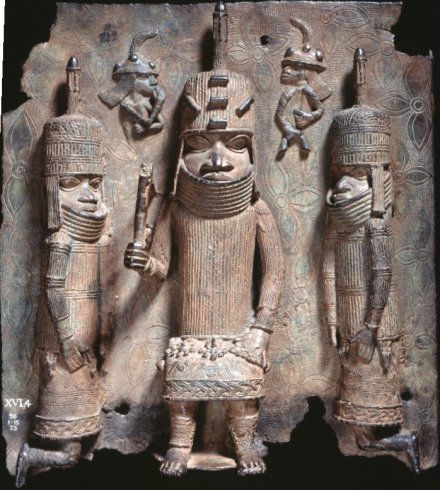
Great Britain’s punitive expedition also resulted in the capture of many hundreds of metal objects scattered to European museums and collections — collectively known as the Benin Bronzes. (It’s a misnomer: they’re actually brass.)

Hocked to defray the expense of their plundering, their diffusion around the empires’ continent helped broaden European appreciation for African art, and influenced modernist art movements. (Notably (pdf) German expressionism: tons of the bronzes ended up in Germany, and many can still be seen at Berlin’s Ethnological Museum.)

Nigeria, and the successor obas of Benin, have for decades besought their return in vain.


Cultural encounter: this Benin “bronze” shows the oba with two attendants, and the smaller floating heads of two European (Portuguese) traders.

More on this object, and its place in the story of Benin and Europe, in this episode of the BBC’s History of the World in 100 Objects; or, at the “bronze’s” page at the British Museum website.

On this day..