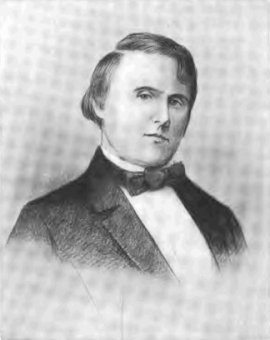
1861: Not William Scott, the Sleeping Sentinel

On this date in 1861, Vermont private William Scott of the new-formed Army of the Potomac, then fortifying Washington D.C. for the unfolding Civil War in the aftermath of Bull Run, was led out for execution for having fallen asleep at his post.

The so-called Sleeping Sentinel took a sick comrade’s watch even though he himself was bushed, and … well, you know the rest.

Condemned for a dereliction of duty which “may endanger the safety of a command, or even of the whole army” (the words of the army’s commander Gen. McClellan), Scott still attracted widespread sympathy due to the obviously sympathetic nature of his situation. He was a youth new to war, with an exemplary military record outside of his forty winks.

“The American people,” reckoned the New York Times, “are quite unprepared to hear of a measure of such fearful and unwarned rigor as that which was awarded private SCOTT.”

Appeals went straight to the White House, which was conveniently located in the Army of the Potomac’s back yard, and freshman president Abraham Lincoln magnanimously spared the lad.

Still, wanting to use the case to impress military discipline upon the rabble of corn-fed conscripts, that clemency was delivered with a terrifyingly dramatic flourish. Scott was left to contemplate his last hours on the earth, and, Dostoyevsky-like, marched out to the stake ostensibly to face the firing squad. Only then did he and his fellow-soldiers hear the commutation order.*

This exhilarating climax did not long stay the hand of the Reaper, as it transpired.

Scott died in battle the following spring. In death he lives on, as befits the habitues of these pages: fellow Vermonter Lucius E. Chittenden, who was serving in the U.S. Treasury when all this sleeping sentinel stuff went down, commemorated William Scott for posterity in a subsequent entry to the merciful-Lincoln mythology, a postwar volume titled Lincoln and the Sleeping Sentinel.

The story was also made into a 1914 silent film, which sadly doesn’t seem to be available online: but never fear, this syrupy poem will amply represent our Sentinel’s contribution to the canon.

But God is love – and finite minds can faintly comprehend
How gentle Mercy, in His rule, may with stern Justice blend;
And this poor soldier, seized and bound, found none to justify,
While war’s inexorable law decreed that he must die.

‘Twas night. In a secluded room, with measured tread and slow,
A statesman of commanding mien paced gravely to and fro.
Oppressed, he pondered on a land by civil discord rent;
On brothers armed in deadly strife: it was the President!

The woes of thirty millions filled his burdened heart with grief;
Embattled hosts, on land and sea, acknowledged him their chief;
And yet, amid the din of war, he heard the plaintive cry
Of that poor soldier, as he lay in prison, doomed to die!

‘Twas morning. On a tented field, and through the heated haze,
Flashed back, from lines of burnished arms, the sun’s effulgent blaze;
While, from a somber prison house, seen slowly to emerge,
A sad procession, o’er the sward, moved to a muffled dirge.

And in the midst, with faltering step, and pale and anxious face,
In manacles, between two guards, a soldier had his place.
A youth, led out to die; and yet it was not death, but shame,
That smote his gallant heart with dread, and shook his manly frame!

Still on, before the marshalled ranks, the train pursued its way,
Up to the designated spot, whereon a coffin lay-
His coffin! And, with reeling brain, despairing, desolate-
He took his station by its side, abandoned to his fate!

Then came across his wavering sight strange pictures in the air:
He saw his distant mountain home; he saw his parents there;
He saw them bowed with hopeless grief, through fast declining years;
He saw a nameless grave; and then, the vision closed-in tears!

Yet once again. In double file, advancing, then, he saw
Twelve comrades, sternly set apart to execute the law-
But saw no more; his senses swam-deep darkness settled round-
And, shuddering, he awaited now the fatal volley’s sound!

Then suddenly was heard the sounds of steeds and wheels approach,
And, rolling through a cloud of dust, appeared a stately coach.
On, past the guards, and through the field, its rapid course was bent,
Till, halting, ‘mid the lines was seen the nation’s President!**

He came to save that stricken soul, now waking from despair;
And from a thousand voices rose a shout which rent the air!
The pardoned soldier understood the tones of jubilee,
And, bounding from his fetters, blessed the hand that made him free!

A few letters from Scott’s own hand are preserved here. A (defunct) mini-blog exploring the case in detail can be perused here.

* There was actually American precedent for this sort of stagey non-execution in a case from the War of 1812.

** Obviously, Lincoln did not actually bring his presidential person to the execution grounds to issue this pardon in the flesh: in fact, the presiding officer on-site simply read out the pardon: “the President of the United States has expressed a wish that as this is the first condemnation to death in this army for this crime, mercy may be extended to the criminal.”

Part of the Themed Set: Americana.

On this day..

1541: Cristóvão da Gama, Portuguese crusader in Ethiopia

On this date in 1541, Cristóvão da Gama — “the most chivalrous soldier of a chivalrous age” — was beheaded in Ethiopia.

This moment was the apex of Lisbon’s empire-building, most vividly symbolized by Cristovao’s famous dad, explorer Vasco de Gama. In the Age of Discovery, Caravels bore Portuguese colors from Brazil to Japan.

Alas, Portugal’s global maritime empire of coastal colonies and remote ports was immediately menaced by rival powers like the also at-its-apex Ottoman Empire.

Young Cristovao would be ground up in this conflict whose mixture of geopolitics and sectarianism overtly smacked of those old-time Crusades.

After a jaunt to India in the train of his older brother, appointed the Portuguese governor of India, Cristavao was sidetracked on a return voyage for an intervention on the Christian side in a raging local war. For Europeans who for generations had trafficked in the vague and fantastical rumors of mythical Abyssinian ruler “Prester John”, putting a thumb on the scale for Ethiopian Christians against the rampant Arabs must have been nigh irresistible.

Let’s listen in.

Joao III and his government, faced with mounting debts as the costs of military operations in the East steadily grew, were now forced to re-evaluate their global commitments … the new viceroy, Estevao da Gama, was ordered to destroy the Turkish fleet in Suez …

Estevao da Gama’s raid into the Red Sea became one of the best remembered episodes in the history of the Portuguese Estado da India. The fleet assembled at Massawa on the African shore and then proceeded to Suakin which was burnt and plundered. Part of the fleet then returned to Massawa while the rest sailed on to Suez where the Turkish ships proved to be securely based and inaccessible. On the shore of Sinai, as close to Jerusalem as the Portuguese were ever to come, Estevao da Gama enacted some of the rituals of crusading chivalary and made a number of knights before returning to Massawa. Meanwhile, Dom Joao de Castro, who accompanied the expedition, used the time to produce his famous guide to the Red Sea, the Roteiro do Mar Roxo, complete with the meticulous drawings of the ports and anchorages, a masterpiece of Portuguese Renaissance geography and science.


One of Joao de Castro’s drawings. (Source, a Portuguese pdf)

Meanwhile the Portuguese at Massawa had suffered extreme privations and a hundred of them had deserted, having been persuaded by [untrustworthy Potuguese-descended Ethiopian ambassador Joao] Bermudes of the richness and wealth of the interior. Their fate was to be captured and massacred by Ahmed Gran. Estevao da Gama now dispatched a force of four hundred soldiers under the command of his brother, Cristovao da Gama, into the interior to assist the Ethiopian king. Cristovao da Gama advanced from the coast with a force much the same size as that which Cortez had led into Mexico in 1519. He had with him horses, arquebuses and eight small cannon. His first objective was to link up with the fugitive Ethiopian king and his followers, but da Gama got separated from his supplies and was forced to fight a superior Somali force supported by Turkish mercenaries. The result was catastrophe. The small Portuguese army was badly mauled and da Gama himself fled wounded from the battlefield and was taken prisoner.

The capture of the viceroy’s brother, son of the great admiral, carried with it huge importance for the Turks. After being ritually humiliated (his beard being set on fire and his face buffeted with the shoes of his negro servant) Cristovao da Gama was beheaded.* For the Portuguese this was a disaster, the symbolic significance of which far transcended the military consequences of the defeat. However, the Christian church had long experience of turning catastrophe into triumph and, soon after the news of Cristovao da Gama’s death reached the outside world, rumours of miracles began to circulate.** Da Gama became one of the first martyrs of the new church overseas which in a hundred years of expansion had had all too few heroic deeds to celebrate.

After the death of their commander fewer than two hundred of the original army survived, but they were able to meet up with the Christian Ethiopian forces and, when the next campaigning season started in 1542, the combined army inflicted a heavy defeat on the Muslims, a defeat which took on a decisive complexion when it was realised that the leader of the jihad, Ahmed Gran, had been killed in the battle.

Da Gama’s expedition had been mounted from the resources of the official empire and had been commanded by one of the leading fidalgos of the Estado da India. However, few of da Gama’s soldiers returned to India Instead they settled in Ethiopia and married Ethiopian women, establishing a ‘Portuguese’ community that mirrored the ‘Portuguese’ communities in Aythia, Bengal, Kongo and elsewhere where soldiers had offered their military expertise to local rulers an had been content to settle and make their fortures far removed from the jurisdiction of the Portuguese Crown.

Although da Gama’s own end was unfortunate, his surviving force’s exploits on a side badly pressed could arguably be considered the decisive factor enabling Christianity to survive in Ethiopia’s highlands interior. Prester John would have been proud.

* “I write what I heard, it may well be that it was thus, for all that is barbarous and cruel about the Moorish king can be believed. The body, after death, was dismembered and sent to various places … because once when Granha was speaking with Dom Christovao, he asked him: ‘If you had me in your power, as I have you, what would you do to me?’ Dom Christovao, with great resolution and freedom replied, ‘If I had you in my power, I would have you killed, the head I would send to one place and the quarters I would distribute to other places’ (naming them, but I do not recall them). And Granha, they say that it was because he heard this, scattered the body to various places.”

** “Directly they cut off his head, God worked a great and manifest miracle through it, which was, that in the place where they slew him a fountain of running water gushed out, which had never been seen before: its water, through the goodness and power of God, gives sight to the blind, and cures those ill of other diseases. It appears that this miracle is like the one that God did in Rome for His Apostle St. Paul. The remains of the body of D. Christovao smell sweetly, giving forth so delightful an odour, that it seems rather of heaven than of earth.”

On this day..

2010: Four in Equatorial Guinea

(Thanks to Meaghan Good of the Charley Project for the guest post. -ed.)

On this date last year, four Equatorial Guinean men were executed immediately after they were convicted of treason in a military court in the tiny African nation’s capital of Malabo.

The defendants, all former military officers, reportedly confessed to attacking the presidential palace in February 2009, supposedly in an attempt to assassinate the president, Teodoro Obiang Nguema Mbasogo.

Fortunately for him, he wasn’t in residence that day.

The attack had originally been blamed on Nigerian militants; in the aftermath, seven Nigerian men were sentenced to prison for their alleged involvement, and dozens of Nigerian expatriates were expelled from the country.

International observers castigated the trials and executions as not meeting international standards of fairness. This is no surprise, seeing as how Equatorial Guinea has one of the worst human rights records in the world.

According to Amnesty International, the four men weren’t even in the country at the time of the attack, having been exiled to Benin some years before. President Obiang’s agents abducted them from Benin in January 2010. Because of the “chilling speed” of the executions, none of the condemned had the opportunity to appeal the verdict and sentences or seek clemency, as Equatorial Guinea’s own law is supposed to provide.

José Abeso Nsue, Manuel Ndong Anseme, Alipio Ndong Asumu and Jacinto Michá Obiang (no apparent relation to his alleged target) were the only Equatorial Guineans known to have faced the death penalty that year.

On this day..

1941: Sixteen Yugoslav partisans and one German soldier

On this date in 1941, this happened.

These sixteen blindfolded Yugoslav Partisans about to be shot at Smederevska Palanka were joined in death by one conscientious German soldier who refused to help carry out the massacre. (Or not. See comments.)

The Partisans were Tito’s Communist guerrilla movement against the Nazi occupation and while they were up against it at this early date, they would in due time wind up on the winning side and help birth the postwar government.

Their legacy remains in every European sports page as the namesake of the Belgrade sports association Partizan founded immediately after the war. It’s the umbrella entity for the frequent Serbian football and basketball champions as well as a variety of other sports. (Current world tennis no. 1 Novak Djokovic played for Partizan, for instance.)

On this day..

1851: Col. William Logan Crittenden, nephew of the Attorney General

“An American kneels only to his God, and always faces his enemy,”* declared William Logan Crittenden, refusing to kneel before his executioners in Havana this date in 1851.

This well-bred** Kentuckian veteran of the Mexican-American War ditched a New Orleans customs-house gig when Narciso Lopez formed a private filibustering expedition to try to steal Cuba from the Spanish.

Placed at the head of one of Lopez’s three battalions, Crittenden’s force was cut off and overwhelmed by the Spanish. (The detailed progress of the campaign is described here.)

He and 50 of his command captured with him were all ordered for immediate execution, six at a time, as pirates, with just a few hours’ allowance to take down official statements and scribble their hasty goodbyes. With “not the heart to write to any of my family,” Crittenden sent one to a friend giving his farewells … then, just before the end, dashed off another addressed to the Attorney General of the United States — his uncle, John J. Crittenden.†

Dear Uncle: In a few moments some fifty of us will be shot. We came with Lopez. You will do me the justice to believe that my motive was a good one. I was deceived by Lopez — he, as well as the public press,‡ assured me tat the island was in a state of prosperous revolution.

I am commanded to finish writing at once.

Your nephew,
W.L. Crittenden

I will die like a man

(Some other affecting last letters from Crittenden’s party can be perused here.)

All this scene, including a post-mortem mutilation by the enraged mob of onlookers, became a bloody banner for U.S. Southerners — since expanding the slave power was core to the entire filibustering project.

When word of the shootings reached New Orleans, a crowd sacked the Spanish consulate.

But in the international relations game, the U.S. had disavowed filibustering and its raiders enjoyed no special diplomatic protection. When a number of the later prisoners were returned in chains to Spain, the Millard Fillmore administration asked their release, but had no grounds to demand it. It was a touchy diplomatic situation … one that our late Crittenden’s uncle, as a member of cabinet, was right in the middle of.

Fillmore eventually secured the captives’ release, atoning the insult to the European power’s agents by causing the Spanish colors to be saluted in New Orleans in honor of the birth of the Infanta Isabella.

All this mincing instead of brawling struck a certain variety of hothead as distinctly unmanful.

Our flag has been wantonly insulted in the Caribbean sea … captured citizens of our country [were] sent in a slave ship to the coast of Spain, fettered, according to the custom of that inhuman traffic, and released, not as an acknowledgement of wrong on demand of our government, but as a gracious boon accorded to a friendly suit … Whilst the dying words of Crittenden yet rung in the American ear, and the heart turned sickening away from the mutilated remains of his liberty-loving followers; whilst public indignation yet swelled at the torture which had been inflicted on our captive countrymen, even then we were called upon to witness a further manifestation of the truckling spirit of the administration …

–Jefferson Davis (yes, that one)

* An alternative version has Crittenden declaring that Kentuckians kneel only to their God.

** According to this public domain book (pdf; it’s also on Google books) of the Lopez expedition, William Crittenden’s cousin George Bibb Crittenden — eventually a Confederate general — was among the Texan filibusters to survive the Black Bean Lottery.

William Crittenden’s brother Thomas Theodore Crittenden fought on the Union side of the Civil War, and became Governor of Missouri in 1881. He’s noteworthy for having issued the bounty on outlaw Jesse James that led to the latter’s assassination by Robert Ford.

† Family in the president’s cabinet was just no guarantee of preferential treatment, abroad or at home; just a few years before, a son of the sitting Secretary of War had been hanged at sea for mutiny.

‡ The Spanish press likewise excoriated American yellow journalism in terms that no few present-day scribes would also deserve.

New Orleans papers, there is your work! There is the result of your diragations, of your iniquitous falsehoods, of your placards with large black letters, and your detestable extras … This blood must flow, drop by drop, upon your heads — this blood will torment you in your sleep, for they have lost their lives when you were in security in your houses.

On this day..

1949: Husni al-Za’im, Syrian president

On this date in 1949, Syrian President Husni al-Za’im and his Prime Minister Mohsen Berazi were seized in a military coup, conducted to a court martial, and immediately put to death.

An ethnic Kurd, al-Za’im had cut his teeth in the armed forces of two different empires — the Ottoman and the French — before Syria attained independence following World War II.

The ambitious al-Za’im had got out from under a Vichy-era prison sentence for corruption and established himself as army chief of staff in time for the 1948 Arab-Israeli War.

Syrian forces’ underwhelming performance in this campaign set the stage for what would follow — both for al-Za’im and, arguably, down to the present day.

Syria actually sported an open and democratic polity; it had a successful election in 1947. But the civilian leaders were essentially wealthy landowners who, having successfully led the movement for independence, had scant agenda for actual governance save enriching themselves and their allies. It was “an edifice of nepotism and mismanagement … [a] creaking network of family patronage and administrative venality.”

A stagnant economy, kleptocratic elite, and political malaise came into sharp focus with the debacle of the Arab-Israeli War. Arab commander Fawzi al-Qawuqji would charge that feckless Arab elites ran the war “from behind their office desks, and in accordance with their own personal interests, ambitions, and whims.”

Encouraged by the United States — just then breaking into the growth industry of short-sighted oil patch coups — al-Za’im overthrew the civilian government to “put things right and restore this nation its honour, its dignity and its freedom.”

This undergraduate thesis makes a case for the Za’im coup as the turning point normalizing and privileging military intervention in Syrian politics. This was the fear of a young American diplomat in Syria, who reckoned American support for the coup “the stupidest, most irresponsible action a diplomatic mission like ours could get itself involved in … we’ve started a series of these things that will never end.”

So it was that on this date the next domino toppled, a counter-coup that ended al-Za’im’s installment of the dictatorship series most abruptly.

Colonel Sami Hinnawi, an officer who had served under Husni Zaim, then sat as president of a “higher war council” of 12 senior officers, which tried the President and Prime Minister and condemned them to death. Sentence was carried out at once at the Mezza fortress near Damascus. Mohsen Berazi was shot first. He protested, although Husni Zaim, who stood by waiting his turn, urged him to be quiet.

–London Times, Aug. 15, 1949

Hinnawi last another year before a relative of Mohsen Berazi assassinated him in revenge, and on it went. It was during Syria’s sequence of unstable military juntas in the 1950s that the young Hafez al-Assad earned his stripes in the Syrian air force.

Assad would eventually execute a much more permanent takeover, rule the country for 30 years, and upon his death in 2000, bequeath leadership to his son Bashar — a fellow who, as of this writing, stands in some danger of winning an entry of his own in these pages should his ruthless crackdown against pro-democracy protesters prove unavailing.

On this day..

1961: José Isaías Constante Laureano, the last executed in Mexico

At dawn fifty years ago today, Jose Isaias Constante Laureano was shot in Saltillo, Coahuila for murder — the last application of capital punishment in Mexican history.

Laureano, an infantryman, died under military law for getting drunk and shooting dead two of his comrades in arms. (Spanish link; here’s another)

Though only formally abolished in 2005, capital punishment in Mexico simply dwindled away in the middle part of the century. The last civilian execution was all the way back in 1937. Mexico’s closest engagement with the death penalty these days has been protesting the dozens of cases of Mexican nationals condemned in the United States after being denied Vienna Convention rights of consular access.

Since past performance is no guarantee of future returns, nowhere is it written that the next five decades will also remain death penalty-free in Mexico. In fact, given the country’s wave of destructive drug war crimes, calls to restore the ultimate sanction have been heard from Coahuila’s own governor as well as from such unexpected quarters as Mexico’s Green Party.


Green Party pro-death penalty billboard in Mexico. (cc) image from Randal Sheppard.

On this day..

1573: William Kirkcaldy of Grange, former king’s man

On this date in 1573, William Kirkcaldy of Grange was hanged at Edinburgh. A marker at Edinburgh Castle honors the man who “held this castle for Queen Mary from May 1568 to May 1573 and after its honourable surrender suffered death for devotion to her cause.”

It’s a surprising epitaph.

The fellow’s father, James Kirkcaldy, was one of the realm’s prominent Protestants, and young William worked in France as an English secret agent in the 1550’s while that same Queen Mary held court there as the consort of crown prince turned underprepared child-king Francis II.

After Francis died in 1560, his widow returned to Scotland — not only as Mary, Queen of Scots but as a potential Catholic champion for the throne of England itself.

Kirkcaldy was a natural enemy in a confusing political situation. Scotland in the 1560s slid into civil war between the “Marian” party and the (more Protestant, more pro-English) “king’s men” supporting the regents governing in the name of Mary’s son, James VI.*

As one might expect, Kirkcaldy was a king’s man. He beat Mary in battle in 1567 and took her prisoner, helping force her abdication; after she escaped and had another go at it, he beat her again, and Mary fled to England, never to see Scotland again.

But a funny thing happened to Kirkcaldy on his way to the winner’s circle. In the jockeying that followed Mary’s flight, a fellow pol pulled him over to the Marian party.

Kirkcaldy’s considerable talents now strained themselves for the return of the monarch and the curtailment of the regents. He lost.

When it came again to open conflict, the king’s men (backed by aid from England) trapped Kirkcaldy in Edinburgh Castle and besieged it until the man was forced to surrender to the scanty mercy of his captors and the immortality of that latter-day plaque.

* James is notable in these pages for his adulthood penchant for witch hunting.

On this day..

1946: Andrei Vlasov, turncoat Soviet general

On this date in 1946, Soviet Gen. Andrei Vlasov and 11 fellow members of the Russian Liberation Army were condemned to death in Moscow for German collaboration, and immediately hanged.*

Vlasov was at the peak of his career at the outset of World War II, and earned a decoration for his part in defending Moscow against the Nazi invasion.

So far fortunate, the Red Army ran him out at the head of an army mounting an ill-fated attempt to lift the withering Siege of Leningrad.

Vlasov was encircled and captured.

And then, as a German prisoner, he switched sides.

The conversion of a top Soviet general, who now professed anti-bolshevism, was a stupefying propaganda coup for Germany, and the recent hero of Moscow was quickly employed authoring anti-Soviet leaflets and persuading POWs of the virtues of working for Berlin.

Somewhat more guarded were the Germans when it came to forming up the military unit our defector was supposed to be head of, the Russian Liberation Army, a phantom force of patriotic anti-communist Russians fighting for their country’s self-determination free of Uncle Joe.


By hanging other Russians from trees.

In reality, this “army” didn’t exist beyond the patches slapped onto the various anti-Soviet Russians who signed up to fight against the motherland. And it’s not too hard to reckon why.

Though Russian nationalism might be an expedient club to beat the Red Army with, it was just as liable to boomerang on a Reich itself bent on eastward expansion. A German interrogator of Vlasov in 1942 writing of the captive officer’s notions of national renewal concluded his report editorially (Russian link), “Russia for hundreds of years has constantly threatened Germany, regardless of whether it was the tsarist or the Bolshevik regime. Germany is not interested in reviving the Russian state.”

Besides, given the Nazis’ racial ideology, could these Slavs be trusted in a pinch? Enough to hand them their own command structure? The thousands of eastern front POWs who volunteered to serve Berlin could be suspected of having made the devil’s choice due less to principled anti-Stalinism than the fearful privations of a German camp. (Vlasov himself is often accused of changing teams for some venal reason of cowardice or greed.)

Only late in 1944, when the prospective long-term problems of Russian nationalism had been rendered academic to Berlin by the progress of the war, did the scattered collaborator units get organized into an actual army under Vlasov’s command.

The ineffectual ROA only got into one real scrap with the Red Army, and confirmed German suspicions about Slavic reliability in the last days of the war by turning its German guns against the SS in support of the Czechs’ Prague Uprising.

But surely nobody counted on returning to Stalin’s good graces with this last-second conversion.

From that successful engagement, Vlasov’s men fled out of Prague towards the American occupation zone, desperate not to be taken by the Red Army.

They made it. But after just a few days in American hands, Vlasov was turned over at a Russian checkpoint.

Though structured by the Allied powers’ Yalta accords, which stipulated repatriation into Stalin’s hands of any Soviet citizens held in the West, Vlasov’s handover might at the moment have been part of what must have been innumerable quid pro quo arrangements to sort out command and control in the disaster area late dignified as the Third Reich.

Historian Patricia Wadley has hypothesized that Vlasov’s detention by the Soviets conditioned the landing just an hour later of an airlift to evacuate the airman’s POW camp Stalag Luft I from behind Soviet lines.

However they got their hands on him, the Soviets made no mistake once they had him. Most of Vlasov’s junior officers were executed, and his rank and file dispatched to Siberia. The brass got a three-day trial — in camera, not a show trial; they were still defiant — from July 30 to August 1, with the inescapable result.

Vlasov’s legacy after the fact remains debatable. In the official Soviet story, of course, he’s a Nazi collaborator and that’s that. Aleksandr Solzhenitsyn attempted to vindicate Vlasov in The Gulag Archipelago, and one can find pro-Vlasov posts and tributes — but post-Communist Russia has shown no interest in overturning the verdicts against the ROA.

One might allow him sincerity in his convictions, but only at the cost of allowing that his movement had no independent force in the war save what Germany breathed into it for Germany’s own reasons. Something like that holds true for nearly every human being caught up in the eastern front in those terrible years.

Some have characterized Vlasov a vile collaborator; others have seen him as a Russian national hero. Neither description quite fits. Andrei Andreevich Vlasov, given to drink and fits of fatalism and inertia in captivity, lacked the sterling character deemed essential for a martyr. On the other hand, the ROA chief was anything but a Nazi — he caused his German supporters discomfort with his strong Russian nationalism and his personal refusal to lend his voice to the prevailing, official anti-semitism. He possessed neither a Quisling‘s moral blindness to questions of patriotism nor a Joan of Arc‘s penchant for self-immolation. He came closer to the mean of most humans, aptly personifying the nightmarish predicament which confronted millions of the Eastern Front’s victims. Vlasov, like multitudes of other helpless Soviet citizens, was cruelly pulverized between the enormous and unfeeling millstones of Nazism and Communism. Shuffled about Europe’s wargame board, first by Stalin, then by Hitler, Vlasov was a pawn in the epic struggle just like the lowliest POW or forced laborer. He fantasized a Russia minus Marx, and though his failure was complete, he still came closer than any other Russian since the Civil War to fulfilling that dream.

-Mark Elliott, “Andrei Vlasov: Red Army General in Hitler’s Service,” Military Affairs, Apr. 1982

* Vlasov’s execution was announced in Pravda on Aug. 2, but with no reference to the precise time. (The sentence was certainly issued in the very early morning of Aug. 1.) Though some sources continue to list Aug. 2 as Vlasov’s execution date, Aug. 1 seems much better attested.

On this day..

1602: Charles de Gontaut, duc de Biron

On this date in 1602, Charles de Gontaut, duc de Biron, was beheaded in the Bastille for treason.

The son of a celebrated soldier* in the intractable French Wars of Religion, Charles de Gontaut (English Wikipedia page | French) was no slouch himself on the battlefield.

Henri of Navarre, in prevailing over his rivals for power in France and becoming King Henri IV, had good cause to appreciate Gontaut’s service, and even consider the man a friend.

But our Gontaut, having ascended the posts of Admiral, Marshal, Governor of Burgundy — and, of course, Duke — still coveted greater prestige. “Ambitious, arrogant, and of no great intelligence,” is this popular history’s judgment. (p. 360)

So he started conspiring with the Duke of Savoy — even as Gontaut bore the French standard in the field against this same character — for an arrangement to set himself up as an independent ruler or otherwise do something seriously deleterious to Henri’s kingdom.

The stories consistently report (pdf) that the lenient Henri was disposed to pardon his man if Gontaut would but make the show of submission implied in begging pardon, confessing his sin, vouchsafing loyalty, and all the rest of it, but out of pride and/or stupidity, Gontaut did not do it.

This fatal vanity recommended the Duc de Biron as a character study for his contemporary, English playwright George Chapman, whose The Conspiracy and Tragedy of Charles, Duke of Byron was published in London (heavily censored, at the insistence of the French ambassador) in 1608.

* Charles de Gontaut’s father, Armand de Gontaut, was also godfather to the child who would grow up to become Cardinal Richelieu.

On this day..