1661: Oliver Cromwell, posthumously

On this anniversary date of King Charles I’s beheading, the two-years-dead corpse of the late Lord Protector Oliver Cromwell was hung in chains at Tyburn and then beheaded, along with the bodies of John Bradshaw and Henry Ireton.

The great-great-grandnephew of ruthless Tudor pol Thomas Cromwell rose higher than any English commoner, high enough to be offered the very crown he had struck off at Whitehall. Oliver Cromwell declined it in sweeping Puritan rhetoric just as if he hadn’t spent weeks agonizing over whether to take it.

“I would not seek to set up that which Providence hath destroyed and laid in the dust, and I would not build Jericho again.”

The House of Stuart never could rebuild its Jericho while the Lord Protector ran the realm* — thirteen years, writes Macaulay, “during which England was, under various names and forms, really governed by the sword. Never, before that time, or since that time, was the civil power in our country subjected to military dictation.”

“Cromwell lifting the Coffin-lid and looking at the body of Charles I”, by Hippolyte (Paul) Delaroche — a French painter with an affinity for English execution scenes. The painting is based on an apocryphal but irresistible legend, also used by Nathaniel Hawthorne in a tedious short story.

And not only England. Cromwell’s prodigious depredations in Ireland — justifiably or not — remain a source of bad blood.

The English Commonwealth foundered after Cromwell’s death, however, and restoration of the monarchy — a rock, as it turned out, on which the Puritans’ bourgeois revolution could erect its colossus — came with the price of a few examples being made.

Of course, “executing” dead guys displays about as much strength as it does sanitation, and for all Charles II‘s demonstrative vengeance, the politically circumscribed throne he resumed was very far from his father’s dream of absolutism. Between the late dictator and the new king, the future belonged to the corpse clanking around on the gibbet.

When the able Charles II followed Cromwell into the great hereafter, his brother James II promptly fumbled away the crown with his anachronistic insistence on royal authority and his impolitic adherence to Catholicism.**

In the emerging England of the century to come, the divine right would depart the Stuarts for another dynasty more amenable to the rising authority of the parliament whose sword Oliver Cromwell once wielded.

* Resources on the particulars of Cromwell’s career, the English Civil War, et al, are in plentiful supply online. This BBC documentary is a very watchable overview: part I; part II; part III; part IV.

** James II remains England’s last Catholic monarch.

On this day..

1781: Mutinous ringleaders of the New Jersey line

On this date in 1781, George Washington quelled a dangerous mutiny in his starving Continental Army with a couple of salutary summary executions.

Weeks before, the Pennsylvania Line had mutinied for better pay — successfully. (When approached by British agents offering hard currency should they turn coat, the mutinous troops patriotically arrested the agents.)

General Washington had cause to fear widespread discontent in his chronically undersupplied army, however. He circulated to Congress and to several state governors an urgent appeal (.pdf) for more aid to hold up morale.

The aggravated calamities and distresses that have resulted from the total want of pay for nearly twelve months, the want of clothing at a severe season, and not unfrequently the want of provisions, are beyond description … it is vain to think an army can be kept together much longer under such a variety of sufferings as ours has experienced … unless some immediate and spirited measures are adopted to furnish at least three months’ pay to the troops in money, which will be of some value to them, and at the same time ways and means are devised to clothe and feed them better … the worst that can befall us may be expected.

Washington vowed in the meantime to “continue to exert every means I am possessed of to prevent an extension of the mischief.”

The mischief, however, extended.

The New Jersey line at Pompton imitated — and the imitation was reportedly explicit — the Pennsylvania line. They had legitimate grievances, like nearly everyone in the Continental Army, and that was precisely the problem: if mutiny became the means to resolve grievances, Washington wouldn’t have a Continental Army much longer.

Washington detailed Gen. Robert Howe to make an example.

Sir: You are to take the command of the detachment, which has been ordered to march from this post against the mutineers of the Jersey line. You will rendezvous the whole of your command at Ringwood or Pompton as you find best from circumstances. The object of your detachment is to compel the mutineers to unconditional submission, and I am to desire you will grant no terms while they are with arms in their hands in a state of resistance. The manner of executing this I leave to your discretion according to circumstances. If you succeed in compelling the revolted troops to a surrender you will instantly execute a few of the most active and most incendiary leaders.

And as Washington reported this afternoon to New Jersey Governor William Livingston … success.

Dr. Sir: I have the pleasure to inform your Excellency, that the measures concerted for quelling the mutiny in the Jersey line were this morning carried into full execution. The mutineers were unexpectedly surrounded and awed into an unconditional surrender with little hesitation and no resistance. Two of the principal actors were executed on the spot, the rest pardonned. The spirit of mutiny seems now to have completely subsided and to have given place to a genuine repentance. This was very far from being the case previous to this step, notwithstanding the apparent submission which the assurances of redress had produced; they still continued insolent and refractory and disobedient to the commands of their officers.

A general pardon was promised by Colonel Dayton, on condition of an immediate and full return to duty. This condition was not performed on the part of the mutineers and of course they were not entitled to the benefit of the promise; besides which the existence of the Army called for an example. I have the honor etc.

That second paragraph of the letter hints at a bit of ass-covering from Washington. The officer on the scene, Elias Dayton, had, according to Charles Patrick Neimeyer, already smoothed the disturbance by promising that a state commission would adjudicate discharge claims.

The placated “mutineers” were therefore surprised to be roused from their beds at Ringwood, N.J., by Howe’s forces and forced to form a firing squad to execute their own sergeants. (Neimeyer also claims that the first six-man squad intentionally missed.)

This in-the-field execution to enforce military discipline was a precedent later cited by Alexander Mackenzie to justify hanging Philip Spencer, Samuel Cromwell and Elisha Small at sea for mutiny.

On this day..

1903: Arthur Alfred Lynch condemned

On this date in 1903, Irish MP Arthur Alfred Lynch waited 26 minutes for a jury to convict him, then heard the sentence of a British court for having fought against the British Empire in the Boer War.

[T]he jury have found you guilty of the crime of high treason, a crime happily so rare that in the present day a trial for treason seems to be almost an anachronism — a thing of the past. There can be no doubt that in times gone by there was great abuse, and many persons were indicted, convicted, and punished for matters which would not now be thought worthy of serious or, perhaps, any notice. There has been a kind of national reaction by which many persons have been disposed to treat serious crimes against the State as if the name of treason, and as if the thing, no longer existed. One moment of reflection will show you how erroneous is such a conception …

Yes, even if the black cap gave away the ending, the judge was going to take his time getting to it.

The misdeeds which have been done in this case, and which have brought you to the lamentable pass in which you stand, must surely convince the most sceptical and apathetic of the gravity and reality of the crime. What was your action in the darkest hour of your country’s fortunes, when she was engaged in the deadly struggle from which she has just emerged? You joined the ranks of your country’s foes. Born in Australia, a land which has nobly shown its devotion to its parent country, you have indeed taken a different course from that which was adopted by her sons. You have fought against your country, not with it. You have sought, as far as you could, to dethrone Great Britain from her place among the nations, to make her name a byword and a reproach, a synonym for weakness and irresolution. …

Even allowing that this sentence was pronounced before either of the coming century’s world wars, calling the Boer War to conquer South Africa for the crown England’s “darkest hour” only underscores how very long Britannia had stayed in the sun. Were the early shadows of empire’s twilight visible from here … or was it just standard issue judicial showboating?

[Y]ou thought it safe, no doubt, to lift the parricidal hand against your country. You thought she would shrink from the costly struggle wearied out by her gigantic efforts, and that, at the worst, a general peace would be made which would comprehend a general amnesty and cover up such acts as yours and save you from personal peril. You misjudged your country and failed to appreciate that though slow to enter into a quarrel, however slow to take up arms, it has yet been her wont that in the quarrel she shall bear herself so that the opposer may beware of her, and that she is seldom so dangerous to her enemies as when the hour of national calamity has raised the dormant energies of her people — knit together every nerve and fibre of the body politic and has made her sons determined to do all, to bear all, to sacrifice all on behalf of the country that gave them birth.

…

The only — I will not say excuse, but palliation that I can find for conduct like yours is that it has been for some years past the fashion to treat lightly matters of this kind, so that men have been perhaps encouraged to play with sedition and to toy with treason, wrapt in a certain proud consciousness of strength begotten of the deep-seated and well-founded conviction that the loyalty of her people is supreme, and true authority in this country has slumbered or has treated with contemptuous indifference speeches and acts of sedition.

There’s some relish here, the kind you’d hear if Antonin Scalia had an opportunity to pass sentence on Cynthia McKinney.

This ponderous bombast was the culmination of a highly-anticipated, highly-publicized trial of a man who had returned to London and arrest as an elected Irish parliamentarian after upholding the Boer cause in print throughout Europe, and enrolling an Irish unit in the fight.*


Col. Lynch’s Irish Brigade, from this South African military history page.

Incidentally, this is the same judge who sentenced Oscar Wilde for the love that dare not speak its name, intoning on that occasion that “people who can do these things must be dead to all senses of shame, and one cannot hope to produce any effect upon them.” (Mr. Justice Wills’ update of his father’s classic treatise on circumstantial evidence is available from Google books, as is Wanderings Among the High Alps, which he wrote in his capacity as mountaineering hobbyist.)

But had you and those with whom you associated yourself succeeded, what fatal mischief might have been done to … that inheritance of power which it must be our work to use nobly and for good things; an inheritance of influence which will be of little effect even for good unless backed by power, and of duty which cannot be effectually performed if our power be shattered and our influence impaired. He who has attempted to do his country such irreparable wrong must be prepared to submit to the sentence which it is now my duty to pronounce upon you … that you be taken hence to the place from which you came and from thence to a place of execution there to be hanged by the neck until you are dead.

For all this sound and fury, one would hardly know that it was generally and publicly understood the sentence would be swiftly commuted — as it was, a few days later.

Arthur Lynch received a free pardon in 1907, and in 1909 was returned to parliament as an Irish nationalist delegate to resume his remarkable career as writer, physician, engineer and all-around polymath.

* Lynch’s part in the war is included in The Boer Fight for Freedom, another century-old tome in the public domain and available on Google Books.

On this day..

1758: Francois Macandal, forgotten black messiah

(Thanks to Mark Davis of macandal.org for the guest post on a remarkable historical parallel to today’s inauguration of Barack Obama. -ed.)

The world was astounded when Barack Obama was elected to the Presidency in 2008 knowing the cultural barriers minorities have faced for hundreds of years. The date of inauguration, January 20, also happens to be the anniversary of the burning at the stake of a virtually unknown man, Francois Macandal,* whose epic war against cultural barriers has been buried for centuries.

Read some of his story and judge if the historic election of Barack Obama could have occurred without the man they called “Macandal.”

The parallels with Barack Obama’s journey are numerous, but the life of Macandal was perhaps even more remarkable, reaching great heights and falling into the darkest chasms of despair, yet succeeding in spite of staggering odds. Macandal’s travails may be about finding one’s purpose and dreaming of victory even when condemned by a majority, as he was relentlessly pursued by soldiers and hounded by countless naysayers.

251 years ago on January 20, 1758, Macandal was chained to a post on a platform before thousands of slaves brought together to witness his brutal torture and execution. Because of his importance, the French gathered slaves from hundreds of plantations throughout the colony of St. Domingue (now Haiti and the Dominican Republic). They believed such a horrific spectacle would quash Macandal’s Revolution, which he began to end French rule and abolish slavery, 12 years before.

Around 1746 Macandal escaped his plantation, united thousands of escaped slaves along with many still enslaved, and proclaimed that he would lead them all to independence and freedom. This declaration, from someone who had only six years before been taken from his home in the Congo, was unprecedented, since no slave colony had ever defeated a European nation. Then Macandal mobilized tens of thousands and may have inspired millions to end slavery and defeat colonial hegemony in the Haitian Revolution consummated decades after his death.

But ironically even the famous, black Marxist writer C.L.R. James, attributed one of the greatest revolutions in history to something akin to ‘spontaneous rioting’ by 500,000 black slaves in 1791. Since 1791 almost every historian has reduced the “Haitian Revolution,” the only successful overthrow of a colonial power by black slaves, to a ‘collective rage,’ inspired by the whites of the “French Revolution.” Yet it may have been Macandal’s Revolution, not the starving peasants of France, that inspired their uprising in 1789.

The true story of Macandal represents obscure but recorded testimonies about his life and explains why the slave revolt of 1791 was in fact, “Macandal’s Revolution,” almost 50 years in the making. Macandal foretold the end of slavery, then planned it, plotted it and began it. His story shatters a myth that has gone unchallenged for over 200 years: that the Haitian Revolution of 1791 was a spontaneous slave uprising inspired by the French peasants who had charged the Bastille Prison in Paris two years earlier.

The Haitian Revolution ultimately ousted the French, defeating Napoleon and numerous French generals. It also succeeded against the vaunted British army and established a new government run by former slaves. It was the first domino in a series of colonial defeats and changes in law that led to the end of institutional slavery; and Macandal started it all.

Correcting the Historical Record

Macandal is rarely the focus of historians and when mentioned only his insignificance is noted. But the popular version of his story was immortalized by the original French writers themselves, in the interest of bolstering a self-image of innate superiority as a nation and a race. To have recognized Macandal’s brilliance would have acknowledged slavery’s illegitimacy, so Macandal’s real story had to be trivialized and buried.

This telling of Macandal’s journey from a free child in Africa to slavery and then revolution, relies less on popular writings and more on a review of all of the records in context. For example French writers claimed Macandal broke free because he was tied with ropes and the post was made of rotted wood that fell apart when he was set ablaze. Historians have repeated this without scrutiny. The French on St. Domingue regularly burned slaves to death at the town square of the capital, “Cap Francais.” At Macandal’s execution they gathered thousands of slaves as witnesses, to insure a humiliating defeat and halt his widely supported rebellion. Yet, despite this grandiose staging, we are supposed to believe Macandal was insignificant. And we must accept that the French military was so inept they forgot how to execute and did not know that ropes burn and untreated, rotted wood is flammable. Many such dubious “facts,” are still repeated blithely about Macandal and few Westerners grant him his bravery, genius or impact.

Interestingly, the U.S. Bill of Rights guaranteeing equality for all was also adopted in 1791, but it would be more than seven decades before slavery was outlawed in the U.S. and almost two centuries before equal opportunity laws were passed and enforced. For one tiny nation, Macandal enabled this to occur over 200 years ago.

Background

I began researching the life of Macandal 20 years ago, startled and inspired by one chapter in Wade Davis’ popular book The Serpent and the Rainbow, which focused on secret societies, Voodoo and Zombification. His version of Macandal’s story was dictated to him by Rachel Bouvoir-Dominique, a Haitian Anthropologist I interviewed in 1997, at her office in Cap Haitien. Working under the tutelage of well-known author and expert on Haitian history Michel Laguerre, a professor at U.C. Berkeley, I received grants for a field study and documentary on the subject of Macandal.

Anthropologists often allocate greater weight to oral history, informal observer accounts, burial remains, maps and gravures, re-evaluating more accepted published works historians rely on, and so this account reflects my perspective and research as an Anthropologist. I examined European gravures (illustrations) and colonial records cited commonly more skeptically, because they were clearly burdened by religious, sexist and racial paradigms of the day. For example illustrations portrayed slaves with happy smiles and sanguine facades, enjoying their lives in idyllic settings on the plantations. Yet slaves faced torture, rape, separation of family and death from over-work, every day. Blacks were often drawn with monkey features (toes, ears etc.) and other demeaning caricatures.

Western writers were fiercely loyal to provincial rhetoric, including the gender and racial bias then considered crucial foundations of Christian theology. Western scholars dehumanized natives and women to rationalize slavery, prejudice and justify the infamous “hierarchy of being,” which granted “white men” a closeness to God that no one else could approach. This endowed them with the right to use others as they saw fit.

There were many reasons colonial authorities destroyed or buried the noteworthy exploits of slaves. Few accounts of courageous acts from among the ranks of millions of Africans during 400 years of slavery were recorded and preserved, primarily to maintain the perception that slavery was justified, necessary and Nubian Africans were not truly human but beasts of burden. There are literally thousands of articles, books and films about individuals among the six million Jews who died during the holocaust but only a scant few from among the 100-200 million indigenous peoples killed during the colonial expansion; all the more reason to re-evaluate slaves like Macandal.

A Brief History of Macandal

During the early 18th century, around the age of 12, Macandal was taken from the west coast of Africa, probably the Loango Kingdom in the Congo. I claim the date of his birth was 1728 primarily because oral historians in Haiti I interviewed believed him to be 30 when he was fastened to a post before thousands and set on fire in 1758.

The French called him Macandal which may derive from a city in the Congo called “Makanda.” The town of Makanda no longer exists due to civil war but could have ancient roots and slaves were often named after the places they came from. His name may have been taken from the term makanda (plural form of “kanda”) referring to African societal groups. Some written accounts report that Macandal claimed to be descended from a ranking societal group and the son of a Chief or King.

Amazingly, Macandal could speak, read and write Arabic fluently. Some believe this is because he was raised Muslim, yet the Congo was Christianized long before Macandal was born. Portuguese mercenaries, missionaries and armies had combed every square inch of the Congo beginning in the late 1400’s, searching for gold, diamonds and slaves, forcing conversion to Christianity. However Macandal’s words and actions reveal a unique knowledge of both Christianity and Islam. His ancestors may have emigrated from the east coast where Muslims and Asians had allied with Swahilis to build beautiful cities and schools before the Portuguese invasion. His family may have then hidden themselves for centuries.

Conversion to Christianity was also a requirement for slaves on colony plantations but Macandal defied the French by learning the underpinnings of Christianity, to understand the roots of slavery and challenge newly acquired doctrines. Despite many influences the adult Macandal claimed no affiliation with Christianity, Islam, Voodoo or Animism.

As a child Macandal was educated and known to be accomplished in both music and art, including painting and sculpture. His dedication to learning was apparent throughout his life. He displayed a vast knowledge of plants, became a doctor on the plantation he was taken to and was sought by even the French themselves for treatment of diseases and ailments. Yet the vegetation on St. Domingue was completely different from that of the Congo; therefore, Macandal had to study his new environment and learn the properties of perhaps hundreds of plants. He secretly taught himself French and became so eloquent that the French aristocrats remarked that he could speak it better than they themselves, though education was strictly forbidden for slaves.

Based on historical records and interviews, it appears that Macandal was first sentenced to death on his plantation, around 1746 at the age of 18, for falling in love with the plantation owner’s favorite lover, a young and beautiful house slave. He underwent a scene of heinous torture intended to culminate in his death in front of many witnesses, but escaped mysteriously and fled into the hills. The French replaced this account with a tale about Macandal becoming handicapped from losing a hand in a sugar mill and then being left unguarded. His escapes were always attributed to poor guard oversight.

Though Macandal probably began his new life of freedom with the intention of bringing vengeance to his former owner Lenormand de Mezy and rescuing his true love, for some reason his objective evolved. Perhaps because of the totality of his traumatic experiences or because of the influence of Maroons (ex-slaves already living in the distant mountains) Macandal met after escaping, he began working for a new goal of freedom for all.

Macandal led a sweeping and unwavering revolution during the 12 years after his escape from the plantation. Unlike other escaped slaves, Macandal actually made the end of slavery his stated mission. He became the first to unite thousands of disparate Maroons who were living free but divided by tribal affiliation and known to be ardently dedicated to the destruction of each other. His uniting of these groups was an extraordinary accomplishment and he is the first known black leader and ex-slave to do so.

He began calling himself the “Black Messiah” and gave rousing speeches in secret locations to recruit slaves. He made dangerous and daring appearances on plantations during the night to urge loyalty and inspire hope. The name “Black Messiah” had great meaning to Macandal as evidenced by one of his famous speeches at a secret recruitment meeting. The words exposed Macandal’s understanding of Islam and Christianity and their link to institutional slavery. The term was a powerful catalyst he used to preempt religious and ethical indoctrination of blacks and free them from the ideological bonds of slavery. He had to usurp the authority of the Church and French government to convince slaves they deserved equality, freedom, family sanctity, education and self-government.

Macandal became a brilliant strategist and had a large, organized camp with lieutenants, captains and other ranks. He led countless attacks and escaped capture mysteriously many times. His tactics were unique and devastating. They were known to be carried on after his disappearance despite the brutal efforts of the French to extinguish illegal grassroots activity. During his reign as a Maroon leader he may have recruited half or more of the 100,000 slaves living on the plantations as secret agents of his revolution.

Maroons and slaves apparently employed his tactics for decades after his disappearance in 1758. During the decade before the final thrust for overthrow in 1791, and despite harsh measures to thwart rebellion, Maroon activity greatly increased. This activity was so secret that virtually nothing is known about this period and is one reason historians assume the war for independence was unplanned, even though the first massive attack was led by Boukman Dutty, formerly a cruel black overseer who was a contemporary of Macandal. His gathering, which launched the war, was convened at a hidden location where Macandal formerly gave his speeches, the symbolism of which cannot be denied.

Generals that followed Boukman used ingenuity and unique strategies to win the 13-year war and Toussaint L’Ouverture is given most of the credit for the victory. But Toussaint refused to support the war until after it had begun; its inevitability certain. He was 13 when Macandal was sentenced to death in 1758. A voracious reader and student of warfare he was well aware of Macandal but content as a slave under a liberal planter.

It is my thesis the “Macandal Revolution” continued through the three decades preceding the Haitian Revolution. No other slave is known to have prophesied and promised the end of slavery yet Macandal predicted that blacks would defeat the French, become free and independent of colonial rule and control the colony of St. Domingue. His rally cry and pronouncement repeatedly rang throughout the colony despite opposition and betrayal from many slaves who greatly feared the French and did not believe victory was possible.

The Haitian Revolution remains the only successful movement by black slaves to defeat a colonial power and achieve complete independence. It stands alone as a towering victory against incalculable odds. Though it is characterized as a ‘riot’ that generated its own momentum, 500,000 slaves and free blacks mysteriously rose up in unison, using sticks and stones, against over 50,000 heavily armed soldiers, landowners and henchmen.

The Fall of Colonialism

As Macandal’s victories mounted I propose that word of his revolution spread to Europe and bolstered many anti-colonial movements. For example one of his closest secret allies was a French Jesuit priest and the Jesuits along with other religious leaders in Europe began fomenting rebellion during this period. Before news of Macandal’s revolt spread, many in Europe believed the slave trade was not only profitable but philanthropic. It had long been heard in the churches that slaves were heathens being brought to Christ and treated well in the process. His uprising no doubt made many Europeans aware that slaves were not being treated well and were desperate. Macandal’s shocking victories may have provoked Europeans to finally condemn colonialism and slavery. His fearless attacks and disregard for colonial might may have also seeded the French Revolution.

What really happened on January 20, 1758? Macandal endured great agony during an intense and excruciating punishment. He did this so that slaves everywhere might become free. The French claim Macandal was burned alive at the town square in Cap Francais.** Admitting he broke free and leaped out of the fire, they wrote that soldiers reclaimed Macandal and threw him back in. However some observers claimed Macandal broke his chains and fled, never to be seen again. How he broke free during any of his escapes despite being surrounded by guards and soldiers, is not known. It is interesting to note that his remains were never found and there is no burial site. Given the French proclivity for making examples of slaves to increase fear and enforce discipline, a successful execution should have been commemorated by another French monument.

For most historians, January 20, 1758, came and went with barely a mention in official memorandums. Yet a detailed search of documents reveals a massive cover-up, confusion and consternation. Macandal’s Revolution was not quashed or even slowed; instead it was impelled and sent wildly rumbling down a path of manifest destiny. Plantation owners later discovered their most trusted slaves were working for the revolution. New restrictions were put on all blacks throughout the colony and 4-5 rebels were burned at the town square every month to strike fear into the rest. Intense interrogation and torture revealed ever more depth to the conspiracy. Macandal’s execution day inflamed slaves and intensified their commitment to him and they became more united and fervently bent on winning freedom. Jesuits were banned from St. Domingue five years later.

As the first U.S. President with African roots is inaugurated on January 20, no one will speak of Macandal or Macandal’s Revolution, which led to equal rights in 1804 for one small nation. January 20, 1758, the day the French sought to secure colonialism and slavery in perpetuity, became a day of victory for Macandal and a watershed event which brought colonialism down. Though Macandal has been denied his place, his actions may have ended slavery and paved the way for people like Barack Obama to make history.

Mark Davis received his Bachelor of Arts degree in Anthropology from U.C. Berkeley and a Master’s in Anthropology from the University of Hawaii. He is the foremost authority on Macandal and his one hour documentary The Black Messiah was broadcast on PBS in 1997. He publishes information through his website at www.macandal.org.

* The man’s true name is lost to us; the one he was given by the French can be alternately spelled “Mackandal” or “Makandal” or “Mackendal”.

** Renamed Cap Haitien after Haiti won its independence.

On this day..

1980: Four Iraqi Turkmen

On this date in 1980, a professor, a soldier, a bureaucrat and a businessman were hanged by Saddam Hussein in his campaign to cow Iraq’s Turkic ethnic minority.

The ethnic and religious quiltwork of Iraq is much more nuanced than Sunni vs. Shia — and this blog has noticed its deadly potential before.

This day’s hangings belong to an earlier era, of the Ba’athist secular pan-Arab aspiration that had Hussein quashing minority national aspirations. (Though the anti-minority stance was hardly unique to him.)

Nejdet Kochak, Abdullah Abdurrahman, Riza Demirji and Adil Sherif were ethnic Turkmen (or Turkomen), ethnically and linguistically distinct Moslem descendants of those far-flung peoples of the Eurasian steppes.

More to the point, they were relatively prominent voices for Turkoman civil rights in the face of harsh state suppression.

This being Saddam Hussein’s Iraq, the problem had an easy solution. The four were made examples of, convicted of spying for their brother Turks in Turkey, and hanged — but not forgotten.

On this day..

1864: Two Dodds, as two spies, in two states, and twice botched

On January 8, 1864, young David Owen Dodd was hanged in Little Rock for spying on federal troops … and cavalryman Ephraim Dodd (no known relation) suffered the same fate for the same crime in Knoxville.

Just one of those strange coincidences.

Ephraim Dodd

Ephraim Shelby Dodd is the subject of an outstanding HistoryNet profile whose contents this blog can not so much improve upon as summarize.

A member of Terry’s Texas Rangers (“men who ride like Arabs and fight like devils”) Dodd was captured in December 1863 and convicted by his diary — a particularly harsh reading of his diary in which a reference to having passed himself off as a Yankee was interpreted as evidence of espionage. (The diary is available online and as part of a book on Terry’s Rangers.)

Knoxville worthies rallied to save him and Ephraim Dodd insisted upon his innocence, but not so vociferously that he displayed any terror of his fate.

Do not grieve for me, my dear parents, for I am leaving a world full of crime and sin for one of perfect bliss.

The hanging itself wasn’t bliss, exactly, despite a well-planned soundtrack.

From the “Death March” the music gradually slid into “Mary’s Dream,” and then we were carried back by the magic of the plaintive notes to juvenile days; to visions of “Sandy far at Sea,” and to the sad cadence of that fading refrain,

“When, soft and low, a voice she heard
Saying, Mary, weep no more for me.”

The solemn march, the wailing notes of the fife, and perhaps above all the calm, unmoved, manly bearing of the prisoner — so we thought — produced a mournful impression upon the spectators.

Points earned on artistic merit, however, were deducted for technique.

At a signal the bolt was now withdrawn, the culprit fell, but the cotton rope broke by the sudden tension, and the man lay stretched and stunned upon the frozen ground below. A mummer of horror, mingled with expressions of pity, ran through the assembled crowd. Recovering for an instant from the shock — for his neck was not broken — he said — perhaps incoherently: “Release me quick, if you please.” For some ten minutes the unfortunate man lay thus upon his back, without moving a muscle. Meantime the officers and men, whose painful duty it was to see to the execution of the law, adjusted this time two parts of the same rope instead of one, and the half-conscious man was borne up the fatal steps a second time, being partly supported upon the drop until the double noose had been adjusted. Not a word or sign of suffering all this time escaped his lips. In another moment the drop fell, and prisoner’s form now hung by the neck — the knot behind the head. Death finally ensued by strangulation. In ten minutes, Dr. Cogswell, the officiating surgeon, pronounced life extinct, and the body was taken down and buried.

David Owen Dodd

A few hours later and 500 miles down the way, the entirely unrelated hanging of David Owen Dodd proceeded in Little Rock, Ark.

David Dodd’s final resting place at Mount Holly cemetery. Image courtesy of Richard Theilig.

Only 17 at his hanging and not physically robust enough to get his brains blown out at Gettysburg, Dodd was sent by his father on a business trip across Union lines — everything legit, and carrying a pass — but got busted with morse code notations of Union troop strength in the city.

Unlike Ephraim, who was basically a normal soldier thrust into incriminating-looking circumstances by the chance of war, young David Dodd was rightly accused.

He didn’t bother protesting his innocence, but he also kept mum about his contacts. (Suggestively, a teenage girl and her father were whisked out of town and kept under guard in Vermont for the rest of the war.) That proud silence has won him quite a reputation in Arkansas as the Boy Hero of the Confederacy.

But similarities between the condemned men extended beyond their names. David’s parting filial reassurance could pass for a paraphrase of Ephraim’s.

[D]o not weep for me for I will be better off in heaven. I will soon be out of this world of sorrow and trouble.

And the hanging itself, conducted in a tense atmosphere, was likewise a botched job. In this case, the slight young man didn’t fall hard enough to break his neck, but did fall far enough to get his tiptoes on the ground, initiating an agonizingly protracted strangulation which the soldiers on detail expedited by (accounts differ) pulling on David Dodd’s legs and/or pulling up on the rope.

On this day..

1946: The treacherous Theodore Schurch

One day after William Joyce became the last Briton put to death for treason, 27-year-old Theodore Schurch hanged for treachery at London’s Pentonville Prison.

Like Joyce, Schurch had enrolled in the British Union of Fascists as a teenager in the 1930’s, and it was reputedly at the party’s direction that he joined the army as a driver.

During World War II, Schurch crossed and recrossed enemy lines, delivering operational intelligence to the Italians and Germans by helping to interrogate prisoners of war, or posing as a P.O.W. himself to gain the confidences of other captured Allied soldiers.

Scurch’s army buddies seemed to think he was alright, and there was probably more than a shred of truth to the defense’s contention, paraphrased by the London Times (September 18, 1945), that the lad

was a poor, uneducated fool who was caught young [by fascist ideology] when he knew no better and jockeyed into a position from which he could not recover.

But obviously, one makes this argument when one is in no position to contest factually the capital charges against oneself, and indeed has admitted much of it. Schurch was convicted on all nine counts of treachery, plus one of desertion. Not a big fish, maybe — but just the right size to become the last man hanged in Britain for a crime other than murder.

He’s actually listed as a war casualty, which in a way he was, on the Commonwealth War Graves Commission’s Brookwood Memorial outside of London.

On this day..

1900: En Hai, the murderer of von Ketteler

On the last day of the 19th century, a Chinese officer was beheaded on the public street where he had precipitated western* military intervention in the Boxer Rebellion by killing a German diplomat.

Foreign commercial penetration — and domination — was generating domestic turmoil in China. As liberal reforms foundered in the late 1890’s, a more radical anti-foreigner movement blending spiritualism and martial arts launched the Boxer Rebellion (or Yihetuan Qiyi, in the local coinage).

In addition to massacring hated missionaries, the Boxers besieged foreign diplomatic missions in Peking … and veteran German ambassador Klemens von Ketteler was killed in a firefight on a crowded street. (The particular circumstances of the killing seem highly confused, and were immediately colored by the various interested parties’ axe-grinding; it’s sometimes called an “assassination,” but there’s no proof von Ketteler was specifically targeted, and the ambassador himself managed to get a shot off in the fray.)

Given the financial interests at stake, it would be far too much to say that von Ketteler’s death caused the military intervention that ensued, but it certainly catalyzed the conflict. The next day, China’s Dowager Empress declared war against the Eight-Nation Alliance. Within two months, Peking (Beijing) was under foreign occupation.

The man detained as von Ketteler’s murderer — En Hai, or Enhai, or Su-Hai — was proud to claim the act himself, and intimations of the Chinese government’s official blessing for anti-foreigner activities were carefully massaged since the Eight-Nation powers would have need of the Qing dynasty to keep order locally.


On the afternoon of this day in 1900, En Hai was brought out from German custody to the street where von Ketteler had met his end and handed over to the Chinese for beheading. Notice the substantial foreign attendance in both the photograph and the drawing. A German officer’s diary entry cited in The Origins of the Boxer War: A Multinational Study recounted the scene.

Ketteler’s murderer was executed at last — for months past the unfortunate wretch has been begging for his execution. It took place in one of the busiest thoroughfares but there were only a few curious onlookers. Scarcely fifty yards away the usual business was being quietly transacted in the streets, people who were eating did not suffer themselves to be interrupted, and a teller of fairy-tales who was recounting his absurd stories had interested his numerous audience much more than the execution.

And to see that the lesson would not be lost on future generations of Chinese, the humiliating peace imposed upon China that December (and formally signed the following year) required China to expiate its guilt by

erect[ing] on the spot of the assassination of his Excellency the late Baron von Ketteler, commemorative monument worthy of the rank of the deceased, and bearing an inscription in the Latin, German, and Chinese languages which shall express the regrets of His Majesty the Emperor of China for the murder committed

Having been made an offer it couldn’t refuse, China honored the intersection (German link) where both the victim and his killer had died in their turns with a massive pailou archway, inscribed

This monument has been erected by order of His Majesty the Emperor of China for the Imperial German Minister Baron von Ketteler, who fell on this spot by heinous murder on the 20th of June, 1900, in everlasting commemoration of his name, as an eternal token of the Emperor’s wrath about this crime, as a warning to all.


A historical postcard of Ketteler monument.

“Everlasting commemoration,” in this case, lasted 15 years.

The national aspirations that had fired the Boxers reared up again in 1911-12 to topple the Qing. Days after Germany’s surrender in World War I, the Chinese Republic began removing the von Ketteler monument.

Visitors will need to look sharp to catch it now, in Zhongshan Park (aka Sun Yat-Sen Park or Central Park), where it has been rededicated to abstractions that age a little better than our German civil servant.

But this was still not quite the last the name von Ketteler was heard in the consular world. A relative (German link) of the man slain in Peking was a conservative diplomat of the Weimar and early Nazi period who opposed the national socialist government. Wilhelm Emmanuel von Ketteler was abducted by the Gestapo in 1938 and murdered thereafter in unclear circumstances, possibly for involvement in a very early plot to kill Hitler.

* “Western” in this case includes Japan, the regional industrial power that also flanked the Russian Empire to the east — very much a player on the European balance-of-power chessboard. Germany (obviously), France, Italy, Russia, the U.K., and the U.S.A. were the other nations involved in the intervention, along with the Austro-Hungarian Empire, whose naval deployment to China included future Sound of Music character Georg Ritter von Trapp.

A fair amount of detail on China’s foreign relations during this period is available free in the (dry, and sometimes dated) public-domain 1918 work The International Relations of the Chinese Empire.

On this day..

1862: Asa Lewis, Confederate deserter

On this date in 1862, a 19-year-old Confederate infantryman became the tragic victim at Murfreesboro, Tenn., of his army’s need to shore up military discipline.

Kentuckian Asa Lewis was shot for desertion, for having returned home after his enlistment expired in order to help his family plant the season’s crops.

“French leave”,* it’s sometimes called — an illicit but temporary and often unpunished absence from the unit.

According to Mark Weitz’s More Damning Than Slaughter: Desertion in the Confederate Army, it was a pervasive phenomenon — as were more permanent desertions which menaced the small Confederate army, fighting amid the soldiers’ own farms, whose languishing from the conscription of able-bodied men presented a constant temptation to depart.**

[The South’s] white population combined with its preferred form of agriculture to create a potential pool of men who could hardly be called disposable … To find the Southern soldier one must go down the food chain into that vast sea of men referred to as yeomen and poor whites. These men and their sons would form the backbone of the Southern army, an army of farmers, men whose lives were as governed by the seasons as the lives of their fathers and grandfathers before them. These men could not be spared in the same way as their Northern counterparts without affecting the quality of their families’ lives — and often those families’ very survival.

Under less urgent circumstances, Lewis would be the poster child for the guy who would sort of deserve to slide for the odd spell of French leave.

He’d fought with distinction, earning decorations and promotions, and his mother and sisters were reportedly starving without his help. He was only being kept in the army after his term of engagement by the 19th-century equivalent of a stop-loss policy.

But Lewis had the bad fortune to go AWOL — it seems he did intend to return — right when the urgency of the army-wide desertion situation was becoming apparent to Confederate brass … and while serving under the general who Weitz says took it most seriously.

Gen. Braxton Bragg had issued an amnesty earlier that fall to clear the decks, and then declared pitiless treatment of desertion going forward.

Bragg understood something that his superiors, peers, and colleagues did not: the Confederacy had an army of farmers … Bragg knew that these men were fighting at home, that they would [sic] were being drawn back there, and that he had to take immediate steps to close off the avenues of departure.

Bragg tightened the screws on soldiers who straggled on the march (a common strategy to slink away), on grunts seeking medical furloughs (already establishing themselves as a halfway house towards a discharge), and on Confederate prisoners obtained by exchange for Union POWs (who were no longer paroled back home, but kept with the army).

Asa Lewis was hardly the only man shot under the policy. But construing mere French leave as capitally punishable “desertion” gave the general a chance to put the fear of a Confederate firing squad into other potential stragglers and malingerers — and the Kentuckian campaign to obtain clemency for the poor kid probably only helped Bragg’s purpose.

The next day’s Rebel Banner (cited in this free Google books offering) ran this item:

[A]midst a drenching rain-storm, Asa Lewis, member of Captain Page’s company, Sixth Kentucky regiment, was shot by a file of men. He was executed upon a charge of desertion, which was fully proven against him. The scene was one of great impressiveness and solemnity. The several regiments of Hanson’s brigade were drawn up in a hollow square, while Generals Breckinridge and Hanson, with their staffs, were present to witness the execution. The prisoner was conveyed from jail to the brigade drill-ground on an open wagon, under the escort of a file of ten men, commanded by Major Morse and Lieut. George B. Brumley. Lewis’s hands were tied behind him, a few words were said to him by Generals Brekinridge and Hanson, and word fire was given, and all was over. The unfortunate man conducted himself with great coolness and composure. He was said to have been a brave soldier, and distinguished himself at the battle of Shiloh.

Official journos may have been approving — Weitz says a contemporary newspaper report approvingly claimed that “when Bragg saw his army melting away from desertion he began shooting every man convicted by a court-martial, and that as a result his army had become ‘well disciplined'” — but less charitable interpretations of Bragg would hew more to the line that the man was simply being a petty, vindictive tyrant.

The aforementioned execution witness Breckinridge, for instance, was a Kentuckian himself and hated Bragg’s guts. (A week later, Bragg would waste 10,000 Confederate lives at the Battle of Stones River, and the rift became irreparable.)

* The French call it “English leave”.

** Other able-bodied farm laborers in the South, of course, were better inclined to back the Union.

On this day..

1948: Hideki Tojo and six other Japanese war criminals

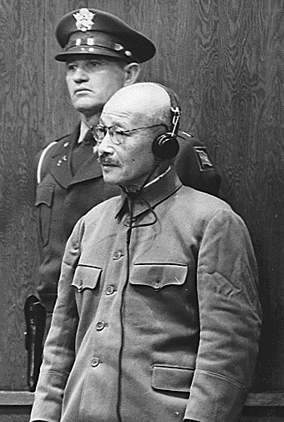
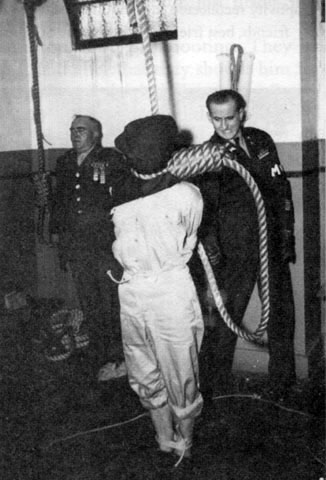
On this date in 1948, seven “Class A” war criminals, including Japan’s wartime Prime Minister Hideki Tojo, were hanged at Sugamo Prison by the American occupation authorities.

Like other Axis heads of state, Tojo was in for a bad end: he shot himself in the chest before American troops could arrest him, but missed his heart even though a doctor had helpfully marked the spot on his chest for him.


Fail.

However inevitable Tojo’s postwar fate, however, he was not exactly of a kind with the likes of Hitler and Mussolini. Indeed, he’d been cashiered from his Prime Ministerial gig in 1944 by the real power behind the throne — the Japanese military.
Unlike the “Fuhrer” and “Il Duce,” Tojo was a reflector, not a creator, of national thought. His word was not law. It was not his command or dictate. He was one among many and not even the first among equals. He was a militarist — misguided, naive, and narrow in outlook; he regarded war as a legitimate instrument of national policy; he apparently believed what he told the court, and failed to recognize the patent contradictions between his contentions and the facts. This had been his undoing.

That’s Robert Butow in Tojo and the Coming of War. Butow argues that the titular authority in Japan (he became Prime Minister shortly before the bombing of Pearl Harbor), a dedicated, patriotic officer of adequate talents but limited vision, came much too late and controlled much too little to be seen as the equal of the European theater’s villains.

The Japan of which General Hideki Tojo became premier was operated by remote control. It was a country in which puppet politics had reached a high state of development, to the detriment of the national welfare. The ranking members of the military services were the robots of their subordinates — the so-called chuken shoko, the nucleus group, which was active “at the center” and which was composed largely of field-grade officers. They, in turn, were influenced by younger elements within the services at large and by ultranationalists outside military ranks. The civilian members of the cabinet were the robots of the military — especially of the nucleus group, working through the service ministers and the chiefs of the army and navy general staffs. The Emperor himself, through no fault of his own, was the robot of the government — of the cabinet and the supreme command, a prisoner of the circumstances into which he was born … Finally, the nation — the one hundred million dedicated souls, the sum and substance of Japan, from whom the blood and toil and tears and sweat of Churchill’s phrase were wrung — the nation was the robot of the throne.

He was the man for his time and place. He fit right in.

Even when being fitted for a noose.

Once Tojo had recovered from his errant self-inflicted wound,* and even though he had been among those opposing surrender even after the atomic bombings, he played ball with the International Military Tribunal for the Far East (whose trial transcripts run to 50,000 pages).

The former premier embraced responsibility, diligently shielding the Emperor from any intimation of guilt (some argue this was the procedure’s entire raison d’etre, from the perspective of both the prosecution and the defense), and walked a dignified and honorable last mile in the courtrooms of the victor’s justice, presenting his perspective as he knew it in the context of a wish for peace between the late antagonists.

1. I deny that Japan “declared war on civilization.”

2. To advocate a New Order was to seek freedom and respect for peoples without prejudice, and to seek a stable basis for the existence all peoples, equally, and free of threats. Thus, it was to seek true civilization and true justice for all the peoples of the world, and to view this as the destruction of personal freedom and respect is to be assailed by the hatred and emotion of war, and to make hasty judgments.

3. I would like to point out their [my accusers’] inhumane and uncivilized actions in East Asia ever since the Middle Ages.

4. In the shadow of the prosperity of Europe and America, the colored peoples of East Asia and Africa have been sacrificed and forced into a state of semi-colonization. I would point out that the cultural advance of these people has been suppressed in the past and continues to be suppressed in the present by policies designed to keep them in ignorance.

5. I would point out that Japan’s proposal at the Versailles Peace Conference on the principle of racial equality was rejected by delegates such as those from Britain and the United States.

6. Of two through five above, which is civilization? Which is international justice? Justice has nothing to do with victor nations and vanquished nations, but must be a moral standard that all the world’s peoples can agree to. To seek this and to achieve it — that is true civilization.

7. In order to understand this, all nations must hate war, forsake emotion, reflect upon their pasts, and think calmly.

The “Class A” convicts not executed along with Tojo were freed afterwards.

Tojo has enjoyed a bit of a latter-day resurgence in the public regard, product of the nationalist right’s resurgence in Japan. The hanged man’s granddaughter Yuko Tojo has waged a tireless campaign to clear him.

Further to that end, his ashes — and those of the other Class A convicts — were covertly added to the controversial Yasukuni Shrine, and remain there to this day. That public tribute to principals of Japan’s bloody foreign occupations has become a hot political football between Japan and other nations, especially China.

But after all, Tojo the man was never a leper, but part and parcel of his times. Small wonder that we moderns hear an echo of the general’s postwar justification for the War in the Pacific from the country that hanged him.

Japan … faced considerable military threats as well.

Japan attempted to circumvent these dangerous circumstances by diplomatic negotiation, and though Japan heaped concession upon concession, in the hope of finding a solution through mutual compromise, there was no progress because the United States would not retreat from its original position. …

Since events had progressed as they had, it became clear that to continue in this manner was to lead the nation to disaster. With options thus foreclosed, in order to protect and defend the nation and clear the obstacles that stood in its path, a decisive appeal to arms was made.

The problematic nature of the war crimes proceedings in postwar Japan (especially vis-a-vis those in Germany) is examined in Yuma Totani’s The Tokyo War Crimes Trial: The Pursuit of Justice in the Wake of World War II. The author discussed her research on the New Books In History podcast.

[audio:http://newbooksinhistory.com/podpress_trac/web/720/0/Totani%20Interview.mp3]

* According to John Dower’s Embracing Defeat, the suicide scenario angered some nationalists because Tojo only “belatedly summoned the will to die,” and “chose the foreigner’s way of the bullet rather than the samurai’s way of the sword, and then botched even this.”

On this day..