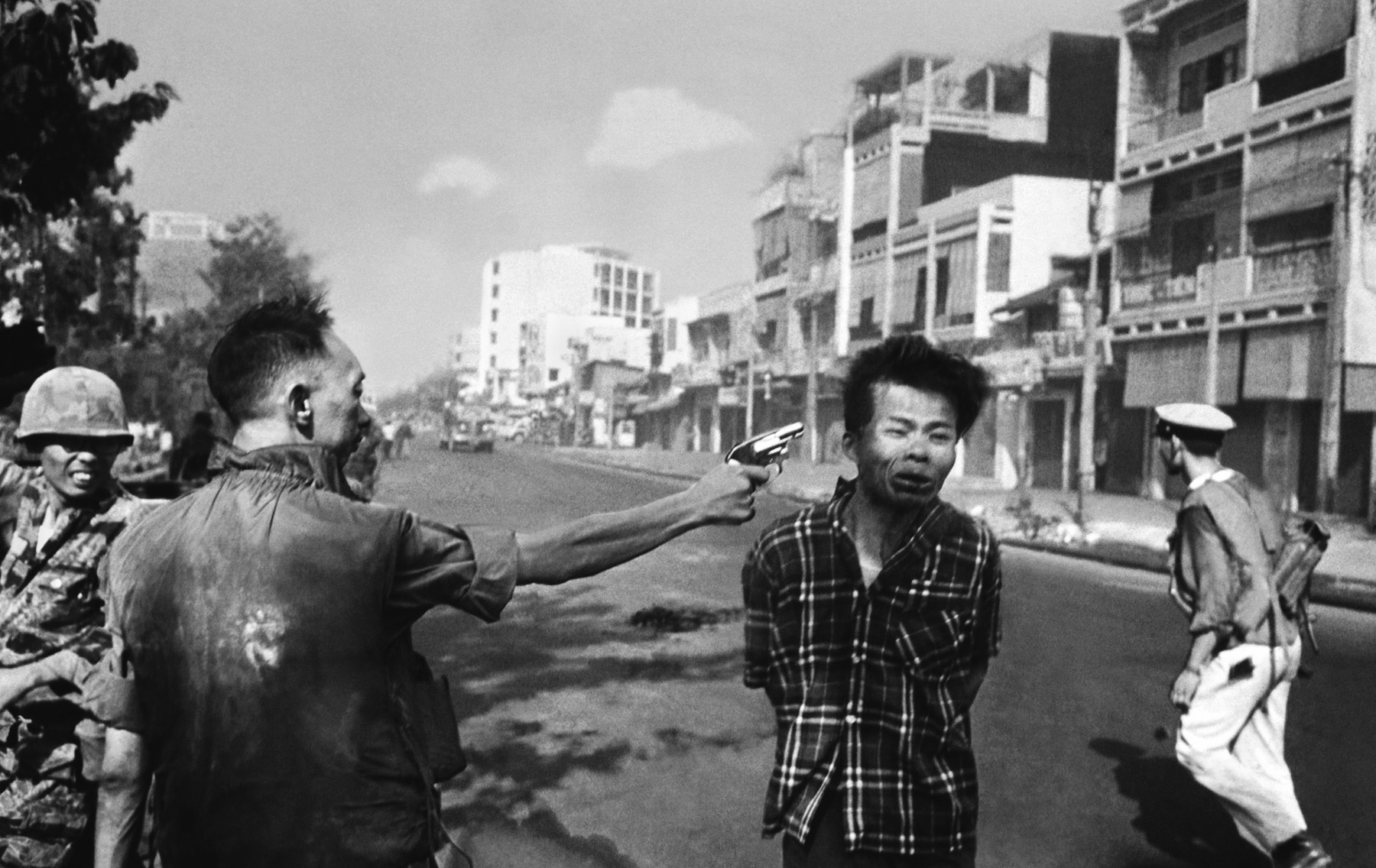
1960: Hoang Le Kha, NVA cadre

On this date in 1960, the former French colony of Vietnam made its last use of that most characteristically Gallic killing-machine: the guillotine.

Communist cadre Hoang Le Kha of the Vietnam People’s Army — the insurgent force also known at different times, in different manifestations, and through different eyes as the Viet Minh, the North Vietnamese Army (NVA) and the Vietcong* — earned the unpleasant distinction. According to a disappointingly truncated article (.pdf) from the Texas Tech University Vietnam Archive, the beheading took place notwithstanding an appeal pending before the International Control Commission, the multinational body charged with overseeing the supposedly temporary partition of Vietnam.

So, six years after Dien Bien Phu, what was independent Vietnam using this hated machine for?

Why, the same thing the French used it for: Terror.

The demonstrative device was redeployed in 1959 by Ngo Dinh Diem — a man whose obliviousness to blowback would soon land him in these pages — for exacting frightful, visible justice on subversive types.

According to that troubled former Secretary of Defense Robert McNamara,

On May 6, 1959, Diem signed Law 10/59, which, in an ironic bow to the former French colonial masters, inaugurated the era of death by beheading, as Diem’s lieutenants traveled the countryside with mobile guillotines and platforms, looking for “communists.” Article 1 of Law 10/59 called for “sentence of death, and confiscation of the whole or part of his property” for anyone convicted of crimes ranging from murder to stealing farm implements and water buffalo. Article 3 proclaimed that anyone belonging to “an organization designed to help to prepare or to perpetrate” such crimes “will be subjected to the sentences provided for” — that is, they will also be beheaded. … Article 16 announced: “The decisions of the special military court are not subject to appeal, and no appeal is allowed to the High Court.”

He then cites Hanoi historian Tran Van Giau’s recollection of the period.

“In 1959, the most difficult period of the revolution in South Vietnam, the Ngo Dinh Diem puppet regime dragged the guillotine everywhere and carried out a bloody fascist repression.”

Though officially downplayed overseas, all-but-summary beheadings were intentionally publicized in Vietnam in an effort to cow rebels.

The Diem government had many public executions. A lot of people in the West denied that it happened but Diem made no bones about it. They advertised the executions and there were pictures in the paper of people getting their heads chopped off by a guillotine. … In 1959, when I went around with the map teams there were many military outposts where they summarily chopped off the heads of people they thought were Communists. They put the heads on stakes right in front of their outposts, sometimes with two cigarettes up the nostrils. They even invited people to take pictures of it. They were very proud of themselves.

It didn’t work.

As a result, the guillotine itself, an archaic French model, can be seen among other dreadful mementos of that horrific war at Ho Chi Minh City’s War Remnants Museum.

Right alongside it is a picture of Hoang Le Kha.

(Many images — some of them graphic or disturbing — available at this Vietnamese page.)

* This is a very hasty lumping-together; the terms are not synonymous.

On this day..

1836: The defenders of the Alamo, much remembered

On this date in 1836, Mexican forces commanded by President Antonio Lopez de Santa Anna overran the Alamo — and executed those few of its defenders who survived the day’s battle.

“Remember the Alamo!”

This most memorable battle of the Texas Revolution has since retained its place in the founding mythology of Texas and its draw as a tourist destination in San Antonio, no matter the complexities on the ground. (You can watch the earliest surviving film treatment, The Martyrs of the Alamo, free online. D.W. Griffith made it the same year he made Birth of a Nation.)

That Alamo of blood and legend, and the countervailing interpretations it eclipses, are much beyond our scope here, but we are attracted to notice the reputed summary execution of five to seven defenders who had surrendered or otherwise been captured during the fight. (A few dozen mostly civilian noncombatants in the former mission also survived, and were not executed.)

According to Robert Scott, Santa Anna was empowered by a Mexican resolution holding (not without cause) that

“foreigners landing on the coast of the Republic or invading its territory by land, armed, and with the intent of attacking our country, will be deemed pirates.”

Who counted, at this moment, as “foreigners” among the Anglo settlers trying to break away from Mexico and their supporters among from the United States to which Texas would eventually attach poses a historiographical riddle. But then, Santa Anna wasn’t there to write a dissertation, but to win a war — and he was said to be sorely annoyed at the defenders having tied him down for a week and a half.

King of the Wild Frontier

Covered by most any definition of “foreigner” would have been the Alamo’s most famous defender, Tennessee frontiersman and former U.S. Congressman Davy Crockett. He had arrived in Texas just a few months before, on a rendezvous with destiny.*

It’s a matter of dispute whether Crockett was among those last few executed; in an event this emotionally remembered, every version of the Crockett death scene — from “found dead of injuries amid a heap of Mexican casualties” to “cravenly bargained for his life” — gores someone’s ox.

Even if the account of Crockett’s presence among the executed derives from a disputed source — well, this blog has not scrupled to highlight the fictional and the mythological, those executions whose resonance transcends factual accuracy.

And even if Davy Crockett was not among those anonymous souls put to death this day, it is by his name that they have their tribute, as in the 2004 film** The Alamo:

* Destiny by way of Walt Disney.

** This Disney film diddles with the Crockett legend that Disney helped to inflate in the 1950’s — to the annoyance, of course, of traditional-minded Alamo partisans.

On this day..

1916: James Crozier, an Irishman in His Majesty’s service

On this date in 1916, a young soldier drugged with rum to the point of stupefaction was dragged to the stake and shot near the western front.

There are hooks on the post; we always do things thoroughly in the Rifles. He is hooked on like dead meat in a butcher’s shop. His eyes are bandaged – not that it really matters, for he is already blind. … A volley rings out — a nervous volley it is true, yet a volley. Before the fatal shots are fired I had called the battalion to attention. There is a pause, I wait. I see the medical officer examining the victim. He makes a sign, the subaltern strides forward, a single shot rings out. Life is now extinct. (quoted in Forgotten Soldiers: The Irishmen Shot at Dawn)

The Belfast youth — who may or may not have been underage; reports appear to vary on this point — enlisted in the 9th Royal Irish Rifles during the initial blush of wartime enthusiasm.

The service of these loyal units from both north and south while Ireland teetered on the brink of of civil war and some of its partisans treated with the Germans was naturally valorized by the crown.

[flv:https://www.executedtoday.com/video/Irish_World_War_I.flv 440 330]

They would experience the full measure of that war’s ample stock of horrors — including numerous executions to enforce military discipline.

Just a few months after 9th was shipped to France, Crozier was found wandering miles behind lines, unarmed and out of uniform, apparently shellshocked.

Events moved quickly from there; Crozier’s lackadaisical service record weighed against him, and it was decided to make an example of him.

Charged with carrying out the sentence* was Frank Crozier (no relation), who would attain some controversial postwar renown. In his memoirs, he recalled the pathos of James Crozier’s fate.

He was no rotter deserving* to die like that. He was merely fragile. He had volunteered to fight for his country … at the dictates of his own young heart. He failed. And for that failure he was condemned to die — and he did at the hands of his friends, his brothers, with the approval of his church.

Eventually, the British government came to agree.


Crozier’s posthumous pardon, from his family genealogy. His Commonwealth War Graves Commission entry is here.

* According to Timothy Bowman, an officer of the 9th Royal Irish Rifles convicted on the same offense received a free pardon days after James Crozier’s conviction, to the consternation of the rank and file.

On this day..

1858: Chief Leschi

On this date in 1858, Chief Leschi of the Nisqually tribe was controversially hanged at Fort Steilacoom (present-day Lakewood) in the Washington Territory.

Yankee officer Isaac Stevens only spent four years in the Washington Territory as Franklin Pierce’s appointed governor, but he left his stamp on the state.

And no project defined the tenure of this authoritarian executive like putting the screws to the native peoples. Growing white settlement in the Pacific Northwest was creating conflict with the Indians who already inhabited it. In time, that conflict would claim Leschi.

Late in 1854, Stevens summoned the chiefs of several tribes in the newly-minted Washington Territory for an offer they couldn’t refuse: pack up and move to reservations of a few square miles’ undesirable territory, ceding 2.5 million acres to white settlers.

Chief Leschi — and it was Stevens’ men who had designated him a “chief”, the operation upon an alien culture of a bureaucracy that required official spokesmen — allegedly refused to sign the Treaty of Medicine Creek, although the evidence is unclear. Whatever the truth of that matter, sufficient signatures were cajoled for the government to ratify an agreement for massive dispossession, and Leschi became a prominent voice in the growing Indian dissatisfaction once the extent of the hustle became clear.

An attempt to arrest Leschi, who increasingly feared white assassination, touched off the Puget Sound War in 1855, and with an analogous conflict brewing on the other side of the Cascade Mountains, all Washington was soon a conflict zone.

That story’s end is predictable enough, but Leschi’s fate was protested by both native and white contemporaries. Leschi was condemned for “murdering” a militiaman during hostilities, a charge whose logic flowed from the rights asserted by American authorities but whose fundamental injustice (even leaving aside the very doubtful factual evidence) seems manifest, as it did to the defendant.

I have supposed that the killing of armed men in wartime was not murder; if it was, the soldiers who killed Indians are guilty of murder too.

George W. Bush would’ve called him an illegal combatant. That was hardly common sentiment.

So much good will did Leschi enjoy among whites — with whom he had years of amicable relations prior to Gov. Stevens’ arrival — that a scheduled January 22 hanging was deviously put off by the sheriff charged with the task: he arranged to have himself arrested on a liquor charge while in possession of the death warrant shortly before Leschi was to have been hung, and the two-hour window allotted for the execution of the sentence elapsed before matters could be put right.

They carried the sentence out four weeks later — “I felt then I was hanging an innocent man,” executioner Charles Grainger would say, “and I believe it yet” — but that hardly put an end to Chief Leschi’s story. The Nisqually have pushed hard for Leschi’s official exoneration, and won a Washington Senate resolution to that effect and an “acquittal” (of no legal force) from a panel of state jurists. But even though it attached to a convicted murderer, Leschi’s was never a black name in the state; it adorns a Seattle neighborhood and a number of schools and other public places. (“Stevens” is similarly prominent.)

There’s an excellent summary of the Leschi case from Oregon Historical Quarterly, a Washington State Historical Society website, and a 1905 public domain book published to make the case for Leschi.

On this day..

1957: Dedan Kimathi, Mau Mau commander

At a Nairobi prison this morning in 1957, the most famed and feared of the so-called Mau Mau was hanged under emergency measures permitting the death penalty for illegal firearms possession.

The armed Mau Mau uprising against British colonialism was by this time on its last legs militarily, having been ground down by years of murderous anti-insurgent operations and pleasantries like mass internment.

It had been an ugly fight on all sides, with overlapping conflicts — within the Kikuyu tribe, between Kenya’s native populations, and between the British Empire and her faraway subjects — brutally settled.

Certainly the Mau Mau’s depredations had garnered voluptuous press coverage in the mother country; accordingly, the capture of “Field Marshal” Kimathi, the biggest name in the insurgency, was a plume in the British lion’s cap.

(An earlier propaganda piece along the same lines sounded the war tocsin “so that peace may come to this troubled colony.”)

Notwithstanding the (still) official London take on Kimathi and the Mau Mau, their fight for the independence Kenya would soon attain has made Kimathi a hero to many Kenyans.* He was honored on the 50th anniversary of his death with a bronze statue in Nairobi.

And more than that: the Mau Mau would metastasize into a sort of floating signifier for implacable racialized anti-colonialism, a powerful symbol for an age of decolonization. Malcolm X frequently invoked the Mau Mau example. Frantz Fanon saw in the Mau Mau the potency of spontaneous rural resistance in generating white interest in “compromise” with the moderate who

never stop saying to the settlers: ‘we are still capable of stopping the slaughter; the masses still have confidence in us; act quickly if you do not want to put everything in jeopardy.’ … as the settlers cannot discuss terms with these Mau-Mau, he himself will be quite willing to begin negotiations.

* Although many surviving Mau Mau themselves are nonplussed by their post-independence treatment.

On this day..

1573: Matija Gubec, peasant revolt leader

On February 15, 1573, the brief but scintillating career of insurrectionary Matija Gubec came to a brutal end when he was publicly tortured to death in Zagreb.


You know what they say about the size of a man’s feet: Matija Gubec about to be crowned with a red-hot iron ringlet and quartered.

Gubec emerged from (to us, at least) obscurity to leadership of a short-lived peasant uprising in Croatia against Franjo Tahi (Croatian Wikipedia link), your basic feudal tyrant.

Although put down inside of two weeks, this revolt and its personification in Gubec have endured as potent national symbols in Croatia.

In the revolutionary 20th century, both left and right claimed Gubec’s standard as their own: a multiethnic company of Yugoslav volunteers fought under his name in the Spanish Civil War, as did multiple partisan units during World War II who took inspiration in his peasant class uprising. By contrast, the Ustasha conceived Gubec as

one man, who was not the exponent of any class, but … a reflection of an entire nation’s beliefs.*

Fascist and communist alike can jam to the rock opera Gubec Beg.**

* See Pavlakovic, Vjeran (2004) ‘Matija Gubec Goes to Spain: Symbols and Ideology in Croatia, 1936-1939’, The Journal of Slavic Military Studies, 17:4, 727 — 755.

** According to Pavlakovic, Gubec’s real given name is unknown and birth records suggest it might have been “Ambroz”. He was known as “Gubec called Beg,” using the Turkish term for a lord.

On this day..

1920: The White Admiral Aleksandr Kolchak

On this date in 1920, White commander Admiral Aleksandr Kolchak was shot in Irkutsk.

Absent the Russian Revolution, Kolchak‘s epitaph would read “naval officer and arctic explorer.”*

After the Russian Revolution touched off civil war, Kolchak became Supreme Ruler — and ruthless dictator — of an anti-Bolshevik government stretching from the Urals to the Pacific Ocean.

It didn’t last.

Fleeing east, Kolchak was arrested by a Bolshevik-allied government in Irkutsk on Lake Baikal. The White army mounted an offensive to retrieve him — leading the Soviet government to order his immediate execution, along with one of his government ministers, Viktor Pepelyayev. Unable to bury them in the frozen soil, their captors unceremoniously dumped the corpses in the Ushakovka River.


A monument to Admiral Kolchak in Irkutsk, Russia. Image courtesy of Jack Sheremetoff of Baikaler.com.

* An inhospitable Arctic island he helped explore was named (and is now again named, following a Soviet change of moniker) for Kolchak.

On this day..

1703: 47 Ronin forced to commit seppuku

On this date in 1703, Japan’s most renowned epic of bushido vengeance reached its endgame with the condemned ronin who had avenged their executed master forced to commit seppuku.

So compelling an allegory of conflicting loyalties could hardly have been so skillfully constructed as outright fiction. The 47 Ronin owed personal fealty to a daimyo who drew his blade when provoked by the insolence of a shogunate official, and was condemned to death for the offense.

For the shogun, it was a just assertion of a central state’s prerogatives.

For the samurai made ronin by the death of their lord, it was a test of honor.

Knowing that the offending shogun retainer would be well-defended on the lookout against retribution, forty-seven of them (or possibly more at first; in any case, not the entirety of the samurai force) feigned dissipation and indifference for over a year … then raided his palace and slew him once he dropped his guard.

The ronin were condemned to death, but authorities “allowed” them the more honorable route of seppuku — which they committed to a man.*

Theorists of bushido honor may dicker over whether this plot fulfilled the demands of honor, but less philosophically exacting interlocutors have made the tale among the most beloved in Japanese history — like these illustrations of a traditional adaptation, or several films.

Their graves can be honored by the discerning Tokyo visitor at the popular Sengakuji Temple.

* Actually only 46 of the 47; the other was sent as a messenger, or perhaps fled, but was otherwise separated from his party, and ended up spared.

On this day..

1968: Nguyen Van Lem

Around noon of February 1, 1968, in the opening days of the communist Tet Offensive, South Vietnamese General Nguyen Ngoc Loan summarily executed a Viet Cong prisoner on the streets of Saigon — and photographer Eddie Adams captured perhaps the war’s most unforgettable image.

An American cameraman also captured it in on celluloid. Caution: This clip shows … well, a man being shot in the head at point-blank range.

Though the image brought Adams the Pulitzer Prize, he would express discomfort with it later in life, and eulogized General Loan in Time magazine when he died in the U.S. in 1998.

The general killed the Viet Cong; I killed the general with my camera … photographs do lie, even without manipulation.

For Adams, the lie was the omission of context — that the plainclothes Lem had allegedly just been caught having murdered not only South Vietnamese police but their civilian family members; that Loan was a good officer and not a cold-blooded killer.

Adams’ editor has said that many such summary executions were taking place during the Battle of Saigon — a broader context to the image no matter its specific fairness to the executioner.

But of course, the shot gained its deeper resonance from the growing disgust with the Vietnam War … and from its concise tableau of a century’s brutality. Here is a frozen image of Orwell’s boot stamping on a human face, forever.

Like any great work of art, Adams’ serendipitous photograph took on a life of its own … and a tapestry of meanings richer than its creator could ever have intended.

On this day..

1945: Private Eddie Slovik, the last American shot for desertion

On January 31, 1945, Private Edward Donald “Eddie” Slovik became a curious outlier of World War II: he was executed by firing squad by the U.S. Army for desertion. He is the only person to have been so punished for that crime since the Civil War.

Pvt Slovik was, by all accounts, quiet and helpful, by no means a coward, and more than willing to aid in the effort of World War II, traits which would have put him among a large class of that war’s veterans. Unfortunately, he was also immobilized by shelling. Equally unfortunately, he knew it, and he decided to do something about it.

Slovik and a friend, Pvt John F. Tankey, first separated from their detachment under artillery fire in late August 1944, shortly after being shipped to France. The pair hooked up with a Canadian unit and spent six weeks pitching in. Having recused themselves from the hard shelling others were experiencing on the front line, they opted to rejoin their regular U.S. unit: Slovik and Tankey sent a letter to their commanding officer explaining their absence and returned on Oct. 7.

But the front lines were not a place for Pvt Slovik.

After his assignment to the rifle unit, which would face imminent danger during shelling, Slovik asked to be placed in the rear guard, indicating he was too scared to remain in front. His request was refused. He then reportedly asked whether leaving the unit again would be considered desertion, was told it would be, and opted for the seemingly safer route of, well, deserting. One day later, Slovik was back at a U.S. camp, this time turning himself in to the camp cook. He had drafted a letter explaining his actions and indicating that he knowingly deserted, permanently recording his guilt on paper.

It’s not clear whether Pvt Slovik was acting on principles or out of an understanding of the U.S. military judicial system. He was by no means the only soldier without affinity for the conditions of war, particularly on the allied side. During the war, thousands of soldiers were tried and convicted in military courts for desertion, but up to then, all had received only time in the brig. What is clear is that Slovik was repeatedly offered opportunities to return to the line, and he equally repeatedly refused.

The case was adjudicated on Nov 11 by nine staff officers of the 28th Division, none of whom had yet been in battle. One of those judges, Benedict B. Kimmelman, wrote a stark and intriguing account of his role in the story of Pvt Slovik, capturing the scene thusly:

Five witnesses were heard. The cross-examinations were perfunctory. The defense made no closing argument. The court recessed for ten minutes, resumed, and retired almost immediately afterward. Three ballots were taken in closed court, the verdicts unanimously guilty on all counts. In open court once more, the president announced the verdict and the sentence: to be dishonorably discharged, to forfeit all pay and allowances due, and to be shot to death with musketry. The trial had begun at 10:00 A.M.; it was over at 11:40 A.M.

As with all court martial cases, Slovik’s was sent to a judge advocate for review. His criminal record, including everything from destruction of property to public intoxication to embezzlement, did not endear him to the reviewer. More importantly, though, the advocate felt Slovik could be made an example:

He has directly challenged the authority of the government, and future discipline depends upon a resolute reply to this challenge. If the death penalty is ever to be imposed for desertion, it should be imposed in this case, not as a punitive measure nor as retribution, but to maintain that discipline upon which alone an army can succeed against the enemy.

Strangely, Pvt Slovik was the only person who would be exemplified this way.

Though the military tried 21,000 desertion cases and passed down 49 death sentences for desertion during the war, it carried out only Slovik’s. And in the war’s final battles, with Germany collapsing, his execution seemed like a surreal throwback. As Kimmelman notes, hundreds if not thousands of soldiers were strictly guilty of dereliction of duty and desertion in the waning days of 1944.

They’re not shooting me for deserting the United Stated Army — thousands of guys have done that. They’re shooting me for bread I stole when I was 12 years old. (Source)

Three weeks after his conviction and three weeks before the Battle of the Bulge, Slovik’s execution order was confirmed by the 28th Division’s commander, Major General Norman “Dutch” Cota. Cota was disturbed by Slovik’s forthrightness in confessing to the desertion, and, as a front line commander who had sustained severe casualty rates in the Battle of Hurtgen Forest, had no sympathy for the crime.

After an appeal to the deaf ears of Dwight Eisenhower shortly before the sentence was to be carried out, Slovik was out of options. He was taken to the courtyard of an estate near the village of Sainte-Marie-aux-Mines and shot by 11 Army marksmen* at 10 a.m. By 10:04, as they were reloading, he was declared dead. His body was interred at a French cemetery, and after decades of lobbying the U.S. government, his remains were returned to Michigan in 1987.

Because he was dishonorably discharged, Slovik was not entitled to a pension, and his wife, Antoinette, stopped receiving payments. Curiously, though the Army managed to communicate this to her, they omitted the bit about the execution. She found out in 1953 from William Bradford Huie.

Huie was a journalist who took immediate interest in Slovik’s story, popularizing it with his book The Execution of Private Slovik, which was released in 1954. Twenty years later, the book and title were requisitioned for a well-received TV movie starring Martin Sheen.

Perhaps more interesting than this film was its never-produced predecessor, which is entitled to a place in the history of the Hollywood Blacklist. Frank Sinatra acquired rights to The Execution of Private Slovik and in 1960 announced that he would produce it as his directorial debut — with the script of this inherently political story to be written by “Hollywood Ten” blacklistee Albert Maltz. Maltz and other blackballed writers had continued working pseudonymously during the anti-Communist blacklist, but Sinatra’s openly announcing an intent to hire and credit Maltz constituted a significant crack in the wall — even though commercial and political heat eventually forced Sinatra to abandon the project. This event has treatment in a recommended episode of the magnificent cinema-history podcast You Must Remember This.

* The firing squad included 12 marksmen, but one was given a blank. Despite their skill, the 11 remaining shooters did not manage to kill him instantaneously.

On this day..