On this date in 1521, the day after winning the decisive battle in the Castilian War of the Communities, royalist forces beheaded its three principal leaders in Villalar.
Even while the Spanish Empire was burgeoning in the New World, its home peninsula remained a house divided.
The Iberian Kingdoms of Aragon and Castile had joined in a personal union with the marriage of Ferdinand and Isabella in the late 15th century.
When the couple passed, it was not a given that their conjoined territory would become, as it did, the germ of a unified Spain.
Instead, the royal power couple’s crazy daughter was kept under lock and key while her infant son grew into the redoubtable Emperor Charles V. To exacerbate the local annoyance, Chas had continent-spanning territories, and ambitions; Spain was not his base, merely one of his provinces. (He’d grown up in Flanders. Ah, dynastic politics.)
The Emperor was only a teenager when his Castilian subjects rose against his levies, and against the paradoxical perception that the first true King of Spain was a foreign ruler.
A riot in Toledo mushroomed into a revolt, and everyone started drawing up sides. (Spanish link) Things went south when the commoner rebels started adopting an unwelcome radicalism (beyond rebelling against the king, that is), enabling the imperial rep (and future pope) Adrian of Utrecht to pull back into the royalist camp rebellious nobles increasingly fearful of expropriation at the hands of the firebrands.
The Execution of the Comuneros of Castile, by Antonio Gisbert. Segovian Juan Bravo allegedly asked to die first, so as not to witness the death of so good a knight as Padilla.
The demise of the “Caballeros Comuneros” pretty much squelched the revolt — although Padilla’s widow Maria Pacheco defended the rebel ground zero of Toledo for several months more.
The comuneros have lived on ever since as a symbol in literature and propaganda, among monarchists (for whom they are a symbol of perfidy), liberals (rather the reverse) and Castilian nationalists. Though “comuneros” was for a period an all-purpose smear against agitators in the Spanish dominions, April 23 (the date of the fateful battle) has been Castile and Leon Day, a public observance, since 1986.
This monolith in the Villalar town plaza commemorates the Comuneros. Image (c) Julio Alvarez, and used with permission.
On this date in 1945, French general and Resistance figure Charles Delestraint was hastily disposed of, ten days before the liberation of Dachau.
Delestraint, who also spent the First World War as a POW, was among those who noticed the hidebound military dogmas of the past needed updating.
With de Gaulle, Delestraint was a forceful advocate in the interwar period for mechanized warfare.
He didn’t get far enough, certainly not as far as the soon-to-be-vaunted Wehrmacht.
In 1940, just months after retirement, Delestraint was recalled to lead a mechanized division against the Germans, which of course turned out to be a spectacular triumph of tank warfare … for the Germans. While the French distributed armor units throughout their forces, the Germans massed them at a schwerpunkt aiming to break through the French line and speedily conquer in the rear.
Delestraint later remarked of the doctrinal difference,
We had 3,000 tanks and so did the Germans. We used them in a thousand packs of three, the Germans in three packs of a thousand.
Recruited subsequently into the French Resistance and thence betrayed, Delestraint enjoined the hospitality of many concentration camps and the tender mercies of one of their more infamous torturers.
Uncertainty remains over exactly how the Germans killed Delestraint, or even why the Dachau commandants wanted to finish off him in particular, although he was a primo catch in the anti-Resistance operation. The body was immediately cremated, camp records of the execution order disappeared if they ever existed, and eyewitness testimony at variance.
But dying in Dachau for the French Resistance? By any standard, that’s a passport to hero status, as attested by any number of Rue General Charles Delestraints to be found in his native land.
Putatively in the service of a rebellious lord, Topi immediately established himself as the cause’s most capable commander. His forces bloodily seized Cawnpore (Kanpur) in a heady surprise victory during the conflict’s opening stages.
A British counterattack overturned that promising development. The Indian lord was captured, but “all the capacity for resistance that he ever displayed” had been supplied by Topi. Now, Topi found a more impressive liege in Rani Lakshmibai, and deployed his genius for soldiery in a fast-evolving war — harrying the occupiers in both conventional and (increasingly) guerrilla-style combat.
The rebels were outclassed; the time was not yet ripe — but Topi’s was the model of anticolonial guerrilla insurgency that would figure so prominently in the next century.
Topi’s exploits and elusiveness, maintaining his freedom in the field long after every other pillar of the uprising had collapsed, made him a domestic hero, and formed a continuing theme in the British press in 1858 and 1859. He was genuinely admired by his enemies as a soldier, however much his cause was abhorred. (The stiff-upper-lippers dinged him for inadequate personal courage, however.)
Topi was taken, at last, by betrayal, and dead at the order of a drumhead military court within days.
But the day after the London Times published its report of the popular hero’s hanging (“a great scramble was made by officers and others to get a lock of hair, &c”), it editorially eulogized* Topi with the gusto of victor catching, perhaps, the foreshadow of Indian resistance awaiting in generations still to come.
He raised armies as fast as we could disperse them, took up one position after another to our infinite annoyance, and led us a chace which, despite of unexampled efforts on the part of our soldiers, seemed to be really endless. Our troops pursued him without intermission, contrived more than once to surprise him, repeatedly captured his artillery and scattered his troops, but could never deprive him entirely of followers or guns. He seemed to summon forces from the earth as if by magic. As the pursuit grew hotter and hotter he mounted his men on ponies and camels, and marched, it is said, at the average rate of 60 miles a-day. Wherever we found him he had always cavalry and guns, and these he posted with remarkable skill.
…
Be it remembered that for half a century we had been training soldiers, and that in Bengal alone there were 150,000 natives under arms when this revolt broke out. Now, in all this enormous host there was not a single man who, when the bonds of allegiance and discipline were abruptly removed, displayed the intuitive capacities of a military commander. … The two years of the revolt, with all their opportunities, never produced one native General. … One man alone reproduced the old Indian character, and that man was TANTIA TOPEE — an obscure civilian, without place or power. He, by the light of nature alone, discerned the strong points of the rebels’ position and our own weak points. By the exercise of that faculty with which heroes are gifted he could always, even in his most desperate straits, draw followers to his standard. …
Nothing could more forcibly illustrate the reputation which this man had acquired than the fact that his fate has been attended with some regret … if he had not met his match in those opposed to him he might have founded a dynasty.
* May 21, 1859. Information moved a little slower.
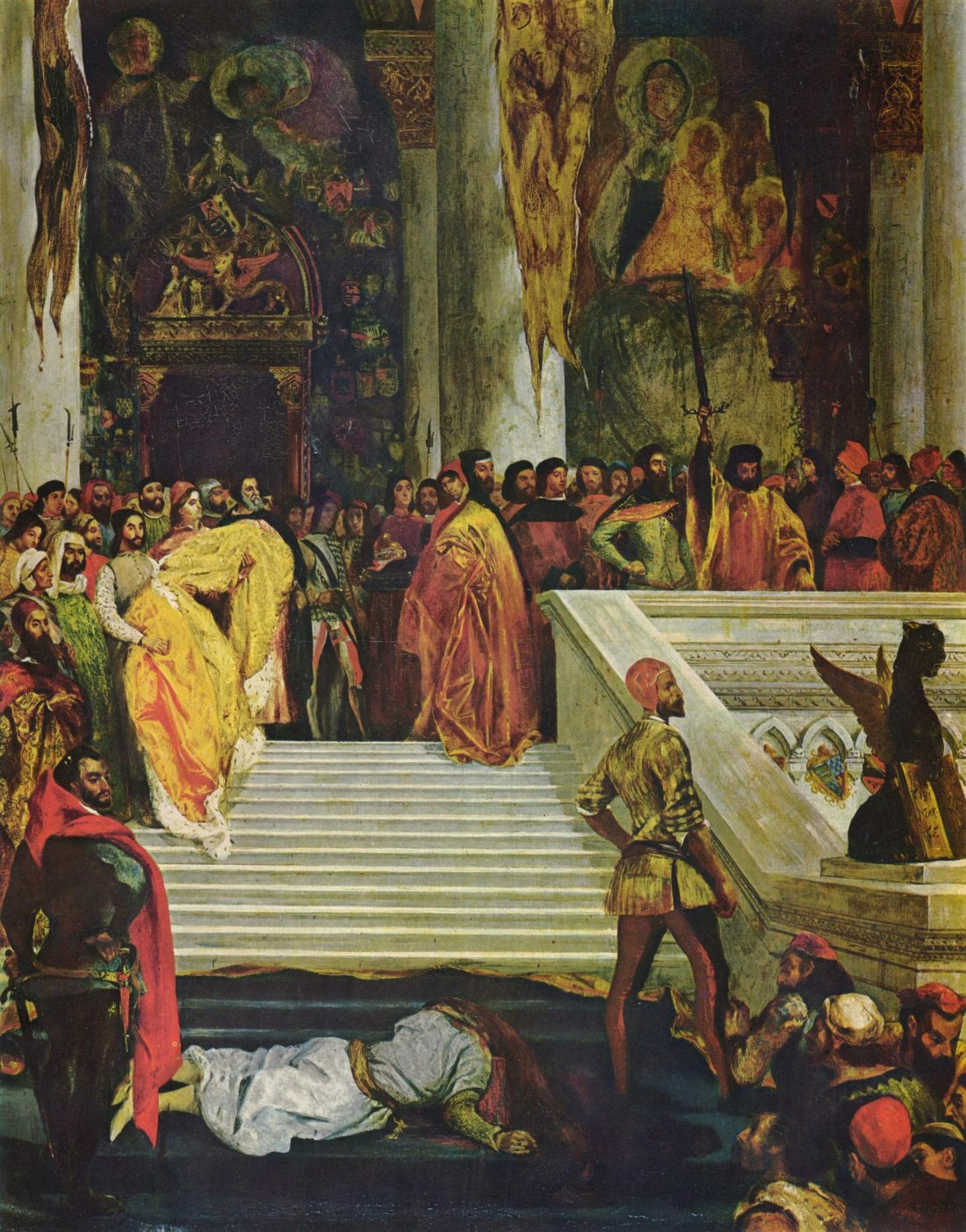
On this date in 1355, Marino Faliero* was escorted to the spot where he had been crowned Doge of Venice scant months before. There, he was ceremoniously relieved of his robes of state … and then his head.
Some fog surrounds the day’s proceedings, product not only of time but of the Doge’s executioners’ damnatio memoriae upon their victim. What was written was circumspect; even Faliero‘s portrait in the great hall of the Doge’s Palace was veiled.
What is known — or at any rate, was admitted by the elderly first citizen — is that the ruler attempted a coup against the overweening power of Venice’s great families.
The putsch was supposed to occur on April 15, with the bell of St. Mark’s Cathedral tolling on a fabricated hue and cry. In the tumult, the Doge’s supporters meant to cut down the nobles who flexed the real political muscle in the maritime republic and consolidate ducal power.
Why?
The salacious version has the old goat in a tiff with a noble, who made fun of his May-December marriage —
Marino Faliero of the beautiful wife,
Others enjoy her while he maintains her
A tribunal of fellow-nobles let the rascal off with a slap on the wrist.
Power being what it is, and princes and nobilities being born for conflict with one another across the centuries in Europe, one may as well discern a straightforward political intent — heightened, perhaps, by the then-dire state of Venice’s naval contest with Genoa.
Downright Byronic under either scenario … and Byron wrote a play about Faliero. The doomed ruler gives throat to quite a magnificent curse upon his city, with all the foresight of Byron’s half-millennium of hindsight:
I perish, but not unavenged; far ages
Float up from the abyss of time to be,
And show these eyes, before they close, the doom
Of this proud city, and I leave my curse
On her and hers for ever! —
…
— She shall be bought
And sold, and be an appanage to those
Who shall despise her! — She shall stoop to be
A province for an empire, petty town
In lieu of capital, with slaves for senates,
Beggars for nobles, panders for a people!
…
Amidst thy many murders, think of mine!
Thou den of drunkards with the blood of princes!
Gehenna of the waters! thou sea Sodom!
Thus I devote thee to the infernal gods!
Thee and thy serpent seed!
[Here the Doge turns, and addresses the executioner.]
Slave, do thine office!
Strike as I struck the foe! Strike as I would
Have struck those tyrants! Strike deep as my curse!
Strike — and but once!
This sort of thing knocking about among litterateurs in the 19th century practically guarantees an opera.
* Or simply “Marin Falier”, in the Venetian dialect.
But Honest Abe had one last order of business to attend to before his carriage called him away to destiny: the pardon of a convicted Confederate spy due to be shot in St. Louis two days hence. Lincoln’s handwritten clemency for George Vaughn was the last official act of his presidency.
Lincoln in Story (“The Life of the Martyr-President told in Authenticated Anecdotes,” a light 1901 volume for popular consumption) relates:
Before the war Vaughn, with his wife and children, lived in Canton, Mo. He was a friend of Martin E. Green, a brother of United States Senator James S. Green, both strong pro-slavery men. At the opening of the war Martin E. Green recruited a regiment and received a colonel’s commission from the Confederate Government. George Vaughn enlisted under Green’s command and fought through the war.
After a period of fighting, Green and Vaughn crossed into Mississippi from Tennessee, camping at Tupelo, Miss. Not having heard from his family, Green was anxious to hear from his old home, so he delegated Vaughn to go on the mission of delivering letters to his wife.
Vaughn had almost completed his trip, having reached La Grange, six miles south of Canton, when he was captured by a squad of Federal troops.
They searched his person, and, finding letters and papers concealed about him, he was tried as a spy and sentenced to be shot. John B. Henderson, Senator from Missouri, finally succeeded in getting an order from the President for a retrial, but the verdict remained as hitherto. Again Henderson appealed to Lincoln, who granted a third trial, with the same result.
Henderson was not disconcerted, and again went to Lincoln. It was on the afternoon of April 14, 1865 — a melancholy date — that the Senator called at the White House. He called the attention of Lincoln to the fact that the war was practically closed, and said: “Mr. Lincoln, this pardon should be granted in the interest of peace and conciliation.”
This story gravitates naturally to the clemency of “the Great Heart” (as, for instance, D.W. Griffith called Lincoln). Far be it from us to say otherwise, but this is also self-evidently a story of the unusual prerogatives of the well-connected: not just any accused spy could get two trial do-overs and then a pardon free and clear ordered straight from the White House.
Mr. Lincoln replied: “Senator, I agree with you. Go to Stanton and tell him this man must be released.”
Henderson went to the office of the Secretary of War. Stanton* became violently angry, and swore that he would permit no such procedure.
Vaughn had but two days to live, and Henderson hastened to make one more stand. After supper he went to the White House. The President was in his office, dressed to go to Ford’s Theatre, when the Senator entered and told of the meeting he had had with Stanton.
Lincoln turned to his desk and wrote a few lines on an official sheet of paper. As he handed it to Senator Henderson he remarked: “I think that will have precedence over Stanton.”
It was an order for an unconditional release and pardon — the last official paper ever signed by Abraham Lincoln.
* Stanton is supposed to have delivered the remark as Lincoln’s deathbed, “now he belongs to the ages” … an alleged epitaph whose actual content is subject, like all biography, to textual uncertainty and ideological redefinition.
Update: The excellent tale of a different soldier pardoned on this same date has recently been debunked by the National Archives in an academic scandal: in January 2011, researcher Thomas Lowry confessed to altering the pardon order for one Patrick Murphy from the true (and much less dramatic) date of April 14, 1864 to April 14, 1865.
Vaughn was actually pardoned just before Lincoln went to Ford’s Theater; Murphy (totally unconnected to Vaughn) was pardoned 365 days prior.
As of this date, it’s been 48 years since the United States military last carried out an execution — the Fort Leavenworth hanging* of John Arthur Bennett for rape.
An epileptic black soldier with a family history of mental illness, Bennett had enlisted to find a way up out of sharecropping. Instead, on Christmas Eve 1954, he drunkenly raped a 12-year-old girl near his base in Austria.
He spent six years awaiting execution — “six years,” observed the Los Angeles Times, “in which six other black soldiers were hanged while all four of the white men — many of them multiple murderers — were saved.”
Bennett dodged two execution dates, once receiving his stay during his last meal, but a seemingly compelling plea for clemency — the victim herself, and her parents, asked for mercy — availed Bennett nothing. His last frantic plea to the new president, John F. Kennedy, was dispatched with only hours yet to live.
I beg in the name of God … Will you please in the name of God and mercy spare my life?”
Coincidentally, but poignantly for this case, the Kirk Douglas vehicle A Town Without Pity opened a month before Bennett’s execution. In that film (trailer here), four American servicemen face capital trial for the rape of a German girl — and Douglas, as their lawyer, struggles to talk pity into someone so he won’t be obliged to humiliate the victim in court in order to save his clients from the noose.
The victim’s father in that movie is so blinded by his lust for vengeance that he forces Douglas to destroy his own daughter: striking contrast with the real-life father of Bennett’s flesh-and-blood victim, who wrote in support of clemency for his daughter’s assailant, “I know how hard it is for the parents when their own child is so close to the verge of death.”
Bennett’s milestone, however, is hardly assured of lasting much beyond this 49th year.
In 2008, President George W. Bush affirmed the death sentence of condemned Army cook Ronald Gray, the first such action by any U.S. president since Bennett’s day. According to the NAACP Legal Defense Fund’s Death Row USA most current as of this writing,** Gray is one of nine prisoners currently on the U.S. military’s death row.
* Curious to know about the procedure? The Library of Congress has that period’s Procedure for Military Executions — complete with exact diagrams — online in pdf form.
On this date in 1548, the Spanish crown cemented its authority over the territory of the former Incan Empire by beheading its rebellious conquistador authorities.
Gonzalo Pizarro (English Wikipedia entry | Spanish) had served in the force that late elder half-brother Francisco used to destroy the Incas. The poor bloke was always second banana in the conquistador game; when he wasn’t being one-upped by his flesh and blood, he was bailing on the expedition that “discovered” and navigated the Amazon River. (Francisco de Orellana earned those honors instead.)
No, Gonzalo had a more prosaic specialty: killing.
While big bro went off to pacify more territory, Gonzalo along with siblings Hernando and Juan, the Baldwin brothers of New World conquest, chilled in the former Incan capital Cusco and sparked a rebellion in the 1530’s with their iron-fisted rule.
Appointed Governor of Quito in 1541 — he forced the appointment with some exemplary hangings — Gonzalo was just the sort to get a burr in his saddle when the Emperor Charles V promulgated the New Laws requiring slightly less crappy treatment of the natives.
And that was a low bar to clear indeed.
Although the following passage is not particular to Gonzalo Pizarro, gadfly monk Bartolome de las Casasdescribed (perhaps exaggeratedly, but still) the previous Spanish depredations in “Perusia”:
[T]he Spaniards, without the least provocation on their part, as soon as they entred [sic] upon these Territories, did burn at the Stake their most Potent Caciq Ataliba, Prince of the whole Country, after they had extorted from him above Two Millions of Gold, and possessed themselves of his Province, without the least Opposition … As also some few days after, the Ruler of the Province of Quitonia, who was burnt, without any Cause given, or Crime laid to his Charge … and in like manner, burnt the Feet of Alvidis, the greatest of all the Quitonian Lords, and rackt him with other Torments to Extract from him a discovery of Ataliba’s Treasure, whereof as appear’d after, he was totally ignorant …
[T]hese Eyes of mine the Spaniards for no other reason, but only to gratifie their bloody mindedness, cut off the Hands, Noses, and Ears, both of Indians and Indianesses, and that in so many places and parts, that it would be too prolix and tedious to relate them. Nay, I have seen the Spaniards let loose their Dogs upon the Indians to bait and tear them in pieces, and such a Number of Villages burnt by them as cannot well be discover’d: Farther this is a certain Truth, that they snatched Babes from the Mothers Embraces, and taking hold of their Arms threw them away as far as they would from them: (a pretty kind of barr-tossing Recreation.) They committed many other Cruelties, which shook me with Terror at the very sight of them, and would take up too much time in the Relation …
More urgent than “recreation,” Pizarro (and many of the New World’s new landholding elite) were miffed that meddlesome European bleeding hearts types were going to cut into their profit margins.
Pizarro revolted, enlisting the brilliant officer Francisco de Carvajal, a longtime fixture of the Old World battlefield. Now an octogenarian, he had lost neither vigor in command, nor cruelty in conquest. (He played bad cop to Gonzalo’s good cop.) The two killed the guy sent to impose the emperor’s decree.
This uprising forced the next Spanish viceroy to repeal the hated New Laws in order to win political support against Pizarro and Carvajal — a happy outcome for Pizarro’s base, but not for the conquistador himself.
Pedro de la Gasca’s adroit diplomacy caused the entire rebel force to desert before the fight at the “Battle” of Jaquijahuana in Sacsayhuaman.
The two principals were quickly arraigned. Carvajal, at his age, could be wry about being singled out for punishment: “very merciful is the Lord President; for, if the victory had been ours, there would have fallen on this spot nine hundred men.”
Carvajal was hanged and Pizarro beheaded, both of them winding up on pikestaffs at the gates of the city Francisco Pizarro had founded — Lima.
Their partnership — and the arc of Spanish exploits in the New World — is covered in this Google Books freebie.
On this date in 1796, Republican France subdued the troublesome Vendee with the execution of its last great rebel.
Royalist officer Charette (English Wikipedia link | French) had assumed leadership of the anti-Republican revolt that broke out in the Vendee in 1796 — albeit with some turf rivalry with other anti-Republican figures in the area.
After a capable stretch of guerrilla campaigning, Charette had no sooner laid down his arms than the desperately counterrevolutionary English pushed for an ill-considered resumption of hostilities.
This time, the rebels took it in the culottes.
Charette, having upheld the monarchist cause long past his fellows — and much past any hope of success — became the figure the Republic had to eliminate to pacify the region. As English historian Archibald Alison has it, Charette paid a grim price for refusing to just be bought off.
Anxious to get quit of so formidable an enemy on any terms, the Directory offered [Charette] a safe retreat into England with his family and such of his followers as he might select, and a million of francs for his own maintenance. Charette replied, “I am ready to die with arms in my hands; but not to fly, and abandon my companions in misfortune. All the vessels of the Republic would not be sufficient to transport my brave soldiers into England. Far from fearing your menaces, I will myself come to seek you in your own camp.” …
This indomitable chief, however, could not long withstand the immense bodies which were now directed against him. His band was gradually reduced from seven hundred to fifty, and at last, ten followers. With this handful of heroes he long kept at bay the Republican forces; but at length, pursued on every side, and tracked out like a wild beast by bloodhounds, he was seized after a furious combat, and brought, bleeding and mutilated, but unsubdued, to the Republican headquarters. … Maltreated by the brutal soldiery, dragged along, yet dripping with blood from his wounds, before the populace of the town, weakened by loss of blood, he had need of all his strength of mind to sustain his courage; but, even in this extremity, his firmness never deserted him.
He was shot in Nantes after a perfunctory trial, refusing a blindfold and giving the orders to his own firing squad.
Execution of General Charette, in Nantes, March 1796, by Julien Le Blant.
Napoleon, who had done well to duck a possibly career-killing assignment to the Vendee the year before and was in consequence at this very moment the Revolution’s emergent man on horseback,* paid tribute from his suitable distance to Charette’s brilliance.
Charette was a great character; the true hero of that interesting period of our Revolution, which, if it presents great misfortunes, has at least not injured our glory. He left on me the impression of real grandeur of mind; the traces of no common energy and audacity, the sparks of genius, are apparent in his actions.
* Having made his name by efficiently putting down a royalist putsch in Paris a few months before, Napoleon had wed Josephine just three weeks before Charette’s execution.
On this date in 1836 — Palm Sunday, as it happened — over 300 Anglo POWs fighting to separate Texas from Mexico were executed en masse outside Goliad’s fortress
Less widely celebrated than the Battle of the Alamo preceding it by a fortnight, the Battle of Coleto on March 19-20 had seen Mexican troops surround and capture another force of Texians at Goliad.
Unaware of a Mexican order issued the previous December to execute foreign prisoners,* the men under Col. J.W. Fannin — a dithering commander whose military competence didn’t quite equal his romantic aspirations — expected to be released in a matter of weeks. They were marched out this morning on some innocuous pretext and had bare moments to apprehend their impending fate before their guards mowed them down. (Fannin was individually shot apart from his troops.)
Nineteenth-century musketry was a mediocre tool for mass slaughter, especially when the targets were nearly as many as their executioners. A number of prisoners survived the volley and managed to escape the subsequent cavalry charge and bayoneting by leaping into a nearby river. A fortunate few others were intentionally preserved. This thorough site on the massacre** preserves several survivor accounts.
These memoirs also detail life in the unit and troop maneuvers that are certainly of interest; in these pages, of course, we are most drawn to the accounts of those who stared death in the face — like this (understandably melodramatic) description by Herman Ehrenberg:
Either life or death! Behind were the bayonets of the murderers, and before me was the sword of a coward that crossed my way to the saving stream. Determinedly I rushed upon him. Forward I must go, and — the coward took flight in characteristic Mexican gallantry. Now the path was open, near was the point of my escape.
…
Arriving at the other bank of the river, I looked around once more to where my comrades were dying, while the bullets of the still firing enemies whistled about me. The hellish exaltations of the enemy mixed with the cries of pain of my dying brothers sounded over to me. What feelings took possession of me here! I cast another look and a farewell greeting to my dead companions and turned to flee. I had to hasten if I did not wish to fall into the hands of the lancers who were now on this side of the river less than a half a mile below me.
Which makes an interesting stylistic contrast with the story of John C. Duval, similar in its events but strikingly low-key, even ironic:
Some one near me exclaimed “Boys! they are going to shoot us!” and at the same instant I heard the clicking of a musket locks all along the Mexican line. I turned to look, and as I did so, the Mexicans fired upon us, killing probably one hundred out of the one hundred and fifty men in the division. We were in the double file and I was in the rear rank. The man in front of me was shot dead, and in falling he knocked me down. I didn’t get up for a minute, and when I rose to my feet, I found that the whole Mexican line had charged over me, and were in hot pursuit of those who had not been shot and who were fleeing towards the river about five hundred yards distant. I followed on after them, for I knew that escape in any direction (all open prairie) would be impossible, and I had nearly reached the river before it became necessary to make my way through the Mexican line ahead. As I did so, one of the soldiers charged upon me with his bayonet (his gun I suppose being empty). As he drew his musket back to make a lunge at me, one of our men coming from another direction, ran between us, and the bayonet was driven through his body. The blow was given with such force, that in falling, the man probably wrenched or twisted the bayonet in such a way as to prevent the Mexican from withdrawing it immediately. I saw him put his foot upon the man, and make an ineffectual attempt to extricate the bayonet from his body, but one look satisfied me, as I was somewhat in a hurry just then, and I hastened to the bank of the river and plunged in. The river at that point was deep and swift, but not wide, and being a good swimmer, I soon gained the opposite bank, untouched by any of the bullets that were pattering in the water around my head.
The Texas state flower — the bluebonnet — blooms in front of the monument put up to the Goliad Massacre on its centennial. Creative Commons image from Matthew Lee High.
History buffs in the Goliad environs this weekend can catch the annual re-enactment of the Goliad Massacre this weekend at Presidio La Bahia.
* The order came from the top, but the general who captured Goliad had no stomach to carry it out. He asked for leniency … but received an emphatic confirmation of the execution order.
On this date in 1877, Mormon leader John D. Lee was shot at the site of (and for the crime of instigating) the Mountain Meadows Massacre 20 years before.
As the only person ever prosecuted for this dreadful affair, which saw 120 California-bound settlers slaughtered by a Mormon militia, Lee “was allowed … to carry to his grave Mormondom’s guilt for this horrible and barbaric act.” (Jan Shipps)
On this anniversary of Lee’s death, Executed Today interviews author Judith Freeman, whose historical novel Red Water tells Lee’s story through the eyes of three of his 19 wives.
You grew up Mormon — what brought you to this story? I gather that it wasn’t exactly daily discourse in your youth.
Growing up in northern Utah, I’d only heard vague, shadowy references to the massacre. It was the dirty little secret buried in the Mormon past — except for those people in Southern Utah who lived with that story as part of every generation’s experience and shame. I felt I had to write a novel about it, in part to try and understand this question: How do you get basically good people, like those Mormon settlers, to commit such evil?
You paint a picture of John Lee through the eyes of three of his wives. What kind of man was he — and how representative of the Mormon hierarchy would that be?
I think Lee was first and foremost a brilliant pioneer and survivalist and also a big blowhard, the kind of guy who would talk your head off — affable and a bit boring when it came to promoting his own virtues and experiences. He was self-aggrandizing, he’d do anything to make a buck, he had problems with the truth. He was a suck-up to Brigham Young who became his substitute father and then betrayed him.
He wasn’t entirely trustworthy because he put his own interests before all else. He could also be incredibly generous and kind, helpful to others. He wanted people to like him though they often didn’t, and he had an ingratiating quality. He was an orphan, with an orphan’s life-long neediness. In many ways I think he was good to his wives and cared deeply about his family — all sixty something kids and 19 wives. He was an amazingly talented man, skilled at many trades and businesses.
Was he representative of the Mormon Hierarchy? I don’t know. In some ways yes but I sense he was more sycophantic than some, and had a more amusing character than others, but what they all had in common was an absolute deference to church authority. I think I might have enjoyed meeting John D. Lee, he might have been more lively and fun than Brigham Young who strikes me as a misogynist and a brittle, cold man.
What about the women — three very different characters. What’s the sense you got of life for these women as pioneers, living in a polygamous family? How did they relate to one another, and how did the massacre and the execution of John Lee change their situation?
The women were also amazingly inventive as pioneers, strong, tough, formidable women though how can you generalize about 19 different personalities? Some liked each other and some couldn’t stand each other and the good thing was that Lee was a small industry and many of his wives had their own farms so they weren’t required to live on top of each other. He understood the “kitchen thing” when it comes to women, and said he wanted every one of his wives to have her own stove. The Lee family/families were devastated by his execution. His families were left penniless and destroyed, treated very cruelly, the women dispersed and shunned, the children shamed, and this shame was carried for generations.
To what extent is polygamy in the back story of the Mountain Meadows Massacre? What, for that matter, was the massacre really “about” in your judgment?
Polygamy had a small role to play in the massacre. The practice of polygamy, outlawed by the United States, was a part of what disturbed Washington and caused the federal government to send troops to Utah, which scared the Mormon populace into committing violent acts. One must remember that they had been the victims of violence and massacre, and fear turned in their minds.
What the massacre was really about, in my judgment, was the struggle for power in Utah. Would Brigham Young and the Mormon hierarchy control the territory and be masters of their own destiny, or would the federal government impose control of the “fiefdom”? The massacre came out of the idea the Indians could be made to carry out an attack and then the government would be forced to realize that if the Mormons were not allowed to control the territory and “their” natives, terrible things could happen. But the whole thing got out of control and took on a terrible life of its own.
A large party of Mormons, painted and tricked out as Indians, overtook the train of emigrant wagons some three hundred miles south of Salt Lake City, and made an attack. But the emigrants threw up earthworks, made fortresses of their wagons and defended themselves gallantly and successfully for five days! Your Missouri or Arkansas gentleman is not much afraid of the sort of scurvy apologies for “Indians” which the southern part of Utah affords. He would stand up and fight five hundred of them.
At the end of the five days the Mormons tried military strategy. They retired to the upper end of the “Meadows,” resumed civilized apparel, washed off their paint, and then, heavily armed, drove down in wagons to the beleaguered emigrants, bearing a flag of truce! When the emigrants saw white men coming they threw down their guns and welcomed them with cheer after cheer! And, all unconscious of the poetry of it, no doubt, they lifted a little child aloft, dressed in white, in answer to the flag of truce!
The leaders of the timely white “deliverers” were President Haight and Bishop John D. Lee, of the Mormon Church. Mr. Cradlebaugh, who served a term as a Federal Judge in Utah and afterward was sent to Congress from Nevada, tells in a speech delivered in Congress how these leaders next proceeded:
They professed to be on good terms with the Indians, and represented them as being very mad. They also proposed to intercede and settle the matter with the Indians. After several hours parley they, having (apparently) visited the Indians, gave the ultimatum of the savages; which was, that the emigrants should march out of their camp, leaving everything behind them, even their guns. It was promised by the Mormon bishops that they would bring a force and guard the emigrants back to the settlements. The terms were agreed to, the emigrants being desirous of saving the lives of their families. The Mormons retired, and subsequently appeared with thirty or forty armed men. The emigrants were marched out, the women and children in front and the men behind, the Mormon guard being in the rear. When they had marched in this way about a mile, at a given signal the slaughter commenced. The men were almost all shot down at the first fire from the guard. Two only escaped, who fled to the desert, and were followed one hundred and fifty miles before they were overtaken and slaughtered. The women and children ran on, two or three hundred yards further, when they were overtaken and with the aid of the Indians they were slaughtered. Seventeen individuals only, of all the emigrant party, were spared, and they were little children, the eldest of them being only seven years old. Thus, on the 10th day of September, 1857, was consummated one of the most cruel, cowardly and bloody murders known in our history.
John Lee: murderer, scapegoat, or both? How did he come to be prosecuted at all, and how to be the only one prosecuted?
John D. Lee was both murderer and scapegoat. He was bold and careless enough to hang around the area after the massacre, and to prosper from his various businesses and appear almost indifferent to what had happened — perhaps he thought he had the protection of the church authorities who continued to insist the Indians had committed this atrocity. A lot of others who’d participated in the massacre left the area, driven out by fear and shame. But Lee hung on.
John D. Lee, seated beside his coffin just before his execution.
How he was thrown to the wolves by the church authorities is a long story, as is the story of his two trials. He was the easiest person to scapegoat. He took the bullet for his church, and I think the authorities felt that they could put the affair behind them once he was dead, and they did for a very long time, until brave little Juanita Brooks wrote her book in the 1950s and was the first to tell the truth: the Mormons did it.
Does the Mormon church have some unfinished reckoning here? If so — why, after all these years?
Who cares what I think? But in my opinion, of course they do. They need to stop saying it was a “local” affair, carried out by some “local” renegade fanatics in southern Utah. The whole situation that led to the massacre was put into motion by people high up in the church, but I doubt very much they’ll ever go there and admit that. Too many lawyers, too much money, too impossible to admit culpability of prophets, seers, revelators.
Finally, I just want to say that after writing Red Water and thinking about this massacre for the five years it took to research and write the book, this is what I came to believe about how you get good people to do bad things.
You need to get three things going: First, you have to make people afraid and use that fear to manipulate them (think of 9/11). Second, you need get people to obey some greater force or consciousness other than their own — the Mormons had a principle of Perfect Obedience where you were required to subject yourself to the authority of the priesthood and church elders, but this idea could as well be inculcated in the concept of patriotism, or military duty. The point is, you subdue your own conscience in favor of deferment to an outside force. Third, you make people think their system is better than the other guy’s, that you’re doing God’s will, that your sense of right is greater than theirs. If you can make people think they are doing God’s will, you can get them to do anything. Get these three things going, and you can get good people to commit great evil.




 Gonzalo Pizarro (
 Royalist officer Charette (

 Unaware of a Mexican order issued the previous December to execute foreign prisoners,* the men under Col.
 As the only person ever prosecuted for
