1814: Four of five deserters, in Buffalo

On this date* in 1814, an American army in Buffalo, N.Y., shaken by desertions lined up five absconding soldiers for execution.

The memoirs of one Jarvis Hanks, a drummer, recalled the singular scene that ensued.

In this alternative history of the war of 1812, the sergeant commanding the firing party and the soldier not executed make their way down the continent as an odd couple and fight in the Battle of New Orleans.

During the time we remained at Buffalo, five men were sentenced to be publicly shot for the offence of desertion. They were dressed in white robes with white caps upon their heads, and a red target fastened over the heart. The army was drawn up into a hollow square to witness the example that was about to be made of their comrades who had proved recreant to the regulations of the service. Five graves were dug in a row, five coffins placed near them, also in a line, with distance between coffins and graves to enable the criminals to kneel between them. About twelve men were assigned to the execution of each offender. Their guns were loaded by officers, and they were not permitted to examine them afterwards until they had fired.

All things being in readiness, the chaplain made a prayer, the caps were pulled down over the eyes of the poor culprits, and the word of command given: “Ready! Aim! Fire!” They all fell! Some into their graves, some over their coffins. One struggled faintly and the commanding officer ordered a sergeant to approach and end his misery. He obeyed by putting the muzzle of his piece within a yard of his head, and discharging it. This quieted him perfectly!

At this time one of the condemned slowly arose from his recumbent position to his knees and was assisted to his feet. His first remark was, “By God, I thought I was dead”. In consequence of his youth and the peculiar circumstances of his case, he had been reprieved, but the fact was not communicated to him until this moment. He had anticipated execution with his comrades, and when the report of the guns took place, he fell with them, though not a ball touched him. The platoon assigned to him had guns given to them which were not charged, or at least had nothing but powder in them.

Even Dostoyevsky didn’t get to the point where the mock executioners actually “fired”.

These executions took place during the Niagara campaign in the latter stages of the war — the Americans’ last push in their unsuccessful bid to conquer Canada.

* This execution, which obviously has a folklorish quality, has somewhat slippery particulars. The not-necessarily-dependable dating of the Espy file (pdf) places it on this date, as does The Rivers of War, which squares with the quoted soldier’s account of timing and the known troop movements. Hanks’ writings (and that of two other War of 1812 soldiers) is published in Soldiers of 1814: American Enlisted Men’s Memoirs of the Niagara Campaign. (Review.)

Espy names the executed soldiers as John Black, Mahlon Christie, George Orcote, and Isaac Kent.

On this day..

1962: Gheorghe Arsenescu, Romanian partisan

On this date in 1962, partisan Gheorghe Arsenescu was put to death at Bucharest’s Jilava Prison.

Arsenescu was a leader and co-founder of one of Romania’s several bands of anti-communist resistance units. Arsenescu’s Haiducii Muscelului — the Muscel Outlaws — were a band of 30 to 40 in the Carpathian fooothills who scarcely posed a serious threat to the Romanian state, but who nevertheless managed to elude capture for nine solid years in the 1950’s.

(More about the Haiducii in this Romanian pdf.)

Arsenescu was finally nabbed in 1960, a few months after his former comrades Toma and Petre Arnautoiu had themselves been executed. According to Revolution and Resistance in Eastern Europe, Arsenescu’s wife and father were also given long prison sentences for aiding him.

This band was perhaps most especially notable for one of its members who not only survived capture, but outlived the Communist regime: Elisabeta Rizea.

Crippled by torture, Rizea became a potent symbol in post-Communist Romania of the resistance of Arsenescu and others.

On this day..

1871: The Paris Commune falls

On this date in 1871, the last barricade of the Paris Commune fell to the onslaught of the army — and a legion of Parisians fell to the army’s firing squads.

On the evening of that bright Sunday when the insurrection finally collapsed, a Sunday when the streets of central Paris were crowded with returning bourgeois, all expressing their satisfaction that the struggle was at last over, the city’s walls were placarded with a proclamation emanating from MacMahon. “Inhabitants of Paris,” said he, “the Army of France has come to save you. Paris is delivered. At four o’clock our soldiers carried the last position occupied by the insurgents. Today the struggle is over, order, work and security will now revive.

I read that announcement in the Rue de Rivoli, not far from the Hotel-de-Ville. A moment later, however, I heard a discharge of musketry … Several insurgents who had been taken fighting were being shot. (My Adventures in the Commune, Paris, 1871, an anti-Commune source)

The day was climax and curtains for the first working-class seizure of power in industrial Europe, but in truth indiscriminate reprisal executions had been underway since troops of the conservative Versailles government first breached rebellious Paris on May 21.

What followed was semaine sanglante, the “bloody week” — each barricade’s surviving defenders executed summarily, and anyone in the city liable to a similar fate if the nearest French officer disliked the cut of his or her jib. Rumors swept the city that women of the Commune were torching buildings, for instance, and suddenly any woman in the street could be killed as an arsonist; some firefighters were shot as saboteurs when the “water” they threw on such flames failed to speedily quench them,* and was consequently adjudged to be kerosone.

And heaven help he who should chance to resemble one of the wanted Communard leaders!

Any passer-by calling a man by a revolutionary name caused him to be shot by soldiers eager to get the premium … Members and functionaries of the Commune were thus shot, and often several times over, in the persons of individuals who resembled them more or less.


Un rue de Paris en 1871, by Maximilien Luce.

The total body counts are guesswork: the killing ran far ahead of the record-keeping. Twenty thousand, or thirty, or more are thought to perished by summary execution. Even the press of the bourgeoisie, whose sword arm the Versailles men comprised, was aghast. London’s Times filled its broadsheets with calumnies upon the Commune, but noted on May 29:

“The Revolution is crushed;” but at what a cost, and amid what horrors! … the Communists seem not very much worse than their antagonists. It sounds like trifling for M. Thiers to be denouncing the Insurgents for having shot a captive officer “without respect for the laws of war.” The laws of war! They are mild and Christian compared with the inhuman laws of revenge under which the Versailles troops have been shooting, bayoneting, ripping up prisoners, women and children, during the last six days.

Whatever the true death toll, it massively surpassed that of the much more eagerly commemorated Revolutionary Terror.

Not for Executed Today to number what the butchers themselves could not. In a city turned charnel house in the midst of a Week of Blood, a few scenes of mortality from the day the Commune fell. (Heavily sourced to the very pro-Commune — hence potentially sensational — History of the Commune of 1871)

This people, heroes in the face of the foreigner, must therefore by called assassins, criminals, wretches, because they died for the Universal Republic, because in defense of their beliefs, their conscience, their idea, they preferred, in their fierce enthusiasm, to bury themselves in the ruins of Paris rather than abandon it to the coalition of despots a thousand times more cruel and more lasting than any foreigner.

-Lissagaray

The 147 Fédérés at Communards’ Wall

At a wall still consecrated to leftists in the Pere Lachaise cemetery of Belleville, 147 were summarily shot.

The 147 are acclaimed as the last defenders of the Commune.

the Commune is in its death throes. Like the dragon of fairy lore, it dies, vomiting flames … What must these men feel who are killing and being killed in the cemetery! To die among the dead seems horrible. But they never give it a thought; the bloody thirst for destruction which possesses them allows them only to think of one thing, of killing! Some of them are gay, they are brave, these men. That makes it only the more dreadful; these wretches are heroic! Behind the barricades there have been instances of the most splendid valour. A man at the Porte Saint-Martin, holding a red flag in his hand, was standing, heedless of danger, on a pile of stones. The balls showered around him, while he leant carelessly against an empty barrel which stood behind. — “Lazy fellow,” cried a comrade. ‘”No,” said he, “I am only leaning that I may not fall when I die.”

–Paris Under the Commune, an anti-Commune source

Communard Eugene Varlin

Varlin, alas! was not to escape. On Sunday the 28th May he was recognized in the Rue Lafayette, and led, or rather dragged, to the foot of the Buttes Montmartre before the commanding general. The Versaillese sent him to be shot in the Rue des Rosiers. For an hour, a mortal hour, Varlin was dragged through the streets of Montmartre, his hands tied behind his back, under a shower of blows and insults. His young, thoughtful head, that had never harboured other thoughts than of fraternity, slashed open by the sabres, was soon but one mass of blood, of mangled flesh, the eye protruding from the orbit. On reaching the Rue des Rosiers, he no longer walked; he was carried. They set him down to shoot him. The wretches dismembered his corpse with blows of the butt-ends of their muskets.

Varlin was shot along with a nameless batch of others to whom the March 18 execution of Generals Lecomte and Thomas had been hastily imputed (they were held at the generals’ execution site, to contemplate their sin). A pro-government paper allowed that Varlin “died game.”
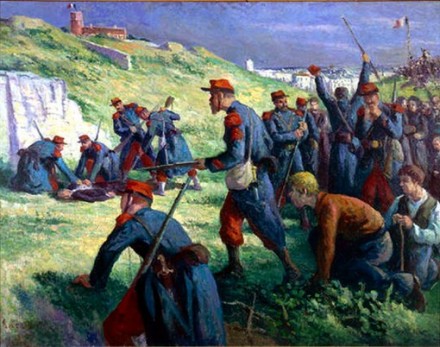

L’execution de Varlin, another Maximilien Luce scene.

Many at the stock exchange

According to the Paris Francais as quoted by this Marxist review of the events

It is at the Bourse that there was to-day the largest number of executions. The doomed men who attempted to resist were bound to the iron railing.

The stock exchange is “a fit place, to be sure, for this sort of business,” observes our interlocutor.

Eighty-plus defenders of Belleville, at the Arc de Triomphe

The London Times editorialized on May 31 upon this incident when the Marquis de Gallifet plucked from the mass of Belleville’s May 28 captives “eighty prisoners, principally soldiers of every arm, linesmen, artillerymen, and Zouaves, [who] were set apart and afterwards led to the right of the rampart to be shot.”

The French are filling up the darkest page in the book of their own or the world’s history. The charge of ruthless cruelty is no longer limited to one party or to one class of persons. The Versailles troops seem inclined to outdo the Communists in their lavishness of human blood. The Marquis de Gallifet is escorting a column of prisoners to Versailles or Satory. He “picks out eighty-two of them, and shoots them at the Arc de Triomphe.” Next came a lot of 20 firemen, then a dozen women, one aged 70. On another spot our Correspondent came upon “80 corpses, piled upon each other, a mass of arms and legs and distorted faces, while the roads and gutter literally flowed with blood.” About 1,000 are said to have thus suffered. By this wholesale and summary execution of prisoners in batches of 50 and 100, not only must the innocent perish with the guilty, but many must bear the penalty of imaginary guilt.

An utterly disconnected Englishman, according to the paper’s correspondent, was accidentally among the four score at the Arc, and only saved by the fortuitous intervention of a Belgian attache.

an English officer somehow got mixed up in the procession, and was forced to keep in it by the escort, who, out of 5,000 prisoners, could not, of course, be expected to recognize one innocent man … it so happened that some of the prisoners tried to escape, and to make an example the leader of the cavalry escort, the Marquis de Gallifet, a man who is not prone to err on the side of mercy, had then and there 81 shot, and the English officer was all but one of them, his explanations being at first refused the slightest attention. Human life has, in fact, become so cheap that a man is shot more readily than a dog.

Socialist physician Tony Moilin

One single fact was Tony Moilin reproached with: that of having on the 18th March taken possession of the mairie of his arrondissement, and having thus had a share in giving the signal for the insurrection …

The court-martial condescended to tell him that the fact of the mairie, the only one he could be reproached with, had in itself not much importance, and did not merit death, but that he was one of the chiefs of the Socialist party, dangerous through his talents, his character, and his influence over the masses; one of those men, in short, of whom a prudent and wise Government must rid itself when it finds a legitimate occasion to do so …

[A] respite of twelve hours was granted him in order that he might make his testament, write a few words of farewell to his father, and finally [marry his pregnant lover] … on the 28th May, in the morning, Tony Moilin was led into the garden a few steps from the palace and shot. His body, which his widow claimed, the surrender of which had been at first promised, was refused her. (History of the Commune of 1871)

The unnumbered dead of Lobau Barracks

Since morning a strong cordon is being formed round the theatre (Châtelet); where a court-martial is permanently established. From time to time one sees a band of fifteen to twenty individuals coming out, composed of National Guards, civilians, women and children fifteen to sixteen years old.

These individuals are condemned to death. They march two by two, escorted by a platoon of chasseurs, who lead and bring up the rear. This cortege goes up the Quai de Gevres and enters the Republican Barracks in the Place Lobau. A minute after one hears from within the fire of platoons and successive musketry discharges; it is the sentence of the court-martial which has just been executed.

The detachment of chasseurs returns to the Chatelet to fetch other prisoners. The crowd seems deeply impressed on hearing the noise of the shootings.

This is another publication’s story cited in the History of the Commune of 1871, which itself also details the court-martial procedures of this drumhead tribunal:

Thousands of prisoners who were led there were first of all penned in upon the stage and in the auditorium, under the guns of the soldiers placed in the boxes; then, little by little, like sheep driven to the door of the slaughter-house, from wing to wing they were pushed to the saloon, where, round a large table, officers of the army and the honest National Guard were seated, their sabres between their legs, cigars in their mouths. The examination lasted a quarter of a minute. ‘Did you take arms? Did you serve the Commune? Show your hands.’ If the resolute attitude of a prisoner betrayed a combatant, if his face was unpleasant, without asking for his name, his profession, without entering any note upon any register, he was classed. ‘You?’ was said to the next one, and so on to the end of the file, without excepting the women, children, and old men. When by a caprice a prisoner was spared, he was said to be ordinary, and reserved for Versailles. No one was liberated.

The classed ones were at once delivered to the executioners, who led them into the nearest garden or court. From the Châtelet, for instance, they were taken to the Lebau Barracks. There the doors were no sooner closed than the gendarmes fired, without even grouping their victims before a platoon. Some, only wounded, ran along by the walls, the gendarmes chasing and shooting at them till they fell dead. … There were so many victims, that the soldiers, tired out, were obliged to rest their guns actually against the sufferers. The wall of the terrace was covered with brains; the executioners waded through pools of blood.


Summary executions — death squads — continued for days or weeks afterwards in Paris; martial law throttled left organizing in the city; and those “fortunate” enough to have been captured alive were processed in a steady stream of judicial executions over the months yet to come.

The Commune, a palpably subversive example even in the present day, was destroyed in every way possible for the Versailles government. But its example could hardly be forgotten.

Marx would write The Civil War in France of the only proletarian revolution he would actually witness in his lifetime.

The next generation’s subversives also took inspiration from the Parisian example … and lessons from its mistakes. Lenin — a fond student of the Commune, who was eventually buried wrapped in a Communard banner — said that

two mistakes destroyed the fruits of the splendid victory. The proletariat stopped half-way: instead of setting about “expropriating the expropriators”, it allowed itself to be led astray by dreams of establishing a higher justice in the country united by a common national task; such institutions as the banks, for example, were not taken over … The second mistake was excessive magnanimity on the part of the proletariat: instead of destroying its enemies it sought to exert moral influence on them; it underestimated the significance of direct military operations in civil war, and instead of launching a resolute offensive against Versailles that would have crowned its victory in Paris, it tarried and gave the Versailles government time to gather the dark forces and prepare for the blood-soaked week of May.

“The lesson learnt by the proletariat will not be forgotten,” Lenin vowed, and his own revolution gained a vital object lesson in the Bloody Week of Paris, and an anthem besides: Communard Eugene Pottier, fleeing the Versailles army’s slaughter, wrote the verses that have been sung ever since by millions dreaming of a better world — the Internationale.

* Water can accelerate a fire, under the right circumstances.

On this day..

1525: Thomas Müntzer, prophet of the Peasants’ War

On this date in 1525, radical religious reformer and Peasants’ War leader Thomas Müntzer lost his head in the town of Mühlhausen.

Müntzer, a university-educated theologian, caught the whiff of Lutheranism in the Zeitgeist; following Luther’s call to study the Biblical text directly without the intervention of the doctors of Rome, Müntzer swiftly discerned a heavenly admonition to set to rights the many wrongs of an unjust world.

Luther had not had in mind dispossessing the haves, particularly not when imperial electors defended him from the Pope’s inquisitors.

When in 1517 opposition against the dogmas and the organisation of the Catholic church was first raised by Luther, it still had no definite character. Not exceeding the demands of the earlier middle-class heresy, it did not exclude any trend of opinion which went further. It could not do so because the first moment of the struggle demanded that all opposing elements be united, … Luther’s sturdy peasant nature asserted itself in the stormiest fashion in the first period of his activities. “If the raging madness [of the Roman churchmen] were to continue, it seems to me no better counsel and remedy could be found against it than that kings and princes apply force, arm themselves, attack those evil people who have poisoned the entire world, and once and for all make an end to this game, with arms, not with words. If thieves are being punished with swords, murderers with ropes, and heretics with fire, why do we not seize, with arms in hand, all those evil teachers of perdition, those popes, bishops, cardinals, and the entire crew of Roman Sodom? Why do we not wash our hands in their blood?”

This revolutionary ardour did not last long. The lightning thrust by Luther caused a conflagration. A movement started among the entire German people. In his appeals against the clergy, in his preaching of Christian freedom, peasants and plebeians perceived the signal for insurrection. Likewise, the moderate middle-class and a large section of the lower nobility joined him, and even princes were drawn into the torrent. While the former believed the day had come in which to wreak vengeance upon all their oppressors, the latter only wished to break the power of the clergy, the dependence upon Rome, the Catholic hierarchy, and to enrich themselves through the confiscation of church property. The parties became separated from each other, and each found a different spokesman. Luther had to choose between the two. Luther, the protégé of the Elector of Saxony, the respected professor of Wittenberg who had become powerful and famous overnight, the great man who was surrounded by a coterie of servile creatures and flatterers, did not hesitate a moment. He dropped the popular elements of the movement, and joined the train of the middle-class, the nobility and the princes. Appeals to war of extermination against Rome were heard no more. Luther was now preaching peaceful progress and passive resistance.

Muntzer became adopted into the Marxist pantheon sufficiently to grace East Germany’s five-mark bill.

That’s Engels in The Peasant War in Germany, revisiting the theological conflicts at the birth of the Protestant Reformation from the perspective of 19th century Marxism.

Projecting backwards, Engels saw in Müntzer a distant forerunner of their own day’s class conflicts — the man whose language was Biblical and apocalyptic but whose subject matter was the peasantry’s demand for material justice.

[Luther] says in his booklet on commerce that the princes should make common cause with thieves and robbers. But in this same writing he is silent about the source of all theft … Behold, the basic source of usury, theft, and robbery is our lords and princes, who take all creatures for their private property. The fish in the water, the birds in the air, the animals of the arth must all be their property, Isaiah 5[:8]. And then they let God’s commandment go forth among the poor and they say, “God has commanded, ‘Thou shalt not steal’.” But this commandment does not apply to them since they oppress all men — the poor peasant, the artisan, and all who live are flayed and sheared, Micah 3[:2f]. But, as soon as anyone steals the smallest thing, he must hang. And to this Doctor Liar says, “Amen.” The lords themselves are responsible for making the poor people their enemy. They do not want to remove the cause of insurrection, so how, in the long run, can things improve? I say this openly, so Luther asserts I must be rebellious. So be it!*

In this detail view of East German artist Werner Tübke’s weird panorama of the Battle of Frankenhausen, a crestfallen Müntzer realizes divine aid is not forthcoming.

Müntzer embraced the cause of a massive peasant revolt in central Europe in 1524-25. Luther said God wanted them “knocked to pieces, strangled and stabbed, secretly and openly, by everybody who can do it, just as one must kill a mad dog!”

So it was with Müntzer, who was captured in the decisive Battle of Frankenhausen, tortured into recanting his heretical doctrines,** and beheaded.

Whether one thinks of politics leading Müntzer’s theology or theology leading his politics† or some sort of dialectic between them, we see Müntzer latterly through a glass darkly — the wasted root of a lost Reformation.

* From a 1524 pamphlet vituperatively entitled “Highly provoked defense and answer to the spiritless, soft-living flesh at Wittenberg, who has most lamentably befouled pitiable Christianity in a perverted way by his theft of holy Scripture,” reprinted in Revelation and Revolution.

** Müntzer’s theology included rejection of infant baptism, which ranks him as an early anabaptist.

† “I have done nothing but say that a Christian should not so wretchedly sacrifice someone else on the butcher’s table. And if the political bigwigs do not cease to do so, the government should be taken from them. Whenever I have seriously proclaimed this to Christendom, it either refused to act or was too scared to do so. What more shall I do? Should I perhaps be silent, like a dumb dog? Why should I then make a living off the altar?”

On this day..

1948: Witold Pilecki, Auschwitz infiltrator

On this date in 1948, Polish resistance hero Witold Pilecki was shot by Poland’s Communist government for a variety of subversions.


Witold Pilecki as an officer (top), imprisoned in Auschwitz (middle), and at his fatal trial (bottom).

A former cavalry officer turned Home Army figure,* Pilecki authored one of the Great War’s most daring (and oddly obscure) covert escapades. In 1940, he volunteered to infiltrate Auschwitz — whose operations were then largely opaque to the Polish resistance — and allowed himself to be rounded up by the Gestapo.

Pilecki spent 31 months in the notorious concentration camp, organizing an inmate resistance network and shipping intelligence about the camp’s operations to the Polish resistance and (through them) the western Allies.

Though his pleas for a raid to liberate Auschwitz were in vain, Pilecki’s report catalogued the today-familiar horrors of the camp.

One bit, as it turned out, was a bit of foreshadowing.

The fourth and most heavy kind of punishment was an execution by shooting: death effected quickly, how much more humane and desired by those undergoing torture. “Execution” is not the right term; the right one would be “shooting dead,” or just “killing.” … The butcher Palitsch** — a handsome boy, who did not used to beat anybody in the camp, as it was not his style, was the main author of macabre scenes in the courtyard. Those doomed stood naked in a row against the Black Wall, and he put a small calibre rifle under the skull in the back of their heads, and put an end to their lives.†

Pilecki escaped Auschwitz in 1943, rejoined the Home Army, and had the good fortune to wind up in Italy at war’s end.

Instead of retiring to write his memoirs, he slipped back into Poland to spy on the postwar Communist government … but the man who had lived through Nazi internment couldn’t pull the same trick on the reds, who were in the process of rooting out anti-Communist resistance elements.

Polish Prime Minister (and fellow Auschwitz survivor) Jozef Cyrankiewicz provided testimony against Pilecki in his show trial (Polish link) on espionage and arms charges.

Pilecki was executed May 25, 1948, at Warsaw’s Mokotow Prison just as he had seen so many killed at the Black Wall — with a single shot to the back of the head.

Pilecki was posthumously rehabilitated by the post-Cold War Polish government, and honored with the country’s highest decoration

* Pilecki co-founded an early resistance organization, the Secret Polish Army (Tajna Armia Polska, or TAP), subsequently absorbed by the Home Army.

** Gerhard Palitsch — or Palitzsch — was a notorious SS roll-call man thought to have personally executed some 20,000 people in the manner described by Pilecki.


An illustration of Gerhard Palitsch executing prisoners at the Black Wall, by Polish inmate Jan Komski

Disliked by camp commandant Rudolph Hoess, Palitsch’s proclivity for taking inmate mistresses eventually got him busted for race defilement, whereupon he himself landed in the camp’s confinement, obliged to “[beg] inmates who used to tremble before him for bread.” (People In Auschwitz)

He was not for the ovens or the Nuremberg trials, however, and instead found himself mustered to the eastern front, eventually dying in action against the Red Army in Hungary. This page (in Polish) assembles various inmate recollections of Gerhard Palitsch.

† As the translation in the cited source is a tad uneven, I’ve taken the liberty of cleaning it up a bit.

On this day..

1980: Kim Jaegyu, intelligence chief

On this date in 1980, the former intelligence chief of South Korea was hanged for assassinating President Park Chung-hee.*

In this surreal affair — known after its date as the “10.26 incident” in South Korea — the head of the Korean Central Intelligence Agency popped the autocratic head of state during a private dinner party at a secret KCIA compound.

He then returned to another dinner party at the compound and, without disclosing what he had done, reported an “accident” and started dropping suggestions to a general that this might be an opportune moment to arrange martial law. Instead, the two repaired to a bunker. There, several hours’ confused wind-gauging by a hastily assembled cross-section of the country’s power brokers (not knowing their own chief spook had pulled the trigger) gave illustration to the Ovid maxim that “treason doth never prosper: what’s the reason? If it prosper, none dare call it treason.”

Only two participants, Kim Chae Kyu and Kim Kye Won, had witnessed the assassination, and neither disclosed the killer … Without an explanation from these two, the others present were left to speculate whether the killings were truly accidental, organized by North Koreans, or perpetrated as part of a South Korean conspiracy, large or small. They could not rule out the possibility that some among them … were part of a plot. Without knowing the balance of power, both civilian ministers and military officers worried about making a wrong move … (Source)

The truth, eventually, would out. But the reason for this shocking internecine turn by a supposed confidante of the president? The murder was too well-planned to square with initial reports of an argument gone out of control. It seems a coup, but if so, our assassin disastrously — almost delusionally — miscalculated the post-Park lay of the land. Maybe we have to entertain the defendant’s own far-out claim to have struck against the authoritarian concentration of presidential power.

I shot the heart of Yusin Constitution like a beast. I did that for democracy of this country. Nothing more nothing less.

The controversial 2005 flick The President’s Last Bang offers a darkly comic look at the twisted mise en scene in the intelligence compound that fateful 10.26 … and doesn’t find a lot of participants worth admiring.

Whatever its cause, South Korea’s unanticipated transition was a wobbly one. Even as the spymaster who had set it in motion was hanged this date with some of his conspiring security men, successor dictator Chun Dwoo-hwan was crushing a student uprising in Gwangju.**

* Park had survived previous assassination attempts, often authored by North Korea — including one that slew his wife in 1974.

** This uprising resulted in a death sentence against future South Korean president Kim Dae-jung — obviously not carried out. Under Kim’s administration years later, Chun was himself condemned to die for the massacre; Kim returned the gesture of clemency.

On this day..

1946: Karl Hermann Frank

On this date in 1946, the Sudeten German whose fifth column had paved the way for the Nazi conquest of Czechoslovakia expiated his war crimes at Prague’s Pankrac Prison.

Karl Hermann Frank (English Wikipedia page | German) had been a prewar mover and shaker in the Sudeten German Party, increasingly the Reich’s stalking-horse as it bluffed European rivals into acceding to Czechoslovakia’s dismemberment.

The onetime Czechoslovakian MP did well by the Anschluss, gaining the rank of Obergruppenführer and becoming one of Bohemia and Moravia’s top evildoers.

Notably, he helped orchestrate (though the orders for it came from above) the notorious massacre of Lidice in revenge for the assassination of Reich Protector Reinhard Heydrich.

The Lidice operation formed a war crimes charge against Herr Frank after the war, and Frank’s own lasting badge of infamy: the systematic destruction of the entire male population of an arbitrarily chosen village remains the emblematic crime of the Nazi occupation to this day.

(Source of the video)

Thousands of spectators came to see the former “Protector of Bohemia and Moravia” executed in Prague’s Pankrac Prison by the Austro-Hungarian “pole hanging” method, as depicted in the film above.

Those of Lidice’s widows who were able to come — and widows of some of the 30,000 other Czechs for whose executions Frank had been adjudged indirectly responsible — occupied the second row of seats. …

Not the slightest gleam of compassion could be seen in that long row of unforgiving eyes as Frank, garbed in a ragged Nazi Elite Guard uniform, walked quietly between two guards. …

As the noose was adjusted about his neck, Frank muttered: “Deutschland wird leben auch wenn wir nicht leben” (“Germany will live even if we do not live.”)

The spectators, admitted by special cards, watched quietly in the bright sunshine. (New York Times)

On this day..

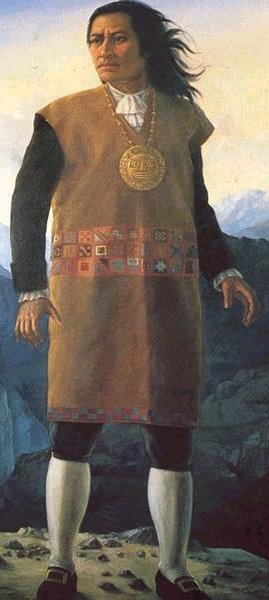
1781: Tupac Amaru II, Incan insurgent

On this date in 1781, the last name in Incan rebellion met a horrible end in the ancient Incan capital of Cusco.

José Gabriel Condorcanqui — rechristened Tupac Amaru II, as he was a distant descendant of the last Incan king — was a member of the privileged indigenous population depended upon by the Spanish to administer the forced and extorted labor that made its New World empire worth having.

Condorcanqui evidently had an epiphany.

In November 1780, he launched a well-planned rebellion by engineering the public execution of a hated corregidor Antonio de Arriaga at the hands of his own servant.

“From this day, no longer shall the Spanish feast on your poverty!”

This attention-grabbing entry onto the political chessboard was followed with an exemplary victory over Spanish forces. His revolt rapidly metastasized into an ethno-religious crusade, with all the accumulated bitterness of the Indians’ two-plus centuries maltreatment ferociously visited upon the Spanish.

It was a heady moment — but only a moment; within a few months, the Spanish had rallied and Tupac Amaru was betrayed into their hands.

The rebel had seized Incan symbology for his own purposes — speaking at ancient shrines, for instance — and the Spanish sentence against him included not only the inevitably horrific execution (of both Tupac Amaru and his wife and family) but a comprehensive and explicit programme of cultural annihilation to consign the Incan identity to the past. This lengthy sentence is well worth the read. (Sourced here, a pdf file; the bolded sections are my highlights.)

I must and do condemn José G. Túpac Amaru to be taken out to the main public square of [Cuzco], dragged out to the place of execution, where he shall witness the execution of the sentences imposed on his wife, Micaela Bastidas [Spanish link]; his two sons, Hipólito and Fernando Túpac Amaru; his uncle, Francisco Túpac Amaru; and his brother-in-law, Antonio Bastidas, as well as some of the principal captains and aides in his iniquitous and perverse intent or project, all of whom must die on the same day.

And once these sentences have been carried out, the executioner will cut out his tongue, and he will then be tied or bound by strong cords on each one of his arms and feet in such a way that each rope can be easily tied or fastened to others hanging from t he saddle straps of four horses, so that, in this position, each one of these horses, facing opposite corners of the square, will pull toward his own direction; and let the horses be urged or jolted into motion at the same time so that his body be divided into as many parts and then, once it is done, the parts should be carried to the hill or high ground known as “Picchu,” which is where he came to intimidate, lay siege to, and demand the surrender of this city; and let there be lit a fire which shall be prepared in advance and then let ashes be thrown into the air and a stone tablet placed there detailing his main crimes and manner of his death as the only record and statement of his loathsome action.

His head will be sent to the town of Tinta where, after being three days on the gallows, it shall be placed on a stake at the most public entrance to the town, one of his arms will go to the town of Tungasuca, where he was chief, where it will be treated in like manner, and the other in the capital of the province of Carabaya; one of the legs shall likewise be sent for the same kind of demonstration to the town of Libitaca in the province of Chumbilcas, while the remaining one shall go to Santa Rosa in the province of Lampa along with the affidavit and order to the respective chief magistrates, or territorial judges that this sentence be proclaimed publicly with the greatest solemnity as soon as it arrives in their hands, and on the same day every year thereafter; and they will give notice in writing of this to their superiors in government who are familiar with the said territories.

Since this traitor managed to arm himself and form an army and forces against the royal arms by making use of or seducing and leading with his falsehood the chiefs who are the second in command in the villages, since these villages, being of Indians, are not governed by such chiefs but rather by mayors who are elected annually by the vote or nomination of the chiefs: let these same electoral communities and the chief magistrates that care to give preference to candidates who know Spanish, and who are of the best behavior, reputation, and customs so that they will treat their subjects well and lovingly, honoring only those who have demonstrated honestly their inclination and faithfulness, eagerness, respect, obedience, submission, and gratitude to the greater glory of our great Monarch through the sacrificed of their lives, properties, or ranches in deference of their country or religion, receiving with brave disdain the threats and offers of the aforesaid reel leader and his military chiefs, yet taking care that these elected leaders are the only ones with the right to the title of chief or governor of their ayllus [communities] or towns, and that they cannot transmit their position to their children or other family members.

To this same end, it is prohibited that the Indians wear heathen clothes, especially those who belong to the nobility, since it only serves to symbolize those worn by their Inca ancestors, reminding them of memories which serve no other end than to increase their hatred toward the dominant nation; not to mention that their appear is ridiculous and very little in accordance with the purity of our relics, since they place in different parts images of the sun, which was their primary deity; and this prohibition is to be extended to all the provinces of this southern America, in order to completely eliminate such clothing, especially those items which represent the bestialities of their heathen kings through emblems such and the unco, which is a kind of vest; yacollas, which are very rich blankets or shawls of black velvet or taffeta; the macapaycha, which is a circle in the shape of a crown from which they hand a certain emblem of ancient nobility signified by a tuft or tassel of red-colored alpaca wool, as well as many other things of this kind and symbolism. All of this shall be proclaimed in writing in each province, that they dispose of or surrender to the magistrates whatever clothing of this kind exists in the province, as well as all the paintings or likenesses of their Incas which are extremely abundant in the houses of the Indians who consider themselves to be nobles and who use them to prove their claim or boast of their lineage.

These latter shall be erased without fail since they do not merit the dignity of being painted in such places, and with the same end in mind there shall also be erased, so that no sign remains, any portraits that might be found on walls or other solid objects; in churches, monasteries, hospitals, holy places or private homes, such duties fall under the jurisdiction of the reverend archbishops or bishops of both viceroyalties in those areas pertaining to the churches; and in their place it would be best to replace such adornments with images of the King and our other Catholic sovereigns should that be necessary. Also, the ministers and chief magistrates should ensure that in no town of their respective provinces be performed plays or other public functions of the kind that the Indians are accustomed to put on to commemorate their former Incas; and having carried out the order, these ministers shall give a certified account to the secretaries of the respective governments. In like manner shall be prohibited and confiscated the trumpets or bugles that the Indians use for their ceremonies and which they call pututos, being seashells with a strange and mournful sound that celebrate the mourning and pitiful memorial they make for their antiquity; and there shall also be prohibited the custom of using or wearing black clothing as a sign of mourning, a custom that drags on in some provinces in memory of their deceased monarchs and also of the day or time of the conquest which they consider disastrous and we consider fortunate since it brought them into the company of the Catholic Church and the very loving and gentle domination of our Kings.

With the same goal it is absolutely forbidden that the Indians sign themselves as “Incas,” since it is a title that anyone can assume but which makes a lasting impression on those of their class; and it is ordered, as is required of all those who have genealogical trees or documents that prove in some way their descent, that they produce them or send them certified and without cost by mail to the respective secretaries of both viceroyalties so that the formalities may be observed by those persons responsible to their excellencies the viceroys, consulting His Majesty where necessary according to each case; and the chief magistrates are charged to oversee the fulfillment of such requirements, to seek out and discover anyone who does not observe them correctly, in order to have it done to collect the documents with the aim of sending them to the proper authorities after giving their owners a receipt.

And so that these Indians renounce the hatred that they have conceived against the Spaniards, and that they adhere to the dress which the laws indicate, adopting our Spanish customs and speaking Castilian [Spanish], we shall introduce more vigorously than we have done up to now the use of schools, imposing the most rigorous and fair penalties on those who do not attend once enough time has passed for them to have learned the language; the duties and responsibilities involved in this plan going to the very reverend ecclesiastical prelates so that, in the opposition between parishes and doctrinas, they take care that those candidates bring affidavits from the provincial judges as to the numbers of people who speak the Said Castilian in those provinces … it being left up to the sovereign discretion of His Majesty to reward and honor those towns whose inhabitants have rendered, under the present circumstances, their due loyalty and faithfulness.

Finally, the manufacture of cannons of all kinds shall be prohibited under the penalty that any noble found manufacturing such items will be sentenced to ten years of prison in one of the presidios in Africa and any commoner will receive two hundred lashes as well as the same penalty for the same time period; reserving for a future time a similar resolution with regards to the manufacture of powder. And since there cannons of almost every caliber in the many ore-crushing mills and timber yards in these provinces, they will be gathered up by the magistrates once of the pacification of this uprising has been completely terminated in order to give account of them to the respective captaincy general so that he may determine whatever use he deems proper for them. Thus have I visualized, ordered, and signed: this is my final judgment.

José Antonio de Areche.

Tupac Lives.

The Spanish campaign to eradicate his name and identity didn’t exactly have legs.

The savagery of the crackdown helped generate Incan support for the rebellions that would shake off Spanish authority in the generations to come. He entered the official iconography of the post-colonial state, and can be found on Peruvian currency.

The very name Tupac Amaru became pregnant with the spirit of resistance — both in Peru, where it was adopted by a 1990’s revolutionary movement, and abroad, where a New York City Black Panther activist (pdf) gave the name to a son: Tupac Amaru Shakur.

On this day..

1450: William de la Pole, Duke of Suffolk

Henry VI, Part 2 — Act IV, Scene 1

The Coast of Kent.

[Alarum. Fight at sea. Ordnance goes off. Enter a Captain, a Master, a Master’s Mate, WALTER WHITMORE, and others; with them SUFFOLK, and others, prisoners.]

SUFFOLK.
Obscure and lowly swain, King Henry‘s blood,
The honourable blood of Lancaster,1
Must not be shed by such a jaded groom.
Hast thou not kiss’d thy hand and held my stirrup?
Bare-headed plodded by my foot-cloth mule
And thought thee happy when I shook my head?
How often hast thou waited at my cup,
Fed from my trencher, kneel’d down at the board,
When I have feasted with Queen Margaret?2
Remember it and let it make thee crest-fallen,
Ay, and allay thus thy abortive pride,
How in our voiding lobby hast thou stood
And duly waited for my coming forth.
This hand of mine hath writ in thy behalf,
And therefore shall it charm thy riotous tongue.

WHITMORE.
Speak, captain, shall I stab the forlorn swain?

CAPTAIN.
First let my words stab him, as he hath me.

SUFFOLK.
Base slave, thy words are blunt and so art thou.

CAPTAIN.
Convey him hence, and on our long-boat’s side
Strike off his head.

SUFFOLK.
Thou dar’st not, for thy own.

CAPTAIN.
Yes, Pole!

SUFFOLK.
Pole!

CAPTAIN.
Pool! Sir Pool! lord!
Ay, kennel, puddle, sink, whose filth and dirt
Troubles the silver spring where England drinks.
Now will I dam up this thy yawning mouth
For swallowing the treasure of the realm;3
Thy lips that kiss’d the queen shall sweep the ground;
And thou that smil’dst at good Duke Humphrey‘s death4
Against the senseless winds shalt grin in vain,
Who in contempt shall hiss at thee again.
And wedded be thou to the hags of hell,
For daring to affy a mighty lord
Unto the daughter of a worthless king,
Having neither subject, wealth, nor diadem.
By devilish policy art thou grown great
And, like ambitious Sylla, overgorg’d
With gobbets of thy mother’s bleeding heart.
By thee Anjou and Maine were sold to France,
The false revolting Normans thorough thee
Disdain to call us lord, and Picardy
Hath slain their governors, surpris’d our forts,
And sent the ragged soldiers wounded home.5
The princely Warwick, and the Nevils all,
Whose dreadful swords were never drawn in vain,
As hating thee are rising up in arms;
And now the house of York, thrust from the crown
By shameful murther of a guiltless king6
And lofty proud encroaching tyranny,
Burns with revenging fire, whose hopeful colours
Advance our half-fac’d sun, striving to shine,
Under the which is writ ‘Invitis nubibus.’
The commons here in Kent are up in arms;7
And, to conclude, reproach and beggary
Is crept into the palace of our king,
And all by thee.–Away! convey him hence.

SUFFOLK.
O that I were a god, to shoot forth thunder
Upon these paltry, servile, abject drudges!
Small things make base men proud; this villain here,
Being captain of a pinnace, threatens more
Than Bargulus the strong Illyrian pirate.8—
Drones suck not eagles’ blood but rob bee-hives.
It is impossible that I should die
By such a lowly vassal as thyself.
Thy words move rage and not remorse in me.
I go of message from the queen to France;
I charge thee waft me safely cross the Channel.9

CAPTAIN.
Walter,–

WHITMORE.
Come, Suffolk, I must waft thee to thy death.

SUFFOLK.
Gelidus timor occupat artus; it is thee I fear.

WHITMORE.
Thou shalt have cause to fear before I leave thee.
What, are ye daunted now? now will ye stoop?

1 GENTLEMAN.
My gracious lord, entreat him, speak him fair.

SUFFOLK.
Suffolk’s imperial tongue is stern and rough,
Us’d to command, untaught to plead for favour.
Far be it we should honour such as these
With humble suit; no, rather let my head
Stoop to the block than these knees bow to any
Save to the God of heaven and to my king,
And sooner dance upon a bloody pole
Than stand uncover’d to the vulgar groom.
True nobility is exempt from fear;
More can I bear than you dare execute.

CAPTAIN.
Hale him away, and let him talk no more.

SUFFOLK.
Come, soldiers, show what cruelty ye can,
That this my death may never be forgot!
Great men oft die by vile bezonians:
A Roman sworder and banditto slave
Murther’d sweet Tully; Brutus’ bastard hand
Stabb’d Julius Caesar; savage islanders
Pompey the Great; and Suffolk dies by pirates.10

1 Shakespeare brackets Suffolk clearly into the political faction that would become the winning contestant in the War of the Roses and give rise to the Tudor dynasty that ruled England at the time of the play’s writing. Suffolk’s key ally, Somerset, was slain in 1455 at the first battle of the generation-long conflict.

2 Margaret of Anjou was wed to the feebleminded King Henry VI by William de la Pole’s offices. Shakespeare portrays Suffolk and Margaret as maybe a little too close. When Suffolk’s head is posthumously retrieved for her, she laments,

… who can cease to weep and look on this?
Here may his head lie on my throbbing breast;
But where’s the body that I should embrace?

3 William de la Pole had a serious popularity problem, on several scores (as we shall see). Endemic corruption that had dissipated the wealth of the crown during Henry VI’s reign was among the most explosive, and laid at his door because of his proximity to power (and because Suffolk had not failed to exploit the revenue opportunities afforded by his position).

4 Another grievance: Humphrey, Duke of Gloucester, the popular uncle to the king and onetime Lord Protector, had been arrested for treason at the Suffolk-Beaufort faction’s instigation in 1447. He died shortly thereafter, which naturally gave rise to suspicions of assassination.

5 Perhaps most damaging of all for Suffolk, England’s foothold in northern France from which it had maintained itself during the Hundred Years’ War preceding, had suddenly collapsed in the 1440s. Maine was handed directly over to Charles VII — the price, critics charged, of the king’s marriage to Anjou. Then an ill-advised offensive had invited a French counterattack that rousted the English from Normandy and brought furious domestic recriminations for the debacle.

Incidentally, as a younger man, this day’s victim had been one of the commanders besieging Orleans when Joan of Arc famously relieved the city. He was captured by the Maid shortly thereafter, and eventually ransomed.

6 Again, a clear identification of the the factions taking shape for the Wars of the Roses. Richard, Duke of York, the standard-bearer of (obviously) the Yorkist cause in the coming conflict, had been Suffolk’s main rival at court, and is a key suspect in engineering Suffolk’s death. The guiltless king referred to is Richard II, overthrown a half-century before by Henry Bolingbroke which gave rise to the competing claims of legitimacy that would color the York-Lancaster contest.

7 Weeks after Suffolk’s death, Jack Cade’s rebellion erupted in Kent, an infamous affair whose dubious connection to York was great fodder for Tudor propaganda like, well, Henry VI, Part 2. Be that as it may, the Bard placed one of his immortal lines in the mouth of one of Cade’s peasants:

The first thing we do, let’s kill all the lawyers.

8 This reference may be an anachronism. Pirates operating from Illyria — the uskoci (or uskoks) — plagued the Adriatic Sea in Shakespeare’s time.

9 As a royal minister, Suffolk was essentially immune from Parliament as long as the king backed him … unless he could be hit with a treason charge. Given his unpopularity, a great many mostly outlandish charges of treason were duly conjured early in 1450, and Suffolk had not the political support to repel them. Henry VI, still Suffolk’s supporter, exiled the noble to protect him from possible execution. He was intercepted as he left England for France, however, and what the House of Commons had wanted done by a bill of attainder was simply handled extrajudicially upon the seas instead.

10 The duke was beheaded (“within half a dozen strokes” of “a rusty sword”) upon one of the pirate vessel’s small boats.

On this day..

1649: John Poyer, the lucky winner

On this date* in 1649, John Poyer, late the mayor of Pembroke, was shot at London’s Covent Gardens for switching sides in the English Civil War.

John Pembroke had earned his Round head by taking Carew Castle from King Charles‘ forces in the First English Civil War.

But the silly hats in Parliament wanted much of the potentially dangerous army to demobilize, and do so without settling the small matter of its back pay. Poyer refused to hand over his command and Pembroke Castle to a Parliamentary agent, and sought a better deal from monarchists.**

Only with a painstaking siege was the imposing medieval fortress of Pembroke reduced. Poyer, his superior Rowland Laugharne, and Rice Powell were hauled to London and condemned to death.†

In an interesting twist, it was decided that one example would prove the point as well as three, and to allot the clemencies by chance. When the three refused to draw their own lots, a child was given the job instead, and distributed three slips of paper. Laugharne and Powell read “Life given by God.” Poyer’s was deathly blank.

Mark Twain latched onto the singular role of a child in this deadly lottery, and wrung it for every drop of pathos in a short story, “The Death Disk”.

Unlike the proposed victim of that story, Poyer did not benefit from any last-second Cromwellian pity. His death is related in the zippily titled “The Declaration and Speech of Colonell John Poyer Immediately Before his Execution in Covent-Garden neer Westminster, on Wednesday, being the 25 of this instant April, 1649. With the manner of his deportment, and his Proposals to the people of England.”‡

Having ended his speech, he went to prayers, and immediately rising up again, called the men designed for his execution to him, which were six in number, and giving them the sign when they should give fire, which was by holding up both his hands, they observed his motion, who after some few expressions to his friends about him, prepared an embracement for death, and casting his eyes to Heaven, with both hands lifted up, the Executioners (with their fire locks) did their Office, who at one voley bereav’d him of his life, his corps being taken up, was carryed away in a Coach, and the Souldiery remanded back again to White-Hall.

* A few sources say April 21, but the overwhelming majority concur on the 25th — as do the primary citations available in 17th-century comments on his death (e.g., “he was upon the 25 of this instant Aprill being Wednesday, guarded from White-Hall in a Coach, to the place of execution” in “The Declaration and speech of Colonell John Poyer before his execution…”)

** D.E. Kennedy observes that the divide between Parliament and Royalist was not so bright as might be imagined — and that Cromwell himself was at this time negotiating with the future Charles II as an expedient to get around Charles I.

† The rank and file of Welsh insubordination basically skated, a display of clemency from the Lord Protector that Ireland would not enjoy.

‡ The title promises much more scaffold drama than two and a half forgettable pages deliver — basically, that Poyer died (a) penitent; (b) Anglican; and (c) wishing for peace.

On this day..