This fraught situation ended much easier for the English crown than it might have, with a royal negotiating strategy of nominally accepting the Pilgrimage’s terms inducing the massive rebel force to disband, allowing its leaders to be seized thereafter on the first pretext of renewed trouble.
Robert Aske, the barrister who had come to the fore of the Pilgrimage movement and had personally negotiated terms with Henry, was among about 200 to suffer death for their part in the affair. In Aske’s case, it was against the will of Jane Seymour, Henry’s demure third queen and also a Catholic-inclined traditionalist; she made an uncharacteristic foray into state policy by ask(e)ing for Aske’s life, summarily vetoed by the king’s reminding her the fate of her politically-minded predecessor.*
Here’s Aske hanged at York Castle in The Tudors:
And here’s an inscription on a Yorkshire church reminding one of Aske’s surviving brothers of the events of those pivotal months.
* In other wives-of-the-king developments, Henry’s future (sixth, and final) wife Katherine Parr was taken a hostage by the rebels during the Pilgrimage.
Early this Monday morning in 1836, Louis Alibaud — having been condemned to death by the Chamber of Peers at trial the preceding Friday and Saturday — lost his head for taking a shot at oft–shot–at French King Louis-Philippe.
As related by the London Times (July 6, 1836),
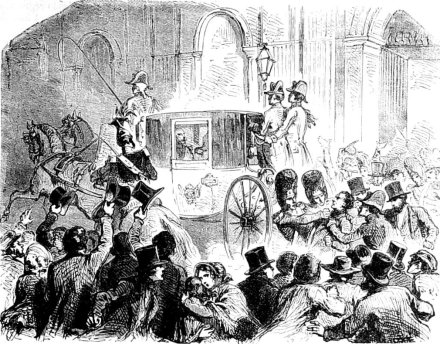
at half-past 6 in the afternoon of the 25th of June, 1836; the windows of the carriage were lowered, and it was passing through the gate [of the Tuileries palace] leading to the Pont Royale, when a man, who had been standing by a post in the court, raise [sic] a cane gun and discharged it against the King. By a miraculous chance the King was lowering his head to salute the National Guard under arms, and the ball passed just four lines above his head, and entered one of the angles of the carriage, settling about an inch deep in an oak beam.
The assassin was immediately arrested; he was a young man, of about 25 years of age, dressed in a dark coat, cloth pantaloons, and black hat, and wearing under his chin a thick brown beard.
Naturally, this line had neither the intent nor the effect of securing clemency, and he was repeatedly cautioned by the court against pursuing it; all concerned knew precisely where matters were headed, of course, and the state had no interest in providing a public forum for sedition.
On this date in 1187, Saladin dealt the Crusader Kingdom a crippling blow at the Battle of Hattin — and a fatal beheading to douchebag French knight RaymondRaynald of Chatillon after the fray.
Conduct so ill comporting with Saladin‘s reputation for chivalry had been earned by Raynald’s own bad behavior.
Crusaders with a view to realpolitik saw that the Kingdom of Jerusalem had to coexist with its Muslim neighbors. Raynald (or Reynald, or Renaud) just preferred killing them.
His raids against Saladin’s caravans when the Crusader state was supposed to be at peace with the Ayyubids precipitated the war that would claim his own head — and, within three months of this date, Jerusalem itself.
The Muslim commander vowed going in to slaughter the notoriously vicious Raynald if he captured him. Here he is making good the threat in the Ridley Scott epic Kingdom of Heaven:
According to the account (sourced to Wikipedia, such as it is) of Saladin house historian Imad ad-Din al-Isfahani, an eyewitness to the event,
Saladin invited the king [Guy] to sit beside him, and when Arnat [Raynald] entered in his turn, he seated him next to his king and reminded him of his misdeeds. “How many times have you sworn an oath and violated it? How many times have you signed agreements you have never respected?” Raynald answered through a translator: “Kings have always acted thus. I did nothing more.” During this time King Guy was gasping with thirst, his head dangling as though drunk, his face betraying great fright. Saladin spoke reassuring words to him, had cold water brought, and offered it to him. The king drank, then handed what remained to Raynald, who slaked his thirst in turn. The sultan then said to Guy: “You did not ask permission before giving him water. I am therefore not obliged to grant him mercy.” After pronouncing these words, the sultan smiled, mounted his horse, and rode off, leaving the captives in terror. He supervised the return of the troops, and then came back to his tent. He ordered Raynald brought there, then advanced before him, sword in hand, and struck him between the neck and the shoulder-blade. When Raynald fell, he cut off his head and dragged the body by its feet to the king, who began to tremble. Seeing him thus upset, Saladin said to him in a reassuring tone: “This man was killed only because of his maleficence and perfidy.”
The Egyptian classic El Naser Salah el Dine, whose composition and subject matter reflect its production at the acme of Nasser-led Pan-Arabism, noticeably soft-pedals this scene, with Raynald as an over-the-top boor who challenges his captor to a duel and is slain in a fair fight. (Skip to about 35:25 in the clip below to see it, but the whole thing is well worth the watching.)
On this date in 1574, Gabriel de Lorges was beheaded in Paris for treason.
Known by the time of his death as the Comte de Montgomery (English Wikipedia entry | French) — though the title was punitively stripped from the man and his heirs, causing him to spit at the scaffold, “tell my children, if they are not able to reclaim their position, I curse them from the grave” — Lorges’ treason was going Protestant and fighting for the Huguenots in the wars of religion ravaging France.
But his claim to fame, and indeed (if quite unjustly) one of the explicit charges laid against him, was a regicide that fueled those wars and helped bring down the Valois dynasty.
The ol’ lance-in-the-eye
The vigorous 40-year-old French king Henri II seemingly had the Valois in good shape and anti-Huguenot policy firmly in the saddle.
In 1559, though, the sporting monarch put his own butt in the saddle at a joust with our day’s principal, then a captain of Henri’s Scots Guards (and a Catholic).
Gabriel’s shattered lance somehow found a chink in the king’s visor and managed to tolchock the royal gulliver just beside the eye.* After a week and a half in agony, Henri succumbed to the injury.**
Henri’s sudden death was bad news for France, because the oldest† of his seven children was only 15 years old, and feeble. He died the next year.
As the widowed Italian queen Catherine de’ Medici struggled over the ensuing decades to find a stable Valois heir among her brood, the aggressively Catholic House of Guise‡ flexed its political muscle to the resentment of the Bourbons and the Huguenot lords, and pitched France towards civil war.
Our errant knight, meanwhile, although forgiven by the dying Henri II, had despairingly retired and hurled himself into study that soon converted him to the Protestant party.
Quickly distinguishing himself as perhaps the ablest Huguenot commander, Montgomery was in Paris in 1572 during an ostensible truce for interparty dynastic nuptials when the Catholic faction sprang the St. Bartholomew’s Day massacre.
Though Montgomery was a specific target for assassination that day, he somehow managed to escape. He gave the Catholics fits for the two years left him, enough that the crown tried to buy him off. (Like most Protestants, he was distrustfully defiant after the horrors of St. Bartholomew’s Day.)
He was finally overcome in 1574; as Henri’s second son had just kicked the bucket without an heir, Catherine assumed the regency while a third boy was fetched from Poland, and got herself some gratifying but untoward revenge on the inadvertent author of her family’s unfolding ruin.
No time was lost in condemning [Montgomery] to the penalties of high treason; he was beheaded at the Greve, his body quartered, and his family degraded from their nobility. Previous to his execution, he was cruelly tortured to make him confess the existence of the late admiral‘s conspiracy, but the pain drew no such acknowledgment from him, and mangled and wounded as he was, he went to the scaffold with remarkable serenity. We have an account, given by a contemporary, of his steady attachment to his principles: “He would not confess to the Archbishop of Narbonne, who went to him in the chapel to admonish him; nor would he take or kiss the crucifix, which is usually presented to those who are being led to execution; nor in any way attend to the priest, who had been placed in the cart by his side. A cordelier thinking to draw him out of error, began to speak to him, and said that he had been abused. Looking at him steadily, he answered, ‘How! abused? and if I have been it is by those of your order: for the first person who ever handed me a Bible in French, and made me read it, was a cordelier like you; and therein I have learned the religion which I hold, which alone is the true religion, and in which, having since lived, I wish now by the grace of God to die.'”
(Some sources place Montgomery’s execution on May 27, which I believe confuses his date of death with his date of capture.)
Just like Montgomery himself, the Huguenot cause proved resistant to every policy of Catherine or the Guises; this day’s execution only screwed up the nerve of a party that had been given notice on St. Bartholomew’s Day that their lot must be to conquer or die. Since Henri II’s boys could neither, over 30 years’ time, produce an heir nor master their foes at arms, the Huguenots conquered when the throne finally passed to a Bourbon.
A public-domain biography of Gabriel de Lorges, comte de Montgomery, can be enjoyed by French-speakers here. For the English-speakers, Alexandre Dumas’ fictionalized treatment, The Two Dianas, is freely available in translation.
* French surgeon Ambroise Pare attended the dying monarch. Pare’s grim description of the king’s injuries appears in this biography of the physician, which also reports that Henri’s caregivers
secured the heads of four criminals that had been beheaded and experimented upon them with a lance in order to ascertain the probable course of the splinters.
** The fatal joust is alleged to be one of the vindicated prophecies of Nostradamus. Prophecy or no, the family had bad luck with sports; Henri came in line for the throne when his older brother dropped dead after playing tennis.
† Henri II’s immediate heir Francis II was married to Mary, Queen of Scots. After the death of her husband, she unhappily shipped back out to Scotland to contest the English throne, with unsatisfactory results.
Hatano Hideharu, chief of the minor Hatano clan, got himself on the outs with powerful daimyoOda Nobunaga. Nobunaga’s samurai general Akechi Mitsuhide forced Hideharu’s capitulation, convincing him to lay down his arms by offering his own mother as a hostage.*
And here’s where the bodies start piling up.
Nobunaga overruled Mitsuhide’s promise of safe conduct and had Hatano Hideharu put to death.
Outraged, the Hatano clan retaliated by crucifying Akechi Mitsuhide’s mother.
Since Mitsuhide suffered the consequences for the bad behavior of his boss, this tit-for-tat left a bit of tension between the two. (The Hatano were done as a factor in Japanese politics, so having served to poison this relationship, our story takes its leave of them here.)
Perhaps as a result — there’s no single agreed-upon reason, but the personal vendetta has drawn the most commentary — Mitsuhide himself rebelled and forced Oba Nobunaga to commit seppuku.
It probably wasn’t exactly like this fanvid of Samurai Warriors 2 scenes.
Mitsuhide’s betrayal opened the door for another Nobunaga retainer, Toyotomi Hideyoshi, to in turn crush Mitsuhide,** and seize power for himself.
And maybe — with a stretch — they owe it all to Hatano Hideharu.
* The online sourcing on the death of Makiko, Akechi Mitsuhide’s mother, is a bit inconsistent; some suggest that the Hatano didn’t have her a hostage, but found a way to kidnap her for revenge.
** Mitsuhide’s daughter Hosokawa Gracia, became a legendary Christian convert after his death.
On this date in 1592, Roger Ashton was hanged, drawn and quartered at Tyburn.
Ashton is a minor martyr on the Catholic rolls, one of many in the age who (as Edmund Campion put it) were called by determinedly Protestant English crown to “enjoy your Tyburn.”
He was hanged, drawn, and quartered at Tyburn, 23 June, 1592. His indictment is not preserved. Challoner says it was for procuring a dispensation from Rome to marry his second cousin. Later evidence, while confirming this, shows that it was not the only cause.
In 1585 he had gone to serve in the under the Earl of Leicester against the Spaniards. Sir William Stanley having been placed on guard over the town of Deventer, which had revolted from the Spaniards, he, with the assistance of Ashton, gave the town back to Spain and went over to their side (29 January, 1587).*
Cardinal Allen published a “Defence” of this act** in the form of a letter addressed to one “R.A.”, whose letter to the Cardinal prefixed and under these initials it seems natural to recognize our martyr. Stanley next entrusted to Ashton the difficult task of bringing over his wife from Ireland, but she was already under arrest, and he is said to have been sent Ashton to Rome. At the close of the year 1587 he returned to England and was apprehended in Kent with the marriage dispensation already mentioned. In January, 1588, he was in the Tower, where he lay ill towards the close of the year, when he was transferred to easier confinement in the Marshalsea. From this he managed to escape and fled to his brothers in Lancashire.
He was seized later, at Shields near Newcastle, while trying to escape over the seas. Transferred thence to Durham and York, he was tried and sentenced at Canterbury, and died “very resolute”, making profession of his faith and “… pitied of the people”, though the infamous Topcliffe tried to stir up ill-feeling against him by enlarging on his services to Spain.
Executions at Tyburn in the time of Elizabeth. From Tyburn Tree.
* This event — an English commander betraying a city to the enemy during wartime (in fact, two English commanders, as Rowland York (or Yorke) handed the Spanish the fortress of Zutphen on the same day) — naturally raised a scandal in 1587.
Although this treacherous William Stanley is not to be confused with the contemporaneous fellow-noble of the same name who has a horse in the “who really wrote Shakespeare?” race, Lily Bess Campbell argues that the imprint of events in Deventer and the subsequent volley of pamphleteering informs a discourse of royal prerogative in the Bard’s Henry V, when the disguised monarch goes slumming with the common soldiery on the eve of the Battle of Agincourt.
BATES
… wee
know enough, if wee know wee are the Kings Subiects:
if his Cause be wrong, our obedience to the King wipes
the Cryme of it out of vs
WILLIAMS
But if the Cause be not good, the King himselfe
hath a heauie Reckoning to make, when all those
Legges, and Armes, and Heads, chopt off in a Battaile,
shall ioyne together at the latter day, and cry all, Wee dyed
at such a place, some swearing, some crying for a Surgean;
some vpon their Wiues, left poore behind them;
some vpon the Debts they owe, some vpon their Children
rawly left: I am afear’d, there are few dye well, that dye
in a Battaile: for how can they charitably dispose of any
thing, when Blood is their argument? Now, if these men
doe not dye well, it will be a black matter for the King,
that led them to it; who to disobey, were against all proportion
of subiection
Henry replies that soldiers should look after their conscience on their own time and obey the prince of the realm in wartime. No doubt Queen Elizabeth approved.
if they dye vnprouided, no more
is the King guiltie of their damnation, then hee was before
guiltie of those Impieties, for the which they are
now visited. Euery Subiects Dutie is the Kings, but
euery Subiects Soule is his owne.
(As long as we’re digressing with Shakespeare and anti-Stratfordian candidates, here’s an argument that the jittery national mood post-Deventer and pre-routing the Spanish Armada — the time when Mary, Queen of Scots lost her head — makes a case for dating the Henry plays to that period, which in turn makes a case for Edward de Vere as their true author. Make of that what you will.)
** The obedience due a sovereign as opposed to the obedience due to an abstract standard of Right is a lasting modern question, so it’s no surprise that Cardinal Allen’s justification has a modern ring.
For that to revolt, is of itselfe, lawful or unlawful, honorable or otherwise, according to the justice, or injustice of the cause, or difference of the person, from or to whom the revolt is made … Whensoever thou art armed, & in readinesse for battayle, let this be thy first cogitation, that thy very corporal streingth itselfe, is the gift of God: whereby thou shalt stil be put in minde, never to use the gift of God, against God him selfe, that gave it thee.
Presumably he wouldn’t have supported the “only following orders” defense.
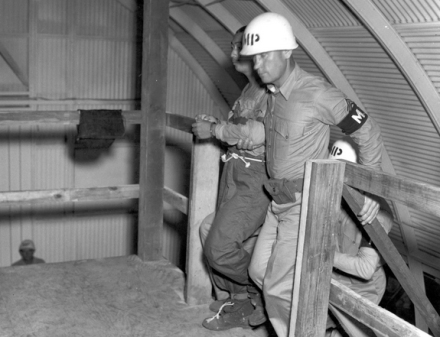
An unidentified Japanese prisoner ascends the gallows on Guam.
The most lastingly notable of the six was Rear Admiral Shigematsu Sakaibara, who was hanged for ordering (and perhaps in one instance, personally conducting) an infamous mass execution on Wake Island that has already appeared in these pages.
For some, the hanging of one of these six men had been a horrible tragedy and perhaps even a mistake. Rear Adm. Shigematsu Sakaibara had enjoyed the reputation of “gentleman soldier” and protector of the common man. Hailing from a wealthy family near Misawa in Tohokhu province, some 450 miles north of Tokyo, Sakaibara never forgot his roots. Forever poking fun at the fast-paced Tokyo lifestyle, the rear admiral touted the value of rural living, the integrity and honesty of those who lived in Japan’s rugged north country, and Tokyo’s need to recognize their great contributions to the war effort. Contemplating a postwar political future, he would be following in the footsteps of his politically influential family in northern Japan. That future was linked to championing the rights of returning veterans and other have-nots. Misawa had indeed had a heroic reputation as an important navy town and base for years. Sakaibara had assisted in the training exercises held there for the Pearl Harbor attack plan in late 1941. His future seemed golden no matter who won the war. But what some in his command called “The 1943 Incident” changed all that.
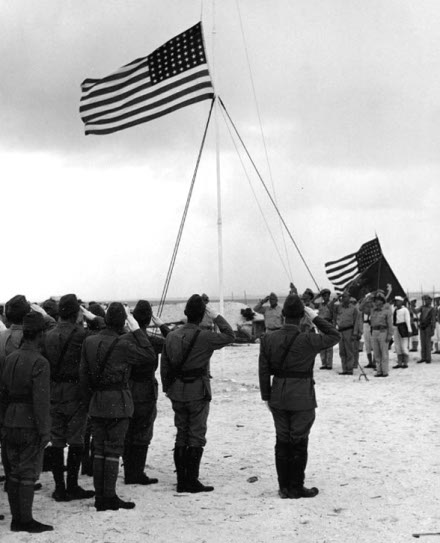
Shigematsu Sakaibara (right foreground) surrendering Wake Island on September 4, 1945.
These events, Sakaibara admitted in his trial, had taken place in an atmosphere of near starvation and impending doom. The defense counsel especially emphasized that point, asking the commission to understand and respect the pressures and strains on Sakaibara at the time of the incident. But the commission was not in a forgiving mood. In the chaos of retreat or not, innocent civilians had been murdered.
… Unfortunately for Sakaibara, several members of his former command expressed surprise on the witness stand when asked about the desperate situation on Wake in 1943. These men insisted that Sakaibara and his defense team’s description of a starving, chaotic Wake was an exaggerated one. There had been no unexpected miseries, confusion, or sense of peril, they said. Sakaibara’s fate was sealed.
True to form, defendant Sakaibara offered a very literate final statement to the commission. In contrast to so many of his colleagues on trial in Tokyo, on Guam, or elsewhere, Sakaibara, albeit with carefully picked words, admitted he was guilty of rash and unfortunate actions. He appeared especially convincing when he noted that he wished he had never heard of Wake Island. But his most memorable comments involved his own view of morality in war. A nation that drops atom bombs on major cities, the rear admiral explained, did not have the moral authority to try so many of his countrymen. With Hiroshima and Nagasaki in mind, Sakaibara claimed there was little difference between himself and the victors over Japan. With that statement a legend grew, particularly in his home town, of Sakaibara, the victim of American revenge.
… As late as the 1990s, some people there, not necessarily of the World War II generation, still bowed in reverence to Sakaibara family members out of respect for the “sacrificed” gentleman soldier.
His last words:
I think my trial was entirely unfair and the proceeding unfair, and the sentence too harsh, but I obey with pleasure.
* Some sources places the executions on June 19; the U.P. wire story, dated June 19th, referred to the hangings occurring “last night,” and the preponderance of evidence I have been able to locate appears to me to support the 18th rather than the 19th.
** An interesting bit of interservice-rivalry color on proceedings in Guam, courtesy of Prisoners of the Japanese:
The United States Navy had hanged fewer than a handful of men in more than a hundred years … Now on Guam they had all kinds of Japanese to try and sentence to death … They had to requisition an Army executioner to show them how to hang. He was a lieutenant with silver-rimmed glasses, a leading-man moustache, and a paunch. He used the traditional British drop formula, but he was an innovator as well: He invented a method of lowering the dead body to the stretcher without having to cut the rope.
On this date in 1944, the Gestapo shot French historian Marc Bloch among a batch of Resistance members.
When war broke out between France and Germany in 1939, the 52-year-old professor spurned advice to get out of the country. Driven by his love of France, he resigned his post at the Sorbonne to join the reserves.
I was born in France, I have drunk the waters of her culture. I have made her past my own. I breathe freely only in her climate, and I have done my best, with others, to defend her interests.
(Bloch had won the Legion of Honor for his brilliance and bravery in World War I, “always ready to March and give example.”)
High-profile intellectuals of Resistance proclivities and Jewish extraction, needless to say, had a problem in those terrible years.
The remarkable Bloch almost made it through the whole of the war in the French Resistance, but was arrested a few weeks before the Allied landing at Normandy, tortured, and shot. Comrades in arms remembered his death as an unusually sobering loss.
We couldn’t, no we couldn’t bear that image: Marc Bloch, our “Narbonne” of clandestine life, turned over to the Nazi beasts; this perfect exemplar of French dignity, of exquisite and profound humanism, this spirit become a prey of flesh in the vilest hands. We were there, a few of us, in Lyons, his friends, his comrades in the clandestine struggle, when we learned of the arrest, when we were immediately told that, “They tortured him.” A detainee had seen him in the offices of the Gestapo, bleeding from the mouth (that bloody trail in the place of the last malicious smile he had left me with on a street corner before being caught up in the horror). I remember: at those words, “He was bleeding,” we broke out in tears of rage. The most hardened lowered their heads despondently, as we do when things are just too unfair.
For months we waited, hoped. Deported? Still in Montluc? Transferred to another city? We didn’t know anything until the recent day when we were told, “There’s no more hope. He was executed at Trévoux on June 16, 1944. His clothes and papers were recognized.” They killed him, alongside a few others who he inspired with his courage.
For we know how he died. A kid of sixteen trembled not far from him. “This is going to hurt.” Marc Bloch affectionately took his hand and simply said, “No, my boy, it doesn’t hurt,” and fell first, crying out: “Vive La France!”
Marc Bloch, commemorated at this French site, bequeathed 20th century scholarship one of its great intellectual legacies. His The Historian’s Craft,* a composition halted short of completion by the Nazi firing squad, was posthumously published and remains one of the classic texts of historiography; the journal he co-founded in 1929 gave its name to a whole school of thought in the field. (Bloch’s own name also adorned a school in a more literal sense, the Marc Bloch University, now subsumed by the University of Strasbourg.)
Works By and About Marc Bloch
* The blog To The Roots is in the midst of a series of posts exploring The Historian’s Craft.
On this date (by the Julian calendar then in use) in 1389, Stefan Lazar Hrebeljanovic — that’s Tsar Lazar to you — led the armies of Moravian Serbia against the expanding Ottoman Empire at the Battle of Kosovo.
The Serbs were defeated — thereby plunging, in the national mythology, into a half-millennium of Turkish domination. Lazar was supposedly* captured and beheaded.
For a generation, Lazar had firmed up his authority as the most significant Serbian autocrat outside the Ottoman orbit. The gravity of that orbit, however, grew more powerful with each passing year; soon, it would devour Byzantium.
Here in the 14th century, the Turkish expansion took on vassals in southeastern Europe. For a prince in the marches, a reckoning had to come due.
Of course, some Serbian lords and other Christian rulers were prepared to owe fealty to the Turks.
In the national epic poem The Battle of Kosovo, our day’s hero receives divine visitation charging him to choose between the treasures of earth and those of eternity, perhaps the author’s critique of European nobles who joined the infidel.
‘Lazar! Lazar! Tsar of noble family,
Which kingdom is it that you long for most?
Will you choose a heavenly crown today?
Or will you choose an earthly crown?
If you choose the earth then saddle horses,
Tighten girths- have your knights put on
Their swords and make a dawn attack against
The Turks: your enemy will be destroyed.
But if you choose the skies then build a church-
O, not of stone but out of silk and velvet-
Gather up your forces take the bread and wine,
For all shall perish, perish utterly,
And you, O Tsar, shall perish with them.”
This particular battle grew into one of mythic importance in the national memory of Serbia: the sacred apogee of national honor, even the bulwark of Christendom upon which the Islamic wave broke.**
Its site, “Kosovo Polje” or the “Field of Blackbirds” near Pristina, is a monument to the Serbian and Orthodox cause; that it is located, as its name suggests, in the province forcibly detached from Belgrade by NATO during the Kosovo War makes it a politically touchy bit of topography. Nationalist outfits like the Tsar Lazar Guard are violently displeased with Albanians having say-so about the place.
Not surprisingly, the record of the time suggests less a Balkan Thermopylae than that old historical standby — shifting relationships of collaboration, resistance, and negotiated boundaries amid Ottoman advances and (sometimes) reverses.
Lazar’s own son and heir Stefan Lazarevic became an Ottoman ally; when the Ottomans were themselves invaded, he shifted his alliance to a different regional power, Hungary. His successor, Durad Brankovic, became estranged from that alliance and eventually fought against the Hungarians in the Second Battle of Kosovo … as an Ottoman vassal.†
Be that as it may, St. Vitus’ Day — Vidovdan in Serbo-Croatian — which is now observed on its Gregorian calendar date of June 28th, remains one of the most sacred days on the Serbian calendar (it’s also the feast day of Lazar, a saint in the Orthodox tradition).
Vidovdan obtained another layer of meaning in 1914, for it was June 28 that Yugoslav nationalists then under the heel of a Christian empire assassinated Austro-Hungarian Archduke Ferdinand and ignited the First World War.
* It’s the predominant version of legend but not a settled historical fact that Lazar was actually beheaded as a prisoner. He may have simply died in battle, or of wounds taken sustained in the fight.
Last year on this date, India’s Maoist “Naxalites”publicly beheaded a former comrade who had surrendered and collaborated with police.
Naxalites.
The incident that occurred in village Murgaon of Dhanora sub district has the entire Maoist-affected region in the grip of tension because of the manner in which the reprisal has been carried out.
A group of 40 to 50 Maoists went to the village Saturday night, called out Anandrao Sainu Koram from his house, tied him to a tree and beheaded him in full view of the villagers who had gathered at the spot, deputy superintendent of police Anant Rokde said Sunday.
“They also warned Anandrao’s colleague Shantaram Gawde, who too had surrendered to the police in April this year along with three others, that he would meet the same fate if he did not desist from acting as an informer,” Rokde told IANS on the basis of the complaint lodged by Anandrao’s wife.


 Known by the time of his death as the Comte de Montgomery (
 When war broke out between France and Germany in 1939,

