1851: Narciso Lopez, filibuster

On this date in 1851, Venezuelan-born adventurer Narciso Lopez was garroted in Havana for his repeated expeditions to overturn Spanish dominion in Cuba.

Narciso Lopez had fought for the Spanish against Simon Bolivar, and migrated to Cuba when Bolivar carried the day.

Initially a loyal government functionary, Lopez gradually became sweet on the anti-Spanish cause, and fled Cuba for the United States (pursued by a death sentence in absentia) when a treasonable conspiracy of his was discovered.

Like MacArthur, he meant to return — and did.

Lopez crisscrossed the United States, drumming up support for filibustering raids on Cuba meant to detach it from Spain and make it an American slave state.

In this proposed enterprise, wedded alike to both national expansionism and southern sectionalism, Lopez rubbed shoulders with the likes of Jefferson Davis and Robert E. Lee, even helping precipitate criminal charges against a former U.S. Senator who backed him.

But the five expeditions went from bad to worse, until Lopez was captured in August 1851.

Tom Chaffin’s Fatal Glory: Narciso Lopez and the First Clandestine U.S. War Against Cuba, describes the scene of his death, just days after capture.

Between the wide Gulf sky and the waters of Havana harbor, the Gothic Morro Castle’s high tabby walls gleamed in the Sunday morning light on September 1, 1851. Though it was barely seven o’clock, a noisy crowd of four thousand already had gathered in a public plaza just across the harbor from the Morro. The plaza spread below the walls of the Punta, a small citadel guarding the western side of Havana’s finger-shaped harbor. At the center of the crowd’s attention on the cloudless dawn was a ten-foot high wooden scaffold that rose from the plaza. At its top was a garrote, an iron chair with a pair of clasps on its back. The mechanics of this grim machine were simple: just below its clasps, designed to grip the condemned man’s head, was a metal collar for his throat. With a turn of the screw on the garrote’s back, the collar tightens, strangling the prisoner.

…

Lopez was brought out at seven o’clock. At age fifty-four, with his mustache, white hair, and dark piercing eyes, he remained a handsome man. Accompanied by a line of Spanish soldiers, he wore a long white gown and a white cap. His wrists were tied in front. Another rope, binding his elbows, was knotted from behind, its strands held by guards. With two friends who had been allowed to join him, Lopez climbed the steps of the wooden tower. At the top he knelt in prayer for a moment, then rose and faced the crowd. “Countrymen,” he said in a steady voice that observers would recall as one of remarkable composure, “I most solemnly, in this last awful moment of my life, ask your pardon for any injury I have caused you. It was not my wish to injure anyone, my object was your freedom and happiness.” When an officer interrupted, Lopez quickly concluded, “My intention was good, and my hope is in God.”

He bowed, took his seat in the iron chair, and eased his head back. The executioner, a black man, placed the iron clamps around Lopez’s throat. His feet were then tied to bolts on the sides of the chair. He exchanged a few words with his friends and kissed a small cross. Then, with a turn of a screw, Narciso Lopez’s three-year campaign to vanquish Spain’s dominion over Cuba came to an end.

This forbidding example put a real damper on American plans to annex Cuba (for a while), but hardly stanched the North American appetite for filibustering.

Despite the bad end of his own project, Lopez managed to bequeath the eventually independent Cuba the flag (Spanish link) which it still flies today.

On this day..

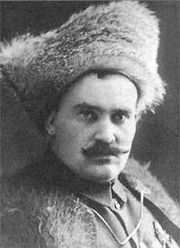
1946: Grigory Semenov, anti-Bolshevik

At 11 p.m. this date in 1946, White general turned Japanese collaborator Grigory Semenov (or Semyonov) was hanged for a generation’s worth of anti-Soviet depredations in the Far East.

The tsarist officer Semenov joined the Russian Civil War as a notoriously vicious White commander with the grandiosely retro title of Ataman of the Baikal Cossacks.

According to G. Patrick March, Semenov’s “penchant for killing, torturing, and looting” extended to executing a captured socialist by tossing the man into his locomotive’s fuel chamber.

Although also a rival in the suicidally fractious White political jostle, Semenov was the designated successor of Aleksandr Kolchak when the latter was shot in 1920, but by that time there wasn’t much left to succeed.

Knocking around the interwar era in gloryless exile, Semenov was an easy recruit for the Japanese war machine, which was in the market by the late 1930’s for locals with command experience and a grudge against Moscow and put him on retainer in Manchuria. Like the Soviet-Japanese front in general after Khalkin Gol, nothing much came of that enterprise; the Ataman’s last great hurrah was but a footnote for Japan, and his death would be a footnote in the annals of postwar victors’ justice.

Having picked a loser two wars in a row, Semenov was captured during the short-lived Soviet invasion of Manchuria at the tail end of the war and packed off for the inevitable. Five co-defendants, including Semenov’s son Mikhail, suffered death as well — although they were simply shot, while Semenov was ignominiously hanged. (According to White Terror: Cossack Warlords of the Trans-Siberian, the hanging was either botched or engineered to be an ugly strangulation job.)

On this day..

1944: Bronislav Kaminski, Waffen SS collaborator

On this date in 1944, the Gestapo eliminated more-trouble-than-he-was-worth Russian SS man Bronislav Kaminski.

The St. Petersburg-born Kaminski was Soviet by citizenship, but not Russian by nationality. Half-German and half-Polish, he’d done time twice for his questionable loyalties during the paranoid 1920’s and 30’s.

Turns out the commissars were on to something … or maybe, to paraphrase the old saying, that a Nazi is a Communist who’s been to the gulag.

Either way, when the front swept past Belarus where Kaminski was serving his post-release internal exile, the engineer jumped on an opportunity to join a classmate with the Russian National Liberation Army (RONA, or ROA). Kaminski soon rose to command the anti-partisan “army,” and earned an Iron Cross and the rank of Major General when it was incorporated into the Waffen-SS.

Unfortunately for Kaminski — and more so for anyone who happened to be in his unit’s vicinity — the 29th Waffen Grenadier Division was much better at roughing up partisans and their presumed civilian sympathizers than conducting disciplined military operations.

Little more than a roving band of armed thugs,* it was completely ineffective in the Siege of Warsaw earlier in August 1944, spending its time raping and looting instead.

That, evidently, was enough for Himmler, who had Kaminski eliminated** in punishment for his own looting (the booty was supposed to belong to the Reich), and the alleged rape-murder of German women along with all the expendables in Warsaw.

The exact trigger for this execution (for the juridical machinery always veils acts of discretion and intentionality; certainly, this is evident in a state like Nazi Germany) has never been completely clear; it may have been that between Kaminski and turncoat Red Army general Andrei Vlasov, the shrinking Reich had room enough for only one Russian commander.

Devil knows what he was commanding, anyway.

When, post-Kaminski, Vlasov assigned the remains of the RONA to Ukrainian collaborator Sergei Bunyachenko, the latter fumed, “So that’s what you’re giving me, bandits, robbers and thieves! You’ll let me have what you can no longer use!” … and soon bailed on his “patrons” by switching sides in the war yet again.

* It had some operations with the notorious Dirlewanger Battallion.

** The official announcement was that Kaminski had been killed in a partisan ambush; crazy conspiracy theorists refused to buy it.

On this day..

406: Radagaisus the Barbarian

Rome in the 5th Century was a difficult place for the general populace. The Roman Empire was at the front end of its long decline, and with its partitioning in 395 on the death of Theodosius I, a series of invasions was to follow that would shake confidence in the leadership of the Empire.

Possible etymological connection to the possibly proto-Slavic barbarian horde: shadowy Slavic god Radegast lends his gnarly visage to a Czech beer — and maybe to a Tolkein character.

Much of the activity in Rome at the time was tied to the young Visigoth King Alaric. Alaric initially invaded the Eastern Roman Empire, but he was met with resistance in Greece. During negotiations, the de facto head of the Western Roman Empire,* Stilicho, who has been claimed by some sources to have been born a Visigoth, marched on the Goths and prepared to engage in what likely would have been Alaric’s downfall.

According to accounts, Stilicho was called out of the neighboring province of Illyricum, and Alaric, now unencumbered of the prospect of a Western reinforcement, marched through Greece.

But Stilicho would not sit still, and in 397, he brought his army against the Goths and forced them into a difficult spot in the mountains of Pholoe, in the southern prefecture of Illia. Alaric slipped away,** moving his forces north and setting his sights on the Western Roman Empire, starting in northeastern Italy, in 400 AD.

While Stilicho was engaged on this eastern front, the Ostrogoths, led by the commander Radagaisus, prepared for their own invasion. While history is uncertain as to how the series of events transpired, it is clear that Stilicho bested Alaric at Pollentia and Verona and, because of a budding camaraderie with the defeated commander, enjoyed a few years’ respite from the Gothic invaders. Which was useful, because the Roman army had shrunken to a point where even small defeats were extremely costly to the Empire.

So it was that, when Radagaisus invaded Italy in 405, Stilicho had nearly all his army in place. Radagaisus marched with 100,000 people (likely) to 400,000 people (highly unlikely), though a relatively small percentage of these were thought to be armed. His trail of terror displaced uncounted Romans as Radagaisus made his way through northern Italy.

Finally, at the start of the 406 campaign, Stilicho had mustered sufficient forces to assault the invaders. As Radagaisus blockaded Florence, Stilicho amassed his regulars and, fortified also with recalled frontier soldiers, massacred the opposition. The battle was decisive, with the Roman army starving out the invading hordes, and Radagasius apparently quickly losing control of his loose band of warriors.

Whether he was turned on by his own men, or whether the Romans simply overran their enemies after a period of famine, Radagasius eventually fled the battlefield and was captured at one of Stilicho’s outposts. On 23 August 406, the man who called himself King Radagasius was beheaded.† Many of his soldiers defected to the Roman army — joining a long line of conscripts from conquered people — and his supporting band was scattered or enslaved.

Like Alaric, Radagasius has sometimes been indicated as King of the Goths, but his history is a little more murky than that. Radagasius (or Rhodogast, or Radegast, depending on the source) issued from northern Germany before making his march. He had united several tribes under his banner, but he could hardly be said to rule any region. And because of the remoteness of Ostrogoth territories and the limited written history on the region, it’s difficult to assess his true nature.

* Stilicho was protector of the underage Honorius, who has been regarded as weak and incompetent. Honorius died in 423, long after Stilicho was murdered.

** Alaric and Stilicho may have been conspiring at this point: Stilicho again claimed to have been recalled from the battlefield, but, owing to their common heritage and their later connections in defense of the Empire, it’s thought that Stilicho was actively recruiting Alaric for military service in defense of Rome.

† “The death of the royal captive, who was ignominiously beheaded, disgraced the triumph of Rome and of Christianity,” sniffed Edward Gibbon.

On this day..

1972: Mohamed Oufkir

When last we met Mohamed Oufkir in these pages, he was violently suppressing an attempted coup against Morocco’s King Hassan II.

Mohamed Oufkir’s wife and six children were “disappeared” to a desert prison, not to emerge for 18 years. Daughter Malika, a royal favorite in happier times, wrote Stolen Lives about that ordeal. (Interview | Another)

We find him today, 13 months later as the arrow of time flies, in the same story — on the other end of the gun-barrel.

At around 4 o’clock this afternoon, a stunning attempt on the monarch took place as he flew back to Morocco from France. The king’s 727 was attacked by F-5 fighters of the Moroccan Air Force, surviving, it is said, when the quick-thinking king himself took the radio, pretended to be a flight engineer, and informed the attacking fighters that the pilots were dead and the king mortally wounded.

The ruse tricked the attacking pilots into allowing the crippled plane to make its landing in Rabat; they returned too late to strafe the airfield when they realized their mistake.

This quashed coup was swiftly laid at the door of Oufkir, the powerful Defence Minister.

Oufkir was declared to have committed suicide late this night, or else in the small hours of August 17; this still-standing official explanation has always had its doubters, with more extravagant versions implicating the offended sovereign himself in dealing out the punishment. Probably not, but here’s foreign correspondent Stephen O. Douglas’s reconstruction in Morocco Under King Hassan:

[Interior Minister Mohamed] Benhima said that when Oufkir arrived at the Skhirat palace at 11 p.m. he was met in an anteroom by General Mawlay Hafid and Colonel Dlimi, and when he realised that the king knew he had masterminded the plot he pulled out a revolver saying, ‘I know what to expect.’ Benhima added, ‘The two witnesses tried to stop him. In the struggle he fired three shots, one wounding him in the chest, the second I don’t know where, but the third was the most fatal.’ He said this was ‘the truthful and authentic version’.

‘General Oufkir committed suicide. He was not killed. It has been asked if it was a suicide of loyalty or a suicide of treason. Well then, I am authorised to tell you, to certify that since 1 p.m. today, and considering the elements of inquiry we have in our possession, I can affirm that it was a suicide of treason and not a suicide of loyalty,’ Benhima said.

Later at the same news conference, Benhima indicated he was just as astonished as most of the journalists. He said he and Oufkir were ‘great friends. We appreciated each other very much and had confidence in each other. We had a common denominator: our loyalty, and I think we wore the same decoration, given to us on the same day for the same reasons. He was a great patriot, a great minister. As I just told one of your colleagues, I cannot figure how he could have done what he did. But he is one of the most attractive people I have known, and what I have said about him today is painful to me, but the truth had to be told.’

I learned later that during the fatal night a military ambulance took Oufkir’s blood-stained body back to his Souissi house where it was placed on the floor of a playroom. His wife Fatima was away on vacation on the Mediterranean coast and there were very few people in the house. They found Oufkir had four bullet wounds, three in the back and the fourth having gone through the nape of his neck and out through his left eye, shattering his glasses, the coup de grace. Suddenly someone decided it was a mistake to send the corpse back to his family and it was hastily retrieved the same night. Thus evidence that he may have been ‘suicided’ disappeared.

Hassan somehow escaped the day with his crown, but with two attempts to overthrow him over the previous 13 months and a need to purge the many unreliable Oufkir loyalists in the armed forces — well, as the London Times put it (Aug. 22, 1972), “short of his incredible good fortune there is little else that can be cited in real terms to guarantee the perpetuation of his rule.” You could have made good coin wagering informed observers of the time that Hassan would live and reign another 27 years and be internationally saluted at his peaceful death at age 70.

On this day..

1864: Romuald Traugutt and the January Uprising leaders

On this date in 1864, the leadership of Poland-Lithuania’s abortive January Uprising against the Russian tsar was hanged before 30,000 at Warsaw Citadel.


Romuald Traugutt depicted (somewhat ironically) on the 20-zloty note of Soviet bloc Poland.

Romuald Traugutt (English Wikipedia link | Polish) had been a decorated Lieutenant Colonel in the Tsarist army, and a heretofore apolitical man — but he resigned shortly after the outbreak of the doomed national uprising to take up sides against Russia.

This installment of the venerable Russians vs. Poles series was characteristically nasty.

In 1863 – Polonia by Jan Matejko, an allegory for the Polish nation is manacled by the Russians.

And it ended the way these affairs have ended these last 400 years or so: Russian victory.

The fallout was severe.

In addition to this day’s batch — Traugutt along with (all Polish Wikipedia links) Rafal Krajewski, Jozef Toczyski, Roman Zulinski and Jan Jezioranski — a further 391 were put to death after the war; tens of thousands were deported to Siberia or otherwise scattered in the vast Romanov empire; a war indemnity tax was imposed; and over three thousand estates in Poland and Lithuania were confiscated.

Traugutt has gained some latter-day support in the Catholic Church for beatification.

On this day..

1826: The Decembrists

On this date* in 1826, five leaders of the Decembrist revolt were hanged at St. Petersburg’s Peter and Paul fortress for their abortive eponymous uprising eight months before.

The most renowned and romantic of Russia’s hapless liberals, the Decembrists were a secret clique of idealistic young officers, many of whom had cut their teeth chasing Napoleon’s grande armee out of Russia in 1812.

In Russia’s complex interaction with the West — its ideas, its political institutions, its ways of life — these were the westernizers, who saw constitutionalism as the way of the future.

Upon the mysteriously sudden death of Tsar Alexander I, an irregular succession to the second-oldest surviving brother, Nicholas I, gave our day’s doomed and gallant youth cause to occupy St. Petersburg’s Senatskaya Square to uphold the rights of the first brother — and more to the point, to uphold the constitution to the extent of constraining the monarchy.


Decembrists at Senate Square, as depicted by Karl Kolman.

Uh … Now What?

This badly organized affair failed in its aim to attract the mass of soldiery and, constitutionalists as its organizers were, did not even aim at mobilizing the general populace.

After the initial heady rush of marching into the square in the name of liberty, the Decembrists were left in a standoff against a much larger force of loyalists. When the latter started shooting, that was that.

Those that survived faced trial, with five — Peter Kakhovsky, Kondraty Ryleyev, Sergei Muravyov-Apostol, Mikhail Bestuzhev-Ryumin and Pavel Pestel — initially sentenced to drawing and quartering.

“Mere” hanging was deemed sufficient for the purpose. That would be about the maximum embrace of liberalism by the Russian autocracy, whose lesson from the uprising was to crack down against any hint of forward-thinking politics — ultimately an unsuccessful strategy for the Romanov dynasty.

St. Petersburg’s Senate Square — renamed Decembrist Square by the Soviet government — where the action happened. The iconic equestrian statue of Peter the Great, commissioned by Catherine the Great and unveiled in 1782, witnessed it all; the statue acquired its enduring moniker, “The Bronze Horseman”, from a poem of the same title penned in 1833 by Alexander Pushkin, a friend of several Decembrists.

One of the greatest works of Russian literature, Pushkin’s “Bronze Horseman” weaves an ambiguous Decembrist-tinged critique of cruel imperial power and overreach into a complex narrative of St. Petersburg whose upshot is still up for lively literary debate. “The Bronze Horseman’s crag rose up before the poet on an empty square,” wrote one historian, “washed with the blood of those who rebelled on December 14, 1825”

Appalling there
He sat, begirt with mist and air.
What thoughts engrave His brow! what hidden
Power and authority He claims!
What fire in yonder charger flames!
Proud charger, whither art thou ridden,
Where leapest thou? and where, on whom,
Wilt plant thy hoof?

“They don’t even know how to hang you …”

When the hangings were carried out, Kakhovsky, Muravyov-Apostol and Ryleyev all had their ropes break; while some in the crowd anticipated the old prerogative of mercy for any prisoner who survives an execution, they just got re-hung instead. “Unhappy country,” quipped Ryleyev as the fresh nooses were fixed up, “where they don’t even know how to hang you.”**

Other Decembrists not condemned to the unreliable craftmanship of the Russian gallows were shipped to Siberia, where they invigorated the cultural life of the Lake Baikal city of Irkutsk — many of them famously followed by their “Decembrists’ wives,” an iconic type that continues to denote heroically sacrificial loyalty since the women had to renounce their own right to return to European Russia.

These, at least, had a place to call their own, however distant. But the class of Russian elites to which they belonged would be thrust into a trackless wilderness by their failure (in the Decembrist rising and otherwise) to carve out some distinct place for themselves. Russia’s long reckoning with modernity still had many years to run.


A worn postcard of a 19th century Russian painting depicting (perhaps) a political prisoner in the Peter and Paul Fortress.

* July 25 was the date on the Gregorian calendar; per the Julian calendar still in use in Russia at the time, the date was July 13.

** Ryleyev was quite the saucy one, having fought a “mysterious” duel with Pushkin in 1823, and instigated (and served as second at) a famous St. Petersburg jilted-love duel in 1825 that cost the lives of both antagonists.

A poet himself and a romantic to the point of fanaticism, Ryleyev wrote odes extolling executed national heroes like Artemy Volynsky and Severyn Nalyvaiko, seemingly alluding (as in this excerpt from the latter work) to his anticipation of joining them.

I know full well the dire fate
Which must upon the patriot wait
Who first dare rise against the foe
And at the tyrant aim the blow.
This is my destined fate

On this day..

1976: Lt. Col. Abu Taher

At 4 a.m. this date in Dhaka Central Prison, Lt. Col. Abu Taher was hanged for treason.

A series of coups in the mirrored-sunglasses era of military governance shook the young state of Bangladesh:

  • The autocratic Sheikh Mujibur Rahman was toppled by a revolt of junior officers on August 15, 1975;
  • Senior brass in turn felled the ruling junta on November 3, 1975, jailing powerful officer Ziaur Rahman;
  • A quick counter-coup of junior officers — also remembered as the “sepoy mutiny”* — mounted by leftist war hero Abu Taher on November 7 put Ziaur Rahman’s hand back on the helm of state.

While November 7 is still marked in Bangladesh as National Revolution and Solidarity Day, its author got short shrift from its beneficiary.**

Abu Taher, a retired officer and a hero of the 1971 Bangladesh Liberation War that had detached the former East Pakistan from Islamabad, had visions of social revolution. But three coups in as many months is the sort of thing to rattle the new big man, and Zia consolidated his own power by eliminating threats to both left and right political flanks.

A mere 17 days after doing that National Revolution and Solidarity thing, the guy with the mass movement (pdf) of armed men was arrested for treason. He faced a military tribunal the following year.

Taher scorned the charges against him, but of course the fix was in.

* An allusion to colonial history.

** However, Taher’s own date of martyrdom is also still marked by his posthumous partisans.

On this day..

1865: Chief Ahan of the Tsilhqot’in

“The Indian Ahan,” read the dispatch in the British Columbian this date in 1865, “will have expiated his crime upon the gallows ere these lines meet the public eye. The execution will take place in the rear of the jail early this morning.”

Ahan and another Tsilhqot’in (or Chilcotin) were of the party of Klatsassin, whom we have already met in these pages. Months after the Chilcotin War‘s mass execution, the luckless pair were arrested trying to pay what would have been a routine-for-them bit of blood money.

Both were condemned; Lutas received clemency, and his freedom. (“I eagerly availed myself of some favorable circumstances in the case of Sutas and sent him back pardoned to his tribe. A sufficient number of Indians has now perished on the scaffold to atone for the atrocities committed last year.”)

Documents related to this proceeding are archived at a canadianmysteries.ca page on Klatsassin.

Ahan’s execution in New Westminster, now part of the Vancouver, B.C. metropolis, isn’t dead, though — and isn’t even past.

Over the course of the past year, a public school project in the city that had been built over an old pauper’s grave that might have become the hanged man’s resting place was gravely (ahem) complicated by the continuing Tsilhqot’in search for Ahan’s remains. While Ahan’s own situation remains unresolved, the suit on his behalf eerily outlined the macabre past lurking everywhere beneath our workaday feet.

On this day..

1971: Ten failed putschists in Morocco

On this date in 1971, four generals, five colonels and a major who had attempted a coup d’etat in Morocco less than three days before were shot without trial at the military barracks in Rabat.

The senior officers* had taken military cadets and stormed the palace where birthday celebrations for King Hassan II were taking place. They captured the monarch himself before the cadets themselves wavered, and loyal troops successfully counterattacked. Ninety-two people, including the Belgian ambassador, were killed in the affair; the king was at their state funeral on this date at the time the putschists were being shot.

This selection of the coup’s leadership gunned down this day in Rabat did not make an end to the reverberations; other trials followed later in the year, and some others who were implicated were simply “disappeared”.

Although we lack the testimony of any of the coup leaders themselves for their motivations, it occurred in the context of political and social upheaval in post-colonial Morocco. Frank H. Braun (“Morocco: Anatomy of a Palace Revolution That Failed”, International Journal of Middle East Studies, Vol. 9, No. 1 (Jan., 1978)) argues that it was rooted in an eclipse of the traditional prerogatives of the military — and especially of the Berber nobility, who can be said to be the authors of the attempt.

So too can its failure be ascribed to the scant support this parochial and backward-looking cause commanded; non-Berber officers didn’t join the plot. Even so, with one of his government’s traditional pillars of support so heavily compromised (and decimated by this day’s executions and other reprisals), the coup led Hassan II to somewhat liberalize Morocco’s constitution the following year.

Which did not exactly still the tumultuous power politics scene in Rabat.

Mohamed Oufkir, the general who had coolly suppressed the 1971 coup** to become the preeminent military officer in the country, mounted his own bid for power in 1972 and suffered the same fate as this date’s doomed rebels.

* Notably, Mohamed Medbouh (French link), “one of my closest collaborators” in the estimation of the king himself (but also of “the mentality of a jackal”). His surname actually meant “cutthroat,” and was earned by his father’s literally having his throat cut — and surviving — in the 1920’s.

** A Berber himself, Oufkir may have been aware of the earlier coup — and cunning enough not to commit himself until he saw which way the wind was blowing.

On this day..