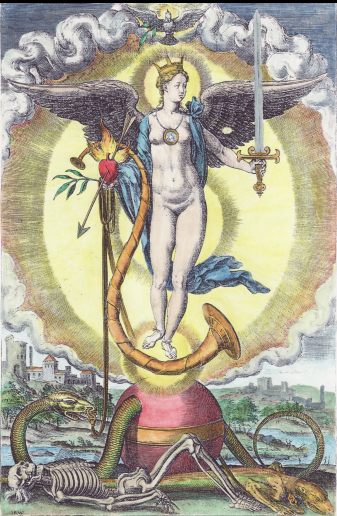
1559: The remains of David Joris, Anabaptist fugitive

On this date in 1559, the corpse of “Johann van Brugge” — recently exposed as underground Anabaptist leader David Joris, even though Brugge/Joris was three years dead — was burned in Basel.

The flame-bearded Joris (English Wikipedia entry | the more detailed Dutch) was a glass-painter by trade who came to the fore of the Anabaptist movement following its catastrophe at Muenster.

His home city of Delft in 1528 had flogged him and bored his tongue for his religious scruples, but Joris maintained a strong following among the re-baptized in that city. Many of those followers had occasion to try their faith against the torturers’ tongs, and dozens of arrestees impressively concealed their leader’s whereabouts from his enemies. The man’s own mother was executed in 1539.

He could only duck in and out of Delft — once he had to slip out in a basket innocuously loaded onto a boat* — or any other city. From the 1530s, his was a life on the run in Reformation Europe, where Anabaptists were no safer from Protestants than they were from Catholics.

(Sample dangerous heresy: Joris was a very early adopter of the idea that the devil was best understood as an allegorical figure, not an actual entity.)

With a literal price on his head he wandered to Strassburg, to England, back to the continent in Westphalia and Oldenburg, Strassburg again, then Antwerp, and on to Basel, Switzerland in 1544.

In Deventer in 1542 his ecstatic Wonder Boeck was printed. (We recommend the engravings.)

In Basel our hunted man was able to settle in as Brugge and live out the balance of his life, still pouring out voluminous writings in secret — a very impressive retirement considering his notoriety and his distinctive facial hair. Joris was in his fifties when he died: the years of rough living on the run had done him no favors.

Three years after his death, his son-in-law — who disagreed with Joris theologically — exposed his real identity. Basel had nothing left to do about it but to visit on his bones the punishment David Joris’s living flesh escaped to the end of his days.

* From Gary Waite’s “Staying Alive: The Methods of Survival as Practiced by an Anabaptist Fugitive, David Joris” in the January 1987 Mennonite Quarterly Review.

On this day..

1624: Antonio Homem, at the hands of the Portuguese Inquisition

On this date in 1624, Coimbra University theologian Antonio Homem was burned at the stake in a Lisbon auto de fe.

Homem came from a “neo-Christian” family, Jews who had been forced to convert to Christianity. Considering the compulsion, one could fairly question the piety of such “Christians”; in a great moment in damned-if-you-do, damned-if-you-don’t, the Spanish Inquisition fired up to probe the potential un-Christian activity of neo-Christians.

Neighboring Portugal was just a beat behind Spain in all this; Spain expelled its Jews — the ones who weren’t willing to convert — in 1492, and Portugal did so in 1497. The Portuguese Inquisition began in 1536 and, like Spain’s, took conversos as a primary focus.*

Homem’s family’s response was to be more Catholic than the Pope and have Antonio trained for the clergy; he became canon of the Cathedral of Coimbra and a doctor at the University of Coimbra.

Homem was in his fifties when it became known among his colleagues that he was of New Christian stock, and this circumstance soon attracted unwanted attention — and eventually, his denunciation for allegedly leading a secret Judaic cell. Homem, it is said, “often took the part of priest”; The Other Within: The Marranos, Split Identity and Emerging Modernity describes a Kippur ceremony from the Inquisition records.

The public, all fasting and dressed in white, used the Christian Bible (the Vulgate) to recite Latin Psalms that expressed a Jewish-Marrano sentiment (Psalms such as “When Israel came out of Egypt,” “On the rivers of Babylon,” and “From the Abyss I called you, O God”). In those ancient Jewish poems the Marranos expressed their own, specific sense of exile and yearning for redemption. A few “priests of the Law of Moses,” replicating a Catholic ceremony, dressed Homem in a long elegant garment and put “a sort of miter” on his head, decorated with golden plaque. There was an altar there, and incense, and painted images of Moses and of a Marrano martyr or saint “who had been … burned as a Jew.”

The inner life of the converso is a great riddle from our distance of time and context. It is immediately tempting to perceive religious martyrs here, people who were forced underground but still kept what they could of the faith of their fathers at risk of life and limb.

Such a reading paradoxically allies us with their persecutors, for it is by the Inquisition’s hand that we have the evidence — and this is a source whose evidence we greet very skeptically when it, for instance, charges conversos with murdering Christian children. Inquisitors all around Europe were after all involved in these very years in scaring up secret witches’ covens to incinerate, and it was not unknown for the deadly judicial apparatus to be borrowed here and there from restraining the minions of Hell in order to service business opportunities, political aspirations, or private grudges of the personal or professional variety. Try asking a present-day academic how easy they’d sleep knowing their colleagues on the tenure committee also had a few buddies in the Holy Inquisition.

Antonio Jose Saraiva’s The Marrano Factory: The Portuguese Inquisition and Its New Christians 1536-1765** contends that most “Judaizing” Christians were just plain Christians — caught up like accused witches and warlocks could be in some specious neighborhood rumor that became a self-fulfilling accusation. “Inevitably,” says Saraiva, “a family quarrel or a commercial intrigue would lead to several series of denunciations, followed by arrests. Arrests led to trials which spiraled into new rounds of arrests and trials.” Saraiva argues that Homem’s recently-exposed Jewish heritage probably just made him a ready target when a commercial dispute of some sort led the Inquisition’s Coimbra tribunal to seize “scores of merchants engaged in the triangular commerce between Brazil, Oporto and Amsterdam.”

Whether Homem really did head a covert cult with 100-plus adherents reading Old Testament verses from the Latin Bible — or whether this was what an inquisitor goaded by Homem’s enemies supposed a secret Jew might do — he was left to rot in prison several years† after his 1619 condemnation while the Inquisition investigated dozens of his alleged adherents. These included other cathedral canons, professors and students at the university, nuns from four nearby convents, and other persons of some stature. (Homem, to his credit, refused to accuse anyone else.)

Homem was eventually among eight burned (Portuguese link) at an auto this date at the Ribeira de Lisboa, and his house was torn down to be replaced with a pillar inscribed “Praeceptor infelix”. Prior to their destruction they were favored with the preachings of Friar Antonio de Sousa who railed against the insidious Semitic threat to homeland security.

For our sins of the last years people of quality have been cross-breeding with these perverse Jews to whom I am referring. They became corrupted by their contact with them and have become Jews like they are. Just a few years ago only low-class, trashy Jews were paraded at the autos-da-fe. See what now appears for sentencing in the autos-da-fe and in this very one at which I am preaching: ecclesiastical personnel, friars, nuns, holders of master’s degrees, licentiates, doctors and professors with family connections to the nobility, people only half of New Christian origin, or a quarter, or an eighth, all confessing and convicted of Judaism. (Translated excerpt via Saraiva)

Readers with Portuguese proficiency can find more on this case in this 1999 book exploring the Inquisition’s Coimbra archives, or in Antonio Homem e a inquisição.

* For the setting of this post, the 1620s, Spain and Portugal are under the personal union of a common monarch, Philip IV.

** We’ve mentioned it before.

† One of the great (and eventually fatal) inefficiencies of the auto-de-fe system was its tendency to leave its future exhibits to languish for years in prisons before the prescribed spectacle could be properly arranged.

On this day..

1493: Peter Dane, in the Sternberger Hostienschänderprozess

On this date in 1493, Peter Dane was burned at the stake in the Baltic city of Rostock.

Dane, the vicar of the church at the small town of Sternberg, allegedly sold consecrated communion Host to a Jew named Eleazar, who proceeded to destroy the pieces in a weird Jewish ceremony because Jews. From this imputation came the mass burning of 27 Jews at Sternberg in October 1492. (Eleazar himself, however, got away.)


Illustration of the burning of the Sternberg Jews, from Hartmann Schedel‘s Weltchronik (1493)

Those Jews not put to death were expelled from the Duchy of Mecklenburg, leading rabbis to pronounce a reciprocal ban against any of their people settling in Mecklenburg — a ban not lifted until the mid-18th century.

Dane enjoyed a more ceremonial expulsion from this mortal coil, beginning with expulsion from the clergy at the hands of the Rostock bishop. Duly relaxed to the secular authorities, Dane too died by fire.

But the story of his sacrilege did not die.

Thanks to Johannes Gutenberg‘s hot new communications technology, pamphlets and broadsides rolled off Europe’s printing presses about the Sternberger Hostienschänderprozess — and the miracles attributed to the outraged Host, like spurting blood and killing Eleazar’s wife in her tracks.*

The very Host said to have been offended by Dane and Eleazar was duly produced, blood and all, and Sternberg became a pilgrimage destination for faithful seeking the bread’s miracle-working powers. A tourist boom came with it.

Miracles were reported, both healings and resurrections; important pilgrims, including Danish royalty and a Spanish princess, came. By March 1494 the bishop of Schwerin had established a division of the pilgrim revenues: a third to the pastor at Sternberg, a third to the bishop of Schwerin, and a third to the cathedral chapter of Schwerin (with some provision for the neighboring chapter at Rostock). Initially all the revenues were to go to Sternberg for building the blood chapel, which was completed by 1496. Six priests were delegated to pray the Hours of Christ’s passion and a seventh to show to the faithful twice daily the martyred, wonder-working hosts. In a competition for revenues that is reflected in the legend itself (the host supposedly resisted a move from court to church), the duke built a chapel on the finding site, where, before 1500, more miracles were worked; finally, against the opposition of both the bishop of Schwerin and the pastor at Sternberg, he managed to extract a portion of the pilgrim income to finance a cloister of Augustinian hermits on the site in 1510. (Source)

That killjoy Martin Luther broke up the hustle.

In his seminal 1520 Address To The Christian Nobility of the German Nation, Luther specifically names Sternberg (among other locales) in the course of denouncing the pilgrimage racket:

The country chapels and churches must be destroyed, such as those to which the new pilgrimages have been set on foot: Wilsnack, Sternberg, Treves, the Grimmenthal, and now Ratisbon, and many others. Oh, what a reckoning there will be for those bishops that allow these inventions of the devil and make a profit out of them! They should be the first to stop it; they think that it is a godly, holy thing, and do not see that the devil does this to strengthen covetousness, to teach false beliefs, to weaken parish churches, to increase drunkenness and debauchery, to waste money and labour, and simply to lead the poor people by the nose.

…

Every man thinks only how he may get up such a pilgrimage in his own district, not caring whether the people believe and live rightly. The rulers are like the people: blind leaders of the blind.

In the case of Sternberg, and of Mecklenburg generally, rulers and people alike — so recently blind with covetousness — went hard for Luther’s reform preaching very early on.

Sternberg’s lucrative traffic in pilgrims dried up abruptly in the 1520s, though the capital improvements they funded live on … and Peter Dane’s onetime parish church still bears a few markers of its bygone fame.

* Latin readers can get a taste of it with this Google Books scan of Mons Stellarum, a humanist review of events dating to the 1510s.

On this day..

1481: Diego Suson, by his daughter’s hand

On this date in 1481, Spain’s first auto-da-fe under the recently established Spanish Inquisition saw six burned at the stake in Seville.

These pageants of orthodox Catholic authority, with parades of heretics publicly confessing their error and being received back into the community on penitential terms, while others more contumacious were consigned to the flames, would soon become one of the signature features of Inquisition Spain. Some 700 people were executed at such events over the decade to come.

But here in the early 1480s, the terrifying powers of the Holy Office for the Propagation of Faith (the Inquisition’s business-card title) were, well … unexpected.


/Mandatory

Don Diego Suson, one of the six put to death this date, was the wealthy patriarch of a marrano family — Jews, who had converted a century prior. The Inquisition’s whole founding spirit was the sense of characters like Torquemada that as such conversions had generally been obtained under duress, the families in question were still secretly maintaining their Semitic rites. That would make them apostates (since they were baptized and supposedly Christian), and it would implicate them in God knows what other malignancy (since they were malignant Jews).

Spain, you’ll recall, is at this point about 11 years away from expelling all its Jews full stop.

This made it especially dicey for Suson that he was also a rabbi to an underground community of still-practicing “converted” Jews. (Spanish source) Torquemada was on to a real thing here.

Unfortunately his daughter — so the legend says — didn’t quite grasp what the Inquisitors had coming and lightly betrayed the fact to her Christian lover. In no time at all, the guys with the racks and thumbscrews had the terrible family secret in hand.

It’s said that the beautiful (of course) daughter was so riven with grief and shame for the careless destruction of her father that she shut herself up in a convent … and arranged that when she died her guilt-stricken head should be hung up at her former home.

The location of this macabre monument is still marked in Seville today; once known as the Calle de la Muerte, it is now called the Calle Susona.

On this day..

1857: Jean-Louis Verger, doctrinaire

On Saturday, January 3, 1857, the Archbishop of Paris Marie-Dominique-Auguste Sibour had just reached the church of Saint-Etienne-du-Mont when Jean-Loiuis Verger stepped out of a crowd — out of obscurity — and plunged a long Catalan knife fatally into Sibour’s chest.

The assassin Verger (English Wikipedia entry | French) was a 30-year-old ordained priest who had accumulated a quarrelsome reputation among his ecclesiastical peers. The previous year, he had been laid under an official interdiction for preaching against the Catholic Church’s controversial new doctrine of the Virgin Mary’s Immaculate Conception.

Some reports had Verger crying out “No goddesses!” as he daggered the archbishop. “It is nowise the person of the Archbishop of Paris whom I wished to strike, but, in his person, the dogma of the Immaculate Conception,” Verger told the magistrates who judged him within days. There wasn’t a whole lot of doubt about the trial, so why wait around? But Verger’s vendetta wasn’t only theological; his suspension meant he wasn’t getting paid, and as his fury mounted over it he went so far as to post himself at the door of a church with a placard proclaiming that he was starving.

Archbishop of Paris was a surprisingly dangerous job in the mid-19th century. Sibour got the post because his predecessor was shot dead negotiating at a barricade during the 1848 revolution; in 1871, Archbishop Georges Darboy was taken hostage by the Paris Commune and executed by his captors when the national government invaded the city.

On this day..

1253: P. Morret, poor guesser

Henry Charles Lea‘s A History of the Inquisition of the Middle Ages brings us the following anecdote of the Kafkaesque legal trap in which those denounced to the Inquisition found themselves.

In reality no advocate could be of material service to the accused, save in the most exceptional cases. The men who organized the Holy Office knew too well what they wanted to leave open any possibilities of which even the shrewdest advocate could take advantage, and it was admitted on all hands as a recognized fact that there was no method of defence save disabling the witnesses for the prosecution. It has been seen that enmity was the only source of disability in a witness, and this had to be mortal — there must have been bloodshed between the parties, or other cause sufficient to induce one to seek the life of the other. If, therefore, the case rested on witnesses of this kind, their testimony had to be rejected and the prosecution fell. As this was the only possible mode of escape, the cruelty of withholding from the prisoner the names of the adverse witnesses becomes doubly conspicuous. He was forced to grope around in the dark and blindly name such persons as he imagined might have a hand in his misfortunes. If he failed to hit upon any who appeared in the case, the evidence against him was conclusive, as far as it went. If he chanced to name some of the witnesses, he was interrogated as to the causes of enmity; the inquisitor examined into the facts of the alleged quarrel, and decided as he saw fit as to the retention or the rejection of their testimony. Conscientious jurists like Gui Foucoix and inquisitors like Eymerich warned their brethren that as the accused had so slender a chance of guessing the sources of evidence, the judge ought to investigate for himself and discard any that seemed to be the product of malice; but there were others who sought rather to deprive the poor wretch of every straw that might postpone his sinking. One device was to ask him, as though casually, at the end of his examination, whether he had any enemies who would so disregard the fear of God as to accuse him falsely, and if, thus taken unawares, he replied in the negative, he debarred himself from any subsequent defence; or the most damaging witness would be selected and the prisoner be asked if he knew him, when a denial would estop him from claiming enmity. It is easy to imagine other tricks by which shrewd and experienced inquisitors could save themselves the trouble of admitting the accused to even the nugatory form of defence to which alone he was entitled. As to allowing him to call witnesses in his favor, except to prove enmity of the accusers, it was never thought of in ordinary cases. By a legal fiction, the inquisitor was supposed to look at both sides of the case, and to take care of the defence as well as of the prosecution. If the accused failed to guess the names of enemies among the witnesses and to disable their testimony, he was condemned.

In England, under the barbarous custom of the peine forte et dure, a prisoner who refused to plead either guilty or not guilty was pressed to death, because the trial could not go on without either confession or defence. Cruel as was this expedient, it was the outcome of a manly sense of justice, which based its procedure on the rule that the worst felon should have a fair opportunity to prove his innocence. Far worse was the system of the Inquisition, which was equally resolved that its culprits should have no such easy method of escape as a refusal to plead. It had no scruples as to proceeding in such cases, and the obstinacy of the accused only simplified matters. The refusal was an act of contumacy, equivalent to disobeying a summons to appear, or it was held to be tantamount to a confession, and the obdurate prisoner was forthwith handed over to the secular arm as an impenitent heretic, fit only for the stake. The use of torture, however, rendered such cases rare.

The enviable simplicity which the inquisitorial process thus assumed in the absence of counsel and of all practical opportunities for defence can perhaps best be illustrated by one or two cases. Thus in the Inquisition of Carcassonne, June 19, 1252, P. Morret is called up and asked if he wishes to defend himself against the matters found in the instructio or indictment against him. He has nothing to allege except that he has enemies, of whom he names five. Apparently he did not happen to guess any of the witnesses, for the case proceeded by reading the evidence to him, after which he is again asked thrice if he has anything further to say. To this he replies in the negative, and the case ends by assigning January 29 for the rendering of sentence. Two years later, in 1254, at Carcassonne, a certain Bernard Pons was more lucky, for he happened to guess aright in naming his wife as an inimical witness, and we have the proceedings of the inquest held to determine whether the enmity was mortal. Three witnesses are examined, all of whom swear that she is a woman of loose character; one deposes that she had been taken in adultery by her husband; another that he had beaten her for it, and the third that he had recently heard her say that she wished her husband dead that she might marry a certain Pug Oler, and that she would willingly become a leper if that would bring it about. This would certainly seem sufficient, but Pons appears nevertheless not to have escaped. So thoroughly hopeless, indeed, was the prospect of any effort at defence, that it frequently was not even attempted, and the accused, like Arnaud Fabri at Carcassonne, August 26, 1252, when asked if he wished a copy of the evidence against him, would despairingly decline it. It was a customary formula in a sentence to state that the convict had been offered opportunity for defence and had not availed himself of it, showing how frequently this was the case.

On this day..

1681: Isabel Alison and Marian Harvey, Covenanters

We turn today to William Crookshank’s (certainly partisan) narrative of the hanging of two Scottish Covenanters on this date in Edinburgh, as told in his The history of the state and sufferings of the Church of Scotland.


On the 25th of December some of the students in the College of Edinburgh brought to the head of the Cowgate the effigy of the pope in his robes, with his keys, mitre, and triple crown; and, when they had excommunicated him, they carried him about in a chair, like that wherein he is elected at Rome, to the foot of the Blackfriars’ Wynd. The students, knowing the thing had taken air, gave out that they were to carry his holiness in procession to the Grassmarket, the place of the execution of criminals; whereupon the guards marched thither. Meanwhile the boys marched in procession by the Black-friars’ Wynd to the High-street, three of them going before with lighted torches. Being come thither they condemned his holiness to be burnt: accordingly the torchmen blew up the effigy with gun-powder, notwithstanding their being attacked by some soldiers commanded by Linlithgow and his son; whom they warned to beware whom he struck, since he had relations among them.

…

The Duke of York’s [the future James II -ed.] being now in Scotland sharpened the edge of the persecution; so that no less than twenty were executed in the course of this year 1681.

The sufferers had, it is true, declared against the king’s authority, for which many of them were hanged, and otherwise persecuted by their enemies, and’censured by their friends. They branded them as madmen, enemies to government and civil society; but it is very plain that they never opposed government or monarchy as such, but only wicked, perjured, and persecuting governors. These they did oppose, and that for the very same reasons that brought about the Revolution and the protestant succession.

I cannot express this better than in the words of the author of the Memoirs of the Church of Scotland, when speaking of the Torwood excommunication. Says he,

I desire the impartial reader to compare it with the memorials above-mentioned, [to wit, the memorial to the Prince of Orange from the people of Great Britain, to invite him to come to their assistance] and see if it be posible for any British protestant, who owns the justice of the Revolution, to reflect upon the zeal of these people, without blushing for himself and the whole nation, that they did not see and abhor the tyranny of those reigns sooner; then they had joined with those people instead of censuring their zeal; the Revolution had then been brought about without sovereign help at all; the Prince of Orange had then been called over, as peaceably as King George, to take possession of the crown; and the blood of near 20,000 people, who were one way or other murdered and destroyed by that now abdicated race of tyrants, had been saved. What a shame is it, says he, to us, and how much to the honour of these persecuted people, that they could thus see the treachery and tyranny of those reigns, when we saw it not; or rather, that they had so much honesty of principle, and obeyed so strictly the dictates of conscience, as to bear their testimony early, nobly, and gloriously to the truth of God and the rights of their country, both civil and religious; while we all, though seeing the same things, yet betrayed the cause of liberty and religion, by a sinful silence and a dreadful cowardice.

But suppose, through the treatment, the unacountable treatment they met with, they had gone a little beyond due bounds, and though sometimes their expressions were not so well chosen, can that either condemn the principles of religion and liberty upon which they acted; nay, or their actual disowning those tyrants, who, for nothing but the matters of their God and Saviour, had declared them outlaws, rebels and traitors? Besides, the blood of many was shed, against whom they could prove nothing, but what they extorted from them by their ensnaring questions. Nay, even some of the weaker sex were hanged or drowned on this score. But I shall relate the matters of fact as they happened in the order of time.

It was a dreadful affront to the Duke of York to find his holiness treated in such a manner, on that grand festival the 25th of December; and therefore the sycophant managers must not overlook such an indignity.

Accordingly, on the 4th of January, the masters of the college declared their abhorrence of what their scholars had done; and on the 6th, the council commanded the magistrates to order the college gates to be shut, and the classes to be dissolved. About this time several of the students were imprisoned, besides Mr Ridpath, which so exasperated the rest, that it is said, they threatened to burn the provost’s house at Priestfield, because the magistrates, who were patrons of the college, instead of protecting them, had acted violently against them; and in a few days the house of Priestfield was burnt.

Whereupon the council, on the 17th, issued a proclamation, offering 2000 merks and a remission, to any who should discover the actors: but it does not appear that any discovery was made …

The order of time leads me to the case of Isobel Alison and Marion Harvey, two young women, who were executed this month, to the perpetual disgrace of the bloody managers, who could have no acts of what they called rebellion, in the least, to lay to their charge.

When they were taken, I know not. Isobel Alison was apprehended at Perth, where she lived, only for speaking against the severity used to sundry good people there; for they could accuse her of nothing else. Marion Harvey was seized while going one day from Edinburgh to hear sermon in the fields, and was last year before the council. But though they had nothing against these two young women, they were resolved to shed their blood: and therefore upon what they owned at their examination they founded their indictment, and took away their lives. That the reader may have a specimen of the injustice of this period, that afterwards became common, I shall here insert the substance of their examination first before the council, and next before the lords of justiciary.

When Isobel Alison was before the council, she was interrogated as follows:

…

Q. Can you read the Bible?

A. Yes.

Q. Do you know the duty we owe to the civil magistrate?

A. When the magistrate carrieth the sword for God, according to what the scripture calls for, we owe him all due reverence; but when they overturn the work of God, and set themselves in opposition to him, it is the duty of his servants to execute his laws and ordinances on them.

Q. Do you own the Sanquhar declaration? [a speech disavowing Presbyterian allegiance to the government]

A. I do own it.

…

Marion Harvey’s examination before the council was upon the same points with that of her fellow-sufferer … Only, among other tilings, they said, Will you cast away yourself so? To which shy replied, I love my life as well as any of you, but would not redeem it upon sinful terms. They said, the rock, the cod and bobbins, were as fit for her to meddle with as those things. They offered her the assistance of ministers, but she would have none of their pro. vidiug

On the 17th of January they were brought before the Lords of Justiciary; for it was the constant practice at this time, the one day to bring such as fell into their hands before the council, and there by ensnaring questions, to bring them into a confession of such things as they accounted treason, and next day to prosecute them before the criminal court. These two women were accused for hearing at field-conventicles, harbouring Messrs Cargill, Cameron, &c. owning the Rutherglen and Sanquhar declarations, &c.

When Isobel Alison was before them, she was examined as follows:

Q. Do you abide by what you said the last day?

A. I am not to deny any thing of it. She owned she had converged with David Hackstoun, and disowned their authority.

Q. Do you disown us and the king’s authority in us?

A. I disown you all because you carry the sword against God, and not for him, and have, these nineteen or twenty years, made it your work to dethrone him, by swearing, year after year, against him and his work, and assuming that power to a human creature which is due to him alone, and have rent the members from their Head, Christ.

… Then they said, Your blood be on your own head, we shall be free of it. She answered, So said Pilate, but it is a question if it was so; and ye have nothing to say against me, but for owning of Christ’s truths and his persecuted members. They made no reply, but desired her to subscribe what she had owned, and, upon her refusing, did it for her.

Marion Harvey, before the justiciary, owned the Sanquhar declaration, &c. and then protested that they had nothing to say against her as to matter of fact; but only that she owned Christ and his truth, his persecuted gospel and members; of which she said, Ye have hanged some, others you have beheaded and quartered quick. To this they said nothing; but called those who were to sit on the jury, who appeared with reluctance. One of them said, He did not desire to be engaged in this matter; but he was obliged: then he desired that the confessions of the two prisoners might be read, because he knew not what they had to say against them. When he was ordered to hold up his hand and swear, he fell a-trembling. The jury being fixed, the confessions were read, and the advocate in a speech, aggravated every particular, in order to prove them guilty of treason. Some of the jury urged that there was no fact proved against them. The advocate said, But treason is fact; and taking himself again, he said, It is true, it is only treason in their judgment, but go on according to our law; and if you will not do it, I will proceed. The jury brought them in guilty on their own confession; however, the passing of the sentence was deferred till the 21st, when they were both condemned to be hanged at the Grassmarket on the 26th.

Meanwhile, on the 20th, the council enlarged the powers of the laird of Meldrum for apprehending those who were in the rebellion. The many searches which were made in consequence of this were most oppresive. The same day the magistrates of Edinburgh were ordered to call all the masters of coffee-houses before them, and obliged them to come under a bond of 5000 merks, to suffer no news-paper to be read in their houses, but such as are approved of by the officers of state.

Next day all the students in the college of Edinburgh were ordered to retire fifteen miles from that place, within twenty four hours, and not to come within these bounds without leave from the council, under the pain of being treated as seditious persons. A fine protestant government, to make such a splutter about burning the pope! But it was decent to compliment his Royal Highness the Duke!

On the 26th, Isobel Alison and Marion Harvey were executed according to their sentence. The reader will find what passed between them and Mr Riddel in the Cloud of Witnesses, together with their respective testimonies. When they were brought from the prison to the council-house, in order to be carried from thence to the place of execution, Marion Harvey said, with a surprising chearfulness and heavenenly transport, Behold, I hear my Moved saying unto me, Arise, my love, my fair one, and come away. When in the council-house, Paterson bishop of Edinburgh (such was the spirit of the man!) said, Marion, you said you never would hear a curate, now you shall be forced to hear one; and immediately ordered one of his suffragans, whom he had prepared for the purpose, to pray. When he began, she said to her fellow-prisoner, Come, Isobel, let us sing the 23d Psalm; which they did, and thereby drowned the curate’s voice, and confounded their persecutors.

Their behaviour on the scaffold is not to be omitted. Isobel having sung the lxxxiv Psalm, and read Mark xvi, cried over the scaffold, and said, Rejoice in the Lord ye righteous; and again, I say, rejoice. She was not suffered to pray till she came to the foot of the ladder. As she went up, she cried out, ‘O be zealous, sirs, be zealous, be zealous! O love the Lord, all ye his servants! O love him; for in his favour is life!’ And added, ‘O ye his enemies, what will ye do? Whither will ye fly in that day? for now there is a dreadful day coming on all the enemies of Jesus Christ. Come out from among them, all ye that are the Lord’s people.’ Then she concluded, ‘Farewell all created comforts; farewell sweet Bible in which I delighted most, and which has been sweet to me since I came to prison; farewell Christian acquaintances. Now into thy hands I commit my spirit, Father, Son, and Holy Ghost.’ Then the executioner threw her over.

Marion Harvey likewise sung Psal. lxxxiv. and having read Mal. iii, she said, ‘I am come here to-day for avowing Christ to be Head of his church and King in Zion. O seek him, sirs, seek him and ye shall find him: I sought him and I found him; I held him, and would not let him go.’ Then she rehearsed briefly the heads of her written testimony. Going up the ladder she said, 0 my fair one, my lovely one, come away. And, sitting down on the ladder, she said, ‘I am not come here for murder; for they have no matter of fact to charge me with ; but only by judgment. I am about twenty years of age: at fourteen or fifteen I was a hearer of the curates and indulged; and while I was a hearer of these I was a blasphemer and Sabbath-breaker, and a chapter of the Bible was a burden to me; but since I heard this persecuted gospel, I durst not blaspheme nor break the Sabbath, and the Bible became my delight.’ Upon this the commanding officer called to the executioner to throw her over, which he did accordingly.

On this day..

Feast Day of Saint Agnes

January 21 is the feast date and traditional martyrdom date (in the year 304) of Agnes of Rome, a 13-year-old put to death in the Diocletian persecutions who has the distinction of being among the seven women mentioned by name in the Catholic Canon of the Mass.

Agnes means “chaste” in Greek,* and this was precisely the problem.

As prosperous as she was pulchritudinous, she was pious even moreso and spurned the many suitors for her hand and bed. Eventually one or the other of them peevishly reported her as a Christian.

Upon arrest, the abstinent youth was allegedly subjected to an official program of sexual assault, including displaying her naked in public and forcing her into a brothel. It’s said that divine intervention prevented her violation in these ordeals. (The flowing locks in the Ribera portrait of her at right are part of that myth, supposed to have sprouted long enough to save her from her public shaming.)

Considering that her defining characteristic is her virginity, Agnes has quite the lurid legend — and that does not exclude her very martyrdom. Per the erotically-charged poetic account of the 4th-5th century Christian poet Prudentius,** Agnes rejoiced sensually in the executioner sent to to render her to her heavenly bridal-bed:

I rejoice that there comes a man like this,
A savage, cruel, and wild warrior,
Rather than a languid, soft,
Womanish youth fragrant with perfume,
Come to destroy my life with the death of my honor.

This lover, this one at last, I confess, pleases me.
I shall rush to his eager steps
And not demur from his hot ardor.
I shall welcome the entire length of
His blade into my bosom, drawing the sword-blow
To the depths of my breast.

–Original Latin here from Prudentius’s Liber Peristephanon (Crowns of Martyrdom)†

Agnes, whose purported relics are interred in the Roman church Sant’Agnese in Agone, is the patron saint of an entire pantheon of feminine sexual incipience: chastity, virgins, young women, and betrothed couples.‡

Little surprise, then, that the legend arose in Christendom that a maid could invoke the vision of her future husband by performing certain suggestive rituals — like lying supine and naked on her bed — on the eve of St. Agnes (that is, the night of January 20).

It’s upon this occasion that Keats pins his narrative poem The Eve of St. Agnes§ (full text here or here), in which a young woman performing these rites is in her dreamlike state deflowered by the desired suitor her family forbids — and then the two slip away by night “o’er the southern moors.”

Beyond a mortal man impassion’d far
At these voluptuous accents, he arose,
Ethereal, flush’d, and like a throbbing star
Seen mid the sapphire heaven’s deep repose;
Into her dream he melted, as the rose
Blendeth its odour with the violet,–
Solution sweet: meantime the frost-wind blows
Like Love’s alarum pattering the sharp sleet
Against the window-panes; St. Agnes’ moon hath set.


The Eve of St. Agnes, by John Everett Millais (1863) shows Keats’s Madeleine about to disrobe before taking to bed on that occasion. The Keats poem was very popular with Millais’s pre-Raphaelite crowd.

* It’s also similar to the Latin word for lamb, agnus; consequently, the lamb is Agnes’s usual iconographic symbol.

** Prudentius, best-known for his seminal allegorical verse Psychomachia, composed a number of hymnal poems. Some are still in use today — such as “Of the Father’s Love Begotten”.

† Translation has a few tweaks of my own but is primarily that of Colbert I. Nepaulsingh in “The Afrenta de Corpes and the Martyrological Tradition,” Hispanic Review, Spring, 1983.

‡ She’s also the patron saint of rape victims.

§ Tennyson later wrote a short poem of his own touching the same theme, “St. Agnes’ Eve”.

On this day..

1944: Max Sievers, freethinker

On this date in 1944, German freethinker Max Sievers was beheaded at Brandenburg Prison for “conspiracy to commit high treason along with favouring the enemy.”

A working-class Berliner, Sievers (English Wikipedia entry | German) became a prominent communist and atheist writer in the interwar years. He directed the Association of Freethinkers for Cremation from the early 1920s, and in 1927 became the chair of the German Freethinkers League.

This was not a demographic Adolph Hitler was courting. In the wake of the 1933 Reichstag Fire, the Nazis stamped out atheistic movements, even converting the Freethinkers’ building into a Protestant recruitment venue.

Briefly imprisoned, Sievers fled Germany upon his release later in 1933 and from exile in Belgium — and then, after Belgium was conquered, in hiding in France — he kept up a drumbeat of antifascist propaganda, notably the 1939 book Unser Kampf gegen das Dritte Reich: von der nazistischen Diktatur zur sozialistischen Demokratie.

He was finally arrested by the Gestapo on June 3, 1943, and condemned to death by Roland Freisler.

Sievers was posthumously exonerated in 1996, and is today — and on January 17th in particular — an honored martyr for German humanist, atheist, and freethinker groups.

On this day..

1554: Guillaume Dalencon, defrocked priest

Felix Platter is our narrator for Guillaume Dalencon’s death at the stake on this date in 1554.

This book portrays the 16th century through the remarkable Platter family.

Platter (English Wikipedia entry | German) was a 16-year-old Swiss student, and we find him on the midpoint of his family’s upward arc in the world. His father, Thomas, had as a child been put out of the house by his impoverished mother and made his way for a time as a beggar; by dint of lifelong struggle and application, he had gained a precarious foothold among the bourgeoisie of Basel. Thomas Platter nurtured still greater ambitions for his son.

Accordingly, the very genial Felix, who had never before traveled, set out in 1552 on the 400-mile journey to the city of Montpellier in southern France. Young Platter was an energetic diarist, and his impressions of the journey and of Montpellier were published in English as Beloved Son Felix. (That’s how Felix’s father addressed him in letters.) Though the book is out of print, it’s available online at archive.org.

One of its immediately striking features is the omnipresence of danger and death. Platter luckily left Basel just ahead of a plague outbreak, but he nearly lost his life in the frightening Jurthen forest. Taking shelter from the rain there in “a wretched inn” at a squalid hamlet called Mezieres, Platter and his companion found the place full of aggressive Savoyard peasants, and having no choice but to stay overnight they blockaded their door with a bed and kept a waking vigil all night with weapons at the ready. Three hours before dawn, they crept through the snoring mass of drunken thugs and slipped away, and a good thing it was too: the boys’ French guide told them as they set out that he had overheard the brutes plotting to murder the hapless travelers that morning.

The bandit “Long Peter”, who was then active in this forest, was eventually caught and executed on the breaking-wheel in Berne. Only in his old age did Platter learn that the brigand’s confession included a declaration that he had planned, but failed, to kill some students in Mezieres.

They had escaped by the skin of the teeth, but seemingly every page of the journal finds others who succumbed to the many paths to abrupt death the 16th century had to offer. (Not a few of them are corpses that Platter stole from their graves with fellow-students in order to anatomize.) This was, too, the age of spectacular public execution: the travelers’ road on October 18th, 1552, passed numerous “bodies of men hanging from the trees” and as darkness fell Platter gave himself a fright when he nearly rode into one. By the 20th they approached Lyons, where they beheld “several men hanging from gibbets and others exposed on wheels.” As they entered that city, they passed a Protestant “being led out to be burnt outside the gate; he was in his shirt with a truss of straw fastened on his back.”

Platter makes no further comment on this sight, but it must have touched him with pity — if not fear. Platter had been born in Basel about the same time that John Calvin, fleeing French persecution, arrived there; it was in Basel that Calvin first published his seminal theology Institutio Christianae religionis. To this faith, predominant in Swiss cities but illicit in France, Platter too subscribed. The French Wars of Religion loomed around the corner in the next decade, and Montpellier would become a Huguenot stronghold during that conflict. While Platter was there, an uneasy peace prevailed between growing ranks of Protestants and the official religion. The University of Montpellier attracted numerous Protestant students (the city lay in the heart of the Languedoc, a center of resistance to the papacy from long before the Reformation), and Platter’s own mentor, the brilliant doctor Guillaume Rondelet, had ambiguous religious affiliations.

Day to day, these students kept their heads down in matters religious and went about mostly unmolested. Taking a vocal stand on theological controversies here would be to embark upon a different path than Thomas Platter had in mind for his son, for heretics were among the many executions Platter recounts in his journal.

Guillaume Dalencon, the boy learned, was a former priest of Mountauban, “unfrocked on the 16th of October” when it was discovered that he had gone Protestant and brought back heretical books from Geneva. “Dressed in his priestly robes, he was brought on to a platform before the bishop” for his defrocking. “After protracted ceremonies in Latin he was divested of his chasuble and the rest, and given secular clothing. Hishead was then shaved, and two fingers were cut off his hand. After this he was delivered to the civil justice and once more thrown into prison.” The secular power took it from there.

On the 6th of January Guillaume Dalencon, unfrocked eleven weeks before, and since then held in prison, was condemned to death. In the afternoon a man carried him on his shoulders out of the town towards the monastery, to the place of execution. A pyre had already been built there. Beind the condemned man two other prisoners walked, one a cloth shearer, in his shirt, with a bale of straw fastened to his back; the other of good appearance, and well dressed. Both of them had recanted and denied the true faith. [i.e., both had recanted Protestantism under the threat of execution. -ed.] Dalencon, however, sang psalms all the way. At he pyre, he sat down on a log and himself took off his clothes as far as his shirt, and arranged them beside him tidily, as though he would be putting them on again. He exhorted the other two, who were about to apostasize, so touchingly that the sweat stood out in great drops, as big as peas, on the forehead of the man in the shirt. When the monks, formed in a curve around him, and mounted on horseback, told him that it was time to make an end, he leapt joyously on to the pyre and sat down at the foot of the stake that rose in the center of it. This stake was pierced by a hole, through which ran a cord with a running noose. The executioner put the cord round Dalencon’s neck, tied his hands across his breast, and placed near him the religious books he had brought from Geneva. Then he set fire to the pyre. The martyr remained seated, calm and resigned, with his eyes raised towards heaven. When the fire reached the books the executioner pulled on the cord and strangled him; his head dropped to his breast and he made no further movement. Little by little the body was reduced to cinders. His two companions stood at the foot of the fire, where they were made to watch his sufferings, and could feel the heat of the flame.

After the execution they were both taken to the Hotel de Ville. Near there, in front of the church of Notre-Dame, a platform had been set up, with a statue of the Virgin on it, before which they would have to recant. The crowd had to wait for them for a long time. At last only one of the two men was brought out. The cloth shearer had refused to abjure and demanded that he should be executed without mercy for having failed his beliefs. He was therefore taken back to prison. The other man, who seemed to be a man of substance, was placed on his knees before the statue of the Virgin, with a lighted candle in his hand. A clerk read out various charges, to which he had to reply. In this way he saved his life, but he was sent to the galleys and there put in chains.

On the following Tuesday, the 9th of January, it was the turn of the cloth shearer again. He was strangled and burnt as the priest had been. He showed great courage, and no less repentance for having come so near to denying his faith. It had rained on that day, and the fire would not burn. The victim, who was not completely strangled, endured great suffering. At last the monks of the neighbouring monastery brought some straw, and the executioner took it and sent for oil of terebinth from my master’s pharmacy to ignite the fire. Afterwards I reproached the assistants who had given it to him, but they advised me to hold my tongue, for the same fate could befall me also, as a heretic.

During these affairs an extraordinary phenomenon occurred. On the 6th of January, immediately after the execution of the first man, it began to thunder violently. I heard it plainly and so did many others with me; but the priests deried us and said that it was the smoke from the burning of heretics that produced that effect.

On this day..