1859: Father Paul Loc, Vietnamese martyr

On this date in 1859, Paul Loc, a Catholic Vietnamese Martyr, was summarily beheaded at Saigon ahead of a French landing.

The orphaned child of a Catholic family from Cochinchina (southernmost Vietnam), Paul Loc was brought up by a pastor and went to seminary.

His ministry during the reign of a sovereign very hostile to the inroads of Christian missionaries, lasted less than two years. At that point, France went to war to conquer Cochinchina.

At that point, Father Loc was clapped in prison, but even then the earnest young man’s treatment seems to have been light. But on this date, French warships had been sighted ascending the Dong-Nai River towards Saigon itself, and the city’s panicking defenders martyred the priest almost without warning.

According to this French text, Paul Loc had his head cut off at the gates of Saigon’s citadel. Just a few days later, the French did indeed successfully take Saigon … the start of a beautiful friendship.

Pope Pius X elevated Paul Loc to “Blessed’ in 1909.

On this day..

1578: Blessed John Nelson, martyr

On this date in 1578, John Nelson was martyred at Tyburn.

A Catholic who had popped across to Flanders to train as a priest, Nelson was captured after about a year’s ministry in December 1577.

Matters with this minor martyr proceeded according to the usual script from that point. Interrogators put it to him whether Queen Elizabeth was the proper head of the Church of England — that old chestnut. The wrong answer would be treason.

[Nelson] was brought forth to be examined before the high commissioners. Here they tendered him the oath of the queen’s supremacy, which he refused to take; and being asked, why he would not swear, he answered, because he had never heard, or read, that any lay prince could have that pre-eminence. And being farther demanded, who then was the head of the church, he answered, sincerely and boldly, that the pope’s holiness was, to whom that supreme authority in earth was due, as being Christ’s vicar, and the lawful successor of St. Peter.

Secondly, [t]hey asked him his opinion of the religion now practised in England; to which he answered, without any hesitation, that it was both schismatical and heretical. Whereupon they bid him define what schism was; he told them, it was a voluntary departure from the unity of the catholic Roman faith. Then (seeking to ensnare him) they farther urged, what is the queen then, a schismatic or no? … he answered, conditionally, if she be the setter forth [of Anglicanism], said he, and defender of this religion, now practised in England, then she is a schismatic and a heretic.

After he was cut down alive from his hanging so that he could be disemboweled and quartered, Nelson’s last words were reportedly “I forgive the queen and all the authors of my death.”

On this day..

1535: Six Protestants for the Affair of the Placards

The Affair of the Placards was the September 11 of the early French Reformation when the overnight posting of anti-Catholic placards sent the polity off the rails, claimed six victims on this date in 1535.

The formerly indulgent Renaissance-king Francis I was obliged by this late-1534 effusion of propagandizing to dissociate violently from heretical tolerance.

And maybe that would have been that. But the first placard incident was repeated by a follow-up posting on the night of Jan. 12-13 of an anti-sacramental pamphlet by Antoine Marcourt — the anthrax mailings to the hijacked planes, as it were — charging (French) that the Catholic “Mass has plunged half the world into an abyss of public idolatry.”

Francis flipped out. He closed bookstores and suppressed publishing. “One does not argue with heretics,” the Sorbonne agreed. What, do you want the terrorists to win?

So on this date in 1535, a grand Catholic procession — representing all the city’s guilds, all its religious orders, all its holy relics, and all its princes of the blood, with Francis himself modestly carrying a penitential taper to absolve his capital — wound through the city, punctuated by the torching of six accused Protestants.

At the ensuing feast, the king announced his intention to destroy heresy.

The procession of January 1535, with the inclusion of the sacrament, the number of holy objects transported, and the involvement of so many notables, was unprecedented. The elaborate character of the ritual is a good indication of the seriousness with which the authorities viewed this most recent evidence of the inclusion of heresy into French territory. The posting of the placards was regarded as a pollution of the king’s realm, the perceived danger being that the disease contaminating and “infecting some of his subjects” would multiply, undermining the very constitution of the social body … An attack upon the holy sacrament, according to the logic of the symbolism employed in the procession, presents a direct threat to the sacral character of the community, to the nation’s well-being, and hence amounts to an oblique attack on the person of the sovereign. Given the close association established between the sacrament and the monarch, it is no wonder that those implicated in the affair of the placards were regarded as being guilty not only of heresy but also of lese-majeste. (Source)

And maybe early modern France had a point with that weird old sacred-monarch stuff. The very same date two and a half centuries later saw a Parisian mob which had clearly lost any sense of the sacral sovereign behead the king himself.

On this day..

1661: The effigy and books of Giuseppe Francesco Borri

Alchemist, prophet, and dashing Italian rogue, the Jesuit-educated Giuseppe Francesco Borri (English | Italian) was burned on this date in 1661.

Luckily, he was hundreds of kilometers away.

A Milanese noble by birth, Borri was studying in Rome when he experienced a vision and started expounding a mystical theology decidedly not acceptable to Catholic orthodoxy.

That Mary’s mother was conceived of the Holy Spirit, and therefore that the Madonna was a goddess. That, with the limitless proceeds of the philosopher’s stone, he’d bankroll a spiritual army under the wings of the archangel St. Michael.

The charismatic young prophet began attracting quite a following — including the eccentric Swedish Queen Christina, then hanging around Rome after her abdication and indulging her own taste for alchemy — and was soon obliged to flee Rome for Milan, and then Milan for Switzerland, with the Inquisition at his heels. (He’s supposed to have left behind the occult markings that adorn the Porta Alchemica.)

While the heresiarch was safe abroard, the Roman Inquisition went ahead with its business without him. It was ruled that Borri was

to be punished as a heretic for his errors, that he had incurred both the ‘general’ and ‘particular’ censures, that he was deprived of all honour and prerogative in the Church, of whose mercy he had proved himself unworthy, that he was expelled from her communion, and that his effigy should be handed over to the Cardinal Legate for the execution of the punishment he had deserved.

Nothing daunted, the “executed” Borri set up as a doctor, scientist, astrologer, and alchemist in northern Europe — Strasbourg, Amsterdam, and Copenhagen. Throughout the 1660s his alchemical arts attracted the patronage of royalty as well as an endless stream of ailing patients and curious hangers-on. Borri even claimed to have accomplished the feat of transmuting a base metal into gold, which magical product can still be seen at a Danish museum.


Borri’s alchemy gold.

In a way, he did: the guy became fabulously wealthy. And he never stopped promulgating his cabalistic spiritual theorems.

Unfortunately his Danish patron died in 1670, and while en route to his next gig in Turkey he was arrested in Hapsburg territory and handed over the papacy. Borri was not put to death bodily, but spent the remainder of his life imprisoned in Rome, finally dying in the Castel Sant’Angelo in 1695.

On this day..

1678: William Staley, “the prologue to the bloody tragedy”

David’s mildness managed it so well,
The bad found no occasion to rebel.
But when to sin our biassed nature leans,
The careful devil is still at hand with means, [80]
And providently pimps for ill desires;
The good old cause, revived, a plot requires.
Plots, true or false, are necessary things,
To raise up commonwealths, and ruin kings.

-John Dryden’s Absalom and Achitophel, a Biblical allegory of the English political/religious scene in which the Popish Plot (“plots, true or false”) took place

On this date in 1678, a Catholic goldsmith was hanged and quartered for treason … a preposterous case that would preview the tragic main acts of the “Popish Plot”.

This 17th century anti-Catholic witch hunt traced to weird and unprincipled Anglican divine Titus Oates.

With his friend Israel Tonge, Oates in 1678 ginned up a fantastical Jesuit plot against the life of Charles II — which supposed conspiracy played insidiously to the realm’s age-old religious divisions, in a moment when a Catholic royal sibling stood next in line to the throne.

Indeed, Oates’s “revelations” would trigger the Exclusion Crisis, an unsuccessful parliamentary bid to balk the heir presumptive James (eventually James II) of his throne. Parliament, argued Henry Capell, “must quiet the minds of the people, as to their fears of Popery and the Succession.”

In Queen Elizabeth’s time there were conspiracies against her, when Mary Queen of Scots was taken off. In King James’s time, the Gunpowder-Treason. In the last King’s time, a horrid Rebellion, that ended in his murder; but here the Crown is under such a character as is more dangerous than all those; and from Popery came the notion of a standing Army and arbitrary power.

Oh, and London had just burned down within everyone’s living memory, an event popularly ascribed to a French Catholic conspiracy even into the 19th century.

There was an awful lot of latent (and not-so-latent) anti-Popery around for Oates to stir up, and he proved to have a gift for this demagoguery. (pdf) In late 1678, a magistrate investigating Oates’s claims, Edmund Berry Godfrey, was mysteriously murdered, and all hell broke loose: a political assassination could now be hung on the alleged Catholic conspiracy. In short order, alleged Catholic conspirators would themselves hang for it.

It was a full 9/12 mentality: people going about armed, loyalty oaths, rumors of French invasion or Guy Fawkes tunneling.

Oates, when feeling his, would have the juice to put peers of the realm on the scaffold … so what chance did poor William Staley have?

This patsy, no great ornament of the “plot”, was more an incidental (and expedient) casualty of the swelling paranoia. Overheard at a tavern chatting about the Protestant freak-out, in French (quelle horreur!), a couple of unscrupulous eavesdroppers shopped for treason when they couldn’t blackmail him.

The sovereign was supposed to have been characterized in this chat as “a great Persecutor or Tormentor of the people of God … And ([Staley] stretching forth his Arm, and then clapping his Hand on his Breast), speaking of His Sacred Majesty, said, I my self will kill him.” (Source) Whether a frustrated Catholic into his cups incautiously popping off, an innocent naif set up by reprobates, or a case of lost in translation, it seems safe to say that William Staley was no danger to the monarchy.

Staley, at any rate, denied having said anything of the sort all the few hours that remained to draw breath, which wasn’t many. It was a mere 12 days from the “treasonable” conversation on Nov. 14 to Staley’s execution.


Image from William Faithorne‘s 1681 (misdated) engraving depicting William Staley being drawn to execution.

With this hanging, and another (that of Edward Coleman) a week later, the Popish Plot persecutions were into full swing … three years of Stuart England McCarthyism that would claim at least 15 lives and end with Titus Oates imprisoned, whipped, and pilloried.

After the Orange Revolution chased the Catholic monarch out of England, Oates was released and pensioned: the incident long remained an ideological litmus test between proto-Whigs (pro-Oates, as he was a club wielded against the absolutist aspirations of Charles II and James II) and Tories (anti-Oates, for the same reason). Centuries later, one commenter could still remark, “There are three events in our history that may be regarded as the touchstone of party men: an English whig who asserts the reality of the Popish plot, an Irish Catholic who denies the massacre of 1641, a Scotch Jacobite who maintains the innocence of Queen Mary, must be considered as men beyond the reach of argument or reason.”

On this day..

1646: Twelve at an Evora auto da fe

This date in 1646, the city of Evora, Portugal, celebrated an auto-da-fe — one of those festivals of Catholic orthodoxy in which penitents were paraded and the most wicked amongst them burnt to death.

They were also fine times for the Inquisitors who prosecuted them, and a burden on the public treasury only made sustainable by the contemporary looting of the New World. We turn for this account of profligacy to The Marrano Factory, a book whose thesis is that the alleged “Judaizers” these displays were meant to showcase were mostly just regular Catholics caught up by the chance factors of torture-adduced accusations or the presence of some remote Jewish ancestor on the family tree.

It’s not hard to see from what follows why the guys running them might have been convinced they were doing God’s work. It’s difficult, after all, to get a man to understand something when his sweetmeats and rabbit feast depend on his not understanding it.

With time and experience, the auto-da-fe publico and its minutely regulated ceremonial grew into a grand and pompous pageant. It was attended by the top brass, often by the king and the royal family and, much as a carnival, it galvanized the whole city into communal bustle …

All defendants appearing at autos-da-fe, public or private, had to wear a sanbenito. At the Evora public auto-da-fe of November 18, 1646, 165 covados (one covado = 0.66 meters) of red and yellow cloth were used, i.e., about 87 meters of cloth for 115 penitents and persons to be executed, costing a total of 62,700 reals at 380 per covado. On the two sides were painted the insignia corresponding to the offenses. In the case of those on death row, painters called in by the Inquisition had — seeing but unseen — to sketch their features and then paint on one side of the sanbenito their portrait, head engulfed by flames.

The day on which a forthcoming auto-da-fe publico was announced in the palace of the Holy Office was a festive one, as we can ascertain from the quantity of compotes and various pastries, procured from neighboring convents and delivered on that day to the secret chambers of the Inquisition. According to the List of Expenses for the Evora auto of November 18, 1646, 64,820 reals were spent on these dainties, hence more than on the 87 meters of cloth for the sanbenitos … and more than triple the cost of feeding a prisoner during an entire year (20,000 reals). It is worth noting that prison fare included meat, in order to test whether the prisoners were observing Jewish dietary laws. This fabulous quantity and variety of foodstuffs was destined exclusively for higher echelons of lawyers and clergy, i.e., three Inquisitors, four deputies, four notaries and a prosecutor, besides the six Jesuit fathers who confessed the six persons sentenced to death …

The feasting did not stop there. Since Friday was a “fast” day on which Catholics abstain from meat, six varieties of fish (sole, mullet, eel, pollock, snapper and sardines) as well as flour and olive oil to cook them in and seasonings for fish-cakes, to the tune of 27,546 reals, were delivered at the Palace of the Inquisition, to be eaten on that day and the left overs [sic] on the Saturday preceding the auto. This fish was distributed to everyone, including the guards who received also rations of bread, meat, wine and fruit, for a total value of 760 reals. The day of the ceremony proper saw the “auto-da-fe supper,” which we are coming to, by and by.

…

When they were done killing, it was time for the “auto-da-fe supper,” served at the estaus. In the Evora account of November 18, 1646 it comprised about 14 kilos of lamb, 20 young chickens and pullets, 12 roasting chickens, 4 ducks, 4 rabbits, 3 turkeys (each one cost more than what was paid to the painter for one portrait of a prisoner condemned to death); one sow “which was divided by the Gentlemen Inquisitors and the notaries” and one large fruit basket, containing Bosc pears, bergamots, chapel apples and rennets. Like the sweatmeats and compotes which had arrived at the palace of the Holy Office a fortnight before the auto, this repast was meant for the higher officials … it is a curious thing that there were as many turkeys as Inquisitors, as many duck and rabbits as deputies and notaries. This evokes both the idea of an alimentary hierarchy and a kind of remuneration in commodities. However that may be, the total expense of these men in food on the occasion of the auto came to about 110,000 reals (not to mention the porcelain and cutlery), or more than half of the total expense of the auto-da-fe.

The count of 12 executed people comes from a footnote in the text attributing a 3,600-real bill to the painter Miguel Fernandes for sanbenitos of hellfire made for the condemned. However, “executed” people “could refer to live people (‘executed in the flesh’) and to dead or otherwise unavailable people (‘executed in effigy’ or ‘executed in statue’) and in the latter case their effigies (‘statues’) were to be decked out and then ‘executed’.” So, call it a total of 12 flesh-and-bones people and effigies, in some combination; if there’s a firm accounting of who was executed (and whether they were alive, dead, or absent at the time) at this particular auto, I have not yet been able to locate it.


Unrelated: Evora’s Bone Chapel.

On this day..

1328: Na Prous Boneta, Beguine heresiarch

“Her heart began to marvel that so great a light as the great light that they revealed could be changed so quickly to so great a smoke …”

-Female Beguine quoted by ‘So Great a Light, So Great a Smoke’: The Beguin Heretics of Languedoc

On this date in 1328, the Inquisition relaxed the heretic Na Prous Boneta (or Bonnet) to the secular authorities at Carcassonne for execution.

Na Prous Boneta was part of the great religious movements towards poverty and spiritual rebirth then shaking Europe — the same impulse that drove men like Segarelli and Dolcino to the stake.

In southern France, the first name in this movement so suspect to Catholic orthodoxy was Peter Olivi, a charismatic prophet of egalitarian poverty from the Franciscan order. The Franciscans were the institutional expression of that same renewal movement, but their incorporation into the church had co-opted their once-radical energy. They were divided internally between the ascetic “Spiritual Franciscans” (or Fraticelli) and their brethren grown comfortable with worldly emoluments.*

After Olivi’s (natural) death in Narbonne, France, in 1298, he became an object of popular veneration for the Fraticelli’s lay admirers, among whom the communities of lay Beguin(e) women were especially prominent.**

As we have seen, the Church would soon resolve upon a fearful suppression of the Fraticelli and the Beguines, who came to be closely identified with one another. Scores went to the flames; the Inquisitor Bernard Gui complained that fugitive Beguines (and their Beghard brethren) had the gall to keep up their own calendar of martyrology. (Executed Today fully endorses this practice.)

According to the confession her adversaries would later extract, a mystical vision on Good Friday 1321 in her home town of Montpellier would transport Na Prous Boneta into Beguine leadership — fully aware of the dangers to life and limb.

“Put your heart and mind into the work of the Holy Spirit,” she preached. And “keep your body prepared for martyrdom if it should be necessary.”

And boy, did she have to be prepared.

Prous was all-in on her heretical denunciation of a church that had committed itself to bloody suppression of her sect. She denied the efficacy of the sacraments, said that salvation followed from good deeds even for “Jews and Saracens” and as for the guy in charge just down the way at Avignon …

this present pope, John XXII, is like Caiaphas, who crucified Christ. Moreover, the poor beguins who were burned, and also the burned lepers, were like the innocents beheaded by Herod’s command. Again, just as Herod procured the death of innocent children, thus this Herod, the devil, procured the death of those burned beguins and lepers. Again, she claims that Christ told her the sin of this pope is as great as the sin of Cain.

Though all these confessions were given in 1325, Na Prous Boneta appears to have been kept in prison for three years in an effort to persuade her to change her tune. That Caiaphas-like pope himself took an interest in the case, even ordering (perhaps suggestive of the woman’s following) that her eventual execution take place not in her own city but in Carcassonne.

That execution took place on this date when the visionary, having refused every blandishment to save her soul, caused the inquisitors to declare that

knowing from experience that those who are evil simply get worse by the day when they think they will go unpunished, we, compelled by our office which we are obliged by holy obedience to fulfill diligently, since we neither should nor indeed wish to tolerate any longer such abominations and such dangerous opposition to the entire church and the catholic faith, having obtained counsel concerning the above matters from many religious and secular persons learned in both laws, having God before our eyes and the holy gospels of Jesus Christ placed before us so that our judgment should proceed from God and appear right before God and our eyes should see what is just, on this day, in this place and time assigned by us to hear definitive sentence, sitting as a tribunal, invoking the name of Christ, we pronounce, judge and declare you, Na Prous, to be an impenitent heretic and heresiarch and pertinacious in your obduracy. Since the church can do nothing more with such people, we release you to the secular authorities.

* This conflict is the subject of The Name of the Rose; Olivi’s heir as the Spirituals’ leader, Ubertino of Casale, is a character in that novel.

** One need not stretch too far to see a bit of comeuppance in the emergence of a feminine anti-papal voice at this period; the original movement into all-women beguinages is thought to have been facilitated by the surplus population of unmarried or widowed women created by Europe’s recent enthusiasm for sending young men to die on Crusade.

On this day..

Feast Day of St. Jude

This is the feast date (in Christianity’s western tradition) of Saint Jude.

Possibly one of the bit players among Jesus’s original 12 apostles — “Jude”/”Judah”/”Judas” was a common name among first-century Israelites, so there’s some confusion about the identities among various texts talking about various (?) Judes — St. Jude is aptly-for-this-blog considered the patron saint of “lost causes” or “situations despaired of”.

He’s traditionally supposed to have knocked around the eastern Mediterranean after the Nazarene‘s crucifixion, introducing Christianity (along with St. Bartholomew) to Armenia, which eventually became the first officially Christian kingdom. (Jude is also a patron saint of Armenia; his other patronage gigs include the Philippines, the Chicago Police Department, a a Brazilian football club, and countless hospitals.)

Despite making so many sad songs better, Jude was eventually martyred, possibly in Armenia, allegedly by halberd; as a consequence, that sinuous poleaxe is Jude’s iconographic symbol on the relatively rare occasions when he’s artistically depicted. It’s also something you can buy in pendant form: come on … embrace The Halberd. But again, there are different versions as to who martyred Jude and where, and considerable confusion over how many Judes those versions might be conflating.

At any rate, for those up against the executioner and despairing of any but the most improbable deliverance, St. Jude is your man.

There’s even St. Jude software which prevents execution … of rootkit exploits.

I, Francis Steinernherz, will be the first noble of my profession, where I shall have despatched one more knight of the Empire.”

“Thou hast been ever in my service, hast thou not?” demanded De Hagenbach.

“Under what other master,” replied the executioner, “could I have enjoyed such constant practice? I have executed your decrees on condemned sinners since I could swing a scourge, lift a crow-bar, or wield this trusty weapon; and who can say I even failed of my first blow, or needed to deal a second? The term of the Hospital, and his famous assistants, Petit Andre, and Trois Eschelles, are novices compared with me in the use of the noble and knightly sword. Marry, I should be ashamed to match myself with them in the field practice with bowstring and dagger, these are no feats worthy of a Christian man who would rise to honor and nobility.”

“Thou art a fellow of excellent address, and I do not deny it,” replied De Hagenbach. “But it cannot be — I trust it can — not be — that when noble blood is becoming scarce in the land, and proud churls are lording it over knights and barons, I myself should have caused so much to be spilled?”

“I will number the patients to your excellency by name and title,” said Francis, drawing out a scroll of parchment, and reading with a commentary as he went on, — ” There was Count William of Elvershoe — he was my assay-piece, a sweet youth, and died most like a Christian.”

“I remember — he was indeed a most smart youth, and courted my mistress,” said Sir Archibald.

“He died on St. Jude’s, in the year of grace 1455,” said the executioner.

-Sir Walter Scott, Anne of Geierstein

On this day..

1489: Domenico Gentile and Francesco Maldente, Bull-shitters

From Pope Alexander VI and his court: extracts from the Latin diary of Johannes Burchardus (line breaks added for readability):


On the Sunday night, 15th September, 1489, Signor Domenico Gentile of Viterbo, apostolic writer, Francesco Maldente, canon of Forli and Conrado, also Battista of Spell, notary of the Apostolic Camera, Lorenzo Signoretto, writer in the Register of Bulls, and Bartolommeo Budello, procurator of the Penitentiary, were successively taken and detained in the Castle of San Angelo on a charge of forging apostolic letters.

The Lord Domenico aforesaid confessed that he had forged about fifty apostolic letters or bulls, containing various matters, in the following way: The Lord Francesco would discover matters to be despatched and agree with the parties upon the sum which they were to pay after the despatch of letters. When the agreement had been made and a bank named by the party for paying the sum agreed upon to be paid when the letters were presented to the bank, then he would despatch one that was expected, or some matter that would pass easily through all the offices by the royal way.

When this was done, the Lord Domenico aforementioned washed out all the writing of the bull, or that part which he did not want, with a certain fluid, restored the paper with flour and stiffened it again. Afterward he wrote on it the matter concerning which Francesco had agreed with the party, leaving in the bull the names of the rescribendary, computators, and other officials.

More often he changed the stamp, and put on another, according to the nature of the matter. He also used different inks. That with which he wrote the first matter to be despatched in the proper way was made of gum or some other material, but was certainly indelible. But the other, which he used to write over the bull that had been erased, was ordinary ink. In this way they gave forged bulls to the parties.

Within about two years they had despatched divers matters, for example, dispensations to one or two benefices for Friars of the Orders of Mendicants, unions of many benefices to the incomes of certain abbots with permission to rule these in an order changeable at pleasure, a dispensation for a certain priest of the Diocese of Rouen, who had married a wife, to the effect that he might lawfully keep her and many others for which they had received sometimes a hundred, two hundred, two hundred and fifty, and two thousand ducats, as is related in the process instituted against them.

The said Francesco also made confession, and on Sunday, the 18th of October, at about nine in the evening, they both were led from the castle aforementioned to the Castle of Soldano, and before they reached that place they believed they were condemned to death. For the auditor of the Camera, the Bishop of Cesena, and the Lord Bartolommeo Deolpito, first apostolic notary and governor of the city, who in their official capacity had prosecuted them, told the said Francesco that if he named his fellow accomplices our Most Holy Lord would be pleased to bestow the office of abbreviator upon him and set him at liberty, and he believing that he would do this accused the above named and several others.

On behalf of the Lord Domenico, his father who had attended our Most Holy Lord in the first illness of his pontificate, and his two brothers interceded most earnestly with the cardinals and other influential men in the city for his life. But no one could prevail upon our Most Holy Lord. So, after they had been established in the said castle, they were told that they were to die on the morrow; and therefore were bidden to take heed to the salvation of their souls, and priests were sent to them to hear their confession and strengthen them in the faith.

On Monday, the 19th of October, 1489, there was a consistory and the auditor of the Camera aforesaid with the governor came to the Castle of Soldano where they passed definite sentence against the said Domenico and Francesco, degraded them, deprived them of office and emoluments, and handed them over to the secular court.

Then mass was celebrated in the said castle, at which the said Domenico and Francesco were present, and at the close they received the holy communion from the hands of the celebrant; after this they were led to the Piazza di San Pietro, where a platform had been erected in a space not far from the lowest step, four rods long, three wide, and one high, or thereabouts.

There the said Francesco who was a priest was robed in full vestments in the usual way. Then the summary of the case was read by the notary, Antonio of Paimpol. After the reading of it, Francesco was degraded and given over to the secular court into the hands of Ambrosino, the apparitor.

After he had been given over, Domenico who had only the first tonsure was robed in a surplice and degraded from that rank by the Father Pietro Paolo, Lord Bishop of Santa Agata, who vested himself in stole and cope upon the platform, and put on in front a plain alb over the rochet. After his degradation Domenico was given over to the court and the said apparitor.

Their heads were not shaved otherwise than they had been before, nor were they stripped of the clothes in which they came from the castle, because of their office and because such was the pleasure of the Bishop of Cesena, the auditor.
After this the aforesaid having been degraded were placed upon a chariot which stood ready there, Domenico on the right and Francesco on the left.

In front of them were seated a friar of the Order of Minors, their confessor, in accordance with the observance in parts of France, and another of the society of the Misericordia who held a crucifix and was robed in the garb of that society with his face covered. Behind the degraded ones were erected two rods, and to the top of them cords were fastened, on which were hung four of the bulls despatched and forged by them.

In this way they were conducted by the Bridge of San Angelo past the Castle of Soldano and hard by the house of the Cardinal of Ascanio, past the Hospital of the Germans, close to the house of the Lord Falco by the Pario straight to another street, thence by the bridge to the Campo dei Fiori, where near the corner by the steps and the Taberna Vacca, so-called, the place of execution had been prepared in the form of a hut, having a wooden pillar erected in the center, and surrounded by piled-up faggots. To the upper part of the column had been fixed two ropes. Below the ropes two stools were placed upon the ground for the accused and another on the other side of the column for the lictor, and around the shed outside many piles of logs.

When the aforementioned degraded persons reached the said place of execution, they got down from the cart, and entered the hut, where in the guise and clothes in which they were brought there, they ascended the two stools prepared for them.

The lictor put ropes upon their neck of which they were scarcely conscious, for the confessor and the other friar who bore the crucifix were continually strengthening them in Christ. When the ropes had been placed in position, the lictor’s assistants drew away the stools from beneath their feet and thus they were hanged and gave up the ghost.

After they were dead they were taken down from the pillar, stripped to their shirts and placed in a sitting position upon the said stools, propped against the pillar, and bound to the column with the chain beneath their arms. Then the fire was kindled and their bodies burned. The lictor heaped up the logs many times until after the hour of vespers, that the bodies might be entirely consumed, and thus the fire lasted until the following morning.

On the following day, about the hour of vespers, ashes, in which many of the bones were still found, were collected by certain of the society of Misericordia with a broom, placed in a sack in a new chest, and with the cross and the usual procession was borne by the said society to the church appointed for the purpose and buried.


As shockingly impious as the forgery of papal bulls sounds (and was), this sort of fraud was very much a thing. Papal bulls were never confined to only grand matters, but issued for all sorts of everyday reasons. In a world where nobody could shoot an email to the Holy See to confirm this or that declaration, a document blazoned with the papal keys which asserted some local monastic prerogative or personal perquisite could be law for a good long time.

(In maybe the most notorious case, the penultimate Count of Armagnac obtained a forged papal dispensation permitting an incestuous marriage to his sister.)

Innocent VIII, born Giovanni Battista Cibo, is scarcely the most egregiously disreputable cleric* of the age — the guy after him was a Borgia, after all — and as may be seen from today’s entry had a care for at least the public relations debacle of particularly flagrant abuses.

But as a Renaissance pontiff, Innocent had a brood of illegitimate children and a view of St. Peter’s Throne as a seat for nakedly worldly ambition — marrying, for instance, one son to the daughter of Lorenzo de’ Medici in a deal that also obtained a cardinal’s hat for a Medici relation who in time would become Pope Leo X. Wholesale ecclesiastical corruption, including the market in bulls-to-order, was simply part of this world; Domenico and Francesco notwithstanding, Innocent did little to tame it.

The Florentine priest Savonarola first rose to prominence thundering against (and supposedly predicting the death of) this guilty Innocent. But that later Medici pope Leo X would in a few decades’ time meet the more serious challenge to ecclesiastical corruption. When that day came, Martin Luther initially suspected that the papal bull Leo X issued denouncing Luther’s theses might be … a forgery. (The reformer even published a short 1520 manifesto to that effect, “Against the New Bull forged by Eck“.)

* Innocent may be best known as the guy who fired up the coming age of wholesale witch persecutions.

On this day..

1895: The Vegetarian perpetrators of the Kucheng Massacre

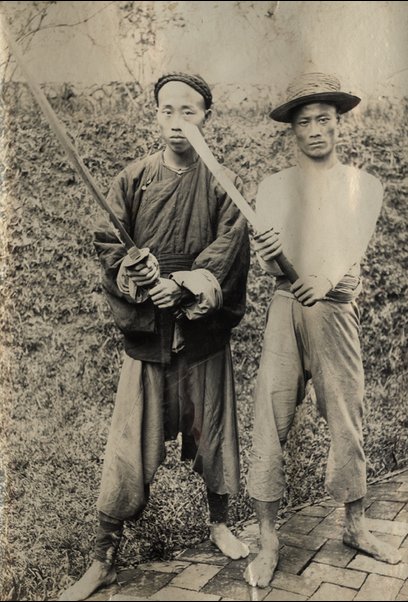
On the morning of September 17, 1895, in the presence of the British and American consuls, seven perpetrators of a Chinese massacre of western Christian missionaries were beheaded at Foochow.

Anticipating the better-known Boxer Rebellion by four years, the Kucheng Massacre (there are many other transliterations of “Kucheng”) was likewise a response to the Celestial Empire’s frustrating second-class status as against European interlopers.

Christian missionaries had been a point of friction in China for decades. Though their rights to proselytize had been guaranteed in a hated treaty dictated to China by force of arms, they often met resentment or worse on the ground.

“You bring incense in one hand, a spear in the other;” one evangelist reported being told: that is, however honorable the immediate intentions of many individual missionaries, their presence looked like a stalking horse for less reputable western interventions like the opium trade. (That’s how it looked to many Chinese. Professional western diplomats themselves found the impolitic preachers a hindrance to their statecraft, according to Ian Welch’s 2006 paper “Missionaries, Murder and Diplomacy in Late 19th Century China: A Case Study” (pdf).*)

On August 1, 1895, these frustrations unleashed a river of blood at the village of Huashan in Gutian County, where a Buddhist secret society — known as “Vegetarians” in the western press for their characteristic dietary vow — fell upon a group of vacationing British Anglican missionaries still abed at dawn and ruthlessly slaughtered eleven of them. (There are some 1890s books paying tribute to the fallen available online: Robert and Louisa Stewart: In Life and in Death, and The sister martyrs of Ku Cheng : Memoir and Letters of Eleanor and Elizabeth Saunders (“Nellie” and “Topsie”) of Melbourne.)

“The attack came,” said a physician from a nearby town who was summoned to the bloody scene, “like a thunderbolt from a clear sky, not one of the victims having received the slightest intimation of the intended assault.”

Word of the carnage struck western powers with similar force.

Incensed newspaper-readers literally demanded** gunboat diplomacy, and literally got it, especially when Chinese authorities drug their feet on the condign punishment the missionaries’ countrymen were clamoring for.

All this put British diplomacy on a sticky wicket, which Welch (pdf) deals with in detail. To satisfy the domestic audience, the government had to be seen to be taking a hard line on avenging the outrages; at the same time, London was wise to the Chinese state’s shakiness and wary that a “barbarous holocaust” perpetrated against the Vegetarians would trigger a mass backlash and bring the whole thing down.

An obdurate Chinese viceroy impeded the quick resolution everyone was after by making inflammatory public proclamations against Christians, and releasing without explanation six of the thirteen men who had initially been condemned to death in the month of August. The seven who were executed on this date were therefore only the vanguard of 26 humans ultimately put to death for their involvement in the atrocity.

Some of the execution photographs that follow are Mature Content. They’re obtained via Visual Cultures in East Asia; some also available at USC Digital Library.


Raids and investigations to bring the Vegetarian movement to heel continued for several months thereafter, and the whole affair ultimately was quelled without doing any of the wider damage that might have been feared — not even to missionaries who continued pouring into China.

And that, effectively, kicked the can down the road on the anti-foreigner sentiments afoot in the land … sentiments that would find much costlier expression a few years later when another secret society kicked off the Boxer Rebellion.

* I’ve relied heavily on Welch for this post. He’s also collected a massive trove (over 1,200 pages) of primary documents from this incident available in a series of pdfs (some quite large) from the Australian National University website:

** This was not universally so. The wife of missionary Stephen Livingston Baldwin, who knew some of the victims of the attack, urged a “charitable” response and sensitivity that “the Chinese feel that all the world is against them, and they are not far from right.” (New York Times, Aug. 10, 1895) In letters responding to intemperate coverage elsewhere, she acidly compared (pdf) western editorialists’ high dudgeon to their look-forward-not-back dismissal of recent stateside anti-Chinese violence.

It was ten years yesterday since more Chinese were killed, and burned alive and left to die wounded, in one hour, at Rock Springs, Wyoming (the very same Territory in which the recent massacre occurred) than have been Americans and English in China in the thirty-four years I have personally known that land, being a resident there twenty years and closely connected with it ever since. Ten years yesterday since that awful Rock Springs massacre, and up to date no one arrested, much less punished! The anti-Chinese papers of the town and neighbourhood gloating over the awful details and assuring all that there would be “no Congressional investigation,” and no waste of “enterprising newspaper eloquence” over the woes of the Chinese, “though their blood flow like rivers, as they had no votes and no friends.” In less than four weeks after the Ku-Cheng massacre, arrest, investigation and execution have all taken place for the Ku-Cheng massacre. Would that our colored, red and yellow brethren, so helpless in our so-called civilized and Christian land, had some power behind them to bestir Ministers Plenipotentiary, wave flags, and run gunboats to the front, to bully, if necessary, our pusillanimous Government into some sort of civilization — I will not say Christian justice!

On this day..