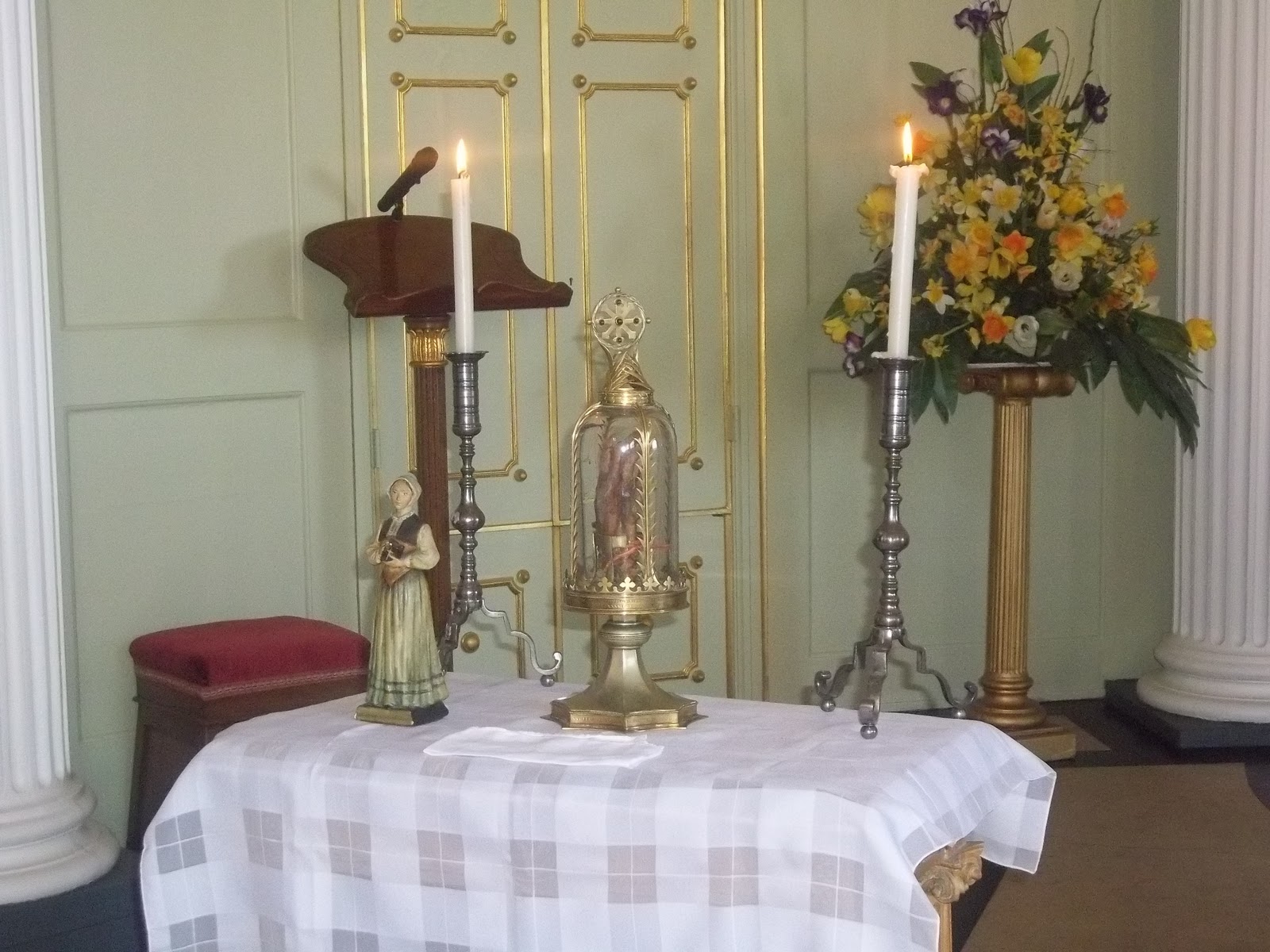
1556: Joan Waste, in Windmill Pit

On this date in 1556, Derby hosted the incineration of a young blind woman who refused to renounce her Protestantism.

The ascendance of Queen Mary briefly restored Catholicism as England’s official religion. The previous decades’ Protestant reforms, however, had been achieved with bloodshed and could only be undone with more bloodshed. (That’s why she’s “Bloody Mary”: because she executed a bunch of people, and because the Protestants who executed a bunch of people won out and got to do the naming.)

In the wrong place at the wrong time was Joan Waste, who though blind proved a deft hand at knitting ropes to support her poor family. Inspired by hearing Scripture in the Queen’s English during Anglican services shaped by Cranmer, Joan scrimped and saved the earnings of her poor profession until she could afford a Bible … specifically (and problematically for the new old faith), one printed in English rather than Latin. Being blind, she then had to recruit friends, townspeople, or other parishioners to read it to her.

This made her a pretty easy target when England reinstated Catholic heresy laws in 1555, although presumably not one selected by the public relations department. Pious Joan preferred the stake to renouncing her heresies.

After enduring an execution sermon from the Catholic churchman Anthony Draycot, Foxe’s martyrology describes the fate of “the poor, sightless object” — which doesn’t look the most felicitous build of a noun phrase — who “was taken to a place called Windmill Pit, near the town, where she for a time held her brother by the hand, and then prepared herself for the fire, calling upon the pitying multitude to pray with her, and upon Christ to have mercy upon her, until the glorious light of the everlasting Sun of righteousness beamed upon her departed spirit.”

The old Windmill Pit execution site can still be found in Derby today. There’s a local legend, of Victorian manufacture, that Joan cursed the location with the words: “never shall this pit, of which ye are about to make a pit of fire, hold drop of water more.”

On this day..

Feast Day of St. James the Greater

It’s a big day today in the Galician city of Santiago de Compostela, because the twenty-fifth of July is the feast of its patron and namesake* St. James the Great.

One of the original Apostles (literally, he and his brother John are the first two whom Jesus calls in the Gospels), James also had the distinction of apparently being the first Apostle to die for Christ.** His execution at the hands of Herod Agrippa† is reported in Acts 12:2;‡ it’s the only apostolic execution in the New Testament.

This, of course, occurred on the southeastern fringe of the Mediterranean, so it’s a wonder that James’s bones came to repose at a Spanish city literally situated on Finisterre, the far western edge of the world as far as Europeans saw it. The Lord works in mysterious ways.

It’s certainly plausible — though impossible to substantiate — that James evangelized in Spain prior to his execution. The whole Mediterranean was a Roman lake. More towards the outlandish is the patriotic story (pdf) that James’s relics were miraculously discovered there in 813 at the moment when Muslim expansion into Iberia gave the hard-pressed Christian kingdoms the greatest possible need for a morale boost.§

James became for those souls Saint James Matamoros, Moor-slayer, and started turning the tide of fictional battles and blessing his own very real chivalric order.


Saint James gets his Moor-slaying on.

“A knight of Christ’s squadrons,” Cervantes wrote. “St. James the moorslayer, one of the most valiant saints and knights the world ever had, and that now the heavens have … this great knight with the vermilion cross has been given by God to Spain for its patron and protection.”

James’s martial prowess is entirely posthumous: when the Son of God recruits him, he’s a humble piscator at labor mending his nets (there are some less-bellicose present-day churches going under the name “Saint James the Fisherman”). Gibbon could not but marvel at the “stupendous metamorphosis [that] was performed in the ninth century, when from a peaceful fisherman of the Lake of Gennesareth, the apostle James was transformed into a valorous knight, who charged at the head of Spanish chivalry in battles against the Moors. The gravest historians have celebrated his exploits; the miraculous shrine of Compostella displayed his power; and the sword of a military order, assisted by the terrors of the inquisition, was sufficient to remove every objection of profane criticism.”

But mythmaking exercises a historicity all its own, and the James legends offered a rallying-point for Spain’s Christians. He stands to this day the patron of Spain as well as a number of places colonized by Spain.

Pilgrims have ever since that stupendous metamorphosis of the 9th century made the journey to the apostle’s purported resting-place; this Way of St. James, actually comprising several different possible routes covering hundreds of kilometers on foot, has in recent years emerged as a major tourist draw. The Way terminates, of course, at Santiago de Compostela and the enormous cathedral there where repose James’s relics.

Saint James’s Day, 25 July, is its celebratory culmination.

James so overawes July 25 on the liturgical calendar that it’s a mere footnote to add that this same day also pays homage to Saint Christopher, a historically dubious Christian martyr from the third or early fourth century Roman Empire.

Christopher is rather nifty, because he’s sometimes depicted in iconography as cynocephalic — that is, having the head of a dog. At least the rest of him is human, unlike Saint Guinefort the Greyhound. (No lie. It’s a doggie saint, albeit of the distinctly unofficial variety. To stamp out folk veneration, an incensed preacher “had the dead dog disinterred, and the sacred wood [where it received offerings] cut down and burnt, along with the remains of the dog.”)

* The name “Santiago” derives from our saint’s name in Latin, Sanctu Iacobu. This is also the source, and James the intended honorary, for other places on the map named Santiago, such as Santiago, Chile.

** Assuming you don’t count Judas Iscariot, of course.

† Herod Agrippa is not to be confused with his grandfather Herod the Great — the Biblical Massacre of the Innocents guy — nor with his uncle Herod Antipas — the guy who punted Jesus’s prosecution back to Pontius Pilate. Three different Herods; three different New Testament heavies.

‡ James’s death in Acts 12 is followed immediately by Saint Peter staging a supernatural jailbreak out of the same prison. The latter goes on to evangelize for another 20-odd years.

§ The holy remains reached that resting point, goes the legend, only by perilously navigating a path of dragons, pagans, and wagons.

On this day..

1608: St. Thomas Garnet, protomartyr of Stonyhurst

June 23, alas, was the end of the line for Jesuit Thomas Garnet, martyred on that date in 1608 for Catholic proselytizing in England.

Now accounted a saint and one of the Forty Martyrs of England and Wales, Garnet was the nephew of Henry Garnet, a priest executed in 1606 for complicity in the November 5, 1605 Gunpowder Plot.

Thomas, too — then about 30 years old — was arrested during this same backlash, and put to torture for evidence against uncle Henry. Thomas had been exercising his covert ministry in England since 1599, after slipping English custody once before.

As a result of the Gunpowder Plot hubbub, Thomas Garnet was among 47 Catholic clerics shipped across the English Channel to Flanders in July 1606, where they were warned that they faced execution should they ever again be caught in England.

Thomas Garnet returned, of course. He was betrayed within weeks by another priest named Rouse — whom Garnet publicly forgave while being drawn, hanged, and quartered on this date in 1608. (His faith was treasonable because he refused to swear an oath of allegiance demanded of Catholics post-5.11.)

Garnet’s remains were translated back to his Catholic school on the continent. In more tolerant times, long after Garnet’s death, this English Jesuit school finally had liberty to relocate back to England proper. While Garnet’s relics were destroyed in the French Revolution, he remains the protomartyr (the first martyr associated with a place) of the venerable Stonyhurst College, now in Lancashire.

On this day..

1886: Twenty-two Uganda Martyrs

(Thanks to Meaghan Good of the Charley Project for the guest post. -ed.)

On this date in 1886, thirteen Catholic men and boys, as well as nine Anglican Christians, were burned alive in Buganda, a kingdom in modern-day Uganda. Most of them pages at the royal court, they had been martyred for their faith.

The kingdom of Buganda came in contact with Europeans in the 1860s; Arab traders had been doing business there a few decades before that. Christian missionaries arrived in Buganda in 1879. In the next few years many court officials converted.

King Muteesa I tolerated Muslims, Catholics and Protestants and played them off against other for political gain, but his sixteen-year-old son, Mwanga II, who ascended the throne in 1884, was a different story altogether. He saw Christianity as a serious threat to his authority and cracked down on its influence.

Mwanga expelled many missionaries ordered converts to renounce their faith on pain of death. He had James Hannington, the Anglican Bishop of Eastern Equatorial Africa, executed in October 1885.

Between 1885 and 1887, Mwanga ordered the deaths of 45 Christian men (22 Catholics and 23 Anglicans). Collectively they are known as the Martyrs of Uganda. Most of them were young. (One of the boys who would die on this day was all of fourteen years old.)

Joseph Mukasa was the first of the Martyrs to die. A page and personal attendant to King Muteesa, he became majordomo after Mwanga took the throne, and had permission to criticize the king. He had converted to Roman Catholicism in 1882. Mukasa had strongly urged Mwanga to spare Bishop Hannington’s life.

For his pains, Mukasa was himself executed and his body burned only two weeks after Hannington. The chief page, Charles Lwanga, became majordomo in his place.

That very same day, Lwanga went and got himself baptized. He was a Catholic catechist, and he anticipated the cup he was about to quaff. The Dictionary of African Christian Biography records:

The following day, the king assembled all the pages and demanded under pain of death that they confess their Christian allegiance. All of them, Catholic and Anglican, except for three, did so. Mwanga was baffled by the solidarity and constancy of the young Christians, but hesitated to carry out his threat to kill them all. Several times in early December the king attempted to intimidate his pages, in spite of visits from the Catholic and Anglican missionaries. On one occasion, Lwanga exclaimed that, so far from helping the white men to take over the kingdom, he was ready to lay down his life for the king.

After the fire in the royal palace on February 22, 1886, Mwanga moved the court temporarily to his hunting lodge at Munyonyo on the shore of Lake Victoria. Here Lwanga continued to protect the pages … and to prepare them for possible martyrdom. By this time, Mwanga had obtained the consent of his chiefs for a massacre of the Christians. Meanwhile, Lwanga himself baptized five of the most promising catechumens. On May 26 … the pages entered the royal courtyard to receive judgement. Once again, they were called upon to confess their faith. This they did, declaring that they were ready to die rather than to deny it. Mwanga ordered them all, sixteen Catholics and ten Anglicans, to be burnt alive at Namugongo.

Several of the condemned were killed before the main event. The oldest, Matthias Kalema, aged about fifty, was dismembered alive and pieces of him were roasted before his eyes. He died slowly and horribly over the course of three days, finally expiring on May 30. Three others collapsed during the march to the execution site in Namugongo and were killed on the spot.

One of them, however, was inexplicably spared at the last possible moment. Denis Kamyuka was pulled away from the fire by some of the soldiers. It’s worth noting that Kamyuka appears to have been among the youngest of the group, around thirteen or fourteen; perhaps his executioners took pity on him for this reason. It is from his testimony that we know the details of what happened to his friends.

Everyone prayed and recited the catechism on the way to their deaths. Each of the pages were bound and wrapped up in reeds before being placed alive in the bonfire. The exception was Mbaaga Tuzinde, the son of the chief executioner; his father, who had pleaded for him to renounce his religion and offered to hide him, ordered that he be clubbed to death before being put into the flames.

Charles Lwanga, their leader, was burned separately from the others and was allowed to arrange his own pyre. As the executioners taunted him he said, “It is as if you are pouring water on me.”

In 1888, Christian and Muslim converts deposed King Mwanga in a British-backed uprising and put his brother on the throne in his place. Mwanga got his crown back in 1889 after he agreed to turn partial control of Buganda to the British East Africa Company. In 1897, however, he declared war on the British and attacked them. Trounced within weeks, Mwanga fled the country and was deposed in absentia. He returned with an army, but was defeated again, this time for good, and exiled to the Seychelles. In the final years of his short life he converted to Anglicanism. He died in 1903, aged 35.

The 22 Catholic converts who were martyred in Uganda during Mwanga II’s reign were beatified in 1920. Denis Kamyuka was present at the ceremony.

The site where the Uganda Martyrs were burned is now a holy shrine, a 33-acre site marked by a distinctive conical building. Every year on this date, pilgrims come there to commemorate Uganda Martyrs Day.


Re-creation of the burning on-site at the shrine. (cc) image from Christian von Schack.

On this day..

1940: Wilhelm Kusserow, Jehovah’s Witness

(Thanks to Meaghan Good of the Charley Project for the guest post. -ed.)

On this date in 1940, 25-year-old Wilhelm Kusserow was executed by firing squad at Münster Prison in Germany.

A Jehovah’s Witness, he interpreted God’s command “thou shalt not kill” literally and refused to serve in the German army — a big no-no in Hitler’s Third Reich.

Kusserow had actually been born Lutheran, but his parents became Jehovah’s Witnesses after World War I and raised their eleven children in the faith. Jehovah’s Witnesses, in addition to not serving in the army, also refused to Heil Hitler, since the tenets of their religion required them to make obeisance only to Jehovah.

They were persecuted by the Nazis from the beginning of Hitler’s regime, and by 1935 the religion was banned altogether. The Kusserows, and many others, continued to practice their faith in secret.

During the Nazi era, some 10,000 Jehovah’s Witnesses did time in prisons and concentration camps (where they were required to wear a purple triangle), Wilhelm’s parents and siblings among them. 2,500 to 5,000 died.

The children in Jehovah’s Witness families were taken from their parents and sent to orphanages, foster families or reform schools.

(French Witness Simone Arnold Liebster would write a memoir about the years she spent in institutions as a child because she and her parents refused to renounce their beliefs.)

At Wilhelm Kusserow’s trial, the judge and the prosecutor were apparently reluctant to condemn this young man. They pleaded with him to back down, promising to spare his life if he did so, but Wilhelm refused. Some things were more important to him than life itself.

In his final letter to his family he wrote,

Dear parents, brothers, and sisters:

All of you know how much you mean to me, and I am repeatedly reminded of this every time I look at our family photo. How harmonious things always were at home. Nevertheless, above all we must love God, as our Leader Jesus Christ commanded. If we stand up for him, he will reward us.

Hitler later decided the firing squad was too honorable a death for Jehovah’s Witnesses and ordered that they be decapitated instead. Wilhelm’s younger brother Wolfgang, who had also refused to serve in the army, was executed in this manner in 1942.

On this day..

1705: The Camisards Catinat and Ravanel

On this date in 1705, two men were burned at the stake and two others broken on the wheel — Camisards all, put to death in Nimes, France.

The Camisards* were French Protestants of the mountainous southern Cevennes region who make their entry into these pages because the crown in 1685 revoked the Edict of Nantes, France’s guarantee of multiconfessional toleration.

Protestants were going to be bullied into conversion — or, in many cases, flight. (London’s Spitalfields textile industry, for instance, got a welcome shot in the arm from refugee Huguenot weavers.)

In 1702, the Cevennes Protestants pushed back.

“A persecution unsurpassed in violence had lasted near a score of years,” Robert Louis Stevenson wrote in his 19th century travelogue of the region. “This was the result upon the persecuted; hanging, burning, breaking on the wheel, had been in vain; the dragoons had left their hoof-marks over all the countryside; there were men rowing in the galleys, and women pining in the prisons of the Church; and not a thought was changed in the heart of any upright Protestant.”

On July 24, 1702, the Catholic torturer-priest running this show was assassinated, and the Camisard revolt was on.

Two years of dirty neighbor-on-neighbor violence mostly petered out in 1704 with the loss of the Camisards’ two main leaders — Jean Cavalier, the brilliant peasant-turned-commander who was bought off by an army commission and a royal pension, and Roland Laporte, who was betrayed as by Judas for 200 pieces of gold.

Catinat and Ravanel were Cavalier’s lieutenants; according to Alexandre Dumas, Catinat was a peasant named Abdias Maurel who picked up his nickname after serving under Marshal Catinat in the War of Spanish Succession.

The prospect of a renewed rising drew them back — a bold and terrible stroke to mount a surprise massacre and kidnap the exiled English Duke of Berwick. Catinat returned from his hidey-hole in Geneva; Ravanel came the bush where he was the last notable Camisard commander in the field.

An informer spilled the secret and the conspirators were busted in Nimes before they could spring their trap.

They faced immediate trial and condemnation — Catinat and Ravanel, along with two younger fighters named Jonquet and Villas.

After a long bout of pre-execution torture on April 21 to reveal their conspirators,**

The next day, the 22nd April, 1705, they were taken from the prison and drawn to the place of execution in two carts, being unable to walk, on account of the severe torture to which they had been subjected, and which had crushed the bones of their legs. A single pile of wood had been prepared for Catinat and Ravanel, who were to be burnt together; they were in one cart, and Villas and Jonquet, for whom two wheels had been prepared, were in the other.

The first operation was to bind Catinat and Ravanel back to back to the same stake, care being taken to place Catinat with his face to windward, so that his agony might last longer, and then the pile was lit under Ravanel.

As had been foreseen, this precaution gave great pleasure to those people who took delight in witnessing executions. The wind being rather high, blew the flames away from Catinat, so that at first the fire burnt his legs only — a circumstance which, the author of the History of the Camisards tells us, aroused Catinat’s impatience. Ravanel, however, bore everything to the end with the greatest heroism, only pausing in his singing to address words of encouragement to his companion in suffering, whom he could not see, but whose groans and curses he could hear; he would then return to his psalms, which he continued to sing until his voice was stifled in the flames. Just as he expired, Jonquet was removed from the wheel, and carried, his broken limbs dangling, to the burning pile, on which he was thrown. From the midst of the flames his voice was heard saying, “Courage, Catinat; we shall soon meet in heaven.” A few moments later, the stake, being burnt through at the base, broke, and Catinat falling into the flames, was quickly suffocated. That this accident had not been forseen and prevented by proper precautions caused great displeasure to spectators who found that the three-quarter of an hour which the spectacle had lasted was much too brief a time.

Villas lived three hours longer on his wheel, and expired without having uttered a single complaint.

A hecatomb of Camisard executions followed, fed by the denunciations of frightened or avaricious people; still others were “merely” condemned to the galleys … bringing at last a sullen peace of arms to the turbulent province.

* Here’s a 19th century public domain novel about the whole Camisard business.

** While three bore the torture quietly, Villas coughed up the name Boeton de Saint-Laurent-d’Aigozre. This man, too, was arrested and executed.

On this day..

1923: Konstanty Romuald Budkiewicz, Catholic priest in the USSR

Late the night of March 31-April 1, which was in 1923 the dark between Holy Saturday and Easter Sunday, the Catholic priest Konstanty Budkiewicz (Konstantin Budkevich) was shot in the cellars of Lubyanka.

Born to a Polish family in present-day Latvia, Budkiewicz (English Wikipedia link | Polish) went to seminary in St. Petersburg. He was in that same city, now a 50-year-old vicar-general, when the Bolshevik Revolution shook Petrograd.

Given the Bolsheviks’ anti-clericalism, this was bound to be a trying position: Catholic clergy, especially of relative prominence, faced intermittent harassment. The outlander Latin rite and any Pole’s hypothetical association with Russia’s ancient geopolitical foe only exacerbated the situation.

Matters came to a head with the March 13, 1923 arrest (Polish link) of a number of Catholic clergy. In the ensuing days, most would be convicted and sentenced to death at a show trial on the grounds of “inciting rebellion by superstition.” To be charged with “inciting rebellion by superstition” is pretty much to stand condemned for it, one would think.

New York Herald correspondent Francis McCullagh, who was present in the courtroom, would later publish his observations of the proceedings in The Bolshevik Persecution of Christianity. The proseutor, McCullagh wrote,

launched into an attack on religion in general and the Catholic Church in particular. “The Catholic Church,” he declared, “has always exploited the working classes.” When he demanded the Archbishop’s death, he said, “All the Jesuitical duplicity with which you have defended yourself will not save you from the death penalty. No Pope in the Vatican can save you now.” …As the long oration proceeded, the Red Procurator worked himself into a fury of anti-religious hatred. “Your religion”, he yelled, “I spit on it, as I do on all religions, — on Orthodox, Jewish, Mohammedan, and the rest.” “There is not law here but Soviet Law,” he yelled at another stage, “and by that law you must die.”

Although information about anti-Christian hostility in the USSR tended to reach the wider world in fragmentary form only, there was an outcry in the western world over this trial’s condemnation of Budkiewicz’s boss, Archbishop Jan Cieplak, as well as that of Monsgnor Budkiewicz. International pressure would ultimately save one of those men … but only one.

Cieplak’s death sentence was commuted, and in 1924 he was even released and allowed to leave for Poland. He died in the United States in 1926.

Budkiewicz made do with grace of the celestial kind. He was whisked from his cell late on the 31st, and shot sometime overnight in the notorious Lubyanka prison in Moscow. Soviet authorities were so tight-lipped and obfuscatory about his situation that the pope prayed publicly in St. Peter’s later that same day for Budkiewicz’s life to be spared. Only several days later was the accomplished fact of Budkiewicz’s execution openly confirmed.

The Polish poet Kazimiera lllakowiczówna dedicated a verse to Budkiewicz, titled The story of the Moscow martyrdom.

Budkiewicz is being investigated by the present-day Catholic church for possible beatification. (Archbishop Cieplak is, too.)

On this day..

1586: Saint Margaret Clitherow, pressed Catholic

(Thanks to historian Courtney Thomas for the guest post. -ed.)

On March 25, 1586 Margaret Clitherow, the wife of a York-based butcher, was subjected to one of the more obscure forms of capital punishment in early modern England: she was pressed to death, the mandated form of punishment for those who refused to enter a plea to a legal charge.*

Margaret was a victim of increasingly stringent attitudes toward recusants in the second half of Elizabeth I’s reign (1558-1603): Margaret was pressed to death just a year before the execution of Mary Queen of Scots for her role in a Catholic plot to overthrow the Elizabethan regime and two years before the 1588 Spanish Armada.

The two officials who were tasked with carrying out the sentence allegedly employed several beggars to perform the job instead and Margaret was taken to the toll-both on the bridge that straddles the river Ouse where she was stripped and had a handkerchief tied over her eyes as a blindfold. She was then placed upon a rock roughly the size of a baseball or an adult’s fist and a large panel of wood (roughly the size of a door) was put on top of her and slowly loaded with 700-800 pounds of rocks and stones.

In theory the smaller rock beneath her would break her back when the heavy rocks were piled on.

Witnesses report that she expired within about fifteen minutes. Other victims of this punishment were not typically so lucky. For example, Giles Corey, executed in Salem in 1692, had weights slowly piled on him for a period of several days (being asked daily before more weight was added if he wished to enter a plea to the charge that he was a warlock) before he expired.

Margaret was born Margaret Middleton in 1552/3, the daughter of a wax-chandler named Thomas and his wife Jane, the daughter of Richard Turner, an innkeeper. One of four children, she was born during the reign of Mary I (who has gone down in history with the unfortunate (but not entirely undeserved) appellation “Bloody” attached to her).

A bit of background on the process of the various reformations in England is necessary to understand why Margaret’s Catholic beliefs were treated so harshly.

Having broken with the Roman Catholic Church and founded the Anglican Church in the 1530s through a legislative reformation designed to assist him in securing the dissolution of his marriage to Catherine of Aragon so that he could wed Anne Boleyn, Henry VIII saw many of his religious policies undone by his heirs.

He was succeeded on the throne in 1547 by his son (with his third wife, Jane Seymour), Edward VI, who made England into a more recognizably Protestant state than Henry appears to have intended (while Henry was interested in reforming stances, he appears to have identified most strongly with Catholic principles and geared his reformation toward abolishing the authority of the Pope in English ecclesiastical affairs, rather than changing beliefs and practices).

Edward was, however, a short-lived king, having died in 1553 after but six years on the throne. He was succeeded by his half-sister Mary (daughter of Henry’s first wife Catherine of Aragon) who was a devout Catholic and spent much of her reign steering England back into the port of Catholicism — a task which involved martyring approximately three hundred of her subjects for their Protestant sympathies.

Mary, in turn, was succeeded by Elizabeth, the daughter of Henry’s second wife, Anne Boleyn. Elizabeth was of a Protestant mindset and reinstituted the Anglican Church. Though initially reluctant to persecute people for their beliefs (she expressed herself as having no desire to “make windows into men’s souls”), political circumstances involving a plethora of plots on the part of Catholics (both real and perceived) against the Queen resulted in a hardening of attitudes.

While fines and penalties were in place for non-attendance at Church of England services, the regime also began to enforce strict penalties against those found guilty of sheltering priests and Jesuits. And it was to these laws that Margaret fell victim.


On July 1, 1571, when she was about eighteen years old, Margaret wed John Clitherow, a local York butcher and a widower with two sons. The number of children borne by Margaret to her husband is unknown; in addition to her stepsons William (1563-1636) and Thomas (d. 1604), she bore Henry (b. 1572) and Anne (1574-1622) and there is mention of other pregnancies but the details do not survive.

In 1574, when she was twenty one, Margaret experienced a spiritual awakening and converted to Catholicism.

While her husband did not join her in converting, members of his family also held Catholic sympathies and he was not unsupportive of her conversion, with the exception of one recorded incident when he railed against Catholics while drunk at a banquet.

Margaret soon became highly involved in northern England’s underground Catholic community. She regularly held masses in her home in the Shambles (where she assisted her husband with his business) and her son, Henry, traveled to Rheims (a Jesuit centre) to train for the priesthood. Inside her home, Margaret created a series of architectural features to facilitate the concealing of priests, including a priest hole and a hole which was cut between the attics of her house and the adjoining house which could be used by a priest to escape in the event that the house was searched.

Inevitably Margaret’s involvement with the local Catholic community drew official censure, and from 1576 onwards, John Clitherow incurred regular fines for her refusal to attend Church of England services with him. She was also imprisoned several times for her refusal to conform, serving three separate terms in York Castle as a recusant (August 1577 – February 1578; October 1580 – April 1581; March 1583 – winter 1584).

Once released, despite her efforts at concealment, on March 10, 1586 Margaret was arrested for harbouring priests (which, in 1585 had been made a capital offense). In a search of her house, a frightened child had revealed the location of a secret room containing Catholic paraphernalia and designed to shelter a priest.

After her arrest, Margaret was jailed and on March 14 she appeared at the assizes. Although she was repeatedly asked to plead, she refused a trial by jury and thereby incurred the penalty of peine forte et dure: being crushed or pressed to death. Margaret maintained that her refusal to plead was a measure to prevent her children and servants having to testify against her and also served to protect the souls of the jury which would find her guilty. It is very likely that she also wanted to protect other local recusants who had assisted her and desired to prevent the revealing of their identity, which a trial would have uncovered. However, many contemporaries simply thought her mad and wondered at her seeming indifference to her husband and children — and Margaret’s willingness to abandon them for martyrdom.

Yet, despite her imminent death, Margaret allegedly did not forget her family in her final days and reportedly sent her hat to her husband and her hose and shoes to her daughter, Anne. Some people, including her father-in-law, engaged in scurrilous mongering and postulated that Margaret’s willingness to die stemmed from guilt over an illicit encounter with her confessor, whose child she now carried. Such views, however, did not attain much popularity.

After her sentencing, she was visited by several local Protestant preachers and kin, who endeavoured in vain to persuade her to plead guilty and throw herself on the mercy of the assize justices. She also appears to have been pregnant at the time as many people urged her to publicly admit her condition and thereby obtain a stay of execution.

Margaret steadfastly refused to consider any of these things; she had embraced martyrdom. After her death, local family and friends (one of whom, John Mush, later authored a biography that remains the primary source for her life) found her corpse (buried anonymously as a criminal) and reinterred her in an unknown location in accordance with Catholic rites.

After his wife’s death, John Clitherow married for a third time and remained a convinced Protestant until his own death. The couple’s children, however, embraced their mother’s Catholic faith. Anne Clitherow was briefly imprisoned in 1593 for her refusal to attend Church of England services and eventually became a nun at the convent of St. Ursula’s in Louvain in 1598. Henry (the son who had traveled to Rheims) studied first to be a Capuchin (he joined that order in 1592) and then to become a Dominican. He died, possibly insane, without having firmly settled on an order. Margaret’s stepson, William, became a priest in 1608, and her other stepson, Thomas, a draper, was imprisoned for his recusancy. He died in Hull prison in 1604.

Margaret’s work for the English Catholic community and her martyrdom resulted in her canonization in the twentieth century. She was beatified in 1929 and canonized in October of 1970 — one of the Forty Martyrs of England and Wales. After her execution, somebody apparently chopped off her hand to preserve as a relic at the Bar Convent in York. Margaret’s feast day in the current Roman Catholic calendar, together with that of the other thirty-nine English martyrs, is May 4 — although in England it is celebrated on August 30.

A few books about Margaret Clitherow

* Editor’s note: the trial could not begin without a guilty/not-guilty plea, so pressing was a means of forcing a mum defendant to the bar. Brute force often succeeded in extracting the necessary plea; however, because death by pressing preceded trial or conviction, a defendant hardy enough to undergo that fate could use it as a means to skip to the “execution” without suffering the other pains of criminal conviction. In Margaret’s case, she avoided the potential implication of other furtive Catholics at trial; in Giles Corey’s case, he avoided forfeiting his property upon the inevitable witchcraft conviction, and passed his estate to his heirs instead.

On this day..

1649: Saint Jean de Brébeuf, missionary to the Huron

It was on this date that the Jesuit missionary Saint Jean de Brébeuf was martyred by indigenous Iroquois near present-day Midland, Ontario.

(cc) image from Patrick Shanks

Brebeuf was of Norman stock, kin to poet Georges de Brebeuf.

Ordained in 1622, Brebeuf soon decamped to the New World to Christianize the natives.

There he teamed up with another Jesuit missionary named Gabriel Lalemant and established the Sainte-Marie among the Hurons mission.

As the name advertises, this outpost aimed to minister to the Hurons (Wyandot); to that end, Brebeuf — who learned the local tongue well enough to write a catechism and a dictionary — composed the still-beloved Christmas song “Huron Carol”.

Brebeuf’s own missives recording Huron established him an energetic chronicler who has been styled Canada’s first serious ethnographer. For instance, Brebeuf on the POW treatment he saw the Huron dish out:

when they seize some of their enemies, they treat them with all the cruelty they can devise. Five or six days will sometimes pass in assuaging their wrath, and in burning them at a slow fire; and they are not satisfied with seeing their skins entirely roasted, — they open the legs, the thighs, the arms, and the most fleshy parts, and thrust therein glowing brands, or red-hot hatchets … After having at last brained a victim, if he was a brave man, they tear out his heart, roast it on the coals, and distribute it in pieces to the young men; they think that this renders them courageous … we hope, with the assistance of Heaven, that the knowledge of the true God will entirely banish from this Country such barbarity. (From the Jesuit Relations, volume 10)

Well … not just yet.

Brebeuf regrettably foreshadowed his own ghastly fate, for during his ministry, the Huron and Iroquois went to war. No fewer than eight men posted to Brebeuf’s mission were martyred during 1640s Huron-Iroquois wars.

On March 16, 1649, Iroquois captured Brebeuf and Lalemant, and subjected them to a horrific death just like the sort of thing Brebeuf had seen inflicted by the Huron. Other Jesuit missionaries recorded the tortures from eyewitness accounts given in the subsequent weeks:

As soon as they were taken captive, they were stripped naked, and some of their nails were torn out; and the welcome which they received upon entering the village of St. Ignace was a hailstorm of blows with sticks upon their shoulders, their loins, their legs, their breasts, their bellies, and their faces, — there being no part of their bodies which did not then endure its torment.

Father Jean de Brebeuf, overwhelmed under the burden of these blows, did not on that account lose care for his flock; seeing himself surrounded with Christians whom he had instructed, and who were in captivity with him, he said to them: “My children, let us lift our eyes to Heaven at the height of our afflictions; let us remember that God is the witness of our sufferings, and will soon be our exceeding great reward. Let us die in this faith; and let us hope from his goodness the fulfillment of his promises. I have more pity for you than for myself; but sustain with courage the few remaining torments. They will end with our lives; the glory which follows them will never have an end.” “Echon,” they said to him (this is the name which the Hurons gave the Father), “our spirits will be in Heaven when our bodies shall be suffering on earth. Pray to God for us, that he may show us mercy; we will invoke him even until death.”

Some Huron Infidels — former captives of the Iroquois, naturalized among them, and former enemies of the Faith — were irritated by these words, and because our Fathers in their captivity had not their tongues captive. They cut off the hands of one, and pierce the other with sharp awls and iron points; they apply under their armpits and upon their loins hatchets heated red in the fire, and put a necklace of these about their necks in such a way that all the motions of their bodies gave them a new torture. For, if they attempted to lean forward, the red-hot hatchets which hung behind them burned the shoulders everywhere; and if they thought to avoid that pain, bending back a little, their stomachs and breasts experienced a similar torment; if they stood upright, without leaning to one side or the other, these glowing hatchets, touching them alike on all sides, were a double torture to them. They put about them belts of bark, filled with pitch and resin, to which they set fire, which scorched the whole of their bodies.

At the height of these torments, Father Gabriel Lallement lifted his eyes to Heaven, clasping his hands from time to time, and uttering sighs to God, whom he invoked to his aid. Father Jean de Brebeuf suffered like a rock, insensible to the fires and the flames, without uttering any cry, and keeping a profound silence, which astonished his executioners themselves: no doubt, his heart was then reposing in his God. Then, returning to himself, he preached to those Infidels, and still more to many good Christian captives, who had compassion on him.

Those butchers, indignant at his zeal, in order to hinder him from further speaking of God, girdled his mouth, cut off his nose, and tore off his lips; but his blood spoke much more loudly than his lips had done; and, his heart not being yet torn out, his tongue did not fail to render him service until the last sigh, for blessing God for these torments, and for animating the Christians more vigorously than he had ever done.

In derision of holy Baptism, — which these good Fathers had so charitably administered even at the breach, and in the hottest of the fight,—those wretches, enemies of the Faith, bethought themselves to baptize them with boiling water. Their bodies were entirely bathed with it, two or three times, and more, with biting gibes, which accompanied these torments. “We baptize thee,” said these wretches, “to the end that thou mayst be blessed in Heaven; for without proper Baptism one cannot be saved.” Others added, mocking, “we treat thee as a friend, since we shall be the cause of thy greatest happiness up in Heaven; thank us for so many good offices, — for, the more thou sufferest, the more thy God will reward thee.”

These were Infidel Hurons, former captives of the Iroquois, and, of old, enemies of the Faith, — who, having previously had sufficient instruction for their salvation, impiously abused it, — in reality, for the glory of the Fathers; but it is much to be feared that it was also for their own misfortune.

The more these torments were augmented, the more the Fathers entreated God that their sins should not be the cause of the reprobation of these poor blind ones, whom they pardoned with all their heart. It is surely now that they say in repose, Transivimus per ignem et aquam, et eduxisti nos in refrigerium.

When they were fastened to the post where they suffered these torments, and where they were to die, they knelt down, they embraced it with joy, and kissed it piously as the object of their desires and their love, and as a sure and final pledge of their salvation. They were there some time in prayers, and longer than those butchers were willing to permit them. They put out Father Gabriel Lallement’s eyes and applied burning coals in the hollows of the same.

Their tortures were not of the same duration. Father Jean de Brebeuf was at the height of his torments at about three o’clock on the same day of the capture, the 16th day of March, and rendered up his soul about four o ‘ clock in the evening. Father Gabriel Lallement endured longer, from six o’clock in the evening until about nine o’clock the next morning, the seventeenth of March.

Before their death, both their hearts were torn out, by means of an opening above the breast; and those Barbarians inhumanly feasted thereon, drinking their blood quite warm, which they drew from its source with sacrilegious hands. While still quite full of life, pieces of flesh were removed from their thighs, from the calves of the legs, and from their arms, — which those executioners placed on coals to roast, and ate in their sight.

They had slashed their bodies in various parts; and, in order to increase the feeling of pain, they had thrust into these wounds red-hot hatchets.

Father Jean de Brebeuf had had the skin which covered his skull torn away; they had cut off his feet and torn the flesh from his thighs, even to the bone, and had split, with the blow of a hatchet, one of his jaws in two.

Father Gabriel Lallement had received a hatchet- blow on the left ear, which they had driven into his brain, which appeared exposed; we saw no part of his body, from the feet even to the head, which had not been broiled, and in which he had not been burned alive,—even the eyes, into which those impious ones had thrust burning coals.

They had broiled their tongues, repeatedly putting into their mouths flaming brands, and burning pieces of bark, — not willing that they should invoke, in dying, him for whom they were suffering, and who could never die in their hearts. I have learned all this from persons worthy of credence, who have seen it, and reported it to me personally, and who were then captives with them, — but who having been reserved to be put to death at another time, found means to escape.

But let us leave these objects of horror, and these monsters of cruelty; since one day all those parts will be endowed with an immortal glory, the greatness of their torments will be the measure of their happiness, and, from now on, they live in the repose of the Saints, and will dwell in it forever.

Brebeuf’s intercultural legacy allegedly lives on in sport form. Though it’s unverifiable folklore, it is said that Brebeuf saw Iroquois tribesmen playing the game of baggataway and, reckoning the sticks used to manipulate the ball resembled bishops’ croziers, conferred upon the game the name lacrosse.

Europeanized versions of this game (“with a few genteel refinements”) remain wildly popular in Canada, and are growing throughout North America. Lax bros can be found especially in the environs of well-heeled private high schools … like Brebeuf Jesuit Prep School (Indianapolis, Indiana).

On this day..

1645: Conor Macguire, Lord Baron of Enniskillen

On this date in 1645, Conor Ma(c)guire, Lord Baron of Enniskillen, was drawn, hanged, and quartered at Tyburn.

Lord Macguire’s offense had occurred three-plus years earlier during the Irish Rebellion of 1641 — a bloody Catholic-Protestant civil war that would start the ball rolling towards Cromwell‘s depredations.

If the grievances of the latter are still well-remembered, English and Scottish Protestants had their own bill of particulars from the Irish Rebellion over Catholic-perpetrated slaughters like the Portadown Massacre. (Irish Catholics had their grievances from spending the preceding decade suffering land grabs for English settlers under the authoritarian rule of Thomas Wentworth. And on it goes.)

Actually, in the wake of the Irish Rebellion, there was a systematic project to collect witness testimony (not all of it reliable) about Catholic-on-Protestant violence. This codex would come in handy for Cromwell’s subsequent statecraft; it’s freely available online in an enormous searchable database.

Such beyond-the-pale doings took place literally beyond “the Pale” around Dublin, and outside similar fortified spots where the English holed themselves up.

These outposts gave the foreign heretics quite a bit of leverage, which Macguire and some other lords contrived to reverse via a plot to seize Dublin castle, kill its English lords, “and to put all the Protestants there likewise to the sword.” It was the lynchpin of an audacious coup that involved similar actions at English strongholds all around the island.

While some other fortresses did succumb, the plot against Dublin failed when Macguire’s co-conspirator Hugh “the Stereotype” MacMahon got drunk the night before and blabbed about it to his Presbyterian brother-in-law. Thus narrowly preserved, Dublin authorities arrested MacMahon and Macguire. (MacMahon was drawn and quartered in November 1644.)

The personal was very much political here, with the loss of lands and revenues under Wentworth stoking national and religious resentments against the English lords and settlers. Macguire described the recruiting pitch made by one of the rebellion’s leading spirits, Rory O’Mo(o)re: “[O’More] began to lay down to me the case that I was in then, overwhelmed in debt, the smallness of my estate, and the greatness of the estate my ancestors had, and how I should be sure to get it again, or at least a good part thereof.” (Source)

Whatever rank greed held in Conor Macguire’s motivations, however, he was constant to his horrific end. This interesting account of the scene on the scaffold will hardly fail to move the most ardent Orangeman to a bit of pity for the poor bastard enduring in his last moments on earth an endless badgering by the London sheriff to endorse a policy statement on intersectional strife.

On Thursday, February 20th, he was drawn on a sledge from the Tower, through London, and so to Tyburn; when being removed into a cart, he kneeled and prayed awhile; after which Sheriff Gibbs spake to him, representing the heinousness of his crime, and the vast numbers who had been murdered by that conspiracy, for which he was to suffer, and, therefore, exhorted him to express his sorrow for it: to which he answered, ‘I desire Almighty God to forgive me my sins.’

Sheriff Gibbs.—Do you believe you did well in those wicked actions?

Macg.—I have but a short time, do not trouble me.

Sher.—Sir, it is but just I should trouble you, that you may not be troubled for ever.

Macg.—I beseech you, Sir, trouble me not; I have but a little time to spend.

Sher.—I shall give you as much time after as you shall spend to give satisfaction to the people; I do require you, as an instrument set in God’s hands here, to make an acknowledgment to the people, whether you are sorry for what you have done or no; whether it be good or no.

Macg.—I beseech you do not trouble me; I am not disposed to give you an account. Pray give .me leave to pray.

Dr. Sibbald.—Give glory to God, that your soul may not be presented to God with the blood of so many thousand people.

Sher.—You are either to go to heaven or hell. If you make not an ingenuous confession your case is desperate. Had you any commission or not?

Macg.—I tell you there was no commission that ever I saw.

Sher.—Who were actors or plotters with you? or, who gave you any commission?

Macg.—For God’s sake give mo leave to depart in peace. They then asked him if he had not some pardon or bull from the Pope for what he did? to which he only answered, ‘I am not of the same religion with you.’ And being further urged about a bull, or pardon, said, ‘I saw none of it; all that I knew I delivered on my examinations; all that I said on my examinations are true; all that I said is right. I beseech you let me depart in peace.’ And so not returning them any answer to their question, he continued mumbling over a paper, which he had in his hand, as he had done from his first coming. The sheriffs commanded his pockets to be searched, whether ho had no bull or pardon about him, but they found in his pocket only some beads and a crucifix, which were taken from him. And then Dr. Sibbald said to him, ‘Come, my Lord, leave these, and acknowledge your fault to God and the world: one drop of the blood of Jesus Christ is able to purge you of all the heavy load that is upon you; it is not your Ave Marias nor these things will do you any good, but it is Agnus Dei qui tollit peccata Mundi.’ The Lord Macguire seemed not to regard his discourse, but read out of his paper to the people as followeth:

Since I am here to die, I desire to depart with a quiet mind, and with the marks of a good Christian; that is, asking forgiveness first of God, and next of the world. And I do forgive, from the bottom of my heart, all my enemies and offenders, even those that have a hand in my death. I die a Roman Catholick, and although I have been a great sinner, yet I am now, by God’s grace, heartily sorry for all my sins; and I do most confidently trust to be saved, not by my own works, but only by the passion, merits, and mercy of my dear Saviour Jesus Christ, into whose hand I commend my soul.

And then added, ‘I beseech you, gentlemen, let me have a little time to say my prayers.’

Sher.—Sir, if you answer ingenuously to those questions we shall ask you, you shall have time afterwards; whether do you account the shedding of Protestant blood to be a sin or not, and whether do you desire pardon of God for that sin?

Macg.—I do desire pardon of God for all my sins: I cannot resolve you in anything for my part.

Sher.—You can tell what your conscience dictates to you. Do you think it was a sin or not?

Macg.—For my part I cannot determine it.

Sher.—Then now it seems nothing to you to kill so many.

Macg.—How do you mean killing of them? to tell you my mind directly, for the killing, I do not know that, but I think, the Irish had a great cause for their wars.

Sher.—Was there any assault made upon you? Had you not entered into a covenant? Had you not engaged yourselves by oath to the king?

Macg.—For Jesus Christ’s sake, I beseech you, give me a little time to prepare myself.

Sher.—Have pity on your own soul.

Macg.—For God’s sake have pity on me, and let me say my prayers.

Sher.—I say the like to you, in relation to your own soul, whether do you think the massacre of so many thousand Protestants was a good act? For Jesus Christ’s sake have pity on your soul.

Macg.—Pray let me have a little time to say my prayers.

All this time his eye was mostly on his papers, mumbling something out of them to himself. Whereupon one of the sheriffs demanded these papers from him; he flung them down; they were taken up and given to the sheriff. They asked him further, whether they were not some agreement with the recusants in England? Whereunto he answered, ‘I take it upon my death, I do not know that any man knew of it;’ and after some other such like talk, the sheriff bidding him prepare for death, he said: ‘I beseech all the Catholics here to pray for me. I beseech God to have mercy on my soul:’ and so was executed.

On this day..