1720: Antoine-Joseph de Horn, humanity from an executioner

(Thanks to Henry-Clement Sanson for the guest post. The former executioner — the last of his illustrious dynasty comprising six generations of bourreaux — was the grandson of that dread figure of the Paris Terror, Charles Henri Sanson. Henry-Clement’s Memoirs of the Sansons: From Private Notes and Documents (1688-1847) describes some famous or infamous executions from the family annals. “If it had for purpose to furnish food for the unhealthy curiosity of people who would seek emotions in a kind of written photograph of the scenes that take place on the scaffold, it should be received with loathsomeness,” our guest author disingenuously explains of his motivations after debts resulted in his dismissal from the family post. Rather, “I have been actuated in the course of my work by an abhorrence for the punishment denounced by so many eloquent voices, the punishment of which I have had the misfortune to be the living impersonation.” Although this document appears to draw from some manner of family records, it deserves a cautious reading as pertains the intimate conversations and beneficent motivations of his kinsmen. -ed.)

Count Antoine-Joseph De Horn was the scion of a princely race; and he was connected with the highest nobility of Europe. At the time when speculation, under Law‘s auspices, was raging in Paris, and the temptation of gain was leading astray many persons of position and family, Count de Horn was living in the capital the life of a young lord of fashion and fortune. The sensation which was produced may easily be imagined when it was heard that he had been arrested and put under lock and key under the twofold charge of having murdered, in company with a Piedmontese, called the Chevalier de Milhe, and a third unknown person, a Jew who speculated in the shares of the Royal Bank, in order to rob him of a pocket-book which contained a sum of 100,000 livres.

The murder was perpetrated in a tavern of the Rue Quincampoix, where, it was alleged, Count de Horn and his accomplices had made an appointment with the Jew, under pretence of purchasing the shares he had in his pocket, but in reality to steal them from him.

The greatest agitation prevailed at Court in consequence of this affair, owing to the illustrious rank or the accused, and of his connection with the loftiest aristocracy of the land. De Horn’s trial was pursued with unprecedented rapidity, and it seems as if the numerous steps taken to save the young man’s life only hurried his fate. When his parents heard of his incarceration, they lost no time in moving heaven and earth on his behalf. On the eve of the trial, a large number of his kinsmen assembled in the Palais de Justice, and waited for the members of the court, to bow to them as they passed, by way of commending the accused to their indulgence. This imposing manifestation, undertaken by the first seigneurs of France, produced no effect: the court of La Tournelle sentenced Count de Horn and the Chevalier de Milhe to be broken on the wheel, and left there until death should follow.

This sentence filled the young man’s friends and parents with terror and surprise. They sent to the Regent a petition in which it was represented that Count de Horn’s father was mad, that his kinsman Prince Ferdinand de Ligne was in a similar condition, that lunacy was a common ailing in his family, and that the young man must have committed the crime when of unsound mind. Among those who signed the petition were Prince Claude de Ligne, Marquis d’Harcourt, the Earl of Egmont, the Duke de la Tremouille, the Duke de la Force, the Archbishop of Cambray, Prince de Soubise, the Princess de Gonzague, and many others of the same rank. All the facts adduced in this petition were certainly authentic. The great race of the Princes de Horn and Overisque had given many examples of mental aberration. All the subscribers of the petition went in a body to the Palais Royal; but the Regent only consented to receive a deputation. He was inflexible with regard to a reprieve; and it was with much difficulty that he consented to a commutation of the sentence into decapitation. He could only be moved by being reminded that he was himself related to the culprit through his mother the Princess Palatine. How he kept his promise will be seen hereafter.

This obstinacy on the part of the Regent was much commented upon. Personal animosity was said to be the cause. M. de Horn, being young, handsome, and captivating, had been something of a lady-killer. Now, morality was not the distinguishing feature of Philip d’Orleans’ court, and it was said that several beauties in fashion had regarded the foreign young lord with more than ordinary favour. Mdme. de Parabere‘s name was particularly mentioned; and it was related that the Regent had once surprised M. de Horn in conversation with the beautiful marchioness. In his fury the prince showed him the door, saying, ‘Sortez’ —to which the Count made the proud and appropriate answer: ‘Monseigneur, nos ancetres auraient dit, sortons.’ To this adventure, whether real or invented, was attributed the Regent’s hatred for Count de Horn, whose life he had sworn to sacrifice. It is not my business to discuss this question. What was most certain was that Law, the minister of finance, and Dubois, the prime minister, showed themselves the bitterest foes of Count de Horn. The influence of the shares of the Royal Bank and of the Mississippi was diminishing; and they were in hopes that this might be mended by a display of unparalleled severity for the punishment of a murder committed with the object of taking possession of some of these shares.

Shortly afterwards, Charles Sanson received a visit from the Marquis de Creqy, the nobleman who had been the instigator and leader of all the attempts made to save the unfortunate youth. He seemed convinced that the Regent would keep his word, and showed him a letter in which the Duke de Saint-Simon expressed his conviction that Count de Horn would be decapitated. The Marquis added that his royal highness had also promised that the execution should take place in the court of the Conciergerie, to spare the culprit the shame of being led through the crowd. The only thing was to spare the unhappy young man as many sufferings as possible. M. de Creqy expressed a wish to see the sword which was to be used for his execution; he turned pale when my ancestor produced the broad double-edged blade, sharp and flashing, which could hardly be styled a weapon. On one side was engraved the word Justitia; on the other a wheel, emblem of torture. It was the sword with which the Chevalier de Rohan had been decapitated.

M. de Creqy could hardly refrain from weeping when he begged Charles Sanson to be as lenient as possible in the execution of his fearful mission, to uncover only the neck of the victim, and to wait until he received the priest’s absolution before giving him the fatal blow.

The conversation then turned to the measures to be taken for the remittance of the body, which M. de Creqy claimed in the name of the family. He requested my ancestor to procure a padded coffin wherein to place the remains of De Horn, which were then to be taken away in a carriage sent expressly for the purpose. Charles Sanson promised to see to the accomplishment of these lugubrious details.

When he left, M. de Creqy, wishing to reward my ancestor for the services he asked, presented him with 100 louis, and insisted on his accepting the gift. But Charles Sanson firmly refused. M. de Creqy appeared moved, and retired. I may be forgiven for dwelling with some complacency on this trait of disinterestedness on the part of one of those who preceded me in the office I held for many years; it may be considered as an answer to the charge of cupidity which has been launched at a profession which did not appear sufficiently soiled by blood.

Only a few hours had elapsed since the visit of the Marquis de Creqy, when Charles Sanson received the order to take, on the next morning at six o’clock, from the Conciergerie, Count Antoine de Horn; to convey him to the Place de Greve, after passing through the torture-chamber, and carry out the sentence of Parliament in its cruel tenour. My ancestor’s expectation was justified; the Regent did not keep his word; Law and Dubois had won the day against the Duke de Saint-Simon and the nobility.

To my ancestor’s extreme surprise, the sentence did not even contain the secret restriction of a retentum, which spared horrible sufferings to the accused, by ordering the executioner to strangle him before breaking his limbs. How could he now keep the promise he had made to the Marquis de Creqy? Charles Sanson passed the night in anything but pleasant reflections.

It was broad daylight when my ancestor arrived at the Conciergerie with his sinister cortege. He immediately entered the prison, and was conducted to a lower room in which were the Count de Horn and M. de Milhe, who-had just been tortured. Both were horribly mangled, for they had supported the boot to the eighth spike. The Count was extremely pale. He cast a haggard look around him, and kept speaking to his companion, who seemed much more resigned and listened with religious attention to the priest who was consoling him. As to M. de Horn, instead of being plunged in the state of prostration which usually followed the abominable sufferings he had just borne, he gesticulated with feverish animation and pronounced incoherent words which almost seemed to justify what had been alleged in his defence concerning the unsoundness of his mind. He violently repulsed the priest, who was dividing his attention between the two sufferers, and repeatedly asked for Monsignor Francois de Lorraine, Bishop of Bayeux, from whom he had received the communion the day before.

The fatal moment came. The culprits were carried to the executioner’s cart. Charles Sanson sat down next to the Count, while the priest continued speaking to the Piedmontese. Seeing the unhappy young man’s extreme agitation, my ancestor thought he might quiet him by giving him some hope, even were that hope to remain unrealised.

‘My lord,’ he said, ‘there is perhaps some hope. Your relations are powerful.’

The prisoner violently interrupted him. ‘They have abandoned me,’ he exclaimed; ‘the Bishop — where is the Bishop? He promised to return.’

‘Who knows?’ my ancestor ventured to say; ‘reprieve may yet come.’

The young man’s lips turned up contemptuously. ‘If they wanted to spare my life, they would not have crippled me in this fashion,’ he replied, bitterly, casting a look at his lacerated legs and feet.

Charles Sanson says in his notes that he really hoped and expected that some attempt would be made to save De Horn. But nothing occurred. The Pont-au-Change was passed, and in another minute the cortege reached the Place de Greve. The Count looked at Sanson reproachfully as if upbraiding him for what he had said; but he was now quite collected and the fear of death had left him.

At length the cart stopped at the foot of the scaffold. The culprits, owing to the torture they had undergone, could not move unaided. Charles Sanson therefore took Count de Horn in his arms and carried him up the steps. At the same time he whispered in his ear the advice that he should ask permission to make revelations, as a means of gaining time; but the unfortunate young man had again lost his self-possession and gave vent to incoherent exclamations. ‘I knew they would not allow the Bishop to come,’ he said; … ‘they have arrested him because he had shares also. But I shall sell my life dearly; only give me arms! … they cannot refuse to give me arms!’ … While he was thus expressing himself, Charles Sanson stepped back, motioning to his assistants to begin their work which consisted in tying him to the plank on which he was to be broken. When this was done, the priest, who had just left the Piedmontese, approached De Horn: ‘My son,’ he said, ‘renounce the sentiments of anger and revenge which trouble your last moments. Only think of God: He is the sovereign author of all justice, if you appear before Him with a contrite and humbled heart.’

The Count at length seemed moved, and he joined in the priest’s prayer. As to my ancestor, he remembered M. de Creqy’s request as to priestly absolution, and in this respect his conscience was firm; but he had also promised not to make the young man suffer. In an instant he decided on the course he should adopt. Simulating sudden illness, he passed his iron bar to Nicolas Gros, his oldest assistant, took the thin rope used for the secret executions of the retentum, passed it round the Count’s neck, and before Gros had raised the heavy bar wherewith he was about to break the culprit’s limbs, he pulled the rope, and thus spared him the most atrocious sufferings ever devised by human cruelty.

On the other hand, the Chevalier de Milhe, who was being broken, uttered wild shrieks. In vain did the priest wipe the perspiration from his brow, and pour a few drops of water into his mouth. Charles Sanson was struck with the inequality of the sufferings of the two men, and told Gros to give him the coup de grace — the blow which broke the chest.

Gros obeyed, but not without casting an uneasy look at the commissaire, who was viewing the execution from the balcony of the Hotel-de-ville. No doubt the latter cared little for executions of this kind, of which, perhaps, he had seen but too many, for he perceived nothing. At this moment the priest, surprised not to hear the cries of Count de Horn, returned to exhort him to repentance: he saw that death had forestalled him. The rope was still hanging from the young man’s neck, and my ancestor hastened to conceal it while the ecclesiastic was standing between the Hotel-de-ville and himself; then, placing a finger on his lips, he solicited the priest’s discretion.

Both passed the remainder of the day beside the mangled remains. Shortly after the execution, a carriage drawn by six horses, preceded by a mounted servant, and followed by six servants in gorgeous livery, entered the Place de Greve. It was the Duke de Croy d’Havre, whose arms could be descried on the panels of his carriage through the black crape which covered it. He was soon followed by three other carriages, which stopped on the north sideof the square. They were all in deep mourning, as also the harness of the horses and the liveries of the servants. The blinds were closed, as much to avoid public curiosity as to conceal the cruel sight of the scaffold. But it was whispered in the crowd that the last comers were the Prince de Ligne, the Duke de Rohan, and a Crouiy, the last scion of the illustrious race of Arpad, which traced its origin to Attila, and put forth more legitimate rights to the crown of Hungary than the house of Hapsburg.

My ancestor was surprised not to see the Marquis de Creqy. But his astonishment was short-lived, for a rumour at the other end of the Place announced the arrival of two other carriages, in an apparel still more pompous. They drove up to the other carriages and took up a position in the same line. The Marquis de Creqy stepped out, and advanced on to the square clad in the uniform of a colonel-general and general inspector of the King’s armies, and wearing the insignias of the Golden Fleece, the grand crosses of Saint-Louis and Saint-Jean of Jerusalem. His countenance bore the traces of profound grief. He traversed the Greve with a firm step; the crowd stepped back respectfully before this great personage, who was one of Louis XIV’s godsons.

As soon as the commissaire saw M. de Creqy, he retired from the balcony of the Hotel-de-ville, as if only waiting for this final protest to bring the scene to a conclusion. This meant that justice was satisfied. The Marquis walked straight up to my ancestor with a severe face, and looking at him almost threateningly:

‘Well, sir,’ said he, in a stern voice, ‘what of your promise?’

‘Monseigneur,’ answered Charles Sanson, ‘at eight o’clock this morning M. le Comte de Horn was dead, and the bar of my assistant struck a dead body.’

The priest confirmed my ancestor’s words.

‘Well,’ said M. de Creqy, in a milder tone, ‘our house shall remember that if it could obtain nothing from the clemency of the Regent and from the justice of Parliament, it is at least indebted to the humanity of the executioner.’

The Count’s body was then untied and taken to one of the carriages. It was so mutilated that the limbs seemed ready to separate from the trunk. As a protest against the cruelty of the sentence, M. de Creqy insisted on holding one of the legs, which only adhered to the corpse by the skin. When this was done the carriages moved away in a file, and stopped before the house of the Countess de Montmorency-Lagny, nee De Horn, where the Count’s remains were placed in a bier and deposited in a chapel. It remained there for two days, surrounded by a numerous clergy who sang the mass of the dead. Meanwhile Prince Francois de Lorraine, Bishop of Bayeux, had returned to Paris. He expressed much grief at having been unable to attend his unfortunate kinsman to the scaffold, thinking that the execution was to take place at a later date. He nevertheless arrived in time to join his prayers to those of the clergy, and, in company with MM. de Creqy and de Plessis-Belliere, he escorted the body to the Castle of Baussigny, in the Netherlands, where the Prince de Horn, eldest brother of the defunct, and head of the family, usually resided.

This extraordinary affair greatly irritated the highest personages of the State against the Regent and his favourites: it proved of no assistance to Law, whose fall was unavoidable. On his return from his country-seat the Duke de Saint-Simon hastened to write to the Duke d’Havre to express his regret at what had occurred, and to say how he himself had been deceived by the false promises of the Duke d’Orleans.

I quote here the Duke d’Havre’s answer, because it not only expressed the sentiments of all the French nobility, but it corroborates what I have said concerning Charles Sanson’s conduct:

My dear Duke, — I accept with gratitude, and I understand quite well, the regret you are kind enough to express. I do not know whether the Marquis de Parabere or the Marquis de Creqy obtained of the executioner of Paris the charity which is attributed to him; but what I do know is that the death of Count de Horn is the result of a false policy, of the financial operations of the Government, and, perhaps, also of the policy of the Duke d’Orleans. You know my sentiments of consideration for you.

CROY D’HAVRE

Was Count de Horn really innocent? We have no right to judge the merits of those it was our mission to put to death. Nevertheless I have taken the liberty to allude to the rumours which were current at the time of De Horn’s arrest, and which made him out to be the victim of the Regent’s personal animosity. Another version tended to establish his innocence, or, at least, so to diminish his responsibility in the Jew’s murder, that, were the version correct, the sentence he suffered could only be regarded as a monstrous iniquity. It was said that M. de Horn and the Chevalier de Milhe had not made an appointment with the Jew with the intention of murdering and robbing him, but merely with the object of obtaining from him a large sum in shares of the Bank which the Count had really entrusted to him; that not only did the Jew deny the deposit, but that he went so far as to strike Antoine de Horn in the face. Upon this the young man, who was hot-blooded and passionate, seized a knife that lay on the table and wounded the Jew in the shoulder. It was De Milhe who finished him and took the pocket-book, of which the Count refused to have a share. If the affair occurred in this way, it must be acknowledged that the Regent, and the magistrates who served his hatred, had a heavy reckoning to answer for.

On this day..

1673: La Chaussee, for the giblet pie

On this date in 1673, a footman named La Chaussee paid the forfeit for acting the agent of fugitive poisoner.

The malevolent concoctions of the Marquise de Brinvilliers have already been detailed in these pages. The sudden death of her lover and accomplice St. Croix in the summer of 1672 had exposed his incriminating effects to unwelcome scrutiny, as a consequence of which said Marquise was at this moment on the lam.

A mere valet might very much aspire to melt into the scenery when an accusing gaze is cast; indeed, La Chaussee — Jean Amelin was his real name — had been the vehicle for delivering the fatal draught* to that lady’s two brothers via a giblet pie which the servant poisoned. Although the widowed Madame d’Aubray became greatly and rightly suspicious of her sister-in-law — who by the murder of her brothers now stood to inherit a good deal of money — it seems never to have occurred to anyone that the help was in on the plot.

That is, until La Chaussee most unwisely emerged from the background at the sensitive moment of St. Croix’s death, daring to assert his rights as the former servant of that man to a bag of money whose position in the late poisoner’s apartment he could precisely describe. Having volunteered and (by his accurate description) substantiated this eyebrow-raising intimacy, La Chaussee promptly received not the 1,700 livres aspired after but a speedy arrest.

Hours before he underwent his sentence on March 24, 1673, he was put to torture to discover his accomplices, and as intended the pain loosened his previously reluctant tongue. From the public domain Madame de Brinvilliers and her times, 1630-1676:

“I am guilty. Madame de Brinvilliers gave poison to Sainte-Croix. He told me about it.”

“What did he tell you?”

“Sainte-Croix told me that she gave it in order that her brothers might be poisoned.”

“Was it a powder, or a liquid?”

“A liquid. It was administered in wine and in soup.”

“What did you put in the dish at Villequoy?”

“A clear liquid, taken from Sainte-Croix’s casket. I gave poison to both the brothers. Sainte-Croix promised me one hundred pistoles.”

“Did you report to Sainte-Croix the effect of the poison on Monsieur d’Aubray?”

“Yes, and he gave me some more poison.”

“You are exhorted to tell the truth. Who were your accomplices?”

“Sainte-Croix always told me that Madame de Brinvilliers knew nothing about the matter. But I believe that she knew everything.”

“What makes you think so?”

“Because she often used to speak about poisons.”

“Was it ever suggested that Madame d’Aubray [the widow of the eldest brother -ed.] should be poisoned?”

“Sainte-Croix was not able to get me into her household. Some days before the death of Sainte-Croix, Belleguise took from his lodgings two boxes, but I do not know what was inside. I knew Belleguise ever since I was in the service of Sainte-Croix. Madame de Brinvilliers asked me to tell her where the casket had been placed, and if I knew what was inside. I did not think it was in Sainte-Croix’s rooms, because for a long while it had been placed in the care of a woman called Guedon, who had been working with me in the Rue de Grenelle. I do not know whether Guedon was acquainted with its contents.”

La Chaussee was again asked if Sainte-Croix had given poison to Madame Villarceau d’Aubray.

“No,” he replied. “But if he could have introduced anyone into her household he would have done so.”

The lackey was then taken to the prison chapel to rest for an hour before being carried to the place of execution. Upon being asked if he had anything further to add, he made some rambling observations about a certain Lapierre who had been living with Belleguise, and who was sent away. The sense is difficult to arrive at, and after his torture he may have been slightly delirious and light-headed.

He was then taken in a cart to the Place de Greve, and his limbs broken with an iron bar, a singularly atrocious punishment which was not abolished until the age of the great revolution. Like all cruelties of this nature, it never prevented a single crime. Indeed the brigands and thieves, for whom it was chiefly intended, were in the habit of hardening their flesh against its agonies, and in their moments of recreation used to carry out mock but painful tortures of the wheel, which enabled them to suffer on the public scaffold with fortitude and resignation.

The Marquise de Brinvilliers was eventually captured, and faced torture and execution in 1676.

* The dark arts of chemistry required for this affair were said to have been learned by St. Croix when he was imprisoned in the Bastille and there chanced to meet the Italian poisoner Exili.

On this day..

1868: Charles Martin and Charles Morgan lynched in Cheyenne, Dakota Territory

(Thanks to Meaghan Good of the Charley Project for the guest post. -ed.)

On this date in 1868, Charles Martin and Charles Morgan were both lynched for unrelated crimes in the nine-month-old city of Cheyenne. Cheyenne was still part of the Dakota Territory at the time; later that year, it became part of the new Wyoming Territory, which was created from bits of the Dakota, Idaho and Utah territories.

Martin was originally from Missouri and, like many of the local residents, a new arrival, who had come to Cheyenne with the railroad in 1867. Historian R. Michael Wilson, in his book Crime & Punishment in Early Wyoming, detailed the start of his fall from grace:

He partnered with William A. James, who was known by everyone as Andy Harris, another member of the rowdy element. The two men bought and jointly managed a dance house and it was rumored their purchase was financed with stolen money, but there was never enough evidence to prosecute them. Eventually they had a falling-out and dissolved their partnership.

On the evening of February 13, 1868, Martin and James were at Thomas and Beauvais’s Hall on 16th Street, both up at the bar, and James came at him saying, “You are a dirty little bastard. I ought to kill you. You are no friend of mine; if I did you justice I’d shoot you now.”

He pointed a Derringer at Martin, who stuck his hand in his pocket and taunted, “Shoot, what do I care?”

James told Martin to get out or he would shoot him, and Martin started backing towards the door, with his erstwhile friend following him every step of the way. Five feet separated the men and when James reached the end of the bar, he started to lower his gun. At this point Martin pulled a five-shooter from his pocket.

James fired one shot from his Derringer and missed. Martin emptied his gun and hit every time, “the five wounds forming a neat line from James’s chin to his navel.” Mortally wounded, James collapsed and died late the following morning.

Martin was arrested. Justice was swift: the trial began on the 17th of February and concluded two days later. Four eyewitnesses to the shooting testified, as did the doctor who tended to James in his last hours. Martin argued self-defense. The jury acquitted him.

Even prior to James’s killing, Martin’s reputation, as noted in T. A. Larson’s book History of Wyoming: Second Edition Revised, was “appalling.” Wilson describes him as “a desperate character who womanized and drank liquor to excess.” His abandoned wife back in Missouri wrote to him, pleading in vain that he should give up his wild ways and return to her and their children. Consequently, Wilson says,

[t]he acquittal of Martin created a great deal of dissatisfaction within the community. Martin, had he used common sense, would have left until the indignation cooled but instead he became more insolent and defiant than ever and began making rounds of his usual haunts celebrating his liberty, and made threats of “furnishing another man for breakfast.”

It probably didn’t help that he had threatened to kill the distinguished attorney W. W. Corlett, who’d assisted with the prosecution.

On the evening of March 21, a masked mob of about fifteen vigilantes abducted Martin from the Keystone dance house where he’d been partying with “females of the lowest type.” Pistol-whipped into semi-consciousness, he was dragged to a crude tripod gallows on the east end of Cheyenne and strung up. His body was found the next morning, his feet brushing the ground, sporting horrific head injuries.

A coroner’s inquest convened that same afternoon and rendered the following verdict:

We, the undersigned, summoned as jurors to investigate the cause of Chas. Martin’s death, find that he came to his death by strangulation, he having been found hanging by his neck on a rude gallows, at the extreme end of 10th Street, in the suburbs of Cheyenne. Perpetrators unknown.

A few hours later, stock thief Charles J. Morgan was also hanged on the east side of Cheyenne.

Earlier that month, a large number of mules had gone missing from the prairie surrounding Cheyenne, including a four-mule team owned by W.G. Smith. Smith and others, determined to recover the stolen animals, seized a man named “Wild Horse” Smith and threatened to lynch him if he didn’t reveal what he knew of their whereabouts. They put a rope around his neck and three times yanked him into the air, but he maintained his silence. When he was told that the fourth time would be his last, Smith cracked and told them where the hidden stock was.

As R. Michael Wilson explains, the searchers found fifteen stolen mules at the location “Wild Horse” specified, but W.G. Smith’s team was not among them.

Smith made further inquiries and learned that Charles J. Morgan had purchased the four-mule team and some other stock for about half their value. He and a man named Kelly were driving the stock south on the road to Denver and were then only a short distance out of town in the mountains. Smith formed a posse of vigilantes and overtook Kelly at Guy Hill. Kelly was arrested and the party started for Cheyenne. On the way back to they met Morgan, a known member of the gang of thieves, who claimed that he and Kelly had bought the mules and were going to Sweetwater. Morgan was also arrested and the two prisoners were taken into Cheyenne at an early hour on March 21st.

The jail in Cheyenne was little more than a tent over a wooden frame with a wooden door and a guard at the flap. So, with escape a certainty and the vigilantes ready for action they decided to settle the matter themselves.

At daybreak, Morgan’s body was found hanging at Elephant Corral on a tripod-shaped gallows very similar to the one where Martin met his end. His remains “had blue and swollen features, tongue and eyes protruding, fists clenched, with feet now brushing the ground.” There was a sign pinned to his back: This man was hung by the Vigilance committee for being one of a gang of horse-thieves.

The coroner’s jury returned the following verdict:

We the undersigned, summoned by the Coroner to inquire into the cause of death of Chas. or J. Morgan, find the evidence that his death was occasioned by strangulation, he having been found hanging by the neck on three poles in the rear of the Elephant Corral, in Cheyenne, D.T. Perpetrators unknown.

At first there was speculation that Kelly, too, had been lynched: shortly after his partner in crime was hanged, he was taken some distance away and shots were heard in the darkness. Searches were made for his body, but it turned out that Kelly had merely been banished from Cheyenne and the shots were fired to speed him on his way.

T. A. Larson notes that this disreputable pair were the first and nearly the last known to have been lynched in Cheyenne; the Cheyenne Vigilance Committee killed only one more man there, for failure to pay a debt he owed a saloon keeper. (They are also known to have lynched three men at Dale City thirty miles away.) “It seems fair to say,” he notes, “that the record of popular justice in Cheyenne was neither very extensive nor very creditable. But it may well be that vigilantes in Cheyenne and elsewhere had a positive deterrent value which is hard to measure.”

Martin and Morgan were buried out on the prairie. No one was ever charged in their deaths.

On this day..

1901: George Parker, drunk marine

From John Sadden’s Portsmouth Book of Days (via):

Elizabeth Rowland, of Prince Albert Street, Eastney, Portsmouth, received this letter [on January 19, 1901] from 22-year-old George Hill [George Parker], whom she had been seeing while her soldier husband was serving in India.

Hill was a marine at Eastney Barracks until he was convicted of stealing there.

He was later arrested for murdering a man on a train during an armed robbery.

Dearest Lizzie,

It makes my heart bleed, as I am writing these few lines, to think I shall never see you again, and that you will be alone and miserable now … I always loved you dearly … I am truly sorry and penitent for having, in an evil moment, allowed myself to be carried away into committing murder.

I went and purchased a revolver so that when I came down to Portsmouth I could end both our lives if I had not been successful in obtaining money from my father.

I know you were not happy at home, nor I either, for I have been very unhappy of late, mostly on account of the false charges brought against me at the barracks.

I shall get hung now. I believe I was mad; I know I was drunk.

God help me!

My days are numbered, but I will bear it unflinchingly.

Your broken-hearted sweetheart,

Geo H Hill

Hill was hanged at Wandsworth Prison on March 19, 1901

On this day..

1830: Robert Emond

(Thanks to Meaghan Good of the Charley Project for the guest post. -ed.)

On this day in 1830, at Libberton’s Wynd in Edinburgh, Scotland, Robert Emond or Edmond was hanged for the brutal murders of his sister-in-law, Catherine Franks, a fifty-year-old widow, and her teenage daughter, Magdalene. They had lived in a village called Abbey, near Haddington.

The story of the killings is told in Martin Baggoley’s book, Scottish Murders. It’s a sad but familiar tale of family trouble and domestic violence.

The victims had been discovered by concerned neighbors on the afternoon of October 28, 1829. Neither of them had been seen for days, and Catherine’s pig was squealing continually from hunger in its sty.

Two men went to the Franks cottage to investigate and found Catherine’s body lying in the pigsty. Her throat had been slashed and, as the Newgate Calendar records, her rings, earrings and watch were missing. The neighbors’ first thought was for Magdalene, and they rushed inside the cottage through the open back door and found her in the bedroom. The girl had been beaten to death; there were eight distinct injuries to her head and her skull had been fractured several times.

The doctor who examined the bodies determined Catherine and Magdalene had probably been killed on either Sunday night, October 25, or early Monday morning. The house had been ransacked, drawers had been pulled out of and their contents dumped on the floor, and the floor was covered with blood, including distinct bloody footprints.

The police didn’t have to look far for a suspect: a neighbor told them Catherine had recently accused her brother-in-law of stealing from both her and his wife, the latter also named Magdalene. Robert had then obliquely threatened her, saying, “If you won’t keep away from here and your sister, who are you are making as cross-grained as yourself, I won’t answer for the consequences.”

Although Robert Emond was of “respectable” parentage, had a good education and had been honorably discharged from the Army, he had a reputation for violence even as a youth and the neighbor kids called him “the fiend.”

The Emonds had been married for less than three years by the time Catherine and Magdalene Franks were murdered, but already the relationship was breaking on the rock of Robert’s violent temper and dissatisfaction with his life.

Unusually for that time, Magdalene Emond owned her own successful business and was of independent means, but Robert had had several financial failures and resented his wife’s success. He also resented Catherine because he felt she was continually criticizing him to everybody and making his marital problems worse.

A broadside about the crimes and Emond’s execution noted,

He seems to have brought himself to think that he was utterly despised by Mrs. Franks and his wife, and on being opposed by them in any of his foolish speculations in trade, although for his own ultimate good, was considered by him as resulting from that deep-rooted [antipathy], as he thought, they treated him with.

Guy B. H. Logan, in his 1928 book Dramas of the Dock: True Stories of Crime, described Robert as “a morose, sullen man, given to brooding over real or fancied wrongs, which, in his warped mind, became intolerable injuries,” and suggested he might have been mentally unbalanced, pointing out that there was a history of mental illness in his family.

When police went to Emond’s home in North Berwick, neighbors there told them Robert and his wife had had a violent, screaming argument after she refused to lend him money, and he’d beaten her and tried to throw her down the garden well. During their quarrel, the witnesses said, Magdalene had screamed that she knew Robert had taken money from her and her sister.

When questioned, Robert’s wife admitted the argument had taken place. Magdalene said they’d slept in separate rooms since their fight, and she kept her bedroom door locked from the inside at night.

Catherine Franks’s younger daughter, who was also named Catherine, lived with her aunt and uncle to maximize the reader’s confusion: we’ve got Catherine and Magdalene as victims, survived by Magdalene and Catherine in the killer’s household. The latter Catherine reported that she’d tried to go into Robert’s room at eight o’clock on Monday morning to give him a cup of tea, but found the door shut from the inside.

Magdalene became worried that her husband had “done himself some mischief” and summoned two men, who got a ladder and looked in the bedroom window. Robert wasn’t there and the bed had not been slept in. When he returned several hours later, he was dishelved and agitated.

The little girl would later testify at the trial, “He was wild-like, and trembling a lot. His eyes were fixed and staring.” He wouldn’t say where he’d been. His boots and stockings were wet and little Catherine saw him cleaning them later.

Suspicious, police searched the house and found Robert’s vest and pants, which were damp and bloodstained. They also found a shirt which had a bloody handprint on the fabric in spite of someone’s attempt to clean it. They also confiscated his boots.

Under arrest on two counts of murder, Robert Emond steadfastly maintained his innocence. He wrote the following letter to his wife while in custody:

My dear wife,

I am now confined in Calton Jail charged with the murder of your sister and daughter, of which I declare to you I am perfectly innocent, though I have done as much as deserves the gallows.

My dear Magdalene, I am sorry and even wish to take my own life when I think upon what I have done to you. I can’t rest night or day. I can’t rest night or day. I confess that I am a great sinner and nothing hurts me more than to think that I am suspicion of the crime of murder. I assure you that I am perfectly innocent of the crime laid to my charge and I hope God Almighty who sees into all things will be my advocate on the day of the trial.

I am aware the people are inveterate against me, because the proof, in their opinion, is so much against me. I again, my dearest Magdalene, declare I am innocent, although at this time my mind is so much affected that I hardly know what I say.

I have been examined before the Sheriff of Edinburgh several times but I think they can’t prove nothing against me. The public are aware I understand of the iron heels of my shoes corresponding with some marks at Mrs. Frank’s [sic] house and with a bloody shirt found in my house, which you can prove was occasioned by the bleeding of my knows, or you know better by the blood that flowed from your head the Sunday preceding that most horrid murder. I understand that the authorities in Edinburgh are anxious to discover my old coat, but I hope they never shall.

My dearest wife, my name has been branded in Edinburgh by illiterate stationers and I suppose that even in North Berwick is held in as much dread as the notorious murderers Burke and Hare. I must allow suspicions are against me that is nothing. I again implore you to banish from your mind the idea [that I am] a murderer of your sister and niece.

My love to all your friends, for friends I have none. Would that God take me to himself.

Robert Emond

Robert was tried in February. The prosecution argued that he’d killed Catherine Franks to get revenge, and Magdalene Franks because she was a witness, and then tore the house apart and stole Catherine’s jewelry to make it look like a robbery.

Some local witnesses who saw Robert on October 26 testified, reporting that he had “blood about his mouth, both above and below,” and that he complained that Catherine Franks was ruining his marriage and said, “This is a terrible business. I am so confused I don’t know what I am doing.” He told a friend that “the devil had been very busy with him.”

Robert pleaded not guilty and claimed the blood on his clothes came from a nosebleed, the injuries his wife sustained when he beat her, or a chicken he’d killed. The coat he mentioned in his letter never did turn up, but one witness testified that he’d seen Robert wearing it shortly after the murders and it had a “wet, reddish stain” on the sleeve.

But there wasn’t a lot he could say about the bloody footprints at the crime scene: a local cobbler testified and said he’d compared the prints to Robert Emond’s boots and “it was a most unusual design and they matched the heels of Emond’s boots perfectly.”

The jury deliberated an hour before convicting him, and after his conviction he finally confessed. In spite of several attempts at suicide while in jail, Robert lived to be hanged five weeks later. On the scaffold he admitted his crime and said he deserved to die. His body was dissected at the University of Edinburgh, as per the custom.

* Line breaks have been added to this letter for readability.

On this day..

1841: The Jewboy’s Gang

On this date in 1841, Australian bushranger Edward “Teddy the Jewboy” Davis was hanged in Sydney along with five others of his gang. The reader may guess the chief’s distinguishing demographic characteristic, and some lists mark him the only Jewish bushranger.

He’d been transported from England in 1833 at the age of about 16, for a trifling theft. “Obsessed by the idea that he had been wronged when he was transported and governed by an indomitable desire for freedom,” Davis began repeatedly escaping from his penal assignments only to be repeatedly captured.

Indefatigable as Monty Python’s Swamp Castle King, he just kept trying until he got it right.

By 1839 the young Hebrew had formed a seven-strong outlaw gang plundering New South Wales’s future wine country, the Hunter Valley. Their captain seems to have brought along from the old country the romantic conception of a cavalier-thief, as this charming account of one of their raids suggests, wherein the victim “says he was treated in the most gentlemanly manner by them, and that he never spent a happier night in his life.” The stylish marauders, we find, dressed themselves “rather gaudy, as they wore broad-rimmed Manilla hats, turned up in front with abundance of broad pink ribbons, satin neck-cloths, splendid brooches, [and] all of them had rings and watches.”

They kept by a sage policy of Davis’s to eschew deadly violence for fear of bringing down the authorities’ wrath, but they didn’t quite keep to it well enough. One of their number, John Shea, slew a man in December 1840, and a posse hunted them down the very next day, and interviewed in jail, “Davies said that he would always oppose the shedding of blood, for he knew if they once committed a murder they would not reign a week; whilst saying so he looked at the other four men,* and said, you now see we have not reigned a day.”

Edward Davis, 26, Robert Chitty, 37, James Everett, 25, John Marshall, 27, Richard Glanville, 31, and the 27-year-old Shea were hanged behind Sydney Gaol on the 16th of the following March.

The notoriety which the crimes of these men has attained drew together a large concourse of spectators to witness their execution. The entrance to the Gaol, in George-street, was besieged for admission long before the arrival, at nine o’clock, of a strong military guard from the barracks, and so great was the pressure of the crowd, that it required the unremitting exertions of Captain Innes to preserve order. At ten minutes past nine, the culprits were strongly pinioned, and conducted from the cells to the area in front of the drop, where they knelt down. Chitty, Everett, Marshall, and Glanville, were attended by the Rev. William Cowper and the Rev. John Elder. The Rev. Mr. Murphy, Catholic Priest, accompanied Shea; and Davis (being of the Jewish persuasion), was attended by Mr. Isaacs, Minister of the Jewish congregation in New South Wales. All the culprits (if we except Everett), deeply lamented their having committed the crimes for which they were about to die, and acknowledged the justice of their sentences. Everett ascended the scaffold hurriedly, and in an evident state of excitement. He was followed by Chitty, Marshall, and Glanville, all three of whom, on reaching the scaffold sung the first verse of the Morning Hymn, to be found in many editions of the book of Common Prayer, commencing “Awake my soul, and with the sun.”

This act of devotion, we have since heard was entirely spontaneous, not having been suggested, or even expected by either of the reverend gentlemen, who attended to administer the consolations of religion according to the rites of the Protestant Church. The ropes were speedily adjusted, and the white caps drawn over the faces of the wretched criminals; in the short interval which elapsed before the withdrawal of the fatal bolt, Marshall and Glanville were engaged in loud and apparently fervent prayer, and we observed the culprit Davis (who was attired in a suit of mourning), thank the Jewish Minister for the attention paid him in his last moments. The struggles of all the men were of short duration; the immense crowd dispersed peaceably. It will be remembered that these men were apprehended, chiefly through the active exertions of Mr. Day, Police Magistrate, Maitland.

* A fifth accomplice was captured a short time afterwards and joined his mates on the gallows.

On this day..

1766: Nicholas Sheehy, Whiteboys priest

On this date in 1766, Irish priest Nicholas Sheehy was hanged, drawn, and quartered in Clonmel — a victim to the years-long campaign of enclosures by Ireland’s landlords, whom English agriculturist Arthur Young reported as “harpies who squeezed out the very vitals of the people and by process, extortion, and sequestration dragged from them the little which the landlord had left them.”

Sheehy was a sympathizer of the peasant “Whiteboys” resistance movement, so named for the snowy frocks these secret guerrillas donned when out on midnight raids to strike back against the owners where tenants’ livelihoods were at stake. Where landlords enclosed public grounds, Whiteboys knocked down the fences; where they displaced peasant farmer with commercial livestock, Whiteboys hamstrung the cattle.

“It could not be expected,” wrote Margaret Anne Cusack, “that the Irish priest would see the people exposed to all this misery — and what to them was far more painful, to all this temptation to commit deadly sin — without making some effort in their behalf.”

Father Sheehy, parish priest of Clogheen, was one of these, and a villain in the eyes of Protestant elites for his denunciations of enclosure and his comforts to its more muscular foes.

He had interfered in the vain hope of protecting his unfortunate parishioners from injustice; and, in return, he was himself made the victim of injustice. He was accused of encouraging a French invasion — a fear which was always present to the minds of the rulers, as they could not but know that the Irish had every reason to seek for foreign aid to free them from domestic wrongs. He was accused of encouraging the Whiteboys, because, while he denounced their crimes, he accused those who had driven them to these crimes as the real culprits. He was accused of treason, and a reward of £300 was offered for his apprehension. Conscious of his innocence, he gave himself up at once to justice, though he might easily have fled the country. He was tried in Dublin and acquitted. But his persecutors were not satisfied.

A charge of murder was got up against him; and although the body of the man [John Bridge, a former Whiteboy turned informer -ed.] could never be found, although it was sworn that he had left the country, although an alibi was proved for the priest, he was condemned and executed. A gentleman of property and position came forward at the trial to prove that Father Sheehy had slept in his house the very night on which he was accused of having committed the murder; but the moment he appeared in court, a clergyman who sat on the bench had him taken into custody, on pretence of having killed a corporal and a sergeant in a riot. The pretence answered the purpose …

At the place of execution, Father Sheehy most solemnly declared, on the word of a dying man, that he was not guilty either of murder or of treason; that he never had any intercourse, either directly or indirectly, with the French; and that he had never known of any such intercourse being practised by others.

Father Sheehy’s head wound up on a pike (it was said that the birds in reverence would not peck at it), and his name in the rich firmament of Irish martyr-patriots. He’s been occasionally proposed for canonization.

On this day..

1964: Jack Ruby condemned

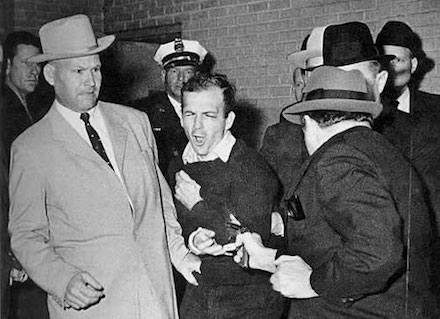
On this date in 1964, Dallas nightclub owner Jacob Rubenstein — notorious to history as Jack Ruby — was condemned to the electric chair for the dramatic live-televised murder of accused John F. Kennedy assassin Lee Harvey Oswald, captured by snapping shutters in one of the 20th century’s indelible images.

Ruby would never sit on that mercy seat.

For one thing, his punishment arrived as the American death penalty lulled into hibernation. Had he lived his sentence eventually would have been vacated by the 1972 Furman v. Georgia ruling. But instead of seeing that juridical landmark, the enigmatic Ruby died in prison inside of three years, awaiting retrial after an appeal.

On this day..

1931: Alfred Arthur Rouse, Blazing Car Murderer

On this date in 1931, Alfred Arthur Rouse hanged at Bedford Gaol for the murder of … someone.

A traveling salesman, Rouse tomcatted around old Albion leaving several illegitimate children and at least three bigamous marriages in his wake.

The weight of these strata of deceptions (and financial obligations) eventually drove Rouse to start thinking about how he could “start afresh” (his words) and darned if he wasn’t undone by the added decency of wanting to be sure that his legal wife and son would be looked-after once he walked out on them. And they say romance is dead.

The answer to his dilemma was a life insurance policy plus “a down-and-out” case that Rouse met at a pub who tellingly remarked over pints that “nobody in the world cares whether I live of die.”

Dangling the prospect of a job, Rouse convinced this man to accompany him to the Midlands on Guy Fawkes night of 1930 — a night when “a fire would not be noticed so much.” Before the night was over, Rouse’s Morris Minor made just such a fire, with a charred corpse of Rouse’s age and build behind the wheel.

The Headsman is fully prepared to believe that the Edmond Dantes-like corpse switcheroo has been executed by a few clever folk in history. Rouse, however, seems not to have thought through the endgame for he returned home — just briefly, but long enough for his wife to get a cockamamie story from him about his car being stolen — and then proceeded to Walea and the arms of one of those mistresses on whom he was allegedly trying to get a fresh start. Suspicious of him because he scrammed when she showed him the newspaper article reporting his possible roadside murder, she rang the police.*

Rouse’s claims that he’d picked up a hitchhiker who accidentally set himself ablaze in the car while refilling the gas tank while Rouse took a piss didn’t get much traction in view of the obvious motive presented by Rouse’s misbehavior. (And the fact that he’d previously told his wife and mistress the different story about his car being stolen.) Furthermore, crown forensic witnesses were able to show that whoever burned to death in that car was alive but unconscious when the fire killed him — perhaps incapacitated by a blow from a wooden mallet also found in the Morris Minor.

Rouse professed innocence of murder deep into his appeals but as hope disappeared he wrote a confessional to the Daily Sketch from which the quotes herein have been derived.

In it, he said that he never asked his passenger’s name. It’s a name that has not been established in the intervening decades, and not for want of trying; there have been several DNA misses on leads brought by families of men who disappeared in 1930. We may one day discover it; for now, the mysterious last word belongs to the Times of March 21, 1931.

At dawn yesterday the funeral of the unknown man murdered by Alfred Arthur Rouse in his motor-car took place in secret at Hardingstone parish church.

On Thursday night the remains of the body were removed from Northampton Hospital to the mortuary. Early yesterday morning the coffin was placed in a police tender and taken to Hardingstone.

The vicar officiated at a brief service. Six police officers carried the coffin to the grave by the side of the path behind the church. The plate on the coffin bore the inscription, “Man unknown. Died November 6, 1930.” A wreath was placed on the coffin by Superintendent Brumby, and was inscribed: “With deepest sympathy from the officers and constables of the Northampton and Daventry Division.”

* Rouse would claim that he intended to disappear to some new life but, having been observed by passersby down the road from the blazing car, he feared that he would not after all be taken for the victim.

On this day..

2016: Coy Wayne Westbrook

Going to his death on this date in 2016, Texas mass murderer Coy Wayne Westbrook was anything but.

I want to say that I’m sorry for the pain that I have caused you people. I’m sorry I can’t bring everybody back. I wish things could have been a lot different …

I can understand your outrage and why you are mad at me. God be with all of us.

He’d had a lot to say over the years about the incomprehensible quintuple shooting that brought him to that moment, a moment he claimed to be “looking forward to.”

Hoping to reconcile with his ex-wife, Gloria Jean Coons, Westbrook joined her at a small party at her Channelview, Texas, apartment. After several drinks, he says — and he’s the only witness remaining — he was incensed when Coons took two different men to the bedroom at which point Westbrook, to use the clinical term, flipped his shit.

“You hear all your life if you catch your old lady in bed with somebody, don’t just shoot her but shoot her lover too,” Wesbrook informed journos. “In her case, there was a bunch of lovers. I just took care of my business.” And also he had to shoot the other two people there when they came running at him for some reason.

The victims were Coons, 37; Diana Ruth Money, 43; Anthony Ray Rogers, 41; Antonio Cruz, 35; and Kelly Hazlip, 32. The state would argue that our man was being, well, coy about the degree of calculation in this rampage.

“As I saw her collapse and die, the spell was broken,” he said of Coons. “I could see her for what she was. I no longer found her attractive.”

In a different interview Westbrook said that he’d “regretted everything a trillion times.” But he struck a less penitent note in conversation with the television program 60 Minutes, saying that “I’m a victim in this as well as everybody else.”

The man’s already quite extensive roster of “everybody else” fortunately never came to include Westbrook’s first (pre-Coons) ex-wife, upon whom he allegedly tried to put out a hit while in jail.

On this day..