A day in the executions of Franz Schmidt

The free imperial city of Nuremberg has been a regular feature on this site thanks to the detailed journal of executions kept by its legendary executioner Franz Schmidt.

We have profiled many of the more remarkable cases individually. Today, we’ll pause for a few of central Europe’s lesser criminals whose deaths at Schmidt’s hand on various August Fourths were more representative of the everyday malefactors who paid the last penalty on early modern scaffolds. All block text records Schmidt’s own words.


August 4, 1586: Hans Weber and Lienhardt Hagen

Hans Weber, of the New Town, a potter and thief, whom I whipped out of Neunkirchen ten years ago; Lienhardt Hagen, of Teusslen, a bath-keeper, alias der Kaltbader, a thief and robber, who with his companion helped to attack people by night, tortured them, burnt them with fire, poured hot grease on them and wounded them grievously; also tortured pregnant women, so that one died at Schwertzenbach; stole all manner of things everywhere. The potter was hanged, the bath-keeper executed on the wheel. The bath-keeper had broken into the church at Lohndorff and stolen the chalice, also helped once to steal 500 florins. (a list of many other small sums follows.)


August 4, 1607: Margaret Marranti

Margaret Marranti, a country girl from the knackers’ sheds, who was in service with the innkeeper there, had intercourse with a carrier whom she did not know, and became pregnant. Took service with the farmer at Dorrenhof at Candlemas, concealing her pregnancy. When she was haymaking in the meadows, was seized with pains and contortions, and when the farmer’s wife said she would send for the midwife, the girl made an excuse, and remaining behind at night, gave birth to a child near a shed by the river Pegnitz. She immediately threw the child into the water and drowned it, though it stirred and struggled. Beheaded with the sword here on this account.


August 4, 1613: Matthew Werdtfritzn

Matthew Werdtfritzn of Furth, a Landzknecht, alias ‘Eightfingers,’ a robber. With the help of a companion he attacked the carrier from Regensburg in the Neuenwald, wounded him and his son mortally, and took about 800 florins’ worth of money and goods. Took 84 florins from the baker woman of Lauff, and wounded her lad in the same way, so that he was thought likely to die. Took 40 florins from a carter and 18 florins from the fisherman of Fach; in all twelve highway roberies. For these crimes he was executed on the wheel as a robber.

On this day..

1829: John Stacey, in Portsmouth town

A barbarous, foul, & horrid deed
I shortly will recite,
Which did occur in Portsmouth town
Upon a Sunday night;
An aged man of eighty years,
His housekeeper likewise,
Were there most basely murdered,
By a monster in disguise.

All in the night, so dark and drear,
He entrance did obtain,
And with a deadly hammer he
Beat out the old man’s brains,
His throat he cut from ear to ear,
Most horrible to view,
And streams of crimson blood did flow
The bed-room through and through.

The aged housekeeper likewise,
Lay butcher’d on the floor,
Her face and hands most cruelly
Were cut, and stabb’d full sore.
Her head it was nearly severed
From off her body quite.
Those who beheld it shivered,
So dreadful was the sight.

When at the bar the murderer stood,
He could not deny his guilt,
‘Twas clearly proved that he
The aged couples blood had spilt;
The Jury found him guilty,
And the Judge to him did say,
You must prepare to end your days,
Upon the gallows high.

Broadside ballad about double murderer John Stacey, hanged adjacent to the house of his victim on August 3, 1829

On this day..

1766: James Annin and James M’Kinzy

From the Pennsylvania Gazette, Aug. 7, 1766:

BURLINGTON (New-Jersey) August 4

At a Court of Oyer and Terminer, held at Burlington, on Wednesday, the Thirtieth Day of July last, came on the Trial of James Annin, aged 54 Years, and James M’Kinzy, aged 19 Years, on an Indictment for the Murder of two Indian Women, named Hannah and Catherine, who had long resided in the Neighbourhood of the Place where the Murder was committed.

It appeared by their own Examinations, and by the Testimony of credible Witnesses, that they had been on the Western Frontiers of Pennsylvania and Virginia, but that their first Acquaintance began in Philadelphia; that they came to Moore’s Town, in the County of Burlington, on Thursday, the 26th of June last, about Noon, and begged for Charity, and obtained Relief: That while they were eating their Dinners, the two Indians who were murdered, came to the Place where they were, and that the youngest of the Men gave them abusive Language: That the Indians went off, and rested in a Wood, near the Side of the Road: That the one of them was possessed of a clean Shift, and the other of a Piece of new Linen, which they had that Day got: That about 2 o’Clock on the same Day, James Annin sold the Shift, and James M’Kinzy the Piece of new Linen, and a Blanket, about two Miles from Moore’s Town.

That they were parted by Accident, and that many People had seen the Indians lying in View of the Road, and supposed them to be asleep, till Sunday, the 29th of June, when two Persons perceived a Stench, and on going near the Bodies, found they were dead; whereupon the Coroner was called, whose Inquest found them to be murdered by Persons unknown.

On this Alarm the two Criminals were suspected, and pursued.

James Annin was apprehended, and committed to the Goal at Burlington, and the other advertised from the Description given by Annin, and in a few Days taken up by Order of the Mayor of the City of Philadelphia, and sent to Burlington.

The Examinations of the Prisoners, taken before they had an Opportunity of seeing each other, were read, and by each Examination it appeared, that they went to the Indians with Intent to ravish them, if they should refuse their Offers; each acknowledged that he was present at the Murder, but charged the giving the Stroke on the other, and acknowledged also the taking the Goods; in this they persisted at the Bar. The Jury soon found them guilty, and they received Sentence of Death.

On Friday Noon they were hanged at the Gallows; they continued in denying the Fact, and charging it on each other. The Elder declared, he thought it a Duty to extirpate the Heathen, and just before they were turned off, M’Kinzy, the younger of the Men, acknowledged, that one of the Indians, on receiving the Blow from Annin, struggled violently, and that he, to put her out of Pain, sunk the Hatchet in her Head, but that they were both knocked down by Annin.

The youngest of the Squaws was near the Time of Delivery, and had Marks of shocking Treatment, which the most savage Nations on Earth could not have surpassed.

A few of the principal Indians of Jersey, were desired to attend the Trial and Execution, which they did, and behaved with remarkable Sobriety.

On this day..

1934: Otto Planetta and Franz Holzweber, for the Juliputsch

German-Austria must return to the great German mother country, and not because of any economic considerations. No, and again no: even if such a union were unimportant from an economic point of view; yes, even if it were harmful, it must nevertheless take place. One blood demands one Reich. Never will the German nation possess the moral right to engage in colonial politics until, at least, it embraces its own sons within a single state …

The elemental cry of the German-Austrian people for union with the German mother country, that arose in the days when the Habsburg state was collapsing, was the result of a longing that slumbered in the heart of the entire people — a longing to return to the never-forgotten ancestral home. But this would be inexplicable if the historical education of the individual German-Austrian had not given rise to so general a longing. In it lies a well which never grows dry; which, especially in times of forgetfulness, transcends all momentary prosperity and by constant reminders of the past whispers softly of a new future

-Adolf Hitler, Mein Kampf

On this date in 1934, two Nazis were hanged for their part in a failed Austrian coup.

From his political ascent in 1933 — and well before, as the quote above indicates — the Reich’s unification with his native land of Austria had been a cherished goal for Adolf Hitler. To that end, Berlin had fostered a clandestine network of Austrian Nazis branded as “SS Standarte 89” and allowed exiles to broadcast seditious propaganda from German soil.

Their “July Putsch” (English Wikipedia entry | German) was a year or so in the making, and commenced when four truckloads of SS Standarte 89 men in military attire suddenly stormed the federal chancellery in Vienna, murdering chancellor Engelbert Dollfuss in the process.

“Hitler received the tidings while listening to a performance of Das Rheingold at the annal Wagner Festival at Bayreuth,” Shirer noted in The Rise And Fall Of The Third Reich — and Wagner’s granddaughter, also in attendance, could not help observing his “excitement” and “delight” and simultaneous anxiety to feign uninvolvement.

The last of these impulses showed the emerging tyrant’s wisdom, for the coup swiftly collapsed — exposing, to Hitler’s fury, the inept organization of the plot. Basically no other coordinated actions took place to complete the coup and the Austrian army remained loyal to the existing government, leaving to the lonely SS Standarte 89 nothing but a feeble surrender.

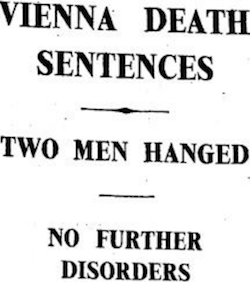
The first targets of the resulting courts-martial were Otto Planetta (cursory English Wikipedia entry | more detailed German), who actually pulled the trigger to kill the chancellor, and Franz Holzweber, the apparent leader of the attack on the chancellery. They would be tried and condemned in a two-day hearing July 30-31 and hanged within three hours of conviction. In time, both the Planetta and the Holzweber name would adorn many city streets in the Third Reich as patriot-martyrs.

Both prisoners, when asked whether they had anything to say before hearing their sentences, addressed the Court. Planetta said: —

I do not know how many hours I have to live. But one thing I would like to say, I am no cowardly murderer. It was not my intention to kill. One thing more. As a human being I am sorry for my deed, and I beg the wife of the late Chancellor to forgive me.

Holzweber said: —

I was assured that there would be no bloodshed. I was told also that I should find Herr Rintelen at the Chancery,, that the new Government was already formed. Not meeting the leader of the operation at the Chancery, I disclosed myself at once to Major Fey. I told him, here I stand, and I do not know what I should do. More or less spontaneously I took over the responsibility for our men because no one was there to take charge of the matter.

Holzweber, who was executed first, cried out on the gallows: “We die for Germany. Heil Hitler.” Planetta said simply, “Heil Hitler.”

London Times, Aug. 1, 1934

The time was not yet ripe — and Hitler, no matter how heiled by his would-be subjects, was required by the diplomatic blowback to forswear ambitions on unifying with Austria.

But the Fuhrer’s soft whispers of a new future would grow ever more insistent in the months to come, and not four years later the Reich accomplished the Anschluss.

That July 25, in 1938, in a Vienna now successfully absorbed to greater Germany,

the fourth anniversary [of the Juliputsch] was celebrated as an heroic act comparable with the Rathenau and Erzberger murders. The survivors of ‘SS Standarte 89’ marched to the federal Austrian Chancellery, which had been renamed the Reichstatthalterei. Here the bereaved families of thirteen men were addressed by Rudolf Hess. A tablet was unveiled which proclaimed that:

154 German men of the 89th SS Standarte stood up here for Germany on 25 July, 1934. Seven found death at the hands of the hangman.

On this day..

1789: Giovanna Bonanno, la Vecchia dell’Aceto

On this date in 1789, the Sicilian poisoner Giovanna Bonanno was hanged in Palermo.

Portrait of an Old Woman, by Giorgione (c. 1500-1510)

Bonanno (English Wikipedia entry | Italian) had borne the unremarked burdens of the poor into her ninth decade; her life prior to the brush with infamy is all but dark to us save a suspected marriage record from 1744. She seems to have scrabbled her way by beggary and folk magic.

In 1786, she chanced upon the formula to concoct a lethal yet subtle draught from white wine vinegar and arsenic. (She never divulged its precise composition.)

For a few years in the late 1780s this vinegar of our latter-day Locusta became the hit choice for the choice hit. It was the ideal concoction: victims couldn’t detect it and doctors couldn’t diagnose it — so dissatisfied spouses, overeager heirs, rivalrous lovers, keepers of grudges, and all other manner of winnowers beat a path to her door.

Inevitably this business was betrayed as word got about; although it would surely have occurred by means of some other leak soon enough, in the event it happened when Bonanno’s delivery-woman realized that her parcel was intended for someone that she knew, and warned him.

As usual, it was the purveyor who bore the brunt of the law, as suppliers and clients alike damned her for a sorceress as well as a poisoner. Although hanged for her crimes, La Vecchia dell’Aceto — “The Old Vinegar” — entered instantly into Sicilian folklore; Italian speakers might enjoy Luigi Natoli‘s novel of that title.

On this day..

1598: Lucas, waterboarded Guale

On this date in 1598, the indigenous Guale youth called Lucas was hanged by the Spaniards in St. Augustine, Florida, for his supposed part in the prior year’s massacre of five Franciscan missionary friars during a 1597 Guale revolt.

This entire tragic affair, documented poorly and with partiality in Spanish sources, remains an interpretive palimpsest to the few who are familiar with it. Historian J. Michael Francis grapples with it in Murder and Martyrdom in Spanish Florida: Don Juan and the Guale Uprising of 1597; a recent talk by the latter at the U.S. Library of Congress delves into the “400-year-old murder mystery”:

The key primary source for this event is Luis Jerónimo de Oré’s text The Martyrs of Florida, from approximately 1619. (Here’s a public domain English translation) The titular “Florida” as claimed by Spain in the New World colonization scramble was a much larger territory than the present-day U.S. state, peninsula, and running Internet gag; hence, the Guale territory relevant to this post lies on what is today the Georgia coast.

Ore informs us that “an Indian youth, who was a Christian and heir to the caciquedom,” was incensed when the Franciscan resident at the settlement of Tolomato presumed to disallow him a second wife.

This cacique and two other Indians, like him, given to the same immoral practice, went into the interior among the pagans, without saying anything or without obtaining permission as they were wont to do on other occasions. After a few days they returned at night with many other pagan Indians, painted and smeared with red paste, and with feathers on their heads. This among them is a sign of cruelty and slaughter.

Thus fearsomely attired, they burst upon the hut of the prudish Fray Pedro de Corpa and butchered him, setting up his head on a spear. Having done this, the angry cacique — who is known only as Juanillo, which is sometimes the name given to this rebellion — ordered other Guale to treat their nosy proselytizers likewise. As a result, four other Franciscans — Fray Miguel de Aunon and a lay brother on St. Catherine’s Island, Fray Bias Rodriguez at the mission village of Santa Clara de Tupiqui, and Fray Francisco de Verascola on Asao — were all murdered within days. A couple of other missionaries had very close escapes.


Map of the relevant part of the Georgia coast.

Besides these, a Fray Francisco de Avila was kidnapped and held hostage for ten months. Although cruelly tortured, Avila would survive captivity and produce a narrative of his own, one that Ore includes wholesale in his volume as a standalone chapter.

In the course of the ensuing Spanish raids on the Guale, the Spanish captured seven boys or young men and interrogation zeroed in on one of them: the son of the cacique of Tupiqui, who appeared as a possible participant in murdering Fray Bias Rodriguez.

Lucas was reticent on the point but after being subjected to the water torture he allowed that “he arrived in time to see Fray Bias die,” and this confession of his presence sufficed to condemn him. He was the only person judicially executed in the course of the entire revolt.

In view of said declarations of these proceedings, the crime falls upon Lucas the Indian, son of the Cacique de Tupiqui, for having been present and participated in the killing of Fray Bias, who was sent to convert the people of Tupiqui. I must condemn him by this my decree, sentenced according to his declaration, with the penalty of death. The justice which I order shall be done him is: That when he leaves the jail where he now is, it shall be with a rope around his neck, his hands tied behind him, and with a loud voice it must be proclaimed to the public his crime; that he be taken to the gallows, already prepared for this purpose, and that there he shall be hung by the neck and strangled until dead. Because, thus is it well to punish with real justice those who dare to commit such crimes, and as an example to the other Indian natives of these provinces that they may not commit similar crimes. So do I pronounce sentence and command.

And if the said Lucas is not mindful of receiving baptism and should not die repenting, and in the Catholic faith, I order that he be hung and after his death his body be burned to powder.

Gonzalo Menendez de Canco, Governor of Florida (Source)

Interpretations of the whole affair have always been driven by Ore’s narrative: either the surface reading of it, that Juanillo and company found monogamy irksome and preferred, in Ore’s words, “to give rein to their sensuality and unlawful pleasures”; or, a converse take for the era of decolonization, that the cultural interference of the Spanish empire triggered a native backlash for whom the friars were the ready-to-hand targets. In either version, the rebellion flourishes briefly but ultimately fails.

Francis in his book and the video above offers a very different reading: as a successful revolt authored by a different cacique, Don Domingo of Asao, who violently renegotiated the local balance of power** and thereby displaced the caciques of Tolomato as the paramount chiefs of the Guale. As a particularly gruesome coda, Domingo made successful obeisance to the Spanish and obtained the crown’s blessing for an expedition to destroy Juanillo, whom he blamed for the disturbance. After capturing the rebels’ last redoubt (beheading Juanillo in the process), Domingo ordered the surviving women to scalp their own men. Now that is paramount chiefdom.

Domingo appears to have maintained his preeminence among the Guale for the balance of his years — backed by and partnering with the Spanish, to the happiness of evangelizing clerics who were never more disturbed. A few years later, the Spanish even plopped down a new mission in his very own native soil … Santo Domingo de Asao.

* The Guale people are thought to have been subsumed into the Yamasee.

** View the Spanish arrivistes, who had a handful of small settlements rather than the dominating presence that their globe-straddling empire might suggest, as just “another powerful Mississippi chiefdom” to local eyes. (Source of this characterization)

On this day..

1820: Stephen Sullivan, for murdering the Colleen Bawn

The hanging this date in 1820 of Stephen Sullivan for killing a 15-year-old a year before closed the real-life case that inspired the popular Irish play The Colleen Bawn.

In the play — which in its own turn is based on the 1829 Gerald Griffin novel The Collegians — an older landowner unhappily wed to an unsuitable younger wife has the marriage murderously annulled by the offices of a loyal factotum.

In The Colleen Bawn, these figures are Hardress (the husband), Eily (the wife),* and Danny (the hunchbacked murderer). It’s still performed today, both on stage and in an operatic adaptation, The Lily of Killarney.

In 1819, their real-life equivalents were John Scanlon, his wife Ellen Hanly, and our man Sullivan, the killer.

Scanlon, the regretful groom and instigator of the murder, had already been captured and executed at a previous assize; Sullivan likewise blamed his patron with his dying breath for “when I looked in her innocent face, my heart shuddered, and I did not know how I could do it!” Somehow he found a way.

The final scene, courtesy of Edinburgh’s Caledonian Mercury, August 14, 1820

* Eily is also the play’s title character — from the Gaelic cailín bán, “fair girl”.

On this day..

1817: Eleanor Gillespie

Two hundred years ago today, Bath County, Kentucky housewife Eleanor (sometimes spelled Ellenor) Gillespie hanged “at the forks of the road on Mt. Sterling pike” for strangling her abusive husband.

The best account we’ve found of this affair is the Gillespie family lore as related in a letter to the Bath County News-Outlook on Nov. 4, 2009.

The family version of events was that [second husband, and sheriff, John] Hawkins was a drunkard who was both physically and sexually abusive to Eleanor and her children. She couldn’t turn to “the law” for help as he was the law. She took matters into her own hands on the night in question. He was drunk and up to the usual. Luckily for little 7 yr. old Rebecca Gillespie, he passed out before he was able to abuse her. Eleanor had had enough. With the help of her son [Jacob Gillespie, aged about 14 years and therefore lightly handled by the law] they tied a rope around the man’s neck and as the family version goes, “One went one way and the other went the other way.” …

The acting sheriff after the murder was none other than the son of John Hawkins … Hawkins, Jr. is the one who quite possibly started the rumor that Hawkins was murdered over money, not wanting to real reason to get out.

It seems that Eleanor still enjoyed some public sympathy notwithstanding; local magnate George Lansdown(e) was involved in a caper to spring her from jail, perhaps owing a debt of inspiration to the cross-dressing flight of Jacobite Lord Nithsdale: Lansdown called on the jail as a visitor and there stripped himself so that Eleanor could put on his civilian men’s clothing and just stroll on out of lockup.

She just about accomplished this but a do-gooder or do-badder guard named David Fathey recognized her on the way out and arrested her; evidently our disrobed rescuer was counting on some look-the-other-wayism via what must have been a sentiment widely abroad in the community, for “Lansdown was incensed at Fathey for not permitting her to escape; a fight ensued and Fathey whipped Lansdown.”

On this day..

1242: William de Marisco, pirate knight

On this date in 1242, the knight, outlaw, and pirate William de Marisco was drawn by a horse to Coventry and put to the pains of disemboweling and quartering — albeit only after he had already been hanged to death.


Illustration of William de Marisco’s execution by the amazing 13th century chronicler Matthew Paris.

He’d eventually be damned as a kingslayer but Marisco’s doom began with the 1235 murder of a messenger of King Henry III named Henry Clement, slain at the very gates of Westminster “to our no small dishonour and scandal of the realm.” Suspicion settled on the Mariscos, who might have been motivated by Clement’s boasting of having helped recently lay in his grave the Earl of Pembroke, a magnate and great rival to the king.*

Marisco, whose architectural legacy for us is Coonagh Castle, County Limerick in Ireland, fled the scene of the crime and took refuge on Lundy Island, a gorgeous and remote fingerbone in the westerly Bristol Channel that had once been granted to the Knights Templar.**

There, as our chronicler-illustrator Matthew Paris describes, he made his way thereafter by piracy.

Whilst these occurrences were taking place, William Marsh [“de Marisco” means “of the Marshes” -ed.], son of Geoffrey Marsh, took up his quarters on an island near Bristol, called Lundy, a place impregnable by the nature of its situation, where he lived like a pirate with a number of proscribed and wicked men, indulging in plunder and rapine, and, attended by his companions, traversed the places on the neighbouring coast, despoiling the inhabitants of their property, especially wine and other provisions. By sudden incursions lie frequently carried off vast booty from the country lying near the island, and in many ways injured the kingdom of England both by land and sea, and caused great loss to the native and foreign merchants.

William de Marisco would manage seven years on the lam, seizing victuals and booty and ransomable hostages as he could from his island fastness. He’d been dispossessed of his lands in Ireland and nursed against King Henry the personal grudge of an aggrieved nobleman.

Such injuries were known to heal over time, and amid the tangle of authority and kinship among medieval Europe’s bluebloods, today’s rebel might become tomorrow’s hand of the king. But in 1238, William cut the roads behind him and made himself permanently anathema by allegedly sending an assassin after Henry III. Matthew Paris, again, with a story that will easily bear the interpretation that Marisco’s name was put into a deranged regicide’s mouth by his torturers:

on the day after the Nativity of St. Mary, a certain learned esquire, as it is said, came to the king’s court at Woodstock, pretending that he was insane, and said to the king, “Resign to me the kingdom, which you have unjustly usurped, and so long detained from me;” he also added, that he bore the sign of royalty on his shoulder. The king’s attendants wanted to beat him and drive him away from the royal presence, but the king prevented those who were rushing on him from violence, saying, “Let the insane man rave as becomes him, for such people’s words have not the influence of truth.” In the middle of the night, however, this same man entered the king’s bedchamber window, carrying an open knife, and approached the king’s couch, but was confused at not finding him there, and immediately began to look for him in the several chambers of his residence. The king was, by God’s providence, then sleeping with the queen. But one of the queen’s maids, named Margaret Biseth, was by chance awake, and was singing psalms by the light of a candle (for she was a holy maid, and one devoted to God), and when she saw this madman searching all the private places, to kill the king, and frequently asking in a terrible voice where the king was, she was greatly alarmed, and began to utter repeated cries. At her dreadful cry the king’s attendants awoke, and leaped from their beds with all speed, and running to the spot, broke open the door, which this robber had firmly secured with a bolt, and seized the robber, and, notwithstanding his resistance, bound him fast and secured him. He, after some time, confessed that he had been sent there to kill the king, after the manner of the assassins, by William Marsh, son of Greoffrey Marsh, and he stated that others had conspired to commit the same crime.

Paris has evident contempt for William, but he does note that “William boldly denied all these charges, yet he did not obtain any credit, nor was he listened to; he therefore, however unadvisedly, betook himself to out-of-the-way places, and became a fugitive and an outlaw.” It is not clear to this author that outlawry is “unadvisable” vis-a-vis standing to the judgment of a king who is certain you have attempted his life; nevertheless, it is usually little better than the temporary expedient for the doomed.

On the feast of St. James, by the king’s order, the said William, with sixteen of his accomplices taken with him, was tried and condemned, and, by the king’s order, was sentenced to an ignominious death. He was, therefore, first dragged from Westminster to the Tower of London, and from thence to that instrument of punishment called a gibbet† suspended on which he breathed forth his miserable life. After he had grown stiff in death, his body was let down and disembowelled; his entrails were immediately burnt on the spot, and his wretched body divided into four parts, which were sent to the four principal cities of the kingdom, that the sight of them might strike terror into all beholders.

His sixteen accomplices were all dragged through London at the horse’s tail, and hung on gibbets. The said William, after his condemnation, when about to imdergo the sentence pronounced upon him, invoking the divine judgment to witness, boldly declared that he was entirely free and guiltless of the crime of treason imputed to him, and likewise of the murder of the aforesaid clerk Clement; he also asserted that he had betaken himself to the aforesaid island for no other reason than to avoid the king’s anger, which he had always above all things wished to pacify by submitting to any kind of trial, or by any other humiliation; but that, after he had taken refuge as a fugitive in the said island, he was obliged to prolong his miserable life by seizing on provisions wherever he could find them. He then poured out his soul in confession before God, to J. de St. Giles, one of the brethren of the Preacher order, and confessed his sins with contrition, not excusing himself and giving vent to evil words, but rather accusing himself. This discreet preacher and confessor then administered gentle comfort to him, and dismissed him in peace, persuading him that he underwent the death to which he was doomed by way of repentance. And thus, as before mentioned, horrible to relate, he endured not one, but several dreadful deaths.

Readers of Latin can peruse the transcript of the trial, which has surprisingly survived the ravages of century, in this 1895 English Historical Review article.

* Pembroke’s brother and heir was also suspected initially, but was able to clear himself; however, he was later made to take a vow no longer to protect William de Marisco, suggesting that Pembroke was at least in simpatico with the hit. Both William and Geoffrey de Marisco had been fined previously for adhering to the Pembroke side in a fight with the king.

** The Templars at best barely possessed Lundy and the Mariscos who claimed it opposed those banker-knights’ stake, successfully.

† Paris’s unfamiliar marking of the term “gibbet” is interesting here; according to dictionary.com it was during the 13th century that this word for gallows entered Middle English from French.

On this day..

1972: Misao Katagiri

On this date in 1972, Misao Katagiri hanged for a Tokyo gunfight he had perpetrated seven years earlier.

A gun fancying 18-year-old, Katagiri triggered a shootout by seizing some hostages in Shibuya, an event that thousands of Tokyo residents witnessed — including future spree shooter Norio Nagayama. Somewhat miraculously the death toll from Katagiri’s moment of madness numbered only one, a policeman. (Seventeen others were injured.) But the one was enough.

On this day..