1880: Three juvenile offenders in Canton, Ohio

(Thanks to Meaghan Good of the Charley Project for the guest post. -ed.)

At 11:35 a.m. on this day in 1880, three teen boys were publicly hanged in Canton, Ohio. George E. Mann was sixteen, Gustave Adolph Ohr was somewhere between fifteen and seventeen, and John Sammet(t) had just turned eighteen the day before. Between them, they had committed two murders.

Left to right: Mann, Ohr, and Sammett.

George Mann and Gustave Ohr came from similar backgrounds: both lost a parent in early childhood — George’s mother and Gustave’s father — and both didn’t adjust well. By the summer of 1879, both boys had run away from home. They were riding the rails when they met each other and began traveling with an older tramp, John Watmough.

The trio had reached Alliance, Ohio when, on June 27, 1879, Gustave and George decided to rob Watmough as he slept. They beat him on the head with a railroad coupling pin, mortally wounding him, and the boys took his watch, money and clothes and ran away. Watmough was able to crawl to a nearby house and mumble a few words before dying. His killers were arrested within minutes.

George, although he insisted it was Gustave who’d struck the fatal blows, was convicted of first-degree murder on December 6. Gustave was convicted on December 13. On December 31, both were sentenced to death. George went to his grave saying he was innocent, but his partner-in-crime refused to cinch his clemency argument by taking full responsibility.

According to the Stark County Democrat, while awaiting their deaths, George and Gustave were both able to obtain “many luxuries” by selling copies of the gallows ballads they supposedly wrote themselves. (Mann’s | Ohr’s)

John Sammett, like George Mann, lost his mother at a very early age and lived with his father and stepmother at the time of his crime. Like the Bavaria-born Gustave Ohr, he was of German parentage, although John was born in Ohio. He developed a reputation as a petty thief and was arrested several times, but his relatives always bailed him out of trouble.

In August of 1879, John and a sixteen-year-old friend, Christopher Spahler, broke into a saloon. They were arrested, and Spahler agreed to turn state’s evidence and testify against his erstwhile friend. The burglary trial was scheduled for November 26; the day before, John tracked down Spahler and tried to get him to change his mind. Spahler would not relent, and John shot him in the chest.

People heard the shot and came running; Spahler died a short time later without speaking, but both John and the murder weapon were still at the crime scene. He was arrested immediately, and on March 2, 1880 he was convicted of murder and sentenced to death.
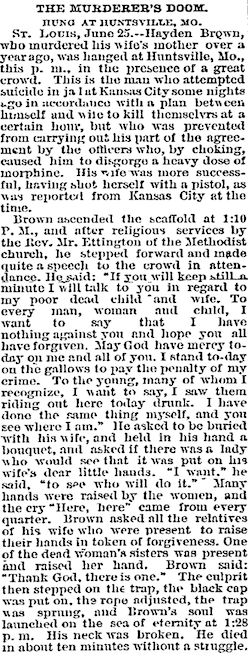
Meanwhile, in a different hanging circus … (widely reprinted wire story via the Milwaukee Journal of Commerce of (despite the dateline) June 23, 1880.

This Akron Law Review article notes,

The public hanging of Mann and Ohr, along with John Sammett, was the occasion for a community-wide extravaganza. People came to the small town of Canton in eastern Ohio by excursion train from as far away as Chicago and Pittsburgh to witness the event. A circus was part of the extravaganza [literally, Coup‘s circus was in town at the same time -ed.] and the night before the hangings included much music, cannon firing, speech making and similar merriment. The next morning, Mann and the other two teenaged boys were hanged in the city square of Canton before an estimated crowd of 10,000 people!

After the triple hanging, sheriffs deputies placed the three bodies in the jail corridor and permitted the entire crowd to file through and view the bodies. The public viewing lasted almost four hours, with the doors being closed at 3:30 p.m.

This was the first time the state of Ohio had executed minors.

These three young killers were featured in Daniel Right Miller’s 1903 book The Criminal Classes: Causes and Cures, which remarks (speaking of Ohr specifically) “that parental neglect, impure literature, and vicious companions were all responsible for this ruined life and forced death.”

On this day..

1936: Edward Cornelius, vicarage murderer

On this date in 1936, Edward Cornelius hanged at Victoria’s Pentridge Gaol for the vicarage murder.

The Murder at the Vicarage also happens to be the title of Agatha Christie’s very first Miss Marple novel, published several years before the very real vicarage murder of Rev. Cecil.

One lonesome night the preceding December, Cornelius, a mechanic, turned his spanner on the aged head of plain-living 60-year-old Rev. Harold Laceby Cecil of St. Saviour’s — the horrible conclusion to Rev. Cecil’s 18-year ministry in Fitzroy, then one of Melbourne’s roughest neighborhoods.

Cornelius’s motive was robbery, and it was hardly the first time that Rev. Cecil had been braced for the few quid in donatives he kept on hand for charity cases. Though undeterred from his mission, Cecil was philosophical about repeated robberies: “I will get them, or they will get me.” According to Cornelius’s confession, it was the getting that got Cecil killed: surprised in the course of a midnight stealth pilfering of the vicarage study, Cornelius grabbed the tool of his other trade and clobbered the intercessor, repeatedly: there would be 17 distinct head wounds discerned by investigators.

He fled the vicarage with £8 and few gold and silver trinkets. Some, like a silver watch, he would discard as too incriminating; others, like a gold crucifix, he pawned to obtain ready cash and readier eyewitnesses against him.

A death-house chum of similarly notorious Arnold Sodeman — the two passed Sodeman’s last hours on earth together, playing draughts — Cornelius followed the latter’s steps to the same gallows three weeks later.

On this day..

1877: Pennsylvania’s Day of the Rope

This date in 1877 was Pennsylvania’s “Day of the Rope”, a Thursday blackened by the execution of ten Irish coal miners as labor radicals.*

These are supposed “Molly Maguires”, others of whom we have previously met in these pages.

Though the term is now best associated with these anthracite miners of eastern Pennsylvania, it enters the textual record earliest in Great Britain right around 1845 … which, no coincidence, was the dawn of Ireland’s Great Famine.

Where tenant farmers starved even as absentee landlords exported crops, militancy naturally ensued — intrinsically criminal and therefore secretive, inevitably characterized as terroristic by its foes. For this desperate movement the fictitious heroine “Molly Maguire” would be name and watchword, a mythic resistance character in the tradition of Captain Swing or Ned Ludd; legend — perhaps reality? — would hold that her earliest followers had desolated a lord’s land after he turned subsistence farmers off it in favor of cash crops by murdering new tenant after new tenant until nobody dared occupy the tract. Newspapers began to denounce her followers proportional to the publication’s proximity to London capital.

A sympathetic domestic description is provided by the Cork Examiner of July 9, 1845, which contends that Molly McGuireism is nothing but “the tenant creed.”

The spirit and letter of legislation are all for ramparting round the rights of property. The meaning of this plainly is — legislating for themselves, whilst the population of the country may perish. Hence, stone walls and bogs, and houses and fields, with all dead matter, are cared for and legislated upon by landlords, whilst the living and producing beings — the Christian inhabitants of the country, who are formed to make up the sum of its riches, naturally and artificially, are exterminated, expatriated, famished, or shot down like dogs. What is the necessary consequence of this infamous state of things? Circumspice. Look around you and behold the monument raised to the desolating idol. Its history and its effects are written in the hovelled mud, and the squalid wretches and the naked children, which form the social and rural beauties of the soil of Ireland.

Well, the people feel and say — they would be stupid and brutal if they did not — that legislation or legislators will do nothing for them. They are thus thrown upon their own resources and their own energies. By the midnight lamp they write their own fearful enactments. If the code of their specified rights be written in blood, it is awful, but it is not unnatural.

And in Pennsylvania’s coal fields, during the depression of the 1870s, this was much the condition of Irish immigrant miners — no few of whom had been driven there by the very famine that spawned the original Molly Maguires.

Since verifiable documentary evidence of Molly Maguireism as an organized movement is very scant it’s an open question for posterity to what extent we behold the traces of an international Irish Catholic labor militancy or the hysteria of the boss. In whichever dimensions, the ghost of Molly Maguire crossed the Atlantic and haunted the violent carbon-harvest business in Pennsylvania … a ghost that rattles its chains ever so faintly whenever your Monopoly piece takes a ride on the Reading.

Though it’s difficult to think it today, the Reading Railroad company was one of the world’s largest corporations in the 1870s. The firm’s captain of industry, Franklin Gowen, figures as the antagonist and perhaps the concoctor of the Mollies, whose appearance as a criminal offshoot of the fraternal Ancient Order of Hibernians he alleged as a calumny against the union he fought blood and nail.

In the course of an 1871 strike, Gowen complained that the union’s ability to achieve general compliance with the work stoppage could only be the result of a shadowy association of foreign agitators “which issues orders which no one dare disobey.”

There has never, since the middle ages, existed a tyranny like this on the face of God’s earth. There has never been, in the most despotic government in the world, such a tyranny, before which the poor laboring man has to crouch like a whipped spaniel before the lash, and dare not say that his soul is his own … I say there is an association which votes in secret, at night, that men’s lives shall be taken, and that they shall be shot before their wives, murdered in cold blood, for daring to work against the order. (Source)

Fired by his public-spirited humanitarianism, Gowen went to work against the despotism of refusing his wage by retaining the Pinkerton Detective Agency. Its agent, James McParland, would make his name** famous or infamous with his claim to have infiltrated secret Molly meetings orchestrating routine political assassinations (assassinations he notably failed to prevent). His (thrilling) allegations, supplemented by confessions of alleged Mollies who turned state’s evidence to save their own lives,† were decisive in noosing the Mollies as murderers. For this McParland would receive both laurels and death threats, and also inspire a character in the Sherlock Holmes adventures.


Cincinnati Commercial, June 22, 1877.

The hysteria Gowen, McParland et al orchestrated was so self-confirming in the moment that newsmen wrote as categorically about the Mollies as they would in our era about Iraq’s weapons of mass destruction, and their terroristic reputation would be freely wielded to bludgeon the miners’ union. But curiously these existential menaces, once prosecuted, vanished with nary a footprint from their former rollick … so was the whole network phenomenally thorough about its secrecy, or was there never any such Hibernian Black Sabbath at all? There’s never been a historical consensus save that their trials by political allies of Gowen were at the very least travesties of justice — if not outright frame-ups.

Three weeks after the Day of the Rope, deep wage cuts for railroad workers triggered the Great Railroad Strike of 1877 which soon gave the Reading Railroad company its second bloody association in as many months: the Reading Railroad Massacre.

* Six hanged in Pottsville, and four in Mauch Chunk (since renamed as Jim Thorpe). Andrew Lanahan also hanged for murder on the same day at Wilkes-Barre, giving Pennsylvania 11 executions overall for its day of the rope; Lanahan’s was not one of the Molly Maguire cases but owing to his own Irish heritage there was never-proven conjecture that his crime was “inspired” by Maguireism. Accordingly, one can find different sources claiming either 10 or 11 Mollies hanged on this occasion. After this date’s harvest, ten additional supposed Molly Maguires were hanged by Pennsylvania during the next 18 months.

** McParland is the subject of a recent biography, Pinkerton’s Great Detective.

† Pennsylvania deployed demonstrative ferocity here: a 15-year-old who gave an alibi for her uncle got slapped with a thirty-month perjury sentence for contradicting a Pinkerton detective.

On this day..

1985: Kent Bowers, the last hanged in Belize

(Thanks to Meaghan Good of the Charley Project for the guest post. -ed.)

On this day in 1985, murderer Kent Bowers met his death by hanging at Belize Central Prison in Hattieville. Only seventeen on the date of his crime, he had reached legal age by the time of his death.

On July 4 of the previous year, Bowers had gone to the Sueno Beliceño restaurant in Belize City, where Francis and Dora Codd were having a private party to celebrate their 25th anniversary. Bowers hadn’t been invited to the party, and he was asked to leave. The Codds’ son Robert escorted him to the door, but outside, a struggle ensued and Bowers stabbed Robert in the chest and abdomen. The victim died within minutes and Bowers was arrested.

He pleaded self-defense at trial, but this argument went nowhere. An appeals court noted,

On the evidence of the prosecution witnesses it can hardly be said that the accused in producing a knife and stabbing indiscriminately was acting in self defence. None of the persons around him were armed, two were women and their efforts were directed to separating the appellant and the deceased rather than to attacking the appellant. Indeed it was never suggested to any of the witnesses in cross examination that anyone had struck the appellant or threatened him.

Kent Bowers was convicted on October 23; the death sentence was mandatory. 2,500 people signed a petition for clemency, but it was denied.

Bowers’s crime and execution were fairly forgettable, but for one detail: as of this writing, he remains the last man to have been hanged in Belize.

The death penalty is still on the books, however. Glenford Baptist was the most recent death row prisoner; he was convicted in 2001, and in 2015, his death sentence was commuted to 25 years.

On this day..

1943: Maria Kislyak, honeytrapper

Soviet resistance operatives Maria Kislyak, Fedor Roudenko and Vasily Bougrimenko hanged on this date in 1943 by Nazi occupation.

Kislyak, an 18-year-old from Kharkov, Ukraine who is esteemed a Hero of the Soviet Union,* is the best-known of them and made herself the poisoned honey in a trap for German officers.

As ferocious Eastern Front fighting raged near her city, Kislyak feigned affection for a German lieutenant and thereby lured him to a woodland rendezvous where her friend Roudenko ambushed him and bludgeoned him to death.

Kislyak endured German torture without admitting anything and was even released since the man’s comrades couldn’t be sure that the local flirt had anything to do with the murder. But when she and her friends pulled the trick a second time, the Germans forced the assassins to reveal themselves by threatening to shoot random hostages en masse.

* One of three women so honored for their service during World War II, all of whom have been featured in these grim annals; the others are Klava Nazarova and Zoya Kosmodemyanskaya.

On this day..

2008: Tsutomu Miyazaki, the Nerd Cult Killer

(Thanks to Meaghan Good of the Charley Project for the guest post. -ed.)

On this date in 2008, serial killer Tsutomu Miyazaki was hanged in Japan, alongside two men convicted of unrelated crimes. Sometimes called the “Nerd Cult Killer” for his fascination with anime and manga, Miyazaki had kidnapped, murdered and mutilated four young girls in the course of less than a year, between August 1988 and June 1989.

Like many serial killers, Miyazaki had a bad start in life. He was born premature, weighing in at only four pounds, and both his hands were badly deformed. His fingers were gnarled and his wrists fused, making it impossible for him to bend them upwards. The defect meant he was bullied in school, and at home, his entire family seemed to detest him. (Meanwhile, his father was sexually abusing his sister.)

Miyazaki was bright, and initially did well in school, even becoming the first student at his junior high school to pass the entrance exam to the exclusive Meidai Nakano High School. But in high school his grades got worse and he didn’t land a place in university. Instead he went to a tech school and learned to be a photography technician.

By his early twenties he had become obsessed with child pornography. Things got even worse when his grandfather, the only person he was close to, died in May 1988; Miyazaki killed his first victim a few months later.

Four-year-old Mari Konno walked out of her home in Saitana, Japan on August 22, 1988 and vanished. Robert Keller describes the ensuing search in detail in his book Asian Monsters: 28 Terrifying Serial Killers from Asia and the Far East:*

The little girl’s disappearance caused massive public distress in Saitana, an area unused to violent crime. Police cars with loudspeakers patrolled the streets warning parents not to allow their children out of their sight. Meanwhile the police spent nearly 3,000 man-days interviewing people who lived near Mari’s home. They distributed 50,000 missing person posters and brought in tracking dogs in hope of picking up a scent. Nothing.

A couple of people did report seeing Mari in the company of an adult man and the descriptions they gave, 5-foot-six with a pudgy face and wavy hair, were accurate, but the information lead nowhere. When the police received a genuine clue — a postcard sent to Mari’s mother with the cryptic message “There are devils about” — they dismissed it as a hoax.

Six weeks later, with Mari still missing, Miyazaki abducted seven-year-old Masami Yoshizawa, took her into the hills near Komine Pass, strangled her and sexually violated her corpse, leaving it 100 yards from where he’d dumped Mari’s body earlier.

The police thought the two disappearances were probably related, but they had almost nothing to go on and little hope that the children were still alive.

Miyazaki struck again on December 12, luring four-year-old Erika Namba into his Nissan, taking her to a park and telling her to undress. He started taking photos of her naked body, but then panicked and strangled her. He was driving away, with Erika’s body in the trunk of his car, when the car got stuck. Miyazaki carried the body into the woods and hid it, and when he returned to his vehicle, two men had stopped to help. They were able to get his car back on the road.

When Erika’s body was found the next day, the two witnesses told police about the man and his car, but they said it was a Toyota Corolla, not a Nissan. The police dutifully investigated 6,000 Toyota Corolla owners.

In the months that followed, as Keller records:

[Miyazaki] began stalking his victims’ families, calling them at all hours and then saying nothing on the other end of the line. When the distraught parents stopped picking up the phone, Miyazaki would allow it to continue ringing for upward of twenty minutes. Eventually he grew tired of taunting the grieving families by telephone and resorted to more sickening measures.

A week after Erika Namba was murdered, her father got a postcard with a message formed from cut-out magazine letters: “Erika. Cold. Cough. Throat. Rest. Death.”

On February 6, 1989, Mari Konno’s father found a box on his doorstep containing 220 human bone fragments and ten baby teeth — later identified as Mari’s — and photos of his late daughter’s shorts, underpants and sandals. There was a note also, typed on copier paper: “Mari. Bones. Cremated. Investigate. Prove.”

When the Konno family returned home after Mari’s funeral, they found another communication from the killer: a letter, titled “Confession,” where he described in detail the physical changes in Mari’s body as it decomposed.

On June 6, 1989, Miyazaki abducted five-year-old Ayako Nomoto and strangled her, then photographed and videotaped her body in various poses over the next three days. When the smell became too offensive, he dismembered the body, putting the torso in a public toilet and the head and limbs in the woods. He kept Ayako’s hands, roasted them and ate them.

Ayako’s torso was quickly found, but again the homicide investigation went nowhere. Like a lot of serial killers, Miyazaki was caught by accident.

On July 23, Miyazaki accosted some schoolgirls, sisters, playing in a park. The older one ran to get their father, leaving Miyazaki alone with the younger one. When the girls’ father arrived, he found Miyazaki taking pornographic pictures of his daughter. He was arrested and charged with “forcing a minor to commit indecent acts,” but after 17 days in custody he broke down and confessed to the four murders.

At his trial, he tried for an insanity defense, talking nonsensically and blaming an alternate personality named “Rat Man” for the murders. One court-appointed psychiatrist thought he did have multiple personality disorder; another thought he was schizophrenic; a third said Miyazaki believed the murders were resurrect his dead grandfather, his only friend in the world.

Nevertheless, the verdict was guilty and the sentence, death. The Supreme Court of Japan upheld the death sentence in 2006; Chief Justice Tokiyasu Fujita said, “The crime was cold-blooded and cruel. The atrocious murder of four girls to satisfy his sexual desire leaves no room for leniency.”

To his final breath, Miyazaki never expressed remorse for his crimes.

* We cite the titles, not write the titles. -ed.

On this day..

1939: Robert Nixon, Richard Wright inspiration

On this date in 1939, Illinois electrocuted Robert Nixon for bashing Florence Johnson to death with a brick as he burgled her Chicago home.*


The Chicago Tribune‘s Family Circus-esque May 28, 1938 illustration of the crime scene.

Nixon’s fingerprints would also link him to three previous rape-murders in California; separately, he admitted raping and killing Illinois nursing student Anna Kuchta in 1937, although he would also argue that Chicago police tortured the confessions from his lips.

Crudely nicknamed the “Brick Moron”, Nixon was vilified in shockingly racist terms by a hostile press.

This Chicago Tribune article is one of the worst exemplars and is only the start of a much longer piece in the same vein but even straight-news bulletins routinely went with a casual “savage colored rapist” label. His possible developmental disability (“moron” …) was generally cast not as any sort of mitigating consideration but as the indicator of a superpredator: “It has been demonstrated here that nothing can be done with Robert Nixon,” the sheriff of the Louisiana town where he grew up wrote to Chicago. “Only death can cure him.”

Richard Wright allegedly mined the commentary on Nixon to inform his classic novel Native Son, which hit print the next year … and sees its lead character Bigger Thomas die in the Illinois electric chair.

* It was supposed to be a triple execution but late reprieves spared Steve Cygan and Charles Price, both murderers in unrelated cases.

On this day..

1820: William Holmes, Edward Rosewaine, and Thomas Warrington, pirates

On this date in 1820, William Holmes, Edward Rosewain, and Thomas Warrington aka Warren Fawcett all hanged in Boston as pirates.

A Scotsman, an Englishman, and a Connecticut Yankee (respectively), the three numbered crewed a privateer bearing the flag of newly independent Argentina. Having captured a merchantman heavy with valuable cargo, they’d been put aboard it with a few others, to sail the prize home.

On July 4, 1818, following a drunken quarrel between one of their number and the mate of this skeleton crew, they stole below and agreed upon a mutiny whereupon that very evening they crept upon the sleeping mate and “Holmes and Warrington seized him by the heels and pitched him over the rail of the vessel.” Roused by the mate’s shrieking, the captain raced up to the deck where he too was overpowered and forced over the edge where he clung for dear life to a rope, until the trio cut it. (According to the testimony of one of the surviving crew, Salem Gazette, July 12, 1819)

The hijackers then trimmed sail for Baltimore which even those pre-Wire days was renowned as a haven for freebooters. Unfortunately they weren’t the best mariners, and overshot the Chesapeake all the way to Scituate, Massachusetts, where they clumsily ditched their ride and were rounded up in due course. A U.S. Circuit Court condemned them for “piratical and felonious homicide upon the high seas,” and the Supreme Court upheld the judgment. (A pdf of proceedings is here)

Heinousness aside, we are by this point in history well abroad in the period of fretful chin-wagging over the deleterious spectacle of public execution, and as church bells tolled the condemned out of jail on the morning of June 15 in 1820 right-thinking observers again wondered whether the whole scene wasn’t counterproductive to its purported objectives.

The Christian Watchman of June 17, 1820 — having observed with “regret” that “no satisfactory evidence of the genuine repentance of the sufferers has come to our knowledge” — approvingly reprinted another paper’s editorializing against the public execution:

The frequent recurrence of these scenes compels us to ask, whether the manner in which, in obedience to custom, they are now conducted, be such as promotes the great ends of this dreadful judicial infliction.

It scarcely need be said, that every thing which has a tendency to mislead the public feeling on these occasions, — to turn the reflections of the beholders from the enormity of the crime to the severity of the punishment — defeats the great objects, which the law has in view.

It is not from any want of humanity and tenderness toward the unhappy persons themselves, that we make this remark; but because we think the scene of a public execution, as it takes place among us, runs too far into a dramatic spectacle, and has the effect, first of exciting and occupying the curiosity, and then of making an untimely pity for those, whose dark and murderous passions have brought down upon them the righteous inflictions of the law.

The unreflecting spectator, who sees the Reverend priest in the party-coloured vestments of his church, pouring into the ears of the convicts those precious promises of Christianity, which it is scarce the right of the most tried faith and patience to claim, who sees them standing on the fatal scaffold in the arms of a Confessor, and receiving with the fatal doom of bloody crime in this world, the promises of eternal blessedness in the other; we say that the unreflecting spectator, who beholds this, if he do not conclude that the whole is a solemn mockery — will either be thrown wholly into confusion to his notion of judicial infliction, or he will be inclined to pity and sympathise with the sufferers. And either of these effects will defeat the order of justice.

The ceremony of execution should, in our opinion, be as short and simple as possible. The Warrant of Execution, in an abridged form, should be read; a short and solemn prayer, without purple surplices or embracings, or kissings, be made, and the last horrid moment hastened, as far as public decency admits.

On this day..

1935: May Hitchens Carey and Howard Carey, mother and son

(Thanks to Meaghan Good of the Charley Project for the guest post. -ed.)

On this date in 1935 in Georgetown, Delaware, a mother and son were hanged for the murder of Robert Hitchens, May Carey’s brother and Howard’s uncle.

The execution of May, 52, attracted some attention as it was the first time in living memory that a woman had faced capital punishment in Delaware. The last time a woman was executed there had been in the 1860s.

On November 7, 1927, May enlisted the help of her two oldest sons, Howard, then 20, and James, 16, to murder their uncle Robert. May had taken out a $2,000 insurance policy on his life and promised to buy her boys a car if they helped her. After Robert got home from work, the three of them jumped him, beat him with a club and sledgehammer, and then finished him off with a gunshot to the head. They poured alcohol over his body and down his throat and rummaged through his belongings in an attempt to make the murder look like a robbery.

The police fell for the robbery gambit and thought Robert had been slain by bootleggers. For a long time it appeared the trio had gotten away with it.

But murder will out. The homicide went unsolved until December 1934, when May’s youngest son, Lawrence, was arrested on an unrelated charge of burglary. He told the police everything he knew about his uncle’s murder, which was enough to put his mother and brothers behind bars.

Lawrence testified against his family at the ensuing trial. (Not that his cooperation in the murder case helped with his own legal difficulties; he got seven years for the burglary.) May tried to shoulder all the blame — “I drove my children to do it. It was all my fault. They killed him but they would not have done it, if I hadn’t made them do it.”

May, James and Howard were all convicted but the jury recommended mercy for the two young men. In the end, James was sentenced to life in prison but Howard, who had sired a family of three children, got a death sentence, as did his mother.

During the time period between the trial and the time the sentence was carried out, both Howard and May turned to religion for solace and read their Bibles “cover to cover.” Their last meal was cake and ice cream.

Authorities erected the gallows behind a high fence to conceal it from prying eyes. They even stretched a piece of canvas overhead to prevent aerial photography. A single rope was used for both hangings, and May was first in line. She wore a new black dress with white ribbon around the throat. Her son was dressed in a formal suit and tie. Mary died at 5:30 a.m. and Howard followed her at 6:08.

As for James, he outlived his mother and brother by only nine years, dying in prison of natural causes at the age of 34.

On this day..

1730: Sally Bassett, Bermuda slave

(Thanks to Meaghan Good of the Charley Project for the guest post. -ed.)

Perhaps on this day in 1730,* an elderly mulatto slave named Sarah or Sally Bassett was burned at the stake for attempted murder in the British Caribbean colony of Bermuda.

Sally was the property of Thomas Forster, as was her granddaughter, Beck. (Thomas Forster was the grandson of Josias Forster, who was governor of Bermuda from 1642 to 1643.) The Forster family lived in Sandys Parish.

Being so old, Sally wasn’t worth much: her value was appraised at one pound, four shillings and sixpence, or about $160 in modern U.S. currency. She also had the reputation of a troublemaker: in 1713, for example, she was whipped the length of Southampton Parish after being accused of threats, property damage and killing livestock.

On December 18, 1729, Sally allegedly gave two bags of poison, said to be “white toade”** and “manchineel root”, to her granddaughter, Beck, and told her to poison Thomas, his wife Sarah, and Nancey, another slave in the Forster household.

Beck slipped a dose into the master and mistress’s food, “where if her Mistress did but smell on’t twould poison her.” She put the rest of the poison in the kitchen door, where Nancey found it and “by only looking at it ye said. Nancey was poyson’d.” (Quotes are as cited in Slaves and Slaveholders in Bermuda, 1616-1782.)

Sally was not arrested and charged with the crime until June 2, nearly six months later. The victims were all still “sick and Lye in a very Languishing and dangerous Condition,” but Sarah Forster was at least well enough to drag herself out of her sickbed and testify against her slaves.

Beck was acquitted but Sally, “not having the fear of God before her Eyes, Butt being moved and seduced by ye Instigation of the Devil,” was convicted of petit treason for her attempt on her master and mistress’s lives.

Although she maintained her innocence, she was sentenced to death.

Barefoot, wearing only pants and a loose blouse, on the way to the place of execution Sally is said to have looked at the crowds rushing to see the show and quipped, “No use you hurrying folks, there’ll be no fun ’til I get there!” When she looked at the logs waiting to fuel the fire she supposedly said, “Ain’t they darlin’?”

She was burned alive on an unusually hot day, in public, either on an island off Southampton Parish or at Crow Lane at the east end of Hamilton Harbor. After her death a purple Bermudiana, Bermuda’s official flower, is reputed to have grown in the ashes. Days later, Bermuda enacted new laws to tighten control of the “many heinous and grievous Crimes as of that Secret and barbarous way of Murdering by Poison and other Murders … many times Committed by negroes and other Slaves and many times malitiously attempted by them.”

Sally’s death has passed on into legend and is considered part of Bermuda’s cultural heritage. Even today, nearly three hundred years later, a very hot day in Bermuda is sometimes called a Sally Basset day. In 2009, a ten-foot statue of Sally was dedicated at the Cabinet Office grounds in Hamilton, the first time in Bermuda that a slave was so memorialized.

* There are some shouts for June 21, 1730. If there is an authoritative primary document establishing the execution date with certainty, we have not been able to unearth it.

** The involvement of white toad, as historian Justin Pope observes, points — alarmingly for 18th century white Bermudians; intriguingly for posterity — to transatlantic black (in multiple senses) economies.

There were no indigenous white toads in Bermuda. However, as noted by the Bermudian historian Clarence Maxwell, poisonous toads were used in ceremonies among Akan speaking peoples in the tropical forests of West Africa and carried into the voudou traditions of San Domingue.

… If there really was a white toad used in the Bermuda poisoning conspiracy, then it was almost certainly brought to the colony by a slave mariner who believed he was arming a spiritual practitioner against her enemies. It was not something that Sarah Bassett could have asked for lightly. The person who purchased the item would have easily been able to discover, or at least suspect, its usage. Whoever carried it had to be trusted. The toad would have had to been captured or cultivated in the tropical forests of West Africa or northern South America, purchased in the slave markets of towns like Paramaraibo, on the Surinam River of Dutch Guyana, or in the markets of Elmina, on the southern coast of West Africa. We can only surmise the origins of the poisonous toad, yet its very presence on the island of Bermuda suggests a trade in poisons, betweens slave societies and through the hands of black mariners.

On this day..