2014: A day in aborted death penalty moratoriums around the world

Pakistan

Pakistan hanged four militants on December 21, 2014, after abruptly lifting a standing moratorium on the death penalty in response to a Taliban massacre of Peshawar schoolchildren executed five days prior.

(The first post-moratorium hangings actually took place on Friday, December 19: Aqeel Ahmad and Arshad Mehmood, both hanged at Faisalabad Jail.)

“We have started these executions by hanging two terrorists,” Anti-Terrorism Minister Shuja Khanzada said. “Today’s executions of terrorists will boost the morale of the nation, and we are planning to hang more terrorists next week.”

The hanged men on this date had no direct connection to the Peshawar attack; they had instead been condemned for plotting the assassination of former Pakistan President Pervez Musharraf.

They were identified as Rasheed Qureshi, Zubair Ahmad, Ghulam Sarwar and Akhlas Akhlaq Ahmed. The last of these men was a Russian national, who protested in vain that he had not even been in Pakistan during the terror plot.

Jordan

Jordan also ended an eight-year moratorium on executions on December 21, 2014 and did so in volume — hanging no fewer than 11 people at dawn for murders dating back to 2005 and 2006.

On this day..

1882: Myles Joyce, Maamtrasna murder miscarriage

Thanks to James Joyce for the guest post on “the ancient tribe of the Joyces”, originally published as “Ireland at the Bar” on September 16, 1907 during Joyce’s Italian exile for nationalist newspaper Il Piccolo della Sera of Austrian-dominated Trieste. As the reader will see, James Joyce is interested here in this case as symbolic,* but readers curious about the particulars of the murders and this still-notorious miscarriage of justice might want to tune into the Irish History Podcast’s three-part series on the case or follow the various links for more. -ed.

The definitive 1992 book on this trial, Maamtrasna: The Murders and the Mystery, is out of print but not difficult to find on the used book market. An earlier volume, The Maamtrasna Massacre: Impeachment of the Trials, is in the public domain.

Several years ago a sensational trial was held in Ireland. In a lonely place in a western province, called Maamtrasna, a murder was committed. Four or five townsmen, all belonging to the ancient tribe of the Joyces, were arrested. The oldest of them, the seventy year old Myles Joyce, was the prime suspect. Public opinion at the time thought him innocent and today considers him a martyr. Neither the old man nor the others accused knew English. The court had to resort to the services of an interpreter. The questioning, conducted through the interpreter, was at times comic and at times tragic. On one side was the excessively ceremonious interpreter, on the other the patriarch of a miserable tribe unused to civilized customs, who seemed stupefied by all the judicial ceremony. The magistrate said:

‘Ask the accused if he saw the lady that night.’

The question was referred to him in Irish, and the old man broke out into an involved explanation, gesticulating, appealing to the others accused and to heaven. Then he quieted down, worn out by his effort, and the interpreter turned to the magistrate and said:

‘He says no, your worship.’

‘Ask him if he was in that neighbourhood at that hour.’

The old man again began to talk, to protest, to shout, almost beside himself with the anguish of being unable to understand or to make himself understood, weeping in anger and terror. And the interpreter, again, dryly:

‘He says no, your worship.’

When the questioning was over, the guilt of the poor old man was declared proved, and he was remanded to a superior court which condemned him to the noose. On the day the sentence was executed, the square in front of the prison was jammed full of kneeling people shouting prayers in Irish for the repose of Myles Joyce’s soul. The story was told that the executioner, unable to make the victim understand him, kicked at the miserable man’s head in anger to shove it into the noose. [The hanging was botched -ed.]

The figure of this dumbfounded old man, a remnant of a civilization not ours, deaf and dumb before his judge, is a symbol of the Irish nation at the bar of public opinion. Like him, she is unable to appeal to the modern conscience of England and other countries. The English journalists act as interpreters between Ireland and the English electorate, which gives them ear from time to time and ends up being vexed by the endless complaints of the Nationalist representatives who have entered her House, as she believes, to disrupt its order and extort money.

Abroad there is no talk of Ireland except when uprisings break out, like those which made the telegraph office hop these last few days. Skimming over the dispatches from London (which, though they lack pungency, have something of the laconic quality of the interpreter mentioned above), the public conceives of the Irish as highwaymen with distorted faces, roaming the night with the object of taking the hide of every Unionist. And by the real sovereign of Ireland, the Pope, such news is received like so many dogs in church. Already weakened by their long journey, the cries are nearly spent when they arrive at the bronze door. The messengers of the people who never in the past have renounced the Holy See, the only Catholic people to whom faith also means the exercise of faith, are rejected in favour of messengers of a monarch, descended from apostates, who solemnly apostasized himself on the day of his coronation, declaring in the presence of his nobles and commons that the rites of the Roman Catholic Church are ‘superstition and idolatry’.


Myles Joyce (leftmost) along with Patrick Joyce (center) and Patrick Casey (right). All three hanged together.

There are twenty million Irishmen scattered all over the world. The Emerald Isle contains only a small part of them. But, reflecting that, while England makes the Irish question the centre of all her internal politics she proceeds with a wealth of good judgment in quickly disposing of the more complex questions of colonial politics, the observer can do no less than ask himself why St. George’s Channel makes an abyss deeper than the ocean between Ireland and her proud dominator. In fact, the Irish question is not solved even today, after six centuries of armed occupation and more than a hundred years of English legislation, which has reduced the population of the unhappy island from eight to four million, quadrupled the taxes, and twisted the agrarian problem into many more knots.

In truth there is no problem more snarled than this one. The Irish themselves understand little about it, the English even less. For other people it is a black plague. But on the other hand the Irish know that it is the cause of all their sufferings, and therefore they often adopt violent methods of solution. For example, twenty-eight years ago, seeing themselves reduced to misery by the brutalities of the large landholders, they refused to pay their land rents and obtained from Gladstone remedies and reforms. Today, seeing pastures full of well fed cattle while an eighth of the population lacks means of subsistence, they drive the cattle from the farms. In irritation, the Liberal government arranges to refurbish the coercive tactics of the Conservatives, and for several weeks the London press dedicates innumerable articles to the agrarian crisis, which, it says, is very serious. It publishes alarming news of agrarian revolts, which is then reproduced by journalists abroad.

I do not propose to make an exegesis of the Irish agrarian question nor to relate what goes on behind the scene in the two faced politics of the government. But I think it useful to make a modest correction of facts. Anyone who has read the telegrams launched from London is sure that Ireland is undergoing a period of unusual crime. An erroneous judgment, very erroneous. There is less crime in Ireland than in any other country in Europe. In Ireland there is no organized underworld. When one of those events which the Parisian journalists, with atrocious irony, call ‘red idylls’ occurs, the whole country is shaken by it. It is true that in recent months there were two violent deaths in Ireland, but at the hands of British troops in Belfast, where the soldiers fired without warning on an unarmed crowd and killed a man and woman. There were attacks on cattle; but not even these were in Ireland, where the crowd was content to open the stalls and chase the cattle through several miles of streets, but at Great Wyrley in England, where for six years bestial, maddened criminals have ravaged the cattle to such an extent that the English companies will no longer insure them. Five years ago an innocent man, now at liberty, was condemned to forced labour to appease public indignation. But even while he was in prison the crimes continued. And last week two horses were found dead with the usual slashes in their lower abdomen and their bowels scattered in the grass.

* Even, Christine O’Neill-Bernhard argues in “Symbol of the Irish Nation, or of a Foulfamed Potheen District: James Joyce on Myles Joyce” (James Joyce Quarterly, Spring-Summer 1995) to the point of indulging “highly tendentious” polemical misrepresentations, such as inflating the middle-aged Myles Joyce into a 70-year-old patriarch. In James Joyce’s defense, his expatriate apartments on the Adriatic did not comprise a strong fact-checking position with regard to Irish criminal annals, and he might have been working entirely from memory.

On this day..

1661: Murad Bakhsh, son of the Taj Mahal builder

Mughal prince Murad Bakhsh, the youngest son of Taj Mahal builder Shah Jahan, was executed on December 14, 1661.*


There’s blood in the stones … (cc) image from Vil Sandi.

Despite writing into stone a love to transcend time, Shah Jahan had the monarchy’s eternal managerial challenge: succession.

This ought not have surprised him. Jahan himself had been a third son, who took his own power by rebellion and clinched it by fratricide. And through the empress to whom Jahan would dedicate the Taj, Mumtaz Mahal, Shah Jahan had four sons who all thought they like their illustrious dad deserved the helm of the wealthy Mughal state.

In descending order of age, those rivalrous brothers were: Dara Shikoh,** Shuja, Aurangzeb, and our man Muhammad Murad Bakhsh. As we open the scene, each governs a portion of the father’s empire; by the end of this post, Aurangzeb will be emperor — his reign to span nearly a half-century — and his brothers will be all be dead.

The oldest boys had the first go, with Dara Shikoh’s power as the officially designated regent of the incapacitated Jahan challenged quickly by Shuja, who was governor of Bengal. Shuja decared himself emperor and marched on Dara Shikoh, who turned little brother aside.

The two were soon forced to come to terms with one another as the younger brothers, Aurangzeb and Murad, had combined their own forces — and the youth had their say in May 1658, smashing Dara Shikoh at the Battle of Samugarh. Murad is credited in this watershed battle with a decisive charge, personally slaying the enemy second-in-command using a composite bow. This fight made Aurangzeb emperor; Dara fled for Afghanistan but was caught and killed a few months later. (Shah Jahan, still living, was confined comfortably but sorrowfully by Aurangzeb.) In January of 1659, Aurangzeb put down Shuja’s challenge at the Batte of Khajwa.

Having wagered the Peacock Throne in battle twice for the honor of supplanting his elders, Aurangzeb had a more expedient solution to sweep away his last potential rival.

On arriving at Muttra (Mathura) Aurangzeb threw off the veil that he had worn with Murad. That brave but savage Prince was arrested while suffering from the effects of a carouse, and sent in all secrecy, a prisoner, to Dehli, where he was confined in the Salimgarh, a fort near the palace.

Murad would be put to death a couple of years later via the instrument of a murder charge supplied by the family of a courtier whom Murad had previously killed.

* The equivalent date on the Julian calendar, December 4, is also sometimes reported.

** The name means “as magnificent as Darius,” which is the sort of conceit destined to set a body up for disappointment.

On this day..

1924: A day in the death penalty around the U.S.

From the New Orleans Times-Picayune, Dec. 13, 1924:

Shreveport, La., Dec. 12 — Alfred Sharpe, about 25 years old, a negro, was hanged here today at 12:16 p.m. for the murder of Tom Askew, a white man, veteran of the World war and manager of a plantation near Keithville, which occurred last September 9.

Sharpe, in a statement just before going to the gallows blamed liquor for his trouble. He admitted since his captured two days after the killing that he was guilty.

The negro, who was unable to read or write, and did noot know his exact age, said as he mounted the scaffld: “I know I violated the law and that the law must be fulfilled.”

From the Cleveland Plain Dealer, Dec. 11, 1924:

COUMBUS, O., Dec. 11. — Alexander Kuszik, 20, of Akron, must die in the electric chair at the state penitentiary shortly after 1 a.m. tomorrow for the murder of his thirteen-year-old cousin, Elizabeth Nagy, who spurned his proffered love.

Gov. A.V. Donahey late today denied a last minute appeal by Kuszi’s counsel that the death sentence be commuted to life imprisonment. This plea, supplemented by the testimony of three alienists [psychologists — ed.] to the effect that Kuszik was not mentally responsible for his acts at the time of the crime’s commission, failed to convince the governor, however, that he should exercise his powers to extend clemency

Even Kuszik’s counsel, C.G. Roetzel, former prosecutor of Summit county, admitted the crime for which Kuszik was convicted was one of the most brutal on record, and made no claim the prisoner was insane. Roetzel based his plea for clemency on the theory, supported by alienists, that Kuszik was mentally irresponsible although he did know the difference between right and wrong.

Theory of Alienists.

The alienists advancing this theory were Dr. J.C. Hassall, superintendent of Fair aks sanitorium, Cuyahoga Falls; Dr. Arthur G. Hyde, superintendent of the Massillon State hospital, and Dr. D.H. Morgan of Akron.

Drs. Hassall and Hyde had made their observations of Kuszik within twenty-four hours after the crime had been committed. Dr. Morgan made his observations about a month later.

These specialists made their examinations at the request of Prosecutor Arthur W. Doyle, but their testimny was not used at the time of the trial, Dr. Doyle explained, because he reached his own conclusion that Kuszik was responsible for his acts.

Countering the views of this group of alienists was the testimony of three others who, after making an examination of Kuszik at the governor’s request, reported that the youth not only was not insane but that he was mentally responsible.

Mentality Subnormal.

These alienists were Dr. Charles F. Clark, superintendent of the Lima State hospital; Dr. H.H. Pritchard, superintendent of the Columbus State hospital, and Dr. Guy Williams, superintendent of the Cleveland State hospital. They all said Kuszik had no mental disorders. All the alienists had agreed that Kuszik’s mentality was sub-normal — that it represented the mentality of a child of about 11.

Prosecutor Doyle told the governor that, in his opinion, so long as the state recognizes capital punishment Kuszik’s case was one in which it should be used.

Kuszik exhibited no concern when told his appeal had been denied and that he was to die.

In complete control of his faculties, he walked even jauntily to the death cell to spend his few remaining hours.

“The youth has shown more spirit today than at any time since confined,” Warden P.E. Thomas said.

Two consecutive stories from the Portland (Ore.) Oregonian, Dec. 13, 1924:

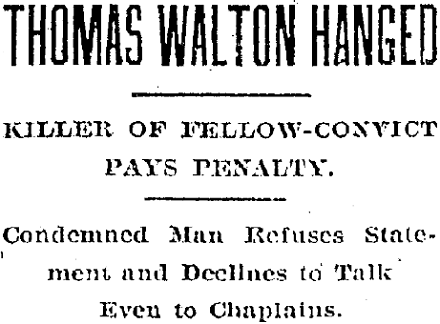
WALLA WALLA, Wash., Dec. 12. — Thomas Walton, convicted of the murder of S.P. Burt, a fellow convict, in the state penitentiary here October 7, 1923, was hanged at the penitentiary this morning. The trap was sprung at 5:06 A.M. and the prison physicians pronounced him dead 10 minutes later.

Walking to his death with the same fearlessness that he has displayed since the beginning of his prison career, Walton refused to make any final statement and even declined to talk with Rev. A.R. Liverett, prison chaplain, or Father Buckley, Catholic priest, in his cell prior to the execution.

His body will be sent to relatives in Montague, Cal.

Although Walton paid the penalty for killing Burt, he has of official record killed two other men. The first was in 1915 in California, for which he was sentenced to life imprisonment in San Quentin prison. The other was that of George McDonald, cellmate of Burt, whom he stabbed following his attack on Burt.

Walton and Burt were life termers in San Quentin and made their escape together in a prison automobile in January, 1923.

FOLSOM, Cal., Dec. 12 — Robert Matthews, negro, convicted of the murder of Coleman Stone, a grocer near Los Angeles, was hanged at the state prison here this morning. [Joe] Sinuel will be hanged next Friday.

On this day..

2014: Robert Wayne Holsey, despite a drunk lawyer

On this date in 2014, Georgia executed a contrite Robert Wayne Holsey.

Out on probation for an armed robbery conviction, this avatar of the classic middle name robbed a convenience store at gunpoint, then shot and killed a deputy who pursued him.

Georgia somehow didn’t have a state public defender system until 2003, a system presenting to the counties who were supposed to appoint indigent defense counsel on a local and ad hoc basis a fine opportunity for callous graft dovetailing the interests of the prosecutor’s office in winning its cases with court’s interest in pinching its pennies.

Accordingly, Baldwin County stuck Holsey with a man to test appellate courts’ standards for minimal representation, an alcoholic attorney named Andy Prince* who was rock-bottoming during the trial to the gobsmacking reported tune of a quart of vodka every night. Prince was disbarred shortly after Holsey’s conviction for robbing another client of $100,000.

According to a tragic Mother Jones profile, Prince, who was white, also happened to get in a dispute around this same time with a black neighbor and hurled some racist invective, which doesn’t seem ideal when your day job consists of trying to keep a black defendant off death row.

The late Prince — he died in 2011 — told an appeals court in 2006 that he “shouldn’t have been representing anyone,” but appeals courts, which must generally find that such “shoulds” clearly “would” have changed the trial outcome, have much less scope to act on the determination.

It’s a massive systemic cheat still in widespread use, albeit not always in such egregious fashion: use some underhanded means to get a death sentence on the books, then argue to every higher court that the deficiency can’t be proven certainly decisive vis-a-vis what might have happened in a fair fight. Do you know Holsey wouldn’t have received a death sentence? He did shoot a cop in the course of committing a violent felony, after all.

There are many general reasons why a robust defense might mitigate a sentence, but the specific reason of interest in Holsey’s case — a reason not litigated by Prince, an omission that likewise foreclosed appeals avenues — was that Holsey was severely mentally disabled.

With a testing IQ around 70, just at the border of the conventional definition for so-called “mental retardation,” Holsey had at the minimum a very strong card for the mitigation phase of the trial — if not an outright bar to execution.** Prince failed to play that card … and as of this date in 2014, American jurisprudence and the state of Georgia determined themselves content to leave it permanently face-down.

There’s a WNYC podcast about this case here.

* The Guardian article cited in this post calls him Andy Price. As all other media citations I find call him Prince, I’m going with that — but as it’s likely that everyone is copying from the last story instead of doing original reportage, I’m not completely confident that it isn’t Price after all.

** Georgia was actually among the first states to bar the execution of mentally disabled prisoners — although paradoxically its early standard thereafter became one of the nation’s weakest as other states implemented their own over the years. The Supreme Court theoretically bars executing the mentally disabled, but as it has enforced no coherent standard the executing states themselves generally get to decide who qualifies.

On this day..

1884: Howard Sullivan, ravisher and murderer

From the New York Times, Dec. 3, 1884:

SALEM, N.J., Dec. 2. — The hanging of Howard Sullivan, the negro, which took place at the county jail this morning, was the closing act of a tragedy that has never been equaled in Salem and rarely in any other county in the State of New-Jersey. Ella Watson, on the night of Aug. 18, while proceeding to her home over a lonely road near Yorktown, a thrifty little village, nine miles north of this place, was waylaid, robbed, ravished, and murdered, and her body concealed in some bushes near by, where it was discovered a few days later.

For a time the murder was enveloped in mystery, but the vigilance of two or three detectives, among them a colored man, who exhibited remarkable skill in working up the case, soon unraveled it, and Sullivan was charged with the murder.

He had not been long in jail before a confession was wormed from him,* and when placed on trial before a Supreme Court and three lay Judges, in the Court of Oyer and Terminer, he pleaded guilty and was sentenced to be hanged. Sullivan stood the prison life bravely, and not once did he display the slightest emotion.

Sullivan did not go to bed until after midnight last night. A great part of the time he spent in singing and praying, and when not engaged in this he was conversing with his death-watchers.

Confined in a cell on the third floor, the one he formerly occupied, and from which he attempted to escape,** is a colored woman named Sallie Fisher, convicted of the larceny of a watch chain, and sentenced to imprisonment in the county jail for 90 days. Nearly all last night she prayed and wept aloud for Sullivan. Her voice could be heard for a long distance from the jail, and her cries were piteous in the extreme. Sullivan’s mother called to see him and remained with him for some time. The scene between them was an affecting one.

The morning opened clear and pleasant, and Sullivan arose at exactly 7:05 A.M., when he was awakened by the Warden. He left his breakfast untouched, saying he would eat “after a while.” When asked if he wished to make any statement for the public, he said: “There is nothing more that I care to say about the case. I have got no complaint at all to make about my trial or my treatment. I have had all I want to eat and Sheriff Kelty and ex-Sheriff Coles have been very kind to me. I hope to go to a better world, and I believe my sins will be forgiven.”

Sullivan added that he had slept quite as well as usual during the night. After making this statement he ate the breakfast that had been prepared for him. His manner was calm, and when talking to his companions he was almost cheerful.

At 9 o’clock the gallows was tested and found to be in good working order. A few minutes later the condemned man’s fater and mother called to see him, and while they were with him in the cell all others, except his spiritual adviser, were excluded. The father is a bright, honest looking man, 65 years of age, though his appearance does not indicate it.

The meeting between Sullivan and his father and mother, together with the Rev. Richard Miles, Pastor of the Mount Pisgah Methodist Episcopal (colored) Church, of this city, one of his spiritual advisers, was a quiet one. They all sat around a stove in an outer room and chatted pleasantly for a few minutes. Sullivan said to his parents: “If you cry I will want to cry, but if you control yourselves I will.” This was all he said regarding his feelings.

While his family were still with him the Rev. William S. Zane, Pastor of the Walnut-Street Church, and the Rev. W.V. Louderbough, Pastor of the First Presbyterian Church, called on him and uttered a few consoling words. They have been regular visitors for some time, but took no part in the execution. The Rev. Wilson Peterson, Pastor of the African Church of Bushtown, also called while Sullivan’s parents were with him, and before taking their final leave all joined in singing “Take the Name of Jesus with you.”

Finally, the prisoner’s sisters entered the jail, and his parting with them was distressing.

His sister Emeline fell in a fainting fit and had to be carried out. This sight proved too much for his mother’s nerves, and, weeping and wailing, she was led into another room. When Emeline was taken to the street, on her way to the railroad station, she again fell in a fainting fit, and was actually dragged to the train. Mrs. Sullivan kept up long enough to reach the house of a friend, where she remained until her departure for Yorktown at noon.

After Sullivan’s cell was cleared of all except his spiritual adviser a final prayer in the jail was offered by the Rev. Mr. Peterson, after which, at 10:20 A.M., Sheriff Kelty, in the presence of Prosecutor Slape, read the death warrant. Sullivan was the coolest man in the party.

At 11:18 the jury appointed by the court filed down stairs to the basement and thence to the yard.

Sullivan, preceded by the two spiritual advisers, and accompanied by his friend, ex-Sheriff Coles, followed immediately after. He was dressed in a neat-fitting black diagonal suit, and wore black cloth gloves.

At the scaffold the Rev. Mr. Miles offered a prayer. Then the prisoner’s ankles were pinioned and his hands were fastened behind him with handcuffs

Ex-Sheriff Coles asked him if he desired to say anything, and he replied: “I hope the Lord will bless you all, and I hope to meet you all in heaven. Good-bye. When I fall from here I will fall into the arms of Jesus. It is a warning for all. It is very sad for my mother, my father, for Mr. Kelty, and for every one, but it is not sad for me. It is a marriage ceremony with me, and I want to be there in time for the feast with all those good men that have gone before me. I want all you gentlemen who have sons to take heed and learn them. Good-bye all.”

As the black cap was being adjusted Sullivan bade his friend Coles good-bye. There was just the slightest tremor in his voice as he spoke.

At exactly 11:29 the drop fell. There was a twitching of the body for a minute, and then it hung withut motion. In three minutes Sullivan was pronounced dead; his neck had been broken. The body was allowed to hang for half an hour, when it was cut down and placed in the coffin. It was buried at Bushtown in the afternoon.

* By a Pinkerton detective infiltrated into his cell for the purpose. According to the Chicago Tribune report of the trial, relating that detective’s gloss on Sullivan’s alleged jailhouse confession,

Sullivan said he sneaked up behind Ella Watson unperceived and struck her three or four terrible blows with a cane had had picked up in the woods. She fell to the ground, and, grasping the prostrate form, he dragged it across the road into the bushes, where he attempted to commit a dastardly assault upon the dying girl. She resisted his attempts, but he accomplished his design. Then the girl raised her head and exclaimed, “O, I know you!” “Then,” said Sullivan, “I clutched her by the throat and choked her with all my might. That killed her. I didn’t stop choking her until a shudder ran through her and I knew she was dead.”

** One important moral of this story is that when you have the opportunity to break out of death row, don’t dawdle.


Philadelphia Inquirer, Dec. 1, 1884

On this day..

1944: Charlie Kerins, IRA Chief of Staff

On this date in 1944, the Irish Free State hanged Irish Republican Army Chief of Staff Charlie Kerins.

The IRA had been sorely pressed in these war years by the Special Branch, and the inroads of counterintelligence help explain why Kerins himself took such a prominent position in the IRA at the tender age of 24.

And it also explains how he ended up on the gallows at Mountjoy Prison.

Key to the Special Branch’s campaign was the recruitment of Irish republicans — men like Denis O’Brien, a veteran of the Civil War turned police spy whom Kerins and two mates ambushed and shot to death in his driveway on the morning of September 9, 1942.

As one might expect, this incendiary assassination redoubled state pressure against the IRA. Living on the run under assumed names, Kerins managed to dodge arrest until June 1944. But when captured, he knew how to comport himself from implacable precedent of forerunners like Kevin Barry.

Kerins refused to recognize with a defense the legitimacy of the court that tried him; indeed, so reluctant were the authorities to make a martyr of Kerins that they paused proceedings for six hours with his conviction cinched to give Kerins the opportunity to save his neck by applying to submit to mercy. Kerins wasn’t the submitting type.

“You could have adjourned for six years as far as I am concerned,” Kerins sneered when the session reconvened. “My attitude to this court will always be the same.”

In the words of a verse he wrote to a friend just before his hanging —

What, said Cathal Brugha, if our last man’s on the ground.
When he hears the ringing challenge if his enemies ring him round.
If he’d reached his final cartridge — if he fired his final shot.
Will you come into the empire? He would answer, I will not.

On this day..

1759: William Andrew Horne, long-ago incest

On this date in 1759,* a man hanged at Nottingham for destroying the bastard infant of an incestuous affair … and for his belligerence decades afterwards.

William Andrew Horne, a sybaritic and well-off “bumpkin squire” in the estimation of the Newgate Calendar, had his way with the Nottingham ladies in the early 18th century including two servants of his mother’s and a local farmer’s daughter who we are informed thereafter “died in consequence of her grief.”

Even kin were not immune to the charms of such a ladykiller, and Horne had an affair with his sister that produced a child born in February 1724. Days later, Horne and his brother Charles took the tot out for a midnight ride and abandoned it in a haystack at a country estate. Many years later, Horne would claim that he intended the child be rescued there as a foundling; what actually occurred was that the boy died of exposure from being abandoned in the middle of a winter’s night.

Neither Horne nor Hornier breathed word of the affair thereafter but it seems that the other Horne — that brother Charles — was shocked enough to tell some others, like his father. Practical-minded dad ordered Charles to keep his big mouth shut, as did a local magistrate Charles blabbed to years later — who “said I had better be quiet, as it was of long Standing, and might hang half the Family.” (That’s via this 18th century pamphlet on the case.) But his conscience and an obvious sibling resentment** vis-a-vis brother Bill needled Charles. Over time, the reluctant accomplice revealed the secret rather promiscuously to folks including “John Kessell … Mr. Cook, of Derby … one Septimus Riley, a Tenant of my Brother’s … Mr. John Cooper, of Ripley, as I came back from Derby” and finally, when he feared he might be on his deathbed, to “Mr. John White, of Ripley.”

Though most of these were at a loss to urge action about Charles, all this whispering to the reeds successfully put the rumor abroad — and at long last the story returned to William’s ears, and neck.

In 1758, 34 years and who knows how many brokenhearted lovers after his midnight ride with the family’s shame, William Horne as a crotchety codger of 72 fell into a barroom row over game-hunting with a fellow by the name of Samuel Roe. Roe called Horne “an incestuous old dog,” and the combative Horne retaliated against this public calumniation by taking Roe to court and winning a judgment against him even though Roe’s description was precisely correct.

Roe in his fury tracked the infanticide rumor back to Charles and finally persuaded the vacillator to swear out a warrant. He wasn’t one to let a sleeping incestuous old dog lie.

* The date is frustrating here because I have not been able to locate an original news or trial document that definitively establishes a November 30 execution. I’m going ultimately with the date on the thorough and highly reliable Capital Punishment UK site; the careful reader will have noticed that this post cites a primary document which contradicts it: A genuine account of the life and trial of William Andrew Horne, of Butterly-Hall, in the County of Derby; who was convicted at Nottingham Assizes, August 10, 1759, for the murder of a child in the year 1724, and executed there on the 11th of December, 1759 … (This is also the date that the Newgate Calendar adheres to.)

Two things: first, this account situates the trial on Saturday, August 10 — but August 10 was not a Saturday in 1759. We have credibility issues right out of the gate.

Second, it is noted both in this document and elsewhere that our man got the name William Andrew in honor of his birth on the Feast of St. Andrew, which is Nov. 30. The prisoner “mentioned several Times” that he was to be hanged on his birthday.

This hanging occurred just seven years after England finally switched to the Gregorian calendar, entailing at the time a leap eleven days forward. As one side effect, this leap also created a stratum of “old” feast days that also shifted eleven days to maintain a 365-day distance from their former occasion. The case for December 11 would entail supposing that Horne from 1752 began treating December 11 as his actual birthdate, the “old St. Andrew’s Day”. Did Horne in fact do this? The documents I have seen are far less interested than some guy with an almanac blog would like them to be.

Someone with access to an 18th century database of Nottingham newspapers could probably clear this right up.

** As the oldest son, William inherited all the real estate: that is part of Charles’s pique. Another part is that William was “universally feared and hated” in the words of Edmund Burke’s Annual Register, acted the asshole towards everybody including Charles, and even “though he knew [Charles] was master of such an important secret, would not give the least assistance to him, nor a morsel of bread to his hungry children begging at their uncle’s door.” (William called several witnesses who testified that Charles often complained about his miserly sibling and publicly mused about swearing William’s life away.) It’s a wonder it took Charles so long to find someone to give him the thumbs-up on turning Judas against this lout.

Part of the Themed Set: Sexual Deviance.

On this day..

1910: Johan Alfred Ander, the last executed in Sweden

On this date in 1910, Sweden made its first and only use of the guillotine — in the very last execution of that country’s history.

The milestone subject’s name was Johan Alfred Ander, a failed hotelier and petty thief who, on January 5 of 1910, robbed a currency exchange outfit and in the process beat the clerk to death with a steelyard balance. As Ander had been casing his target from a nearby hotel whose own staff had grown suspicious of him, it didn’t take long to connect criminal to crime. An ample supply of incriminating booty in Ander’s possession (e.g., the beaten clerk’s wallet) confirmed the link.

Executions were already disappearing in Sweden at this point; by 1910, it had been a decade since the most recent one, ferry spree killer John Filip Nordlund. On the other hand, Sweden clearly anticipated repeat performances in the future because in the meantime it had ordered a guillotine. (Nordlund’s beheading was done by hand, by Albert Gustaf Dahlman, who also executed our man Ander.)

Ander never copped to the murder and refused to appeal for royal clemency.* Whether it was the savagery of the crime or the pride of its author, he was found a worthy candidate to interrupt the hiatus.

The death penalty was formally abolished in Sweden in 1921.

* Ander’s father did make an appeal on his behalf. It was (obviously) refused.

On this day..

1946: Twice double executions around the U.S.

On November 22, 1946, American executioners recorded a double-double with twin killings in both North Carolina and Georgia.

North Carolina

Charles Primus, Jr., and Wilbert Johnson carjacked a couple in Raleigh, forced them to drive six miles into the country,

got out and ordered the occupants to do likewise, demanded their pocketbooks, commanded them to go down a road in the woods; the defendants then held a whispered conversation, after which Johnson, with gun in hand, directed Miss Lipscomb to “stay there,” with Primus and marched Guignard approximately 200 feet down a path and demanded to know where his money was. While the parties were thus separated, Primus had intercourse with the prosecutrix after threatening to kill her if she did not submit. She says, “I submitted to Primus on account of fear.” The defendants were over 18 years of age; and the prosecutrix was 25 years old at the time of the assault.

Soon after the rape was accomplished the defendants freed the prosecutrix and her companion and allowed them to make their way to a house in the neighborhood.

The defendants admitted in statements in the nature of confessions that they obtained $650 from Guignard and $38 from Miss Lipscomb. Each originally claimed the other committed the rape, but finally Primus admitted he was the one who actually assaulted the prosecutrix. Johnson was tried on the theory of an accessory, being present, aiding and abetting in the perpetration of the capital offense. He was referred to by Primus as “the boss” of the hold-up conspiracy.

The specification abut “submitt[ing] on account of fear” — obviously, right? — mattered because Primus and Johnson took an appeal all the way to the state Supreme Court that this submission made intercourse no longer legally “forcible.”

Georgia

Johnnie Burns and Willie Stevenson were both electrocuted at Georgia State Prison November 22, 1946 for the ax murder of a man named Lucius Thomas, a crime that netted the pair $27.14.

Stevenson was only 16 years old at the time of the murder, and 17 when he was executed.

Arkansas

There was also a fifth, singleton execution on the same day in Arkansas: Elton Chitwood was electrocuted for murdering Mena pharmacist Raymond Morris during an armed robbery.

On this day..