2014: Thirteen Xinjiang terrorists

One year ago today, China executed as terrorists 13 separatist militants.

According to Xinhua, the 13 were condemned in 7 different cases from Aksu, Turpan and Hotan — all prefectures of the western Xinjiang region.


Xinjiang. By TUBS [CC BY-SA 3.0], via Wikimedia Commons

Muslim Uighurs comprise a near-majority of that province’s population, and although Xinjiang is formally an “autonomous region” many Uighurs find it not nearly autonomous enough. Going tension has fomented a separatist movement that has appeared to gain strength — or at least visibility — during the past decade, including multiple spectacular and deadly terrorist attacks as well as several riots.

“The execution of criminals involved in terrorist attacks and violent crimes answers the calls of all ethnic groups, deters criminal activities, and demonstrates the resolve of the Communist Party of China and the government in cracking down on terrorism,” a Chinese court spokesman said, speaking of three of this date’s condemned who were sentenced together for a series of attacks in Lukqun (Turpan prefecture) that slew 24 police officers.

The executions on this day were surely coordinated for their demonstrative effect, days after Chinese authorities announced a “one-year crackdown” in Xinjiang one day after two SUVs bombed a market in Ürümqi, killing 43 people and injuring over 90 others.

Notwithstanding China’s strenuous attempt to frame the “crackdown” as one targeting only terrorists, security measures have bled insensibly into a crackdown on Muslims, targeting conservative Islamic cultural markers like veiled faces. It’s a sure bet that we haven’t heard the last of this flashpoint.

On this day..

1899: John Headrick and Carroll Rice, Missourians

On this date in 1899, young John Headrick was hanged outside Cape Girardeau‘s courthouse for murdering James Lail.

The 19-year-old Headrick was an embittered ex-farmhand of his victim, James Lail — who fired the youth for stealing a buggy.

In July of 1898, he turned up on the farm and found Lail in the barn. Lail’s wife and daughter both saw young Headrick arrive; they would testify that within half a minute of him entering the barn, they heard gunshots.

At trial, Headrick would claim that he shot in self-defense when Lail menaced him with a deadly currycomb (a brush used for horses), offering the prosecutor the opportunity for a bit of sport on the cross-ex:

Q: “You want the jury to understand that you are afraid of your life when a man assaults you with a curry comb?”

A: “Yes, sir, when I am in a place where I can’t get away.”

Q: “Especially if you are armed?”

A: “If I wasn’t armed I would have been killed.”

Q: “He aimed to curry you? He didn’t strike you with the curry comb?”

A: “No, sir, he did not. He struck at me mighty hard.”

Jokes aside, Lail’s surviving family had a terrifying ordeal still to come. As Headrick blasted away at his fallen boss, Lail’s wife Vernie arrived and threw herself over her husband protectively.

The young assailant shot her, too, then began beating her. By now, 19-year-old Jessie Lail was on the scene too. “John Headrick, what do you mean!” she shrieked. “You have wrecked my life forever! You have killed Papa, now you are killing Mother!”

In the ensuing chaos, Vernie Lail tried to make a run for it only for Headrick to chase her down and stab her — to death, or so he thought. Then the young assailant marched Jessie Lail off at gunpoint. Somehow, Vernie Lail survived a slashed throat, a shot through the back, and numerous other injuries to rise yet again and make it a quarter of a mile down the road to her mother-in-law’s house.

“By God, the old woman is gone, you can’t kill her, can you?” Headrick exclaimed to the daughter when they re-crossed the spot where mom’s body should have been. Headrick at this point wisely abandoned the scene of his carnage after trying and failing to extract a pledge from his hostage not to give evidence against him. A posse found him shortly afterwards, hiding in a barn.

The sturdy and surprisingly low-to-the-ground tree on which Headrick was hanged just outside the Cape Girardeau courthouse still stands, or did as of 2010 when it was endangered by a proposed traffic roundabout. Have a gander at the old gallows-tree in this post by Cape Girardeau journalist Ken Steinhoff, here.


Headrick’s hanging took place behind jail walls, but on the same date in Alton, Carroll Rice was hanged before a reported crowd of 5,000 for the murder of his wife.

“Just before the black cap was adjusted, and while his legs were being pinioned, the condemned man broke away form the sheriff and attempted to escape,” press reports ran.

It was worth a try.

On this day..

1873: A day in the death penalty around the U.S., courtesy of the New York Herald

Dispatches to the New York Herald from 1873 give us today’s post: a little portrait of public hangings in Reconstruction Dixie.

Isham Belton O’Neill, 32 at his death, hanged in Atlanta on this date in 1873; the Herald reported it in the next day’s edition.

O’Neill grew up on a farm outside Atlanta but was taken to the city by service in the Confederate army.

Postwar, he started a short-lived painting business with a fellow veteran, John Little: short-lived, because within a few months the courts were sorting out the partnership’s dissolution. Little, evidently, felt hard done by their rulings and “met O’Neill on the street several times after the snit, and even visited him at his shop, always urging him to let him have a sash, which he claimed to be his own property.”

On September 5th, 1871, they bumped into each other again by accident and after a few pleasantriles, Little started in on the sash again. “You got it be swearing a damned lie,” he insisted.

The testimony is that O’Neill then struck him in the face, and [Little] seized O’Neill first by the collar and then by his hands, which he endeavored to hold firmly; but O’Neill, by turning and exerting himself, wrenched his right hand from Little’s grasp, put it behind him and drew from under his coat a large Bowie Knife and quickly stabbed Little in the abdomen, the knife penetrating six inches deep, making a surface cut of two inches long, the sides of which were jagged, as if the sharp, two-edged knife, after having been plunged in, had been twisted round and drawn out.

Enough about the sash, okay?

O’Neill was a respectable fellow in the community (apart from the unpleasantness), and he stuck to a shaky “self-defense” story long enough that he might have started to believe it himself. So even though Little gurgled his last that night with five feet of bowel hanging out of the jagged fissure O’Neill had carved, the killer felt inordinately confident of an executive reprieve.

O’Neill even eschewed the opportunity to escape during a general jailbreak in February 1872, obediently remaining in his spot even with the cell door popped wide open in front of him. Several fellow prisoners successfully absconded on this occasion and avoided recapture.

O’Neill only received word of the governor’s final rejection of his petition at 1 in the morning on the date of his hanging, when “he was awakened out of a sound sleep to receive it.”

Up to that moment he had been confident in the belief that his life would be spared by the Governor, and had refused to listen to the advice of his counsel and spiritual advisers to prepare for death. When he was told that the last hope was gone he felt very bad and was convinced. For the first time he seemed to realize the awful situation, broke down and gave way to piercing cries and lamentations — “Oh! is it all over with me? My God! it is terrible. Does the Governor refuse even a respite? O merciful God, is there no other chance!” and he ended with long heartrending, choking sobs.

We turn now to the Herald‘s June 17 report of a public execution from Lebanon, Virginia.

A steady, sharp stroke of a hatchet, a rope is cut, the crash of a falling drop follows, another rope is stretched to its utmost tension, there is a rebound and the body of Archie Johnson, a negro, is swinging in the air, a solemn warning to an immense multitude of spectators that “he that sheddeth man’s blood by man shall his blood be shed.”

Archie Johnson, “a copper-colored negro, about twenty-eight years of age” with a countenance “regular and well cut for a negro” was the former slave of a local Russell County gentleman.

Upon liberation, the correspondent charges, he “began a career of dissipation and vice,” driving away a wife with his wantonness before he “totally abandoned himself to all that was degraded, vicious and criminal.” At last, he murdered a man named Hunt.

This story is particularly intriguing for the writer’s detailed — often editorializing — reportage of the hanging details.

Not only all Russell county were on the grounds, but from Washington, Scott and other surrounding counties many thousands came to behold the death struggles of a condemned felon. The number of females in the vast throng was somewhat astonishing, and their complexions were as varied as the costumes they wore. Some were as black as a traditional ace of spaces, others as fair as the whitest lily, while the intermediate embraced every imaginable shade between the two. A large number of these came on horseback, their long, dark riding skirts forming a happy contrast with the innumerable bright and gaudy colors worn by the pedestrians. As to horses, all the available racks, trees and fences in town were thickly lined with them, and then it seemed that the surrounding woods were densely picketed with them. The prevailing costumes of the men were blue and gray jeans. The valleys, the knobs, the peaks and plains, the huts and houses, seemed to have poured themselves out to-day, all actuated by the same common, morbid curiosity, and it can safely be said that scarcely a score of them were solemnly impressed by the terrible scene they witnessed. The number present was estimated at six thousand people.

Turning from sociology to engineering, our observer sketches the construction of the lethal apparatus:

THE SCAFFOLD

was a very ordinary, rude affair, consisting of the usual two main uprights, a narrow platform in the rear, in front of which was the drop, supported by a rope. This ran through the crossbeam near the centre, and was secured to a peg driven in one of the uprights, about four feet from the ground. It allowed of a fall of six feet, and was in all respects as thorough and effective as a majority of the clumsy, murderous machines* generally used in such instances in the South. The structure was situated in the old field to the north of the town and about half a mile distant from the jail.

As for Johnson himself, he signed off on a written confession blaming for his downfall those usual suspects: liquor, cards, loose women. Then he puffed a nonchalant cigar as he rode on his coffin to the gallows, “neatly and tastefully attired in a suit of entire black cloth, black cap, with gloves and gaiters”; he sat on a chair beside his noose for two different sermons (Methodist and Baptist), then a hymn which Johnson “joined with great spirit and religious zeal,” asked one last cigar which he puffed happily for ten minutes in which “his coolness just at this time excited the wonder of many and the admiration of more,” and finally at 2:24 p.m. — 48 minutes after he arrived at the gallows — submitted to his fate.


There was a third U.S. hanging on June 13, 1873: Joseph Duncan, in a public execution at Paris, Ky., for murder. All I have been able to learn in particular of Duncan’s hanging was that his first rope broke, necessitating the ol’ do-over.

* Presumably the Yankee’s judgment of the gallows here is informed by New York’s having “progressed” to upward-jerking hangings.

On this day..

1886: Tabby Banks and Tom Honesty, for election rejection

This date in 1886 gives us the double execution of two men named Banks and Honesty — words we don’t hear in the same sentence every day, amirite?


Baltimore Sun, June 5, 1886: the source of all newspaper quotes in this post.

That’s Tabby Banks and Tom Honesty, to be exact, “two full-grown and powerful negroes” who to nobody’s satisfaction denied all the way to the gallows that they had murdered a white 18-year-old, Joseph McFaul, outside the (still-extant) Taylor Hotel on November 14, 1884. The sources I have located do not explicate any beef specifically known to have existed between these individuals; they do, however, situate the conflict squarely within America’s political environment in that electoral year. It is not only in passing that we have noted the parties’ racial identities.

Days before McFaul died, former hangman Grover Cleveland was elected President — the first Democrat to win the office since before the Civil War.

It might be better to say that Cleveland was the first Democrat to hold the office. The tossup 1876 presidential election was more-or-less won by New York Democrat Samuel Tilden, but he was bilked of the prize in an electoral college bargain that exchanged another Republican presidency for the end of Reconstruction.

In the 1870s and 1880s, northern whites were steadily coming around towards Southern whites’ distaste for the ongoing rigor necessary to enforce the putative equality of ex-slaves with their former masters.

Recognizing that such lethargy among white elites in effect amounted to abandoning the field to the violent reassertion of white supremacy, blacks were deeply apprehensive about 1884. Some even feared that chattel slavery might be restored outright. For all the growing indifference of the Republicans, the potential election of the Democrat Cleveland, T. Thomas Fortune wrote during the campaign, “would be a cold afternoon for this country and especially for the Negro and the laboring classes.” (Via)

This is presumably why McFaul, a Democrat taking part in a celebratory parade for Cleveland’s election, would have been hateful to Banks and Honesty. According to the Baltimore Sun, those latter two had previously “traversed the [march] route, threatening to kill some democrat.” Later, McFaul chanced to nominate himself their target by stepping into an alley, where the two churls “immediately attacked him.” Some passing Samaritan saw what was happening and managed to pull McFaul out of the alley and onto the street; still, his assailants did not disdain to press the assault in public view and clobbered the young man with a rock.

Everyone parted and went their separate ways, but young McFaul was a dead man walking. His skull fractured by the stone, he died that night in his sleep.

President Cleveland, of course, did not restore slavery. He took little interest in the situation of black Americans and did nothing to check the onset of Jim Crow, but in this he was not so different from his Republican contemporaries. Nobody among the nation’s white elite had a belly for the fight any longer.

Frederick Douglass had to concede in a Washington, D.C. speech of 1886 that “as far as the colored people of the country are concerned, their condition seems no better and not much worse than under previous administrations.”

Lynch law, violence, and murder have gone on about the same as formerly, and without the least show of Federal interference or popular rebuke. The Constitution has been openly violated with the usual impunity, and the colored vote has been as completely nullified, suppressed, and scouted as if the fifteenth amendment formed no part of the Constitution, and as if every colored citizen of the South had been struck dead by lightning or blown to atoms by dynamite. There have also been the usual number of outrages committed against the civil rights of colored citizens on highways and by-ways, by land and by water, and the courts of the country, under the decision of the Supreme Court of the United States, have shown the same disposition to punish the innocent and shield the guilty, as during the presidency of Mr. Arthur.

On this day..

1691: William Fielding, scammer

Four men and four women stretched their necks at Tyburn on this date in 1691.

Among them we find one William Fielding, condemned for robbing three houses by using a 17th century variant of the Nigerian prince email scam:

The Prisoners came to all the Prosecutors and pretended that there was a Lady Dead who had left them Legacys, and Wheedled them to go to look after it, and the whilest Robbed their Houses; which was lookt upon as a very wicked Invention.

Proving that even confidence men are vulnerable to their own trick, however, the Ordinary of Newgate‘s dispatch from the foot of the gallows reports that Fielding

said, That he was afraid that if he might be spared that he should be tempted to Rob again, because of his extream poverty: Therefore he now submitted to dye willingly, that he might not add sin to sin, and so encrease his future punishment.

Well might he fear hellfire if he took the judiciary for his example. In a time when property was far dearer than life, Fielding himself and all but one of the other seven to hang with him (the one was an infanticidal mother) died for felony thefts of various types — ranging from the pathetic (“stealing from Charles Thurston, on the 4th of this Instant May, one Linnen Bag, value 1 d. and 20 l. in Mony”) to the ludicrous (“Robbing Daniel Leery, on the 12th Instant, in the Street, as he was going along, in St. James’s Parish, snatching his Hat and Perrywig off his Head, in the Night”).

On this day..

1581: James Douglas, Earl of Morton

On this date in 1581, James Douglas, the Earl of Morton was beheaded on the Maiden.

The fourth and last of little King James‘s regents, Morton was arguably the most able of the bunch and distinguished his span of authority by winning the raging civil war against James’s mother Mary.

Regent Morton had a reputation for avarice during his run in the 1570s. However, deriving as it does from his executive impingement on the treasures of courtiers and clans no less grasping than himself, that reputation probably ought to be taken with a grain of salt.


Rimshot

If nothing else, Regent Morton had the excuse of king and country. Sir Walter Scott, for one, favored this Red Douglas with a much more charitably statesmanlike gloss in The Monastery and The Abbott.

As one example, Morton irked divines by enforcing with a minimum of pious exceptions a pre-existing statute requiring a one-third cut of ecclesiastical revenues.

Likewise, he made an enemy of Lady Agnes Keith — the widow of the assassinated first regent — and her (subsequent) husband, the Earl of Argyll by forcing them to turn over crown jewels that were being held in their quote-unquote safekeeping.

In 1578, this Argyll kidnapped King James VI and induced the 12-year-old to declare his majority and dismiss the Earl of Morton. Argyll landed a Chancellorship out of the deal: Morton — well, you know. He would eventually be accused, 14 years’ belatedly but not inaccurately, of complicity in the 1567 murder of Lord Darnley.

Argyll in the end lost his head to that distinctive Scottish proto-guillotine known as the Maiden. Though the apparatus actually dates back to 1564,* a legend as moralistic as it is specious holds that the Regent Morton was himself the man who ordered construction of the device that would eventually end his own life. Sir Walter could hardly be asked to resist that kind of material:

“Look you, Adam, I were loth to terrify you, and you just come from a journey; but I promise you, Earl Morton hath brought you down a Maiden from Halifax, you never saw the like of her — and she’ll clasp you round the neck, and your head will remain in her arms.”

“Pshaw!” answered Adam, “I am too old to have my head turned by any maiden of them all. I know my Lord of Morton will go as far for a buxom lass as anyone; but what the devil took him to Halifax all the way? and if he has got a gamester there, what hath she to do with my head?”

“Much, much!” answered Michael. “Herod’s daughter, who did such execution with her foot and ankle, danced not men’s heads off more cleanly than this maiden of Morton. ‘Tis an axe, man, — an axe which falls of itself like a sash window, and never gives the headsmen the trouble to wield it.”

“By my faith, a shrewd device,” said Woodcock; “heaven keep us free on’t!”

-Sir Walter Scott, The Abbott

When next in Edinburgh, quaff Scots engineering acumen with the friendly backpackers crashing at the High Street Hostel — the glorious stone town house that was once Regent Morton’s very own crib.


By Kim Traynor (Own work) [CC BY-SA 3.0], via Wikimedia Commons.

On this day..

1806: Polly Barclay, accessory in the murder of her husband

On May 30, 1806, Polly Barclay of Wilkes County, Georgia was “taken by a proper officer to a gallows previously to be erected in or near the town of Washington, and then and there on the day aforesaid, between the hours of ten o’clock in the forenoon and two o’clock in the afternoon … hung by the neck until you are dead.”

And may God have mercy on her soul.

The purported triggerman, Polly’s brother, had been acquitted of murdering Polly’s husband; then, said assassin turned right around and testified against his sister — who was duly condemned for hiring him. (They do say that Justice is blind.)

But don’t take Executed Today‘s word for it. For this sordid all-in-the-family homicide, we’re pleased to recommend a visit to the annals of Washington, Ga., we gladly defer to genealogist and historian Stephanie Lincecum‘s Peachy Past post.

On this day..

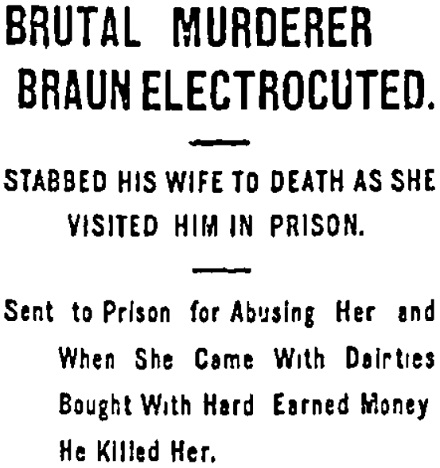
1899: Adrian Braun, who murdered his wife in Sing Sing


Wilkes-Barre Times, May 29, 1899.

On this date in 1899, Adrian Braun was electrcuted at Sing Sing.

Braun was a hulking German cigar-maker with a reputation for habitually thrashing his wife. Authorities got involved when he bashed a neighbor who intervened in a beating so hard that it fractured the man’s skull.

In August 1897, Braun caught a two-year sentence for assault. With her batterer put away, Kate Braun now had to shift for herself; struggling to make ends meet as a washer-woman, she had to give up two of her five children to the St. Joseph’s Roman Catholic Orphan Asylum. Still, she scraped together enough money to buy her incarcerated husband some sweets on a prison visit.

Mr. Braun was at work peeling potatoes in the prison kitchen when he was summoned for the arrival of his spouse in March 1898. After using up their visiting time on a conversation that appeared entirely mutually affectionate, the two were about to part when Adrian Braun suddenly whipped out the potato-knife he had recently been employing and daggered the poor woman’s throat — with lethal effect.

Braun never explained his shocking crime and pursued only a half-hearted insanity defense at his ensuing trial.

“No man was ever executed at the prison who had less sympathy than was felt for Braun,” the Wilkes-Barre Times reported on the day of the man’s execution.

On this day..

1879: Alexander Soloviev, bad shot

On this date* in 1879, would-be regicide Alexander Soloviev was hanged

Soloviev (English Wikipedia entry | Russian), a Narodnik revolutionary, was one of the less competent assassins to have a go at Tsar Alexander II.

Surprising the undefended sovereign on the latter’s morning constitutional near Winter Palace, Soloviev couldn’t connect with his revolver from four meters’ distance. As Alexander fled, Soloviev gave chase, firing four more times in the process to no effect before the gathering crowd wrestled him to the cobblestones.

Soloviev admitted the crime — the admission was hardly necessary — and hanged before a crowd of 70,000 souls. Despite the ensuing police crackdown on subversives (resulting in still more executions), many of those 70,000 surely numbered among the gawkers two years later for the hanging of the Narodnaya Volya terrorists who at last successfully assassinated Alexander.

* May 28 was the local (Julian calendar) date for the execution; by the Gregorian calendar prevailing outside Russia, it was June 9.

Part of the Themed Set: Terrorism.

On this day..

1925: The Sveta Nedelya bombers

Three perpetrators of Europe’s most spectacular terrorist attack were hanged on this date in 1925 in Bulgaria’s capital Sofia — after each stood on the gallows for forty minutes while the names of their victims were read to them.

Those 40 minutes of victims had unknowingly begun their path to Calvary two years before, when the Bulgarian military overthrew the post-World War I civilian government.

Though the Communist party stayed out of this putsch — it was a peasants‘ party that was toppled from power — the reds responded a few months later with their own countercoup: the September Uprising.


Septemvri 1923, by Ivan Milev. Perhaps topical to the horrible events yet to come in this post, also check out his 1926 Our Mothers Are Always Dressed In Black.

The eventual Cold War Communist government of Bulgaria would officially regard September 1923 as “the first anti-fascist uprising” — an ex post facto interpretation that would be aided by the Bulgarian dicator‘s eventual affinity for the World War II axis, and by the “White Terror” unleashed by the military after it routed the Communist revolt.

Harried and hunted, and their underground leadership succumbing to assassinations, the Communists conceived a punchback as devastating as it was contrary to the standard Leninist line on terrorism.

On April 14, 1925, a Communist agent assassinated Gen. Konstantin Georgiev.


Memorial marker for Konstantin Georgiev. Photograph by Miko (Own work) [CC BY-SA 3.0].

Shocking as this murder was, it was only the overture — and Gen. Georgiev was only the bait.

Two days later — Holy Thursday — a huge crowd turned out for the general’s funeral in Sveta Nedelya Church, perhaps Bulgaria’s most important cathedral. Unbeknownst to them, they shared the sacred vault with 25 kilograms of explosives packed into a column under the church’s dome.

When detonated during the service, it brought the dome down on the congregation.

“A tremendous explosion occurred and all became dark,” a former War Minister told the London Times correspondent. “Fortunately, I was standing almost below a pair of arches and I escaped without injury, not even losing my balance. A minute later the fumes began to disperse and, with six or seven others, I found myself standing while every one else was lying on the ground. Fragments of masonry were falling from the walls and the roof.”

One hundred fifty people died and another 500 were injured when Sveta Nedelya’s roof fell in — though amazingly, none of the many top state officials attending were killed. (And Tsar Boris III was not even in attendance.)


Sveta Nedelya after the explosion.

Like Samson, the bombers brought the walls down on their own heads, too.

Already none too lenient with the subversive element, the dictatorship directly implemented martial law and began rounding up suspected fellow-travelers, “disappearing” hundreds in the process. (One notable victim was poet Geo Milev, who never returned from a May 15 police interview; his remains were discovered 30 years later in a mass grave.)

The lucky ones managed to escape to Yugoslavia and thence to the Soviet Union. But three men* implicated in the plot remained to face the more decorous vengeance of the judiciary: Lieutenant-Colonel Georgi Koev, Marko Fridman, and Petar Zadgorski. The last of these was a sexton at Sveta Nedelya whose role as the inside man was essential to infiltrating the deadly package into the sanctuary.

* There were actually eight death sentences at this proceeding, but five of them were delivered in absentia … an absentia caused, for three of the five, because they had already been murdered during the post-bombing crackdown.

Part of the Themed Set: Terrorism.

On this day..