1943: The massacre of Janowa Dolina

On or very near this date in 1943, a Ukrainian militia massacred the Poles of the village of Janowa Dolina (Yanova Dolina).


Janowa Dolina in the 1930s. The village was a model settlement for workers at the nearby basalt quarry, jobs given at that time by official preferences to Poles. It was created in the 1920s, and featured an orderly plot with running water and electricity throughout.

In World War II, each theater of the war was unhappy in its own way. For the beautiful region of Volhynia long straddling the blood-soaked marches between Poland and Ukraine, it meant a ghastly local war under the umbrella of German occupation.

Mostly Polish in the interwar years, when Ukrainian residents chafed under “Polonization” policies, Volhynia had come fully under Soviet control when Berlin and Moscow carved up Poland in 1939, and then, of course, fully under German control in 1941. In these years of ash and bone, ethnic compositions in Volhynia were redrawn with every desperate ferocity nationalism could muster: pogroms visited neighbor upon neighbor, or ethnic cleansing visited state upon subject. It would be Ukrainian ultras positioned in the end to fantasize about ethnic purity by dint of their collaboration with the conquering Reich.

Come 1943, Poles comprised a shrinking minority in Volhynia. The prospect of purging this borderlands to cinch its place in a Ukrainian homeland made those Poles an inviting target for a campaign of ethnic slaughter that’s remembered now as the Volhynia or Volyn Massacres. And with the German defeat at Stalingrad and the Red Army’s advance on eastern Ukraine, Reich administration further west had become sufficiently distracted by more urgent priorities that genocidaires* perceived their moment to strike.

“We should undertake a great action of extermination of the Polish element,” thundered Dmytro Klyachkivsky, a commander of the Ukrainian Insurgent Army (UPA), military organ of the Organization of Ukrainian Nationalists (OUN-B).** “As the German armies withdraw, we should take advantage of this convenient moment for liquidating the entire male population from the age of 16 up to 60 years. We cannot lose this battle, and it is necessary to diminish Polish forces at all costs. Forest villages and those near forests, should disappear from the face of the earth.”

Many specific atrocities, beginning in February 1943 and continuing well into 1944, comprise this liquidation drive.

The one of interest for this post is the invasion on the night of April 22-23 — the eve and morning of Good Friday — of Janowa Dolina, a predominantly Polish village where 600 were massacred by the UPA and the village put to the torch.†

This horror is commemorated by a monument at the site …


The 1990 monument commemorating Poles murdered by UPA. Here’s a closer view of the stone marker, and here’s the inscription on the adjacent cross.

… but there seems to be a slight difference of opinion: the event is also memorialized by a rival stone erected by Ukrainian nationalists which “gives glory to the Ukrainian heroes” of the UPA for “destroying the fortifications of the Polish-German occupiers.”‡


(Thanks to Sonechka for translation help.)

As anyone holding even passing familiarity with events in present-day Ukraine will surely know this is no mere historiographical quibble; the legacy of the OUN from World War II and of its descendants on the modern far right remain deeply contentious in and out of Ukraine.

* Poland officially (and to the dismay of Ukraine) considers this campaign a genocide. There’s also a Polish film on the horrors of Wolyn.

** The OUN split factionally; the “-B” suffix in this case stands for Stepan Bandera, leader of the most militant faction; his surname is still today a byword and/or slur (“Banderists”) for Ukrainian fascism. Its rival faction was the more moderate OUN-M, led by Andriy Melnyk.

† The territory became Ukrainian — which at the time meant Soviet — after World War II and remains so today, so Janowa Dolina is now the Ukrainian town of Bazaltove. There’s a Flickr album tour of the muddy mining village, including photos of the Polish monument and a separate marker for Soviet POWs, but not the UPA monument, here.

‡ The UPA stone also cites April 21-22 as the date. It appears to me, a distant non-specialist, that the Ukrainian construction on what adherents prefer to more neutrally describe as the “tragedy” of Janowa Valley spreads action over two days and emphasizes alleged guerrilla actions by the UPA against German occupation targets prior to destroying the village.

On this day..

1374: Tile von Damm, Braunschweig mayor

On this date in 1374, mayor Tile von Damm was beheaded by rebel populares in his home city of Braunschweig (Brunswick).

One of northern Europe’s great Hanseatic merchant cities, Braunschweig enjoyed a rich history of civic unrest — the Braunschweiger Schichten. (Literally shift, but also carrying the sense of rebellion.)


The Great Rebellion in Braunschweig, by Alfred von Schüssler (mid-19th century).

One of its most outstanding installments — the one recalled as the Große Schicht — kicked off on April 17, 1374. (Most of the information about this incident is in German, as are most of the links in this post.) On that evening, a meeting of the ruling council of merchant magnates with its guild chiefs on how to deal with Braunschweig’s crippling debt turned tetchy and spilled into a popular protest. Within hours, as a chronicler would later put it, the devil was set loose in Braunschweig.

Guild protests carried to the “House of the Seven Towers” where Tile von Damm(e) resplended in the manner fitting the city’s mayor and its wealthiest patrician. That house still exists to this day, but the mayor’s thread was measured in mere hours: he was soon hauled out and beheaded on the Hagenmarkt.

Either eight or ten magnates (sources seem to be split on the figure) were slain during these April disturbances with others fleeing as guild rebels took full control of the city, not to be fully restored until 1386 — although in a show of transnational oligarch solidarity, Braunschweig was booted out of the Hanseatic League while the lower orders had the run of the place.


Allegory of the Great Rebellion (1514).

On this day..

1986: Alec Collett, Lebanon hostage

On (or very near) this date in 1986, Palestinian terrorist Abu Nidal had British hostage Alec Collett hanged in revenge for the previous day’s U.S. bombing of Tripoli.

Collett, a journalist and U.N. aid worker, had been abducted in Beirut more than a year earlier.

Abu Nidal, his captor, was the brand-name terrorist of his era. Indeed, his own name was a brand: Sabri Khalil al-Banna was the name he was born into, in a wealthy Palestinian family driven to dispossession and refugee camps by the Nakba. It was the Abu Nidal organization‘s assassination attempt on Israeli diplomat Shlomo Argov that triggered Israel’s counterproductive 1982 invasion of Lebanon, perhaps (for its long-term consequences) the crowning achievement of Abu Nidal’s career.*

This very conflict brought Collett to Beirut, as an aid worker for the United Nations Relief and Works Agency for Palestine Refugees in the Near East (UNRWA).

Stopped at a militia checkpoint on March 25, 1985 where he might have been taken because of an Israeli-stamped passport, Collett became one of about 100 foreigners seized as hostages by various factions over the long course of the Lebanese conflagration.

Only a few of these hostages died in their captors’ hands; they were in the main prisoners for leverage, and so efficaciously did they lever that it was these very souls that Ronald Reagan‘s U.S. administration proposed to retrieve by purchasing the (officially enemy) influence of Iran in the Iran-Contra arms-for-hostages scandal.

Confusingly shifting factional advantage has tangled Middle East politics for many a year, to be sure, and here the prospect of a negotiated release was aborted by the April 5, 1986 terrorist bombing of a Berlin discotheque frequented by U.S. soldiers — two of whom died in the blast.

This outrage proved to be the project of Libyan dictator Muammar Gaddafi, who then stood in a very tense position vis-a-vis the West. Ten days after the disco attack, Reagan responded with an air raid on Libya clearly intended to assassinate Gaddafi — who fled his compound moments before it was crushed by a fleet of 2,000-pound bombs. (The bombing might or might not have slain the dictator’s infant daughter.)

This attack on Gaddafi was also an attack on that arch-terrorist Abu Nidal, whom Gaddafi had recently taken in after a former patron Saddam Hussein made a bid for respectability by expelling him from Iraq.** And it so happened that Collett’s unoffending person offered Abu Nidal the most immediate vehicle for retaliation.

It’s not completely certain that April 16 was the date of Collett’s murder, though there is no real reason to doubt his executioners’ claim on this point. The matter was confused at the time because three other dead westerners discovered on April 17 were initially reported to include Collett among their number — a claim subsequently debunked. On April 23, Collett’s captors released a grainy video of their masked prisoner being hanged;† however, the identification of the noosed man was still questioned for many years. Collett’s remains — confirmed by DNA testing — were only discovered in 2009.

The anniversary of Collet’s initial abduction, March 25, is kept annually by the United Nations as International Day of Solidarity with Detained and Missing Staff Members.

* Israel withdrew from the bloody morass three years later, having displaced the Palestinian Liberation Organization for a much more effective new resistance movement in Hezbollah. Decades later, Osama bin Laden would cite Lebanon as the event that “gave birth to a strong resolve to punish the oppressors,” including the sight of “demolished towers in Lebanon” to inspire a bit of tower-toppling of his own.

** Abu Nidal had only recently on Gaddafi’s behalf hijacked an EgyptAir flight, killing dozens.

† I have thus far not been able to locate this video online.

On this day..

1942: The massacre at the Pit

On this date in 1942, the start of Purim,* Nazi forces occupying Minsk massacred approximately 5,000 Jews from the Minsk Ghetto at a site known simply as Yama, “the Pit”.

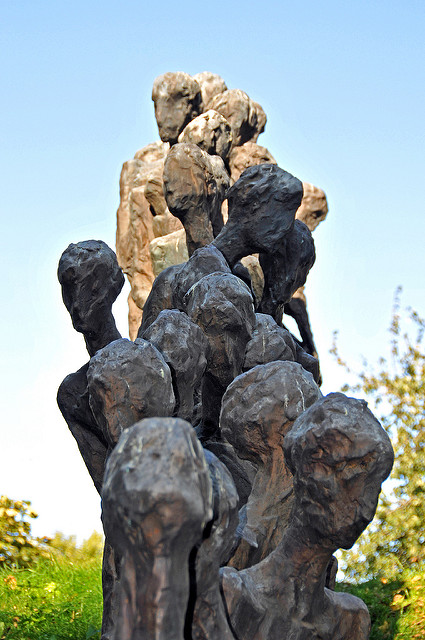
The site, which hosts memorial events every March 2, was marked with a somber obelisk in the immediate postwar years; unusually for a Stalin-era monument, it is overt about the Jewish character of the victims — for Soviet propaganda often obfuscated this with a technically-correct formulation such as “Russian citizens”. In this case, the 1940s memorial obelisk remarkably had a Yiddish inscription to mirror its Russian one. (The sculpture of a column of faceless people tragically descending the slope into the pit was added in the post-Soviet period.)


All images (cc) Dennis Jarvis.

Minsk’s pre-war Jewish population of more than 50,000 was almost entirely annihilated during World War II.

* It was not the only place in the Reich’s occupation to mark Purim with blood.

On this day..

1943: Dora Gerson, cabaret singer

Jewish cabaret singer and silent film actress Dora Gerson was gassed with her family at Auschwitz on this date in 1943.

IMDB credits the Berlin entertainer (English Wikipedia entry | the more detailed German) with two silver screen roles,* both in 1920 and both now believed lost.**

Gerson’s cabaret career was the more robust through the roaring twenties but with benefit of retrospection we admit with Liza Minelli that from cradle to tomb, it isn’t that long a stay.

And the ominous next act would not belong to Weimar Jews.

After being elbowed off German stages by Reich race laws, Gerson recorded several songs in German and Yiddish; her “Vorbei” (“Beyond Recall”) hauntingly commemorates the lost world before fascism — “They’re gone beyond recall / A final glance, a last kiss / And then it’s all over.”

Gerson fled Nazi Germany to the Netherlands; once that country fell under its own harrowing wartime occupation, she tried to escape with her family to neutral Switzerland but was seized transiting Vichy France. Gerson, her second husband Max Sluizer, and their two young children Miriam (age 5) and Abel (age 2) were all deported to Auschwitz and gassed on arrival on Valentine’s Day 1943.

* Her first marriage was to film director Veit Harlan, who would later direct the notorious anti-Semitic propaganda film Jud Süß — based on an executed Jewish financier. From the German-occupied Netherlands, Gerson unsuccessfully appealed to this powerful ex for protection.

** Future horror maven Bela Lugosi also appeared in both Gerson films, Caravan of Death and On the Brink of Paradise. Gerson’s German Wikipedia page also identifies her as the voice of the evil queen in the 1938 German-language dub of Disney’s Snow White and the Seven Dwarves.

On this day..

1878: Gauchito Gil, Argentina folk saint

January 8 is the execution day in 1878 of Argentine folk saint “Gauchito Gil”.

Nobody knows for sure if he really existed, but thousands flock to his sanctuary near Mercedes on this remembrance date while roadside red-flagged shrines throughout Argentina pay him homage all the year round.

If he was real at all, or even if he wasn’t, Antonio Mamerto Gil Nunez was an freelance ranchhand gaucho who ditched his conscription into the Argentine Civil Wars for life as an outlaw — flourishing in the classic social bandit guise as a friend to the put-upon peasantry with beneficence extending all the way to saintly healing powers.

Ambushed and captured at last, Gil’s last charity was reserved for the policeman who decided to have him summarily executed — whom Gil warned was about to receive an en-route pardon. The cop didn’t buy this obvious dilatory gambit and slit the bandit’s throat, only to return and find the promised clemency riding on up. As Gil had also prophesied, the policeman’s son had fallen quite ill and now he prayed to the brigand he had just put to death, who posthumously secured the boy a miraculous recovery.

The reports of the duly impressed executioner proliferated and soon fathered a flourishing popular veneration. Although Gauchito Gil is of course entirely unrecognized by the institutional Catholic Church, many devout pilgrims visit his site to pray for, or to offer thanks for, a favorable intercession in life.

On this day..

1944: Kaj Munk, Danish pastor-poet

Danish “pastor-poet” Kaj Munk was kidnapped and extrajudicially executed by the German occupation on this date in 1944.

Named for the adoptive family who raised him on the Baltic island of Lolland, Munk (English Wikipedia entry | Danish) was one of his country’s most popular playwrights of the 1930s.

He felt then the era’s pull to the Führerprinzip, and expressed admiration for the fascist rulers emerging in Germany and Italy — and disdain for parliamentarian prattle. Mussolini, he wrote, “was the new man, the future of Europe.”

At the same time, Munk’s deep religiosity led him to condemn Nazi anti-Semitism, and fascist Italy’s invasion of Abyssinia, and then later Germany’s seizure of Czechoslovakia — an expansion that would presage Germany’s easy conquest of Denmark in 1940. By now well past disillusionment with Hitler, the outspoken Munk did not shrink from denouncing the occupation, and the “cowardice” of Copenhagen in acceding to it just hours after German tanks rolled across the border. (See Resisters, Rescuers, and Refugees: Historical and Ethical Issues.)

He could scarcely have been ignorant of the danger this posture invited.

To this period dates Munk’s postwar fame, as well as his celebrated play Niels Ebbesen — which is all about a medieval Danish squire who assassinated a German tyrant. You can imagine how that went over in Berlin.

And as a working pastor, Munk had another platform, too.

“The pulpit has become for us a place of responsibility,” he wrote in 1941. “We tremble in our black garments when we ascend its stairs, because here, in God’s house, the Word is free … the Holy Ghost … forces us not to stay silent but to speak.”

And Munk was willing to do it, to exploit his position to oppose the cooperative stance his superiors were trying to promulgate; to preach against the occupation from the Copenhagen Cathedral in December of 1943; and to have subversive sermons illegally printed and promulgated — the last just days before his death.

Seized by the Gestapo on January 4, 1944, he was shot immediately after at Silkeborg. (The site is dignified by a a pious and understated memorial.) His abandoned corpse was discovered the next morning; consequently, January 5 is often the occasion for events marking the anniversary of Munk’s martyrdom.

On this day..

831: St. Euthymius of Sardis, iconophile

This is the martyrdom date in 831 for the iconodule saint Euthymius of Sardis.

Euthymius was just a child when Byzantium’s century-long internal conflict over image-veneration wrote St. Stephen the Younger into the pages of this here blog way back in 764.

By the time Euthymius attained the bishopric of Sardis in the 780s, the Empress Irene was putting an end to her predecessors’ anti-icon campaigns, and Euthymius took part in the Second Council of Nicaea that made the new policy official.

Posterity has a difficulty measuring by way of scanty and partisan sources the true state of sentiments surrounding icons during this period but it’s a sure thing that for an empire besieged both west and east, religious questions connected inextricably to geopolitical ones. Irene’s shift towards embracing what iconoclasts saw as graven images spanned about a quarter-century which also coincided with humiliating reverses for Constantinople. Irene’s son was thrashed by the Bulgars to whom her treasury was then obliged to submit tribute; then Irene had that very son deposed and blinded. Irene was toppled in her turn by her finance minister but Emperor Nikephoros too was trounced in battle and his skull wound up as the Bulgar Khan’s ceremonial goblet.

Small wonder that when Leo the Armenian took power in 814 he reflected that

all the emperors, who took up images and venerated them, met their death either in revolt or in war; but those who did not venerate images all died a natural death, remained in power until they died, and were then laid to rest with all honors in the imperial mausoleum in the Church of the Holy Apostles.

For a prelate like Euthymius, this meant a return to the opposition benches. He’s reported to have been arrested and exiled twice in the ensuing years before finally being scourged to death in 824 at the behest of Leo’s successor; however, scholarship has better associated this event with the more vigorous anti-icon persecutions of Theophilus after 829. In 831, Arab forces devastated Cappadocia and also captured Panormos in Byzantine Sicily. In light of these reverses Theophilos discovered that an anti-iconoclast manifesto predicting the emperor’s imminent death had been circulated — so again the link between prestige abroad, sedition within, and those damned icons. Theophilus attributed the pamphlet to a pro-icon bishop named Methodius, who was a friend of Euthymius, and had both men arrested.

Imprisoned on the island of St. Andrew, near Constantinople in the Sea of Marmara, the two men were questioned about their associates by the postal logothete — probably Arsaber, the brother of [anti-icon future patriarch] John the Grammarian — who was accompanied by the chartulary of the inkpot Theoctistus. Euthymius seems to have mocked Theoctistus and would name only one of his visitors: Theoctista, the mother-in-law of both the logothete and the emperor!* Theophilus had both Euthymius and Methodius beaten soundly. While Methodius, who was just over 40, could endure it, the 77-year-old Euthymius died from his injuries on December 26 and became an iconophile martyr. The empress Theodora was reportedly so upset at Euthymius’s death that she told Theophilus that God would desert him for what he had done. (Source)

The History of Byzantium podcast covers this period in episode 103.

* Theoctista was an actual iconophile. Her house in Constantinople later became the Monastery of Gastria — and post-1453, a mosque.

On this day..

1569: Orthodox Metropolitan Philip II of Moscow

This date in 1569, Orthodox Metropolitan Philip II of Moscow was martyred for his opposition to Ivan the Terrible.

He was elevated in 1566 as Russia’s top prelate* by that same Ivan, who soon regretted and then raged at his selection when Philip righteously withheld the church’s blessing from the tyrant in the midst of Ivan’s Oprichnina bloodbath.

That was in Lent of 1568. Before the year was out Ivan, who did not fear to bully churchmen, had forced Philip’s deposition and had him immured in a Tver monastery.

Safely out of the way there, the tsar’s fell henchman Malyuta Skuratov arrived two days before Christmas of 1569 pretending to bear a message. “My friend, do what you have come to do,” the monk replied. Skuratov strangled him to death.


Here comes trouble: Metropolitan Philip in prayer as his executioner arrives. (By Aleksandr Nikanorovich Novoskoltsev, 1880s.) For a more mannered and less violent interpretation of the same scene, try this number by Nikolai Nevrev

The Russian Orthodox Church observes this saint’s feast date on January 9. His relics are enshrined today at the Kremlin’s Dormition Cathedral.

* Moscow did not become a patriarchate until 1589, so Philip did not bear that title.

On this day..

1942: Six aspiring escapees from Dulag-205

On about the 18th December 1942 a group of about 6 prisoners intended to escape but were betrayed by somebody. All six prisoners were led out ofthe camp beyond the wire, taken about 20 metres to a pit and shot without any hearing. Before the execution the interpreter told the prisoners that the 6 men had wanted to escape from the camp and for that they would be executed. This would happen to anyone who tried to escape from the camp. The surnames of those who died are not known to me.

This is the testimony of Konstantin Krupachenko, a Red Army prisoner-of-war retrieved from the Germans’ “Dulag-205” camp — a transit facility behind German lines at Stalingrad which was liberated as the Soviets overran the encircled German position.

Krupachenko’s testimony was part of the evidence prepared against six Wehrmacht officers taken prisoner at that camp and ultimately executed, men whose case we have previously detailed.

Though not well-known and hardly by scale a major contributor to the ghastly death toll among Soviet POWs, Dulag-205 was horror aplenty for those who survived it. Starvation rations gave way to no rations at all in the dead of winter, and the skeletal inmates cannibalized the dead. Harassment by guard-dogs, capricious beatings, and the usual regimen of dawn-to-dusk forced labor were the lot of the lucky ones.

The less fortunate, well …

On about the 25th November 1942 while working on a road which led to Gumrak three kilometres from the camp a group of prisoners of about 50-60 was levelling and clearing the road. One prisoner whose name I don’t know collapsed from tiredness and exhaustion and couldn’t work. The guard tried to force the exhausted man to stand and work but the prisoner couldn’t get up. Then the guard shot the prisoner dead with a sub-machine gun and ordered that he be buried in a ditch at the side ofthe road. (Krupachenko again)


There were public executions in the camp. In January 1943 on about the lOth-llth a former senior Lieutenant of the Red Army, his surname I don’t know, was executed for allegedly organising an escape attempt. (Anatoly Alexeev)


In all cases the Germans would shoot prisoners without any warnings at all. In the month of October 1942 I personally saw up to 30 prisoners shot. They shot people every day for falling behind to and from work, and sometimes for breaking ranks. I am unable to give the surnames of the prisoners shot by the Germans. Moreover, when we were herded from the Alekseevka camp to the area of Karpovka village, then several prisoners were shot dead by German officers for the fact that when we were working we were bombarded by Soviet troops and several prisoners took cover. After the firing had stopped the officers came out of their trench dug-outs and shot them on the spot. Three prisoners were shot dead for taking some tobacco while working on a dump. (Ivan Kosinov)


As one of the Germans on trial for these abuses agreed (Otto Mäder was trying to throw blame onto the camp commanders),

[t]here was no trial of any kind, they [prisoners] were shot without any trial on the order of [Dulag-205 commandant] Colonel Korpert. I am a lawyer by education and I understand perfectly that this these shootings were illegal, simply murder in fact.

All these quotations are via Frank Ellis’s “Dulag-205: The German Army’s Death Camp for Soviet Prisoners at Stalingrad” (Journal of Slavic Military Studies, March 2006),

On this day..