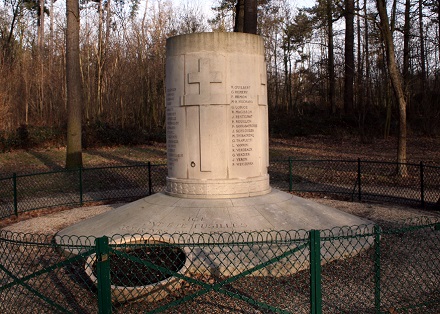
On this date in 1943, German troops occupying Greece massacred the entire male population of the town Kalavryta.
Memorial to the December 13, 1943 massacre.
Weeks earlier, resistance partisans had waylaid a German patrol in the vicinity, taking about 80 German soldiers prisoner and subsequently executing them.
A bestial Lidice-like mass reprisal, Unternehmen Kalavryta, commenced in December with German columns descending on the small Peloponnesian town — murdering civilians at nearby towns and firing the historic Agia Lavra monastery in the process.
Once they reached their target, the women and children of Kalavryta were locked in a school that was put to the torch, while men and older boys were marched to the outskirts and machine-gunned en masse, killing at least 500. (About thirteen are known to have survived this mitraillade and its ensuing finishing-off with axes.) The total death toll in Kalavryta was near 700, significantly mitigated by the women eventually forcing their way out of their burning tomb. Those survivors faced immediate winter privation to go with the horror of the massacre, for the Germans also destroyed homes and drove off the livestock.
A memorial at Kalavryta today* records some 1,300 names including villagers from the surrounding towns slain during the course of the operation — and the church clock is permanently fixed to 14.34, the moment on that awful December 13 that the massacre in Kalavryta began.
There weren’t any there — just townsfolk whose numbers were swollen by peasant refugees from the brutal civil war. After ransacking the town and interrogating and robbing the residents, the Atlacatl Battalion sent everyone home and bivouaced down for the night in the town square.
Dawn’s light the next morning would bring the unspeakable horror.
The battalion forced the entire population to the town square, divided men from women, and set about murdering men with gunshot, machetes, and worse — and raping and murdering the women — and then slaughtering all the children, too.
More than 800 civilians died. The next month, a Washington Post journalist described “dozens of decomposing bodies still seen beneath the rubble and lying in nearby fields, despite the month that has passed since the incident … countless bits of bones — skulls, rib cages, femurs, a spinal column — poked out of the rubble.”
A few survivors did manage to reach neighboring villages and the story of what had occurred at El Mozote worked its way out to the wider world over the days and weeks to come. It made little matter to the government in San Salvador where bloodbath was policy, openly espoused by the likes of the man who was about to be elected president of the Constituent Assembly.
In Washington, where the checks were written, destroying Latin American peasant guerrilla movements was a Cold War lodestar and so Orwellian denial of this atrocity soon became the virtual law of the land. After heroically risking his life venturing into the conflict zone to collect evidence, the New York Times reporter Raymond Bonner was tarred and feathered by America’s foreign policy apparatchiks and eventually driven off the Times foreign policy beat while the U.S. continued pumping money to the murderers. The Atlacatl Battalion in particular would author several more notorious atrocities in the course of the 1980s dirty war.
A U.N.-backed Truth Commission convened after the conflict finally ended in 1992, investigated the affair and agreed that
There is full proof that on December 11, 1981, in the village of El Mozote, units of the Atlacatl Battalion deliberately and systematically killed a group of more than 200 men, women and children, constituting the entire civilian population that they had found there the previous day and had since been holding prisoner… there is [also] sufficient evidence that in the days preceding and following the El Mozote massacre, troops participating in “Operation Rescue” massacred the non-combatant civilian population in La Joya canton, in the villages of La Rancheria, Jocote Amatillo y Los Toriles, and in Cerro Pando canton.
The El Salvador government officially apologized in 2011. Nobody has ever been prosecuted for the slaughter.
On this date in 1915, a mob visited Cordella Stevenson’s cabin, dragged her out, and lynched her.
The good citizens of Columbus, Mississippi, found her body the next day, hanging from a tree limb. The site of her lynching was only 50 yards north of the Mobile and Ohio Railroad, and rail passengers who came in and out of the city that day saw her corpse thus displayed. She had been “maltreated” (that is, raped) and stripped naked before being strung up.
Several months before, Gabe Frank, a local white man, lost his barn to fire. Although there was no direct evidence to implicate him and he had not been seen in the area for months prior to the fire, Cordella and Arch Stevenson’s son came under suspicion of arson.
The parents were respectable people who had worked for the same white employer for over a decade, but the son had a “worthless” reputation. Frank tried tracking the young man with bloodhounds, but was unsuccessful. The local police arrested Cordella and kept her locked up for several days, hoping she might know something of her son’s whereabouts, but they eventually released her without charge.
The Stevensons thought or hoped that would be the end of the matter.
Arch and Cordella had already gone to bed that Wednesday night in December when, at about 10:00 p.m., they heard someone pounding on their door. Before they could get to the door to answer it, the vigilantes had broken it down. They seized Cordella, pointed their rifles at Arch, and threatened to shoot him if he moved. At some point he managed to flee, bullets whizzing miraculously past him in the dark, and he ran to town for help. Arch knew what was good for him; after reporting what happened to the authorities, he fled the area for parts unknown. Meanwhile, somewhere out there in the night, the mob fell on his wife.
Sheriff Bell telephoned to Justice of the Peace McKellar to hold an inquest. He was out of town and did not return until Thursday night. As a result, the naked body was left hanging in view of the “morbid” crowd that came to see it until Friday morning when it was cut down and the inquest was held. That inquest jury returned a verdict that Cordella Stevenson came to her death at the hands of persons unknown.
The Chicago Defender, a (still-extant) black newspaper noted for its accurate reporting of Jim Crow era violence, bitterly editorialized, “This these southern culprits did. No law below the Mason and Dixon line that would cause them to fear. No officer in the police department that would dare to do his duty. No man in the government circles in Washington that has enough backbone to enforce the Constitution of the United States. This mob knew and they went on with their ghastly work.”
A century later, Cordella Stevenson’s ghastly death has still not been forgotten. In 2013, a poem for her, titled “What the Dark Said”, was published in the collection Ain’t No Grave, by Tennessee poet TJ Jarrett.
Though he is even to present-day Turkey the iconic traitor, it would be more generous to take him as the prophet of a future stillborn in the whirlwind of war.
Although he was of their generation, just a few years older than the “Three Pashas”, Kemal was not at all of their ethno-nationalist outlok. A cosmopolitan with a Circassian mother and a British wife — Kemal happens to be the great-grandfather of British pol Boris Johnson* — Kemal clashed with the Young Turks’ political organ and consequentially found European exile more congenial for much of the run-up to World War I. His book Fetretanticipates an inclusive, liberal, and westernized Ottoman Empire. It was a dream that shellfire pounded into mud, and not only for the Ottomans: these were years for national chauvanism run amok.
Politically sidelined within Turkey as the Young Turks steered the empire into war and genocide, Kemal re-emerged post-1918 — when the former empire lay supine before its conquerors — as a minister of state not merely acceptable to the Allied occupation but actively collaborating in its objectives. (Quite impolitic was his co-founding The Association of the Friends of England in Turkey even as England was occupying Istanbul and carving up the defeated empire.)
It is from this that his reputation as a Quisling figure derives, though there is little cause to believe that Kemal undertook these actions in anything other than a spirit of sincere public-service. The fact that he did so under the aegis of foreign domination, however, underscores the futility of his position: that Anglo-friendly, polyglot Turkey of his imaginings was not in the cards.
He and the nationalists were anathema to one another now, and though he resigned from the government in 1919 his university position gave him a platform to continue writing and lecturing against the Ataturk’s growing Turkish National Movement. Curiously, he did not join the sultan in flight from Turkey when the nationalists took the capital in hand and abolished the sultanate. Instead he was arrested having a placid shave at a barber shop by minions of Gen. Nureddin Pasha. The Nov. 13, 1922 New York Times described the horrific aftermath:
Ali Kemal Bey, editor of the anti-Nationalist newspaper Sabah, who was arrested at Ismid on the charge of subversive actions, was killed by a mob after having been officially condemned to death.
He was taken before General Nureddin Pasha who pronounced the death sentence dramatically: “In the name of Islam, in the name of the Turkish nation, I condemn you to death as a traitor.”
Ali Kemal remained passive, uttering no word of protest. His hands tied, he was led to a scaffold.
Before he reached the gibbet, however, an angry mob of women pounced on him, attacking him with knives, stones, clubs, tearing at his clothing and slashing at his body and head with cutlasses.
After a few minutes of excruciating torture, the victim expired. His body was dragged through the streets by the mob and exposed to public gaze on the scaffold for several hours.
The editor’s death has caused profound resentment and emotion in Constantinople, where he was known as one of Turkey’s most enlightened and most impartial citizens.
* Johnson, the former Mayor of London and (as of this writing) Britain’s Secretary of State, embraces this part of his ancestry but things were a little touchier when the Ottoman Empire and British Empire took opposite sides in World War I: at this awkward juncture, Ali Kemal’s English in-laws Anglicized his children’s names, using the surname of his late wife’s mother — Johnson.
Kemal also had a Turkish son by a subsequent marriage; his grandsons via that line, Boris Johnson’s cousins, are a major Istanbul publisher and a Turkish diplomat.
Aiken, South Carolina disgraced October 8, 1926 with the lynching of three members of the Lowman family.
American lynch law come 1926 was into its decline phase; the 30 lynchings in that year across the country have never been equalled in the nine decades since, but were also 50% below the rates at the beginning of the 1920s, and very far from the peak 1890s where triple-digit counts of mob murder were the perennial norm.
One might say that both the phenomenon and its pracitioners had matured. If exhortations to better refer justice to the law were the authorities’ running strategy for quelling lynch mobs, then the mobs themselves became complicit with the barristers — and could reserve recourse to extrajudicial means for occasions when the courts failed to work Judge Lynch’s will. Leo Frank’s case a decade prior to this is an excellent example: though there was a virtual lynch atmosphere at his trial, it was only after the man’s death sentence had been commuted by the governor that a lynch gang systematically extracted the man from prison to slay him.
Something like this pattern appears to distinguish the Lowman lynchings.
This dreadful case began with an exercise in that other grand tradition of racialized justice, the drug war — Prohibition-style. On April 25, 1925, the Lowmans’ tenant farm near Monetta was raided by police on a bootlegging tip.* The Lowmans resisted and a firefight broke out, leaving two dead: Annie Lowman, and Sheriff Henry Hampton “Bud” Howard.
Annie’s killing would of course never be punished. But inside of three weeks, fourteen-year-old Clarence Lowman was death-sentenced as Sheriff Howard’s killer, along with his cousin and “conspirator” 21-year-old Demmon Lowman. Bertha Lowman, Demmon’s older sister, received a life sentence.
And so Judge Lynch might rest easy.
Except that one year later, the South Carolina Supreme Court surprisingly threw out the Lowmans’ sentences as prejudicially obtained. The second trial began in October and right away the state suffered a setback when Judge Samuel Lanham threw out the murder case against Demmon Lowman.
Judge Lynch was wide awake now.
That very night — October 7 — white vigilantes organized a new verdict. According to the NAACP’s investigation, “within one hour of [Lanham’s] decision, news had been sent to as distant a point as Columbia that the three Lowmans were to be lynched that night.”
At 3 o’clock in the morning of October 8, and aided by the local constabulary, the mob stormed the jail and dragged Clarence, Demmon and Bertha Lowman away to a pine thicket outside of town where they were gunned down.
“On the way Clarence Lowman jumped from the car in which he was held,” the NAACP investigator would later report in the summation of his interviews.
He was shot down and recaptured, in order to prevent telltale blood marks, a rope was tied to the back of the car and the other end of it around Clarence’s body. In this manner he was dragged about a mile to the place of execution. The members of the mob sated that Bertha was the hardest one to kill. She was shot but not killed instantly. She dragged herself over the ground and as one member of the mob put it, ‘bleated like a goat.’ Another member of the mob, slightly more decent, said that she begged so piteously for her life and squirmed about so that a number of shots had to be fired before one found a vital spot and ended her agony.
Although the NAACP supplied South Carolina’s governor with the identities of 22 alleged members of the lynch mobs (including the sheriff himself) and 11 other witnesses to its actions, no man was ever sanctioned for this event, and an all-white grand jury declined to forward any indictments.
A distant Lowman relative was quoted in the Augusta Chronicle recollecting the stories his grandmother told about that horrible night, and the impression those stories had in his own life.
“She [grandma] talked about it all the time,” William Cue said. “Took them out of jail — drug them out like dead mules. When I drive past, I think about it — it happened in that house. … I learned something from that. … There was a lot of times where a man mistreated me and it kept me from doing anything.”
* It’s been argued by latter-day researchers that the tip itself was bogus, and supplied to police further to a personal vendetta — which, if true, would make the Lowmans victims of the 1920s version of SWATting.
When our party took over political power, the exploiting classes and reactionary forces went into action. The only rusty and antiquated tool that they use against us is preaching in the name of faith and religion against the progressive movement of our homeland.
On this date in 1979, Afghanistan’s Communist ruler Nur Muhammad Taraki was deposed and summarily executed (or just murdered, if you like: he was held down and suffocated with pillows) by his defense minister.
The writer whom the Soviets had once hailed as “Afghanistan’s Maxim Gorky” had been one of the most prominent Communist leaders in Afghanistan for a generation by the time he led a coup against Mohammad Daoud Khan in 1978. It was Taraki who inaugurated the Democratic Republic of Afghanistan, and so came to number among the USSR’s accidental gravediggers.
Like any proper Red he dreamt a far grander legacy: his program for Afghanistan featured wide-ranging land reform, education, and women’s rights. But he would quickly discover that the resistance to these aggressive changes wielded tools far less antiquated than expected.*
The rebellion that broke out against Taraki in 1978 — joining rural magnates, religious traditionalists, ideological anti-Communists, and people pissed off about the new government’s egregious human rights abuses — is basically the same war that’s still raging there today.
To Moscow’s credit, the morass-detector went to high alert when Taraki first began soliciting Kremlin aid. Soviet Foreign Minister Alexei Kosygin gave a sharp and apt refusal when Taraki first invited his Russian allies to come visit that graveyard of empires:
It would be a fatal mistake to commit ground troops. … If our troops went in, the situation in your country would not improve. On the contrary, it would get worse. Our troops would have to struggle not only with an external aggressor, but with a significant part of your own people. And the people would never forgive such things.
You know how they say you should usually obey your first instinct?
Taraki in the end wheedled very little by way of Russian props for his regime. It was only with his downfall that events took a different turn — for the aide who overthrew and then killed Taraki, Hafizullah Amin, was not half so trusted in the USSR as his predecessor. Before the year was out, Moscow had worriedly (and somewhat impulsively) begun committing its divisions into that self-destructive struggle Kosygin had warned about, vainly trying to manage the deteriorating situation. (Russia also overthrew and executed Amin into the bargain.)
* It also didn’t help Taraki that his own Communist movement was sharply divided. Members of the rival faction were widely purged or driven to exile in 1978-79; a notable exemplar of the exiled group was Mohammad Najibullah, who became president in the late 1980s and ended up being lynched when the Taliban took over in 1996.
Zum Kampf! Zum Kampf! from Max Bruch‘s 1877 oratorio about Teutoburg Forest victor Arminius. Also be sure to check out the Handel opera.
September 11 in the year 9 AD marked the bloody conclusion of the Battle of Teutoburg Forest — the engagement that permanently scared the Romans off Germany.
One of history’s true turning-point battles, Teutoberg Forest abruptly stanched decades of expansion that had seen Roman arms ascendant from Britain to the Levant. Indeed, the Roman commander who had the dishonor of falling on his sword at this legendary defeat, Publius Quinctilius Varus, was an experienced imperial patrician as well-traveled as the Roman standards who has been seen in these very pages collaborating with the Judean King Herod to execute Herod’s former heir.
But it was in the shadows and bogs of Germany’s primeval forests that Varus made his legacy to the world, which was to have his name famously bemoaned by facepalming Emperor Augustus once news of the disaster made its way back to the Eternal City.
Prior to this cataclysm, the empire had been working a years-long plan to annex fringe chunks of the vast Magna Germania beyond the Rhine and Danube rivers with its customary view towards eventually bossing the whole place. “Upper Germania” and “Lower Germania” to the west of Magna Germania already answered to Rome, testament to recent campaigns launched from neighboring Gaul;* the vast frontier beyond peopled by fractious warring barbarian tribes, with whom Rome cut strategic divide-and-conquer alliances, appeared to promise a future march of Roman glories all the way to the Baltic Sea.
This imperial hubris was shattered at a blow by the Cheruscan chief Arminius, who thereby made his name immortal to Germany.**
He had the element of surprise on his side, because his family had been such loyal Roman allies that Arminius had been trained up in the Roman army as a youth, and even held Roman citizenship. Whatever it was he experienced seems to have nurtured an implacable desire him to keep it away form his homeland. When the time came his familiarity with Roman military orders would be a high card in his hand, too.
Back in Germania, Arminius maintained his overt affiliation with Rome but started sending out feelers to assemble a confederation against the legions. He played this double game so adroitly that Varus still trusted his “ally” implicitly when Arminius reported a Germanic uprising that wanted Roman chastisement. Blind to his danger, Varus duly (and with casual discipline that would read very culpably in retrospect) marched his 17th, 18th, and 19th legions out through the unfamiliar glooms of the Teutoburg Forest.
It was a right massacre.
Their column broken up by rough terrain and pounding autumn rains, the Romans were ripe pickings for German sorties beginning on September 9. Harried by the Germans over two days’ panicked marching, the Romans were pressed into a dead end where palisades trapped the desperate legions at the edge of a slough and put them to slaughter. A bare handful escaped to tell the tale, and no future legion would bear the numerals of those annihilated on this day.
Varusschlacht, by Otto Albert Koch (1909).
The scale of the defeat, by rude tribesmen the empire always counted on being able to bully, beggared the Roman imagination.
“An army unexcelled in bravery, the first of Roman armies in discipline, in energy, and in experience in the field, through the negligence of its general, the perfidy of the enemy, and the unkindness of fortune was surrounded,” Paterculus lamented. “Hemmed in by forests and marshes and ambuscades, it was exterminated almost to a man by the very enemy whom it had always slaughtered like cattle, whose life or death had depended solely upon the wrath or the pity of the Romans.”
To judge by Roman reports — and what gives this event a purchase on the annals of Executed Today — the battlefield rout transitioned directly to the ceremonial butchery of captives. (As well as the posthumous beheading of the suicide Varus.) While some suffered torture and execution, others were offered as ritual sacrifices to the Germanic gods who had so magnificently delivered the day.
Several years later, a Roman force out to re-capture the lost standards of the Teutoburg legions reached the site of the empire’s humiliation. Tacitus describes the scene as a horror.
In the center of the field were the whitening bones of men, as they had fled, or stood their ground, strewn everywhere or piled in heaps. Near lay fragments of weapons and limbs of horses, and also human heads, prominently nailed to trunks of trees. In the adjacent groves were the barbarous altars, on which they had immolated tribunes and first-rank centurions.
Some survivors of the disaster who had escaped from the battle or from captivity, described how this was the spot where the officers fell, how yonder the eagles were captured, where Varus was pierced by his first wound, where too by the stroke of his own ill-starred hand he found for himself death. They pointed out too the raised ground from which Arminius had harangued his army, the number of gibbets for the captives, the pits for the living, and how in his exultation he insulted the standards and eagles.
And so the Roman army now on the spot, six years after the disaster, in grief and anger, began to bury the bones of the three legions, not a soldier knowing whether he was interring the relics of a relative or a stranger, but looking on all as kinsfolk and of their own blood, while their wrath rose higher than ever against the foe.
Despite the devastation, Teutoburg Forest was no extinction-level event for the Roman Empire. The Rhine and Danube frontiers remained an ongoing source of action for the many centuries to come, but despite raids and incursions here or there Rome never more seriously aspired to Magna Germania.
A few books about the Battle of Teutoburg Forest
* The future emperor Tiberius campaigned heavily in Germania, the last of which was post-Varus operations from 10 to 12 AD sufficient to permit the Romans to declare an honorably victorious conclusion to the project. (Tiberius celebrated a Triumph afterwards.)
** Arminius — whose name has been held equivalent with “Hermann” — has been the subject of many literary celebratins in a nationalist vein, great business especially in the 19th century.
The Hermannsdenkmal nomument in the Teutoburg Forest, the life’s labor of sculptor Ernst von Bandel who was able to finish it thanks to a mood of national exultation after the triumph of the Franco-Prussian War. For some reason it has a sister in Minnesota. ((cc) image by Hubert Berberich.)
On this date in September 10, 1893, the same day that they admitted to their roles in a murder conspiracy, Mehaley (or Mahaley) Jackson and Louisa Carter were lynched in the town of Quincy in eastern Mississippi, 137 miles east of Memphis.
The two black women’s slayings were only part part of a grisly tragedy that resulted in the deaths of six people, perhaps more.
In late August or early September 1893, a white gentleman named Thomas Woodruff fell ill along with his entire family. Two of his five children died. Two weeks later, what was left of the Woodruff family were all still languishing in the hospital, and there was little hope that any of them would recover. Neighbors who nursed the sick family also became ill.
A search of the Woodruff property turned up three packages of Rough-on-Rats, an arsenic-based poison, in the well.
Suspicion fell on Ben Woodruff, a local black man. The previous fall, Ben had “entered Woodruff’s house violently, and so excited his wife, who was in a delicate condition from childbirth, that she died in a few hours.” Ben had faced criminal charges in connection with the incident, and Woodruff was one of the witnesses against him, which, it was thought, provided motive to for Ben to kill him. (The news report below prefers a stolen wagon as the source of the friction.)
New Orleans Times-Picayune, September 10, 1893.
On September 9, during the inquest following Ben Jackson’s arrest, a group of unmasked men dragged him away from the police who had custody of him and hanged him. The murder inquiry continued without the suspect and, a day later, his widow, Mehaley Jackson, and mother-in-law, Louisa Carter, testified before the jury. They admitted they had known of Ben’s plan to poison the Woodruffs’ well. The two women were not arrested, but it would have been better for them if they had been: when they left the courthouse, an armed mob was waiting for them and hanged them as well.
Vigilante justice wasn’t finished yet: Mehaley and Louisa had said a neighborhood man named Rufus Broyles had given Ben Jackson the money to buy the poison. Broyles fled the area after Ben’s death and went into hiding in a nearby town.
On September 14, he was caught there, and strung up like the others.
Circuit court judge Newman Cayce made a “forcible and peremptory” order to the grand jury to identify and indict the lynchers. Predictably, there’s no record of any charges being brought against anyone.
On this date in 1972, Argentina’s junta authored the extrajudicial execution of 16 political prisoners after a jailbreak attempt.
Remembered as the Trelew Massacre (English Wikipedia entry | Spanish), it’s been back in the news for an Argentine court’s 2012 conviction of executioners Emilio Del Real, Luis Sosa and Carlos Marandino for crimes against humanity.
One week to the day before those 16 crimes, more than 100 captured guerrillas from both leftist and Peronist movements attempted a mass breakout from Rawson Prison. The plan was to rendezvous with some well-timed getaway drivers who would whisk everyone to the airport where a flight waited to carry them to Salvador Allende’s Chile, which was then still a year away from its own military coup.
Between drivers failing to turn up and others arriving late to the airstrip the operation was a logistical catastrophe. Six people actually managed to escape abroad;* nineteen others, having made it to the airport but missing the flight, salvaged what they could be summoning a press conference and surrendering without resistance. They hoped to protect themselves by putting their case into the public eye.
Navy Lt. Commander Luis Emilio Sosa took the would-be fugitives to a naval base near the port of Trelew — not back to Rawson.
In the early hours of the morning on August 22, all nineteen were awoken, lined up, and machine-gunned by a detachment commanded by Sosa and Lt. Roberto Bravo. Twelve died on the scene; the others were dumped in the infirmary where four more succumbed. It would be put about, as usual, that the murdered prisoners had been shot trying to escape but that story didn’t convince many people. From exile, Juan Peron decried it as “murder”; protests and guerrilla attacks occurred on the anniversary of the slaughter for the next several years.
Sosa and Real both died just a few weeks ago, in July 2016. Beyond the three men it convicted for the Trelew affair, Argentina has also appealed unsuccessfully to the U.S. to extradite Lt. Bravo, who has been living comfortably in Miami since 1973.
* These escapees went on to various interesting — and often violent — fates in revolutionary Latin America. One of them, Enrique Gorriaran Merlo, would eventually help to assassinate exiled Nicaraguan dictator Anastasio Somoza.
August 16 is a day of reverence in France for the execution on that date in 1944 — just days ahead of the allied liberation of Paris — of 35 young Francs Tireurs partisans.
In a dastardly operation, a French collaborator known as “Jacques” — actually Guy Glebe d’Eu, who was himself executed after the war — who had insinuated himself into resistance networks lured the youths, all aged about 18 to 22, to a purported weapons-smuggling operation. They were unarmed when they arrived, but the Gestapo was not.
By nightfall the victims were being lined up at in the Bois de Boulogne and shot. The site today is marked by a stately monument that hosts public memorials every August 16.


 Though he is even to present-day Turkey the
  The writer whom the Soviets had once hailed as “Afghanistan’s Maxim Gorky” had been one of the most prominent Communist leaders in Afghanistan for a generation by the time he led a coup against