1408: Konrad Vorlauf, Vienna Burgermeister

Konrad Vorlauf, late the mayor of Vienna, was beheaded on this date in 1408 with two other councillors.

The patrician Burgermeister was a casualty of the dynastic civil war between brothers Leopold IV and Ernest the Iron, which manifested in Vienna — a rising city on the brink of becoming (in 1440) the Habsburgs’ permanent residence — as a conflict between the city’s merchant oligarchs (allied to Ernest) and her artisan craftsmen (allied to Leopold).

It was a violent conflict even within city walls: in January of 1408, Vorlauf had seized five Leopold-friendly guild leaders and had them beheaded on the Hohenmarkt. (See this public-domain history of Vienna, in German)

During a subsequent truce, Vorlauf along with fellow Vienna grandees Hans Rock, Rudolf Angerfelder, Stephan Poll, Friedrich von Dorffen, Wolfhardt Schebnitzer, Niklas Untermhimmel and Niklas Flusthart went to a confabulation called by Leopold under his safe conduct, only to be seized on their return by knights allied to his cause and held to ransom.

Vienna duly paid it up but perhaps might have done better to keep the cash. Somewhere around this time Leopold imposed himself in Vienna itself, and when the artisan class caused a ruckus over new taxes, the prince was pressured to seize Vorlauf along with the aforementioned Hans Rock and another councillor named Konrad Rampersdorfer. Their beheading — in the city’s Pig Market, for added disgrace — proceeded under no color of law. The aged Rampersdorfer asserted his seniority for the privilege of dying first, saying

I have hitherto been a precursor to all others, and I have not earned the death penalty, but I have stood always for the natural rights of my prince. Therefore I offer to my fellows my own example, not to fear a righteous death, but to submit to it voluntarily.

With the childless death of Leopold a few years later Ernest became the uncontested chief of the Leopoldian line, and his martyred Viennese compatriots celebrated as municipal patriots — eventually exhumed from their graves and reburied with honor in St. Stephen’s Cathedral. They were fortuitously allied, as events would transpire, to the imperial glory conquered by Ernest’s descendants in what became the chief Habsburg dynastic line (the mighty Maximilian I was Ernest’s grandson).

Today, the place of the mayor’s execution is called Lobkowitzplatz; it’s marked by a plaque paying tribute to the men who bled there in 1408.


Commemorative plaque honoring Vorlauf and the others beheaded with him.

On this day..

1835: The unknown lynched of the Murrell Excitement

We’ve done several posts in these pages devoted to Mississippi’s July 1835 slave insurrection panic and there are several more yet to come.

But today’s post is dedicated to the dead that we can’t date, and mostly can’t even name: the unknown slaves killed beyond the reach of law and documentation in forgotten lynchings or private murders around Madison County and environs. There’s no way to know how many these were; it’s guessed that they ranged into the dozens.

Well might one outrage to the well-documented extralegal lynch committee stretching necks in the county seat of Livingston — but as this was a committee of local oligarchs it had an orientation towards order, even if not law, and it brooked cross-examination and extenuating evidence, issued sub-lethal sentences and even acquittals. According to Joshua Rothman in Flush Times and Fever Dreams: A Story of Capitalism and Slavery in the Age of Jackson, many claimed — right or wrong — that Livingston was an island of relative calm in a panic compassing “a territorial belt along the Mississippi River stretching northward from Mississippi’s boundary with Louisiana nearly 250 miles toward Tennessee and inland roughly 75 miels toward the center of the state.”

Numerous public reports in Mississippi tried to suggest that a very different atmosphere prevailed in and around Madison County during the insurrection scare that continued on past the hangings of the gamblers in Vicksburg, and that the Livingston Committee of Safety had successfully introduced order to a situation that might otherwise have escalated into an uncontrolled orgy of violence.

Yet even in Livingston, the narrative is absorbed with the white purported masterminds; slaves’ executions appear as a part of the scenery, never exhaustively categorized. The white artisan Ruel Blake would be impeached on evidence given by a slave whose capture and hanging by a mob dignifying itself an ad hoc lynching subcommittee is entirely recounted — sans date — in a single footnote to the Livingston proceedings.

He was run by track-dogs some two hours without being taken, making his escape by taking to water. He remained in the woods until the excitement had partially subsided. By the laudable exertions of his master, he was decoyed into Livingston, where he was taken … the committee of safety had adjourned when he was taken. The citizens seemed determined he should be hanged, and consequently organized a committee, composed of some of the members of the first committee and other freeholders, who condemned him to be hanged; and, in pursuance of the sentence, he was executed in Livingston. Under the gallows he acknowledged his guilt, and said that R. Blake told him of the insurrection … Blake told him he must kill his master first, which he promised to do. Blake told him he was to be one of the captains of the negroes, &c.

And this is a wealth of information compared to some. Elsewhere we are left with passing allusions, shocking and frustratingly sparse, fragments deposited by a whirlwind.

In Warren County, the slave Israel Campbell remembered in his autobiography how he “saw the place where the slaughter took place. Two large wooden forks, with a pole laid from one to the other, served for the gallows, and they told me men hung there two days and nights.” But he never quite tells us how many or just when.

A July 8 letter from a white man in Clinton, Mississippi,* remarks that “a general excitement prevails, and every one is vigilant in the detecting and hanging of all villains, and it requires but little proof. I cannot say how many have been hung and shot among the white and blacks.”

From Mississippi Springs* on the same date: “Many white persons have been suspected of giving encouragement to it — some taken up, others pursued — those taken up have invariably been hung after a hasty examination by those who apprehended them; no more ceremony than is usually used upon hanging a dog for killing sheep is extended to them … A great number of negroes have been hung, and they are hanging them daily.”

Rothman again:

From near Natchez, about forty miles south of Claiborne, a plantation governess wrote in her diary about “insurrections, hangings, patrolling, and all sorts of frights” in the area, and one man wrote from Natchez itself that everyone in the city was “under arms all the time” and “hourly expect[ed] an insurrection, as the celebrated negro stealers Murrel and his band, are at the head of all the negroes.” All the towns upriver from Natchez, the man reported, were similarly guarded, and people in those places were “catching from 5 to 20 every day … and they hang them without judge or jury …

Future U.S. Senator and Mississippi Governor Henry Stuart Foote lived then in Clinton and his memoir heaped scorn on the ur-text of this statewide paroxysm, Virgil Stewart’s pamphlet claiming that small-time outlaw John Murrell was really a master criminal orchestrating a slave revolution. Foote remembered how in a timeless phenomenon “those who dared even to question the actual existence of the dangers which he depictured [sic] were suspected by their more excited fellow-citizens of a criminal insensibility to the supposed perils of the hour.”

[In Clinton] after the first organization of the vigilance committee, which sat afterward every day, the excitement, as was natural, increased perceptibly every hour. Suspected persons, both white and black, were apprehended everywhere; some of whom were brought before the committee for examination, while others, whose guilt seemed to be fully established, were hung without ceremony along the roadsides or in front of their own dwellings by those who had apprehended them …

Madison county was still the main focus of excitement, and every day we heard in the peaceful village where I dwelt of some new case of supposed guilt which had been there developed, and some new application of punishment not known to the law of the land, but which was supposed to be justified by the terrible necessity then dominating over all things beside.

Circumstances being what they are, we cannot but assume that such episodes each stand in for added multiples of lives taken by fire or noose or musketry, on plantation fastnesses or remote byways or hamlets too small for their own scrivener … nameless lives whose loss never spilled a drop of ink.

* Published in the Ohio State Journal, July 24, 1835.

* Published in the Baltimore Gazette and Daily Advertiser, July 30, 1835.

On this day..

1835: Five professional gamblers lynched at Vicksburg

On this date in 1835, five professional gamblers were strung up in Vicksburg.

It was an event more adjacent to than constituent of the slave rebellion panic shaking Mississippi, for the men were neither slaves nor their confederates and they were not struck down for threatening the Slave Power; at best, the uneasiness of possible insurrectionary stirrings abroad informed the tense background, or offered the post hoc justification — but these lynchings were a different thing that inhabited by chance the same time and place.

A Mississippi River boomtown “created by the easy credit of the Jacksonian ‘flush times’ and the scramble for wealth coincidental to Indian removal,” wrote Joshua Rothman,* Vicksburg had become a haven for faro players and other imps. The reports of this date’s events run thick with moralizing but as Rothman observes,

The merchants, doctors, lawyers, and planters who constituted Vicksburg’s budding elite may have believed professional gamblers threatened their moral integrity, but most people in Vicksburg were essentially speculators who had risked migration to the Southwest for the allure of fast profits almost unimaginable everywhere else in the country. In a very real sense, nearly everyone in Vicksburg was a gambler.

Then as now the high rollers at the tables of casino capitalism make free to snort at their louche progenitors and their marked cards and cathouse molls; gambling was a top-shelf moral hazard throughout 19th century America.

Whatever uneasy accommodation Vicksburg’s respectable had made with their cardsharps came to an abrupt end at an Independence Day barbecue that Fourth of July, when a player got into an altercation with a civilian and, ejected from the festivities, boldly returned to the scene armed, looking for trouble. Incensed townspeople overpowered him and drug him out of town to tar and feather him and order him out of town.

The summary executions that will follow two days hence would be widely condemned as news of the event echoed to the corners of the Republic, but that condemnation would always be attenuated by the nigh-universal public disapproval attached to gambling. A dispatch from Vicksburg that reached many other newspapers — we’re quoting it from the July 31, 1835 Richmond (Va.) Whig; one may find the piece in its entirety here — trowels on thick paragraphs of sermonizing before we come to the narrative: “shameless vices and daring outrages … destitute of all sense of moral obligations … intent only on the gratification of their avarice … vile and lawless machinations … every species of transgression … drunken and obscene mirth …” Et cetera, et cetera.

Now that we’ve forded this mighty river of invective, we find the townspeople of Vicksburg post-tar-and-feathering, “having thus aggravated the whole band of these desperadoes,

and feeling no security against their vengeance — the citizens met at night in the Court house, in a large number, and there passed the following resolutions:

Resolved, That a notice be given to all Professional Gamblers, that the citizens of Vicksburg are resolved, to exclude them from this place and its vicinity; and that twenty-four hours notice be given them to leave the place.

Resolved, That all persons permitting faro-dealing in their houses, be also notified that they will be prosecuted therefor.

Resolved, That one hundred copies of the foregoing resolutions be printed and stuck up at the corners of the streets — and that this publication be deemed notice.

Most of Vicksburg’s wagering fanciers took the ultimatum seriously and blew town. They were wise to do so.

On the 6th, as promised, Vicksburg’s soldiery marched door to door through a roster of homes suspected of hosting illicit gambling and there “dragged out every faro table, and other gambling apparatus that could be found” … until,

At length they approached a house which was occupied by one of the most profligate of the gang, whose name was North, and in which, it was understood that a garrison of armed men had been stationed. All hoped that these wretches would be intimidated by the superior numbers of their assailants, and surrender themselves at discretion, rather than attempt a desperate defence.

The House being surrounded, the back door was burst open, when four or five shots were fired from the interior, one of which instantly killed Doctor Hugh S. Bodley, a citizen universally beloved and respected.

The interior was so dark that the villains could not be seen, but several of the citizens, guided by the flash of their guns, returned their fire. A yell from one of the party announced that one of the shots had been effectual, and by this time a crowd of citizens, their indignation overcoming all other feelings — burst open every door of the building and dragged into the light, those who had not been wounded.

North, the ringleader, who had contrived this desperate plot, could not be found in the building, but was apprehended by a citizen, while attempting in company with another, to make his escape at a place not far distant. Himself, with the rest of the prisoners, were then conducted in silence to the scaffold.

One of them not having been in the building before it was attacked, nor appearing to be concerned with the rest, except that he was the brother of one of them, was liberated. The remaining number of five, among whom was the individual who had been shot, but who still lived, were immediately executed in presence of the assembled multitude. All sympathy for the wretches was completely merged in detestation and horror of their crime.

The whole procession then returned to the city, collected all the Faro Tables into a pile and burnt them.

The names of the individuals who perished, were as follows: North, Hullams, Dutch Bill, Smith and McCall.

Their bodies were cut down on the morning after their execution and buried in a ditch.

It is not expected that this act will pass without censure from those who had not an opportunity of knowing and feeling the dire necessity out of which it originated. The laws, however severe in their provision, have never been sufficient to correct a vice which must be established by positive proof, and cannot, like others, be shown from circumstantial testimony.

It is practised too, by individuals whose whole study is to violate the law in such a manner as to evade its punishment, and who never are in want of secret confederates to swear them out of their difficulties, whose oaths cannot be impeached for any specific cause.

We have borne with these enormities, until to have suffered them any longer would not only have proved us to be destitute of every manly sentiment, but would also have implicated us in the guilt of accessories to their crimes. Society may be compared to the elements which although “order is their first law,” can sometimes be purified only by a storm. Whatever therefore sickly sensibility or mawkish philanthropy may say against the course pursued by us, we hope that our citizens will not relax the code of punishment which they have enacted against this infamous and baleful class of society — and we invite Natchez, Jackson, Columbus, Warrenton, and all our sister towns throughout the State, in the name of our insulted laws — of offended virtue and of slaughtered innocence, to aid us in exterminating this deep-rooted vice from our land.

* “The Hazards of the Flush Times: Gambling, Mob Violence, and the Anxieties of America’s Market Revolution,” The Journal of American History, Dec. 2008. Also recommended: Rothman’s book Flush Times and Fever Dreams: A Story of Capitalism and Slavery in the Age of Jackson.

On this day..

1835: A white man at Vicksburg and two black men at Livingston, and five slaves at Beatties Bluff

The first casualties of the Murrell Excitement, a purported slave rising in Madison County, Mississippi, were strung up by vigilance committees on this date in 1835.

Having been alerted to rebellious talk by slaves on a Beatties Bluff plantation, a vigilance committee organized itself and interrogated every slave there.

Events were moving fast, and those in the middle of them had all they could do to keep up with developments — as can be seen by this staccato letter from Canton, Mississippi in the center of Madison County. It was reprinted widely in the U.S. in late July; we’re quoting here from the July 25, 1835 Baltimore Gazette And Daily Advertiser.

Canton, Mississippi
July 3, 1835.

I have to inform you the disagreeable news that the negroes are about to rise upon the whites. It come out about two weeks ago; the whole country is in alarm — There have been meetings throughout the state, to adopt measures to find out the ringleaders and to appoint patrols. We are out patroling every night. — Last night I was in company to ride about the country to the plantations to see if every negro was at his home. There was a white man taken up at Vicksburg concerned with the negroes; they called a court together, and brought him in guilty and HUNG him right off. There have been three more white men taken up, but they have not had their trials yet.

In Livingston a town twelve miles from here, they gave a negro six hundred lashes, before he would discover any thing; then he informed them that the blacks were to rise on the Fourth of July. The jail here is full and they are bringing more and more in every day. We have a meeting here to day to form a volunteer company, to be ready at a minute’s notices and we are prepared with guns and ammunition.

Whilst I am writing this, there is a large meeting here to adopt resolutions to protect the citizens; also to send on to the Secretary of War to send a company of soldiers to protect the citizens of the County. — They hanged two negroes yesterday at Livingston, and they have about fifteen more that they are going to hang. We had four brought in here this morning to examine, and expect they will hang one of them.

The Court has just adjourned. They tried three blacks and flogged them all. To one of them they gave two hundred lashes! There were three white men at the head of the insurrection, that have run away. They have one in jail. They took him out yesterday, and gave him Lynch’s law, and that is thirty-nine lashes in this country. They expect to hang him.


Meanwhile, at Beatties Bluff, interrogators on July 1-2 harrowed the slaves with scourges. A letter from one of their number described the transaction with the first man to crack, a blacksmith named Joe. We do not know for a fact whether there was any slave plot, but if one reads it from the perspective of Joe’s likely innocence it presents as an archetypical feeling-out dialogue between torturer and prey, each party half-guessing at the other’s direction so as to steer a story to its acceptable destination.

We then called for a rope, and tied his hands, and told him that we were in possession of some of their conversation, and that he should tell the whole of it; after some time he agreed that, if we would not punish him, he would tell all that he could recollect. He said he knew what we wanted, and would tell the whole, but that he himself had nothing to do with the business. He said that Sam had told him that the negroes were going to rise and kill all the whites on the 4th, and that they had a number of white men at their head: some of them he knew by name others he only knew when he saw them. He mentioned the following white men as actively engaged in the business: Ruel Blake, Drs. Cotton and Saunders, and many more, but could not call their names; and that he had seen several others. He aso gave the names of several slaves as ringleaders in the business, who were understood to be captains under those white men.

Joe appears to have managed this frightful situation with aplomb and “was set at liberty”; however, on his evidence, other slaves were brought in: an aged preacher named Weaver (“no offers of lenity could shake his courage, and he remained steadfast under the torture of the lash, when even his executioner was nigh to fainting with his task”); a man named Russell (“all was mystery with him” until, prompted, he made a statement “in all particulars, precisely like the one made by Joe”); a handsome youth called Jim who offered more white man’s names and claimed that the slaves intended “to slay all the whites, except some of the most beautiful women, whom they intended to keep as wives”; and “a boy” — presumably a child — called Bachus who confirmed same.

“After getting through with these examinations, Jim, Bachus, Weaver, Russell, and Sam, were all put to death by hanging.”

A tense albeit perhaps dramatized narration of the violent interrogations and summary executions can be found in chapter 29 of The Life and Adventures of J. A. Murrell, the Great Western Land Pirate, which is also the source of the illustration above, and of the parenthetical quote about the preacher Weaver.

On this day..

1996: The Abu Salim prison massacre

On this date in 1996, Muammar Qaddafi‘s Libya massacred hundreds of prisoners in mass shootings at Tripoli’s notorious prison Abu Salim.

Human Rights Watch has charged that the death toll might surpass 1,200 although the government’s long-term stonewalling has helped to obscure the scale.

The day prior, inmates had seized a guard to protest poor prison conditions. Qaddafi’s own brother-in-law Abdullah Senussi was dispatched to negotiate a settlement. It was a simple arrangement: release the guard. Have some grievances redressed.

The guard was duly released, in good faith.

And by way of reciprocity, Senussi unleashed a general slaughter. Multiple prisoners have given accounts to human rights investigators of mass murders, inmates “lined up and shot, execution-style, by young conscripts whose choices were shoot, or stand with them to be shot” and buzzard squads picking through the groaning heaps of bullet-riddled men to administer coups de grace. A kitchen worker quoted by this 2001 BBC Witness broadcast who described how

soldiers in khaki uniforms fired upon the prisoners in the courtyard from the rooftops with automatic weapons and then followed through with pistols, individual shots, and killed what he claimed were 1,200 of his fellow prisoners … the number came to him based on the amount of meals he said he had prepared prior to the incident, and thereafter.

Senussi, who was Qaddafi’s spy chief, was at last notice under sentence of death himself in post-Qaddafi Libya.


“The people want the death penalty for Abdullah Senussi for the Abu Salim massacre” reads the poster, according to the BBC.

On this day..

Feast Day of St. Cetteus

June 13 is the feast of St. Cetteus, patron of the Adriatic port city of Pescara.

This saint’s legends smudges the line between just-so story and real historical events, illustrating the Church martyrology’s great strength as a ready-made memorial of Christians’ trials down the years. In this case the suffering was less a religious persecution per se than the shame of being trod over by conquerors who installed themselves almost without opposition in the hollowed husk of Roman greatness and did as they pleased.

The Lombard incursion beginning in 568 in some ways signals the permanent sundering of east from west in the Roman world, for the Germanic invaders — a mixture of pagans and Arian heretics, no less — in time ousted Byzantium from the latter’s Italian holdings and meanwhile underscored the Roman Empire’s near-impotence in its ancestral homelands. “From Italy the emperors were incessantly tormented by tales of misery and demands of succor, which extorted the humiliating confession of their own weakness,” writes Gibbon. “The expiring dignity of Rome was only marked by the freedom and energy of her complaints: ‘If you are incapable,’ she said, ‘of delivering us from the sword of the Lombards, save us at least from the calamity of famine.'”

For the near term, it was a violent and unstable period; Lombard rulers assassinated and warred with one another as their hegemony devolved into a patchwork of feuding duchies, helping set the scene for the fractured medieval peninsula.

The perils of internal strife manifest in our martyr’s story; despite his eventual association with Pescara, his bishopric was inland at Amiternum and it was there, the story goes, that he was ordered drowned in 597 by a tyrannous Lombard warlord who mistakenly thought him a crony of his rival.

Tossed into the drink, the bish floated downstream to Pescara where a fisherman, recognizing the corpse’s ecclesiastical raiments without knowing exactly who wore them, buried him under the whimsical name “Peregrino”.

On this day..

1940: Julien Vervaecke, Tour de France cyclist

On or around this date — exactly when is forever obscure* — the former Tour de France cyclist Julien Vervaecke was summarily executed by Polish and British soldiers in German-occupied Belgium.

The Belgian velocipeddler raced professionally from 1924 to 1936 and reached the top ten of cycling’s signature event four times — capped by a third-place ride in 1927.

He’s most famous in the annals of his sport for his controversial victory in the 1930 Paris-Roubaix race, when he crossed the finish line second after getting the worst of a late collision with French cyclist Jean Marechal, but was awarded the win by judges who faulted Marechal for the incident. (Vervaecke got the medal but not the branding: it’s known as l’affaire Marechal.)

By the time war clouds had gathered anew, Vervaecke (English Wikipedia entry | German | French) had retired to proprietorship of a restaurant in Menen, on the French border.

As the Wehrmacht blitz overran Belgium, Vervaecke’s home chanced to fall within the British pocket pinned to Dunkirk, 70 kilometers away away. The famous evacuation would commence on May 26.

On May 24, scrambling soldiers of the British Expeditionary Force, apparently including some officers of the exiled Polish army,* tried to ransack Vervaecke’s place for supplies, and the ex-cyclist resisted. As with Marechal all those years ago, Vervaecke had the worst of this collision, and the tetchy troopers led him away.

Nobody witnessed what happened to him; his body only turned up weeks later, over the border in France. It’s guessed that he might have been detained and then shot out of hand hours later — more prey to the fog of war.


At least he didn’t die of lung cancer: In a different era for athletics, Vervaecke and Maurice Geldhof take a trip to flavor country during the Tour de France.

* Poland had already been occupied by Germany and the USSR, in September 1939.

On this day..

1996: Yevgeny Rodionov, Chechen War martyr and folk saint

On this date in 1996 — his 19th birthday — Russian hostage Yevgeny Rodionov was beheaded by his captors outside a village in Chechnya.

The young conscript was seized by guerrillas/terrorists/rebels along with three other comrades* during the horrible Chechen War.

Whatever ransom was demanded, the young man’s family could not pay it and in the end the the kidnappers sawed off his head. Searching for his remains at great personal peril his mother met a Chechen who claimed to be Yevgeny’s executioner, and was told by him that “your son had a choice to stay alive. He could have converted to Islam, but he did not agree to take his cross off.”

If it was meant as a taunt it backfired, for the story was later picked up by Russian media and, championed by his mother, the young Rodionov has become elevated into a contemporary folk saint — icons and all.

From the standpoint of the Orthodox hierarchy, Rodionov’s cult is thoroughly unofficial, but when it comes to popular devotion people often vote with their feet. Rodionov’s martyrdom expresses themes of great importance to some Russians: the growing cultural currency of Orthodoxy after the fall of the irreligious Soviet Union; a muscular resistance to Islamic terrorism;** an intercessor for common people ground up in the tectonic shifts that have reshaped Russia.

Thy martyr, Yevgeny, O Lord, in his sufferings has received an incorruptible crown from thee, our God, for having thy strength he has brought down his torturers, has defeated the powerless insolence of demons. Through his prayers save our souls.

* The other three — Andrey Trusov, Igor Yakovlev and Alexander Zheleznov — were all likewise murdered by their kidnappers.

** Although the war that he died in ended for Moscow in humiliating futility, Rodionov only became widely visible in the early 2000s amid an upswing of Russian patriotism following the outrages of the Moscow apartment bombings. (And, a more successful re-run of Chechen hostilities.)

On this day..

1945: Majda Vrhovnik, Slovenian resistance

On this date in 1945, Slovene resistance member Majda Vrhovnik was executed by the Gestapo in Klagenfurt, days before the end of World War II.

A University of Ljubljana medical student and Communist destined to be honored as a national hero of Yugoslavia, Vrhovnik (English Wikipedia entry | Slovenian) joined the underground resistance when the Nazis occupied Yugoslvia in 1941. She’d spend the bulk of the war years producing and distributing illicit anti-occupation propaganda but by war’s end she had been detailed to nearby Klagenfurt — a heavily Slovene city just over the border in Austria.
She was finally caught there and arrested on February 28, 1945, and shot in prison even as Klagenfurt awaited Allied occupation which would arrive on May 8.

Her credentials as a patriotic martyr — there’s a Majda Vrhovnik school named for her — would surface her name in 1988 in connection with an affair that helped begin the breakup of Yugoslavia into ethnic statelets, when an opposition journalist published a censored article under the pseudonym “Majda Vrhovnik”.

On this day..

1919: Rudolf Egelhofer, Bavarian Soviet commandante

On this date in 1919, the commandante of the “Red Army” of the short-lived Bavarian Soviet Republic was shot by the German soldiers and Freikorps that had just overrun the revolutionary republic.

The son of a pauper basketweaver, Rudolf Egelhofer enlisted in the navy in World War I and was involved in a naval revolt in the war’s closing days. Transplanting to Munich in the chaotic postwar environment, Egelhofer joined the Communist Party and became a fixture of the revolutionary movement; the socialist writer Oskar Maria Graf would record of Egelhofer’s stature at a parade that he stood “determined and sincere, in a sailor’s uniform, sometimes raising his fist. Those who heard him, had to believe in him.”

After a left-wing coup claimed Bavaria in early April, Egelhofer’s steel and magnetism received the impossible mandate of organizing a Red Army before Munich went the way of the Paris Commune. But the Bavarian Soviet was overwhelmed in less than a month.

In the first days of May, Egelhofer’s fate was shared by something like 700 supporters of the defeated Soviet.


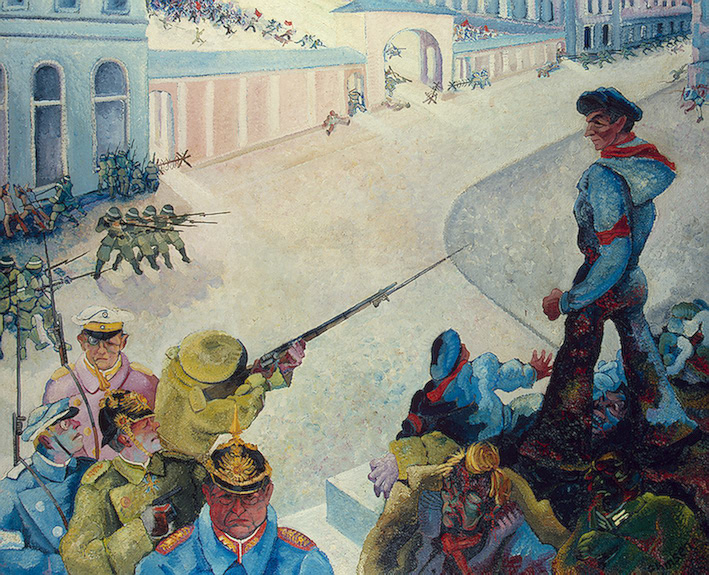
The fierce “victim” dominates his executioner in Execution by Firing Squad of the Sailor Egelhofer, by Heinrich Ehmsen (1931). This is only the central panel of a triptych depicting the White storming of Red Munich; the piece is described in this post.

Ehmsen has a similar idea about relative stature at work in Execution by Firing Squad (Red Jacket) (1919).

Though little memorialized at the place of his glory and martyrdom — which fell on the western side of the Iron Curtain — numerous East Germany streets, public buildings, and naval vessels bore Egelhofer’s name in tribute during the Cold War.

On this day..