1941: Ben Zion bar Shlomo Halberstam, the second Bobever Rebbe

(Thanks to Meaghan Good of the Charley Project for the guest post. -ed.)

On this date in 1941, less than two months after the Nazis invaded the Soviet Union, they executed the Hassidic Rabbi Ben Zion Halberstam along with his son, Rabbi Moshe Aaron, three of his sons-in-law, and a number of other Jews.

Born in Galicia in 1874, Ben Zion was the son of Grand Rabbi Shlomo Halberstam in the village of Bobov. After the father’s death in 1905, the Chassidim elected the son Grand Rabbi in his place.

During World War I, the Bobever Rebbe fled to Austria, but he returned to Poland once hostilities ceased and founded a highly regarded yeshiva. During the mid-thirties he lived in the town of Trzebinia in south central Poland, and developed a following of thousands of disciples.

He was a farsighted man and in 1938, when Germany expelled its Polish-Jewish minority, he wrote an open letter to the Jews of Poland explaining the terrible situation and asking them to help their displaced brethren. After the Nazis invaded Poland, Haberstam fled to Lvov,* which was under Soviet control and relatively safer. He hid there in a disciple’s house, and his followers tried and failed to get him papers to travel to the United States.

In June 1941, Nazi Germany invaded the Soviet Union. By June 30 they’d reached Lvov, and by July 25, Rabbi Halberstam and several other members of his family were placed under arrest and marched to the Gestapo prison.

As Yad Vashem records,

Rabbi Ben Zion [he was 67 years old by then] was weak, and could not keep up with the fast pace of the march. When he fell to the back of the column, the policemen whipped him and shouted at him to move faster. The march continued until the prisoners arrived at the Gestapo headquarters. Rabbi Ben Zion’s family tried everything to win their release, but after three days, he was executed at the Yanover forest together with his son, three sons-in-law and the other prisoners.

They were a mere 19 kilometers from the future site of Auschwitz.**

Although the Halberstam family suffered significant losses during the Holocaust, at least one of Ben Zion’s sons survived, and so their dynasty did not die out. There exists today a community of Bobover Hassidim in Borough Park, Brooklyn.


Rabbi Ben Zion Halberstam in the center, pictured during his time in Trzebinia. The bare-faced youth directly over the rabbi’s shoulder is Moshe Aaron Halberstam, the son who would eventually be shot at the rabbi’s side.

* Called Lviv in Ukrainian, Lvov in Russian, Lwow in Polish and Lemberg in German; the city is at the heart of Galicia, and has changed hands repeatedly between these countries. Right now it’s Lviv.

** Although the smaller Auschwitz I camp for political prisoners existed from 1940, Auschwitz II-Birkenau, the Reich’s metonymical extermination facility, was constructed towards the end of 1941.

On this day..

1941: Numberless Poles and Jews by Felix Landau’s Einsatzkommando

(Thanks to Meaghan Good of the Charley Project for the guest post. -ed.)

On this date in 1941, near the city of Lvov in eastern Poland (now called Lviv and part of Ukraine), an Einsatzgruppe—mobile Nazi killing squad—shot an unknown number of Poles and Jews. We know a little bit about what happened because of Felix Landau, a young SS Hauptscharführer of Austrian origin, who kept a diary of his experiences in the Einsatzkommando.

The diary has been translated and published in several anthologies; this version of it comes from “The Good Old Days”: The Holocaust as Seen by Its Perpetrators and Bystanders, edited by Ernst Klee, Willi Dressen and Volker Riess.

Landau was a Nazi of the Old Guard who’d been involved in National Socialist activities since the age of fifteen, served time in prison for his role in the assassination of Engelbert Dollfuss, and ultimately became a naturalized German citizen. He volunteered for the Einsatzkommando on June 30, 1941 — the same day the Wehrmacht arrived in Lvov — and went right to work.

It should be emphasized that Landau was not, by SS standards, a particularly vicious man. He rapidly became disillusioned with the kommando, writing that he preferred “good honest open combat.” In his first diary entry he referred to “scum” who “did not even draw the line at children” and also wrote, “I have little inclination to shoot defenseless people — even if they are only Jews.”

Yet shoot them he did, and he described it in his diary in a flat, matter-of-fact way.

Often he simply put down the dry numbers, as on July 22: “Twenty Jews were finished off.”

Other times, Landau recounted his gruesome work in chilling detail. And so it was on July 4, when over 300 people were killed. His entry describing that day is worth quoting at length:

One of the Poles tried to put up some resistance. He tried to snatch the carbine out of the hands of one of the men but did not succeed. A few seconds later there was a crack of gunfire and it was all over. A few minutes later after a short interrogation a second one was finished off. I was just taking over the watch when a Kommando reported that just a few streets away from us a guard from the Wehrmacht had been discovered shot dead.

One hour later, at 5 in the morning, a further thirty-two Poles, members of the intelligentsia and the Resistance, were shot about two hundred meters from our quarters after they had dug their own grave. One of them simply would not die. The first layer of sand had already been thrown on the first group when a hand emerged from out of the sand, waved and pointed to a place, presumably his heart. A couple more shots ran out, then someone shouted — in fact the Pole himself — “shoot faster” What is a human being? […]

The stench of corpses if all pervasive when you pass the burnt-out houses… During the afternoon some three hundred more Jews and Poles were finished off. In the evening we went into town for an hour. There we saw things that are almost impossible to describe… At a street corner we saw some Jews covered in sand from head to foot. We looked at one another. We were all thinking the same thing. These Jews must have crawled out of the grave where the executed are buried. We stopped a Jew who was unsteady on his feet. We were wrong. The Ukrainians had taken some Jews up to the former GPU citadel. These Jews had apparently helped the GPU persecute the Ukrainians and the Germans. They had rounded up 800 Jews there, who were supposed to be shot by us tomorrow. They had released them.

We continued along the road. There were hundreds of Jews walking along the street with blood pouring from their faces, holes in their heads, their hands broken and their eyes hanging out of their sockets. They were covered in blood. Some of them were carrying others who had collapsed. We went to the citadel; there we saw things that few people had ever seen. […] The Jews were pouring out of the entrance. There were rows of Jews lying one on top of the other like pigs whimpering horribly. We stopped and tried to see who was in charge of the Kommando. “Nobody.” Someone had let the Jews go. They were just being hit out of rage and hatred.

Nothing against that — only they should not let the Jews walk about in such a state.

Writing on July 6, Landau described himself as “psychologically shattered” — not due to what he had just seen and done, but because he was homesick and especially missed his girlfriend Trude. He complained of not being able to find stationery to compose a letter to her. (Landau was forever fretting when they weren’t able to write to each other, constantly worried she would leave him.)

He was, however, able to find “a lovely big traveling bag” for only 3.80 reichmarks.

Just another day on the job.

It is often said that the reason the Nazis stopped using the Einsatzgruppen to kill Jews and started using gas chambers was because it was more efficient: they could kill more people in less time using gas. This isn’t true. The Einsatzgruppen’s shooting at Babi Yar, for example, killed more than 33,000 people in two days. Gas chambers could not have done better than that.

In fact, the reason for the switch to the quieter, cleaner method of gassing had more to do with the effect the shootings were having on the Einsatzkommando men themselves. Men would rapidly develop what, in the modern parlance, would be called post-traumatic stress disorder; many were ruined for life. Given the conditions Landau described in his diary, it’s no wonder.

August Becker, a gas van inspector, later stated, “The men in charge of the Einsatzgruppen in the East were increasingly complaining that the firing squads could not cope with the psychological and moral stress of the mass shootings indefinitely. I know that a number of members of these squads were themselves committed to mental asylums and for this reason a new and better method of killing had to be found.”

The first gas vans wouldn’t be created until December 1941, however, and gas chambers came later still. In the meantime, the Einsatzgruppen traveled from town to town, massacring civilians everywhere they went.

As for Felix Landau: in late 1941 he moved in with Trude, and they married in 1943 after Landau divorced his first wife. He and Trude divorced in 1946, though, and that same year he was recognized and arrested for war crimes. Escaping from an American prison camp, he adopted an alias name and lived in plain sight as an interior decorator.

In 1959 he was arrested again and ultimately sentenced to life in prison for his role in the killings, but pardoned in 1973. Felix Landau died a free man in 1983, at the age of 73.

On this day..

1921: Richard and Abraham Pearson, the Coolacrease killings

On this date in 1921, an Irish Republican Army detail detained Richard and Abraham Pearson at their farm in rural County Offaly.

While the Pearson brothers watched in horror along with their mother, three sisters, and other family members, the Republicans readied the kindling to fire the family house. Then, Richard and Abraham were executed by an IRA firing detail.

The shooters were inexperienced as executioners and nobody delivered a coup de grace, so the Pearson brothers took hours to bleed to death from their assortment of debilitating torso wounds; Abraham did not expire until the next morning, some 14 hours later.

It might perhaps be said that few places exemplify like Ireland after its dirty war of independence Faulkner’s bromide that the past is never dead, and it’s not even past.

The Irish network RTE exhumed these once-past Killings at Coolacrease in a 2007 broadcast —

— claiming that the evangelical Protestant Pearsons were essentially targeted by neighboring Catholics on grounds of sectarian bigotry and/or an interest in pinching their 341 acres. (The surviving Pearsons emigrated to Australia and their land was indeed broken up and distributed.)

This line, whose upshot obviously impugns Irish Republicanism, occasioned a furious counterattack from that sector arguing that the Pearsons were punished for a much more prosaic reason: that they had shot at and wounded IRA volunteers who were setting up a roadblock by cutting down trees at the perimeter of the Pearson farm.

The family patriarch, William Pearson, was away at the time and later filed for compensation from London, noting that “I was always known as a staunch Loyalist and upholder of the Crown. I assisted the Crown Forces on every occasion, and I helped those who were persecuted around me at all times.” “Crown Forces” in this instance would have been the hated paramilitaries, the Black and Tans, who pack their own upshots.

Extrajudicial executions might perhaps rate among the inevitable casualties of a tooth-and-claw war over the nation’s destiny, but so too are the clash of interpretive meanings given them by later generations. Even eighty-odd years later, the urgent need to confute RTE’s “revisionist” gloss on the Pearson executions led almost immediately to a book of essays by Republican historians.

On this day..

1948: Tessie Hutchinson, Lottery winner

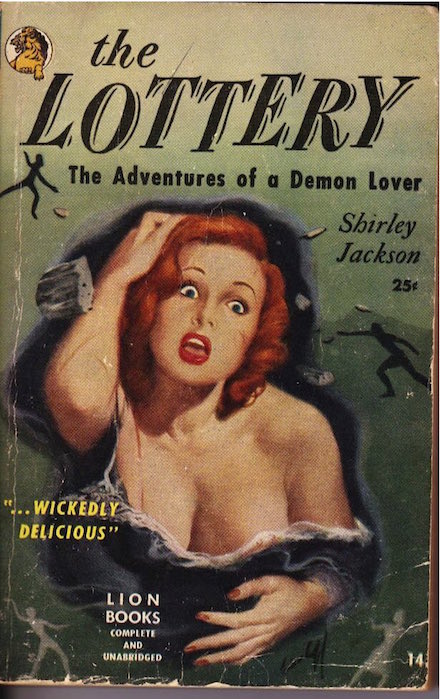
June 27 — of 1948, implicitly — was the setting for Shirley Jackson‘s classic short story “The Lottery”.


Before we dive into the grim stuff, here’s a hilariously campy pulp cover (mis)interpretation.

Less an “execution” than a human sacrifice — the village old feller’s folksy “Lottery in June, corn be heavy soon,” evokes a primal flash of blood trickling off the maize-god’s altar — the titular event is an annual tradition for a tiny American town. Though unnamed, the town and some of its denizens were patterned on North Bennington, Vermont, where Jackson was living as the wife of a professor at Bennington College.

The setting was entirely contemporary to the story’s publication, right down to the day: it hit print in the June 26, 1948 edition of The New Yorker magazine. And what took Jackson two hours to write has continued to disturb and perplex generations of readers.

In “The Lottery” (available online here (pdf)), friendly townsfolk gather “in the square, between the post office and the bank” to enact a curious civic ritual dating to a time and purpose they no longer even remember.

We see each household’s father draw a slip of paper from a battered old box and although we do not understand the reason we grasp from the dark atmosphere afoot in the crowd that something ominous is unfolding.

After the last slip is drawn,

there was a long pause, a breathless pause, until Mr. Summers. holding his slip of paper in the air, said, “All right, fellows.” For a minute, no one moved, and then all the slips of paper were opened. Suddenly, all the women began to speak at once, saving. “Who is it?,” “Who’s got it?,” “Is it the Dunbars?,” “Is it the Watsons?” Then the voices began to say, “It’s Hutchinson. It’s Bill,” “Bill Hutchinson’s got it.”

“Go tell your father,” Mrs. Dunbar said to her older son.

People began to look around to see the Hutchinsons. Bill Hutchinson was standing quiet, staring down at the paper in his hand. Suddenly. Tessie Hutchinson shouted to Mr. Summers. “You didn’t give him time enough to take any paper he wanted. I saw you. It wasn’t fair!”

“Be a good sport, Tessie.” Mrs. Delacroix called, and Mrs. Graves said, “All of us took the same chance.”

“Shut up, Tessie,” Bill Hutchinson said.

Tessie has good cause to fear. A second drawing now ensues among the five members of the Hutchinson family — Tessie and Bill, plus their three children.

And as soon as Tessie reveals the slip of paper with the black spot, her friends and even her family (“someone gave little Davy Hutchinson a few pebbles”) immediately turn on her and stone her to death.

“I hoped, by setting a particularly brutal ancient rite in the present and in my own village to shock the story’s readers with a graphic dramatization of the pointless violence and general inhumanity in their own lives,” Jackson explained.

On this day..

1940: 32 innocent Poles

(Thanks to Meaghan Good of the Charley Project for the guest post. -ed.)

On this day in 1940, in the tiny village of Celiny in Nazi-occupied Poland, German soldiers and gendarmes stood 32 Polish citizens against the wall of a house and shot them all to death.

The victims of the shooting had, by the Germans’ own admission, done nothing to deserve their fate. They were killed in reprisal for crimes committed by others: namely, the murder of a German gendarme the previous day.

Seventy years later, the inhabitants of Celiny shared their memories of the incident with British historian Mary Fulbrook:*

Two Poles had apparently become involved in a dispute with the gendarme, provoked by a disagreement over the legality of ordering a certain dish in a local hostelry: that particular cut of meat was not supposed to be available to Poles under the rationing system introduced by the German administration. The Poles initially succeeded in escaping from the fracas by bicycle, but were caught up by the gendarme, on a motorbike, in Celiny; here, a further scuffle had ensued, in the course of which the gendarme was fatally wounded.

In a slightly different version of the story, the German gendarme had not even been killed by the Poles but had died as a result of crashing when, somewhat inebriated as well as angry, he took a corner too fast in pursuit of the two Poles. Whatever the truth of the matter, the latter knew they were in for trouble and rapidly escaped; they were nowhere to be tracked down.

The Germans had previously registered prominent local citizens to serve as hostages for just this sort of situation. But everyone on the registration list was forewarned by their friends and family and went into hiding to avoid arrest.

The next morning, unable to find any of their hostages, the local German authorities got together and argued for a full three hours over what to do. In the end they settled on a plan: They went to the prison in the nearby city of Sosnowiec and grabbed 32 inmates who had been “incarcerated for all the manner of reasons, including minor infringements of the most trivial of the new rules imposed by the German occupation, political resistance, and sheer bad luck.”

The men’s bad luck got even worse: the 32 men (29 Catholics and three Jews) were trucked fifteen miles back to Celiny, taken to the scene of the fight from the night before, stood in a row against the wall and shot dead at point-blank range.

Nearly three-quarters of a century later, Fulbrook visited the site of the massacre:

The wall against which the thirty-two people were shot remains pockmarked by the bullet holes, daubed now with dashes of red paint to intimate their bloody origins; there is a memorial stone, for which money had arduously to be raised among the local community; and fresh flowers were often laid there, to keep the memory of former compatriots and relatives alive.

The memorial stone lists the names of the 29 Catholic victims, but not the names of the Jews, apparently because the townspeople didn’t know who they were.

Fulbrook notes that this incident seems insignificant when put into context of the “enormity of other crimes that were soon to engulf the area.” Indeed, she says, “This incident would scarcely bear mention in comparison with the crimes committed on an infinitely larger scale at Auschwitz.”

But to the tiny village it was devastating and not easily forgotten — a small emblem of the countless nameless Poles casually put to execution in those years.

Andrzej Wróblewski

The Polish artist Andrzej Wróblewski created this series of eight paintings titled Rozstrzelania (Executions) in 1949, the year he turned 22. (They have no specific connection to the Celiny executions.)

* Mary Fulbrook was interviewed about her Holocaust research in this New Books In History podcast.

On this day..

1688: Constantine Gerachi, the Siamese Falcon

On this date in 1688, the astonishing Constantine Gerachi — the Greek cabin-boy turned virtual prince of Siam — plummeted to earth.

The son of a Cephalonian innkeeper, Gerachi ran away to sea in 1660 and soon caught on with the English East India Company ships who plied the Mediterranean and all the Seven Seas. Though little-educated, Gerachi proved himself frightfully clever and picked up his crewmates’ English. In time he also mastered French, Portuguese, Malay, and of course Siamese.

The word gerachi is Greek for falcon, and no name was ever more aptly conferred. From the humblest beginnings, Constantine Phaulkon soared higher than all.

By the late 1670s, Constantine had segued from hauling East Indies cargo to trading it, and this brought him to the attention of the Siamese king Narai. For Siam, the growing influence of European traders, diplomats, and arms was the prevailing issue of the late 17th century; Narai engaged fully with those interlopers and most especially with the French, who provided architects, mathematicians,* missionaries, and military engineers to the Siamese kingdom and received lucrative commercial concessions in return.

The king appreciated our polyglot adventurer’s many talents and attracted him to the Siamese court, where the pro-French Constantine quickly rose to become Narai’s indispensable chief counselor — basically the equivalent of the Siamese Prime Minister, the power in the kingdom.

But Gerachi’s close association with Narai, and with a French relationship that Siamese grandees increasingly feared might convert insensibly into domination, finally felled the Falcon.

In 1688, the ailing king tried to arrange for the succession of his daughter. Instead, he triggered a revolt by his foster brother Phetracha, backed by a “broad coalition of anti-foreigners, including Buddhist monks, the nobility and low-ranking officers.”**

This Chief of the Royal Elephant Corps seized power, murdering a number of royal relatives (and possibly hastening along the dying Narai himself). Monsieur Constantine of such discreditable familiarity to the French naturally went in his own turn, unsuccessfully trying to rally the realm’s French garrisons to defense of the mutual benefits of the ancien regime.

Nor was this merely a palace coup: Petracha’s takeover became the Siamese Revolution of 1688, “one of the most famous events of our times, whether it is considered from the point of view of politics or religion” in the judgment of a European contemporary. Thais who had resented the growing prominence of the farang now expelled most Europeans, or worse: though not a Japan-like closure (Siam maintained active intercourse with its neighbors), the country would remain essentially dark to Europeans until the 19th century.

Historical Fiction Series by Axel Aylwen

* The relationship gave to European mathematics the “Siamese method”.

** Thanet Aphornsuvan, “The West and Siam’s quest for modernity: Siamese responses to nineteenth century American missionaries”, East Asia Research, vol. 17, no. 3. (Nov. 2009)

On this day..

1945: Sudeten Germans, known but to God

Jirí Chmelnicek shot this footage in just-liberated Prague on May 10, 1945 of Czechs celebrating the end of World War II by doling out mistreatment — including a chilling mass-execution — to Sudeten Germans. It was the presence of that population, the reader will recall, that Berlin invoked to justify its occupation of Czechoslovakia.

Chmelnicek’s video only surfaced publicly in 2010: its images were far too sensitive to air closer to the Great War, especially while Czechoslovakia was under communist control. As Der Spiegel reported.

Chmelnicek’s film shows how the Germans were rounded up in a nearby movie theater, also called the Borislavka. The camera then pans to the side of the street, where 40 men and at least one woman stand with their backs to the lens. A meadow can be seen in the background. Shots ring out and, one after another, each person in the line slumps and falls forward over a low embankment. The injured lying on the ground beg for mercy. Then a Red Army truck rolls up, its tires crushing dead and wounded alike. Later other Germans can be seen, forced to dig a mass grave in the meadow.

We do not know who these people are. Considering the indiscriminate revenge visited on Sudeten Germans after the war, it is not likely that these several dozen souls were selected for their fate with care.

On this day..

1715: Thomas Nairne, Charles Town Indian agent

The generations-long conquest of indigenous peoples in North America might look from posterity like a historical ienvitability, but the 1715-1718 Yamasee War was perhaps “as close to wiping out the European colonists as ever [they] came during the colonial period.” (Gary Nash, quoted by William Ramsey in “‘Something Cloudy in Their Looks’: The Origins of the Yamasee War Reconsidered”, Journal of American History, June 2003. This post draws heavily from Ramsey’s article, which is the source of any quote not otherwise attributed.) In it, not only the Yamasee but a vast coalition of peoples throughout what is today the United States Southeast nearly swept the British out of South Carolina.

And it started three hundred years ago today with some executions.

British South Carolina had extensive trading contacts with the native peoples in their environs — acquiring deerskins and Indian slaves for the plantation colony — and said trading had too often been a flashpoint between alien cultures. South Carolina’s annals record a number of instances of natives crudely abused by Anglo merchants, including women whose bodies were next to sacrosanct for the matrilineal Yamasee, and traders aggressively taking slaves even from friendly tribes. Many years later a Lower Creek man would recall that “we lived as brothers for some time till the traders began to use us very ill and wanted to enslave us which occasioned a war.”

It has never been entirely clear just why and how such individual abuses, even as a pattern, triggered in 1715 something as drastic as military action; our source William Ramsey suspects that they only hint at much wider-ranging economic pressures of the Atlantic economy, which entangled native peoples in debt and warped traditional lifeways towards producing ever more deerskins for export, obtained at ever poorer prices from ever more belligerent merchants.

Just as trade relations were at their most antagonistic, the colonial capital Charles Town fell down on the diplomatic side of the job. (This is, again, per Ramsey.)

The colony had created in 1707 an office of Indian Agent.

Intended to manage the complications of its sometimes-delicate cross-cultural trade and police the traders, the post instead became a locus of bitter competition between two men: Thomas Nairne and John Wright. (There’s a 1710 account of South Carolina in Nairne’s hand available here.) These two men, South Carolina’s most expert Indian diplomats and the only two men ever to hold the Indian agent office, had by the 1713-1715 period become consumed with their internal rivalry. Wright, a trader who thought Nairne too accommodating of the natives generally and unduly meddlesome with Wright’s own commerce specifically, bombarded the latter with lawsuits; Nairne eventually had to stay in Charles Town almost permanently to protect his own affairs. The colony’s diplomatic voice fell silent — which meant that rapacious traders squeezing mounting debts on their spring rounds in 1715 were that voice.

In annoyance, one tribe returned an ultimatum to Charles Town: “upon the first Afront from any of the Traders they would down with them and soe goe on with itt.” (See The Southern Frontier, 1670-1732)

That warning got the colony’s attention.

The Indian Agent rivals Wright and Nairne were dispatched together to meet with the Yamasees at Pocotaligo and smooth things over. But just as these men stood at loggerheads professionally, they were noted for quite distinct policies towards the Indians: Nairne was the friendly hand, the man who sympathized with natives. Wright was the asshole. If their joint presence was intended to be a good cop-bad cop act, they carried it off as clumsily as their mutual antipathy might suggest.

In a famous meeting on the night of April 14, Nairne, Wright, and a number of traders seemingly reassured the Yamasees over a feast that their grievances would be redressed, and went to sleep satisfied that matters were well in hand.

It was not so for the Yamasees, who held council that night after the Europeans were tucked away. An unknown Indian leader who signed himself “the Huspaw King” would later dictate a letter to a hostage charging that at the April 14 meeting

Mr. Wright said that the white men would come and fetch [illegible] the Yamasees in one night and that they would hang four of the head men and take all the rest of them for slaves, and that he would send them all off the country, for he said that the men of the Yamasees were like women, and shew’d his hands one to the other, and what he said vex’d the great warrier’s, and this made them begin the war.

We don’t know if this was on-message for the delegation — a glimpse of the iron fist that Nairne’s politesse was to glove — or delivered privately in Wright’s going campaign to undermine his opposite number. What we do know is that the Yamasees had seen both these men in authority over colonial-Indian trade over the past several years: on the night of April 14-15, they had to decide between mixed messages. Could they count on Nairne’s reassurances of comity? Or should they believe, as Wright intimated, the increasingly obnoxious inroads of traders presaged the outright destruction of their people?

April 15th was Good Friday. And the Europeans awoke to their Calvary.

The Yamasees’ decision about the intentions of their European counterparts was far from internally unanimous — but it was instantly effected.

“The next morning at dawn their terrible war-whoop was heard and a great multitude was seen whose faces and several other parts of their bodies were painted with red and black streaks, resembling devils come out of Hell,” a plantation owner later wrote to London. Most of the Europeans were killed on the spot, Wright apparently among them. A couple of them escaped.

And for Thomas Nairne, a stake in the center of the little village awaited, with an agonizing torture-execution said to have required three days before Nairne mercifully expired on April 17th.

The red indicates War, and the black represents the death without mercy which their enemies must expect.

They threw themselves first upon the Agents and on Mr. Wright, seized their houses and effects, fired on everybody without distinction, and put to death, with torture, in the most cruel manner in the world, those who escaped the fire of their weapons. Amongst those who were there, Captain Burage (who is now in this town, and from whom I derive what I have just said) escaped by swimming across a river; but he was wounded at the same time by two bullets, one of which pierced his neck and came out of his mouth, and the other pierced his back and is lodged in his chest, without touching a vital spot. …

Another Indian Trader (the only one who escaped out of a large number) saved his life by crawling into a marsh, where he kept himself hid near the town. He heard, during the whole day, an almost continual fire, and cries and grievous groans. He often raised his head in his hiding-place, and heard and saw unheard-of things done; for the Indians burned the men, and made them die in torture. They treated the women in the most shameful manner in the world. And when these poor wretches cried O Lord! O my God! they danced and repeated the same words mocking them. Modesty forbids me to tell you in what manner they treated the women: modesty demands that I should draw a veil over this subject.

This man who had witnessed so many cruelties, stripped himself naked so as completely to resemble the Indians; and in this state, made his escape by night, crossing the town without being perceived, he heard many people talking there, and saw several candles in each house; and having avoided the sentries, God granted that he should arrive here safe and sound.

Mr. Jean Wright, with whom I had struck up a close friendship, and Mr. Nairne have been overwhelmed in this disaster. I do not know if Mr. Wright was burnt piece-meal, or not: but it is said that the criminals loaded Mr. Nairne with a great number of pieces of wood, to which they set fire, and burnt him in this manner so that he suffered horrible torture, during several days, before he was allowed to die.

On this day..

2014: Amin Abdullah Mohammed Al-Mu’alimi, an American spy in the Arabian peninsula

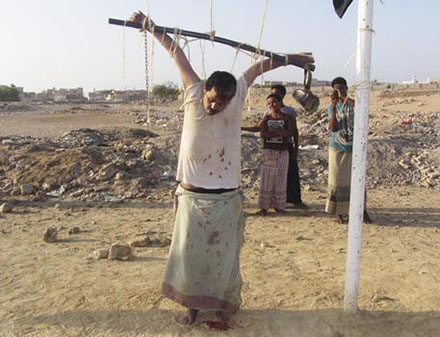
On this day last year, Al-Qaeda’s Ansar Al-Sharia group (Partisans of Islamic Law) executed an alleged American spy in the town of Shahr, in southeast Yemen.

Al-Qaeda also released a video (titled “An American Spy in the Arabian Peninsula”) in which a man calling himself Amin Abdullah Mohammed Al-Mu’alimi denounced himself as a spy and saboteur, who had placed tracking chips that enabled the U.S. to target militants with drones.

His bullet-riddled body was found lashed to the goalposts on a dirt football pitch.

On this day..

628: Khosrau II, Sassanid emperor

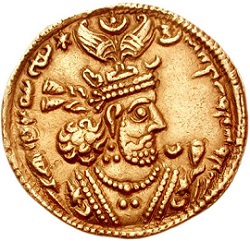
On this date (or very close to it) in 628, the Persian emperor Khosrau* II was put to death by the order of his son and usurper.

Chip off the old block, that boy, since he was taking power the same way as Khosrau himself had done way back in 590. But with the old man’s fall, the Sassanid Empire entered its death spiral: by 651, it would be overwhelmed by the armies of Islam.

Little could the younger Khosrau have conceived of his glorious Persian state laid low by these desert zealots! Persia’s last great pre-Muslim empire flourished in Khosrau’s heyday.

Briefly deposed in his youth, Khosrau reinstated himself with the aid of the Byzantines — ironic aid, in retrospect. After his Constantinople angel Emperor Maurice was deposed and slain in 602, Khosrau availed the pretext of vengeance to make war on Byzantium.

The season of this war would span the entire quarter-century to Khosrau’s own death — and would initially redound to Khosrau’s glory. Byzantium foundered in civil war, coming near the brink of outright destruction under continuous Persian pummeling. Khosrau’s top general Shahrbaraz won a crushing victory in 614, capturing Jerusalem where they carried off thousands of prisoners, the city’s patriarch, and the True Cross. In the years to follow, Persia conquered Egypt and pressed so deep into Anatolia that the Byzantines are said to have considered evacuating the capital to Carthage. Khosrau aspired, wrote Theophanes the Confessor more than a century later, “to seize the Roman Empire completely.”

The fall of the Sassanids, and Khosrau, from this apex was precipitous and entire.

The Byzantines under Heraclius rallied dramatically and in the winter of 627-628 carried Roman arms to the city of Dastagerd, just a short march from the Sassanid capital Ctesiphon. The intrepidity of the counterattack threw the Sassanids into a commotion; Khosrau disgracefully fled Ctesiphon, and in the power vacuum that followed, his heir Kavadh seized power. A usurper cannot afford to found his authority on sentiment; Kavadh not only had his father executed — allegedly by being shot slowly with arrows — but he ordered the deaths of all his half-brothers to extinguish as many future rivals as possible.

The precautions did not grant Kavadh a long reign: he died of the plague later that same year, beginning a dismal progression of feeble claimants overthrowing one another. The Arabs overran Ctesiphon by 636, leaving the rump of the Sassanid state shrinking towards nothingness, and its last emperor to be ignominiously slain by a miller.

Dig into the seventh century Byzantine-Persian frontier during gym time with an ample selection of audio product:

  • The History of Byzantium podcast has treated this period in some detail: for Byzantium, it was a dramatic phoenix-from-the-ashes story, and the running war with Persia is one of its principal themes. Try episodes 44, 45, and 46
  • The (defunct, but still available) Twelve Byzantine Rulers podcast has a snappy episode on Khosrau’s Byzantine opposite number, Heraclius
  • The BBC In Our Time podcast has an enjoyable 2011 episode on the Sassanids available here.

* Also rendered Chosrou or Chosroes, among many others.

On this day..