On this date in 1978, peripatetic Communist intellectual Hu Nim vanished into Khmer Rouge Cambodia’s charnel house along with 126 others at Tuol Seng.
The child of a poor peasant’s family, Nim was a gifted young state worker who studied in Paris in the 1950s, where he met several future Khmer Rouge leaders.
Nim charted an independent — some might say hypocritical — course over the next two decades, serving uneasily as a leftist parliamentarian in Prince Sihanouk‘s nationalist coalition government, fleeing ahead of a conservative purge into the bush to join Communist guerrillas, then returning once more to Sihanouk’s now-leftist Chinese-backed government-in-exile. It’s a period whose interests and alliances don’t map straightforwardly onto the familiar Cold War axis.
Hu Nim’s stature as Minister of Information in the government-in-exile transitioned directly to that same portfolio when the Khmer Rouge came to power.
Maybe those old ties to the ancien regime did him in — Vietnam, after invading Cambodia, would seize on the late minister’s reputation for independence to damn the Khmer Rouge for purging a moderate socialist — but there was no ideological talisman for safety during those terrible years. Hu Nim’s longstanding pro-Chinese position was also a dangerous association come 1977, and Phouk Chhay, a fellow officer of the Khmer-Chinese Friendship Association, was among the batch of prisoners shot along with Hu Nim this date.
Early in 1977, a massive internal purge shook the regime; as many people (some 1,500) went to Tuol Sleng from mid-February to mid-April of that year as had gone in all of 1976.* Almost every one of these humans would be, in the terrible bureaucrat-ese of the security apparatus, “smashed.”
Hu Nim was one of these, a denunciation wrung from a local commander leading to his April 10, 1977 arrest. Under repeated torture over the ensuing three months, the ex-Minister of Information would write and re-write his confession, fashioning himself “a counterfeit revolutionary, in fact … an agent of the enemy … the cheapest reactionary intellectual disguised as a revolutionary,” a stooge of the CIA since the high school, and a skeptic of the disastrous forced agricultural collectivization who had swallowed his doubts lest “I would have had my faced smashed in like Prom Sam Ar.” The confession ultimately tallied 200-plus pages. (Here’s some of it.)
Four days after his arrest, Hu Nim submitted the first of seven draft “confessions” to his interrogator, who appended a note to Deuch, saying: “We whipped him four or five times to break his stand, before taking him to be stuffed with water.” On April 22, the interrogator reported: “I have tortured him to write it again.” Five weeks later, Hu Nim was abject: “I am not a human being, I am an animal.” (Source
* Official count for all of 1977: 6,330 “anti-party” types tortured and executed at Tuol Sleng, as against “only” 2,404 in 1975-1976 combined.
A year ago today, 20-year-old Scott McLaren of the 4th Battalion (The Highlanders) the Royal Regiment of Scotland was captured by Afghan insurgents and summarily shot.
The baby-faced McLaren, not yet three months in Afghanistan at that point, had left his base in in the Nahr-e-Saraj district of Helmand province during the middle of the night; reports suggest that he’d done so in order to retrieve mislaid night-vision goggles whose loss he would have been punished for. (This detail, while poignant, is not completely certain.)
Whatever the reason for his sortie, it ended with him being captured by Afghan insurgents.
As British, U.S., and Afghanistan forces mounted a 17-hour manhunt for the missing soldier, McLaren was reportedly stripped of his body armor and equipment and, at some point, shot in the head and dumped in a canal. The exact circumstances of his capture and death may never be known.
The Okudaira, allies of the wars’ eventually-victorious Tokugawa clan, found themselves besieged by the Takeda. This would result in the important Battle of Nagashino.
Kurosawa’s masterpiece Kagemusha imagines the Takeda where the (real) late daimyoShingen was succeeded after his (real) 1573 death (fictitiously) by an imposter thief posing as the great commander. In the film, the imposter is unmasked and deposed, but witnesses the climactic Battle of Nagashino … and then makes a futile charge under the Takeda banner after that side is slaughtered.
After an initial Takeda attempt to take the fortress by storm, the Takeda settled in for a brief siege — knowing the defenders to have only a few days’ supplies on hand. Enter Torii Suneemon.
Under cover of darkness on the night of the 22nd-23rd, Suneemon slipped out of the Yagyu gate and picked his way through Takeda tripwires to escape the investment … and summon help.
Torii Suneemon embarks on his mission: 19th century woodblock print of Yoshitoshi‘s “24 Accomplishments of Imperial Japan” series. The same artist also depicted that event in this triptych.
He made it on the 23rd to Tokugawa Ieyasu and Oda Nobunaga, who upon hearing his report pledged to dispatch a relief force the very next day.
Alas for him, Suneemon’s attempt to sneak back into the encircled fortress to deliver the good news was detected on the 24th, and he came as a prisoner to the Takeda commander. The Takeda prevailed upon their helpless captive to exchange his life for a signal service: approach the fortress walls and shout to the garrison that no help was on the way.
This Suneemon agreed to do.
The legends differ as to whether he walked on up to deliver this bogus bad news, or whether the Takeda lifted him up on a cross to impress upon their new agent the penalty for any funny business. Either way, Torii Suneemon had the last laugh: he immediately began hollering to the defenders that help was coming if they could just hang on a few more days.
The besiegers, of course, crucified him immediately … but everyone could appreciate the doomed man’s heroism.
While the grateful Okudaira elevated his family to samurai rank, even an enemy Takeda commander who witnessed the event was so moved that he adopted the image of the defiantly crucified soldier for his battle standard.
Nor was the brave soldier’s sacrifice in vain. The garrison did hold on — and their allies did relieve them, and did rout the Takeda in the resulting Battle of Nagashino. (The scenario is widely reproduced in video games nowadays).
* Some sites give this as “May 16”, but I believe the primary sources here actually indicate the 16th day of the 5th month on the traditional Japanese lunisolar calendar. This date corresponds to June 24, 1575 of the Julian calendar. (1570s conversion aid in this pdf, or use this converter).
On this date in 1945 — morning after a devastating U.S. air raid that destroyed much of Fukuoka — eight previously-captured American airmen* were summarily executed there in retaliation.
In a precedent that dated back to the Doolittle raids, Japan officially considered as a prospective war criminal any enemy airman who could be connected to indiscriminate bombing. Tokyo didn’t follow this logic to the point of executing all downed Americans — indeed, late in the war, beleaguered Japanese civilians became increasingly hostile towards the government for allowing excess legalism to stand in the way of exacting some satisfying revenge for the cities burning under American bombs — but it did execute some, and it had sanctioned legal theorems that could have accommodated quite a bit more bloodletting.
Finding Tokyo short of prison space, the government ordered on May 1, 1945, that the various armies should no longer send to the capital any downed airmen they captured. In the chaos of the war’s last months, this would create the context for local commanders at the Western Military District in Fukuoka to put those legal theorems to seriously nasty use.
Four captured airmen held in Fukuoka were stuck in an indeterminate judicial process which the army realized was going nowhere slowly. The others were just plain underfoot. Over the period of May-June, between a couple of ambiguously-worded orders and the officers’ annoyance at having to divert scarce resources to these captives, an understanding formed if “the air raids increased and conditions became more chaotic, the prisoners would be executed without a trial.”
About 3,000 tons of … incendiary bombs … were released by the B-24s from low level starting about three a.m. … The three cities [Fukuoka, Toyotashi and Shizuoka] were tasting for the first time the bitter flames of war, roaring over factories, shops and thousands of congested homes.
Timothy Lang Francis, whose “‘To Dispose of the Prisoners’: The Japanese Executions of American Aircrew at Fukuoka, Japan, during 1945” from the November 1997 Pacific Historical Review traces the confluence of factors that made possible this day’s executions, describes the fate that was unfolding for Fukuoka’s eight captive airmen at about the same time those words were going to press.
All were blindfolded and had their hands tied in front. Several swords were obtained from the Legal Section. [Yusei] Wako** then told the twenty or so assembled Japanese that, “in compliance with the Commanding General†’s orders, we were going to execute the plane crash survivors.” One officer, Lt. Michio Ikeda of the Medical Section, volunteered himself, and Wako ordered Probationary Officer Tamotsu Onishi, since he was skilled in kendo, to assist him as a third executioner. Sato watched the proceedings from one side.
The first flyer was brought to the edge of the pit and made to sit on his haunches. Wako then ritually washed one of the swords and stood behind the prisoner, slightly to the left. Raising the sword above his right shoulder with both hands, Wako brought it down on the flyer’s neck. “Both the body and head fell into the pit,” remembered Wako; “I washed my sword and ordered the guard to bring another flyer to the pit. I killed this flyer exactly the same way I had killed the first one.” Onishi then executed a third prisoner in the same manner.
In the pause that followed, Lt. Kentaro Toji, an officer attached to Western Army Headquarters, approached Sato. According to his pretrial affidavit, Toji said to Sato, “My mother was killed in the air raid on Fukuoka this morning, and I think it would be fitting that I be the one who execute these American flyers.” Sato told him to wait while Wako ordered Ikeda to execute the fourth flyer. Toji, after borrowing a sword from Onishi, beheaded the last four prisoners. The pit was then filled with dirt.
This is all well and good, but Tokyo’s orders to its armies had been to do the juridical legwork on these cases themselves — and not just to summarily kill prisoners. So, in a bit of ex post facto bureaucratic butt-covering, the Western District Army’s legal section proceeded to close the matter by shipping the central government a report saying that all these prisoners had been killed during the previous night’s air raid. Problem solved!
No known direct connection to this particular atrocity, but there’s a recent documentary about an elderly Japanese man who used to serve at Fukuoka that looks worth the watching.
* Six of the eight were Robert J. Aspinall, Merlin R. Calvin, Jack V. Dengler, Otto W. Baumgarten, Edgar L. McElfresh, and Ralph S. Romines. The other two remain unidentified. These eight were, maybe, the lucky ones: Fukuoka had had 16 prisoners from downed bombers, but the other eight weren’t around to be beheaded because they’d previously been given over to the local hospital to suffer ghastly deaths in vivisection experiments.
** A Judge Advocate who had also been involved in the Doolittle trials.
† Gen. Isamu Yokoyama. When he’d been briefed prior to the June 19 raid that the army was fixing to just dispose of its prisoners if it came to that, Yokoyama had done the Pontius Pilate act and informed Wako, “I have decided to concern myself only with the decisive battle and hereafter do not bother me with the problem of the flyers.”
In June 1953, some discontented young citizens of Magdeburg, East Germany revolted and began demonstrating against the repressive Communist regime. On June 17, in the spirit of totalitarian governments everywhere, the authorities ordered a platoon of soldiers to open fire on a crowd of protesters.
Incredibly, the soldiers refused.
Every one of them vanished shortly thereafter, never to be seen again.
It was long assumed that the entire platoon had been executed for insubordination. This wasn’t confirmed until 1998, however. Four years previously, Magdeburg construction workers digging the foundation for a new building accidentally unearthed a mass grave containing 32 bullet-riddled skeletons. From the condition of the remains, authorities determined the victims — all of them young men — had died sometime between 1945 and 1960.
They could have been the missing Soviet platoon, but they could also have been prisoners executed by the Gestapo mopping up in May 1945, just before the Germans fled the city in advance of the Red Army.
As Jessica Snyder Sachs noted in her 2001 book Corpse: Nature, Forensics, and the Struggle to Pinpoint Time of Death, the victims all had extensive tooth decay and no sign of dental work, which was consistent with Russia but not central Europe. This was hardly conclusive, however.
To solve the mystery, investigators turned to Reinhard Szibor, a biologist at the nearby Otto von Guericke University.
Szibor had helped in criminal cases before and was famous for using pollen to link suspects to crime scenes. Pollen clings to people’s hair, skin and clothes and is, of course, also inhaled. The stuff is nearly indestructible and will remain long after human remains have disintegrated. Authorities hoped Szibor could use pollen samples from the mass grave to determine what time of year the victims died.
Discover Magazine explains how he did it: Szibor rinsed out the skulls’ nasal cavities, had a look, and found pollen from lime trees, plantains and rye, all of which release their pollen during June and July. In other words, the Magdeburg victims had died during the summer months, the time when the Soviet platoon was reportedly executed, and not in the springtime when the Nazis retreated from the city.
Though we still don’t know the precise date of their deaths, and likely never will, the soldiers who paid for their humanity with their lives had finally been identified.
After the uprising of the 17th of June
The Secretary of the Writers’ Union
Had leaflets distributed in the Stalinallee
Stating that the people
Had forfeited the confidence of the government
And could win it back only
By redoubled efforts. Would it not be easier
In that case for the government
To dissolve the people
And elect another?
On this date in 1842,* British diplomats Charles Stoddart and Arthur Conolly were summarily beheaded by a Central Asian potentate as London’s ill-chosen intervention in Afganistan came to a disastrous conclusion.
The backdrop is “the Great Game”,** the long-running chess match for supremacy in Central Asia between an expanding Russian Empire and Great Britain, with its imperial position in India.
Seeking to pre-empt a Russian move into Afghanistan, Britain invaded in 1839. This was the First Anglo-Afghan War: it would have, for the Brits, an inglorious end.
Our day’s featured principals were among the postscript casualties of that catastrophe, never-avenged losses for an empire that had overreached itself.
Stoddart, an intelligence officer, had been dispatched northward to the ancient silk road city of Bokhara intending enlist the allegiance, or at least the benign neutrality, of its emir, Nasrullah Khan. Today Uzbekistan’s fifth-largest city, Bokhara was then an independent state .
[I]n the nineteenth century, the executions carried out there with genuine cruelty, as well as the tales told by travelers gave the city a reputation of being a forbidden, closed, and hostile place. It was “despotic” Bukhara, and the Europeans projected onto it their own oriental fantasies: with citadel, dungeons, palaces, and city walls bolted shut at night, all helping to set the scene.
Scenic! Bukhara’s historic citadel, the Ark, where Stoddart (and later Conolly) were imprisoned (and later executed). (cc) image from elif ayse.
Into this scene, our Brit entered clumsily, immediately irritating the ruler he intended to supplicate. Reportedly (though the fact has been disputed), he was on the brink of execution when he acceded to save his life to Nasrullah’s formulaic offer of clemency in exchange for conversion to Islam.
In any event, Stoddart languished for years, alternately imprisoned and in the custody of the (better-received) Russian mission. Though the latter had also been charged by its sovereign to retrieve the ill-favored English emissary as a gesture of Great Powers goodwill (and to deprive England of any rationale for intervention that his captivity might offer), Stoddart seems to have been too stubbornly prideful to get out via St. Petersburg while the getting was good.
Instead, he waited on the arrival of countryman Arthur Conolly, who showed up in late 1841 on a mission to secure Stoddart’s release. But Stoddart’s situation little improved, considering Nasrullah Khan’s wary reaction to this second British interloper.
Word has it that the Bukharan prince was piqued that correspondence to him did not arrive over the signature of the British monarch herself, but merely some subcontinental subaltern — as well as, we might think understandably, suspicious at his guests’ motivations and mission.
The captor’s uncertain attitude towards his prisoners was resolved by Britain’s catastrophic loss of Kabul and the subsequent massacre of an entire 16,000-strong army as it attempted to retreat.
Seriously, the whole army. To a man. Except for one guy.
Remnants of an Army, by Elizabeth Butler, depicts the only British subject on retreat from Kabul to reach Jalalabad, William Brydon.
Battles don’t get much more decisive than that.†
Reasoning‡ that the routed British were now of no conceivable threat, nor his prisoners of any conceivable benefit, Nasrullah Khan now accused them of espionage and abused them with impunity.
The two were cast into an Indiana Jones-esque “bug pit,” an oubliette infested with … well, you know.§
Later, finding illicit writing materials secreted on his captives’ persons, the mercurial Nasrullah disposed of them outright.
their quarters were entered by several men, who stripped them, and carried them off to prison … In stripping Colonel Stoddart a lead pencil was found in the lining of his coat, and some papers in his waist. These were taken to the Ameer, who gave orders that Colonel Stoddart should be beaten with heavy sticks until he disclosed who brought the papers, and to whom he wrote. He was most violently beaten, but he revealed nothing; he was beaten repeatedly for two or three days. On Friday, the 8th or 9th (the 7th) of Jemmadee-ool-Eovel (17th of June), the Ameer gave orders that Colonel Stoddart should be killed in the presence of Captain Conolly, who was to be offered life if he would become a Mahomedan. In the afternoon they were taken outside the prison into the street, which is a kind of small square. Their hands were tied across in front. Many people assembled to behold the spectacle. Their graves were dug before their eyes. Colonel Stoddart exclaimed aloud at the cruelty and tyranny of the Ameer. His head was then cut off with a knife.
The chief executioner then turned to Captain Conolly, and said — “The Ameer spares your life if you will become a Mussulman.” Captain Conolly answered, “Colonel Stoddart has been a Mussulman for three years, and you have killed him, you killed Yoosoof too; I will not be a Mussulman, and I am ready to die.” Saying which he stretched forth his neck. His head was then cut off.
The veracity of this faint bulletin from a distant and inaccessible realm nevertheless remained in some doubt. Friends of the lost men, despairing of obtaining definitive word of their fate, commissioned a strange but courageous missionary named Joseph Wolff to brave his own sojourn to Bokhara to investigate.
Wolff barely escaped with his own life, but seemingly confirmed the sad story and published a Narrative of his travels in 1845 (Part 1, Part 2).
* The initially reported June 17 execution date was subsequently contested by Joseph Pierre Ferrier, who argued that the chronology instead pointed to the next Friday, June 24. The matter appears to me permanently unresolvable.
** Ironically, the sportive phrase “the Great Game” was itself attributed to Arthur Conolly for whom, in the end, events turned out to be quite other than playful.
† Britain recaptured Kabul in reprisal later in 1842, upon which pretext it was able to declare its honor vindicated and depart Kabul (sans massacre), ending the war. Certain latter-day occupations of that “graveyard of empires” might envy their forebear’s talent for declaring victory and leaving.
‡ Correctly. Nasrullah Khan faced no British reprisal for his treatment of Stoddart and Conolly, notwithstanding the attempt by some friends to use their sad fate as some sort of casus belli. This public domain book from 1845 bears a dedication to Queen Victoria in “hope of directing your Majesty’s attention to the cruel sufferings and alleged murder of two British officers … abandoned in an unaccountable manner, by your Majesty’s Government … [in circumstances] degrading to the British nation;” the same man had previously published an “Appeal to the British Nation” in an “endeavour to excite the public sympathy.” Sympathy or no, the two British officers stayed abandoned.
§ Bug tortureenhanced interrogation was actually authorized during the Bush administration for the insect-averse Abu Zubaydah. The gentleman approving that technique, Jay Bybee, is now a federal circuit judge.
Originally an Atlantic coast peoples — “Manhattan” is a Delaware word, although “Delaware” itself isn’t — the Delawares or Lenape had with other native peoples removed to an Ohio territory supposed to be reserved against white settlement. It was the fruit of a deal that kept them on the British side (or at least, off the French side) in the Seven Years’ War.
But staying out of it would be a nonstarter during the American Revolution, because said territory was situated right between the British in Detroit and the westward American settlements in the Ohio Valley. Our man William Crawford was on hand to sign the colonists’ 1778 Treaty of Fort Pitt making nice with the Delawares: it’s the first written treaty between the United States and any Native Americans, and like most of that genre it didn’t last long.
The Delawares were okay with letting colonists march through their territory to attack Detroit, but when the U.S. pushed for them to get into the fight themselves — and when frontiersman murdered the pro-neutrality chief — it pushed many Delawares over to the British side. Opinion among their neighbors, the Shawnee, Wyandot and Mingo, likewise tended to range from “hoping to stay out of it” to “allying with the British,” and the latter sentiment was further encouraged by a kindling sentiment among peoples all along the frontier that uniting their efforts was their only hope of holding back imminent Anglo expansion.
“Quite otherwise,” said M.M. Quaife in a 1930 address to Ohio’s Wittenberg College* “was the situation west of the Alleghenies. In this area the war was prosecuted with increased vigor and fury throughout 1782, which thereafter acquired the significant designation, the Bloody Year.” It was not a clean fight by any party.
In March of 1782, an expedition by colonials hunting settler-killing Indian raiders resulted in the Gnadenhütten massacre, the wholesale butchery of a settlement of noncombatant Delawares — Christian converts, no less.
In May of that same year, finding Indian raids not deterred, the Crawford Expedition finally set out: a party of officially-blessed volunteer frontiersmen whose object was “to destroy with fire and sword (if practicable) the [Delaware] Indian town and settlement at Sandusky, by which we hope to give ease and safety to the inhabitants of this country; but, if impracticable, then you will doubtless perform such other services in your power as will, in their consequences, have a tendency to answer this great end.” (General William Irvine)
Crawford had come out of retirement for this great end. And he made out his will before he departed.
The expedition came to grief within days, as an attempt to fall back by nightfall from a spot called Battle Island (actually a copse of trees in an open space, not an island in a river) deteriorated into a disordered rout. And though most of the expedition was able to flee safely back to their point of departure, Crawford himself and a few subalterns became separated, and lost.
When Indians picked them up, with Gnadenhütten still on their minds … well, Crawford made out that will for a reason. Most of the lesser prisoners were simply tomahawked and disposed of, but Crawford and a Dr. John Knight were reserved for more fearful treatment.
When we went to the fire the colonel was stripped naked, ordered to sit down by the fire, and then they beat him with sticks and their fists. Presently after I was treated in the same manner. They then tied a rope to the foot of a post about fifteen feet high, bound the colonel’s hands behind his back and fastened the rope to the ligature between his wrists. The rope was long enough for him to sit down or walk round the post once or twice, and return the same way. The colonel then called to Girty, and asked if they intended to burn him? Girty answered, “Yes.” The colonel said he would take it all patiently. Upon this Captain Pipe, a Delaware chief, mae a speech to the Indians, viz., about thirty or forty men, sixty or seventy squaws and boys.
When the speech was finished they all yelled a hideous and hearty assent to what had been said. The Indian men then took up their guns and shot powder into the Colonel’s body, from his feet as far up as his neck. I think not less than seventy loads were discharged upon his naked body. They then crowded about him, and to the best of my observation, cut off his ears; when the throng had dispersed a little, I saw the blood running from both sides of his head in consequence thereof.
The fire was about six or seven yards from the post to which the Colonel was tied; it was made of small hickory poles, burnt quite through in the middle, each end of the poles remaining about six feet in length. Three or four Indians by turns would take up, individually one of these burning pieces of wood and apply it to his naked body, already burnt black with the powder These tormentors presented themselves on every side of him with the burning fagots and poles. Some of the squaws took broad boards, upon which they would carry a quantity of burning coals and hot embers and throw on him, so that in short time he had nothing but coals of fire and hot ashes to walk upon.
In the midst of these extreme tortures he called to Simon Girty and begged of him to shoot him; but Girty making no answer, he called to him again. Girty then, by way of derision, told the colonel he had no gun, at the same time turning about to an Indian who was behind him, laughed heartily, and by all his gestures seemed delighted at the horrid scene.
Girty then came up and bade me prepare for death. He said, however, I was not to die at that place, but to be burnt by the Shawanese towns. He swore by G-d I need not expect to escape death, but should suffer it in all its extremities …
Col. Crawford, at this period of his sufferings, besought the Almighty to have mercy on hi soul, spoke very low, and bore his torments with the most manly fortitude. He continued in all the extremities of pain for an hour and three-quarters or two hours longer, as near as I can judge, when at last, being almost exhausted, he lay down on his belly; they then scalped him, and repeatedly threw the scalp in my face, telling me that “that was my great captain.” An old squaw (whose appearance every way answered the ideas people entertain of the devil) got a board, took a parcel of coals and ashes and laid them on his back and head, after he had been scalped; he then raised himself upon his feet and began to walk round the post; they next put a burning stick to him, as usual, but he seemed more insensible to pain than before.
The Indian fellow who ha me in charge now took me away to Capt. Pipe’s house, about three-quarters of a mile from the place of the colonel’s execution. I was bound all night, and thus prevented from seeing the last of the horrid spectacle. Next morning, being June 12, the Indian untied me, painted me black [signaling his imminent execution -ed.], and we set off for the Shawanese town, which he told me was somewhat less than forty miles distant from that place. We soon came to the spot where the colonel had been burnt, as it was partly in our way; I saw his bones lying among the remain of the fire, almost burnt to ashes: I suppose, after he was dead, they laid his body on the fire. The Indian told me that was my big captain, and gave the scalp halloo.
Detail image (click for the full view) of an illustration of Crawford’s torture and execution. Here’s another.
Counties in both Pennsylvania and Ohio bear Crawford’s name; several historical markers in Ohio chart the course of the ill-starred Sandusky campaign … including a phallic monument at the approximate spot of the burning, just north of the tiny town of Crawford, Ohio. (Map)
* Printed as “The Ohio Campaigns of 1782” in The Mississippi Valley Historical Review, March 1931.
** Here’s another description by another white eyewitness (alleged, anyway), who was taken in an unrelated raid some weeks before.
On this date in 1945, American troops liberated the Dachau concentration camp in Upper Bavaria — and then proceeded to summarily execute a number of its SS personnel.
The “Dachau massacre” involves several distinct incidents of wantonly killing defenseless POWs by American troops, who may have been set on edge by warnings of potential fake-surrender gambits, and then evidently went right off the rails with discovery of emaciated dead bodies around the place. In particular, a stranded transport that had been sent from Buchenwald, christened the “death train”, greeted the liberators with a 40-car phantasmagoria of horror.
“We had seen men in battle blown apart, burnt to death, and die many different ways, but we were never prepared for this. Several of the dead lay there with their eyes open, a picture I will never get out of my mind. It seems they were looking at us and saying, ‘What took you so long?'” -Private John Lee
“It made us sick at our stomach and so mad we could do nothing but clinch our fists. I couldn’t even talk.” -Lt. William Cowling
These stunned, outraged soldiers, some of them still teenagers, would soon have a bunch of disarmed German troops from the camp under their power. Uh-oh.
As the dry but shocking (and also marked “Secret”: nobody ever faced a court-martial for the incident*) U.S. Army investigation remarked, “The sight of these numerous victims would naturally produce strong mental reaction on the part of both officers and men. Such circumstances are extenuating, but are the only extenuating facts found.” (Read the entire report in this forum thread.)
The behaviors these facts propose to extenuate may also produce a strong mental reaction. “‘After what we saw, we shot any German guards we saw on sight,” one of the Dachau liberators admitted in the 1990s.
A Lt. William Walsh took the surrender of four SS men near one of these train cars, then forced his prisoners inside the car and shot them on the spot.
About seven Germans taken prisoner at the camp’s Tower B were lined up a few steps away from the tower preparatory to marching them elsewhere, when for sketchy reasons one of their American guards started shooting, and then others followed suit.
And the most notorious of the incidents, about 50 captured SS men were segregated from other POWs — again, by Lt. Walsh — and lined up in the camp coalyard by the wall of the hospital. There they were machine-gunned, resulting in 17 deaths before a superior officer interceded.
Another 25 to 50 guards were killed by prisoners themselves, many with the implicit blessing of American infantrymen who stood by and watched, and or the explicit blessing of Americans’ weapons on loan from sympathetic troopers.
The irony in all this was that most of the camp’s regular guards had already fled the place. The SS men whom outraged Americans were shooting down in the Dachau charnel house were Waffen-SS who had been transferred from the eastern front just days before and whose specific purpose in the camp was to surrender it to the western Allies. They probably considered this assignment far away from the vengeful Red Army a very lucky break.
It wasn’t so lucky: this is the mischance of war. But they didn’t have anything to do with Dachau’s horrors, and their deaths in a unthinking bloodlust disgraced only their executioners.
“German soldiers after their surrender as prisoners of war to American troops were summarily shot and killed by such troops.”
-Conclusion of the Army Inspector General’s report
* Court-martial charges were filed, but quashed. The whole affair remained unknown to the public until the 1980s.
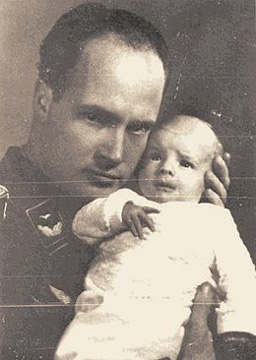
This doctor made his Nazi bones by forging a relationship with Heinrich Himmler (he married Himmler’s ex-mistress), and joining Himmler’s SS.
Rascher was doing cancer-cure experiments on animals, but once he had Himmler in his Rolodex he graduated to research on homo sapiens.
From 1941 to 1944, Rascher conducted some of the textbook ethical trespasses of Berlin’s human experimentation regime, using Dachau prisoners in:
high-altitude experiments to help fighter pilots, tested by subjecting prisoners to rapid de- and re-pressurization;
freezing experiments, tested by subjecting prisoners to freezing water or outdoor exposure, and then attempting by various methods to restore body warmth;
blood clotting experiments, tested by giving prisoners major gunshot wounds or other grievous bodily injuries, then monitoring how well a new drug slowed the bleeding.
Class act all the way. Rascher did publish some papers and deliver some conference presentations on aspects of his horrifying science, but in one of those little contradictions of the evil security state, the man was foiled in his bid for an advanced academic credential because much of the research was too secret for his peers to review.
In the end it was a much more mundane breach of ethics that did him in: Rascher and wife were arrested in 1944 for having actually kidnapped the children they claimed were their own.
They were stashed away in separate camps. For unclear reasons — perhaps because Rascher connected all this atrocious research back to Himmler, who was vainly trying to cut a peace deal with the West at this point, or maybe simply because Himmler was annoyed at the embarrassment his protege’s misconduct had given him — the bad doctor was summarily shot in his cell as the Allies bore down on Dachau.
(We will note in passing this argument, and this, disputing that story as well as this execution date. Executed Today is not in a position to contribute to that conversation.)
Elsewhere …
Caption: Polish and Russian forced laborers shot by the SS after they had collapsed from exhaustion during a death march. Wisenfeld, Germany, April 26, 1945.
On this date in 1945 — the same date when, in Berlin, a last mopping-up terminated the remaining participants in the Valkyrie assassination plot, such as Albrecht Haushofer — successive war crimes by the German and Soviet armies slew hundreds at the nearby village of Treuenbrietzen.
In the German installment of the Massaker von Treuenbrietzen, the army led 131 Italian internees taken prisoner after that erstwhile ally had gone over to the Allies in 1943 out to a gravel pit, and gunned them all down. (Stone markers now label the site.)
Only four men survived the mass execution.
“I can not explain this miracle,” said Edo Magnalardo, an Italian who played dead until the heap of corpses was buried, and then climbed out and found some Russians to surrender to/be liberated by. This German article records Magnalardo’s recollections of events, and the long and fruitless struggle for an official investigation.
For Germans in Treuenbrietzen, surrendering to the Red Army was a much less liberating experience … not that anybody had a choice in the matter.
Beginning on this date, Soviet soldiers carried out a horrifying rampage that left upwards of a thousand Treuenbrietzen men dead.
Apparently provoked when a Russian officer celebrating the village’s capture had been shot dead during a brief German reconquest, Soviet troops shot an estimated 270 or so civilians at the edge of the nearby forest on April 23. Over the next two weeks, they kept shooting: some 800 to 1,000 men (mostly) are believed to have been killed in this way by the end of the war. As for the women … there would soon be a need to set up a gynecological station in a local office, and require that all report for VD testing.
Since Treuenbrietzen ended up in communist East Germany after the war, this part of the massacre was seriously downplayed for a long time.
But no matter how officially favored the winning side in the war, the grim fate of so many noncombatants in Treuenbrietzen surely shames those who participated in it. As one survivor put it in the German press, “He who takes revenge can not be celebrated as a liberator, even though he has helped to end this disastrous war.”
This date is locally commemorated in Treuenbrietzen for both massacres, and both Italian and Russian diplomats have participated in memorial ceremonies.

 The child of a poor peasant’s family, Nim was a gifted young state worker who studied in Paris in the 1950s, where he met several future Khmer Rouge leaders.
 The baby-faced McLaren, not yet three months in Afghanistan at that point, had left his base in in the Nahr-e-Saraj district of Helmand province during the middle of the night; reports


 Originally an Atlantic coast peoples — “Manhattan” is a Delaware word, although


 If that’s what happened, it’s no more than Rascher (

