1945: Wilhelm Cauer, but not Helmuth Weidling

On this date in 1945, the brilliant scientist Wilhelm Cauer was summarily executed by Red Army soldiers advancing into besieged Berlin.

Cauer hailed from a rich lineage of academics.

Although his career prospects in Nazi Germany were ultimately limited owing to that lineage’s kinship to Frederick the Great’s Jewish banker, they were not so limited that he was not able to become a university professor and one of the founding figures in the field of engineering network synthesis filters. The elliptical filter is known as the “Cauer filter” in his honor.*

By the end of World War II, he was, like millions of less-distinguished countrymen and -women, merely a person in the way of a terrible conflagration.

Cauer succeeded in evacuating his family west, where the American and not the Soviet army would overtake it — but for reasons unclear he then returned himself to Berlin. His son Emil remembered (pdf) the sad result.

The last time I saw my father was two days before the American Forces occupied the small town of Witzenhausen in Hesse, about 30 km from Gottingen. We children were staying there with relatives in order to protect us from air raids. Because rail travel was already impossible, my father was using a bicycle. Military Police was patrolling the streets stopping people and checking their documents. By that time, all men over 16 were forbidden to leave towns without a permit, and on the mere suspicion of being deserters, many were hung summarily in the market places. Given this atmosphere of terror and the terrible outrages which Germans had inflicted on the peoples of the Soviet Union, I passionately tried to persuade my father to hide rather than return to Berlin, since it was understandable that the Red Army would take its revenge. But he decided to go back, perhaps out of solidarity with his colleagues still in Berlin, or just due to his sense of duty, or out of sheer determination to carry out what he had decided to do.

Seven months after the ending of that war, my mother succeeded in reaching Berlin and found the ruins of our house in a southern suburb of the city. None of the neighbors knew about my father’s fate. But someone gave identification papers to my mother which were found in a garden of the neighborhood. The track led to a mass grave with eight bodies where my mother could identify her husband and another man who used to live in our house. By April 22, 1945, the Red Army had crossed the city limits of Berlin at several points. Although he was a civilian and not a member of the Nazi Party, my father and other civilians were executed by soldiers of the Red Army. The people who witnessed the executions were taken into Soviet captivity, and it was not possible to obtain details of the exact circumstances of my father’s death.

Cauer’s name was actually on a list of scientists the Soviets were looking to recruit, not eliminate. Presumably he and those other civilians who shared his nameless grave fell foul of the occupying army in some incidental way and were shot out of hand in the fog of war.


By contrast, April 22 was the lucky day for Wehrmacht General Helmuth Weidling.

Weidling had been forced by overwhelming Russian power to withdraw from a position and an enraged Hitler ordered him summarily shot.**

Fortunately, it was not effected so “summarily” that Weidling wasn’t able to get his side of the story in and have the execution order revoked. Lucky Helmuth was within hours, uh, “promoted” to commander of the Berlin Defence Area, which is supposed to have led him to remark, “I’d rather be shot than have this honour.”

This was not to be his fate.

Instead, after a week’s overseeing the suicidal exertions of his underaged, underarmed Volkssturm militia, it fell to Weidling on May 2 to issue the order directing remaining garrisons in Berlin to lay down their arms.

On April 30, 1945, the Führer committed suicide, and thus abandoned those who had sworn loyalty to him. According to the Führer’s order, you German soldiers would have had to go on fighting for Berlin despite the fact that our ammunition has run out and despite the general situation which makes our further resistance meaningless. I order the immediate cessation of resistance.

The devastated Berlin of the Soviet encirclement was Weidling’s last glimpse of his homeland: he was flown to the USSR as a prisoner of war and died there in captivity in 1955.

* Also working against the big brain’s career path in academia: “few people could appreciate the vast potential of Cauer’s special field of work … for mathematicians, he seemed too involved in applied sciences, and for electrical engineers his contributions included too much mathematics.” These days, Cauer’s disciplined application of mathematical principles to the field of network filtering is precisely what he’s remembered for.

** This was a notably bad day for der Fuhrer: it was also on April 22 when the impotence of the German army’s remaining shreds caused him to launch into that bunker tirade that has spawned a thousand Internet parodies.

From the Themed Set: The Death Rattle of the Third Reich.

On this day..

1945: The women of the Endphaseverbrechen at Neuengamme

On the night of April 21, 1945 (possibly verging into April 22), 12 women political prisoners were hanged at Hamburg’s Neuengamme concentration camp.

This forced labor camp had its own nasty history during the war, including medical experiments on children that would get the camp doctor hanged after the war. Those unfortunates had just been disposed of the day before.

It was in the spirit of disposing that Neuengamme on April 21 received 71 political prisoners from the Fühlsbüttel prison/satellite camp. This site, one of the very first concentration camps in Germany, was being emptied out (as Neuengamme also soon would be) with the approach of Allied forces from the west: many Fühlsbüttel prisoners were released outright, while several hundred were sent on a death march to another camp.

These special 71, who weren’t especially major antifascists and hadn’t been convicted of anything, thought their transfer to Neuengamme was just a halfway house to their own release — whether directly by the Germans, or via the imminent arrival of Germany’s foes.

All were elated. They showed each other pictures of their husbands and children (Erika Etter did not know that her husband had been executed), made their clothes as nice as possible. Erika, the youngest, wore white knee socks and borrowed lipstick, with her pretty hair down. (From the German Wikipedia page about these killings)

They were in for an unpleasant surprise: although Nazi Germany was going down, there were elements within it still looking to cripple the Left of whatever would emerge postwar. These 71 people — 58 men and 13 women — were communists, or White Rose activists, or other ideological foes whom the camp bureaucracy had tagged as “non-transferrable” elements.

Annemarie Ladewig, a young artist who’d been booted from the academy due to a partial Jewish ancestry, painted this watercolor of a dancer. (More.) Ladewig’s brother and father were among the 58 male political prisoners killed at Neuengamme over the next few days.

They were eliminated over the period from April 21 through April 24.

The women were the first to be put to death on this night, hanged naked in two groups of six. Either the aforementioned Erika Etter or else the actress Hanne Mertens (German link) was killed separately; the other was hanged, along with these eleven (all links below are to German Wikipedia pages):

From the Themed Set: The Death Rattle of the Third Reich.

On this day..

1098: Rainald Porchet, martyr Crusader

On this date in 1098, Antioch’s besieged Muslim defenders martyred a Crusader knight who refused to secure a ransom for himself.

The armies of the First Crusade had pressed their way through Anatolia and had laid to siege these past five months the ancient Syrian city of Antioch. (It’s in modern Turkey now, where it’s known as Antakya.)

On April 3, 1098, by the account of the priest Peter Tudebode, an eyewitness to the event,

the Turks led to the top of an Antiochian wall a noble knight, Rainald Porchet [alternatively, Rainaud or Reynaud Porquet], whom they had imprisoned in a foul dungeon. They then told him that he should inquire from the Christian pilgrims how much they would pay for his ransom before he lost his head.

According to Encounter Between Enemies: Captivity and Ransom in the Latin Kingdom of Jerusalem — a source which ought to know, if any would — marching a guy out to appeal to his comrades was little to the Antiochians but the time-honored practice of ransoming captured VIPs, “the usual diplomatic method of starting a peaceful encounter with the enemy, in the between-fighting interlude.” It’s not like this sort of hostage-hocking was unknown to Europeans; even hundreds of years later, France cratered its economy by ransoming its captured king from the English.

To the shock of the garrison, Porchet went all clash-of-civilizations on this routine diplomacy.

From the heights of the wall Rainald addressed the leaders: “My lords, it matters not if I die, and I pray you, my brothers, that you pay no ransom for me. But be certain in the faith of Christ and the Holy Sepulchre that God is with you and shall be forever. You have slain all the leaders and the bravest men of Antioch; namely, twelve emirs and fifteen thousand noblemen, and no one remains to give battle with you or to defend the city.”

The Turks asked what Rainald had said. The interpreter replied: “Nothing good concerning you was said.”

The emir, Yaghi Siyan, immediately ordered him to descend from the wall and spoke to him through an interpreter: “Rainald, do you wish to enjoy life honorably with us?”

Rainald replied: “How can I live honorably with you without sinning?”

The emir answered: “Deny your God, whom you worship and believe, and accept Mohammed and our other gods. If you do so we shall give to you all that you desire such as gold, horses, mules, and many other worldly goods which you wish, as well as wives and inheritances; and we shall enrich you with great lands.”

Yaghi Siyan was obliged to make this proposition of apostasy to his prisoner as a prelude to executing him.

Rainald replied to the emir: “Give me time for consideration;” and the emir gladly agreed. Rainald with clasped hands knelt in prayer to the east; humbly he asked God that He come to his aid and transport with dignity his soul to the bosom of Abraham.

When the emir saw Rainald in prayer, he called his interpreter and said to him: “What was Rainald’s answer?”

The interpreter then said: “He completely denies your god. He also refuses your worldly goods and your gods.”

After hearing this report, the emir was extremely irritated and ordered the immediate beheading of Rainald, and so the Turks with great pleasure chopped off his head: Swiftly the angels, joyfully singing the Psalms of David, bore his soul and lifted it before the sight of God for Whose love he had undergone martyrdom.

Rainald got himself a starring role in the Chanson d’Antioche, an epic poem celebrating the Crusade, for this pious self-sacrifice. We can only presume that his name- and numberless compatriots in the dungeons, who also paid the price for Rainald’s obstinacy, were satisfied with suffering the same fate but only getting a role in the chorus.

Then the emir, in a towering rage because he could not make Rainald turn apostate, at once ordered all the pilgrims in Antioch to be brought before him with their hands bound bend their backs. When they had come before him; he ordered them stripped stark naked, and as they stood in the nude he commanded that they be bound with ropes in a circle. He then had chaff, firewood, and hay piled around them, and finally as enemies of God he ordered them put to the torch.

The Christians, those knights of Christ, shrieked and screamed so that their voices resounded in heaven to God for whose love their flesh and bones were cremated; and so they all entered martyrdom on this day wearing in heaven their white stoles before the Lord, for Whom they had so loyally suffered in the reign of our Lord Jesus Christ, to Whom is the honor and glory now and throughout eternity. Amen.

In these heady early months of the Crusades, when the enterprise stumbled from near-disaster to miraculous success, the renown of Porchet et al was clinched by the siege’s success in early June — just days ahead of the arrival of a Turkish relief force which thereafter had to content itself with besieging the now-Crusader-held city.

When this second siege was repelled with the help of the Christians’ convenient — staged, one might think — “discovery” of the Holy Lance of Antioch, everyone had to know that the Big Guy was truly on their side.

On this day..

1312: Pierre Vigier de la Rouselle, Gascon

“It is unjust that that which is rightly judged should result in prejudice to us and bring damage to others …”

-Edward II, letter concerning the Pierre Vigier case

One is like to reckon the phenomenon of the interminable death penalty appeal a modern construct, product of the present day’s moral confusion or juridical inefficiency.

It’s been right about 700 years exactly since Pierre Vigier was hanged in the February-April neighborhood, in the year of our Lord 1312, for his impolitic sentiments on the governance of his native province. This medieval execution went with a very modern-sounding 12 years of indeteminate appeals.

Still, it is true what they say — “The past is a foreign country: they do things differently there.” In this foreign country, Gascony by name, they did the hanging first … and then did the appeals.

Our source here (virtually the only source short of plumbing the archives) is Joseph Kicklighter’s “English Bordeaux in conflict: the execution of Pierre Vigier de la Rousselle and its aftermath, 1312-24” from the Journal of Medieval History, no. 9 (1983).

And the source of all the judicial chaos was the bizarre situation of one king as a rival king’s vassal.

Gascony at this time was a sort of feudal leftover of the Angevin Empire whose Plantagenet descendants were still kings of England. This remaining Plantagenet patrimony* in southwestern France was a going source of conflict between the realms, the most recent of which had been expediently settled by making the English king also Duke of Gascony … and (with respect to Gascony) the French king his liege lord.


Seated French king Philip IV accepts the homage of his “vassal” Edward I.

The territory was worth the “submission”: ducal Gascony’s fertile land gave England a bounty in crops and wine. And the inevitable rivalry over sway in Gascony easily knocked on to the courts. As Barbara Tuchman put it in A Distant Mirror,

[t]he King of France still retained superior sovereignty under the formula of superioritas et resortum, which gave the inhabitants the right of appeal to the ultimate sovereign. Since his decisions were more than likely to go in their favor against their English overlord, and since the citizens, knowing this, exercised the right frequently, the situation was an endless source of conflict.

It was during such a conflict, when the rival factions of the Gascon capital of Bordeaux had the city in virtual anarchy as they jockeyed for power under the nominal lordship of English king Edward II, that the onetime royal castellan Pierre Vigier de la Rouselle apparently dumped on one of the new officials in conversation with a couple of informants.

The municipal government arrested Vigier and had him hanged — quickly, before Vigier’s inevitable attempted appeal to Parlement could save him.

(This all went down just a couple months before Edward II suffered a Gascon humiliation closer to home, when the Gascon nobleman Piers Gaveston, Edward’s dear friend and suspected lover, was executed by rival English lords.)**

Vigier’s aggrieved sons did pursue the appeal (it is they who provide posterity the circumstances of Pierre’s condemnation, so handle the story with care: one latter-day hypothesis is that Vigier was an outright rebel against the new appointees). Inevitably, the French backed their claim, allowing them undercut Edward’s ducal authority.


Productive relationship.

From there, the matter sank into an intractable mire of feudal Europe’s overlapping political authorities and factional rivalries. Parlement decreed some penalties. King Philip remitted some of them as a diplomatic gesture. The sons renewed their complaint. Bordeaux authorities tried to put the matter to bed by persecuting Vigier’s persecutors, only to be slapped down by an indignant King Edward. Persons were seized only to be ordered released, and estates likewise. Just as there was no single unambiguous authority to adjudicate it, there was no single wrongdoer to investigate, no single injury to repair (besides the matter of honor, there was the dead man’s property, and the fact that he was buried in unconsecrated ground), and no single arrangement of interested parties between the Vigier sons on the one side and the Plantagenet king on the other.

Edward seems to have taken particular affront at this imposition on his routine authority, and one must bear in mind that at this stage even the concept of sovereignty as we think of it today was simply not on the map. In some ways, the French appeals policy was pioneering it.

But as the suit bumped up and down or got kicked down the road by a Parlement that was probably enjoying its sport, Edward tried to dispose of it through such expedients as harassing its supporters and attempting to bankrupt the Vigiers. All this, naturally, just got rolled into the messy ol’ case.

Kicklighter:

Only time itself finally ended the appeal … in March 1324, King Charles IV announced the indefinite postponement of all ducal litigation at the Parlement of Paris becase of a mounting Anglo-French crisis which would soon lead to the brief War of Saint-Sardos. But even during the war, the court continued to deal with some aspects of the case; and the appeal was still under judgment when the Anglo-French feudal relationship was resumed with the accession of Edward III to the English throne.† It seems likely … Parlement had dropped the case by the 1330’s … in all probability, the Vigier case had lost the critical importance with which the king-duke and his officials had regarded it for so long. One might, with some justification, wonder why the appeal had ever enjoyed such attention.‡


In 1337, King Philip VI of France attempted to seize Gascony. In response, Edward III declared himself (not without at least some theoretical validity) the rightful King of France. The ensuing hostilities proved to be the opening act of the Hundred Years’ War.

“It was not the dynastic question that brought about the war,” wrote the historian T.F. Tout. “The fundamental difference between the two countries lay in the impossible position of Edward in Gascony.”

* Here’s a lovely free book about the preceding century’s backstory of English rule in Gascony.

** Potentially topical to this digressive connection: Edward’s loyal aide in Bordeaux, a gentleman by the name of Arnaud Caillau, may have been a cousin of Piers Gaveston. Edward certainly had a supportive Gascon faction that his own resentful alleged vassals were frequently keen to harass; maybe the whole Vigier intervention just struck a little too close to home.

† The reader will recall that Edward III’s route to power involved his French mother and her lover invading England and overthrowing Edward II. So there was a good deal of more interesting politics going on around this time than Pierre Vigier’s endless procedural appeal.

‡ Lest we misrepresent Kicklighter, he does go on to attempt to explain this hypothetical wonder as “a certain indication of the limited power of the English in Gascony.” I prefer my own stopping-point.

On this day..

1956: Jesus Maria de Galindez

(Thanks to Meaghan Good of the Charley Project for the guest post. -ed.)

On this date in 1956 or very shortly thereafter, Jesus Maria de Galindez was probably executed in the Dominican Republic.

Jesus Maria de Galindez

The previous day, he had vanished without a trace from New York City. According to unconfirmed but highly credible accounts, he was killed on orders from — and in the presence of — Dominican dictator Rafael Leonidas Trujillo.

Galindez’s disappearance caused an international incident. It was covered in numerous newspapers and periodicals, including Time and Life, and was the subject of much speculation and many conspiracy theories. In spite of an extensive search, his body has never been found. The case has remained in memory into the 21st century, however, as this 2001 New York Press article demonstrates.

Who was Galindez?

Born in Spain in 1915, he was a political activist, a committed anti-fascist and Basque nationalist. As a result, he ran into trouble with Spain’s dictator, Francisco Franco, and had to run for his life.

In 1939, Galindez set up shop in the Dominican Republic, only to find fascism polluting this country as well. He had to run again in 1946, this time to New York City.

While working on his Ph.D in political science from Columbia University, Galindez found the time to teach college classes, write a newspaper column which was syndicated throughout Latin America, and represent the Basque government-in-exile. He was a busy man.

He was also very afraid, and with good reason. Like most despots, Rafael Trujillo held grudges for a long, long time, and his henchmen kidnapped and/or killed many of his enemies, even those outside the country. One of Galindez’s friends was killed by Trujillo’s agents in Manhattan in 1952.

Galindez then wrote a letter to be opened in the event of his death or disappearance, stating that if he should come to harm, Trujillo was surely behind it.

On March 12, 1956, Galindez taught a class at Columbia and a student gave him a lift to the subway. This was the last time he was seen alive. When he was reported missing five days later, all his belongings were found undisturbed in his apartment. The FBI and the New York Police Department searched for him without result.

According to an investigation by Life magazine, which published its conclusions in 1957, Trujillo’s agents forcibly abducted Galindez on March 12, drugged him and bundled him aboard a small private plane piloted by an American, Gerald Murphy.

Early in the morning on March 13, Murphy stopped in Miami for fuel, then continued southward, stopping at Monte Cristi in the Dominican Republic. From there another pilot, Octavio de la Maza, took over. De la Maza was a tough character who had already committed one murder, in England. He flew Galindez to Ciudad Trujillo. Galindez was then shot to death in Rafael Trujillo’s presence and buried.

The Dominican government tried to buy off Murphy with a plum job as a flight captain, but pretty soon he started blabbing about his mysterious plane trip and its passenger, whom he’d at first thought was a wealthy invalid.

Pilot Octavio de la Maza: mopped up.

Thus was a second assassination necessary to cover the first: in December 1956, Murphy vanished without a trace in the Dominican Republic, only days before he was due to fly home to America. His body was never found. Now, his co-pilot had to be silenced, and a very neat job it was too: Octavio de la Maza was arrested and charged with Murphy’s murder. He had just enough time to get his parents out of the country before the ax fell, but never came to trial because he was found hanged in his cell in January … conveniently leaving a full confession in writing: Murphy had hit on him, and De la Maza lost his temper and pushed him off a cliff.

The world smelled a rat. Trujillo, of course, denied everything and went so far as to hire an American lawyer, Morris Ernst, to conduct his own investigation into Galindez’s disappearance. After ten months, Ernst issued a report predictably exonerating his employer. He claimed Galindez had stolen money earmarked for the cause of Basque Nationalism and simply walked out of his life.

And there the matter rests.

No charges were brought against anyone in Galindez’s disappearance. Columbia awarded him his Ph.D in absentia and his thesis, published as The Era of Trujillo, became a bestseller throughout Latin America.

What goes around comes around: Trujillo was himself assassinated in 1961. One of the men who plotted his murder was Antonio de la Maza, Octavio’s brother.

On this day..

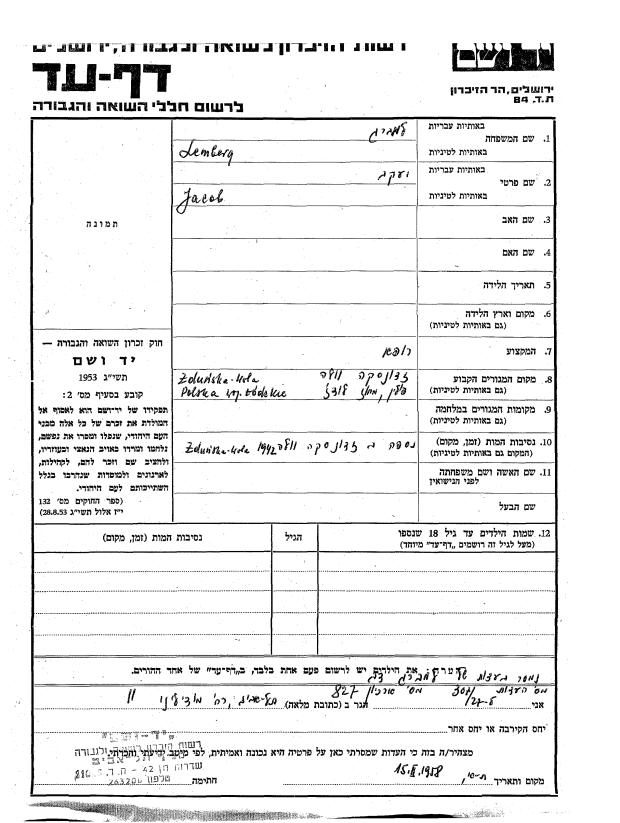
1942: Jakub Lemberg and family

(Thanks to Meaghan Good of the Charley Project for the guest post. -ed.)

On this date in 1942, on the first day of Purim, Jakub Lemberg was executed together with his family in the Nazi ghetto in Zdunska Wola, Poland.

Lemburg, a 43-year-old internist and pediatrician, was head of the Judenrat in Zdunska Wola and thus it was his task to do the Nazis’ dirty work, such as putting together lists of his fellow-Jews for deportation.

He revealed himself to be a man of exceptional character and courage, and the circumstances of his death, as recorded in Louis Falstein’s The Martyrdom of Jewish Physicians in Poland, should not be forgotten:

The Gestapo chief ordered Dr. Lemberg to deliver ten Jews to be hanged for the ten hanged sons of Haman. Dr. Lemberg replied that he could deliver only four Jews: himself, his wife and their two children. Hans Biebow, “the Butcher of Lodz,” seized Dr. Lemberg and turned him over to the executioners, who killed him in the cemetery.

The Zdunska Wola ghetto was liquidated five months later. And in 1947, Biebow got his.

Here’s an image of Lemberg testimony (in Hebrew) from the Yad Vashem database.

On this day..

1864: Martin Robinson, treacherous guide

On this date in 1864, a Union officer frustrated of a design to raid Richmond during the U.S. Civil War hanged a local African-American guide whom he thought had intentionally misled him like Susanin.

The account of an army chaplain attached to the 5th New York Cavalry explains:

The guide, a negro, had misled us during the night, and, to obviate the delay of retracing our steps. Col. Dahlgren, on the representations of the negro that an excellent ford was to be found at Dover Mills, concluded to cross at that point. After two hours’ halt we again moved on, and soon reached Dover Mills, but only to meet disappointment.


Dover Milles, Civil War era illustration

The negro had deceived us, no ford existed at this point nor any means of crossing the river. He then stated that the ford was three miles below: this was obviously false, as the river was evidently navigable to and above this place, as we saw a sloop going down the river.

… he came into our lines from Richmond … [and] was born and had always belonged in the immediate vicinity of Dover Mills, was very shrewd and intelligent, and it would seem impossible that he should not know that no ford existed in the neighborhood, where he had seen vessels daily passing. Col. Dahlgren had warned him that if detected acting in bad faith, or lying, we would surely hang him, and after we left Dover Mills, and had gone down the river so far as to render further prevarication unavailing, the colonel charged him with betraying us, destroying the whole design of the expedition, and hazarding the lives of every one engaged in it, — and told him that he should be hung in conformity with the terms of his service. The negro became greatly alarmed, stated confusedly that he was mistaken, thought we intended to cross the river in boats, and finally said that he had done wrong, was sorry, etc. The colonel ordered him to be hung, — a halter strap was used for the purpose, and we left the miserable wretch dangling by the roadside.

Our correspondent terms this the case of the “Faithless Negro”, but posterity has the luxury of a less paranoiac reading than indulged by a troupe of hotheaded commandos deep in enemy territory all a-panic as their expedition implodes. The James River was just plain swollen with winter rains. Bad luck all around.

A Goochland County marker marks the spot of the botched crossing and subsequent execution.

But we’re really just getting started. Stay tuned for some serious blowback from this bootless military debacle.

The full story of the raid is a tangled and contested affair, but it’s well worth perusing in detail. To sum up:

This expedition’s leader, Col. Ulric Dahlgren, abandoned the effort and in the attempt to fall back, rode into a Confederate ambush the next day. He died in the fusillade, while his men were captured.

The body of this late Col. Dahlgren, on whose authority our misfortunate guide was put to death, was found by the Confederates to bear some startling papers* … indicating that the intent of his ill-starred expedition was not merely to liberate starving northern prisoners, but that “once in the City it must be destroyed & Jeff. Davis and Cabinet killed.”

Within days, the story was abroad and Richmond newspapers floridly outraged at this proposed breach of chivalrous warfare.

Though Confederate General Robert E. Lee was able to quash public demands for the Dahlgren party’s summary execution, the documents may indeed have marked a turning point in the war’s conduct, a public announcement of total warfare sufficient for the South to “inaugurate a system of bloody retaliations.”** If so, it was a well-timed license: the Confederacy was in the process of being steamrolled and would soon require recourse to more desperate strategems.

After Dahlgren, argues Come Retribution: The Confederate Secret Service and the Assassination of Lincoln, “there was an increase in Confederate clandestine activity designed to encourage the antiwar faction in the North to organize and revolt” — even including a mirror-image Confederate cavalry raid on Washington D.C. with an eye towards capturing Lincoln.

There are, in fact, some historians who postulate that it was “bloody retaliation” for Dahlgren’s attempt on the Confederate president that ultimately led southern agents to initiate the late-war plots against Abraham Lincoln’s person — resulting ultimately in Lincoln’s assassination:

Ulric Dahlgren, and [his] probable patron [U.S. Secretary of War] Edwin Stanton set out to engineer the death of the Confederacy’s president; the legacy spawned out of the utter failure of their effort may have included the death of their own president.

That is some blowback.

Books exploring the alleged link between the Dahlgren Papers and the Lincoln assassination

* It must be said that the Dahlgren papers have been continually contested as frauds from the moment they were known, though many historians do indeed consider them legitimate. We are in no position to contribute to that debate, and for the purposes of this post’s narration the question is immaterial: the papers, forged or not, certainly existed, were widely publicized, and genuinely angered many southerners.

** These words are the demand of the March 8, 1864 Richmond Dispatch.

On this day..

1870: Wyatt Outlaw lynched by the Ku Klux Klan

On this date in 1870, the lynching of a mulatto freedman in Alamance County, North Carolina sounded the tocsin for ex-Confederates’ rollback of Reconstruction.

Perhaps America’s most tragic period, the aftermath of the Civil War saw a too-brief attempt to enforce ex-slaves’ civil rights, before it succumbed to violent counterattack. The prevailing historiography in the century-long era of Southern apartheid that followed remembered it as a time of impertinent Negroes ravishing Dixie’s virtue by being seated in the legislature and giving orders to their natural betters.

Winners write history, after all.

Those of the pro-Republican coalition at the time, before Northerners folded their hand, had a mind to write a different history.

Alamance County was one epicenter of this aborted alternative. The enclave was cool to secession from the beginning, and in the early years of Reconstruction had a live black-white coalition. Wyatt Outlaw, a mixed-race Alamance native who had fought for the Union, was a local leader in it. A member of the antislavery Union League, which registered freedmen as voters throughout the South, he was appointed a town commissioner for Graham, N.C. under the state’s new constitution.

This made him a prime target of Ku Kluxers. On the night of February 26, 1870, an armed party of white supremacists about 100 strong raided his home and strung him up on an elm tree facing the county courthouse. Pinned to his corpse for the edification of the morning’s churchgoers was a note:

“Beware you guilty — both white and black.”

North Carolina Governor William Holden complained to the U.S. Senate of federal unwillingness to act against such outrages.

What is being done to protect good citizens in Alamance County? We have Federal troops, but we want power to act. Is it possible the government will abandon its loyal people to be whipped and hanged? The habeas corpus should be at once suspended.

After another pro-Reconstruction politician was murdered later that year, Holden boldly took the initiative himself and called out the troops to arrest suspected Klansmen. But the right-wing Democratic party won midterm elections in 1870, and promptly impeached Holden for this atrocious tyranny; he was the first U.S. governor ever removed from office by impeachment.*


A “carpetbagger” ally of Wyatt Outlaw named Albion Tourgee — a judge who stood as one of North Carolina’s most prominent and hated advocates for African American equality — later wrote a novel about his experiences, A Fool’s Errand, by One of the Fools. Now in the public domain and available free online, this book’s portrayal of the Reconstruction South is receiving renewed scholarly appreciation** — including Tourgee’s catalogue of terrorism against emancipated blacks and the Republican government. The novel was a sensation (pdf) in its time.

One of the characters in Fool’s Errand is a nearly exact representation of Wyatt Outlaw: “Uncle Jerry Hunt”, who resists the Klan. It is “chiefly through Uncle Jerry’s persuasions, and because of his prominence and acknowledged leadership, this spirit had gone out among the colored men of the county.” He meets a graphic end that almost journalistically reports Outlaw’s real fate.

It was a chill, dreary night. A dry, harsh wind blew from the north. The moon was at the full, and shone clear and cold in the blue vault.

There was one shrill whistle, some noise of quietly moving horses; and those who looked from their windows saw a black-gowned and grimly-masked horseman sitting upon a draped horse at every corner of the streets, and before each house, –grim, silent, threatening. Those who saw dared not move, or give any alarm. Instinctively they knew that the enemy they had feared had come, had them in his clutches, and would work his will of them, whether they resisted or not. So, with the instinct of self-preservation, all were silent–all simulated sleep.

Five, ten, fifteen minutes the silent watch continued. A half-hour passed, and there had been no sound. Each masked sentry sat his horse as if horse and rider were only some magic statuary with which the bleak night cheated the affrighted eye. Then a whistle sounded on the road toward Verdenton. The masked horsemen turned their horses’ heads in that direction, and slowly and silently moved away. Gathering in twos, they fell into ranks with the regularity and ease of a practiced soldiery, and, as they filed on towards Verdenton, showed a cavalcade of several hundred strong; and upon one of the foremost horses rode one with a strange figure lashed securely to him.

When the few who were awake in the little village found courage to inquire as to what the silent enemy had done, they rushed from house to house with chattering teeth and trembling limbs, only to find that all were safe within, until they came to the house where old Uncle Jerry Hunt had been dwelling alone since the death of his wife six months before. The door was open.

The house was empty. The straw mattress had been thrown from the bed, and the hempen cord on which it rested had been removed.

The sabbath morrow was well advanced when the Fool [i.e., Tourgee himself] was first apprised of the raid. He at once rode into the town, arriving there just as the morning services closed, and met the people coming along the streets to their homes. Upon the limb of a low-branching oak not more than forty steps from the Temple of Justice, hung the lifeless body of old Jerry. The wind turned it slowly to and fro. The snowy hair and beard contrasted strangely with the dusky pallor of the peaceful face, which seemed even in death to proffer a benison to the people of God who passed to and fro from the house of prayer, unmindful both of the peace which lighted the dead face, and of the rifled temple of the Holy Ghost which appealed to them for sepulture. Over all pulsed the sacred echo of the sabbath bells. The sun shone brightly. The wind rustled the autumn leaves. A few idlers sat upon the steps of the court-house, and gazed carelessly at the ghastly burden on the oak. The brightly-dressed church-goers enlivened the streets. Not a colored man was to be seen. All except the brown cadaver on the tree spoke of peace and prayer–a holy day among a godly people, with whom rested the benison of peace.

The Fool asked of some trusty friends the story of the night before. With trembling lips one told it to him,

“I heard the noise of horses–quiet and orderly, but many. Looking from the window in the clear moonlight, I saw horsemen passing down the street, taking their stations here and there, like guards who have been told off for duty, at specific points. Two stopped before my house, two opposite Mr. Haskin’s, and two or three upon the corner below. They seemed to have been sent on before as a sort of picket-guard for the main body, which soon came in. I should say there were from a hundred to a hundred and fifty still in line. They were all masked, and wore black robes. The horses were disguised, too, by drapings. There were only a few mules in the whole company. They were good horses, though: one could tell that by their movements. Oh, it was a respectable crowd! No doubt about that, sir. Beggars don’t ride in this country. I don’t know when I have seen so many good horses together since the Yankee cavalry left here after the surrender. They were well drilled too. Plenty of old soldiers in that crowd. Why, every thing went just like clock-work. Not a word was said–just a few whistles given. They came like a dream, and went away like a mist. I thought we should have to fight for our lives; but they did not disturb any one here. They gathered down by the court-house. I could not see precisely what they were at, but, from my back upper window, saw them down about the tree. After a while a signal was given, and just at that time a match was struck, and I saw a dark body swing down under the limb. I knew then they had hung somebody, but had no idea who it was. To tell the truth, I had a notion it was you, Colonel. I saw several citizens go out and speak to these men on the horses. There were lights in some of the offices about the court-house, and in several of the houses about town. Every thing was as still as the grave,–no shouting or loud talking, and no excitement or stir about town. It was evident that a great many of the citizens expected the movement, and were prepared to co-operate with it by manifesting no curiosity, or otherwise endangering its success. I am inclined to think a good many from this town were in it. I never felt so powerless in my life. Here the town was in the hands of two or three hundred armed and disciplined men, hidden from the eye of the law, and having friends and co-workers in almost every house. I knew that resistance was useless.”

“But why,” asked the Fool, “has not the body been removed?”

“We have been thinking about it,” was the reply; “but the truth is, it don’t seem like a very safe business. And, after what we saw last night, no one feels like being the first to do what may be held an affront by those men. I tell you, Colonel, I went through the war, and saw as much danger as most men in it; but I would rather charge up the Heights of Gettysburg again than be the object of a raid by that crowd.”

After some parley, however, some colored men were found, and a little party made up, who went out and saw the body of Uncle Jerry cut down, and laid upon a box to await the coming of the coroner, who had already been notified. The inquest developed only these facts, and the sworn jurors solemnly and honestly found the cause of death unknown. One of the colored men who had watched the proceedings gave utterance to the prevailing opinion, when he said,–

“It don’t do fer niggers to know too much! Dat’s what ail Uncle Jerry!”

And indeed it did seem as if his case was one in which ignorance might have been bliss.

The multitalented, ahead-of-his-time Tourgee might well have uttered the same sentiment in 1896, when he was the lead attorney on the losing side of Plessy v. Ferguson — the Supreme Court’s landmark sanction of the color line that Uncle Jerry’s hangmen had drawn.

There are a couple of interesting journal articles touching on Alamance County during Reconstruction which are freely available as pdfs from the Journal of Backcountry Studies: “Other Souths”: The Civil War and Reconstruction in Alamance County, North Carolina and Scalawags Among Us: Alamance County Among the “Other Souths”.

* Narrowly beating Nebraska’s David Butler, who got the boot a few months later. Holden remains the only governor to suffer this indignity in North Carolina history; there has been a recent push in the Raleigh legislature to posthumously pardon him. Holden’s own memoirs are also available free online.

** Along with the book’s contention that northern Republicans were to blame for vacillating on Reconstruction. “This cowardly shirking of responsibility, this pandering to sentimental whimsicalities, this snuffling whine about peace and conciliation, is sheer weakness … [the North is] a country debauched by weak humanitarianisms, more anxious to avoid the appearance of offending its enemies than desirous of securing its own power or its own ends.”

On this day..

1942: Five Jews in Sokal

(Thanks to Meaghan Good of the Charley Project for the guest post. -ed.)

The synagogue at Sokal.

On this day in 1942, the Nazis shot five Jewish men from Sokal, which was then part of Poland and now belongs to the Ukraine.

During the first years of the war, the Germans had designated Sokal as a Judenstadt (literally “Jew-town”), a central destination point for all Jews expelled from nearby towns and villages. Or, as diarist Moshe Maltz put it, “A solitary island in a sea of blood.”

It was Maltz, an Orthodox Jew and native of Sokal, who recorded the executions described in this entry. He kept regular notes throughout the war about the plight of Sokal’s Jews — not a diary exactly, but a chronicle, meant for the benefit of history.

On February 24, five Jews from Sokal were taken to a place somewhere on the outskirts of town and shot. One of them was Yeshaye, son of Yankel the coachman. In 1940, during the period of Soviet occupation, Yeshaye had been a coachman working for the NKVD. Now the Gestapo called him and ordered him to turn over to them the reins of his horses. They said to him, “We’ll give you three days to deliver those reins to us. If we don’t get them by that time, we’ll have you shot.” Yeshaye thought that the Gestapo must be joking. How could he go on working as a coachman without his reins? Unfortunately for Yeshaye, the Gestapo men were in dead earnest.

Also among the five shot was Dr. Knopf, a lawyer who had converted to Christianity. The Germans had ordered him to dismiss his Gentile maid so that she could be sent to work in Germany. Knopf petitioned the Gestapo to let him have his maid back. That’s why the Germans shot him. Despite his baptism, he was simply not an Aryan. The third victim was blind Yankel, who was found guilty of buying and slaughtering a calf. Under German occupation regulations, cattle can be slaughtered only by officially approved butchers.

In October 1942, the Jews of Sokal were confined to a ghetto. The following month Maltz wrote, with the same dispassionate tone, of the murder of his fourteen-month-old daughter at the hands of the Nazis.

Later in November he escaped from the ghetto with his wife and surviving son. They had made an arrangement with a Polish woman who lived nearby, and moved into her hayloft, above the pigsty.

Eventually fourteen people from three families in all would come to live in the hayloft. All of them survived except Maltz’s sister, who died of fever while in hiding. The others staggered out into daylight, barely able to walk, when the Russians liberated the area in July 1944.

Maltz and his entire family eventually emigrated to the USA.

After his death in 1993, his diary was translated and published under the title Years of Horror, Glimpse of Hope: The Diary of a Family in Hiding. In 2009, a Pennsylvania State University professor made a prize-winning documentary based on the book, called No. 4 Street of Our Lady. You can watch it on Netflix or read an article about it here.

On this day..

1934: Augusto Cesar Sandino, national hero

“The sovereignty of a people cannot be argued about, it is defended with a gun in the hand.”

-Sandino

On this date in 1934, the first name in Nicaraguan anti-colonial resistance was abducted and summarily executed by the Nicaraguan National Guard.

From 1927 until his death, Sandino led an armed peasant insurgency from the Nicaraguan mountains against the Yankee imperialists and the domestic dictatorship they backed.

Washington had had its nose (and its marines) in Managua’s business for decades, continuously occupying the Central American country since 1912. The Marine Corps saw this country’s people as

Densely ignorant … little interested in principles … naturally brave and inured to hardships, of phlegmatic temperament, tough, capable of being aroused to acts of extreme violence, they have fought for one party or the other without considering causes since time immemorial … a state of war is to them a normal condition.*

All this was the time of Sandino’s own coming-of-age. The son of a wealthy landowner and his domestic servant, Sandino grew up with the unprivileged and the working classes, eventually asorbing an eclectic mix of that period’s revolutionary ideologies.

From 1927 he took to the Segovia and began writing the playbook for the 20th century guerrilla: mobile infantry irregulars, striking from familiar-to-them forest cover, melting away among sympathetic campesinos.

The “Colossus of the North” — Sandino made no bones about his foe; his personal seal showed an American marine being killed — invariably described him as a “bandit” because he also raided towns to commandeer food, clothing, and medicine.

“Washington is called the father of his country; the same may be said of Bolivar and Hidalgo; but I am only a bandit, according to the yardstick by which the strong and the weak are measured.”

-Sandino

The strong, in this case, found little public appetite for the steady attrition of servicemen, and the U.S. employed a familiar strategy of its own: “Nicaraguanizing” the conflict by building up a National Guard to do the dirty work domestically.

That Guard’s head was headed by Anastasio Somoza — the very son of a bitch of whom FDR said, “but he’s our son of a bitch.”

While it’s hardly the only country to have been favored with an American son of a bitch, you could say that Nicaragua has been the American empire’s very own heart of darkness. Washington’s initial interest in the place after the Spanish-American War concerned preventing a canal project to compete with Panama. It invented dive-bombing to hunt Sandino. And it ranged around the world and outside the law to battle Sandino’s successors under the aegis of a modern imperial presidency.

Small wonder that an official anthem of the movement denounces “The Yankee / The enemy of all humankind.”

In the immediate aftermath of the American departure in January 1933, Sandino began coming to terms with the the country’s new president: the Sandinistas disarmed in exchange for amnesty and land. But Somoza, who at this point was “only” the head of the National Guard, was building up his own power … and he meant to have done with this inconvenient insurgent.

After Sandino left a presidential meeting on this date, at which the erstwhile rebel negotiated for his continuing demand to disband Somoza’s Guardia, Sandino was stopped at the gates by Guardsmen. They took Sandino, his brother, and two of his generals and marched them off to be shot. Then the Guard forcibly broke up the Sandinista remnants. Somoza soon seized official power for himself; his family ruled, and plundered, Nicaragua until 1979. Washington never called them bandits.

While Sandino vanished (the whereabouts of his remains are unknown), his revolutionary vision and praxis also persist down to the present day.

Sandinismo (aging much better than Somocismo) would influence Fidel Castro and Che Guevara during the Cuban Revolution.

And in 1979, the Sandinista National Liberation Front finally succeeded in overthrowing the last loathsome scion of the Somoza dictatorship.

The United States, of course, went right back to war against its long-dead “bandit” foe.

* From Julian C Smith’s officially commissioned History of the Guardia Nacional de Nicaragua (1933), as quoted in Michael J. Schroeder’s “Bandits and Blanket Thieves, Communists and Terrorists: The Politics of Naming Sandinistasin Nicaragua, 1927-36 and 1979-90,” Third World Quarterly, Vol. 26, No. 1 (2005).

Schroeder runs the definitive English-language website on Sandino and the original Sandinistas, with a truly vast collection of documents and resources.

On this day..