1582: Philippe Strozzi, corsair

On this date in 1582, Philippe Strozzi, the Florentine-born commander of a French naval expedition against the Spanish was summarily executed as a pirate.

The Strozzi were long one of Florence’s wealthy and powerful families, as evidenced by, say, the Strozzi Palace, or the Strozzi coat of arms on Michelangelo’s Doni Tondo.

That made the Strozzi sometime-allies, sometime-rivals* of Florence’s more famous powerbrokers, the Medici. It is in both capacities that we meet Philippe (English Wikipedia entry | Italian | French).

To cut a centuries-long story short, the Strozzi had basically come out on the wrong side of the power struggle in the 16th century.

Philippe’s father, Piero Strozzi, was the child of a Strozzi-Medici union, and Piero too married a Medici. He also fought the Medici for power and ended up in exile whereupon he gravitated to the French court of … Catherine de’ Medici. (Catherine had been educated at the home of Philippe’s grandfather, Filippo Strozzi.) Catherine then turned around and used Piero as a French Marshal, including sending him to back Tuscan city-state Siena in opposition to its (and France’s) rival, Florence.**

Your basic tangled geopolitical-genealogical web.

Bottom line, Piero’s son Philippe was born in Florence but grew up Gallic, and fought in the French army all over the continent from the time he was a teenager.

When France got involved in the War of Portuguese Succession, they put this warlike fellow aboard a boat and sent him to dispute Spanish King Philip II‘s attempt to claim the Portuguese throne and unify the Iberian peninsula.

Strozzi’s armada got its clock cleaned at the naval Battle of Ponta Delgada near the Azores, with devastating loss of life.


The Spanish galleon San Mateo, which did yeoman service at this battle.

Since Spain and France were putatively at peace, Spain treated its captives not as prisoners of war but as pirates, and proceeded to execute several hundred in Vila Franca do Campo. Strozzi didn’t even get that much ceremony, however; the day after the battle, he was mortally stabbed, then tossed into the waves.

Happily, the name and the fame of the Strozzi outlived Spanish justice. In the next century, a distant relative by the handle of Barbara Strozzi became one of the most renowned composers of Baroque vocal music. (As befits wealthy Italians of the Renaissance, the Strozzi were big on the arts; Philippe was supposed to be a fine musician himself.)

* The Strozzi-Medici conflict frames the action in the play Lorenzaccio, in which the titular Brutus-like character mulls assassinating the Medici dictator in order to restore the Republic, only to find no such restoration in the offing once he actually does the deed; the father and grandfather of our day’s protagonists are both principal characters.

** That didn’t work. Strozzi was trounced at the Battle of Marciano, which signaled the permanent demise of the ancient city-state‘s independence.

On this day..

1704: John Quelch, pirate

On this date in 1704, John Quelch was hanged on a Boston wharf for piracy.

Quelch had re-appeared in New England less than a year after hastily absconding with a new privateering vessel while the owners tried to sort out the captain’s sickness.

(The captain suspected his crew were up to no good, but the mutineers locked him in his cabin and set sail before the investors could act on the information. The ill captain died at sea and was pitched overboard — in what order, no one can say.)

The privateer Charles had been tricked out and licensed to raid French shipping off Newfoundland, but the avaricious mutineers saw much better buccaneering prospects preying on the gold-laden Portuguese possessions in South America.

One small problem: Portugal had formed an alliance with England.

So when the Charles re-appeared, heavy with the sort of mineral wealth not to be found in North America, authorities could not fail to notice that its crew

Have lately Imported a considerable Quantity of Gold dust, and some Bar and coin’d Gold, which they are Violently Suspected to have gotten & obtained by Felony and Piracy, from some of Her Majesties Friends and Allies …*

This all looks very neat on the legal docket (and it certainly did to the jury-less Admiralty court, the first time this instrument had been used outside of England), except that pirates and piracy were far more integrated into the fabric of the colonial frontiers than their desperado reputation might suggest. Pirates shifted in and out of their outlaw careers; even the strictly law-abiding colonists traded knowingly with these freebooters. Certainly some momentary mutual convenience between London and Lisbon for reasons of continental politics was very far from most colonists’ scope of care.

John Quelch seems to be among those operating in the grey economy, and in this case bringing “gold and silver to specie-starved colonial economies.”**

Hunger for hard currency in an environment of wartime depreciation of various sketchy paper notes helps explain why Quelch’s trial raised hackles in New England. Here were men who had by dint of enterprise and adventure plucked nearly 1,000 pounds of gold from faraway Brazil and hauled it back home to New England, honestly paid out the shares to the crew and gone to settle up with the privateering syndicate’s financiers.

And the high-handed English governor Joseph Dudley responded by clapping them in irons and trying them for their lives, using a dubiously legal and heretofore unprecedent drumhead military tribunal at which Dudley himself presided while his son† prosecuted.

It’s a nice setup for winning convictions, which is exactly what happened.

In the process, Dudley blew through a good portion of the pirates’ confiscated booty, making it rain for “Stephen North, who kept the Star Tavern in which the trial was held, for entertainment of the Commissioners during the sitting of the Court of Admiralty” and that sort of thing. If a later denunciation circulated by Cotton Mather is to be believed, the Dudleys did not scruple to wet their own beaks, either.

There have been odd Collusions with the Pyrates of Quelch’s Company, of which one instance is, That there was extorted the sum of about Thirty Pounds from some of the crew for liberty to walk at certain times in the prison yard. And this liberty having been allowed for two or three days unto them, they, were again confined to their former wretched circumstances.

(The rest of the cash went neither to the privateer’s investors nor back to the aggrieved Portuguese, but was shipped to English mints under the capable administration of Isaac Newton.)

Little wonder at the unrepentant Quelch’s parting shot on this date.

Sarcastically interrupting one of his five fellow-sufferers’ bog-standard scaffold injunction against running with a bad crowd, Quelch urged the throng of onlookers to better “take care how they brought Money into New-England, to be Hanged for it!”

Their bodies remained gibbeted in the harbor.

In Quelch’s Gold: Piracy, Greed, and Betrayal in Colonial New England, Clifford Beal argues that Quelch’s trial marked the onset of an official crackdown on pirates that would drive these formerly semi-legitimate operators further underground and therefore into greater violence. He even suggests, at a bit more of a stretch, that Quelch’s case presaged the colonial resistance to the mother country’s political and economic dictates that would later blossom into the American Revolution.

As for the gold, much of it was not recovered in 1704. Legends to the effect that it remains stashed on New Hampshire’s Star Island continue to attract treasure hunters.

* From the proclamation of Quelch and his crew‘s arrest, quoted in Pirates of the New England Coast, 1630-1730.

** Villains of All Nations: Atlantic Pirates in the Golden Age, by Marcus Rediker.

† That son, Paul Dudley, later endowed a still-extant lecture series at Harvard University — the oldest endowed lectureship, even though (or rather because) the donor’s intention that it be directed “for the purpose of detecting and convicting and exposing the Idolatry of the Romish church” was eventually neglected.

On this day..

1725: John Gow and his pirate crew

On this date in 1725, John Gow and seven comrade raiders hanged for piracy.

Having mutinied to commandeer a merchant vessel in November 1724, Gow managed merely a three-month career of seaboard outlawry* in European waters before an ill-fated landward raid in his native Scotland saw the ship run aground.

Captured, Gow and confederates were hailed to London to stand trial, the captain delaying matters by refusing to plead before the threat of being pressed forced his hand. The inevitable sentence came off a little … unevenly. During the hanging,

[Gow’s] friends, anxious to put him out of his pain, pulled his legs so forcibly that the rope broke and he dropped down; on which he was again taken up to the gibbet, and when he was dead was hanged in chains on the banks of the Thames.

Scottish scribbler Sir Walter Scott mined the local lore of “the Orkney pirate” heavily for his novel The Pirate.

* Exhaustingly catalogued in the Newgate calendar.

On this day..

1871: The Paris Commune falls

On this date in 1871, the last barricade of the Paris Commune fell to the onslaught of the army — and a legion of Parisians fell to the army’s firing squads.

On the evening of that bright Sunday when the insurrection finally collapsed, a Sunday when the streets of central Paris were crowded with returning bourgeois, all expressing their satisfaction that the struggle was at last over, the city’s walls were placarded with a proclamation emanating from MacMahon. “Inhabitants of Paris,” said he, “the Army of France has come to save you. Paris is delivered. At four o’clock our soldiers carried the last position occupied by the insurgents. Today the struggle is over, order, work and security will now revive.

I read that announcement in the Rue de Rivoli, not far from the Hotel-de-Ville. A moment later, however, I heard a discharge of musketry … Several insurgents who had been taken fighting were being shot. (My Adventures in the Commune, Paris, 1871, an anti-Commune source)

The day was climax and curtains for the first working-class seizure of power in industrial Europe, but in truth indiscriminate reprisal executions had been underway since troops of the conservative Versailles government first breached rebellious Paris on May 21.

What followed was semaine sanglante, the “bloody week” — each barricade’s surviving defenders executed summarily, and anyone in the city liable to a similar fate if the nearest French officer disliked the cut of his or her jib. Rumors swept the city that women of the Commune were torching buildings, for instance, and suddenly any woman in the street could be killed as an arsonist; some firefighters were shot as saboteurs when the “water” they threw on such flames failed to speedily quench them,* and was consequently adjudged to be kerosone.

And heaven help he who should chance to resemble one of the wanted Communard leaders!

Any passer-by calling a man by a revolutionary name caused him to be shot by soldiers eager to get the premium … Members and functionaries of the Commune were thus shot, and often several times over, in the persons of individuals who resembled them more or less.


Un rue de Paris en 1871, by Maximilien Luce.

The total body counts are guesswork: the killing ran far ahead of the record-keeping. Twenty thousand, or thirty, or more are thought to perished by summary execution. Even the press of the bourgeoisie, whose sword arm the Versailles men comprised, was aghast. London’s Times filled its broadsheets with calumnies upon the Commune, but noted on May 29:

“The Revolution is crushed;” but at what a cost, and amid what horrors! … the Communists seem not very much worse than their antagonists. It sounds like trifling for M. Thiers to be denouncing the Insurgents for having shot a captive officer “without respect for the laws of war.” The laws of war! They are mild and Christian compared with the inhuman laws of revenge under which the Versailles troops have been shooting, bayoneting, ripping up prisoners, women and children, during the last six days.

Whatever the true death toll, it massively surpassed that of the much more eagerly commemorated Revolutionary Terror.

Not for Executed Today to number what the butchers themselves could not. In a city turned charnel house in the midst of a Week of Blood, a few scenes of mortality from the day the Commune fell. (Heavily sourced to the very pro-Commune — hence potentially sensational — History of the Commune of 1871)

This people, heroes in the face of the foreigner, must therefore by called assassins, criminals, wretches, because they died for the Universal Republic, because in defense of their beliefs, their conscience, their idea, they preferred, in their fierce enthusiasm, to bury themselves in the ruins of Paris rather than abandon it to the coalition of despots a thousand times more cruel and more lasting than any foreigner.

-Lissagaray

The 147 Fédérés at Communards’ Wall

At a wall still consecrated to leftists in the Pere Lachaise cemetery of Belleville, 147 were summarily shot.

The 147 are acclaimed as the last defenders of the Commune.

the Commune is in its death throes. Like the dragon of fairy lore, it dies, vomiting flames … What must these men feel who are killing and being killed in the cemetery! To die among the dead seems horrible. But they never give it a thought; the bloody thirst for destruction which possesses them allows them only to think of one thing, of killing! Some of them are gay, they are brave, these men. That makes it only the more dreadful; these wretches are heroic! Behind the barricades there have been instances of the most splendid valour. A man at the Porte Saint-Martin, holding a red flag in his hand, was standing, heedless of danger, on a pile of stones. The balls showered around him, while he leant carelessly against an empty barrel which stood behind. — “Lazy fellow,” cried a comrade. ‘”No,” said he, “I am only leaning that I may not fall when I die.”

Paris Under the Commune, an anti-Commune source

Communard Eugene Varlin

Varlin, alas! was not to escape. On Sunday the 28th May he was recognized in the Rue Lafayette, and led, or rather dragged, to the foot of the Buttes Montmartre before the commanding general. The Versaillese sent him to be shot in the Rue des Rosiers. For an hour, a mortal hour, Varlin was dragged through the streets of Montmartre, his hands tied behind his back, under a shower of blows and insults. His young, thoughtful head, that had never harboured other thoughts than of fraternity, slashed open by the sabres, was soon but one mass of blood, of mangled flesh, the eye protruding from the orbit. On reaching the Rue des Rosiers, he no longer walked; he was carried. They set him down to shoot him. The wretches dismembered his corpse with blows of the butt-ends of their muskets.

Varlin was shot along with a nameless batch of others to whom the March 18 execution of Generals Lecomte and Thomas had been hastily imputed (they were held at the generals’ execution site, to contemplate their sin). A pro-government paper allowed that Varlin “died game.”
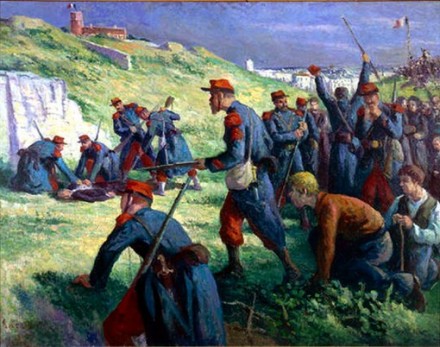

L’execution de Varlin, another Maximilien Luce scene.

Many at the stock exchange

According to the Paris Francais as quoted by this Marxist review of the events

It is at the Bourse that there was to-day the largest number of executions. The doomed men who attempted to resist were bound to the iron railing.

The stock exchange is “a fit place, to be sure, for this sort of business,” observes our interlocutor.

Eighty-plus defenders of Belleville, at the Arc de Triomphe

The London Times editorialized on May 31 upon this incident when the Marquis de Gallifet plucked from the mass of Belleville’s May 28 captives “eighty prisoners, principally soldiers of every arm, linesmen, artillerymen, and Zouaves, [who] were set apart and afterwards led to the right of the rampart to be shot.”

The French are filling up the darkest page in the book of their own or the world’s history. The charge of ruthless cruelty is no longer limited to one party or to one class of persons. The Versailles troops seem inclined to outdo the Communists in their lavishness of human blood. The Marquis de Gallifet is escorting a column of prisoners to Versailles or Satory. He “picks out eighty-two of them, and shoots them at the Arc de Triomphe.” Next came a lot of 20 firemen, then a dozen women, one aged 70. On another spot our Correspondent came upon “80 corpses, piled upon each other, a mass of arms and legs and distorted faces, while the roads and gutter literally flowed with blood.” About 1,000 are said to have thus suffered. By this wholesale and summary execution of prisoners in batches of 50 and 100, not only must the innocent perish with the guilty, but many must bear the penalty of imaginary guilt.

An utterly disconnected Englishman, according to the paper’s correspondent, was accidentally among the four score at the Arc, and only saved by the fortuitous intervention of a Belgian attache.

an English officer somehow got mixed up in the procession, and was forced to keep in it by the escort, who, out of 5,000 prisoners, could not, of course, be expected to recognize one innocent man … it so happened that some of the prisoners tried to escape, and to make an example the leader of the cavalry escort, the Marquis de Gallifet, a man who is not prone to err on the side of mercy, had then and there 81 shot, and the English officer was all but one of them, his explanations being at first refused the slightest attention. Human life has, in fact, become so cheap that a man is shot more readily than a dog.

Socialist physician Tony Moilin

One single fact was Tony Moilin reproached with: that of having on the 18th March taken possession of the mairie of his arrondissement, and having thus had a share in giving the signal for the insurrection …

The court-martial condescended to tell him that the fact of the mairie, the only one he could be reproached with, had in itself not much importance, and did not merit death, but that he was one of the chiefs of the Socialist party, dangerous through his talents, his character, and his influence over the masses; one of those men, in short, of whom a prudent and wise Government must rid itself when it finds a legitimate occasion to do so

[A] respite of twelve hours was granted him in order that he might make his testament, write a few words of farewell to his father, and finally [marry his pregnant lover] … on the 28th May, in the morning, Tony Moilin was led into the garden a few steps from the palace and shot. His body, which his widow claimed, the surrender of which had been at first promised, was refused her. (History of the Commune of 1871)

The unnumbered dead of Lobau Barracks

Since morning a strong cordon is being formed round the theatre (Châtelet); where a court-martial is permanently established. From time to time one sees a band of fifteen to twenty individuals coming out, composed of National Guards, civilians, women and children fifteen to sixteen years old.

These individuals are condemned to death. They march two by two, escorted by a platoon of chasseurs, who lead and bring up the rear. This cortege goes up the Quai de Gevres and enters the Republican Barracks in the Place Lobau. A minute after one hears from within the fire of platoons and successive musketry discharges; it is the sentence of the court-martial which has just been executed.

The detachment of chasseurs returns to the Chatelet to fetch other prisoners. The crowd seems deeply impressed on hearing the noise of the shootings.

This is another publication’s story cited in the History of the Commune of 1871, which itself also details the court-martial procedures of this drumhead tribunal:

Thousands of prisoners who were led there were first of all penned in upon the stage and in the auditorium, under the guns of the soldiers placed in the boxes; then, little by little, like sheep driven to the door of the slaughter-house, from wing to wing they were pushed to the saloon, where, round a large table, officers of the army and the honest National Guard were seated, their sabres between their legs, cigars in their mouths. The examination lasted a quarter of a minute. ‘Did you take arms? Did you serve the Commune? Show your hands.’ If the resolute attitude of a prisoner betrayed a combatant, if his face was unpleasant, without asking for his name, his profession, without entering any note upon any register, he was classed. ‘You?’ was said to the next one, and so on to the end of the file, without excepting the women, children, and old men. When by a caprice a prisoner was spared, he was said to be ordinary, and reserved for Versailles. No one was liberated.

The classed ones were at once delivered to the executioners, who led them into the nearest garden or court. From the Châtelet, for instance, they were taken to the Lebau Barracks. There the doors were no sooner closed than the gendarmes fired, without even grouping their victims before a platoon. Some, only wounded, ran along by the walls, the gendarmes chasing and shooting at them till they fell dead. … There were so many victims, that the soldiers, tired out, were obliged to rest their guns actually against the sufferers. The wall of the terrace was covered with brains; the executioners waded through pools of blood.


Summary executions — death squads — continued for days or weeks afterwards in Paris; martial law throttled left organizing in the city; and those “fortunate” enough to have been captured alive were processed in a steady stream of judicial executions over the months yet to come.

The Commune, a palpably subversive example even in the present day, was destroyed in every way possible for the Versailles government. But its example could hardly be forgotten.

Marx would write The Civil War in France of the only proletarian revolution he would actually witness in his lifetime.

The next generation’s subversives also took inspiration from the Parisian example … and lessons from its mistakes. Lenin — a fond student of the Commune, who was eventually buried wrapped in a Communard banner — said that

two mistakes destroyed the fruits of the splendid victory. The proletariat stopped half-way: instead of setting about “expropriating the expropriators”, it allowed itself to be led astray by dreams of establishing a higher justice in the country united by a common national task; such institutions as the banks, for example, were not taken over … The second mistake was excessive magnanimity on the part of the proletariat: instead of destroying its enemies it sought to exert moral influence on them; it underestimated the significance of direct military operations in civil war, and instead of launching a resolute offensive against Versailles that would have crowned its victory in Paris, it tarried and gave the Versailles government time to gather the dark forces and prepare for the blood-soaked week of May.

“The lesson learnt by the proletariat will not be forgotten,” Lenin vowed, and his own revolution gained a vital object lesson in the Bloody Week of Paris, and an anthem besides: Communard Eugene Pottier, fleeing the Versailles army’s slaughter, wrote the verses that have been sung ever since by millions dreaming of a better world — the Internationale.

* Water can accelerate a fire, under the right circumstances.

On this day..

1891: The Namoa pirates

On this date in 1891, Chinese authorities beheaded 15 at Kowloon, including the leaders of the then-notorious Namoa pirates.

They were nicknamed for the steamer they had infamously commandeered six months before. The tale is related by an English maritime official’s orientalist (and now public-domain) memoir, The Mystic Flowery Land:

The most daring and disastrously successful piracy of late years … was the “Namoa” piracy in 1890. The startling news of this outrage created a general feeling of unsafety and consternation among the foreign communities in China, mingled with grief and just resentment for the cold-blooded murder of Captain Pocock and Mr. Petersen, both most popular and respected men, the latter being a member of the Customs Service.

On Sunday, the 3rd of December, 1890, the Douglas, Lapraik, and Co‘s coasting steamer, “Namoa,” commanded by my late most esteemed friend Capt. Pocock,* left Hongkong at noon, bound on her usual trip up the coast to Swatow, Amoy, and Foochow with several European and a large number of Chinese passengers, most of the latter being Fuhkien people returning to their native homes after many years absence in the United States and California, each with his little hoard of hard-earned dollars, gained by a small lifetime of frugal toil and self-denial in a distant land. These poor men were nearing their well-remembered haunts of earlier days, to once more spend among the relations and friends of their youth the fast-approaching New Year.

Several Chinese passengers [during the voyage] came up out of the main between-decks and walked about for some minutes in a seemingly aimless manner; then others emerged from the hatch, until there were between forty and fifty on deck — some forward near the hatchway leading down to the junior officers’ mess, others near the bridge ladder and entrance to engine-room and stokehole, and the rest at the main hatchway, saloon entrances and after skylight.

Suddenly, at a given signal, off came their loose outer garments, and these harmless-looking passengers were armed men; each with a cutlass and two revolvers in hand, and at their appointed stations.

The ship was now entirely in the hands of the pirates, whose leader placed one of the gang at the helm, with directions to steer a certain course.

The attack had been planned and carried out with consummate tact and forethought, for the pirates were old hands — desperate scoundrels … two or three ventured below … among their terror-stricken countrymen, and ransacked their luggage, robbing them of their treasured packets of dollars, saved during long and lonesome years of comparative exile and drudgery. Every cent was taken from these poor fellows, who wept in vain, and heart-rending scenes ensued. But the wretches took all.

Then [the European passengers] were all driven into the captain’s little berth, which was barely large enough to hold them all, where they were nearly suffocated.

At this point, the pirates steam off to rendezvous with their confederates, transfer their persons and their booty to the getaway ships, and — after debating whether to burn the Namoa — instead abandon the ship unsunk and the hostages unkilled.

These put the ship to rights and got it back to Hong Kong.

Public indignation was great, and considerable pressure was brought to bear on the Chinese Government to bring the pirates to justice. Skilled foreign and Chinese detectives were sent out on their track, doggedly determined to run these criminals to earth and make them pay the full penalty of their dastardly deeds.

… most, if not all, of these notorious crime-hardened criminals were eventually brought to justice, suffering decapitation outside Kowloon city, the majority of them being executed on Monday, April 17th, 1891, and the remaining nineteen on Thursday, 11th May, of the same year.**

The pirates were such big news that posed photos were taken of their public executions. (Both images are detail views; click for the full picture.)

For some time great precautions were taken by the captains and officers of coasting steamers to search the luggage of all native passengers, and thus guard against a similar catastrophe.

* Captain Thomas Guy Pocock was killed by the pirates, and has a private memorial in Hong Kong Cemetery (aka Happy Valley Cemetery). He left a one-year-old son who died in World War I.

** According to a tome on legal administration in Hong Kong, the pirates were beheaded in batches mixed in with other criminals.

A wholesale execution took place at Kowloon City on the 17th April, 1891, when nineteen pirates were decapitated, thirteen of them for participating in the Namoa and other piracies, and six others for various offences in Chinese territory … on the 11th May fifteen more prisoners were beheaded at Kowloon by the Chinese authorities, amongst the number being six Namoa pirates, including the three leaders of the gang, one of the men being the captain of the junks on board which the pirates put their plunder … One of the leaders decapitated, named Lai A Tsat, was a man whose boldness and cunning in carrying out piracies had long made him a terror both at sea and on shore.

On this day..

2003: Three ferry hijackers

On this date in 2003, three men who commandeered a Havana harbor ferry and made a bid for American waters were shot as Cuba cracked down hard on a wave of hijackings.

Things moved extremely quickly for Lorenzo Enrique Copello Castillo, Barbaro Leodan Sevilla Garcia and Jorge Luis Martinez Isaac, described as “the three principal, most active and brutal leaders” of a gang of about 10.* It had been less than two weeks before that they seized the Baragua and ordered it to head for Florida.

The ship ran out of fuel, and the Cuban Coast Guard towed it back to Mariel. There were no injuries reported among the 50 passengers.

In the context of a then three-year-old moratorium on executions on the island, this probably would not have been enough to cost the ringleaders their lives, save that Fidel Castro perceived the need for a salutary example.

Despite the Yankee’s post-9/11 reprobation of “terrorism,” its definition of the phenomenon retained the familiar geopolitical biases — who is and is not a terrorist when it comes to Cuba is driven by anti-Castro Cuban exiles’ outsized political weight in Florida.

So Havana had some alarm to observe a spate of hijackings: two passenger planes had been redirected to Key West in the previous two weeks, and the passengers therefore offered American residency.

Accusing the U.S. of abetting terrorism — Washington blamed Cuba’s airport security — the government sent its own message when the Baragua desperadoes made it three hijackings in a fortnight.**

The Cuban Council of State, including Castro himself, reviewed the charges directly and gave the go-ahead to the shootings.

Hijackings did indeed stop.

Still, such a severe reprisal so swiftly enacted drew sharp rebukes from human rights advocates and even Cuban allies abroad.

Whether chastened by the reaction or just because it was indeed an exceptional circumstance, Cuba subsequently reverted to its de facto moratorium, and has not executed anybody else since this date six years ago. In 2008, Raul Castro commuted most of the extant death sentences in Cuba, leaving only three people — condemned on terrorism charges — still potentially in danger of execution.

* Others drew prison sentences ranging from a few years to life.

** The Cuban government claimed to have prevented yet another attempted skyjacking the night before the execution.

On this day..

1914: Regiment Mixte de Tirailleurs decimated

On this date in 1914, the French army decimated a regiment of its Tunisian soldiers for retreating.

Seriously, decimation? In the 20th century?

Even the most jaded navigator of World War I’s extensive stock of horror may be gobsmacked to find that military executions in this conflict extended to the Roman-pioneered practice of imposing collective punishment on a unit by killing a random tenth of it. Little more is evidently available about this situation online, but the idea of the French military selecting randomly for salutary executions is used in Stanley Kubrick’s Paths of Glory where one officer, charged with providing an enlisted man for trial, simply has them all draw lots.

And according to Gilbert Meynier’s L’Algérie Révélée: La guerre de. 1914–1918 et le premier quart du XX sie`cle (French review), African soldiers’ experience in the Great War with incidents like this tended to underscore France’s colonial domination … and helped contribute to the national identity-forming that would break the French grip on North Africa as the century unfolded.

On this day..

1726: William Fly, unrepentant pirate

On this date in 1726, an obscure boatswain who had mutinied for the liberty of piracy succumbed but did not submit on the gallows in Boston.

Fly overthrew (figuratively and literally — they both ended up in the drink) a tyrannous captain and first mate on a British slave ship in May, reconstituting it Fame’s Revenge, and in a northward journey from North Carolina to New England captured a few less-than-lucrative ships in a month and change.

A minor character in the annals of seaborne pillage. So why should historian Marcus Rediker devote the opening chapter to his Villains of All Nations: Atlantic Pirates in the Golden Age (review) to this man?

[T]he early-eighteenth-century pirate ship was a world turned upside down, made so by the articles of agreement that established the rules and customs of the pirates’ alternative social order. Pirates “distributed justice,” elected their officers, divided their loot equally, and established a different discipline. They limited the authority of the captain, resisted many of the practices of capitalist merchant shipping industry, and maintained a multicultural, multiracial, and multinational social order. They demonstrated quite clearly — and subversively — that ships did not have to be run in the brutal and oppressive ways of the merchant service and the Royal Navy.

Rediker’s sympathetic but unromantic work treats the radical, doomed sphere of resistance pirates offered to the enormous cruelty of the developing Atlantic economy: grinding exploitation of white sailors in the service of the black slave trade under the iron hand of the empire (British, in this case, but hardly exclusive to Old Blighty.)

It bears the trace of Hakim Bey‘s treatment of Temporary Autonomous Zones:

Fleeing from hideous “benefits” of Imperialism such as slavery, serfdom, racism and intolerance, from the tortures of impressment and the living death of the plantations, the Buccaneers adopted Indian ways, intermarried with Caribs, accepted blacks and Spaniards as equals, rejected all nationality, elected their captains democratically, and reverted to the “state of Nature.” Having declared themselves “at war with all the world,” they sailed forth to plunder under mutual contracts called “Articles” which were so egalitarian that every member received a full share and the Captain usually only 1 1/4 or 1 1/2 shares. Flogging and punishments were forbidden — quarrels were settled by vote or by the code duello.

Certainly many men (and women) turned to piracy for many different reasons. Rediker’s work on the systematic brutality in the guts of the imperial economy and the pressures of resistance and coercion they spawned finds an outstanding individual exponent in this day’s victim.

Fly walked indifferently to the gallows; to the astonishment of the spectators, he upbraided the hangman’s poor knot and remade with his own hands the instrument for his own neck — one last use of his seaman’s proficiency with ropes.

On Fly’s turn upon that fatal stage, he would not read from the classics — not cower before his executioners, not salute the majesty of the crown that hung him, not enjoin the mob to straighten up and sail right, and certainly not be cowed on the cusp of the eternal by officious colonial holy roller Cotton Mather’s vain personal bid to convert the corsair:

When the time came for last words on that awful occasion, Mather wanted Fly and his fellow pirates to act as preachers — that is, he wanted them to provide examples and warnings to those who were assembled to watch the execution. They all complied. Samuel Cole, Henry Greenville, and George Condick [three of Fly’s crew], perhaps hoping for a last-minute pardon, stood penitently before the crowd and warned all to obey their parents and superiors and not to curse, drink, whore, or profane the Lord’s day. These three pirates acknowledged the justice of the proceedings against them, and they thanked the ministers for their assistance. Fly, however, did not ask for forgiveness, did not praise the authorities, and did not affirm the values of Christianity, as he was supposed to do, but he did issue a warning. Addressing the port-city crowd thick with ship captains and sailors, he proclaimed his final, fondest wish: that “all Masters of Vessels might take Warning by the Fate of the Captain (meaning Captain Green) that he had murder’d, and to pay Sailors their Wages when due, and to treat them better; saying, that their Barbarity to them made so many turn Pyrates.” Fly thus used his last breath to protest the conditions of work at sea, what he called “Bad Usage.” He would be launched into eternity with the brash threat of mutiny on his lips.

“Bad Usage.” Rediker later defines it as “the violent disciplinary regime of the eighteenth-century deep-sea sailing ship, the ordinary and pervasive violence of labor discipline as practiced by the ship captain as he moved the commodities that were the lifeblood of the capitalist world economy.”

The resistance to a pattern of savage floggings, cheated wages, and the whole spectrum of rough and arbitrary authority on a shipboard dictatorship might be spontaneous and individual in the instant … but it was thick with the stuff of solidarity, and the fraternity of outlawry could make people equal across the boundaries of national rivalry and institutional racism — “Villains of all Nations,” as the title goes.

And the obdurate, like Fly, could every now and then move the pastors who were sent to thunder hellfire at them rather than the other way around.

As it happened, the “stupid” and “impenitent” pirate [Mather uses these words to describe Fly elsewhere] was able to convince the self-righteous minister of at least one primary cause of piracy. During his execution sermon, Mather made it a point to address the ship captains in the crowd, telling them in no uncertain terms that they must hereafter avoid being “too like the Devil in their Barbarous Usage of the Men that are under them and lay them under Tempations to do Desperate Things.”

After the hanging, William Fly’s body was gibbeted as a warning on Nixes Mate, a barely-there speck of an island at the mouth of Boston Harbor. For Rediker, this date marks the end of the Golden Age of Piracy.

Although the full book is worth the buy, a paper Rediker wrote on the subject prior the book’s publication is available free online.

Part of the Themed Set: Embarrassed Executioners.

On this day..

1720: Charles Vane, an unsinkable pirate

On this date in 1720, Charles Vane’s resilient pirate career finally came to the end of a noose.

Like his onetime lieutenant Calico Jack Rackham, Vane plundered the American coast and the Caribbean during the twilight heyday of the buccaneer.

The man had a gift. From 1716 to late in 1718, Vane looted dextrously, even boldly spurning a royal pardon the better to keep his loot and mounting a flamboyant escape from the armada subsequent sent to detain him.

If he had a weakness, it was not as a mariner but as a manager. A notoriously tyrannous captain, Vane saw one aide turn on him and escape with a ship and a second — the aforementioned Rackham — mount a seaborne coup after Vane judiciously refused to engage a larger French man-o-war.

Nothing daunted by the loss of his command, Vane set about rebuilding his fortunes by resuming the conquest of prizes. Little could he see that the day of piracy was fast drawing to a close, and his own hourglass running faster still.

For all the catastrophes visited on him by his confederates, it required the connivance of nature to do him in. Early in 1720, a hurricane obliterated his ship (and most of his crew); tough old Vane managed to wash up on a deserted island* … but was recognized by his “rescuers” and delivered up to the British governor of Jamaica, who strung him up within the week.

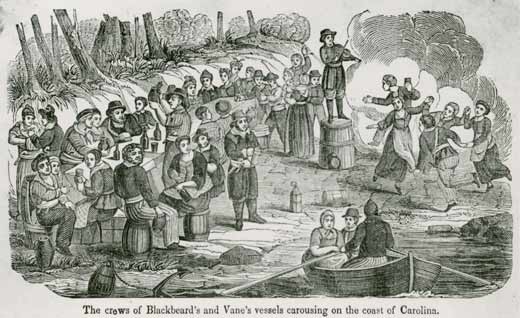
* Straight out of piracy central casting, no? Would you also believe his crew had a renowned “pirate party” rendezvous with Blackbeard’s?

On this day..

1720: Captain John “Calico Jack” Rackham

On this date in 1720Nov. 18, 1720, the pirate captain “Calico Jack” Rackham was hanged together with his crew by the British governor of Jamaica.

Nicknamed for his flamboyant clothing, the Bristol-born buccaneer plundered the West Indies during the “Golden Age of Piracy”, having ousted his former captain Charles Vane. Rackham is chiefly remembered to history for two who were not hanged with the rest of his crew: Anne Bonny and Mary Read, rare female pirates who served aboard Rackham’s ship.

Immortalized by Daniel Defoe in his pseudonymous A General History of the Pyrates, Bonny and Read came to piracy by different paths but were both every bit the part and leaders aboard their ship — “very profligate, cursing, and swearing much, and very ready and willing to do any Thing on board.” Bonny, at least, was Rackham’s lover — having eloped with him from her husband.

Upon capture, both women “pleaded their bellies” to escape the gallows, and though it’s unclear whether either really was pregnant, it seems the gambit spared both from execution.

Read died in prison shortly after, while Bonny vanished from history — prompting speculation that she had escaped, secured a pardon, been ransomed by her wealthy father, and/or returned again to piracy under a different guise. Reportedly, she castigated Rackham at their last meeting in prison for lying drunk below decks while only the women resisted the capture of their ship: “I am sorry to see you here Jack, but if you had fought like a man, you need not be hanged like a dog.”

As the world’s best-known women pirates, Bonny and Read are recalled as anything from sexualized historical curios to action heroines to proto-feminists.

They feature in Disneyland’s “Pirates of the Caribbean” ride, the Witchblade comic book series, utopian theorizing, popular history … and the occasional action figure.

Update: A much more detailed foray into the lives of these daring women is at Scandalous Women.

Also, I posted this under the wrong date: it should be Nov. 18. Balls.

On this day..