Journalist/novelist Michael O’Hanrahan was the close friend and aide-de-camp of one of those May 3 executees, Tom MacDonagh — the two of them directing the rebel occupation of the Jacob’s Biscuit Factory during the week of April 24.
Edward Daly was the brother-in-law of Fenian ultra Tom Clarke, another man who had been shot on May 3.
Daly, at least, was a battalion commander during the Easter Rising and a part of the rising’s leadership; sculptor Willie Pearse was a mere run-of-the-mill rebel of the type that the British were not executing … save for that surname which he shared with his brother Patrick, the third Republican ringleader shot on May 3. Having seemingly absorbed an extra ration of fury intended for his brother, Willie Pearse’s execution was keenly felt as an injustice from the first.
But perhaps none of the Easter Rising executions tugged the heartstrings quite like that of Joseph Plunkett, a poet and Esperantist who was also one of the signatories of the seditious Proclamation of the Irish Republic. Plunkett had been one of the conspiracy’s secret emissaries to Germany, arranging shipments of arms that the British ultimately intercepted.
At midnight, due to be shot in a few hours with the day’s first light, Plunkett was married by a prison chaplain to his sweetheart, artist and Sinn Fein activist Grace Gifford. This tragic union made Grace Gifford and her sister Muriel double widows, for Muriel’s husband was Tom MacDonagh — the aforementioned already-executed associate of Michael O’Hanrahan.
There are roads, railway stations, football clubs, and the like named for all four of these men at various places in Ireland.
Thomas MacDonagh, Padraig (Patrick) Pearse, and Thomas Clarke — three of the principal Irish Republican leaders of the Easter Rising against British domination that had been crushed just days before — were shot in Dublin’s Kilmainham Gaol on this date in 1916.
His songs were a little phrase
Of eternal song,
Drowned in the harping of lays
More loud and long.
His deeds were a single word,
Called out alone
In a night when no echo stirred to laughter,
To laughter or moan.
But his songs new souls shall thrill,
The loud harps dumb,
And his deeds the echoes fill
When the dawn is come.
MacDonagh and Pearse were contemporaries of one another: poets, progressive educators, Gaelic revivalists; men who girded for battle “with a revolver in one hand and a copy of Sophocles in the other.” Each dreamer commanded a unit of Irish Volunteers during the week of April 24-30, MacDonagh occupying Jacobs Factory and Pearse the iconic General Post Office, in which post it was Pearse’s sorrow to issue the surrender order by the end of the quixotic week.
Clarke, cut from another cloth, was a Fenian revolutionist of an older vintage, who had disappeared into British prison after trying to bomb London Bridge in the 1880s, then emigrated for a time to the United States. Drawn to a reviving nationalist movement, Clarke had the honor of affixing his name first upon the Rising’s Proclamation of the Irish Republic. Pearse and MacDonagh signed it too: a fatal endorsement for they three and for each of the other four men to lend it their signatures.
“My comrades and I believe we have struck the first successful blow for freedom,” Clarke said via a statement given out by his impressive wife Kathleen. “And so sure as we are going out this morning so sure will freedom come as a direct result of our action … In this belief, we die happy.”
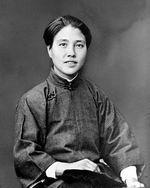
The Chinese Communist Xiang Jingyu was martyred on May Day of 1928.
The preeminent female cadre of her time, Xiang was the 16-year-old daughter of a merchant when imperial China fell in 1911. She came of age, and radicalized, in the tumultuous aftermath, becoming an early advocate for women’s liberation as an essential objective of the revolution. She also became the wife of Mao crony Cai Hesen.
Xiang made her mark with a seminal 1920 essay, published while studying in France, “A discussion of women’s emancipation and remoulding.” In it, “Xiang called upon women who had realized consciousness to form four organizations: a study and propaganda society, a free choice in marriage league, a student loan society, and public nurseries.” (Andrea McElderry, “Woman Revolutionary: Xiang Jingyu,” The China Quarterly, March 1986)
Returning to China the following year, she became one of the Communist Party‘s leading voices in the women’s section, where she dunked on bourgeois feminism (“The result of their efforts will be that the whole bunch of them will enter the pigsties of the capital and the provinces where together with the male pigs, they can preside over the nation’s calamities and the people’s misforturtunes”) and gained only halting traction campaigning for girls’ education and mobilizing female factory workers. Her dour and driven demeanor earned her the nickname “Old Grandma”.
Arrested by French soldiers in Hankou‘s French Concession, Old Grandma had no time for the captors who would betray her to the Kuomintang, and her own death. “I am Xiang Jingyu, a member of the Chinese Communist Party. You can kill me and cut me to pieces. I myself have no hope, but tens of thousands of Xiang Jingyus will rise up in my place.”
The present-day Communist Party esteems her a hero.
The victor, Thordr Kakali Sighvatsson, wisely offered leniency to his vanquished foes inducing many to swear oaths that helped Thoror cement his hold on the north of Iceland. But two chiefs are too many, and when Brandur was overtaken fleeing the battlefield, he was beheaded summarily. A crucifix erected in the 21st century now marks the spot.
Juan Jose Carrera and Luis Carrera were shot together in Mendoza as traitors on this date 200 years ago.
They two of the Hermanos Carrera, a generation of siblings that played a prominent role in the Chilean War of Independence during the 1810s. We have already detailed them through the entry on their more notable brother Jose Miguel Carrera … who would go on to share their fate in 1821.
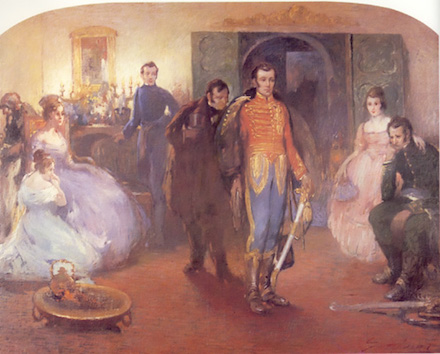
The Carrera Family, by Arturo Gordon Vargas (early 20th c.) features patriarch Ignacio, who was part of Chile’s first independent junta, along with Jose Miguel, flanked by brooding brothers Juan Jose and Luis, as well as their sister Javiera Carrera, the “Mother of Chile” and creator of the Chilean flag.
Said Jose Miguel had established a dictatorship in 1811-1812, with his brothers as trusted lieutenants. But Chile’s initial flower of independence from 1810-1814 was crushed by Spanish reconquest thanks in part to a deadly rift that had opened between the Carreras and fellow independentista Bernardo O’Higgins: prior to the decisive loss to the Spanish, Luis Carrera and O’Higgins had fought a literal battle with one another. They patched things up well enough to fight the Spanish together a few weeks later, but once in exile in Mendoza, Argentina, after their defeat they hurled recriminations at one another for the outcome. Luis even killed O’Higgins’s aide Juan Mackenna in a duel.
In the fullness of time it was the destiny of O’Higgins to be the father of a (permanently) independent Chile … and the destiny of the Carreras to be antagonists he overcame to do it.
O’Higgins attained leadership of the independence movement from exile and after elevated himself to dictator of free Chile in 1817. The Carreras promptly began scheming against him lead in old times, resulting in the arrest of Luis and Juan Jose in Mendoza. They were executed there hours after word reached the city that the Chilean patriot army had finished off the royalists.
On this date in 1525 the radical priest Hans Jakob Wehe was beheaded.
Wehe led a muster of 3,000 Bavarian peasants which briefly seized the town of Lepheim, during Germany’s bloody Peasants War, ere it was routed by the Swabian League.
On the 5th of April towards evening, they [Wehe and some other captives] were taken to a flowery meadow lying between Leipheim and Budesheim to be executed. As Master Jakob was led forward to the block, Truchsess turned to him with the words: “Sir paster, it had been well for thee and us hadst thou preached God’s word, as it beseemeth, and not rebellion.” “Noble sir,” answered the preacher, “ye do me wrong. I have not preached rebellion, but God’s word.” “I am otherwise informed,” observed Truchsess, as his chaplain stepped forward to receive the confession of the condemned man. Wehe turned to those around, stating that he had already confessed to his Maker and commended his soul to Him. To his fellow-sufferers he observed: “Be of good cheer, brethren, we shall yet meet each other to-day in Paradise, for when our eyes seem to close, they are really first opening.” After having prayed aloud, concluding with the words: “Father, forgive them, for they know not what they do,” he laid himself on the block, and in another moment his head fell in the long grass.
The preacher of Günzburg, who had also taken part in the movement, and an old soldier of fortune, who had joined the rebels, were brought forward in their turn to submit to the same fate, when the old soldier, turning to Truchsess, observed: “Doth it not seem to thee a little late in the day, noble lord, for one to lose one’s head?” This humorous observation saved the lives of himself and the preacher. The latter was carried about with the troops in a cage, until he had bought his freedom with eighty gulden. He lost, however, the right of preaching and of riding on horseback!
Having been elevated to the shadow of the throne by one sibling, Thomas Seymour on this date in 1549 was seen to the block by another sibling.
The brother of Henry VIII’s favorite queen, Jane Seymour, our Thomas was when that burly king kicked the bucket beautifully positioned for a share of power, being named to the regency council that would govern for his nephew, nine-year-old heir Edward VI.
His vaunting ambitions were blocked by the oldest ogre of all, big brother: Edward Seymour, Duke of Somerset, who surpassed our Thomas in ability and seniority alike, was the man who rose to the top of the regency and as Lord Protector exercised sovereignty in the child-king’s name. “As the Duke was elder in Years, so was he more staid in Behaviour,” one history has it, observing that Thomas Seymour “was fierce in Courage, courtly in Fashion, in Personage stately, in Voice magnificent, but somewhat empty of Matter.”
Courageous, empty Thomas — whom we shall call Sudeley for the sake of his barony* and our clarity — took a more generous estimate of his own talents and the boys soon festered a sibling rivalry of uncommon consequence. Our man connived to attract the favor of young Edward, inveigling and cajoling him to exercise his kingly prerogatives to lever Somerset out and Sudeley in. This campaign found little traction among fellow regents and finally came to the desperate strait of Sudeley skulking on the grounds of Hampton Court Palace one night in January 1549 in a possible adventure to kidnap the king. Instead, it landed him in the Tower with treason charges pending after he gave away the game by shooting one of the king’s barking dogs. It would afterwards emerge that he had conspired with a corrupted official of the mint to coin him a sum sufficient to furnish the rebellious army he had allegedly already begun recruiting.
King Edward wasn’t the only underage royal to labor under Sudeley’s excessive attentions.
This chancer had married the former queen, Catherine Parr, and in early 1548 they had the young princess Elizabeth — Anne Boleyn‘s daughter, the future queen, who was here all of 14 years old** — living with them at Chelsea. Pushing 40, the cocksure Sudeley got far too friendly with Elizabeth, repeatedly entering her chambers early in the morning despite the reprimands of Elizabeth’s governess and playing a lot of slap and tickle. It’s ambiguous just how far this frolic went and what Elizabeth thought about it but despite Catherine Parr’s occasional participation in such romps(!) Sudeley did eventually cross his wife’s boundary for good, giving, and game. As that governess explained,
the Admiral [Sudeley] had loved the Princess but too well, and had so done for a long while … [until] the Queen [Catherine Parr], suspecting too often access of the Admiral to the lady Elizabeth’s Grace, came suddenly upon them, when they were all alone (he having her in his arms). Whereupon the Queen fell out both with the Lord Admiral and with her Grace also … And this was not long before they parted asunder their families [households].
By the time Sudeley fell, he had resumed his suit of Elizabeth, Catherine Parr having died late in 1548 from childbirth — or, as was rumored, poison. It wasn’t merely that Sudeley was on the perv; he had married Catherine Parr secretly, against the will of the council, and that he now intended the princess should succeed the queen in his bed augured a seditious intent. The regents found out about it and swiped left, and their cockblock might have been the spur for Sudeley’s desperate attempt to grab the king’s own person; certainly his efforts to wed the princess featured among the many charges laid by the bill of attainder that claimed Sudeley’s head.
Her stalker’s attentions also put Elizabeth under close questioning and had she not the sangfroid to deny resolutely any part in the man’s schemes her history, and ours, might have gone very differently. It’s not the last time that Elizabeth proved her mettle under interrogation.
As for Thomas Seymour himself, a delicate proceedings unfolded in the winter of 1549 with the Lord Protector and the King ultimately both assenting to a fatal prosecution of their kinsman, and perhaps also to a convenient magnification of his faults. For example, it was said that he went scheming literally all the way to the block, having prepared secret revengeful letters for posthumous delivery intended to set the princesses Mary and Elizabeth against his brother; this detail would lead Hugh Latimer to preach about the Lord Admiral — “a covetous man … an ambitious man … a seditious man, a contemner of common prayer”:
As touching the kind of his death, whether he be saved or no, I refer that to God only. What God can do, I can tell. I will not deny, but that he may in the twinkling of an eye save a man, and turn his heart. What he did, I cannot tell. And when a man hath two strokes with an axe, who can tell but that between two strokes he doth repent? It is very hard to judge. Well, I will not go so nigh to work; but this I will say, if they ask me what I think of his death, that he died very dangerously, irksomely, horribly.
Edward Seymour himself set his own hand to his brother’s death warrant in concert with the rest of the regency council. In a fine case study for parents who might wish to impress quarreling children with their interest in finding common purpose, Edward met the same fate inside of three years.
As for the savvy young Elizabeth, this early brush with reckless sexuality, political intrigue, and the perpetual proximity of the headsman’s axe, was perhaps an instructive event that would help to see her to her own glory. Her would-be lover had admirable qualities but she perceived well enough how they weighed as compared to his incontinence, and she quipped the definitive epitaph upon receiving news of his destruction: “This day died a man of much wit and very little judgement.”
* Sudeley Castle still stands today, and is open to tourists.
** Also crashing at the maison Sudeley in 1548: Lady Jane Grey. One of Sudeley’s numerous vain machinations was to orchestrate a Jane Grey-Edward VI marriage.
On this date in 1766, Irish priest Nicholas Sheehy was hanged, drawn, and quartered in Clonmel — a victim to the years-long campaign of enclosures by Ireland’s landlords, whom English agriculturist Arthur Young reported as “harpies who squeezed out the very vitals of the people and by process, extortion, and sequestration dragged from them the little which the landlord had left them.”
Sheehy was a sympathizer of the peasant “Whiteboys” resistance movement, so named for the snowy frocks these secret guerrillas donned when out on midnight raids to strike back against the owners where tenants’ livelihoods were at stake. Where landlords enclosed public grounds, Whiteboys knocked down the fences; where they displaced peasant farmer with commercial livestock, Whiteboys hamstrung the cattle.
“It could not be expected,” wrote Margaret Anne Cusack, “that the Irish priest would see the people exposed to all this misery — and what to them was far more painful, to all this temptation to commit deadly sin — without making some effort in their behalf.”
Father Sheehy, parish priest of Clogheen, was one of these, and a villain in the eyes of Protestant elites for his denunciations of enclosure and his comforts to its more muscular foes.
He had interfered in the vain hope of protecting his unfortunate parishioners from injustice; and, in return, he was himself made the victim of injustice. He was accused of encouraging a French invasion — a fear which was always present to the minds of the rulers, as they could not but know that the Irish had every reason to seek for foreign aid to free them from domestic wrongs. He was accused of encouraging the Whiteboys, because, while he denounced their crimes, he accused those who had driven them to these crimes as the real culprits. He was accused of treason, and a reward of £300 was offered for his apprehension. Conscious of his innocence, he gave himself up at once to justice, though he might easily have fled the country. He was tried in Dublin and acquitted. But his persecutors were not satisfied.
A charge of murder was got up against him; and although the body of the man [John Bridge, a former Whiteboy turned informer -ed.] could never be found, although it was sworn that he had left the country, although an alibi was proved for the priest, he was condemned and executed. A gentleman of property and position came forward at the trial to prove that Father Sheehy had slept in his house the very night on which he was accused of having committed the murder; but the moment he appeared in court, a clergyman who sat on the bench had him taken into custody, on pretence of having killed a corporal and a sergeant in a riot. The pretence answered the purpose …
At the place of execution, Father Sheehy most solemnly declared, on the word of a dying man, that he was not guilty either of murder or of treason; that he never had any intercourse, either directly or indirectly, with the French; and that he had never known of any such intercourse being practised by others.
Father Sheehy’s head wound up on a pike (it was said that the birds in reverence would not peck at it), and his name in the rich firmament of Irish martyr-patriots. He’s been occasionally proposed for canonization.
March 11, 222 marked the downfall of the Roman emperor Elagabalus (or Heliogabalus, in the Greek rendering).*
Notorious to posterity for lapping the field in outrageous sensuality, he was the 14-year-old cousin of the deposed brute Caracalla and stepped into the purple because his crafty grandma won the civil war that ensued Caracalla’s assassination.
By family heredity he was by that time already the high priest of the Syrian sun-god Elagabalus,** in the city of Emesa (present-day Homs, Syria). History has flattered the youth with the name of his novel god, although in life the former was simply Marcus Aurelius Antoninus. By any name, his eastern affectations would smell as foul to the Romans.
We’re forever constrained by the partiality of our few sources when it comes to antiquity and the possibility cannot be dismissed that the bizarre and alien portrait remaining us is mostly the outlandish caricature of his foes. However, such sources as we have unanimously characterize Elagabalus as — per Gibbon’s summary — “corrupted by his youth, his country, and his fortune” and it is this that has made his name a western metonym for for the sybaritic Oriental despot. (“I quote in elegiacs all the crimes of Heliogabalus,” patters the Modern Major-General of Gilbert & Sullivan canon.)
But in this they are not faithless to their sources. The ancient chroniclers practically compete for outlandish anecdotes of hedonism (the very dubious Historia Augusta) …
He would have perfumes from India burned without any coals in order that the fumes might fill his apartments. Even while a commoner he never made a journey with fewer than sixty wagons, though his grandmother Varia used to protest that he would squander all his substance; but after he became emperor he would take with him, it is said, as many as six hundred, asserting that the king of the Persians travelled with ten thousand camels and Nero with five hundred carriages. The reason for all these vehicles was the vast number of his procurers and bawds, harlots, catamites and lusty partners in depravity. In the public baths he always bathed with the women, and he even treated them himself with a depilatory ointment, which he applied also to his own beard, and shameful though it be to say it, in the same place where the women were treated and at the same hour. He shaved his minions’ groins, using the razor with his own hand — with which he would then shave his beard. He would strew gold and silver dust about a portico and then lament that he could not strew the dust of amber also; and he did this often when he proceeded on foot to his horse or his carriage, as they do today with golden sand.
Silius Messalla and Pomponius Bassus were condemned to death by the senate, on the charge of being displeased at what the emperor was doing. For he did not hesitate to write this charge against them even to the senate, calling them investigators of his life and censors of what went on in the palace. “The proofs of their plots I have not sent you,” he wrote, “because it would be useless to read them, as the men are already dead.”
Detail view (click for the full image) of The Roses of Heliogabalus, by Sir Lawrence Alma-Tadema (1888). The work alludes to one of the boy-emperor’s crimes of decadence recounted in the Historia Augusta: “In a banqueting-room with a reversible ceiling he once overwhelmed his parasites with violets and other flowers, so that some were actually smothered to death, being unable to crawl out to the top.”
Most scandalous to Romans, or at least most expedient for his foes’ vituperations, were the adolescent’s outrageous transgressions of masculinity — again, we must underscore, “alleged”. They’re clearly deployed by his enemies to magnify Elagabalus’s cultural easternness, and we might suspect them to also hint at the emasculating power of the teenager’s mother and grandmother who were the true chiefs of state (and who were outrageously admitted to the Senate). Yet if we are to believe the half of what we read of Elagabalus then this effeminate priest-king constitutes one of history’s most notable transgender or genderfluid figures.
When trying someone in court he really had more or less the appearance of a man, but everywhere else he showed affectations in his actions and in the quality of his voice. For instance, he used to dance, not only in the orchestra, but also, in a way, even while walking, performing sacrifices, receiving salutations, or delivering a speech. And finally, — to go back now to the story which I began, — he was bestowed in marriage and was termed wife, mistress, and queen. He worked with wool, sometimes wore a hair-net, and painted his eyes, daubing them with white lead and alkanet. Once, indeed, he shaved his chin and held a festival to mark the event; but after that he had the hairs plucked out, so as to look more like a woman. And he often reclined while receiving the salutations of the senators. The husband of this “woman” was Hierocles, a Carian slave, once the favourite of Gordius, from whom he had learned to drive a chariot. It was in this connexion that he won the emperor’s favour by a most remarkable chance. It seems that in a certain race Hierocles fell out of his chariot just opposite the seat of Sardanapalus, losing his helmet in his fall, and being still beardless and adorned with a crown of yellow hair, he attracted the attention of the emperor and was immediately rushed to the palace; and there by his nocturnal feats he captivated Sardanapalus more than ever and became exceedingly powerful. Indeed, he even had greater influence than the emperor himself, and it was thought a small thing that his mother, while still a slave, should be brought to Rome by soldiers and be numbered among the wives of ex-consuls. Certain other men, too, were frequently honoured by the emperor and became powerful, some because they had joined in his uprising and others because they committed adultery with him. For he wished to have the reputation of committing adultery, so that in this respect, too, he might imitate the most lewd women; and he would often allow himself to be caught in the very act, in consequence of which he used to be violently upbraided by his “husband” and beaten, so that he had black eyes. His affection for this “husband” was no light inclination, but an ardent and firmly fixed passion, so much so that he not only did not become vexed at any such harsh treatment, but on the contrary loved him the more for it and wished to make him Caesar in very fact; and he even threatened his grandmother when she opposed him in this matter, and he became at odds with the soldiers largely on this man’s account. This was one of the things that was destined to lead to his destruction.
Aurelius Zoticus, a native of Smyrna, whom they also called “Cook,” after his father’s trade, incurred the emperor’s thorough love and thorough hatred, and for the latter reason his life was saved. This Aurelius not only had a body that was beautiful all over, seeing that he was an athlete, but in particular he greatly surpassed all others in the size of his private parts. This fact was reported to the emperor by those who were on the look-out for such things, and the man was suddenly whisked away from the games and brought to Rome, accompanied by an immense escort, larger than Abgarus had had in the reign of Severus or Tiridates in that of Nero. He was appointed cubicularius before he had even been seen by the emperor, was honoured by the name of the latter’s grandfather, Avitus, was adorned with garlands as at a festival, and entered the palace lighted by the glare of many torches. Sardanapalus, on seeing him, sprang up with rhythmic movements, and then, when Aurelius addressed him with the usual salutation, “My Lord Emperor, Hail!” he bent his neck so as to assume a ravishing feminine pose, and turning his eyes upon him with a melting gaze, answered without any hesitation: “Call me not Lord, for I am a Lady.” Then Sardanapalus immediately joined him in the bath, and finding him when stripped to be equal to his reputation, burned with even greater lust, reclined on his breast, and took dinner, like some loved mistress, in his bosom. But Hierocles fearing that Zoticus would captivate the emperor more completely than he himself could, and that he might therefore suffer some terrible fate at his hands, as often happens in the case of rival lovers, caused the cup-bearers, who were well disposed toward him, to administer a drug that abated the other’s manly prowess. And so Zoticus, after a whole night of embarrassment, being unable to secure an erection, was deprived of all the honours that he had received, and was driven out of the palace, out of Rome, and later out of the rest of Italy; and this saved his life.
He carried his lewdness to such a point that he asked the physicians to contrive a woman’s vagina in his body by means of an incision, promising them large sums for doing so.
Some books about Elagabalus
The essential problem for Elagabalus was that regardless the precise reality of the behavior his sure cultural distance from Roman manners was also a cultural distance from Roman soldiers — the men whose power to arbitrate succession had placed him in the purple to begin with. The reader may hypothesize the direction of causality but Elagabalus’s historical reputation proves that he failed to bridge that distance.
The fickle Praetorian Guard soon harbored an accelerating preference for Elagabalus’s cousin and heir Severus Alexander, a moderate and respectable Roman youth. Elagabalus triggered his own downfall, and summary deaths meted out to his associates and hangers-on like the hated charioteer/lover Hierocles, with an ill-considered attempt to disinherit this emerging rival. For this narrative we turn to Herodian, a contemporary of events who has disdain for the emperor’s weird god and his “dancing and prancing” but is not nearly so colorful on the subject of his purported sexual depravity. (For Herodian, Elagabalus’s “mockery of human marriage” consists in taking and discarding several different wives, including a Vestal Virgin.)
the emperor undertook to strip Alexander of the honor of caesar, and the youth was no longer to be seen at public addresses or in public processions.
[11 or 12 March 222] But the soldiers called for Alexander and were angry because he had been removed from his imperial post. Heliogabalus circulated a rumor that Alexander was dying, to see how the praetorians would react to the news. When they did not see the youth, the praetorians were deeply grieved and enraged by the report; they refused to send the regular contingent of guards to the emperor and remained in the camp, demanding to see Alexander in the temple there.
Thoroughly frightened, Heliogabalus placed Alexander in the imperial litter, which was richly decorated with gold and precious gems, and set out with him for the praetorian camp. The guards opened the gates and, receiving them inside, brought the two youths to the temple in the camp.
They welcomed Alexander with enthusiastic cheers, but ignored the emperor. Fuming at this treatment, although he spent the night in the camp, Heliogabalus unleashed the fury of his wrath against the praetorians. He ordered the arrest and punishment of the guards who had cheered Alexander openly and enthusiastically, pretending that these were responsible for the revolt and uproar.
The praetorians were enraged by this order; since they had other reasons, also, for hating Heliogabalus, they wished now to rid themselves of so disgraceful an emperor, and believed, too, that they should rescue the praetorians under arrest. Considering the occasion ideal and the provocation just, they killed Heliogabalus and his mother [Julia] Soaemias (for she was in the camp as Augusta and as his mother), together with all his attendants who were seized in the camp and who seemed to be his associates and companions in evil.
They gave the bodies of Heliogabalus and Soaemias to those who wanted to drag them about and abuse them; when the bodies had been dragged throughout the city, the mutilated corpses were thrown into the public sewer which flows into the Tiber.
More detail on reprisals — not exactly dated — comes from Cassius Dio:
His mother, who embraced him and clung tightly to him, perished with him; their heads were cut off and their bodies, after being stripped naked, were first dragged all over the city, and then the mother’s body was cast aside somewhere or other, while his was thrown into the river.
With him perished, among others, Hierocles and the prefects; also Aurelius Eubulus, who was an Emesene by birth and had gone so far in lewdness and debauchery that his surrender had been demanded even by the populace before this. He had been in charge of the fiscus, and there was nothing that he did not confiscate. So now he was torn to pieces by the populace and the soldiers; and Fulvius, the city prefect, perished at the same time with him.
The History of Rome podcast covers Elagabalus in episode 104.
* As pertains the mandate of this here site Elagabalus’s death is far more a murder than an execution, while the actual and threatened executions surrounding this murder are not necessarily dated, and verge towards lynchings. But between them we have a patina of somewhat orchestrated state violence with a somewhat dependable calendar peg that will suffice for a worthy cheat.
** The deity Elagabalus was among several pagan forerunners of the later sun god Sol Invictus, whose cult in turn became eventually conflated with another strange Asian religion, Christianity. There is a reading (distinctly a minority one) of Elagabalus as Rome’s Akhenaten, an unsuccessful proto-monotheist traduced by the incumbent priests who defeated his before-his-time religious revolution.
† Cassius Dio was a senatorial historian which both positioned him to know the scandalous things he reported and problematically incentivized him to concoct scandalous things to report. In particular we should note that Elagabalus’s successor Severus Alexander was personally and politically tight with Cassius Dio and, the historian boasts, “honoured me in various ways, especially by appointing me to be consul for the second time, as his colleague, and taking upon himself personally the responsibility of meeting the expenditures of my office.” In reading Cassius Dio we read the party line of the post-Elagabalus regime.
On this date in 1291, Sa’ad al-Dawla, a Jewish physician become grand vizier, was put to summary death as his patron and protector Arghun Khan lay expiring on his deathbed.
The story has it that Sa’ad won the khan’s confidence by a successful medical consult, and then told the big guy all about the corruption of his courtiers.
This descendant of Genghis Khan* knew an able servant when he saw one and Sa’ad soon had charge of the empire’s finances — the latter not failing to exercise the patronage prerogatives of his office on behalf of his own kith and kin. For the khan, a Buddhist heir to steppe conquerors, he was an able man to make the caravans run on time and the treasuries burst with gold. The Muslim populace saw it a bit differently, as one Baghdad poet gibed:
The Jews of this our time a rank attain
To which the heavens might aspire in vain.
Their is dominion, wealth to them does cling,
To them belong both councillor and king.
O people, hear my words of counsel true
Turn Jew, for Heaven itself has turned a Jew!
We have seen many times in these pages that upstart administrators elevated by the caprice of the sovereign — Jews or otherwise — often risk an extremely perilous situation should their master predecease them. Sa’ad had resentment in proportion to his power … and when the khan fell ill, the former redoubled while the latter vanished.
Expediently accused of poisoning the dying Arghun Khan, Sa’ad was seized in the royal camp and given over to summary execution/murder. (Less exalted Jews in Baghdad faced a less exalted riot.)
* Arghun Khan’s grandfather Hulagu Khan was Genghis Khan’s grandson. Hulagu Khan has been seen in these pages, for he conquered Baghdad and executed the last Abbasid caliph in 1258.


 The preeminent female cadre of her time,

 The brother of Henry VIII’s favorite queen,
  Notorious to posterity for lapping the field in outrageous sensuality, he was the 14-year-old cousin of the deposed brute