1645: John Hotham the Elder

On this date in 1645 — one day after the same fate befell his son — Sir John Hotham was beheaded by the English Parliamentarians for attempting to betray Hull to the Cavaliers in the English Civil War.

Part of the Daily Double: John Hothams.

On this day..

1645: John Hotham the Younger

On this date in 1645, John Hotham the Younger — former M.P., and (too) briefly an adherent of Parliament in the English Civil War, was beheaded as a traitor.

Part of the Daily Double: John Hothams.

On this day..

104 B.C.E.: Jugurtha

(Thanks to Daily Kos diarist “emperorhadrian” for licensing this guest post, originally published on that site June 24, 2007. -ed.)

The Jugurthine War was a key war in the final century of the Roman Republic.

Like the Americans in Iraq, Rome assumed that their war against Jugurtha, King of Numidia (a nation in north Africa), would be a cakewalk. They believed that Numidia was a nation of savages with a bizarre religion. They assumed that their own “shock and awe” attacks by the superior legions would decapitate and destroy the “evil doer” Jugurtha. They believed that in order to liberate the Numidians of their primitive ways, they had to impose the civilized will of the Roman state on this backward nation. Rome never expected that the Numidians would wage an insurgent war against their Roman occupiers. This war ended up dragging on for almost a decade. And in the end, it showed the depravity of the ruling party (the ultra-conservative republican Optimate party), which was sending the Roman Republic on its way to tyranny, empire and ruin.

In 148 BC, the King of Numidia, Masinissa, died. The Roman proconsul, Publius Cornelius Scipio Aemilianus, had been given authority by Masinissa to divide Masinissa’s estate. He divided it between Masinissa’s three sons, Micipsa, Gulussa, and Mastarnable. Soon after, Gulussa and Mastarnable died, leaving Micipsa as the sole King of Numidia. Around the year 134 BC, Micipsa sent Jugurtha (who was Masinissa’s grandson, but the son of another Numidian) to Spain with Scipio Aemilianius. Scipio was fighting the Celtiberians, who lived in a part of what is now Spain. Jugurtha was able to raise an army to help Scipio. Because of the valor of Jugurtha and his army at the Siege of Numantia, Scipio was able to win his war against the Celtiberians.

While fighting for Rome, Jugurtha worked alongside his future enemy, Gaius Marius. Jugurtha not only learned the superior Roman style of fighting, but he also learned of Rome’s weakness for money and thus bribery. Jugurtha described Rome as “urbem venalem et mature perituram, si emptorem invenerit” (“a city for sale and doomed to quick destruction, if it should ever find a buyer”). When Jugurtha returned to Numidia, Micipsa adopted Jugurtha, and decided to include Jugurtha in his will.

After the fall of Numantia, Jugurtha returned home with a letter from Scipio addressed to his uncle; in it, the commander praised Jugurtha’s exploits and congratulated Micipsa for having “a kinsman worthy of yourself, and of his grandfather Masinissa” (Sallust Iug. 9). On this recommendation the king formally adopted Jugurtha and made him co-heir with his own children

In 118, Micipsa died. He left his kingdom to Jugurtha and his two natural sons, Hiempsal and Adherbal. Shortly after Micipsa’s death, Jugurtha had Hiempsal killed. Adherbal fled to Rome. The Roman Senate sent a commission to Numidia to make peace. Jugurtha bribed the Romans on the commission, and thus the commission gave the better regions of the kingdom to Jugurtha.

In 113 BC, Jugurtha took his army and cornered Adherbal in his capital city of Citra. According to Sallust, Adherbal had the support of the people, but Jugurtha had the support of the best soldiers. A Roman Commission was sent to Numidia to forge a new peace. Jugurtha then bribed the Romans on this commission. The Romans thus allowed Jugurtha to storm Citra, and slaughter Adherbal and his supporters. Because Jugurtha slaughtered a number of Italian business people (including Roman Equites, or “Knights“), the Roman senate declared war on Jugurtha.

The Roman Senate sent an army under the command of the consul Lucius Calpurnius Bestia to fight Jugurtha. Bestia decisively defeated Jugurtha. But Jugurtha bribed Bestia, and thus was given unusually favorable terms. The Roman Senate viewed the favorable terms with suspicion, so it summoned Jugurtha to Rome. When Jugurtha arrived in Rome, he bribed two Tribunes, who thus prevented him from testifying. While in Rome, Jugurtha attempted to have his cousin and rival Massiva assassinated. Because of this, he was expelled from the city and returned to Numidia.

In 110 BC, the Roman Senate sent the praetor Aulus Postumus Albinus (who was the cousin of a consul for that year) to defeat Jugurtha. Because Jugurtha bribed key Romans involved in Albinus’ army (who then betrayed Albinus), Albinus was defeated.

The Roman Senate then sent the consul Quintus Caecilius Metellus to fight Jugurtha. At the Battle of the Muthul, a young Roman officer named Gaius Marius helped to reorganize Metellus’ legions, which then defeated Jugurtha. But Jugurtha was defeated because he forced his army to retreat before it could suffer heavy losses. The Romans did suffer their own heavy losses. Jugurtha disbanded his army, and had his soliders mount an insurgency to fight the Roman occupiers.

Marius returned to Rome. Dissatisfied with the slow pace of the war under Metellus, the Roman Military Assembly (one of the two Roman legislative assemblies, similar to the US Senate) appointed Marius consul (the Military Assembly, not the senate, appointed consuls). The Roman consuls had similar powers as the US President. The consulship was the highest constitutional office, and the consuls had imperium powers, which allowed them to command armies and conduct wars. The senate didn’t want Marius to be consul, because at this time it was dominated by an ultra-conservative republican party of aristocratic elites known as the Optimates. Marius belonged to the party that opposed the Optimates, the Populares. Partly because the senate didn’t like Marius, and partly because of the increasing difficulty Rome was having in recruiting armies, Marius was forced to raise his own army.

The capture of Jugurtha, from this French history of the Jugurthine War.

Marius took his army to Numidia to fight Jugurtha. But while Marius had been raising his army, Jugurtha allied with his father-in-law, Bocchus, the King of Mauretania. Marius defeated Jugurtha and Bocchus in several key battles. But much like with the American occupation in Iraq, Jugurtha’s strategy of insurgency warfare against the occupiers rendered all conventional victories irrelevant. Marius was playing a game of whack-a-mole. No matter how many times the Numidians were defeated, Jugurtha’s insurgents would regroup and keep fighting. It became clear that because of this, Rome could not defeat Jugurtha.

Marius sent his young Quaestor, Lucius Cornelius Sulla, to Bocchus. Sulla bribed Bocchus, and told him that Bocchus would be given a part of Numidia if he would betray Jugurtha. Bocchus then decided to give Jugurtha to Sulla. Sulla took Jugurtha to Rome, where Jugurtha was strangled in the Tullianum in Rome after marching in Marius’ January 1, 104 B.C. Triumph.


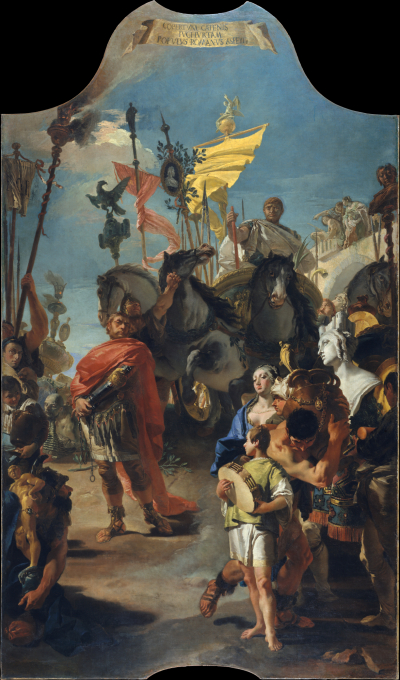
The Triumph of Marius (1729) by Giovanni Battista Tiepolo. The inscription in Latin reads “The Roman people behold Jugurtha laden with chains”.

The Jugurthine War was over. But in the process, several problems were exposed that would cause Rome serious pain in the future. Republicans in this country love to tell us that money in politics is harmless free speech. But as we saw in the Roman Republic during the Jugurthine War, money can be very corrupting. Rome almost lost the war because of money in politics, and the susceptibility of public officials to bribery.

In addition, this war saw the rise of two Romans who would play a key role in the events that directly preceded the fall of the Roman Republic. The first Roman made famous through this war was Gaius Marius. Gaius Marius would later hold the Roman Consulship an unconstitutional 7 times in 21 years (constitutionally, a Roman had to wait 10 years before being reelected consul).

The second Roman made famous through this war was Lucius Cornelius Sulla. Sulla and Marius would fight an unconstitutional civil war with each other several years after this war had ended. Sulla would illegally march his troops on Rome, and unconstitutionally legalize the mass killing of Marius’ supporters. Marius’ supporters in the senate would unconstitutionally prevent Sulla from fighting a war during one of Sulla’s consulships. Sulla would eventually seize absolute power for himself. Sulla would be the first Roman to be Dictator in almost 150 years. He would also be the first Roman in history to hold the dictatorship without the traditional six month term limit.

As dictator, Sulla would illegally change the Roman constitution to make himself and his party (the ultra-conservative republican Optimates) even more powerful. And most importantly, Sulla would set the example (of civil war on Romans, and then the seizing of absolute power) that the future tyrant Gaius Julius Caesar would follow.

In the end, the actions taken by key players in the war against Jugurtha would be repeated in the final destruction of the Roman Republic. The future triumvir Pompey would unconstitutionally hold multiple consulships in a short period of time. Crassus, another future triumvir, would illegally bribe politicians to get his way. And the future tyrant Julius Caesar would bribe, unconstitutionally hold the consulship, and become dictator for life (as Sulla had done). It was Caesar’s actions in this regard, as well as the similar actions of his adopted son and heir, Gaius Octavius (later Gaius Julius Caesar Octavianus, the Emperor Augustus) that would once and for all destroy the Roman Republic, and create the Roman Empire.

1. When when, and whenever death closes our eyelids,
2. Moving naked over Acheron
3. Upon the one raft, victor and conquered together,
4. Marius and Jugurtha together,
5. one tangle of shadows.

6. Caesar plots against India,
7. Tigris and Euphrates shall, from now on, flow at his bidding,
8. Tibet shall be full of Roman policemen,
9. And the Parthians shall get used to our statuary
10. and acquire a Roman religion;

11. One raft on the veiled flood of Acheron,
12. Marius and Jagurtha together.
13. Nor at my funeral either will there be any long trail,
14. bearing ancestral lares and images;
15. No trumpets filled with my emptiness,
16. Nor shall it be on an Atalic bed;
17. The perfumed cloths shall be absent.
18. A small plebeian procession.
19. Enough, enough and in plenty
20. There will be three books at my obsequies
21. Which I take, my not unworthy gift, to Persephone.

From Homage to Sextus Propertius, Canto VI by Ezra Pound

On this day..

1960: The assassins of Hazza Majali

On this date in 1960 — just two days after they had been sentenced — Saleh Safadi, Mohammed Hindawi, Lt. Husham Dabbas, and Karim Shaqra were hanged in Amman’s Hussein Mosque Square for assassinating Jordan’s prime minister earlier that year.

The marquee casualty of Jordan’s standoff against Nasserite Egypt, Hazza Majali might have just been a footnote to the story. According to King Hussein of Jordan: A Political Life,

[i]t may be that the bomb plot which cost Hazza Majali his life was also aimed at the King himself. The first bomb, which killed the prime minister, was followed by a second explosion at the scene less than forty minutes later. Had the King followed through on his initial intention to visit the bomb site, he might well have been caught in the second blast.

Though the bombings didn’t get King Hussein, they claimed 11 other lives besides Majali’s.

The assassins’ conspiracy traced back to neighboring Syria, which at that time was (briefly) unified with Egypt as the United Arab Republic. Syria and Jordan have found plenty of reasons to bicker over the years, and the former’s alliance here with Nasser‘s pan-Arabism added a pointed ideological critique of Jordan’s throwback Hashemite dynasty.*

Syria and the UAR were busily subverting U.S.-backed Jordan, and in this venture they enjoyed dangerously considerable popular support within Jordan; Majali in particular was “regarded by some Jordanians — and particularly Palestine refugees — as a virtual tool of the Western powers.” (New York Times, Aug. 30, 1960)

So it was a dangerous situation, and King Hussein did well to escape those years un-blown-up himself.

Several weeks of brinksmanship followed Majali’s assassination, with Jordanian troops massed on the Syrian border. Matters stopped short of outright war, but Nasser, Syria, and the UAR were all explicitly accused of this operation and others at the resulting trial of the assassins in December: the plot was supposed to have originated in Damascus, been paid for in Damascus, and used bombs shipped from Damascus.

Eleven in all were condemned to death, but seven of those sentences were given in absentia to suspects who had absconded to Nasser’s dominions.

* In response to the Egypt-Syria union, the kindred Hashemite rulers of Jordan and Iraq had formed the Arab Federation of Iraq and Jordan. That arrangement was even shorter-lived than the UAR, because the Iraqi Hashemites were almost immediately overthrown. You can get Jordan’s official take on those perilous years here.

On this day..

1942: Eleven members of the Red Orchestra

On this date in 1942, eleven members* of a Berlin-based anti-Nazi resistance circle were executed at Plotzensee Prison — five by hanging, six by guillotine.

These members of the group organized around leftist Luftwaffe communications officer Harro Schulze-Boysen and intellectual Arvid Harnack were one of three Soviet intelligence nodes all of whom were confusingly designated Die Rote Kapelle.

That designation, assigned by Nazi intelligence rather than the networks themselves, has basically stuck and colored their postwar reputation with the anti-Communist politics of the Cold War.


Red affiliations that blackened Die Rote Kapelle’s memory west of the Berlin wall were more readily embraced by the Warsaw Pact. This East German stamp also honors John Sieg, a member of the circle who committed suicide upon his arrest.

And not only in retrospect: according to Gerald Reitlinger, the capture of known lefties misbehaving became the occasion of a McCarthyesque freakout full of internal political score-settling among the Nazis.

The affair of Burgess and Maclean will give some idea what capital can be made when someone with a leftish record enters and betrays a position of trust. The emotions roused are out of all proportion to the things that have been betrayed. [German military intelligence chief Wilhelm] Canaris declared that the conspiracy had cost the lives of 200,000 German soldiers.

While the cells in France/Belgium and Switzerland also covered by the “Red Orchestra” designation look like straight NKVD espionage operations, the Berliners were apparently more of a loose network of civilian dissidents who got pulled into (amateurish) spying as a part of their variety of quixotic protests from the very citadel of the Third Reich. When not nicking sensitive documents from Schulze-Boysen’s day job and haplessly attempting to ship them to the Russians, they made futile White Rose-like gestures of conscience, like anti-Nazi placarding under the cover of darkness, and more calculated stuff, like collecting war crimes evidence in the hopes of indicting their perpetrators after the war.

Well, what is one supposed to do as an anti-Nazi in Berlin in 1941?

And what if one is in a position to answer that question with, “provide effectual aid to the enormous army poised to destroy Hitler”?

Anne Nelson’s Red Orchestra: The Story of the Berlin Underground and the Circle of Friends Who Resisted Hitler (review | another) attempts to rehabilitate the Berlin circle from postwar red-smearing and underscore the everyday-ness of the participants (not all of them politically left) and the courage of their respective decisions to oppose Hitler actively.

Nelson’s book is new, but her argument is not unique.

Other books also titled Red Orchestra (Perrault, Tarrant | review of both) more strongly emphasize the commie-taskmaster dimension in what by any standard is thrilling real-life fare.

The German Resistance Memorial Center has salutes to the Red Orchestra’s members, networks and activities.

* Arvid Harnack’s American wife Mildred, initially condemned only to a prison term for her part in the Orchestra, had her sentence upgraded and followed her comrades’ fate on February 16, 1942.

On this day..

1520: Hemming Gadh

On this date in 1520, Hemming Gadh was beheaded at Raseborg Castle, Finland for his support of Swedish independence from Denmark.

Gadh (English Wikipedia entry | Swedish | free Swedish biography), around 70 by this time, had had a colorful, opportunistic career in Swedish politics. And religion: he was once temporarily Bishop of Linkoping, but could not win papal approval for the post and got excommunicated a few years later.

A Gadh-fly to the Danish-run Kalmar Union, he was a longtime supporter of Swedish independence agitator Sten Sture the Elder — so much so that when Sten kicked the bucket in 1503, it was Gadh who spiked the story and sent a squire disguised as the late statesman running off to Stockholm to rally his successors before the opposition could capitalize on the situation. (Sweden: The Nation’s History, by Franklin D. Scott)

Gadh was a key figure holding the Swedish party together in a decade-long interregnum until Sten Sture the Younger was up to the task.

And young Sten’s arrival was just in time, because around 1518, Gadh got captured, went over to the Unionist party, and helped it capture Stockholm … precipitating an infamous bloodbath.

Danish King Christian II evidently didn’t trust this turncoat any further than he could throw him, however, which was quite a bit further when he was cut in two. The opportunism that had served Gadh so well for so long this time cost him his head. (Swedish link.)

When in Finland, you can still see the dramatic former island keep where it all went down:


Raseborg Castle (Finnish: Raaseporin linna, Swedish: Raseborgs slott) in Ekenas.

(More information here)

On this day..

1831: Gen. Jose Maria Torrijos y Uriarte and his liberal followers

On this date in 1831, one of the great Spanish liberal officers was shot along with dozens of comrades attempting to spark a revolution.

It was a dark time for Spanish liberals under the autocratic rule of Ferdinand VII.

Jose Maria Torrijos y Uriarte (Spanish Wikipedia page) was one of the heroes of that downtrodden cause from way back, a noble-born officer who had been made a captain at the precocious age of 13 and been around for all of Spanish liberalism’s greatest early 19th century tragedies.

He was in Madrid for the ill-fated uprising against its French occupiers in 1808, and was captured en route to aid Pedro Velarde‘s last stand.

Lucky for Torrijos, and luckier still: as a prisoner, he might have been in line for the ensuing mass execution, but an aide-de-camp of General Murat let him go in gratitude for chivalrously preserving a French officer from the Spanish mob.

A few years after the Peninsular War, with independent Spain yoked to a reactionary Bourbon-backed monarchy, Torrijos’ dangerous opinions made him a prisoner once more.

This time, he was liberated by the brief ascendancy of fellow-traveler Rafael del Riego. This effusion, too, was destined for grief upon the scaffold; once more, Torrijos escaped, this time to exile.


The execution of Rafael del Riego

Pushing forty and a bit emptyhanded for all his strivings, Torrijos’ restless soul was not satisfied knocking about the shores of England. He soon assembled a company of like-minded folk (such as Robert Boyd) to make another bid at liberating Iberia. But he was induced to put ashore under the misapprehension of support, and promptly rounded up.

The Malaga governor’s message to Madrid requesting instruction returned the simple order: shoot them all.* (Spanish link)


El fusilamiento de Torrijos y sus compañeros en la playa de Málaga, by Antonio Gisbert

“A la muerte de Torrijos y sus compañeros”
by José de Espronceda (from here (pdf))

Helos allí: junto a la mar bravía
cadáveres están ¡ay! los que fueron
honra del libre, y con su muerte dieron
almas al cielo, a España nombradía.

Ansia de patria y libertad henchía
sus nobles pechos que jamás temieron,
y las costas de Málaga los vieron
cual sol de gloria en desdichado día.

Españoles, llorad; mas vuestro llanto
lágrimas de dolor y sangre sean,
sangre que ahogue a siervos y opresores,

y los viles tiranos con espanto
siempre delante amenazando vean
alzarse sus espectros vengadores.


Monument to Torrijos at Malaga’s Plaza de la Merced.

* Around 50 or so were shot. The exact figure is differently accounted by various sources; I have been unable to determine if any among them are authoritative.

On this day..

1541: Thomas Culpeper and Francis Dereham, the Queen’s lovers

Indictment:

That Katharine, queen of England, formerly called Kath. Howerd, late of Lambyth, Surr., one of the daughters of lord Edmund Howard, before the marriage between the King and her, led an abominable, base, carnal, voluptuous, and vicious life, like a common harlot, with divers persons, as with Francis Derham of Lambeth and Hen. Manak [Manox] of Streteham, Surr., 20 and 24 May 32 Hen. VIII., and at other times, maintaining however the outward appearance of chastity and honesty. That she led the King by word and gesture to love her and (he believing her to be pure and chaste and free from other matrimonial yoke) arrogantly coupled herself with him in marriage. And the said Queen and Francis, being charged by divers of the King’s Council with their vicious life, could not deny it, but excused themselves by alleging that they were contracted to each other before the marriage with the King;* which contract at the time of the marriage they falsely and traitorously concealed** from the King, to the peril of the King and of his children to be begotten by her and the damage of the whole realm. And after the marriage, the said Queen and Francis, intending to renew their vicious life, 25 Aug. 33 Hen. VIII., at Pomfret, and at other times and places, practised that the said Francis should be retained in the Queen’s service; and the Queen, at Pomfret, 27 Aug. 33 Hen. VIII., did so retain the said Francis, and had him in notable favour above others, and, in her secret chamber and other suspect places, spoke with him and committed secret affairs to him both by word and writing, and for the fulfilling of their wicked and traitorous purpose, gave him divers gifts and sums of money on the 27 Aug. and at other times.

Also the said Queen, not satisfied with her vicious life aforesaid, on the 29 Aug. 33 Hen. VIII., at Pomfret, and at other times and places before and after, with Thos. Culpeper,† late of London, one of the gentlemen of the King’s privy chamber, falsely and traitorously held illicit meeting and conference to incite the said Culpeper to have carnal intercourse with her; and insinuated to him that she loved him above the King and all others. Similarly the said Culpeper incited the Queen. And the better and more secretly to pursue their carnal life they retained Jane lady Rochford, late wife of Sir Geo. Boleyn late lord Rochford, as a go-between to contrive meetings in the Queen’s stole chamber and other suspect places; and so the said Jane falsely and traitorously aided and abetted them.

On this date in 1541, Thomas Culpeper and Francis Dereham paid the penalty for their indiscretions; the former queen would see her lovers’ severed heads mounted on pikestaffs on London Bridge as she was rowed to the Tower.

The onetime court favorite Culpeper was beheaded for cuckolding the royal person, and that’s no more than one would expect. But the political pull-less Dereham — who had slept with (and possibly “pre-contracted” to wed) the willing young Kate before she meant anything to the king — enjoyed the full measure of the traitor’s torture: hanged, emasculated, eviscerated, and dismembered, all of it basically for having failed to anticipate that his little conquest would one day grow up to turn the monarch’s head.

What a time to be alive.

* Catherine Howard’s confessional letter to Henry VIII … desperately attempting to limit her indiscretions to the time before her marriage:

I, your Grace’s most sorrowful subject and most vile wretch in the world, not worthy to make any recommendation unto your most excellent Majesty, do only make my most humble submission and confession of my faults. And where no cause of mercy is given on my part, yet of your most accustomed mercy extended unto all other men undeserverd, most humbly on my hands and knees do desire one particle thereof to be extended unto me, although of all other creatures I am most unworthy either to be called your wife or subject.

My sorrow I can by no writing express, nevertheless I trust your most benign nature will have some respect unto my youth, my ignorance, my frailness, my humble confession of my faults, and plain declaration of the same, referring me wholly unto Your Grace’s pity and mercy. First, at the flattering and fair persuasions of Manox, being but a young girl, I suffered him a sundry times to handle and touch the secret parts of my body which neither became me with honesty to permit, nor him to require. Also, Francis Derehem by many persuasions procured me to his vicious purpose, and obtained first to lie upon my bed with his doublet and hose, and after within the bed, and finally he lay with me naked, and used me in such sort as a man doth his wife, many and sundry times, and our company ended almost a year before the King’s Magesty was married to my Lady Anne of Cleves and continued not past one quarter of a year, or a little above.

Now the whole truth being declared unto Your Majesty, I most humbly beseech you to consider the subtle persuasions of young men and the ignorance and frailness of young women. I was so desirous to be taken unto your Grace’s favor, and so blinded by with the desire of worldly glory that I could not, nor had grace to consider how great a fault it was to conceal my former faults from your Majesty, considering that I intended ever during my life to be faithful and true unto your Majesty ever after. Nevertheless, the sorrow of mine offenses was ever before mine eyes, considering the infinite goodness of your Majesty toward me from time to time ever increasing and not diminishing. Now, I refer the judgment of my offenses with my life and death wholly unto your most benign and merciful Grace, to be considered by no justice of your Majesty’s laws but only by your infinite goodness, pity, compassion and mercy, without which I acknowledge myself worthy of the most extreme punishment.

** Early the next year, parliament declared, “to avoid doubts in future” — read: “retroactively legislated” — that “an unchaste woman marrying the King shall be guilty of high treason.” This also made anyone who knew about said unchastity guilty of (at least) misprision of treason for failing to report it.

† Surviving letter from Howard to Culpeper:

Master Culpeper,

I heartily recommend me unto you, praying you to send me word how that you do. It was showed me that you was sick, the which thing troubled me very much till such time that I hear from you praying you to send me word how that you do, for I never longed so much for a thing as I do to see you and to speak with you, the which I trust shall be shortly now. That which doth comfortly me very much when I think of it, and when I think again that you shall depart from me again it makes my heart die to think what fortune I have that I cannot be always in your company. It my trust is always in you that you will be as you have promised me, and in that hope I trust upon still, praying you that you will come when my Lady Rochford is here for then I shall be best at leisure to be at your commandment, thanking you for that you have promised me to be so good unto that poor fellow my man which is one of the griefs that I do feel to depart from him for then I do know no one that I dare trust to send to you, and therefore I pray you take him to be with you that I may sometime hear from you one thing. I pray you to give me a horse for my man for I had much ado to get one and therefore I pray send me one by him and in so doing I am as I said afor, and thus I take my leave of you, trusting to see you shortly again and I would you was with me now that you might see what pain I take in writing to you.

Yours as long as life endures,
Katheryn.

One thing I had forgotten and that is to instruct my man to tarry here with me still for he says whatsomever you bid him he will do it.

Though this letter is far from conclusively inculpatory, Culpeper confessed that he “intended and meant to do ill with the queen and that in like wise the queen so minded to do with him.”

On this day..

1982: Suriname’s “December murders”

This was the date in 1982 of the “December murders” (“Decembermoorden”), when 15 opponents of Suriname’s military dictatorship were shot at Fort Zeelandia.

(The 15 people shot each have an entry on the Dutch Wikipedia, accessible through its Decembermoorden entry.)

Though the killings weren’t secret at the time, their circumstances have always been murky, beyond the plain fact of being murders of political dissidents — “counterrevolutionaries,” in the parlance of the “Socialist Republic”.

President Desi Bouterse had seized power in a coup in early 1980, and some of the casualties this day might have been suspected of plotting to pull the same trick on him: at least, several were made to read statements to that effect. Others were regime opponents of a less existential menace: dissident university professors; critical journalists; a prominent former footballer. (When in Paramaribo, take in a match at Andre Kamperveen Stadion, which is named for him.)

Bouterse took political responsibility for the slaughter while claiming not to have ordered it. But it’s long been said that Bouterse was actually present for the shootings, personally interviewing/interrogating/”judging” the prisoners. (That’s what the massacre’s lone survivor, the since-deceased Fred Derby, said. (Dutch link))

Decades later, Bouterse — now an ex-dictator — is finally facing trial for the December murders, including fresh evidence of his involvement in the day’s notorious affair.

On this day..

1549: Robert Kett, rebelling against enclosures

On this date in 1549, Robert Kett (sometimes “Ket” or “Kette”) was hanged over the side of Norwich Castle for an eponymous rebellion.

Reviews here and here.

Possibly England’s last medieval peasant rising, and possibly its first modern revolt, Kett’s Rebellion pitted the agrarian feudal commons against the proto-capitalist world taking shape.

A 15th century of relative prosperity for the English peasant had given way to a decades-long process (centuries-long, really) of enclosure.

Impelled by the profitable wool export business, landlords began “enclosing” formerly open arable land for pasture, thereby destroying the communal and quasi-communal agricultural models of the middle ages.

Karl Marx

For Marx, among many others, this revolution in agricultural production — and the attendant proletarianization of the former peasantry — marks the dawn of the capitalist epoch, when

great masses of men are suddenly and forcibly torn from their means of subsistence, and hurled as free and “unattached” proletarians on the labour-market. The expropriation of the agricultural producer, of the peasant, from the soil, is the basis of the whole process …

Although, therefore, the English land, after the Norman Conquest, was distributed in gigantic baronies, one of which often included some 900 of the old Anglo-Saxon lordships, it was bestrewn with small peasant properties, only here and there interspersed with great seignorial domains. Such conditions, together with the prosperity of the towns so characteristic of the 15th century, allowed of that wealth of the people which Chancellor Fortescue so eloquently paints in his “Laudes legum Angliae;” but it excluded the possibility of capitalistic wealth.

The prelude of the revolution that laid the foundation of the capitalist mode of production, was played in the last third of the 15th, and the first decade of the 16th century. A mass of free proletarians was hurled on the labour-market by the breaking-up of the bands of feudal retainers, who, as Sir James Steuart well says, “everywhere uselessly filled house and castle.” … In insolent conflict with king and parliament, the great feudal lords created an incomparably larger proletariat by the forcible driving of the peasantry from the land, to which the latter had the same feudal right as the lord himself, and by the usurpation of the common lands. The rapid rise of the Flemish wool manufactures, and the corresponding rise in the price of wool in England, gave the direct impulse to these evictions. The old nobility had been devoured by the great feudal wars. The new nobility was the child of its time, for which money was the power of all powers. Transformation of arable land into sheep-walks was, therefore, its cry … As Thornton rightly has it, the English working-class was precipitated without any transition from its golden into its iron age. (Capital, volume I, chapters 26–27)

It did not suffer its precipitation quietly.

Thomas More

Enclosures were a predominant social problem in England throughout the century, and if contemporaries could hardly descry the shape of the economic revolution taking shape, they worriedly noticed the poverty, the vagabondage, and the depopulated villages.

In Utopia, Thomas More upbraids a country where

your sheep, which are naturally mild, and easily kept in order, may be said now to devour men and unpeople, not only villages, but towns; for wherever it is found that the sheep of any soil yield a softer and richer wool than ordinary, there the nobility and gentry, and even those holy men, the abbots! not contented with the old rents which their farms yielded, nor thinking it enough that they, living at their ease, do no good to the public, resolve to do it hurt instead of good. They stop the course of agriculture, destroying houses and towns, reserving only the churches, and enclose grounds that they may lodge their sheep in them. As if forests and parks had swallowed up too little of the land, those worthy countrymen turn the best inhabited places into solitudes; for when an insatiable wretch, who is a plague to his country, resolves to enclose many thousand acres of ground, the owners, as well as tenants, are turned out of their possessions by trick or by main force, or, being wearied out by ill usage, they are forced to sell them; by which means those miserable people, both men and women, married and unmarried, old and young, with their poor but numerous families (since country business requires many hands), are all forced to change their seats, not knowing whither to go; and they must sell, almost for nothing, their household stuff

Commissions studied enclosure; edicts forbade and reversed them; commentators denounced them — all to no effect.

Robert Kett

Robert Kett, from a larger painting (click to see it) by Samuel Wale.

Henrician England had plenty of violent social transformation on its plate, of course, and plenty of violent tools to manage it. When the philandering tyrant kicked the bucket in 1547, he left the unfolding social catastrophe to the weakened protectorate government of his sickly nine-year-old heir.

In East Anglia in the summer of 1549, a peasant riot against an enclosure caught a spark. Unexpectedly, when the mob moved to throw down the enclosures put up by Robert Kett (another small landowner), he committed himself to the peasant cause and ably steered the rebellion for six heady weeks.

Kett was the man for his time and place: proving a natural leader, he marshaled the inchoate rage of his countrymen into an orderly, disciplined force.

Kett’s peasant army marched on Norwich, and stunningly captured England’s second city, thereupon petitioning the crown upon a variety of economic grievances (the petition is available on Wikipedia).

And Kett meant business, as this fiery (perhaps slightly fatalistic) oration suggests; he well knew that he had committed his own person to glory or destruction.

Now are ye overtopped and trodden down by gentlemen, and put out of possibility ever to recover foot. Rivers of riches ran into the coffers of your landlords, while you are pair’d to the quick, and fed upon pease and oats like beasts. You are fleeced by these landlords for their private benefit, and as well kept under by the public burdens of State wherein while the richer sort favour themselves, ye are gnawn to the very bones. You tyrannous masters often implead, arrest, and cast you into prison, so that they may the more terrify and torture you in your minds, and wind our necks more surely under their arms. And then they palliate these pillories with the fair pretence of law and authority! Fine workmen, I warrant you, are this law and authority, who can do their dealings so closely that men can only discover them for your undoing. Harmless counsels are fit for tame fools; for you who have already stirred there is no hope but in adventuring boldly.

Alas, like the enclosures themselves, the matter was to be resolved against the peasantry by main force. [bits and bobs on the daily progress of skirmishes and battles in this pdf] Though the rebels actually defeated the first force sent against them, they were decisively beaten at Dussindale on Aug. 27.

“We were promised ynoughe and more then ynoughe. But the more was an hawlter.”*

Promises of clemency induced the survivors to surrender peacably; though wholesale punitive bloodletting seems not to have been imposed, the leaders, of course, had to be made an example of.

Robert Kett and his brother, William, were convicted of treason and hanged.

Smoothly leveraging his dispatch in handling the rebellion, John Dudley, Duke of Northumberland, overturned the national political leadership of the Lord Protector the Duke of Somerset, who was accused of having triggered the rising with an excess of sympathy for the dispossessed peasant class. (Both Somerset and Northumberland would end up on the chopping block themselves.)

* Quote from a survivor of the rebellion, cited by Diarmaid MacCulloch in “Kett’s Rebellion in Context,” Past & Present, No. 84 (Aug., 1979).

On this day..