This is the feast date of early Christian martyr St. Euphemia.
Euphemia the “All-Praised” (that’s an Eastern construction; both east and west honor her martyrdom on September 16) died in the Asia Minor city of Chalcedon around 307. That would place her at the tail end of the Diocletianic persecutions, the part that actually came after said Diocletian retired to his cabbages and left the care and feeding of the eastern empire to Galerius.
Euphemia is said to have been the daughter of a senator, but went off and took vows of chastity and avoided sacrificing to Ares. Like many early martyrs, she is supposed to have survived various creative Roman execution attempts thanks to angelic protection, before the pagans just gave up and pitched her into the arena for the classic Christians-vs.-Lions showdown.
Euphemia would be credited with a supernatural intervention of her own a century and a half after her death.
The 451 Council of Chalcedon, meeting at a cathedral consecrated to St. Euphemia in her native city, featured orthodox Christianity attempting to bring to heel the “heresies” disputing the eminently disputable nature of Christ.
God + man? How does that work?
Monophysites, a substantial minority in the east at that time, took the position that Christ had only one single nature, rather than the view still mainstream to Christianity that Christ had both divine and human natures simultaneously. Among well-educated people sensitive to historicity, it’s the sign of a gross prejudice towards the secular and the modern to consider it absurd that humans spent decades at one another’s throats over this sort of hairsplitting, but seriously … humans spent decades at one another’s throats over this sort of hairsplitting.
But memo to Monophysites: do not get Saint Euphemia involved unless you’re ready for a faceful of hypostasis all up in your christology.
The story goes that at Chalcedon, two quarrelsome prelates representing the orthodox and Monophysite positions submitted the matter to the holy martyr’s adjudication by each leaving an apologia in her tomb. Three days of fasting and praying later, they opened the tomb and found the orthodox manifesto in Euphemia’s right hand, and the heretical manifesto at her feet. As the synod gloated to the (very orthodox) Pope Leo I,
it was God who worked, and the triumphant Euphemia who crowned the meeting as for a bridal, and who, taking our definition of the Faith as her own confession, presented it to her Bridegroom by our most religious Emperor and Christ-loving Empress, appeasing all the tumult of opponents and establishing our confession of the Truth as acceptable to Him, and with hand and tongue setting her seal to the votes of us all in proclamation thereof.
Euphemia’s relics today rest in Rovinj, Croatia, and are not available for settling metaphysical debates.
On this date in 1767, a jeering mob damning her to hell* saw Elizabeth Brownrigg hang at Tyburn.
“The long and excruciating torture in which this inhuman woman kept the innocent object of her remorseless cruelty, before she finished the long-premeditated murder,” says the Newgate Calendar, “more engaged the attention and roused the indignation of all ranks, than any criminal in the whole course of our melancholy narratives.” Hers is a very rich text.
As a middle-class midwife, Brownrigg mined the Foundling Hospital for young girls whom she would take on as apprentice domestic servants.
Brownrigg was far from the only one exploiting this ready pool of virtual slave labor, but it was her home’s marked sexualized sadism that really moved copy (pdf pamphlet). And Chateau Roissy it was not.
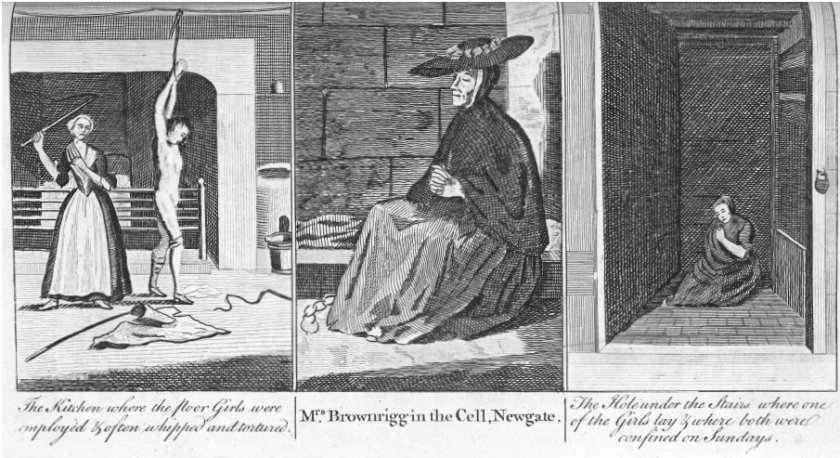
Elizabeth liked to keep the servants locked up, starving, usually naked, and would pinion their hands and inflict merciless corporal punishment for the least transgression against rules like “having any more bread”. The Old Bailey Online preserves one servant’s trial testimony:
Q. In what manner did she use to beat her?
M. Mitchel. She used to tie her up in the kitchen; when first she began to be at her, she used to tie her up to the water-pipe, with her two hands drawed up above her head.
Q. Describe that water-pipe.
M. Mitchel. That goes across the kitchen; the hooks that hold it are fastened into a beam.
Q. Had she used to have her clothes on when your mistress tied her up in this manner to beat her?
M. Mitchel. No, no clothes at all.
Q. How came that?
M. Mitchel. It was my mistress’s pleasure that she should take her clothes off.
Q. What had she used to beat her with?
M. Mitchel. She beat her most commonly with a horse-whip.
Q. How long did she use to beat her in this manner?
M. Mitchel. I cannot justly say, but she seldom left off till she had fetched blood.
This witness Mary Mitchel(l) was the lucky one of the Brownriggs’ last two Foundling Hospital charges: both girls had been stripped and horsewhipped so regularly that ulcerating, infectious sores — never able to heal before the next thrashing — pocked their bodies.
But Mary Mitchell at least survived. Her fellow-sufferer Mary Clifford was flat beaten to death, the body stuffed in the family coal-hole like so much rubbish. (In life, Mary Clifford was sometimes made to sleep there, too.)**
Detail view (click for a larger, three-panel image) of Elizabeth Brownrigg and her crimes illustrated in the Newgate Calendar.
For working-class Londoners struggling to navigate the dislocations of the Industrial Revolution, here was a villainess indeed. London was swelling, urbanizing, bustling with vulnerable orphans and abandoned children like our foundling Marys; all its working classes, for that matter, had reason to feel endangered in the face of fights for their lives against emerging commercial powers working hand in glove with the state — not excluding the ubiquitous threat of the gallows for pitiable property crimes.
And as Peter Linebaugh observes, “apprenticeship” by the 18th century “was less likely to involve the development of highly qualified, skilled labour power than to be the means of organizing the exploitation of young labour power.”† Like it’s not enough working your crappy dead-end unpaid internship; now, it comes with flogging?
Somehow, Brownrigg’s husband and son were convicted only of a misdemeanor and got off with a few months in prison, but Elizabeth bore all the hatred of Londoners more used to seeing apprentices swing than even the vilest master. The Murder Act which had appropriated even the corpses of London’s marginal people was applied to anatomize our former midwife; her skeletal remains were long displayed in a niche at the Royal College of Surgeons.
Oh, and the Foundling Hospital — which had cautioned the Brownriggs before about their excessive abuse of servants but not actually stopped sending them young girls to abuse — started finally instituting some oversight.
There’s a vicious and unsigned satire, “Elizabeth Brownrigge”, published in the September 1832 Fraser’s magazine. Over the years, it has occasioned a great deal of dispute among Thackeray scholars as to whether it might not have been an early creation of that master satirist’s pen. (Thackeray would have just turned 21 when it published.)
We’re not qualified to render judgment on the literary forensics, but the skewering of a murderess through the author’s mock-sympathy has a deliciously Thackerian flavor about it: the world was “incapable of understanding the height of her virtue.” It also underscores the continuing resonance of Elizabeth Brownrigg to Londoners 65 years after her execution.
The magnanimity of her soul, like Mr. Smeaton‘s pharos on the Eddystone, was firmly fixed upon the rock of the soundest principles, and diffused a light around it, for the guidance of those who were beating the waves upon the dark and troubled ocean of adversity, but was itself unshaken by the storm … [in prison] the fair and excellent Elizabeth adopted, as nearly as circumstances would allow, the same admirable disposition of her time to which she had been accustomed when inhabiting her own romantic bower in the village of Islington. She completed a large stock of baby-linen for the poor; she perused new publications of the day; and she composed an elaborate parallel between the characters of Socrates and Lady Jane Grey, after the manner of Plutarch. These are the two distinguished personages, in the whole range of authentic history, who in their strength of mind, purity of life, and extensive accomplishments, bore the strongest resemblance to herself; and to them, perchance, the attention of our heroine was more particularly directed in the quiet and retirement of her cell by the many points of similarity which subsisted between their destiny and her own.
Later, the fictional Elizabeth mounts a defense of such oblivious loathsomeness that it naturally impresses the judge:
“… punishment is a moral medicine. I may, perchance, actuated by too eager a desire for the rapid cure of my little and much-cherished patient, have dispensed my alternatives too liberally, and produced and untoward, an unexpected, and a most deeply-lamented consequence; but am I, therefore, to be condemned as guilty? In the analogous case of the physician, whose too-abundant anodynes may have lulled the sufferer to endless slumbers, or whose too copious phlebotomy may have let out the fever and the life at one and the same moment from the veins, would this most harsh and unmerciful measure be applied? … I demand from the justice of your lordship and a jury of my countrymen — as a matter not of mercy, but of right — the same impunity in my case which would be accorded, freely an unasked, under parallel circumstances, to the medical practitioner.”
Thackeray or whomever lay behind this pasquinade had a wider literary target in mind than simply Elizabeth Brownrigg(e)’s class. The short story is prefaced with a dedication to “the author of Eugene Aram“, meaning the popular novel published earlier in 1832 by Edward Bulwer-Lytton — a lifelong Thackeray bete noir. That novel concerned another renowned 18th century murderer, and it’s safe to say from the dedication that our satirist considered Bulwer-Lytton’s empathetic portrayal of the titular homicide a little, er, soft on crime.
I have been taught by Eugene Aram to mix vice and virtue up together in such an inextricable confusion as to render it impossible that any preference should be given to either, or that the one, indeed, should be at all distinguishable from the other … I had, indeed, in my dramatic piece, been guilty of an egregious and unpardonable error: I had attempted to excite the sympathies of the audience in favour of the murdered apprentices, but your novel has disabused me of so vulgar a prejudice, and, in my present version of her case, all the interest of the reader and all the pathetic powers of the author will be engaged on the side of the murderess.
* The Newgate Calendar: “On her way to the place of execution the people expressed their abhorrence of her crime in terms which, though not proper for the occasion, testified their astonishment that such a wretch could have existed: they even prayed for her damnation instead of her salvation: they doubted not but that ‘the devil would fetch her,’ and hoped that ‘she would go to hell.’ Such were the sentiments of the mob.”
† Conversely, rogues who took to the highway and became working-class heroes were very often men who had absconded from their apprenticeship — for instance, Jack Sheppard and Dick Turpin.
On either September 12 or (as we’re going with here) the early hours of September 13* in 1944, 30-year-old French spy Noor Inayat Khan (also known as Nora Baker, or by her code name Madeleine) was executed at Dachau for her activities on the behalf of the Resistance in Nazi-occupied France.
Noor, the first woman radio operator to be sent into France, came from a rather unusual background: her father was a Sufi religious leader descended from Indian royalty, and her mother an American from New Mexico.
Born in Russia, raised in England and France, Noor studied psychology and wrote poetry and a book of Buddhist-inspired short stories before the war intervened and her she and her family fled to England.
Although Noor had strong pacifist leanings, she decided to join in against Nazi Germany. Because she was fluent in French and English and was a good radio operator, they decided to send her to France. She went in June 1943.
Many of those who had trained her had grave doubts about her suitability as a spy. As part of her Sufi upbringing she had been taught that lying was the worst of all sins. Leo Marks, who taught her cryptography, later wrote his initial impressions of her in his book Between Silk and Cyanide:
She was cycling towards her ‘safe-house’ to practice transmitting when a policeman stopped her and asked what she was doing.
“I’m training to be an agent,” she said, “here’s my radio — want me to show it to you?” She then removed it from its hiding place and invited him to try it. […]
She’d been so startled by an unexpected pistol-shot that she’d gone into a Sufi-like trance for several hours, and finally emerged from it to consult a Bible.
Once in France, however, she displayed lion-like courage.
Even when the Nazis were making mass arrests of the French agents she associated with and the British forces offered to let her come home, she refused to desert her post.
After three and a half months she was betrayed, and pacifism notwithstanding she fought so furiously on arrest that her Nazi guards were afraid of her. In spite of considerable pressure (and we know what that means) she refused to provide them with any information about herself or her Resistance colleagues. On top of all that, she also made two escape attempts.
They decided to send her to Germany to better keep an eye on her.
After her death she was awarded with the French Croix De Guerre and the British George Cross, and made a Member of the Order of the British Empire. Shrabani Basu published her biography, Spy Princess, in 2007 … and there’s a memorial in the works for her for London’s Gordon Square.
Late this night* in 1628 was the fictional execution of The Three Musketeers antagonist Milady de Winter.
Milady de Winter, as the heroine of Agnes Maupre’s revisionist French graphic novel series (Author interview | Another (Both in French)).
This conniving minx bears the fleur-de-lis brand of a teenage crime upon her shoulder — a very naughty beauty-mark indeed — but becomes a secret agent of Cardinal Richelieu. (Richelieu is a point of friction for the Musketeers right from the start.)
This novel — which has long been in the public domain (Text at Gutenberg.org or ClassicReader.com | Free audio book at Librivox.org) — features Milady continually bedeviling the protagonist d’Artagnan. He loves her; she keeps trying to kill him. Pretty typical for these grim annals. (She also used to be Athos’s wife, years ago, until he tried to murder her. Long story.)
To skip to the end of things, Milady is portrayed as having orchestrated at Richelieu’s behest the (actual, historical) assassination of the Musketeers’ buddy the (actual, historical) Duke of Buckingham, which Milady accomplishes by seducing and manipulating his (actual, historical) assassin, John Felton. In reality, Felton was motivated by the stirring Republican sentiment that would soon generate a revolution; in Dumas, he’s a horny dupe who beholds his seductress escaping by sea even as he’s placed under arrest.
Buckingham was (actually, historically) murdered on August 23.
The fictional narrative picks up on August 25, when the escaped Milady writes to Cardinal Richelieu from the safety of Boulogne. Unbeknownst to her, her hours are numbered.
Milady proceeds the next morning to a convent in Bethune where she chances to encounter the mistress of her old foe d’Artagnan … and, by that night, to slay said mistress with poison just ahead of the arrival of the Musketeers.** But the Musketeers are able to track the escaping murderess down by the next evening. There, they subject her to a snap “trial”:
“We wish to judge you according to your crime,” said Athos; “you shall be free to defend yourself. Justify yourself if you can. M. d’Artagnan, it is for you to accuse her first.”
D’Artagnan advanced.
“Before God and before men,” said he, “I accuse this woman of having poisoned Constance Bonacieux, who died yesterday evening.”
He turned towards Porthos and Aramis.
“We bear witness to this,” said the two Musketeers, with one voice.
D’Artagnan continued: “Before God and before men, I accuse this woman of having attempted to poison me, in wine which she sent me from Villeroy, with a forged letter, as if that wine came from my friends. God preserved me, but a man named Brisemont died in my place.”
“We bear witness to this,” said Porthos and Aramis, in the same manner as before.
“Before God and before men, I accuse this woman of having urged me to the murder of the Baron de Wardes; but as no one else can attest the truth of this accusation, I attest it myself. I have done.” And d’Artagnan passed to the other side of the room with Porthos and Aramis.
“Your turn, my Lord,” said Athos.
The baron came forward.
“Before God and before men,” said he, “I accuse this woman of having caused the assassination of the Duke of Buckingham.”
“The Duke of Buckingham assassinated!” cried all present, with one voice.
“Yes,” said the baron, “assassinated. On receiving the warning letter you wrote to me, I had this woman arrested, and gave her in charge to a loyal servant. She corrupted this man; she placed the poniard in his hand; she made him kill the duke. And at this moment, perhaps, Felton is paying with his head for the crime of this fury!”
And so forth.
Then these obviously impartial judges judge her guilty, and have the executioner of Lille — whom they have thoughtfully procured in advance — chop off her head and dump her in a river.
“The executioner may kill, without being on that account an assassin,” said the man in the red cloak [i.e., the executioner himself], rapping upon his immense sword. “This is the last judge; that is all. Nachrichter, as say our neighbors, the Germans.”
Extrajudicial is as extrajudicial does. And in this case, Richelieu is just as happy to be rid of his duplicitous agent and, admiring the protagonist’s moxie, commissions d’Artagnan a lieutenant in the Musketeers. D’Artagnan is the fourth of the titular “three Musketeers”, so this denouement means that he’s finally made it … and he should stand by for duty in sequels continuing to mix-and-match Dumas’s fictional characters with actual, historical events.
Indeed, in the next volume of the series, Twenty Years After, it’s Milady’s vengeful son Mordaunt who acts as Charles I‘s executioner.
This date’s captivating femme fatale has appropriately been portrayed by a ravishing host of silver screen sirens including Lana Turner, Mylene Demongeot, Antonella Lualdi, Faye Dunaway, Rebecca de Mornay, Emmanuelle Beart, and (most recently as of this writing), Milla Jovovich.
* August 27-28, right around midnight. Dumas isn’t specific as to pre- or post-midnight.
** In the novel, it’s Madame de Chevreuse who has arranged this rendezvous of d’Artagnan with his lover — another actual, historical person whom we have met elsewhere in these pages.
You have heard of mother Nottingham, who for her time was pretty well skilled in casting of waters: and after her, Mother Bombye; and there is one Hatfield in Pepper-Alley, hee doth prettie well for a thing that’s lost. There’s another in Coleharbour, that’s skilled in the Planets. Mother Sturton in Goulden-lane, is Fore-speaking: Mother Phillips of the Banke-side is for the weaknesse of the backe: and then there’s a very reverent Matron on Clarkenwell-Green, good at many things: Mistris Mary on the Banke-side is for recting a Figure: and one (what doe you call her) in Westminster, that practiseth the Booke and the Key, and the Sive and the Shears: and all doe well, according to their talent. For myselfe, let he world speake.
This date marks the 400th anniversary of the Pendle witches‘ hanging — perhaps the most notorious witchcraft execution in English history.
Eight women and two men — Alizon Device, her brother James Device, and their mother Elizabeth Device of the Demdike family; Anne Whittle and her daughter Anne Redferne of the Chattox family; Jane Bulcock and her son John Bulcock; Alice Nutter; Katherine Hewitt; and Isabel Robey* — hanged together this date at Lancaster’s Gallows Hill after being tried over the preceding 48 hours; they, along with a woman named Jennet Preston hanged at York on July 29, comprise the Pendle Witches.
It’s an extraordinarily sad case.
The prosecution of the Pendle witches bubbled out of a witches’ brew of circumstances particular to early-17th century England. There was, to begin with, a new(ish) English king, James I and the guy had a major jones for hunting those early modern supernatural terrorists, witches.** The guy even wrote his own book, Daemonologie, to establish “that such divelish artes have bene and are … [and] what exact trial and severe punishment they merite.” A 1604 law had accordingly broadened the reach of the death penalty for supposed instances of sorcery.
Coming as this did in the aftermath of the Tudor Reformation, the nebulous concept of “witchcraft” was handy as well for clamping down on any excessively Catholic practices that might strike the right authorities as subversive, intransigent, or impious. Lancashire where we lay our scene was just such a Catholic-leaning zone.
Lancashire also had, as almost everywhere in the Isles, its share of “cunning folk” — workers of everyday folk magic whose widely tolerated practices could also be taken by a hostile viewer as Catholic superstition and/or hard-core infernal trafficking.
So, these are the brew’s ingredients. Add wool of bat and tongue of dog, stir vigorously … and serve with a length of hemp.
Curses
The Pendle witches brew started bubbling with a freak incident: a cunning woman named Alizon Device (you’ll recognize her name from the list of the hanged, above) tried to beg some needles from a passing peddler. The latter refusing her, Alizon cursed him, just like you do when you’re cut off in traffic.
Except in this case, the peddler promptly suffered a stroke.
Everyone was spooked at this apparent effusion of transmundane malevolence, nobody more so than Alizon herself. She became the first arrestee, and in the end would go the gallows convinced of her own sorcery.
She also started accusing others of occult involvement, either from a sense of panicked guilt or a blithe ignorance that the new legal regime would be interpreting folk spells as capital crimes. This led her bizarre instance of passing-peddler-popping to become a full-on witch hunt.
Alizon Device came from a whole family, the Demdykes or Demdikes, of cunning-women, and she implicated her own grandmother for having taught her the witchy ways. (Grandma would be spared the ignominy of hanging because she suffered the ignominy of dying in the filthy dungeon.) Alizon also accused a rival family, the Chattoxes, themselves well-known as “witches”, and she also implicated the matriarch of that family, Anne Whittle. The dreadful progress of the ensuing investigation, in which the feuding locals hanged each other with the aid of an ambitious local magistrate, is widely available — thanks to the record one lawyer witness to the proceedings set down in his credulous 1613 chapbook The Wonderfull Discoverie of Witches in the Countie of Lancaster.
Foiled Again
Once these initial arrests were in the books, Alizon’s mother Elizabeth apparently convened a solidarity meeting at a hut with the diabolically menacing name of Malkin† Tower. Dining on stolen mutton, and on Good Friday no less, they may have worked out a plan to liberate the prisoners from Lancaster Castle (at least, the Demdike prisoners). But the magistrate got wind of this confabulation and burst in to arrest those participants, too. As these secondary circles were pulled into the investigation, so too were past years of community gossip about these “witches”, of various folk who had died unexplained and various mishaps that befell people whom the witches didn’t like.
These superstitions seem to have been shared by the witches themselves, at least many of them. The Demdikes and Chattoxes used clay figures, human remains, and little effigies of victims with the intent of hurling evil at their enemies. Causality aside, Alizon Demdike did curse the peddler. “Witches think sometimes that they kill, when they do not, and are therefore as culpable, as if they did,” said their contemporary, pastor John Donne.
To augment the assorted confessions and counter-accusations among the accused, Elizabeth Device’s nine-year-old daughter Jennet Device (little sister of the original peddler-curser Alizon) was summoned up to provide coached testimony against her siblings Alizon and James, against her mother, and against those at the Malkin Tower meeting. Several of these latter would be convicted of non-capital crimes or even acquitted outright, but little Jennet’s testimony doomed her own family.
Although not the first time a child had provided evidence, it was a landmark in normalizing minors’ accusations — jurisprudence advocated by James’s Daemonologie. “Children, women and liars,” the sovereign announced, “can be witnesses over high treason against God.”
In later life, Jennet appears to have been caught up in the same trap, when she was accused of witchcraft by a 10-year-old boy. A judiciary grown more cautious by then did not put her to death … but she (unless it was a different person also named Jennet Device) died in prison.
And the acceptability of this sort of children’s testimony, duly documented for country JP’s in Michael Dalton’s Country Justice, containing the Practice, Duty, and Power of Justices of the Peace, would be the lethal linchpin of the witch trials 80 years later across the Atlantic — in Salem, Massachusetts.
This miserable event has informed any number of artistic productions from the 17th century stage to the present-day Pendle Sculpture Trail. Pendle and Lancashire, as bywords for witch superstitions, now trade handsomely on the unfortunate fame.
Many there have also pushed (thus far unsuccessfully) for an official posthumous pardon of the hanged witches.
And the nearby village of Roughlee even erected a statue in 2012 to the hanged Alice Nutter … a gentlewoman (i.e., of considerably higher class standing than her fellow condemned) whose reason for attending the Malkin Tower meeting remains mysterious.
* Isabel Robey is an outlier case; as of this writing, she’s not even named as one of the Pendle witches on the Wikipedia page as it seems she was not associated directly with the Malkin Tower crowd — merely a bystander who got caught up in the storm of denunciations. She was, however, hanged on Gallows Hill for witchcraft on August 20. There’s a lengthy attempt at reconstructing her story in the face of scant documentation here (pdf).
** All well and good for us moderns to pooh-pooh James’s supernatural obsessions, but the man’s security concerns were very real.
† The BBC documentary has Malkin as slang for “shit”; this page proposes that the word can signify a cat, a bindle, a scarecrow, or “an awkward woman.”
On this date in 1942, 39-year-old French/Ukrainian novelist Irene Nemirovsky was gassed at the Auschwitz Concentration Camp in Poland.
She was a victim of the Nazis’ racial laws: anyone with even one Jewish grandparent, even if they themselves did not practice the Jewish religion, could be considered a Jew. Nemirovsky, born to a wealthy Russian-Jewish family in what is now the Ukraine, had converted to Catholicism in 1939 — sincerely, insofar as anyone can discern.
Irene Nemirovsky fled Russian territory after the Bolshevik Revolution and spent a short time in exile in Finland and Sweden before eventually settling in France. There she married a banker, had two daughters, and published her first novel in 1930.
The book, called David Golder, was about a ruthless businessman (described by modern readers as “a Bernie Madoff of her time”) who in old age and poor health begins to regret the way he lived his life. It was a success and was made into a 1930 film.
Although she was widely acclaimed as a writer in France, even by anti-Semites, she was denied citizenship in 1938. By then she had lived in the country for twenty years.
Following the German invasion of France in 1940, Nemirovsky’s books were pulled off the presses and she was required to wear the yellow star. If she and her family had succeeded in obtaining French citizenship, this would have provided some protection; the French were reluctant to deport their own Jews, filling the cattle cars with foreigners instead. Irene was instead classified as a “stateless person of Jewish descent” and the high-ranking Nazi official Ernst Kaltenbrunner called her a “degenerate artist of deluded Jewish hegemony.”
The “stateless” Irene was arrested on July 13, 1942. She had time to write a letter to her family, asking them not to worry about her, before she was deported to Auschwitz four days later.
Although she survived the initial selection and was tattooed with a prisoner number, it was reported a month later that she had died of typhus, a common and deadly disease in the concentration camps. However, later investigation showed she had in fact been sent to the gas chamber. Her husband was also gassed in Auschwitz in November of that year, but their two children survived the war.
One of Nemirovsky’s books, All Our Worldly Goods, was posthumously published in France in 1947. However, for sixty years following the war this once-famous author was largely forgotten.
In 2004, however, she became a literary sensation when a previously undiscovered manuscript, Suite Francaise, hit the press. The “suite” consisted of two books out of a projected five, titled “Storm in June” and “Dolce”. Irene had written them while in hiding in 1940. When she was arrested she gave the manuscripts in a suitcase to her daughter Denise, who safeguarded them all those years.
The book was received to great acclaim and became a bestseller, and publishers blew the dust off her novels from the 1930s and brought them back into print. In 2007, another of Nemirovsky’s works, Fire in the Blood, was published. The book was a companion to Suite Francaise — and like Suite, Nemirovsky had worked on it while in hiding during the Nazi occupation.
Nemirovsky never escaped controversy, in her life or after her death. Several critics and scholars have accused her of being an anti-Semite, a “self-hating Jew,” as detailed in this article from the Australian publication The Age.
Novelist Paul LaFarge charged her as “a Jew who disliked other Jews.” Primo Levi‘s biographer wrote of her, “She has taken on board the idea that Jews belong to a different, less worthy ‘race’, and that their exterior signs are easily recognizable: frizzy hair, hooked noses, moist palms, swarthy complexions, thick black ringlets, crooked teeth…”
There is evidence to support this assertion.
Some of her books were serialized in anti-Semitic magazines, and during the occupation Irene also wrote a letter to Marshal Petain, head of France’s collaborationist Vichy government, to say she disliked Jews and shouldn’t be classified as a Jew, racial laws notwithstanding. Her husband wrote a similar letter to the German ambassador after her arrest, saying his wife “did not speak of the Jews with any affection whatsoever.” The ambassador never bothered to reply.
Irene, however, also has her defenders in this matter: “She didn’t dislike Jews,” said one. “She disliked some Jews. Big difference.” Patrick Marnham, who wrote the introduction to the reprinted David Golder, argued that, “Her choice of an unsympathetic Jewish character [in the book] does not make Nemirovsky anti-Semitic; any more than Robert Louis Stevenson was anti-Scottish because he created the diabolical figure of Ebenezer in Kidnapped.”
You could argue that if she appeared to be anti-Semitic it was because she was trying to conceal her own Jewish origins and thereby protect her family from the deadly consequences. Her daughters believed this was the reason for her assertions that she hated Jews.
In any case, whatever Irene may have said or thought about her religious origin did not save her life. She was just one of many thousands of Christian converts who fell victim to Nazi Germany’s madness.
Irene’s younger daughter, Elisabeth Gille, who died in 1996, wrote a novel titled Shadows of a Childhood which was based on her parents’ disappearance. She had only been five years old when Irene was arrested. In 2010, Olivier Philipponnat and Patrick Lienhardt published the first major biography of Irene, The Life of Irene Nemirovsky, 1903-1942.
On this date in Sing Sing Prison in New York, Italian-American Anna Antonio was electrocuted for murder.
She’d been convicted of hiring two hit men, Sam Ferraci and Vincent Saetta, to kill her husband Salvatore for his $5,000 in life insurance. The dirty deed was done at Easter in 1933: Salvatore’s body turned up beside a country road, full of holes. He’d been shot five times and stabbed fifteen times.
When Saetta and Ferraci were picked up, they implicated Anna. All three conspirators were convicted and sentenced to death. They spent sixteen months on death row, where Anna was the sole female inmate, attended by three matrons.
As chronicled in Geoffrey Abbott’s book Amazing Stories of Female Executions, Anna had been originally scheduled to die with Ferraci and Saetta at 11:00 p.m. on June 28. The executioner, Robert G. Elliott, arrived, set everything up and waited … and waited … and waited …
No one appeared.
It wasn’t until 1:15 a.m. that he was told to just go home: no one would die tonight.
Just ten minutes before eleven on that night, Saetta had had a talk with the prison warden, unburdened himself and signed an affidavit. He admitted he and Ferraci had killed Salvatore, but he said the motive was a $75 drug debt. He swore Anna had had no part in the crime.
In an earlier conversation with a prison clerk, Saetta had said he and his partner in crime had only said Anna was involved because they thought this would save their own lives: “They’ll never send me to the hot seat. Not while there’s a dame in the case. In New York they don’t like to send a woman to the chair and they can’t send me and not her.”
The governor, Herbert Henry Lehman, thought it prudent to issue a 24-hour stay for all three of the condemned in order to investigate this new evidence. Anna Antonio fainted with relief at hearing the news.
Twenty-four hours later, she was again facing the chair. Again, Executioner Elliott showed up at Sing Sing, and again he was turned away: the stay had been extended by a week.
At the end of the week, a further stay was granted; the state was still mulling over what to do.
Meanwhile, the suspense was, pun intended, killing Mrs. Antonio. Abbott records:
At that stage the state of the condemned women can hardly be imagined; suffice it to say that her wardresses reported their prisoner’s condition alternated between bouts of hysteria and collapsing into a semi-coma. Eventually the decision was issued that all executions would take place on 9 August and all hopes were dashed.
She had weighed 100 pounds on June 28, but in the interim she stopped eating and dropped fifteen pounds in six weeks: she was probably among the smallest people to ever sit in the electric chair.* At one point she cried in anguish, “I have already died enough for a million men!” The Crime Library provides a detailed account of her execution.
On the last day of her life (which, horribly enough, was also her daughter’s birthday), Anna told the prison warden she was innocent. She reminded the warden that her late husband had been a drug dealer and said if she had wanted him dead, she could have just killed him with one of the guns that were lying around the house.
She did, however, admit that prior to the murder, Ferraci and Saetta had told her they intended to kill Salvatore. She said she had chosen not to try to prevent it because she was afraid for herself and her three children. Anna didn’t particularly care much for Salvatore anyway; he was violent and abusive.
Anna spent the day of August 9 playing with her children. She may have been expecting yet another reprieve; when she was told the execution was definitely on this time, she seemed stunned.
When asked about a last meal, she said simply, “I want nothing.”
She walked calmly into the death chamber at 11:12 p.m. and was pronounced dead four minutes later. Ferraci came after her, and Saetta was last.
* Even 14-year-old George Stinney, who was too small for the electrocution mask, weighed in at 90 pounds.
On this date in 1852, a white woman and a black man — no connection between them — were hanged on an upward-jerking gallows in Poughkeepsie, New York.
31-year-old (though she looked 22, said smitten newsmen) Ann Hoag was a foundling who’d been raised by an adoptive family, then married a local farmer in a union that featured at least five children, financial loss, and a good deal of unhappiness. The sequence of causation among those mutually convivial characteristics is left for the reader’s imagination. Eventually — the New York Times (July 31, 1852) is most piquant on this — succumbing to the thrall of a younger lover, “the ill-starred woman plunged into misery and degradation, renounced virtue, reputation, husband, and children, until at last she murdered her husband” with arsenic and eloped with her paramour to Bridgeport.
Luckily for Ann, her brief summer of carnal liberty sufficed to quicken her belly, with the result that her delicate condition bought her a few extra months of life. On April 18, 1852, she gave birth to a baby daughter, and sealed her own fate.
A most interesting scene occurred in the separation of the child from the unhappy mother, which none but a mother’s heart can conceive. It appeared as if the last prop of life, the very cords of the heart were being severed, when, with the most endearing caresses, amid tears and sobs, the mother looked for the last time on that innocent babe, which since its birth had unconsciously shared her solitude and been her solace. As it passed forever from her sight, she exclaimed — “Now let them execute me — I have nothing to live for — one by one they have dragged my children from me.” (Albany Journal, Aug. 5, 1852)
Although the faithless wife left a 70-page statement implicating her lover William Somers, that gentleman was acquitted in October of 1852 on a charge of accessory to murder.
Jonas Williams, Ann Hoag’s partner upon the gallows, was much less the sighed-over. Williams committed a “fiendish outrage” upon his 11-year-old stepdaughter, killing her.
On this date in 1735, a truculent indentured servant with a name like a primetime drama was hanged in York, Maine (at that time part of the Massachusetts colony), for killing her master’s grandson.
Patience Boston had cut a hard-partying, hard-drinking swath from her teen years to her execution at age 23, leading a succession of masters to dump her contract on whomever would take it. Early American Crime tracks her rowdy career, “mad and furious in my Drink, speaking dreadful Words, and wishing bad Wishes to my self and others” through a succession of fights, adulteries, dead infants (which she didn’t kill), a nonexistent infant (which she claimed to have killed).
From some groundless Prejudice which I had taken against my Master, to whom I was sold by Mr. Bailey, I did last Fall bind my self by a wicked Oath that I would kill that Child, though I seem’d to love him, and he me; which is an Aggravation of my bloody Cruelty to him. Having solemnly sworn that I would be the Death of the Child, I was so far from repenting of it, that I thought I was obliged to fulfil it. And I often renewed my Resolution when I had been in Drink, and made my Master angry, that to be revenged on him, I might Murder his Grand-Child, of which I thought he was very fond, having bro’t him up from his Infancy. I would have killed my Master himself, if I could have done it; and had Thoughts of putting Poison into his Victuals, if I could have got any. But when the Time came for me to be left under the prevailing Power of Satan’s Temptations; I took the Opportunity of my Master and Mistress being from Home, and both his Sons also abroad; that the Child and I were left alone. The Evening before I had been contriving to burn the Barn, but was prevented: I had also once before drawn the Child into the Woods with me, designing to knock him on the Head, and got a great Stick for the same Purpose; but as I was going to lift it up, I fell a trembling, from a sense of God’s Eye upon me; so that I had not Power to strike. — But now, as I was going to say, when the Time was come to fill up the Measure of my Iniquity; I went to the Well and threw the Pole in, that I might have an Excuse to draw the Boy to the Well, which having done, I asked his Help to get up the Pole, that I might push him in, which having done, I took a longer Pole, and thrust him down under the Water, till he was drowned. When I saw he was dead, I lifted up my Hands with my Eyes towards Heaven, speaking after this Manner, Now am I guilty of Murder indeed; though formerly I accused my self falsly, yet now has God left me &c. And it seemed as if the Ground where I went was cursed for my sake, and I thought God would not suffer me to escape his righteous Vengeance. I went forthwith, and informed the Authority, and when the jury sat on the Body, I was ordered to touch it: This terrified me, lest the Blood should come forth, to be a Witness against me; and I then resolved in my Heart, that I would be a Witness against my self, and never deny my Guilt; so I tho’t God would not suffer the Child to bleed; then I laid my Hand on it’s Face, but no Blood appeared. Yet after this, I would fain have covered my Sin in Part, as if the Child had of himself fallen into the Well, and I was tempted to thrust him down under the Water. After the Jury had bro’t in wilful Murder, I was sent to Prison, but got Drunk by the Way, having little Sense of my dreadful Case; yet my Temptation in Part was to drink that I might forget my Sorrow.
Patience would need her namesake virtue, since she had the best part of a year to wait before the Supreme Court could gavel in a session to hear her case — a case where she would plead guilty and embrace the certain sentence.
In the meantime, we get to the real meat of the Moody pamphlet: our murderess’ conversion.
Allowing even for the interlocution of her reverend ministers, it presents a moving portrait of a genuine spiritual experience during the “Great Awakening” of religious revival. The narrative’s latter half tracks the doomed woman’s refinements of conscience, of fear, of religious comfort and joy in God — all as she grapples with her conduct and her fate.** “How are we condemned by the Covenant of Works,” Patience remarks, “and relieved by the Covenant of Grace.”
Now … as for this clan Moody that supplies our day’s post.
Samuel Moody, the father, had nudged young Joseph into the ministry business in York. Both men appear to have ministered to Patience Boston.
In 1738, the same time they were readying all this text about “rejoyc[ing], though with trembling” the younger Moody began a bizarre practice: he took to shrouding his face with a handkerchief.
In boring reality, this seems to have been occasioned by a breakdown caused by the sudden death of his wife in childbirth, a breakdown from which Moody recovered over the succeeding months.
In the much spicier legendary embellishment that developed, however, Moody was thought to have kept this veil for the balance of his life: he would present himself in this state, it is said, to his own congregation, turning his back on the multitude so that he could lift the veil to read a sermon, and likewise sitting face to corner when he should eat in public.
In this version, Moody is supposed to have confessed on his deathbed to having shrunk from men in his own spiritual torment over having accidentally killed a childhood friend while hunting, a killing that had been popularly ascribed to Indians and therefore unpunished save by the scourge of conscience. Nathaniel Hawthorne mined this irresistible New England folklore for his short story “The Minister’s Veil”.
“Tremble also at each other! Have men avoided me, and women shown no pity, and children screamed and fled, only for my black veil? What, but the mystery which it obscurely typifies, has made this piece of crape so awful? When the friend shows his inmost heart to his friend; the lover to his best beloved; when man does not vainly shrink from the eye of his Creator, loathsomely treasuring up the secret of his sin; then deem me a monster, for the symbol beneath which I have lived, and die! I look around me, and, lo! on every visage a Black Veil!”
-Hawthorne’s “Reverend Hooper”
* “It must be confessed,” the Moodies gamely preface their text, “that it could not be exactly taken in her own Way of expressing her self” so long after her death. But they gave it their best shot, and “here is nothing false or feigned.”
** The Faithful Narrative takes special note of the impression made on our subject by “the Case of the Prisoners at Boston, especially when the Day came for their Execution”. Although the text here refers to “three Malefactors”, there’s no 1734-1735 triple execution recorded in the Espy files; I believe the event intended here is the October 1734 double hanging of Matthew Cushing and John Ormsby.
Margaret might in principle be of interest to this site as the patroness of the falsely accused, and one of the saints who spoke to Joan of Arc, but her star has fallen quite a bit since its medieval heyday on the celestial all-star team; considering the doubtful historicity of this bog-standard Diocletian martyr, the Catholic Church has dropped some of her celebrations.
So instead we’ll turn to a namesake of Margaret’s — well, namesake once removed.
We don’t know the date or even the season in 1301 when the so-called False Margaret and her husband were executed for fraud and treason: he by beheading, and she by burning at the stake.
The pair had made an audacious grab for the Norwegian throne the previous year. The story was told in detail in a nineteenth-century Icelandic history.
The False Margaret (whose true name has been lost to history, as has that of her husband) claimed to be Princess Margaret, known as the Maid of Norway, who was supposed to have died a decade before. How she got the idea to do this is a mystery. It seems unlikely that she came up with the plan on her own, but if she didn’t, then who set her up?
The actual Maid of Norway was the daughter of Eric II of Norway and a mom also named Margaret, this Margaret the daughter of Alexander III of Scotland. Said couple’s marriage treaty specified that if Alexander died without sons, and his daughter had children by Eric, those children would succeed to the throne of Scotland.
This is precisely what happened: Alexander died in 1286 without a legitimate son to succeed him, leaving his kingdom to the three-year-old Norwegian princess.
Technically speaking, the Maid of Norway was Queen of Scots from 1286 until her death. But since she was never crowned and never set foot on Scottish soil, some lists of Scottish monarchs do not include her name. She remained in Norway for the next several years and a selected group of guardians tried to maintain control of the country for her.
On, for the laughter, harps he pressed,
The feast’s right royal quarter; —
But west the ship fared, ever west
With Eric’s little daughter
-From “King Haakon’s Banquet Hall”, by Henrik Ibsen (pdf link)
Eric set about arranging a marriage for his daughter, eventually settling on the future Edward II of England, who was then Prince of Wales. Margaret set off for Scotland in 1290, with the plan that the English wedding would be arranged once she arrived.
Alas, the Maid of Norway never saw Scotland.
In September or October of 1290, en route, she died suddenly somewhere in the vicinity of the Orkney Islands, which were then Norwegian territory. She was only seven years old.
Her death set off a crisis in Scotland as more than a dozen heirs competed for the vacant throne, and this eventually lead to the Wars of Scottish Independence.
But did little Margaret really die?
In 1300, a woman arrived in Bergen, Norway on a German ship, claiming to be the lost princess. She said she had not died but had in fact been “sold” by one of her female attendants and sent to Germany, and had married there. By this time, Eric II had died without male issue and his brother, Haakon V, had become King of Norway.
In spite of the fact that (a) the Maid of Norway’s body had been returned to Norway and was identified by her father and (b) the False Margaret appeared to be about 40 years old when the Maid would have been 17, the False Margaret’s claims drew considerable popular support.
Why? A theory was put forth by the 19th-century Scottish historian John Hill Burton:
The announcement of so portentous an event [meaning the Maid’s death], through indistinct rumors, naturally caused men to talk and doubt. There was none of the solemn detail that might be expected to attend on a royal death, even though less heavily laden with a perplexing future. We are not told of any who were present, of the disease or its progress, of the spot where she died, or the place where she was buried. The time of death is only inferred … The whole affair has left on Scandinavian history a shadow of doubt, in the possibility that the child might have been spirited away by some one of those so deeply interested in her disappearance, and consequently, that it may be an open question whether the royal line of the Alexanders really came to an end…
It should be emphasized that there is no evidence of any conspiracy surrounding the Maid’s death and no evidence of her survival past 1290. Her own father, who had no apparent reason to lie, viewed the body and identified it as his daughter.
But people will talk, and believe what they want, and so the False Margaret found support for her wild story.
Ironically, even if she had been the real Maid of Norway, the False Margaret was not a serious rival to her uncle Haakon; her sex would have prevented her from ruling. But, as the Norwegian historian Peter Andreas Munch noted,
Her pretensions … might, nevertheless, have been extremely distasteful to him, and probably not altogether free from danger in the future, if, as was not at all unlikely, they should be made use of by the party of nobles who were discontented with his absolute government. This party would willingly have thrust him from the throne … but before they could hope to do so they must have a pretender to the crown of the old royal stock to set up opposition to him. [ … ] And for this purpose there would have been none more suitable than Margaret, if she could be conjured from the dead again.
This woman had to be dealt with. There was no getting around it.
Since the False Margaret and her husband were not executed until 1301, a year after their arrival in Norway, it seems likely that there must have been some official investigation into her claims. If so, the records of this have been lost. What seditious nobles might have hoped to gain through her has likewise slipped into a speculative fog. But False Margaret was clearly a matter of highest statecraft at the time: the executions were delayed until King Haakon could personally come to Bergen to see them carried out.
Embarrassingly, the False Margaret’s cause did not die with her. Her supporters actually erected a church to our friend Saint Margaret near the place of her execution. (The church is no longer extant.)


 Noor, the first woman radio operator to be sent into France, came from a rather unusual background: her father was a Sufi religious leader descended from Indian royalty, and her mother an American from New Mexico.
 This miserable event has informed any number of
 Although she was widely acclaimed as a writer in France, even by anti-Semites, she was denied citizenship in 1938. By then she had lived in the country for twenty years.
 She’d been convicted of hiring two hit men, Sam Ferraci and Vincent Saetta, to kill her husband Salvatore for his $5,000 in life insurance. The dirty deed was done at Easter in 1933: Salvatore’s body turned up beside a country road, full of holes. He’d been shot five times and stabbed fifteen times.