1989: Carlos DeLuna, “I didn’t do it. But I know who did.”

On this date in 1989, with the last words “I want to say I hold no grudges,” Carlos DeLuna died by lethal injection in Texas

At the time, not many people took seriously DeLuna’s claim that a different Hispanic man named Carlos — one Carlos Hernandez — was the man who actually slashed Wanda Lopez to death in a Corpus Christi gas station on February 4, 1983.

“I didn’t do it. But I know who did.” That’s what he’d told a police officer soon after his arrest.

A generation later, it’s increasingly clear that Carlos DeLuna really didn’t do it … and that he knew who did it, knew he was going to the gurney for the crime of a man whom the state claimed was just a “phantom” invented by the defendant. Just a few months before DeLuna went to his death, that “phantom”, still on the streets, had knifed a four-inch gash in another woman’s abdomen. Carlos Hernandez had even bragged to others that his “stupid tocayo” — namesake — “took the blame for” a murder he’d committed. (Hernandez died in 1999.)

Carlos DeLuna might be the most convincingCameron Todd Willingham notwithstanding — instance of wrongful execution in America’s modern death penalty era.

DeLuna was arrested suspiciously hiding under a truck near the scene of a grisly knife slaying at a gas station. A Hispanic man had been reported as the suspect, and the eyewitness was able to identify DeLuna as that man, just moments after his arrest. Case closed.

Except everyone was wrong.

He was hiding because he’d been violating his parole by drinking at a strip club across the street. He chanced to look just like another Hispanic man from the area, a fellow who just happened to be a violent thug. And he didn’t have a spot of blood on him even though the murder scene looked like the set of a slasher film.

“It was an obscure case, the kind that could involve anybody,” Columbia Law Prof. James Liebman said. “Maybe those are the cases where miscarriages of justice happen, the routine everyday cases where nobody thinks enough about the victim, let alone the defendant.”

The facts of the case have been extensively documented elsewhere, including a 2006 Chicago Tribune series* and an entire 2012 issue of the Columbia University Human Rights Law Review, culmination of a years-long project organized by Liebman.

The latter investigation, complete with original source documents, video, and photographs, is preserved for public use at the magnificent Los Tocayos Carlos site. Its intensively-sourced book-length treatment comes highly recommended, but you might need to clear your schedule.

Executed Today is pleased to welcome one of the coauthors of Los Tocayos Carlos, Andrew Markquart — a 2012 graduate of Columbia Law who collaborated with Prof. Liebman on the DeLuna investigation and now practices in New York.

ET: How did you come to focus on this case, and what went into the investigation?

AM: I got involved after my first year at law school. I started out as a research assistant for Prof. Liebman, and he had been working on this project for years in one form or another when I got involved. I had already had quite a bit of interest in death penalty issues, so I jumped on it.

The initial investigation that Prof. Liebman did was back in 2004. He had done a previous study called “A Broken System” in which they found a shockingly high rate of reversals in capital cases. And basically the question that came out of that for him was, what does that mean?

Does that mean that the courts are doing their jobs and there are a lot of reversals because they’re being very diligent?

Or, is that high number indicative of some big systemic problems?

He started out looking at cases in Texas, for obvious reasons, and particularly focused on cases involving single eyewitnesses. This one came out fairly early on, but there wasn’t much about it initially to suggest this was a strong case. But Prof. Liebman was having someone going down to Corpus Christi anyway and had him check it out, and within one day this investigator was able to track down a lead and figure out exactly who this Carlos Hernandez person was who DeLuna claimed was the actual killer. From there the floodgates opened.

This case reads like something out of Dumas … your doppelganger, who looks just like you and also shares your name, commits a crime and you take the rap. Speaking as a layperson, it’s astonishing that Carlos DeLuna explicitly made the very argument you’re making, that this guy Carlos Hernandez was the real killer. But it wasn’t so much that DeLuna’s allegation was considered and rejected as that it was never taken seriously at all, even by his own defense. Why was that?

It’s a good question and it’s one of the major points we tried to make.

At first DeLuna was a little hesitant, with good reason: Hernandez was well-known in Corpus Christi; he was a terror in the town and had been known to use violence against people who threatened to expose him. Eventually the threat of execution overcame that.

His defense team did very little to research what could or would have been his saving argument, and on the flip side the prosecution said Carlos Hernandez didn’t even exist, which is just a mind-blowing claim. This guy had a rap sheet a mile long. He had been a major suspect in 1979 in another murder case involving one of the prosecutors in the DeLuna case.

The defense lawyer in that case did what DeLuna’s lawyer should have done: he called Carlos Hernandez to the stand and basically prosecuted Carlos Hernandez as his defense. He got his client off, and we’re pretty confident from our research that Hernandez was actually guilty of that murder, too.

Hernandez was definitely no “phantom”: he was known to law enforcement, known in the neighborhood. Can you explain why the prosecuting attorneys would make such a claim?

It’s hard to explain. I suspect they probably thought they had the right guy, they probably thought he was making up a bogus story … and they cut a few corners. But that’s speculation.

Your report writes, “Central to DeLuna’s obscurity was the failure of lawyers on the defense as well as the prosecution side to have the curiosity and gumption to look just an inch or two below the surface.” It seems like there just wasn’t much of any work done by any actor to pursue evidence that could defend DeLuna.

Carlos DeLuna’s defense lawyer had trouble getting any kind of funding to do investigation. And this was his first criminal case of any kind, let alone capital case.

The police only investigated for a couple of hours before turning it over to the store manager to clean up to open the next morning. It was a simple case of tunnel vision: they had arrested Carlos DeLuna, they got a quick eyewitness ID, and they thought they were done.

There’s all kinds of evidence at the scene. In the police photos, which are available at our website, there’s a footprint in blood that has to be the culprit’s shoeprint, and they never even saw it. It was that sloppy. You can also see the detective, Olivia Escobedo, literally standing on evidence — a nice metaphor for the investigation.

DeLuna’s lead prosecutor has recently reiterated his confidence in the verdict in the face of your investigation, and said that DeLuna lied about his activities that night. Did he?

Yes, he did. For reasons I can’t make sense of, he either was just severely misremembering, or just made up, some story about hanging out with these girls earlier in the evening that was completely untrue. But the thing about it is that the story as he gave it didn’t even help his case. It didn’t give him an alibi. But it hurt his case, because then they could bring in these girls to testify and destroy his credibility.

It’s hard to figure out what was in his head to say that. DeLuna wasn’t the most intelligent person; his IQ tested just barely above the threshold for cognitive impairment.

The original trial was in 1983, and Carlos was executed in 1989. How representative are the circumstances of this case still, relative to new death penalty trials today or to death row prisoners whose appeals are being handled now?

“[DeLuna]’s lying. He won’t admit it. I hope this is the day he gets it. He’ll lie like he’s been lying and now he’ll have to pay for what he did to my daughter.”
-Wanda Lopez’s mother Mary Vargas, quoted in Dec. 7, 1989 Dallas Morning News

“After carefully reviewing the information recently uncovered and printed by Steve Mills and Maurice Possley in the Chicago Tribune, I am convinced that Carlos DeLuna did not kill my sister and that Carlos Hernandez was the real murderer.”
-Wanda Lopez’s brother Richard Vargas, June 2006

You see these kind of cases and issues come up even today. That’s one point we try to make: yes, this case was from 29 years ago, but a lot of things remain the same.

There was no physical evidence, despite all the blood at the scene: it was just based on eyewitnesses.** And you kind of have a casebook bad eyewitness identification. They didn’t use a lineup; it was nighttime; it was a cross-racial identification, which we know are highly error-prone; he [DeLuna] was in the squad car, at the scene, handcuffed, under a highly stressful environment. You have these kinds of show-up identifications happen all the time, all over the country. They’re rife with error.

I know actually someone in the Texas legislature has introduced a bill to reform the eyewitness identification process.

And there’s a lot of good public defenders out there who really work hard and do good work, but also a lot of underexperienced and overburdened public defenders who are just being crushed. There’s always systemic pressure for cops and prosecutors to cut corners. I certainly don’t think the lessons of Carlos DeLuna’s case have been learned.

In your view, what are the most important of those lessons?

The fallibility of our criminal justice system. Carlos DeLuna wasn’t convicted and executed in some third world country — he was given a trial and a lawyer and appeals and all the other protections and yet he still slipped through the cracks.

And the other lesson is the widespread nature of the factors involved, like the unreliable eyewitness ID. People go to prison on that basis every day. It seems highly likely there are more Carlos DeLunas.

The way that we found this story and developed it was enormously labor-intensive. The number of man-hours that went into this, between authors, investigators, research assistants, and the whole staff of the Columbia Human Rights Law Review … you just can’t do this for every case where there’s some kind of colorable suggestion of the possibility of wrongful execution.

I’d be very surprised if there aren’t more like him.

* The Tribune series on DeLuna began on June 25, 2006 … the day before Supreme Court crank Antonin Scalia taunted in Kansas v. Marsh that there was “not one” case of a “clear” wrongful execution. “The innocent’s name would be shouted from the rooftops by the abolition lobby,” Scalia wrote.

** Eyewitness (mis)identification is also at the heart of the Ruben Cantu case, another suspected wrongful execution in Texas.

On this day..

1678: William Staley, “the prologue to the bloody tragedy”

David’s mildness managed it so well,
The bad found no occasion to rebel.
But when to sin our biassed nature leans,
The careful devil is still at hand with means, [80]
And providently pimps for ill desires;
The good old cause, revived, a plot requires.
Plots, true or false, are necessary things,
To raise up commonwealths, and ruin kings.

-John Dryden’s Absalom and Achitophel, a Biblical allegory of the English political/religious scene in which the Popish Plot (“plots, true or false”) took place

On this date in 1678, a Catholic goldsmith was hanged and quartered for treason … a preposterous case that would preview the tragic main acts of the “Popish Plot”.

This 17th century anti-Catholic witch hunt traced to weird and unprincipled Anglican divine Titus Oates.

With his friend Israel Tonge, Oates in 1678 ginned up a fantastical Jesuit plot against the life of Charles II — which supposed conspiracy played insidiously to the realm’s age-old religious divisions, in a moment when a Catholic royal sibling stood next in line to the throne.

Indeed, Oates’s “revelations” would trigger the Exclusion Crisis, an unsuccessful parliamentary bid to balk the heir presumptive James (eventually James II) of his throne. Parliament, argued Henry Capell, “must quiet the minds of the people, as to their fears of Popery and the Succession.”

In Queen Elizabeth’s time there were conspiracies against her, when Mary Queen of Scots was taken off. In King James’s time, the Gunpowder-Treason. In the last King’s time, a horrid Rebellion, that ended in his murder; but here the Crown is under such a character as is more dangerous than all those; and from Popery came the notion of a standing Army and arbitrary power.

Oh, and London had just burned down within everyone’s living memory, an event popularly ascribed to a French Catholic conspiracy even into the 19th century.

There was an awful lot of latent (and not-so-latent) anti-Popery around for Oates to stir up, and he proved to have a gift for this demagoguery. (pdf) In late 1678, a magistrate investigating Oates’s claims, Edmund Berry Godfrey, was mysteriously murdered, and all hell broke loose: a political assassination could now be hung on the alleged Catholic conspiracy. In short order, alleged Catholic conspirators would themselves hang for it.

It was a full 9/12 mentality: people going about armed, loyalty oaths, rumors of French invasion or Guy Fawkes tunneling.

Oates, when feeling his, would have the juice to put peers of the realm on the scaffold … so what chance did poor William Staley have?

This patsy, no great ornament of the “plot”, was more an incidental (and expedient) casualty of the swelling paranoia. Overheard at a tavern chatting about the Protestant freak-out, in French (quelle horreur!), a couple of unscrupulous eavesdroppers shopped for treason when they couldn’t blackmail him.

The sovereign was supposed to have been characterized in this chat as “a great Persecutor or Tormentor of the people of God … And ([Staley] stretching forth his Arm, and then clapping his Hand on his Breast), speaking of His Sacred Majesty, said, I my self will kill him.” (Source) Whether a frustrated Catholic into his cups incautiously popping off, an innocent naif set up by reprobates, or a case of lost in translation, it seems safe to say that William Staley was no danger to the monarchy.

Staley, at any rate, denied having said anything of the sort all the few hours that remained to draw breath, which wasn’t many. It was a mere 12 days from the “treasonable” conversation on Nov. 14 to Staley’s execution.


Image from William Faithorne‘s 1681 (misdated) engraving depicting William Staley being drawn to execution.

With this hanging, and another (that of Edward Coleman) a week later, the Popish Plot persecutions were into full swing … three years of Stuart England McCarthyism that would claim at least 15 lives and end with Titus Oates imprisoned, whipped, and pilloried.

After the Orange Revolution chased the Catholic monarch out of England, Oates was released and pensioned: the incident long remained an ideological litmus test between proto-Whigs (pro-Oates, as he was a club wielded against the absolutist aspirations of Charles II and James II) and Tories (anti-Oates, for the same reason). Centuries later, one commenter could still remark, “There are three events in our history that may be regarded as the touchstone of party men: an English whig who asserts the reality of the Popish plot, an Irish Catholic who denies the massacre of 1641, a Scotch Jacobite who maintains the innocence of Queen Mary, must be considered as men beyond the reach of argument or reason.”

On this day..

1600: The corpses of John and Alexander Ruthven, for the Gowrie conspiracy

Remember, remember, the fifth of … August?

If you didn’t get August 5 off, your jurisdiction is ignoring the Scottish parliament’s 1600 decree: “in all times and ages to come the fifth of August should be solemnly kept with prayers, preachings, and thanksgiving for the benefit, discharging all work, labour, and other occupations upon the said day.”*

They didn’t mean to keep it out of excess reverence for St. Emygdius: rather, August 5 was the date of the Gowrie conspiracy, a sketchy supposed assassination attempt on King James VI of Scotland (soon also to become King James I of England). John Ruthven, Earl of Gowrie and his brother Alexander Ruthven were both slain on the spot during that event … but not until 15 weeks later did Parliament rule that “the said bodies of the said Traitors shall be carried, upon Monday next [i.e., November 17], to the publick cross of Edinburgh: and there to be hangd, quarter’d, and drawn, in presence of the hail People: and thereafter, the heads, quarters, and carcasses, to be affix’d upon the most patent parts and places of the Burroughs of Edinburgh, Perth, Dundee and Stirling.”

Did they deserve it?

Scottish writer John Prebble considered the Gowrie conspiracy one of his realm’s best mysteries. It’s a maddeningly perplexing sequence of ambiguous (or altogether dubious) events related by interested, partisan sources.

I am murtherit!

The summary official version — and we’re skipping over such writerly red herrings as a mystery man in the turret, a still-stabled horse, and a wild fable about a pot of foreign gold — is that while staying at the Ruthven estates, James’s courtiers saw him shouting out the window, “I am murtherit! Treassoun! My Lord of Mar, help! help!”

While Lord Mar and others spent half an hour (!) trying to batter down a locked entrance to the regicidal turret, a page named John Ramsay found another staircase in, where he came upon the king and Alexander Ruthven grappling. Ramsay stabbed Ruthven about the head and neck, and Ruthven fled down Ramsay’s same staircase: there he careened headlong into more arriving royal retainers who killed him flat. Ruthven died exclaiming “Allace! I had na wyte [blame] of it!”

Meanwhile, the Lord Gowrie — quite possibly knowing nothing but that there was a commotion involving the king in his home — had rallied outside the courtyard with his own household and marched in swords drawn, passing the fresh-slain body of his little brother on the way. He must have been in an evil temper when he burst into the chamber, there to discover Ramsay and friends, and only them: the king had been locked in another room for his protection. Ramsay demanded Gowrie’s submission and the two crossed swords, with Ramsay running the elder Ruthven through, too.

(Small wonder Ramsay went on to become a royal favorite.**)

“… if it be true”

“A very wonderful story, your Majesty, if it be true,” one lord is supposed to have replied to James upon hearing this amazing tale.

Suspicion was immediately rife that this “treason” stuff was a cover for the king to take out a rival noble. The Ruthvens had often been at odds with King Jamie’s own family; John and Alexander’s own father was beheaded in 1584 for trying to kidnap the then-teenaged king, and their grandfather had helped a gang of nobles destabilize James’s mother Mary by murdering her favorite courtier David Rizzio right before her eyes. And of course, the crown would be able to seize all the “traitors'” estates, nicely flipping around a significant cash debt owed to the Ruthven clan.

Edinburgh Presbyterian ministers openly disputed the Ruthvens’ guilt, refusing to thank God for James’s “deliverance”.† James found it necessary to forcibly quash this talk, and he would insist upon the Ruthvens’ guilt all his days. But those outside the reach of Scottish royal power had looser tongues.

French nobles who had met Gowrie on the latter’s recent return from his continental studies, and Queen Elizabeth, who had received Gowrie warmly at court, openly doubted the official account: it was thought wildly at odds with the young man’s character. The nature of the interaction between the king and Alexander Ruthven prior to the intervention of John Ramsay depends upon the account of the king himself — that account, and no other. The other witnesses were dead. And the object of the plot seems unclear: sure, maybe Alexander Ruthven could have killed the king mano a mano, but then what? There was no indication at all of confederates (even Alexander’s brother reacted in confusion), nor coherent design for some next step like massacring James’s courtiers or toppling the government or even escaping. These were scheming aristocrats, not deranged lone assassins. And both James and Gowrie had behaved for all the world before this incident as if the unpleasantness with the father was water under the bridge.

“The assassination of the Gowries was the most indefensible act that has ever appeared on the pages of Scottish history,” avers mildy a 1912 volume of the Ruthven family papers. It was “a cunning conspiracy that has disgraced the historical record for more than three hundred years.”

The jury’s still out

Still, the hypothetical account of a royal anti-Gowrie conspiracy seems if anything even less satisfying than the official story. Most of the happenings besides what passed between Alexander and James were witnessed by others, so … the king falsely yelled “treason” counting on the handful of his guys staying in the Ruthvens’ own place to kill the Ruthvens instead of the other way around? Events played out so chaotically that this convenient outcome seems mere [mis]chance. What was the plan if John Ramsay hadn’t found the unlocked second entrance?

And yet some 350 witnesses were examined without turning up any concrete design, and three Ruthven retainers hanged on August 23 insisting upon their innocence of any treasonable intent.

One can go a lot of ways from here, and it’s hard to spin any one story that satisfyingly accounts for all the evidence. A scheme to kidnap (and extract policy change from) the king, rather than murder him? Alexander an unwilling pawn, forced into it by his brother? Or, as one English envoy supposed, a destructive spiral of events proceeding from a silly misunderstanding wherein a chance reference to the Ruthvens’ executed father led Alexander to defend the family a little too hotly and the king to start shouting in panic when he realized he was unarmed in the company of an excited, and much larger, man?‡

We’ll never really know. Light a candle for epistemological uncertainty next August 5.

Much help drawn from a two-parter review of the contradictory evidence in The Scottish Historical Review, nos. 121 and 122 (April and October 1957) by W.F. Arbuckle.

* August 5 was indeed “solemnly kept” during the reign of James, according to F.C. Eeles in “The English Thanksgiving Service for King James’ Delivery from the Gowrie Conspiracy” from the July 1911 Scottish Historical Review. As the title of that piece suggests, there was even a service promulgated (though never incorporated into the Book of Common Prayer), beseeching God that James “may bee kept as the apple of thine eye, and thy kindnesse and mercy may follow him all the dayes of his life, with abundance of all thy blessings both heavenly and earthly upon his Majesty, our gracious Queene, the Prince …”

The Prince in question was the future King Charles I, which might cause one to doubt the prayer’s efficacy.

** Ramsay would be supplanted in the royal sun come the 1620s, by George Villiers.

† Religion affords another potential motivation here, although perhaps only retrospectively. James was working a long-term project to reintroduce episcopacy — crown-appointed bishops — to control the loose canons of Scotch Presbyterianism. “No bishop, no king,” in the aphorism attributed him.

With the Gowrie plot as backdrop, James was able to force radical ministers and their tin-foil hats out of Edinburgh and obtain the consent of the rest to James’s own hand-picked bishops — the camel’s nose under the tent, if you like. (See Maurice Lee, Jr., “James VI and the Revival of Episcopacy in Scotland: 1596-1600,” Church History, 43 (1974).) The Ruthven family papers volume also sets great stock by the idea that a Catholic party was out to get Lord Gowrie.

‡ “by occasion of a picture (as is sayde) or otherwise, speech happening of Earle Gourie his father executed, the k. angrelie sayde he was a traitour. Whereat the youth showing a greived and expostulatorie countenance and happilie Scot-like woords, the k. seeing hymself alone and wythout weapon cryed, ‘Treason, Treason’. The Mr [i.e., Alexander Ruthven], abashed much to see the k. to apprehend yt so … putt his hand with earnest deprecations to staie the k. showing his countenance to them with out in that moode, immediatlie falling on his knees to entreat the k.” Ramsay did say that when he entered the room he saw Alexander’s head under James’s arm, which might be consistent with this supplicatory pose … especially given that accounts of the men’s respective physiques suggest Alexander should have had the clear advantage in an actual scrap.

On this day..

1865: George William Gordon, Jamaican politician

“No incident of the dreadful story” of Morant Bay, wrote Edward Underhill, “produced a more painful impression than the arrest, trial, and execution of Mr. G.W. Gordon” this date in 1865.

The son of a white planter and a mulatto slave, George William Gordon was an able businessman and became a Jamaican assemblyman.

In that capacity, he was a vocal critic of British colonial maladministration, an advocate for blacks, and a political foe of Jamaica’s governor, Edward John Eyre. He’d already had government commissions canceled because of his politics.

Gordon had nothing to do with the Morant Bay outbreak. He was away from the disturbance altogether, in Kingston, when it broke out.

But he was regarded by many white elites as a class enemy, and Eyre did not intend to miss this opportunity to eliminate him. A few years later, a French tribunal would express the rationale as it cracked down on the Paris Commune: guilty or no, “a prudent and wise Government must rid itself [of troublemakers] when it finds a legitimate occasion to do so.”

Accordingly, Gordon was arrested by civil authorities in Kingston — he actually turned himself in when he heard there was a warrant out on him — and then transferred into the hands of the drumhead military tribunals that were operating in the conflict zone, obviously with the intent of terminating a gadfly.

This extra-legal act is discussed in greater detail here, but the long and short of it was tartly summarized by no less than the sitting Lord Chief Justice:

[Kingston authorities] were not the ministers or apparitors of the martial authority, and did not possess the power to take up Mr. Gordon for the purpose of handing him over to the martial law. Nevertheless, they did it. They did it by the exercise of the strong hand of power, because it was thought that a conviction could not be got at Kingston. It was altogether unlawful and unjustifiable. To Mr. Gordon it made the difference of life or death.

Gordon, in his last letter to his wife, took it all in an understandably contemptuous stride:

General Nelson has just been kind enough to inform me that the court-martial on Saturday last has ordered me to be hung, and that the sentence is to be expected in a hour hence, so that I shall be gone from this world of sin and sorrow.

I regret that my worldly affairs are so derranged: but it cannot be helped … I never advised or took part in any insurrection. All I ever did was to recommend the people who complained to seek redress in a legitimate way … It is however the will of my heavenly Father that I should thus suffer in obeying His command, to relieve the poor and needy, and to protect, as far as I was able, the oppressed …

do not be ashamed of the death your poor husband will have suffered. The judges seemed against me; and from the rigid manner of the Court, I could not get in all the explanations I intended. … It seemed that I was to be sacrificed.

Much of what Governor Eyre did in those desperate days skirted, at best, the edges of what might be legally colorable. But at least those instances, in the main, were directed at people alleged to have been actual rebels or rioters. Eyre could safely expect wide latitude where the security of the realm was at stake.

In Gordon, however, there was a man whose crime was nothing other than to have sympathized with the real and crushing plight of the lower orders and advanced their cause politically. Eyre’s magistrates made that fact alone into sedition, and twisted the rules of their own courts-martial to pin it on Gordon.

Given the exceptionally lawless nature of this scenario — and Gordon’s own visibility as a colonial elite — his became the lightning-rod case for English liberals incensed at Eyre’s behavior. John Stuart Mill, Charles Darwin, Herbert Spencer, and others demanded Eyre’s prosecution for the affair, Thomas Huxley writing for the faction,

the killing of Mr. Gordon can only be defended on the ground that he was a bad and troublesome man; in short, that although he might not be guilty, it served him right.

I entertain so deeply-rooted an objection to this method of killing people — the act itself appears to me to be so frightful a precedent, that I desire to see it stigmatised by the highest authority as a crime.

It can hardly surprise the reader, versed as we are by this late date in official impunity, that not Eyre nor any lieutenant was ever thus stigmatised.

While Eyre evaded due punishment, Gordon could not escape the plaudits of posterity. He’s been honored as a Jamaican National Hero, and the very building where the present-day parliament sits is called the Gordon House in his honor.

On this day..

1865: Johnson Speed, arson bystander

The line between a snap military tribunal with a preordained outcome, a summary execution in the field, and simple murder blurs over in this affair where the word of any armed man in a British uniform had virtual color of law.

This account of one poor sod flogged within an inch of his life and then summarily shot when his captor soldiers took it into his heads that he might have had something to do with some fire comes from Illustrations of Martial Law in Jamaica: Compiled from the Report of the Royal Commissioners, and Other Blue Books Laid Before Parliament.


On [October] the 22nd four white soldiers were taken by Mr. Christopher Codrington to his house at Rose Garden, where they had dinner. When they returned in the evening to David Mayne’s shop, at Long Bay, two constables were there with two prisoners, James Sparkes and Johnson Speed.

They tied the former to a tree, and gave him 100 lashes.

They then tied up Johnson Speed, and gave him eighty-five lashes, when the cat broke.

One of the soldiers ran into the shop and brought a horsewhip, but another one interfered as it was not a thing to beat a man with. Another looker-on was here asked whether Johnson Speed had done anything during the disturbance, and he replied that when Mr. Hinchelwood’s house was burning Speed was there. Then the soldier said, “Where is my rifle?”

The man cried out, “Lord, I don’t do nothing, and I am going to dead.”

The soldier fired, but his rifle had no ball in it, or he had missed. He loaded the gun afresh, and hit the man in the middle of the back as he was tied to the tree. Another one went up, as he dropped writhing to the ground, and put a rifle to his ear and blew out his brains. These were soldiers of the 2nd Battalion of H. M. 6th Regiment of Foot. Mr. Christopher Codrington, a Justice of the Peace, was present.


The above is one of the very last accounts in a tome heavy with atrocities destined never to be punished in this world.

It seems apt both for the subject matter of this site and for laying bare the biases of the source to include the very last few paragraphs that follow.


David Burke was shot at Manchioneal. The soldiers ordered him to go before and point out rebels. “He was a big stout young man,” said a witness, ” and he walked quite lumber-like, and they said he was a rebel too, and shot him dead”.

Andrew Clarke was shot in his own house, at Manchioneal, under the following circumstances, as described by his widow :—

I was sitting with the baby, and I saw a black soldier, and he asked Andrew Clark, “Where are all the men’s goods you have ? Please bring them out.” Clarke said, “I have been sick three months, and I did not interfere.” The soldiers searched and found nothing. Then I was sitting down, and three soldiers came in, and a man named Saunders came in with them, and I explained that it was John Murray’s house, and the soldier dropped him, and he dropped on his side and bawled for mercy. The soldier told me, “Take yourself right out,” and I came out, and another soldier said, “Put another bullet into that fellow’s head,” and they blew out his brains. They burnt the house with fire from the kitchen.

These are samples of the scenes enacted in the beautiful island of Jamaica under pretence of repressing disturbances. My task has not been undertaken in vain if it tends to deepen the resolve of my countrymen to resist at all hazards, the preposterous pretensions of Colonial Governors and military officers, to deal with human life and property as they please, without responsibility to the laws which bind society together, or to the nation which places the sword in their hands for the purposes of justice and mercy.

On this day..

1865: William Grant, evidently a ringleader, a persuader, and adviser

The account below of a forgotten saddler hastily attainted a participant “in the background” in the Morant Bay rebellion comes from Illustrations of Martial Law in Jamaica: Compiled from the Report of the Royal Commissioners, and Other Blue Books Laid Before Parliament.


Another victim was William Grant, saddler, of Morant Bay. The following record of the proceedings in his case is probably unique in the history of judicial or quasi-judicial investigations :—

October 20th, 1865.
Drum-head Court Martial.

President:—Lieut. H. Brand, E.N.
Members:—Lieut. Errington, K.N., Ensign Kelly, 4th W.I.R.

William Grant, charged with being one of the ringleaders and originators of this rebellion.

The Provost sworn states :—

About four or five days ago I was informed that this man was the originator and founder of the party who raised the rebellion, that he was not likely to be seen himself, but makes the others. He keeps a saddler’s shop, where the secret meetings took place. On the road from St. Thomas-in-the-East to the Guinness (Ginnep) tree, where placards had been posted, calling secret meetings, I searched the house of Chisholm, also a confederate, and in the presence of Mr. Jones, E.A., I took a blue card, as an admission ticket to a Society of Friends, printed William Grant, Founder. That card I sent to the Governor.

The prisoner Duncan Stuart, in his defence, when called upon by Captain Astwood, voluntarily made this statement. He had previously made it in the presence of Mr. Miller, J.P., whose signatures I here produce. “Grant called Bogle at Dr Alveranga’s, and said, ‘Don’t pull this down, wait a little, don’t join with the Volunteers, when you see what they do, run in.’ Grant said, ‘Now is the time to vindicate.’ ”

Mr. Miller, Justice of Peace, for St. Thomas-in-the-East, sworn:—

That statement was voluntarily given and sworn to before me.

Geo. F. Judah, Sergeant-Major of Volunteers:—

I gave the prisoner my rifle to repair on the morning of the riot, and he has kept it, and I have never seen it since.

The prisoner in his defence merely states that he never knew anything about the riot before it actually broke out. He has acknowledged to having corresponded with Mr. Gordon, but that, he states, was quite private, about some land.

This man was evidently a ringleader, a persuader, and adviser, and did his utmost to keep in the background and push the ignorant on to rebel.

Found Guilty, October 20th, 1865. Sentence, Death.

H. Brand, President,
Lieutenant E.N.
Approved and confirmed,

A. A. Nelson,
Brig. Genl. Commanding Field Force.

[The proceedings of the Courts-martial were retained by the Commissioners, and they refused to exhibit them to the Counsel for the parties complaining of the measures of suppression. General Nelson and others were therefore not cross-examined in reference to these trials.]

The first witness, Ramsay, the Provost-Marshal, told the Court only of what he had been informed — the great crime of the prisoner apparently being that he was the founder of a Society of Friends, and had actually a blue card of membership in his house.

The witness, Duncan Stewart, was not called. He had already been tried and was under sentence of death, and was duly hanged the same evening along with Grant. (See List). A so-called statement of this man was produced in writing. It will be noticed he spoke only of “Grant” having used certain words. Three Grants were hung at Morant Bay, and a William Grant was convicted by a Special Commission at Kingston, while the Royal Commissioners were sitting, and sentenced to penal servitude for life. It is clear from the evidence then given that the William Grant alluded to by Duncan Stewart was the one who was then sentenced. John Dickenson, on being examined by the living William Grant at that trial said:— “There was a William Grant, a saddler, who is hung. You are left. You are the man.” (No. 355 of Papers laid before the Royal Commissioners by Mr. Eyre).

Ramsay had evidently a strong interest in the conviction of this prisoner. He sent the following letter to Captain Luke, on 16th October, 1865:— “I also personally apprehended William Grant, the founder of the Society of Friends. I hope I may not be thought seeking for pecuniary benefit alone in claiming the rewards for information against G. W. Gordon at large, seizure of Chisholm, Grant, and Miles.”

Brand, the President of the Court-Martial, seems to have felt the evidence was weak, and he supplemented it by the following statement of his own. “This man was evidently a ringleader, a persuader, and adviser, and did his utmost to keep in the back ground and push the ignorant on to rebel.” The Judge having thus convinced himself, by his own conclusive testimony, adds “Found guilty. Sentence, death,” and, as a matter of course, the experienced officer of Her Majesty’s Service, who was the revising officer, adds:—”Approved and confirmed. A. A. Nelson, Brig.-Genl., Commanding Field Force, Morant Bay, 20th October, 1865.”

It is unnecessary to add that in the list of the executed is to be found the name “William Grant, under date of the 20th October. Charge, ringleader of rebellion!”

On this day..

1749: Bosavern Penlez, whorehouse expropriator

To the memory of the unfortunate
BOSAVERN PEN LEZ
Who finished a Life, generall well reported of,
By a violent and ignominious Death.
He was the Son of a Clergyman,
To whom he was indebted for an Education, which he so wisely improv’d
As to merit the Love and Esteem of all that knew him.
But actuated by Principles, in themselves truly laudable
(When rightly directed, and properly restrain’d)
He was hurried by a Zeal for his countrymen,
And an honest Detestation of Public Stews
(The most certain Bane of Youth, and the Disgrace of Government)
To engage in an Undertaking, which the most Partial cannot defend,
And yet the least Candid must excuse.
For thus indeliberately mixing with Rioters, whom he accidentally met with,
He was condemn’d to die:
And of 400 Persons concerned in the same Attempt, he only suffer’d,
Tho’ neither Principal, nor Contriver.

How well he deserved Life, appears
From his generous Contempt of it, in forbidding a Rescue of himself;
And what Returns he would have made to Royal Clemency,
Had it been extended to him, may fairly be presumed
From his noble Endeavours to prevent the least Affront to that Power,
Which, tho greatly importun’d, refused to save him.

What was denied to his Person, was paid to his Ashes,
By the Inhabitants of St. Clement Danes,
Who order’d him to be interr’d among their Brethren,
Defray’d the Charges of his Funeral,
And thought no Mark of Pity or Respect too much
For this Unhappy Youth,
Whose Death was occasioned by no other Fault
But a too warm Indignation for their Sufferings.

By his sad Example, Reader be admonish’d
Of the many ill Consequences that attend an intemperate Zeal.
Learn hence to respect the Laws — even the most oppressive;
And think thyself happy under that Government
‘That doth truly and indifferently administer Justice,
‘To the Punishment of Wickedness and Vice,
‘And to the Maintenance of God’s True Religion and Virtue.’

On this date in 1749, Bosavern Penlez — surely one of the all-time great names to hang on a gibbet — was put to death to the sorrow of all of England. You know how they say that horse thieves are not hanged for stealing horses, but that horses might not be stolen? Bosavern Penlez was hanged that whorehouses might not be torn down by mobs of angry sailors.

(Fourteen other less remarkable folk were hanged for less remarkable crimes at the same time. Just another mass execution day at Tyburn.)

A petition of over 300 St. Clement Danes residents for sparing the two men condemned in the riots. (From the General Advertiser, Oct. 11, 1749.) John Wilson received the solicited pardon; Bosavern Penlez did not.

On the first three days of July in 1749, the Strand in London saw a running series of riots after a mob of angry sailors descended on a whorehouse where some of their brethren had been robbed and abused. Those sailors pulled down that bordello and then moved on to the nearby bawdy-houses, eventually also ransacking the Star Tavern owned by a character named Peter Wood.

Gendarmes had to be called out to control the situation (and this done without proper legal authorization), but somehow not the mob’s ringleaders nor its inciters nor its most enthusiastic wreckers wound up in legal jeopardy.

Only two faced death: John Wilson, a journeyman shoemaker. And Bosavern Penlez, a young wig-maker who’d been out drinking in the neighborhood. And both of these seemed to have just been caught up accidentally or opportunistically in events.

They were comprehensively damned by the testimony of Peter Wood, the aggrieved procurer of Star Tavern, and his wife — disreputable people of whom a neighbor remarked, “I would not hang a dog or a cat upon their evidence.” But then, besides the eyewitness testimony, Bosavern Penlez was also apprehended with a bundle of linens he had evidently liberated from the Wood’s devastated cathouse, linens whose source he unconvincingly claimed not to remember. So the picture one has is that Wilson was perhaps little more than a passerby … but Penlez was a distinct, if minor, participant who could more or less be shown to have got himself tanked and treated the mayhem like it was a gift certificate to Bed, Bath & Beyond.

Not exactly saintly but also not a cardinal sin. Public sentiment for these fellows’ clemency was intense, starting right with the jury that convicted them but also recommended mercy.

Only Wilson was spared, however.

According to the Newgate Calendar, George II was mightily disposed to pardon both, but justice John Willes, who heard the case personally, vigorously opposed the royal mercy for “no regard would be paid to the laws except one of them was made an example of.”

Penlez, in the end, was the one made example of.

His hanging this date in 1749 would bleed into an election held later that same autumn, almost dealing a serious setback to the sitting Pelham government. Those events are detailed in Malvin Zirker’s introduction to this out-of-print volume.

And the resultant fusillade of pamphlets and public protests asserting a maximalist take on Penlez’s purity induced novelist Henry Fielding to enter the fray with a manifesto of his own strongly supporting the young man’s execution.

Readers of Fielding’s fiction might start at the rigidity of his editorial line.

Penlez’s defenders couldn’t really argue that he was completely innocent. Still, they contested the justice of the death penalty for such a character whose involvement in the whole thing was so tertiary and happenstance, not to mention influenced by drink. Doubly so that it was attested by the word of such a villain as Peter Wood. In the words of one pro-Penlez polemic, Wood would “run at every one, like a mad Dog, … indifferent who it was he hang’d by his Oath.”

Fanny Hill author John Cleland entered the fray on the side of the accused; his The Case of the Unfortunate Bosavern Penlez is aghast at “shedding the Blood of this young Man for the Example-sake … such a Severity being too much for the Nature of the Guilt actually chargeable on him, [and] will serve rather to confound and destroy all Ideas of Right and Wrong.”

Penlez was convicted not as a thief — which charge would have given the jury leave to find that the value of his linens amounted to less than the threshold necessary to hang him — but under the Riot Act which directly mandated death for “unlawfully, riotously, and tumultuously assembled together, to the disturbance of the publick peace.” Wood’s eyewitness testimony to the effect that Penlez (and Wilson, too) smashed up windows and furniture in his house and threatened him was essential to establishing a part in the tumultuous assembly.*

As this level of guilt was popularly doubted, our friend Henry Fielding — himself the very magistrate** who had engineered the suppression of the disturbance, having returned on the third day of it from a weekend away from London — took up his pen post-hanging to support the government’s handling of Penlez from arrest all the way to the scaffold. His A True State of the Case of Bosavern Penlez produces the witness accounts sworn before him as magistrate during the riots themselves, and reproves those Penlez supporters whose anger at his execution made the “malefactor” into “an object of sedition, when he is transformed into a hero, and the most merciful prince who ever sat on any throne is arraigned of blameable severity, if not of downright cruelty, for suffering justice to take place.”

If, after perusing the evidence which I have here produced, there should remain any private compassion in the breast of the reader, far be it from me to endeavour to remove it. I hope I have said enough to prove that this was such a riot as called for some example, and that the man [Penlez] who was made that example deserved his fate. Which, if he did, I think it will follow, that more hath been said and done in his favour than ought to have been; and that the clamour of severity against the government hath been in the highest degree unjustifiable.

* The Ordinary of Newgate reported that Penlez, who long remained cagey on the point, admitted in the end entering the bawdy-house during the riot, but disavowed any attack upon its owner. Wilson, for what it’s worth, always denied having entered the house and insisted Wood had misidentified him.

** Henry Fielding was the half-brother of magistrate and policing pioneer John Fielding. The Fieldings’ mutual roles in the creation of London’s first professional investigators to supplant the problematic “thief-taking” system of private, rewards-driven prosecution, is the subject of The First English Detectives: The Bow Street Runners and the Policing of London, 1750-1840.

On this day..

1891: William Rose

On this date in 1891, William Rose was hanged — and, when the rope snapped, hauled back up and hanged again — for murdering his feuding neighbor Moses Lufkin in Redwood County, Minn.

The scaffold botch was an apt conclusion to a deeply controversial case. Two juries hung (both leaning towards acquittal) before a third trial finally convicted Rose with the help of new eyewitness testimony that wouldn’t inspire much confidence now — and didn’t even back then.

Lufkin had been shot through a window at night — this is according to that questionable eyewitness testimony — by an unknown assailant who then fled. Connecting Rose to the murder required stitching together circumstances: Rose’s known hatred for Lufkin; the want of an alibi; the fact that he’d recently bought some ammunition. Rose protested his innocence from start to finish, and many people believed him.

In a letter published by the St. Paul Weekly Pioneer Press on Oct. 15, Rose accused that very witness of the murder: Lufkin, who was loathed by many besides Rose, had been living with the witness; said witness also knew Lufkin had cash on hand from a pension payment and the sale of his farm. Rose even repeated this accusation at the gallows.

The contentious proceeding — “one of the most remarkable cases known in the history of the State of Minnesota,” in the words of one contemporaneous report* — has been revived for a present-day audience in Patricia Lubeck’s new book, Murder in Gales: A Rose Hanged Twice. Lubeck and her friend and research assistant Michelle Gatz combed through original trial transcripts and newspaper coverage, and it left the author “pretty sure that William Rose didn’t do.”

Lubeck (author website) is the curator of Redwood County Museum, which still preserves the jail cell where Rose spent his last night on earth. She was gracious enough to share her research with Executed Today. (Other interviews with Ms. Lubeck are here and here.)


Patricia Lubeck. (Photo courtesy of Ms. Lubeck.)

Murder in Gales: A Rose Hanged Twice book coverET: First off, how did you come by this story and what made you decide to devote a whole book to it?

PL: Kind of by a fluke. I came across it at the Minnesota History Center; I was helping my friend research.

When I worked at Yellow Medicine County, I researched the first man hanged in that county and became interested in early crime in southwestern Minnesota. At one point, the archivist at the Minnesota History Center brought out several boxes of court transcripts from trials. I was perusing through several cases when I came across the Lufkin vs. Rose case, and it looked very interesting.

So, William Rose and Moses Lufkin were neighbors and foes. What was the nature of their enmity — how did it get started?

They were two families who settled in southwest part of Minnesota in the late 1800s and they were friendly neighbors in the beginning. But soon petty differences arose, and the quarreling increased in bitterness from year to year.

Then a new element came into the picture when William Rose fell in love with Lufkin’s beautiful daughter Grace, and her father put a stop to the romance. This sparked the feud and lawsuits.

I think because of that feud, when Lufkin was murdered, the community kind of thought that maybe Rose did it.

The problem of the dicey sufficiency of the evidence was at the heart of the case at the time — in trial, on appeal, in the court of public opinion. Does this case have any lessons for thinking about the wrongful-conviction phenomenon here in the 21st century? Or what else do you hope the reader will take away from your book?

I guess I was just really outraged by what William Rose went through, and I felt like I was the voice for Rose. This is a story that not many people know about; it was not just a cut-and-dried case and there were a lot of factors involved. I just want people to know that there were many other possible suspects that could have done it, but that he, Rose, was the one who paid for the crime.

And I still feel that somebody has the missing piece, and somebody may come forward to exonerate Rose. I would like anyone who has information about this case to contact me by mail at: Box 52, Belview, MN 56214.

They had to try him three times to get the conviction, and the case was unusually protracted and controversial. Was there any legal chicanery involved in accomplishing the guilty verdict? By the standards of the time were there any areas where the courts clearly dropped the ball legally?

Another man who lingered alone [after Rose’s funeral] was ol’ man Slover … [who] proclaimed to those still standing at the gravesite, “Gentlemen, this is awful.”

“It certainly is,” replied [Rose’s friend] John [Averill]. “Are you sure you’ve got the right man?”

Slover replied, “I don’t know, John, but I hope so.”

-from Murder in Gales

The difference in the third trial was that Eli Slover came forward and said he was sure that it was William Rose who shot the gun. He had testified at the previous two trials that he wasn’t sure at all … and the shooter was someone he supposedly saw from the back, in the dark, so how would he be sure?

The prosecutor, Michael Madigan, was suspected of meeting with certain witnesses prior to their testimony; coaxing them and possibly even bribing them to give the testimony he wanted in order to bring in a conviction against Rose. I think that the prosecutor wanted to bring in a guilty verdict, and he persuaded Eli Slover to say that William Rose was the one that he saw that night, running away. Later on, this prosecutor got in trouble himself. He went to prison and got disbarred for perjury in 1893.

William Rose on the gallows accused Slover by name as the murderer; Lufkin had moved in with the Slovers and recently sold his farm, so the Slovers knew he had cash on him. He [Slover] is one of a number of other possible suspects I list in the book. This Lufkin guy was a bad man; he himself always stated he would die a violent death.

But at the time that William Rose was facing his trials, there was another murder that happened around the same time period in Redwood County — Clifton Holden, who killed Frank Dodge. People were shocked to have two murders in their midst, after having had a couple of other homicides in the recent past,** and there was a danger that Holden and Rose could have been lynched. At the time, the press and public sentiment cried out for a conviction, and the county was becoming burdened by the costs of trials and so a guilty verdict was found. Holden was also sentenced to hang, but at the 11th hour, Gov. Merriam reduced the sentence to life in prison.


Although memory of these sad events have faded, they were talked-about in the area for years after William Rose’s hanging. “Time and again,” said one newspaper account Lubeck quoted, “has some cute individual started the story that Will Rose was innocent.” There were even confused local rumors that Slover had made a deathbed confession from his later residence in Oregon.

“These events brought home to the people of Minnesota the the truth that the prevailing system during the 1800s, of executing criminals, was radically, morally, and terribly wrong,” Lubeck argues.

William Rose was the only person ever executed in Redwood County. Minnesota abolished the death penalty full stop in 1911.

* St. Paul (Minn.) Daily News, Oct. 15, 1891

** The Marshall (Minn.) News Messenger harrumphed on Nov. 30, 1888, shortly after Rose’s avoided conviction in his first trial, “Redwood County had its fourth murder in two years, and we know of no other county where a murderer may so easily escape, even by going through the court system of Redwood.

“The Alexander murder, premeditated, easily escaped. The Gorres murder only got 6 years for manslaughter, about what a small thief would receive; the Rose murder resulted in acquittal. And now Clifton Holden has murdered a fourth victim.

“Meanwhile the taxpayers are being grieveously burdened with taxation for all these murder trials.”

On this day..

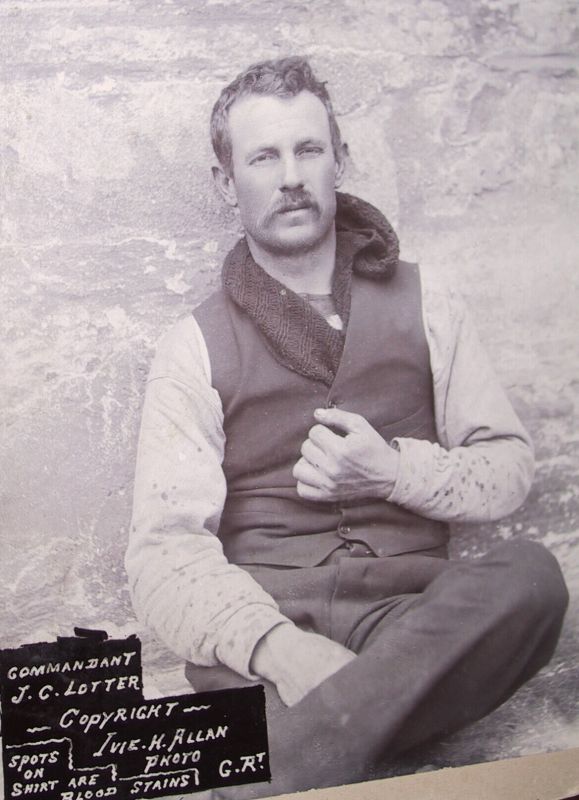
1901: Johannes Lotter, Boer War “rebel”

On this date in 1901, Commandant Johannes Lotter was shot at Middelburg.

Along with Gideon Scheepers, Lotter is one of the most famed Boer guerrillas from the Second Boer War.

Regarded by the British as one of their most nettlesome adversaries in that dirty guerrilla war, Lotter was captured in a bloody early September ambush when matters were well into an unpleasant scorched-earth endgame.

This was cause for much slapping of backs among the Union Jack set, and earned for his captor an immediate promotion.


Lotter’s captured men being jubilantly escorted into Graaff-Reinet.

Lotter almost immediately found himself in the dock for — well, all the things one does in a dirty guerrilla war.*

And one other thing: sedition.

The British charged Lotter as a rebellious subject of the British Cape Colony — rather than a resident of one of the independent neighboring Boer states — who owed allegiance to the British crown; upon this premise things like “killing troopers in war” became “murdering troopers”.

Lotter’s trial hung on his papers.** The defendant “pleaded that he was a Free State burgher, and, as such, entitled to the usage of civilised warfare and a legal combatant’s privileges.”

But he was in a bit of a pickle when it came to proving that the “Commandant Lotter” the British discovered on voting rolls for the Cape Colony city of Colesburg was a different guy. Innocent Blood: Executions During the Anglo-Boer War (its title telegraphs its Boer sympathies) summarizes:

his Free State citizen document was in a small case, which was lost or destroyed theday of surrender. Witnesses for the defence gave evidence that they had seen these papers. British intelligence stated that it could find no proof of his Free State citizenship in Bloemfontein. Lotter responded by asking how he could prove his citizenship when all his witnesses were still on commando and that he had been granted no time to call upon them.

Hey, the guy had six whole weeks from capture to execution to sort it all out.

A “Chair Monument” — there’s a picture of it on this page — commemorates Lotter and his fellow commando Pieter Wolfaardt at the place outside Middelburg where they were shot together on Oct. 12, 1901.

A number of additional prisoners from Lotter’s command taken with him in that same ambush were also eventually executed.

* Specifically: murdering two native spies; killing three British soldiers; blowing up railway lines; and sjamboking loyalist civilians.

** When the British later captured Scheepers, who was unquestionably not a Cape rebel, they simply charged his similar conduct as war crimes to the same capital effect.

On this day..

2003: Vignes Mourthi, framed in Singapore?

On this date in 2003, 23-year-old Malaysian Vignes Mourthi was hanged in Singapore’s Changi Prison as a drug courier, along with his supposed collaborator Moorthy Angappan.

Mourthi vigorously maintained his innocence, and his family has done likewise in the years since, helping turn the young factory worker into a wrongful-execution poster child.

It was a Sgt. Rajkumar who arrested Mourthi by posing as a buyer of his cargo. Rajkumar would later present an undated, unsigned “confession” purporting to show that Mourthi was completely aware that it was heroin he was moving. At first read one might might indeed doubt Mourthi’s insistence that he thought he was carrying “incense stones” … but his compatriot Angappan was indeed an incense dealer and a family friend known to Mourthi as such.

British journalist Alan Shadrake‘s 2010 indictment of Singaporean justice Once a Jolly Hangman (banned in its titular city-state) calls Mourthi’s hanging “arguably one of the most appalling miscarriages of justice in Singapore’s history”.

Rajkumar’s testimony about Mourthi’s confession was instrumental in hanging the young man, but just a couple of days after he arrested Mourthi, Rajkumar himself was arrested (and then released on bail) on a rape accusation. According to the recent book Once a Jolly Hangman, whose denunciations of Singapore’s death penalty system earned its author a prison term in the repressive city-state,

Intense efforts were … made by Rajkumar’s many friends in the CNB and a police friend at Clementi Police Station to persuade ‘J’ to withdraw her statement. The bribes involved large sums of money, which she refused … There were frantic, secret meetings between Rajkumar, his police officer friends and his accuser in shopping malls and fast-food outlets during which he, his family and friends continued to offer large sums of money in exchange for withdrawing her allegations. All this intrigue was going on while Rajkumar was busy getting enough evidence together to ensure Mourthi would be found guilty and hanged.

So. That’s less than ideal.

Sadly for the accused, none of this credibility-melting information was ever known during Mourthi’s trial and appeal. After Mourthi’s execution, the bad cop who hanged him went on trial for corruption over his witness-tampering, and eventually served 15 months.

Certainty is never given to mortals. But Mourthi’s father for one has no doubt: “I know he is innocent.”

On this day..