1812: Not Pierre Bezukhov, in War and Peace

On this date* in French-occupied Moscow of the War of 1812, many alleged arsonists — unnamed and unnumbered — were shot by Napoleon’s army in the ashes of Moscow.

Although real, flesh-and-blood Muscovites died, they are best known via their bespectacled fictional companion, Pierre Bezukhov, whose miraculous escape is one of the pivotal episodes of Tolstoy’s War and Peace.

Merely the greatest novel in history by some reckonings — we’ll just let Tolstoy fight it out with Dostoyevsky for top of table in the competitive 19th Century Russia literary scene — the epic War and Peace tracks that country’s transformation under the revolutionary pressures of the Napoleonic age.

In Russian director Sergey Bondarchuk’s sprawling cinematic adaptation of War and Peace, the part of Pierre Bezukhov is played by Bondarchuk himself.

Pierre Bezukhov (“without ears”) is one of the book’s central figures, the illegitimate son of a count who unexpectedly inherits, forever consumed with his next impulsive, passionate quest for meaning (boozing around, freemasonry, religion …).

Pierre finds himself present in Moscow when the Grande Armee rolls in following its Pyrrhic victory at the Battle of Borodino. His fancy of the moment is to assassinate Napoleon: “he suddenly felt that what before had seemed to him merely a possibility had now become absolutely necessary and inevitable. He must remain in Moscow, concealing his name, and must meet Napoleon and kill him, and either perish or put an end to the misery of all Europe.” And to think, a younger Pierre actually used to admire Napoleon.


Historically, the city of Moscow started burning as soon as the French occupied it. The reasons for this conflagration have been widely disputed; Tolstoy detours in War and Peace to characterize it as nothing more than the natural consequence of the occupation, when the city’s civil infrastructure has broken down and the everyday fires that spark in wooden buildings are more liable to grow out of control.

The French blamed terrorists.

A bulletin of the Grande Armee dated September 20 (Gregorian date; this corresponds to the Julian date September 8) reports on the successful efforts to bring arsonists to heel through the expedient of mass executions.

Three hundred incendiaries have been arrested and shot; they were provided with fuse six inches long, which they had between two pieces of wood: they had also squibs, which they threw upon the roofs of the houses. The wretch Rastapchin had these prepared, on the pretence that he wished to send a balloon, full of combustible matter, amidst the French army …

The fires subsided on the 19th and 20th; three quarters of the city are burned; among other palaces that beautiful one of Catherine, which had been newly furnished: not above a quarter of the houses remain. …

Manufactures were beginning to flourish at Moscow: they are destroyed. The conflagration of this capital will throw Russia one hundred years back. The weather is becoming rainy: the greatest part of the army is in barracks in Moscow.


In this paranoid occupation, the fictional Pierre, wandering Moscow armed without a good excuse, gets himself picked up by French troops.

The travail of his resulting drumhead trial offers the anti-authoritarian (and anti-death penalty) Tolstoy the opportunity to reflect on the “legal” arrangements, a passage Tolstoy dates September 8 on the Julian calendar — the same day that army bulletin above was penned.

[Pierre] learned that all these prisoners (he, probably, among them) were to be tried for incendiarism. On the third day he was taken with the others to a house where a French general with a white mustache sat with two colonels and other Frenchmen with scarves on their arms. With the precision and definiteness customary in addressing prisoners, and which is supposed to preclude human frailty, Pierre like the others was questioned as to who he was, where he had been, with what object, and so on.

These questions, like questions put at trials generally, left the essence of the matter aside, shut out the possibility of that essence’s being revealed, and were designed only to form a channel through which the judges wished the answers of the accused to flow so as to lead to the desired result, namely a conviction. As soon as Pierre began to say anything that did not fit in with that aim, the channel was removed and the water could flow to waste. Pierre felt, moreover, what the accused always feel at their trial, perplexity as to why these questions were put to him. He had a feeling that it was only out of condescension or a kind of civility that this device of placing a channel was employed. He knew he was in these men’s power, that only by force had they brought him there, that force alone gave them the right to demand answers to their questions, and that the sole object of that assembly was to inculpate him. And so, as they had the power and wish to inculpate him, this expedient of an inquiry and trial seemed unnecessary. It was evident that any answer would lead to conviction.

It’s only by Pierre’s chance ability to forge a human connection with the officer detailed to condemn him that he’s mysteriously, and arbitrarily, not sentenced to death — a fact that Pierre doesn’t even realize until he’s led out with the rest of the prisoners only to see that it’s “only” the others who are being shot. This is the narration at length from Book XII, Chapters 10-11.

On the eighth of September an officer- a very important one judging by the respect the guards showed him- entered the coach house where the prisoners were. This officer, probably someone on the staff, was holding a paper in his hand, and called over all the Russians there, naming Pierre as “the man who does not give his name.” Glancing indolently and indifferently at all the prisoners, he ordered the officer in charge to have them decently dressed and tidied up before taking them to the marshal. An hour later a squad of soldiers arrived and Pierre with thirteen others was led to the Virgin’s Field. It was a fine day, sunny after rain, and the air was unusually pure. The smoke did not hang low as on the day when Pierre had been taken from the guardhouse on the Zubovski rampart, but rose through the pure air in columns. No flames were seen, but columns of smoke rose on all sides, and all Moscow as far as Pierre could see was one vast charred ruin. On all sides there were waste spaces with only stoves and chimney stacks still standing, and here and there the blackened walls of some brick houses. Pierre gazed at the ruins and did not recognize districts he had known well. Here and there he could see churches that had not been burned. The Kremlin, which was not destroyed, gleamed white in the distance with its towers and the belfry of Ivan the Great. The domes of the New Convent of the Virgin glittered brightly and its bells were ringing particularly clearly. These bells reminded Pierre that it was Sunday and the feast of the Nativity of the Virgin. But there seemed to be no one to celebrate this holiday: everywhere were blackened ruins, and the few Russians to be seen were tattered and frightened people who tried to hide when they saw the French.

Pierre had been taken by one set of soldiers and led first to one and then to another place with dozens of other men, and it seemed that they might have forgotten him, or confused him with the others. But no: the answers he had given when questioned had come back to him in his designation as “the man who does not give his name,” and under that appellation, which to Pierre seemed terrible, they were now leading him somewhere with unhesitating assurance on their faces that he and all the other prisoners were exactly the ones they wanted and that they were being taken to the proper place. Pierre felt himself to be an insignificant chip fallen among the wheels of a machine whose action he did not understand but which was working well.

He and the other prisoners were taken to the right side of the Virgin’s Field, to a large white house with an immense garden not far from the convent. This was Prince Shcherbatov‘s house, where Pierre had often been in other days, and which, as he learned from the talk of the soldiers, was now occupied by the marshal, the Duke of Eckmuhl (Davout).

They were taken to the entrance and led into the house one by one. Pierre was the sixth to enter. He was conducted through a glass gallery, an anteroom, and a hall, which were familiar to him, into a long low study at the door of which stood an adjutant.

Davout, spectacles on nose, sat bent over a table at the further end of the room. Pierre went close up to him, but Davout, evidently consulting a paper that lay before him, did not look up. Without raising his eyes, he said in a low voice:

“Who are you?”

Pierre was silent because he was incapable of uttering a word. To him Davout was not merely a French general, but a man notorious for his cruelty. Looking at his cold face, as he sat like a stern schoolmaster who was prepared to wait awhile for an answer, Pierre felt that every instant of delay might cost him his life; but he did not know what to say. He did not venture to repeat what he had said at his first examination, yet to disclose his rank and position was dangerous and embarrassing. So he was silent. But before he had decided what to do, Davout raised his head, pushed his spectacles back on his forehead, screwed up his eyes, and looked intently at him.

“I know that man,” he said in a cold, measured tone, evidently calculated to frighten Pierre.

The chill that had been running down Pierre’s back now seized his head as in a vise.

“You cannot know me, General, I have never seen you…”

“He is a Russian spy,” Davout interrupted, addressing another general who was present, but whom Pierre had not noticed.

Davout turned away. With an unexpected reverberation in his voice Pierre rapidly began:

“No, monseigneur,” he said, suddenly remembering that Davout was a duke. “No, monseigneur, you cannot have known me. I am a militia officer and have not quitted Moscow.”

“Your name?” asked Davout.

“Bezukhov.”

“What proof have I that you are not lying?”

“Monseigneur!” exclaimed Pierre, not in an offended but in a pleading voice.

Davout looked up and gazed intently at him. For some seconds they looked at one another, and that look saved Pierre. Apart from conditions of war and law, that look established human relations between the two men. At that moment an immense number of things passed dimly through both their minds, and they realized that they were both children of humanity and were brothers.

At the first glance, when Davout had only raised his head from the papers where human affairs and lives were indicated by numbers, Pierre was merely a circumstance, and Davout could have shot him without burdening his conscience with an evil deed, but now he saw in him a human being. He reflected for a moment.

“How can you show me that you are telling the truth?” said Davout coldly.

Pierre remembered Ramballe, and named him and his regiment and the street where the house was.

“You are not what you say,” returned Davout.

In a trembling, faltering voice Pierre began adducing proofs of the truth of his statements.

But at that moment an adjutant entered and reported something to Davout.

Davout brightened up at the news the adjutant brought, and began buttoning up his uniform. It seemed that he had quite forgotten Pierre.

When the adjutant reminded him of the prisoner, he jerked his head in Pierre’s direction with a frown and ordered him to be led away. But where they were to take him Pierre did not know: back to the coach house or to the place of execution his companions had pointed out to him as they crossed the Virgin’s Field.

He turned his head and saw that the adjutant was putting another question to Davout.

“Yes, of course!” replied Davout, but what this “yes” meant, Pierre did not know.

Pierre could not afterwards remember how he went, whether it was far, or in which direction. His faculties were quite numbed, he was stupefied, and noticing nothing around him went on moving his legs as the others did till they all stopped and he stopped too. The only thought in his mind at that time was: who was it that had really sentenced him to death? Not the men on the commission that had first examined him — not one of them wished to or, evidently, could have done it. It was not Davout, who had looked at him in so human a way. In another moment Davout would have realized that he was doing wrong, but just then the adjutant had come in and interrupted him. The adjutant, also, had evidently had no evil intent though he might have refrained from coming in. Then who was executing him, killing him, depriving him of life — him, Pierre, with all his memories, aspirations, hopes, and thoughts? Who was doing this? And Pierre felt that it was no one.

It was a system — a concurrence of circumstances.

A system of some sort was killing him — Pierre — depriving him of life, of everything, annihilating him.

From Prince Shcherbatov’s house the prisoners were led straight down the Virgin’s Field, to the left of the nunnery, as far as a kitchen garden in which a post had been set up. Beyond that post a fresh pit had been dug in the ground, and near the post and the pit a large crowd stood in a semicircle. The crowd consisted of a few Russians and many of Napoleon’s soldiers who were not on duty- Germans, Italians, and Frenchmen, in a variety of uniforms. To the right and left of the post stood rows of French troops in blue uniforms with red epaulets and high boots and shakos.

The prisoners were placed in a certain order, according to the list (Pierre was sixth), and were led to the post. Several drums suddenly began to beat on both sides of them, and at that sound Pierre felt as if part of his soul had been torn away. He lost the power of thinking or understanding. He could only hear and see. And he had only one wish- that the frightful thing that had to happen should happen quickly. Pierre looked round at his fellow prisoners and scrutinized them.

The two first were convicts with shaven heads. One was tall and thin, the other dark, shaggy, and sinewy, with a flat nose. The third was a domestic serf, about forty-five years old, with grizzled hair and a plump, well-nourished body. The fourth was a peasant, a very handsome man with a broad, light-brown beard and black eyes. The fifth was a factory hand, a thin, sallow-faced lad of eighteen in a loose coat.

Pierre heard the French consulting whether to shoot them separately or two at a time. “In couples,” replied the officer in command in a calm voice. There was a stir in the ranks of the soldiers and it was evident that they were all hurrying — not as men hurry to do something they understand, but as people hurry to finish a necessary but unpleasant and incomprehensible task.

A French official wearing a scarf came up to the right of the row of prisoners and read out the sentence in Russian and in French.

Then two pairs of Frenchmen approached the criminals and at the officer’s command took the two convicts who stood first in the row. The convicts stopped when they reached the post and, while sacks were being brought, looked dumbly around as a wounded beast looks at an approaching huntsman. One crossed himself continually, the other scratched his back and made a movement of the lips resembling a smile. With hurried hands the soldiers blindfolded them, drawing the sacks over their heads, and bound them to the post.

Twelve sharpshooters with muskets stepped out of the ranks with a firm regular tread and halted eight paces from the post. Pierre turned away to avoid seeing what was going to happen. Suddenly a crackling, rolling noise was heard which seemed to him louder than the most terrific thunder, and he looked round. There was some smoke, and the Frenchmen were doing something near the pit, with pale faces and trembling hands. Two more prisoners were led up. In the same way and with similar looks, these two glanced vainly at the onlookers with only a silent appeal for protection in their eyes, evidently unable to understand or believe what was going to happen to them. They could not believe it because they alone knew what their life meant to them, and so they neither understood nor believed that it could be taken from them.

Again Pierre did not wish to look and again turned away; but again the sound as of a frightful explosion struck his ear, and at the same moment he saw smoke, blood, and the pale, scared faces of the Frenchmen who were again doing something by the post, their trembling hands impeding one another. Pierre, breathing heavily, looked around as if asking what it meant. The same question was expressed in all the looks that met his.

On the faces of all the Russians and of the French soldiers and officers without exception, he read the same dismay, horror, and conflict that were in his own heart. “But who, after all, is doing this? They are all suffering as I am. Who then is it? Who?” flashed for an instant through his mind.

“Sharpshooters of the 86th, forward!” shouted someone. The fifth prisoner, the one next to Pierre, was led away- alone. Pierre did not understand that he was saved, that he and the rest had been brought there only to witness the execution. With ever-growing horror, and no sense of joy or relief, he gazed at what was taking place. The fifth man was the factory lad in the loose cloak. The moment they laid hands on him he sprang aside in terror and clutched at Pierre. (Pierre shuddered and shook himself free.) The lad was unable to walk. They dragged him along, holding him up under the arms, and he screamed. When they got him to the post he grew quiet, as if he suddenly understood something. Whether he understood that screaming was useless or whether he thought it incredible that men should kill him, at any rate he took his stand at the post, waiting to be blindfolded like the others, and like a wounded animal looked around him with glittering eyes.

Pierre was no longer able to turn away and close his eyes. His curiosity and agitation, like that of the whole crowd, reached the highest pitch at this fifth murder. Like the others this fifth man seemed calm; he wrapped his loose cloak closer and rubbed one bare foot with the other.

When they began to blindfold him he himself adjusted the knot which hurt the back of his head; then when they propped him against the bloodstained post, he leaned back and, not being comfortable in that position, straightened himself, adjusted his feet, and leaned back again more comfortably. Pierre did not take his eyes from him and did not miss his slightest movement.

Probably a word of command was given and was followed by the reports of eight muskets; but try as he would Pierre could not afterwards remember having heard the slightest sound of the shots. He only saw how the workman suddenly sank down on the cords that held him, how blood showed itself in two places, how the ropes slackened under the weight of the hanging body, and how the workman sat down, his head hanging unnaturally and one leg bent under him. Pierre ran up to the post. No one hindered him. Pale, frightened people were doing something around the workman. The lower jaw of an old Frenchman with a thick mustache trembled as he untied the ropes. The body collapsed. The soldiers dragged it awkwardly from the post and began pushing it into the pit.

They all plainly and certainly knew that they were criminals who must hide the traces of their guilt as quickly as possible.

Pierre glanced into the pit and saw that the factory lad was lying with his knees close up to his head and one shoulder higher than the other. That shoulder rose and fell rhythmically and convulsively, but spadefuls of earth were already being thrown over the whole body. One of the soldiers, evidently suffering, shouted gruffly and angrily at Pierre to go back. But Pierre did not understand him and remained near the post, and no one drove him away.

When the pit had been filled up a command was given. Pierre was taken back to his place, and the rows of troops on both sides of the post made a half turn and went past it at a measured pace. The twenty-four sharpshooters with discharged muskets, standing in the center of the circle, ran back to their places as the companies passed by.

Pierre gazed now with dazed eyes at these sharpshooters who ran in couples out of the circle. All but one rejoined their companies. This one, a young soldier, his face deadly pale, his shako pushed back, and his musket resting on the ground, still stood near the pit at the spot from which he had fired. He swayed like a drunken man, taking some steps forward and back to save himself from falling. An old, noncommissioned officer ran out of the ranks and taking him by the elbow dragged him to his company. The crowd of Russians and Frenchmen began to disperse. They all went away silently and with drooping heads.

“That will teach them to start fires,” said one of the Frenchmen.

Pierre glanced round at the speaker and saw that it was a soldier who was trying to find some relief after what had been done, but was not able to do so. Without finishing what he had begun to say he made a hopeless movement with his arm and went away.

* It’s our practice (although we’re sure it’s been violated here and there) to utilize Gregorian dates universally after the mid-18th century, even for executions in Orthodox Christendom where the Julian calendar prevailed into the 20th century. For this post, seeing as it’s straight from the text of Tolstoy himself, in his magnum opus, channeling the soul of the Russian rodina, we’re making an exception: the 12-day-slower, local-to-Russia Julian calendar prevails … just like the Russians themselves did.

On this day..

1887: Israel Lipski

(Thanks to Meaghan Good of the Charley Project for the guest post. -ed.)

On this day in 1887, 22-year-old Israel Lipski was hanged at Newgate Prison for the murder of Miriam Angel.

His trial and execution were well-publicized in their day, and were the subject of a 1984 book, The Trials of Israel Lipski: A True Story of a Victorian Murder in the East End of London by Martin L. Friedland.

But Lipski has been largely forgotten now … except as a footnote in a much more famous unsolved murder.

Lipski was of Polish-Jewish origin. His real name was Israel Lobulsk; he changed it when he moved to the UK.

He lived in a boardinghouse and worked as an umbrella and walking-stick salesman. Miriam, who was also Jewish, lodged at the same address, 16 Batty Street.

Miriam was found dead in her bed June 28 of that year. She’d been killed in an unusual way: she was forced to consume nitric acid, also known as aquafortis, a strong corrosive chemical now used in rocket fuel. She was six months pregnant at the time of her death.

Lipski was found hiding under her bed. He too had consumed nitric acid and the inside of his mouth was burned. Investigators later determined he’d purchased an ounce of the chemical that very morning. They theorized he had killed Miriam during a rape attempt.

Lipski, for this part, insisted he was innocent of any crime and told an extraordinary story: he stumbled across two co-workers in Miriam’s room rifling through her things. Miriam was already dead at this point. The two men attacked and robbed him, poured the nitric acid down his throat and threw him under the bed, where he fainted.

The judge’s summing-up to the jury, described by one news account as “lucid and temperate,” went with the rape theory:

… that the murderer of Miriam Angel entered her room under the influence of unlawful passion; that, balked in this design, his passion turned to homicidal fury; and that in a reaction of shame and terror he had taken a dose of the same poison that he had given to his victim. If that theory was probable, continued the judge, the murder was much more likely to have been the work of one man than two.

The climate of pervasive anti-Semitism in East London during this time sealed Lipski’s fate. London’s Jewish population, largely impoverished Polish and Russian refugees, was ever liable to blame for a wide variety of social problems. On top of everything else, Lipski’s legal defense was abysmal and the judge clearly biased. He might have been guilty, but the fairness of his trial is questionable.

Following Lipski’s conviction and death sentence there was worried speculation that he might, after all, be innocent. Several prominent people, including members of Parliament and investigative journalist William Stead, petitioned the Home Secretary for a reprieve or commutation. (Stead referred to Lipski as “the young martyr” and the “much injured young exile.”) The wind went out of their sails, however, after Lipski’s confession was published:

I, Israel Lipski, before I appear before God in judgment, desire to speak the whole truth concerning the crime of which I am accused. I will not die with a lie on my lips. I will not let others suffer even in suspicion for my sin. I alone was guilty of the murder of Miriam Angel.

I thought the woman had money in her room, so I entered, the door being unlocked and the woman asleep. I had no thought of violating her, and I swear I never approached her with that object, nor did I wrong her in this way. Miriam Angel awoke before I could search about for money, and cried out, but very softly. Thereupon I struck her on the head and seized her by the neck, and closed her mouth with my hand, so that she should not arouse the attention of those who were about the house.

I had long been tired of my life, and had bought a pennyworth of aquafortis that morning for the purpose of putting an end to myself. Suddenly I thought of the bottle I had in my pocket, and drew it out and poured some of the contents down her throat. She fainted and, recognizing my desperate condition, I took the rest. The bottle was an old one which I had formerly used … The quantity of aquafortis I took had no effect on me.

Hearing the voices of people coming upstairs, I crawled under the bed. The woman seemed already dead. There was only a very short time from the moment of my entering the room until I was taken away.

Even before his execution, “Lipski” became a part of Londoners’ vocabulary. It was used as both a slur against Jews and as a verb, the way a certain kind of suffocation murder still known as “burking” was named after William Burke of “Burke and Hare” fame.

A year after Israel Lipski’s execution, the name “Lipski” once again came under scrutiny after a murder suspect yelled it out in front of a witness, leaving scholars and true-crime buffs to speculate about its meaning for the next 120 years and counting.

The victim in that case was a prostitute named Elizabeth Stride. The suspect is known only by his trade name, Jack the Ripper.

But that’s another story.

On this day..

1788: Not Jean Louschart, rescued by the crowd

On this date in 1788, France’s last attempt at an execution by breaking-wheel was thwarted by a vast crowd sympathetic to the condemned … which stormed the scaffold in Versailles and liberated the victim.

As neat a parable as one might like to find of the entire revolutionary storm then rising on France’s horizons, Jean Louschart’s tale begins with a conflict at home between the young man Jean — neck-deep in Voltaire, Rousseau, and the rest of Enlightenment thought — and his father, a respected and conservative smith not to keen on the boy’s books. Then add to this, that the Louschart family took on one Madame Verdier as a boarder, and Jean grew smitten with that woman’s daughter Helen, to the chagrin of Madame Verdier … who wanted to marry that girl off to Jean’s own father.

So Mathurin Louschart eventually got into it with his son Jean over the boy’s subversive reading. When Mathurin ordered Jean to be silent, the young man just feeling his oats retorted that this was a novel way of settling the dispute. This jab at the elder’s native prerogatives led Mathurin to drive Jean from the house full stop.

That might have been all there was to it if not for the pull of Helen. The Greeks would have understood.

Jean eventually snuck back intending to elope with the willing Helen and salvage her from her father’s hand, but Helen’s mother sniffed out the plan … and the boy entered his former domicile to find Helen being soundly thrashed by Madame. This led Jean to try to protect her, which led Mathurin to intervene, which led to a dramatic bout of father-son violence in which Mathurin was fatally struck with a smithy hammer. Madame Verdier would accuse the young man of willful murder; Jean’s supporters insisted that he had merely tossed the hammer back into the house as he fled it (having overpowered the father’s own murderous rampage), accidentally causing the father’s death. Jean himself kept mum at trial, certain that he could never convince the judges of this version of events and content to suffer for having shed his father’s blood.

We’ll take it here from the Memoirs of the Sansons. The voice here is the grandson of the venerable French Revolution executioner Charles Henri Sanson, who was before that the venerable executioner of the ancien regime. (The mob addresses him familiarly as “Charlot” here.) Fathers and sons had this much in common at least.

the court sentenced [Jean Louschart] to die on the wheel. The prisoner, however, was not condemned to amende honorable, which included the amputation of the hand; and the judges added a retentum to their sentence by which Jean Louschart was to be secretly strangled before his limbs were crushed.

Now public opinion, in Versailles, had already settled that Jean was innocent, and the news of his forthcoming execution caused general excitement. The execution was appointed to take place on August 3. On the morning of the 2nd, Charles Henri Sanson sent from Paris two carts containing the instruments of torture, and beams and boards for the erection of the scaffold. He himself went to Versailles in the afternoon. The emotion caused by Jean Louschart’s impending fate was limited to Versailles; and my grandfather was so thoroughly convinced that he had to deal with a vulgar criminal that he was greatly surprised when he found the whole town in a fever. The Place Saint-Louis was covered with so great a multitude that the assistants and carpenters could hardly go on with their work. No hostility was manifested, however; the crowd was noisy, but its mood was gay; the name of Jean was scarcely pronounced; and the workmen who were erecting the platform were merely jeered. One of the carpenters having, however, struck an urchin who was throwing stones at him, cries of ‘Death!’ were uttered; in an instant all the mocking faces became dark and threatening ; the assistants and carpenters were attacked, and their lives were in great danger. But a body of a hundred men, who could easily be identified as smiths by their athletic proportions and brawny faces, interfered, and partly by strength, partly by persuasion, they induced the crowd to retreat.

My grandfather had not bestowed much attention on this popular demonstration, but he became more attentive when the interference of the smiths took place. He felt convinced that the crowd was obeying a by-word, and that if it had retreated it was merely because it preferred to wait for a more favourable time for action. He directed his assistants to finish the erection of the scaffold as quickly as possible, and returned to Paris, where he lost no time in acquainting the proper authorities with his apprehensions.

Political emotion had already given rise to many storms in the provinces. Normandy, Bretagne, Bear n had risen on behalf of their parliaments, attacked in their privileges. Dauphine had taken a decisive step; after a long series of riots, the representatives of the three orders, nobility, clergy, and tiers-tiat, had assembled, and proclaimed their provincial independence. Paris, however, had heard with indifference of the arrest of two members of the Parliament d’Espremenil and Monsabert; and the authorities had no idea that a struggle between the Government and the people could take place in the very town inhabited by the King and his Court, so that only a few soldiers were sent to Versailles.

The multitude which had thronged the Place Saint-Louis retired during the night; only a few young men remaining to watch what took place around the scaffold. It was rumoured that Helen Verdier had thrown herself at the Queen’s feet, imploring the reprieve of the culprit, and that Marie Antoinette had prevailed on the King to grant it. The news had doubtless led to the dispersion of the crowd.

Charles Henri Sanson made the most of the circumstance. He caused a strong paling to be erected around the scaffold; and, on their side, the executive magistrates took upon themselves to advance the hour of execution.

It was two o’clock in the morning when my grandfather left the Place Saint-Louis for the prison, and he remarked that the men who were still in the place dispersed in different directions as he went away. Jean Louschart was stretched on his pallet when he entered his cell. The doomed man rose and calmly surveyed him. The clerk of the parliament read aloud the sentence, to which he listened with much attention. He then murmured a few words, among which only those of ‘ Poor father!’ were heard, and he added in a loud voice:

‘In two hours I shall justify myself before him.’ On being told that it was time to depart for the scaffold, he turned to the executioner, saying, ‘You can be in no greater hurry than I am, sir.’

At half-past four o’clock the cart moved in the direction of the Place Saint-Louis. The executive magistrates were in hopes that, owing to the retentum, everything could be finished before the population awoke. But they soon perceived their mistake. The streets were swarming with people. The whole of the population was astir. Deafening clamours burst from the crowd as the cart appeared, and it was with the greatest difficulty that it made its way. The prisoner did not even seem to suspect that all this movement was caused by the sympathy people felt for him. At the corner of the Rue de Satory a piercing cry was heard, and a girl was seen waving her handkerchief. Jean Louschart looked up, and rising to his feet, he tried to smile, and exclaimed, ‘Farewell, Helen, farewell!’ At that moment a smith of high stature and herculean proportions, who was walking near the cart, cried in a thundering voice: ‘It is an revoir you should say, Jean. Are good fellows like you to be broken on the wheel?’

A horseman drove him back, but applause and cheers came from every quarter. It was obvious, by the pale faces of the clerk, the policemen, and the soldiers who surrounded the cart, that the agents of the law were anything but confident. The scaffold, however, was reached without accident. The crowd was thickly packed on the Place Saint-Louis. As the cart stopped Jean Louschart addressed a question to the priest who was sitting near him, and my grandfather heard the latter answer, ‘To save you.’ ‘No, father,’ said the doomed man in a feverish voice and with some impatience; ‘if I am innocent of the intention of committing the crime, my hands are nevertheless stained with blood. I must die, and I wish to die.—Be quick, sir,’ he added, turning to my grandfather.

‘Sir,’ answered Charles Henri, pointing to the infuriated masses that were already breaking through the paling, ‘if there is a man here who is in danger of death it is not you.’

Hardly were the words out of his mouth than a tempest of groans and screams burst forth. The paling was broken and trodden under foot, and hundreds of men rushed on the scaffold. The smith who had already spoken to Louschart was among the foremost. He seized the prisoner in his muscular arms, cut his bonds, and prepared to carry him off in triumph. An extraordinary scene now took place; Jean Louschart struggled violently against his saviours, turned towards the executioner and begged for death with the earnestness usually displayed by other culprits in asking for mercy. But his friends surrounded him, and at length succeeded in carrying him away.

My grandfather’s position was perilous in the extreme. Separated from his assistants, alone amidst a crowd that knew him but too well, he really thought that his last hour was at hand. His countenance probably betrayed his thoughts, for the tall smith came up to him, and seized his arm: ‘Fear nothing, Charlot,’ he cried; ‘we don’t want to harm you, but your tools. Henceforth, Charlot, you must kill your customers without making them suffer.’ And speaking to the crowd: ‘Let him pass, and take care he is not hurt.’

This harangue calmed the crowd, and my grandfather was allowed to withdraw. In less time than it takes to write this account the scaffold and all its accessories were broken into pieces, which were thrown on the pile prepared for the burning of the prisoner’s body; and the terrible wheel was placed on the summit as a kind of crown. Fire was set to the heap, and men and women, holding each other by the hand, formed an immense ring and danced around the crackling pile until it was reduced to ashes.

Louis XVI pardoned the unwillingly liberated Jean Louschart, and abolished the breaking-wheel.

Part of the Themed Set: Scary Escapes.

On this day..

1994: Not Arthur Judah Angel, death row artist

On this date in 1994, 38 people were executed at Nigeria’s Enugu Prison … but artist Arthur Judah Angel somehow was not among them.

Angel was convicted of armed robbery and murder: tortured and framed, he says, by corrupt police under the military dictatorship of Gen. Ibrahim Babangida.

At the time, Nigeria was liable to put to death condemned prisoners without warning at any time, like Japan does today … except that Nigeria carried out such executions by the dozens. In one instance Angel witnessed, there were 58 executions in a single day.

On August 2, 1994, a Tuesday, that occasion finally arrived for Arthur Judah Angel — or so it seemed.

“I was chained; I was given my last meal that was August 2, 1994,” Angel said in an interview. “38 others were executed that very day. Only God knew how I was spared. He was the one that made my name disappeared in the book. I did not know how it happened. But it happened. I died, in fact, every person on the death row dies every day.”

Who exactly it was that saved Angel on that date I have not seen conclusively documented, but they say that God helps those who help themselves. In this case, Angel helped himself with his charcoal sketches on death row, which soon brought him to the attention of some well-placed people in the prison bureaucracy, a Catholic bishop — even a British arts organization which organized exhibitions of his work in 1993 and 1994.

Angel’s death sentence was commuted in 1995, and he was released outright in 2000. He well knows that, like those other 38 people who hanged this date, he’d be forgotten if not for his fortuitous escape. Life is just too damn cheap for exonerating the dead.

“I am able to clear my name because I am alive,” Angel said. “If I had been executed, nobody would believe that I was innocent. If I didn’t make it, no one would know. I knew many people who were innocent in prison. Yet they died in prison. Only people like me, who were close to them until their death, knew they were innocent. The rest of the world learnt that armed robbers were executed on so and so day; nobody knew they were innocent.”

But Angel did survive, and is remembered — not only for his exoneration, but for the 51 startling sketches he made of Nigeria’s death row. They (and other anti-death penalty art Angel has created since) have been exhibited worldwide by human rights NGOs.

Angel, who’ll turn 50 this November, continues to work as an artist from a studio outside Lagos — and uses his art to campaign against the death penalty, as one might imagine. He has written a book, I Refused to Die; unfortunately for its prospective international readership, the book requires expensive shipping from Nigeria.

(There’s also a bit of video from a news report here.)

Part of the Themed Set: Scary Escapes.

On this day..

1916: Captain Charles Fryatt, illegal combatant

On this date in 1916, Captain Charles Fryatt was shot at Bruges, Belgium as an illegal combatant.

Fryatt was a 42-year-old civilian mariner captaining the SS Brussels on the Harwick-Hook of Holland route when, in March 1915, a German U-Boat ordered him to heave to.

Fryatt wheeled the Brussels around on the submarine and attempted to ram it. The German ship escaped by a whisker only by scrambling an emergency dive. The Admiralty gave Fryatt a gold watch and a pat on the head for bravery.

It was not until the following year that the Germans captured that same vessel with that same captain on board. When they realized who they had, they subjected him to a snap tribunal for violating the laws of war: he’d participated in combat (by trying to ram the U-Boat) whilst being not a member of his country’s armed forces. That made him an illegal combatant, a franc-tireur in the still-current term for a civilian partisan left over from the Franco-Prussian War.

The Germans mightily loathed such terrorists, feared they would bedevil their steps in Belgium and France: people not sporting enough to stay beaten, people with the effrontery to fight back without being a duly enrolled member of a nation-state’s standing army. They did not scruple to push an expansive line on the definition of civilian non-participation.

“Every non-uniformed person,” read the a Moltke directive to the army, “if he is not designated as being justified in participating in fighting by clearly recognizable insignia, is to be treated as someone standing outside international law, if he takes part in the fighting … [or] participates in any way in the act of war without permission. He will be treated as a franc-tireur and immediately shot according to martial law.” (Source.)

So … that’s exactly what happened to Captain Fryatt.

This shooting set off a flurry of international recriminations and rebuttals.

People of normal moral sense can see readily enough that a merchant captain who scares off a submarine has not committed a grave crime any more than has a teen who chucks a grenade at commando firing at his home. The legal question for deliberation in Fryatt’s case was all about whether the merchant mariner had or had not committed an impermissible belligerent act by charging* … and as always, the definition of a war crime turned out to mirror precisely the political interest of the definer.

The British at this point had the Germans handily bottled up in a naval blockade that even seized food as “contraband”. (A tactic angrily denounced as a war crime in Berlin.) The Germans needed to get out of this stranglehold, and lacking anything approaching parity on the high seas, they staked their hopes on the U-boat. So the German interest was for maximum latitude for submarine activity; in fact, early in 1915, it was just in the process of rolling out its unrestricted submarine warfare policy of unannounced attacks on civilian freighters carrying war materiel. This does not seem to be what the U-boat stopping the Brussels did, but it gives you an idea of the scene. German military judges naturally said that German submarines who stopped a British merchant ship were not to be defied.

And the British interest, and by wonderous coincidence also its policy and legal position, naturally maintained maximum restrictions on a U-Boat’s potential targets, and maximum rights for the realm’s Captain Fryatts to resist.**

Fryatt, indeed, had followed the directives laid down by that Lord of the Admiralty, Winston Churchill. Churchill threatened to prosecute any ship captain who surrendered his vessel to a U-boat without opposing it “either with their armament if they possess it, or by ramming”: the theory was that routine resistance would maximize costs to the German navy, and maybe lead slow and vulnerable U-boats to skip the parley stage in favor of sneak attacks on unflagged steamers, which would sooner or later sink an American ship, which would help pull the U.S. into the war. (In May 1915, making no mistake at all about its target, a German U-boat intentionally torpedoed the Lusitania, generating a helpful stateside scandal also attended by dickering over the legality of the attack.)

So, the initial German announcement tersely reported that Fryatt

was condemned to death because, although he was not a member of a combatant force, he made an attempt on the afternoon of March 20, 1915, to ram the German submarine U-33 … One of the many nefarious franc-tireur proceedings of the British merchant marine against our war vessels has thus found a belated but merited expiation.

Britain replied that the captain had exercised only his “undoubted right of resistance,” and pointed out that a different merchant vessel that did obey such an order on the very same day had been sunk before it could evacuate — drowning 104 souls.

[T]he experience of German methods of warfare warned him that surrender would be no guarantee that the lives of his crew would be spared.

He determined therefore to take the best chance of saving his ship, and to steer for the submarine in order to force her to dive, and, if she were not quick enough in diving, to ram her.

This was his undoubted right under international law – to disregard her summons and resist her attack to the best of his power. It was a contest of skill and courage in which each side took their chance.

This led Germany to reiterate, on August 10, its view that Fryatt’s

act was not an act of self-defence, but a cunning attack by hired assassins …

The German War Tribunal sentenced him to death because he had performed an act of war against the German sea forces, although he did not belong to the armed forces of his country. He was not deliberately shot in cold blood without due consideration, as the British Government asserts, but he was shot as a franc-tireur, after calm consideration and thorough investigation …

Germany will continue to use this law of warfare in order to save her submarine crews from becoming the victims of francs-tireurs at sea.

There’s a 1917 monument to Captain Fryatt still displayed at London’s Liverpool Street Station, as well as a mountain in Alberta named in his honor.

Nobody was ever prosecuted for Fryatt’s execution.

* The distinction as parsed by Germany hung on whether the intended merchant prize was armed (allowed to resist) or unarmed (not).

** U-boats were new legal territory in 1915. The 1930 London Naval Treaty — although Germany was not party to it — attempted to clarify the status of these machines.

On this day..

1537: Janet Douglas, Lady Glamis

On this date in 1537, a Scottish noblewoman suffered the fate decreed for her treason — in the terse entry of the judicial record, combusta.

Knocking around Glamis Castle — where Shakespeare’s great villain Macbeth got his start, as Thane of Glamis* — Janet Douglas had the going enmity of Scottish king James V on the substantial grounds that Janet’s father had held the teen-king his virtual prisoner for a few years in the 1520s. Once James got free, he proscribed the lady’s brother, the Earl of Angus (whom Janet continued to shelter when occasioned), confiscated properties, forbade Douglases from approaching his person, and all that sort of thing.

Presumably according to this same anti-Douglas animus, an abortive attempt was made in 1531 to try our Lady Glamis for poisoning her late first husband, Lord Glamis. However, the charge foundered on the refusal of her peers to participate: “the lairds of Ardoch, Braco, Fingask, Abernethy, Piferran, Lawers, Carnock, Moncreiff, Anstruther, Lord Ruthven, Lord Oliphant, and many others, were fined for absenting themselves from the jury.”

Six years later she was more successfully returned to the dock, this time on a charge of plotting to poison the king himself. There seems to remain very little detail that would trace the precise unfolding of those years and offer later interlocutors a clear interpretation; while “innocent noble railroaded” is the most conventional read — Henry VIII’s agent reported that the conviction was secured “without any substanciall ground or proyf of mattir” — this book gives it a “maybe she did, maybe she didn’t” spin. That whole embittered proscription thing cuts both ways, as motives go.

At any rate, torture induced Janet Douglas’s own 16-year-old son John to testify that she had procured a potion intended to resolve that feud, and despite reported doubts and a spirited defense, the judges found her “committit art and part of the tressonabill Conspiratioune and ymaginatioune of the slauchter and destructioune of our soverane lordis” and therefore to “be had to Castell hill of Edinburghe, and thair brynt in ane fyre to the deid as ane Traytour.” (John was reprieved of this fate, but he still had to watch.)

King Jamie took over Glamis Castle and hung his spurs there until his own death in 1542 … whereupon his crown passed to Mary, Queen of Scots, and the castle reverted to that young John, the new Lord Glamis.

Glamis Castle still stands, picturesquely, and legend has it that the visitor there might encounter the burned woman’s ghost haunting the place as the Grey Lady.**

* Not actually true of the historical man Macbeth.

** Not to be confused with the New York Times. Actually, there are several ghosts who go by this colorless title.

On this day..

1833: Frankie Silver, Morganton legend

On this date in 1833, a young woman named Frankie Silver was hanged in Morganton, North Carolina for murdering her husband Charles.

The cover of Perry Deane Young’s book (available at Amazon.com) shows actress Amanda Ladd in the title role of Young’s play Frankie. Young can be contacted at www.perrydeaneyoung.com or by e-mail at pyoung3@bellsouth.net

Silver is a staple of North Carolina folklore, supposed to have assassinated her spouse in a jealous rage and checked out singing her confession from the gallows.

But the reality, as best one can discern from the distance of time, is quite a bit murkier; indeed, quite a bit more dark and dramatic.

Executed Today is honored to mark the occasion by interviewing author Perry Deane Young.

Young’s acclaimed The Untold Story of Frankie Silver: Was She Unjustly Hanged? debunks many of the fables surrounding this old time true crime.

ET: Just by way of orientation, what’s the baseline legend of Frankie Silver that Appalachian children learn? And how exactly did this particular hanging come to be so richly preserved in ballads and folklore and the like?

PDY: The legend is that this true story was the basis for the black blues song, Frankie and Johnny.

Frankie killed her man out of revenge cause he done her wrong. The legend is that she was the first — or only white — woman ever hanged in North Carolina, that she sang a confession from the scaffold. This was the story I heard as a child; only later would I learn that none of this was based on facts.

Most historians now think the song, Frankie and Johnny, was based on a murder in St. Louis, although several folklore collections published in the 20th century say it was based on Frankie and Charlie Silver.

What is it that drew you to this case in the first place?

Most people’s mothers tell them stories about Winnie the Pooh and, oh my, Tigger the tiger. My mother told me about a woman who cut her husband’s head off with an axe and burned his body in the fireplace.

As a writer, I’ve always been grateful for that.

Your book makes the case that she was wrongly executed, and not only that — but that “the true story, the facts … are even more interesting than the story as it has been passed down by so many ballad singers, folklore specialists, storytellers and newspaper columnists”. What’s the most important misconception people have about Frankie Silver? What surprises you most about the story?

There are many misconceptions, starting with the murder itself. There is ample evidence from the time to prove that her husband was loading his gun to kill Frankie and she picked up the axe to defend herself.

She did not sneak up on him as he lay sleeping; she killed in self defense.

She was not the first or only woman ever hanged in North Carolina, she was one of at least 15.

She did not read or sing a confession from the scaffold.

A young school teacher plagiarized a Kentucky ballad, “Beacham’s Lament,” had it printed and handed out at the hanging. It is this ballad, in which Frankie laments her guilt, that has come down as factual. However, when I was a college student, I came across 17 different letters and petitions to the governor asking for a pardon for Frankie. In these documents, it is clearly spelled out that Charlie Silver was a drunk, abusive husband and Frankie killed him in self-defense.

Hindsight is 20/20, of course … but it doesn’t seem to require hindsight to think that her lawyer would have been expected to introduce evidence of domestic violence even if that wasn’t the main thrust of his defense. Would it also have seemed that way to the reasonable barrister in the 1830s, or was there good reason for him to avoid it? Can we say that she was hanged for poor lawyering?

The late Sen. Sam Ervin was, like me, a great believer in Frankie’s innocence. A letter he wrote me explaining why is reproduced in the new edition of my book. He explained to me that at the time she was tried, the accused was deemed an incompetent witness and could not take the stand in her own defense. The law was changed in North Carolina in 1859 so that, as now, you can choose to defend yourself but you still cannot be compelled to testify against yourself.

Frankie’s lawyer, perhaps at the insistence of Frankie’s father, pleaded innocence. In other words, he could not introduce evidence of extenuating circumstances such as spousal abuse if he was saying she didn’t do it in the first place. In the book, I note that a man named Reuben Southard beat his wife to death that same year in the same county and got off with court costs. In one of the petitions, Frankie’s neighbors assert that it has often happened that a man murdered his wife with no legal consequences. In an article for his local newspaper, Ervin blamed Frankie’s lawyer for the outcome of the trial, not realizing that her lawyer was his own great great uncle.

Over the longer arc, it’s surprising to me that the claim by a woman who killed her husband that he was an abusive spouse — especially if that claim attracted a lot of support at the time — would go underground in the historical recollection of the case. In its essentials, this is one of the stock templates we have for thinking about a domestic crime. What happened in Morganton, and with the families’ descendants, over the years to shape the popular memory of the event? And does it suggest any larger lessons to you about the way we construct our histories?

The explanation is quite simple. All that survived over the years was this ridiculous “ballad,” in which Frankie confessed her guilt. She had nothing to do with that ballad.

Fayetteville Observer, July 30, 1833

But, in fact, she did write out a confession.

The confession itself has never been found but we know from other sources that it explained that she killed in self defense. The documents that detailed Charlie’s abuse and other details about the case remained hidden in the governors’ papers in the North Carolina Archives until I discovered them in 1963 when I was a student at the University of North Carolina at Chapel Hill.

In 2001, Frankie was finally allowed to have her say in a play which I wrote with William Gregg and which was produced by the Southern Appalachian Repertory Theatre in August 2001.

In the play, a minister who is working to save Frankie from the gallows, overhears a young man singing the silly ballad. He is asked if a hundred years from now people will still be singing that ballad, not knowing what really happened. He answers: “People would rather believe a simple lie than a difficult truth.”

Compounding the historical image of Frankie has been the fact that her family was ashamed of having a convicted murderer in their midst. It was Charlie’s family that became the keeper of the legend and all its misconceptions. The Silvers kept alive the fake ballad “confession” and did everything they could to preserve the image of Charlie as a faithful husband who was killed by a spiteful wife.

Do you find that here in 2012, there are still people whose oxen are gored if your research contradicts their own version of the story — especially if you present Charlie as a violent husband?

You betcha! The Silvers to this day are rather vehement in defense of their Charlie.

It was a historic moment when I was invited to speak in the old church house near the murder scene for the Silver family reunion. In the basement of the church, they have created an extraordinary archive on the murder story and the family in general.

By this time, they have accepted that Charlie may not have been the innocent victim they’ve been told about. Many in the family are serious about their historical researches and want to know the facts. However, a contemporary Charlie Silver also said, “I just wish people would stop talking about it.”

You’re working on a program for Discovery channel’s “Deadly Women”. Does it hold any new revelations about this intriguing historical case?

The chief revelation came to me after being questioned by a very bright young woman named Colette Sandstedt for the program. She had done her homework exceedingly well. By the time we had gone over all the historical evidence I had collected over the past 50 years, I was ready for her last question: “What is the most shocking aspect of this case to you?”

I answered: “The most shocking aspect of the case is the way this poor woman has been misrepresented for almost 200 years.”

On this day..

1945: Dr. Achmad Mochtar, quiet hero

On this date in 1945, Japanese forces occupying Indonesia cut off Dr. Achmad Mochtar’s head for a medical experiment gone horribly awry.

Officially, Dr. Mochtar had been responsible for a supposed vaccine whose administration killed hundreds of Indonesian forced laborers.

Latter-day research, however, indicates that it was the Japanese military who administered the vaccine (Indonesian link), an experimental tetanus-cholera-typhoid-dysentery combination shot, getting a trial run before it was administered to Japan’s own soldiers. When this drug proved lethal to most of its recipients, Mochtar and his staff at the Eijkman Institute were arrested in 1944 and subjected to harrowing torture.

According to Jakarta-based British researcher Kevin Baird, Mochtar agreed to take the fall for the experiment in exchange for the release of his colleagues.

“We think of this sort of heroism as the reserve of military men and not learned intellectuals,” Baird told the Guardian. “Achmad Mochtar was not only a hero of Indonesia, but a hero of science and humanity.”


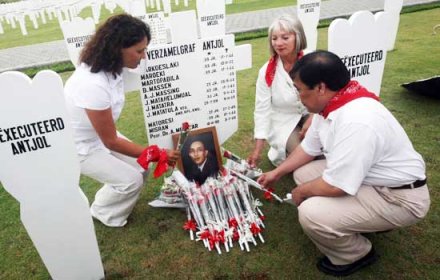
Present-day Eijkman Institute director Sangkot Marzuki (right), and two descendants of the executed man, Monique Mochtar (left) and Jolanda Mochtar (center) lay flowers at a 2010 memorial event after the doctor’s location in a mass grave was discovered. Achmad Mochtar’s name also graces a Sumatran hospital.

On this day..

1799: Admiral Francesco Caracciolo, Neapolitan

On this date in 1799, Admiral Francesco Caracciolo was hanged by the British commander Horatio Nelson from the yardarm of the Sicilian frigate La Minerve in the Bay of Naples.

Poor Caracciolo (English Wikipedia entry | Italian) — and not to be confused with the Italian saint of the same name — got middled by the French Revolution.

He was a trusted admiral from a noble family, and indeed had served with the British Navy (Italian link). Caracciolo got tapped for escort duty to help King Ferdinand IV and his wife Maria Carolina* flee from a Naples threatened by French troops to the safety of a British fleet stationed at Sicily.**

But he seems to have been troubled by that flight by consciousness of a conflict between civic duty and duty to sovereign.

Carraciolo would later tell the drumhead court that condemned him that it was not he who had turned coat; rather, “the King deserted me and all his faithful subjects … The King collected everything that could be converted into specie on pretence of paying [the] army … and fled with it to Palermo, there to riot in luxurious safety. Who was then the traitor — the King or myself?”

With said King a-riot offshore, French conquest initiated in January 1799 the Parthenopean Republic, a fine obscurity for a pub bet today, but for Caracciolo a matter of life and death. He’d returned to Naples, supposedly to tend to his personal affairs; his prominence and popularity, he found, required him to choose between his allegiances.

Under whatever inducement of conscience or calculation, Caracciolo put to sea for the new Republic and engaged the Parthenopeans’ enemies, actually preventing one British landing attempting to restore his former boss.

Alas, the French — by whose arms alone was the puppet Republic supported — soon decamped for greater priorities than Naples, and the royalist elements had the city back in hand by June. While the political revolutionaries would face their own reckoning, the Jacobin admiral was caught attempting to fly and delivered to Nelson for the most summary simulacrum of justice.

“A slight breeze; a cloudy sky,” Lord Nelson’s laconic journal entry for June 29 reads. “Sentenced, condemned, and hung Francesco Caracciolo.”

Fairly or otherwise, this incident is one of the very few blots upon the beloved Nelson’s reputation. That’s partly for the haste with which it was conducted and partly for the jurisdictional matter of the British — to whom Caracciolo owed no loyalty, and against whom he had committed no treachery — doing the Bourbon monarchs’ dirty work by receiving the prisoner, conducting the trial aboard a British ship, and directing the sentence.

And it was all over under that single day’s cloudy sky.

Caracciolo was brought aboard the Foudroyant that morning, a five-member panel of Neapolitan royalist officers rounded up to try him, given a two-hour trial, and condemned to hang that very evening at 5. (Requests for a soldier’s death by shooting, or a day’s time to make peace with one’s maker, went begging.) At sunset, the body was cut down, loaded with weights, and cast into the sea.

They figured that was the last they’d seen of the admiral, but a few days later — with King Ferdinand now having moved onto the Foudroyant — the corpse somehow bobbed up to the surface right beside the ship, like a revenant spirit come to accuse the royal still too nervous to reside in Naples.

“What does that dead man want?” the shocked king is supposed to have exclaimed as he took sight of it.

“Sire,” answered a priest, “I think he comes to demand Christian burial.”


Ettore Cercone, L’ ammiraglio Caracciolo chiede cristiana sepoltura (Admiral Caracciolo requests a Christian burial). Horatio Nelson and Lady Hamilton are in the foreground.

He got it. An 1881 epitaph in the Chiesa di Santa Maria della Catena can still be read in his honor.

“Francesco Caracciolo, Admiral of the Republic of Naples, who fell victim of the hatred and the lack of mercy of his enemies. He was hanged at the mast on 29 June 1799. The people of Santa Lucia took it upon themselves to honour him with a Christian burial. The City Council of Naples, 1881.”

Naples’ harbor-front street, from which one would have had a fine view of Nelson’s fleet back in the day, is today known as the via Francesco Caracciolo. The Republic of Italy’s navy had a Caracciolo-class battleship type in production in the 1910s, but the line was discontinued before any of the four vessels reached completion.

* Sister of Marie Antoinette.

** Where Lord Nelson was banking the proceeds of his recent Egyptian exploits in the famously pleasing form of Emma, Lady Hamilton, the wife of the British envoy to Naples.

† Apropos of the preceding footnote, there’s been some grousing about Lady Hamilton’s role in all this. She was an intimate of the temporarily exiled queen, and the old Encyclopedia Britannica entry on Caracciolo slates her with having exploited her hold over the infatuated Nelson to work Maria Carolina’s vengeful will. We’re inclined to suppose that Nelson’s own reasons of warcraft-slash-statecraft, attempting to swiftly cow any potential Neapolitan resistance, suffice as explanation — whether right or wrong.

On this day..

1844: Gabriel de la Concepcion Valdes, “Placido”

On this date in 1844, Cuban poet Gabriel de la Concepcion Valdes was executed in Matanzas for conspiring to overthrow Spanish authority on the island.

His mother (who gave him up to an orphanage) was a Spanish dancer. His father (who adopted him back) was a “quadroon” barber. Valdes, aka Placido (Spanish link, which is true of most available online resources about him) grew up as a free mixed-race youth in a slave society.

This situated him in the privileged (relative to plantation slaves) but precarious position of the petty bourgeoisie, menaced not only by the prospect of economic reversal but by the vicissitudes of Spanish policy towards his caste — whose growth many colonial officials fretted warily.

Though Placido made his bread apprenticing as a print-maker and later making turquoise combs, he made his fame by dint of literary gift that was celebrated throughout Cuba and abroad. His “La siempreviva” won a literary competition when he was just 25, and led to an invitation to visit Spain (Placido declined it); the Cuban-born, naturalized Mexican poet Jose Maria Heredia visited Cuba in 1836 and made a point to look up Placido; and according to the out-of-print Cuba’s Romantic Poet: The Story of Placido by Frederick Stimson, the young Cuban was wildly popular with North American slavery abolitionists as well.

Placido is less well-remembered beyond his home island today, but arguably rates as Cuba’s most distinguished Romantic poet.

In the 1830s especially, when civil war in Spain put the reigning monarch on the liberal side, Placido was able to exploit the opening to write openly of Cuban political aspirations.

His La Sombra de Padilla, dedicated to Spain’s “wise and exalted Queen”, imagines one of Spain’s martyred comuneros charging him to venture his life for liberty against absolutism.

Better to fall prey to La Parca [the Grim Reaper]
Than to a despotic Monarca

But notwithstanding the war in Iberia, the exalted Queen still put Cuba under special (read: repressive) law. Placido’s prominence, having advocated for much more freedom than Cuba was slated to enjoy, subjected him to automatic Spanish suspicion as more authoritarian governance arrived in the 1840s.

The poet was arrested in the Conspiración de La Escalera (Conspiracy of the Ladder, so named for the structure its accused were tortured upon). This purported plot to raise a slave revolt may or may not (pdf) have really existed, but the crackdown it authorized sure did. Indeed, despite the “slave revolt” bogeyman, it was overwhelmingly free blacks whom the Spanish suppressed in this affair.

Gariel de la Concepcion Valdes, known as “Placido”, was shot with ten others, “miserable instruments of the most depraved machinations of immoral men, men who deserve the curse of the living and the opprobrium of generations to come,” just a week after his conviction.

The appointed lot has come upon me, mother,
The mournful ending of my years of strife,
This changing world I leave, and to another
In blood and terror goes my spirit’s life.

But thou, grief-smitten, cease thy mortal weeping
And let thy soul her wonted peace regain;
I fall for right, and thoughts of thee are sweeping
Across my lyre to wake its dying strains.

A strain of joy and gladness, free, unfailing
All glorious and holy, pure, divine,
And innocent, unconscious as the wailing
I uttered on my birth; and I resign

Even now, my life, even now descending slowly,
Faith’s mantle folds me to my slumbers holy.
Mother, farewell! God keep thee — and forever!

-Valdes, “Farewell to My Mother”

There are volumes of Placido’s poetry (in the original Spanish) freely available via public-domain Google books offerings here and here, with a short thumbnail biography here. For the nonfiction biographical exploration of Placido’s life, and detailed critical analysis of his poetry, this Vanderbilt master’s thesis (pdf) is highly recommended.

On this day..