James Stephens hanged in New York on this date in 1860, for poisoning his wife.
We’ve referenced passingly a number of 19th century hangings on then-trendy “upward-jerking” gallows — whose action is not to drop the offender down through a trap, but to drop a heavy weight which levers the offender up.
Thanks to the Feb. 4, 1860 edition of the New York Herald, we have a very detailed description of this macabre device.
Perhaps the reporter’s skepticism as to this machine’s humane efficacy is informed here by a bit of hindsight, for when it engaged to end the life of our Mr. Stephens,
Up went the culprit high into the air, not with a sudden violent jerk as usual, but slowly, as if by the strength of a man’s arms, instead of a powerful weight of some 300 pounds. It became evident immediately that something was wrong, and soon a rumor went round that the rope had been unwound instead of cut by the hangman. It appeared that the executioner, who was inexperienced, got frightened, and thus the barbarous manner of hanging the culprit was explained.
It was extraordinary that under these circumstances the unfortunate wretch, suspended between heaven and earth, did not exhibit indications of violent suffering. The moment the rope tightened around his neck, and he was elevated about half way up, a slight twitching of the fingers and kicking of the legs were perceptible. Then a few moments intervened without the slightest indication of suffering, except the hard breathing, which was fearful to listen to. After hanging two minutes in this way, another convulsive throe took place; the vessels in the neck seemed to be swelled almost to bursting, the fingers and wrists assumed a bluish hue, and the feet twitched once or twice spasmodically. Three minutes came, and with it a very feeble tremor showed itself in the whole body; but it lasted only a few seconds, when all further motion ceased, and life seemed to be completely extinct. The surgeons, Drs. Woodward, Simmons and Covell, viewed the body after a suspension of five minutes, and gave it as their opinion that animation was certainly gone; but the body was not lowered until fourteen minutes had expired. The surgeons then again examined the body, found no pulse, and the flesh icy cold. Considering the circumstances, the culprit died a remarkably easy death, which was owing, doubtless, to the feeble condition of his constitution. Had he been in good strength at the time of his execution there is no question but that he would have struggled in the most frightful agony for half an hour.
This gentleman is far from antiquity’s most distinguished Christian martyr, but a site such as Executed Today can scarcely omit the sacrifice of one Saint Apronian the Executioner, who we learn was
Executioner for imperial Rome. He was a witness at the trial of Saint Sisinnius who was charged with Christianity in the persecutions of Diocletian. Sisinnius’ statement of his faith converted Apronian. He was martyred soon after.
Many other translations make him not executioner but notary; the Roman Martyrology from which these versions derive marks him as Commentariensis — a prison-keeper.
So there’s a good chance that “executioner” here is a bit of dramatic exaggeration. That said, while ancient Rome had plenty of executions, they wouldn’t necessarily be conducted by a single executioner as we imagine the office from subsequent European history. Depending on the rank of the accused (notably citizen vs. not), the location of the proceedings (Rome vs. provinces), and the prevailing climate, capital punishments might be handled by various civic entities or bodies of armed men.
The office of carnifex, literally “flesh-render” or “butcher”, had the brief to torture and execute slaves and foreigners; evidently, there are hints that this dishonorable position might also be held by a prison warden. Perhaps this is the basis for linking Saint Apronian to the gig.
Despite the distinctive (albeit not unique) professional attribution, Apronian is not the patron saint of executioners. In fact, there is no such sacred patronage, although searches for same turn up this jam:
A call back to the sadly demobilized crime blog CLEWS for the double execution on this date in 1927 of Louisiana adulterous lovers Ada Bonner LeBoeuf and Dr. Thomas E. Dreher, for the murder (via hireling) of Mrs. LeBoeuf’ husband …
The first-degree murder trial that followed a month after the murder of Mr. LeBoeuf was billed in the press as one of the Southland’s most sensational legal battles, since, it was reported, the South hadn’t convicted and hanged a white woman for murder since Reconstruction days, and Louisiana had never hanged a white woman for murder, not even in the days of French and Spanish rule.
The trial was a cross-country sensation. The state produced nearly a dozen witnesses who testified to the details of the scandal. Per these many witnesses, the light-o’-loves carried on their small-town affair in the “negro shacks” on the outskirts of the village. The evidence included love letters that were read aloud.
Vietnamese General Nguyen Van Nhung was (apparently) executed on this date in 1964.
He was the victim of a South Vietnamese coup, after having been a key operative in the previous one. Back on 2 November 1963, he’d piled into the back of an armored personnel carrier with the fresh-deposed President Ngo Dinh Diem, and Diem’s brother Ngô Dình Nhu. When the APC arrived at its destination, Diem and Nhu were both dead.
As we rode back to the Joint General Staff headquarters, Diem sat silently, but Nhu and the captain [Nhung] began to insult each other. I don’t know who started it. The name-calling grew passionate. The captain had hated Nhu before. Now he was charged with emotion … [and] lunged at Nhu with a bayonet and stabbed him again and again, maybe fifteen or twenty times. Still in a rage, he turned to Diem, took out his revolver and shot him in the head. Then he looked back at Nhu, who was lying on the floor, twitching. He put a bullet into his head too. Neither Diem nor Nhu ever defended themselves. Their hands were tied. (Source)
Nhung’s turn as executioner — no unfamiliar role; the guy was notorious for tallying his career kills in notches on his gun barrel — made his boss Duong Van Minh the new President … for all of three months. By all accounts he was a useless executive:
the ruling generals were paralyzed by ineptitude. They had formed a military revolutionary council, composed of twelve members who bickered endlessly. Their normal chairman, General Minh, boasted that the collegial arrangement would guarantee against the autocratic excesses of the old regime. In reality, Minh had contrived the committee in order to bolster his prestige without increasing his responsibility. He was a model of lethargy, lacking both the skill and the inclination to govern. As he confided to me one morning as we chatted in his headquarters, he preferred to play tennis and tend to his orchids and exotic birds than to preside over tedious meetings and unravel bureaucratic tangles … In a cable to Washington, [U.S. ambassador Henry Cabot Lodge] described Minh as a “good, well-intentioned man,” but added a prophetic note: “Will he be strong enough to get on top of things?”
On 30 January 1964, Minh was overthrown by another general, Nguyen Khánh, in a bloodless dawn coup. Well, virtually bloodless. The sole casualty was Nguyen Van Nhung, who paid for the assassination of Diem the next day via a pistol shot to the head at a Saigon villa. The official story promulgated by the new regime described him instead committing suicide in shame for the Diem murder.
Mat Indera’s contribution was the 1950 Bukit Kepong incident — an armed attack on a police station in that town that killed 19 policemen.
The 1981 movie Bukit Kepong dramatizes the events in question.
The British put a handsome price on the man’s head, and in 1952 someone took it.
His name and his deed are still controversial enough in Malaysia that a politician in 2011 found himself upon a sticky wicket for suggesting that Mat Indera was an anti-imperial hero.
That life is often cheap is Executed Today‘s stock in trade and few hanged cheaper than Henry Neal on this date in 19733.
Two bare entries at the Old Bailey Online constitute, we suspect, something close to the entirety of the documentary trail civilization holds for this soul.
Working backwards in time, we begin with the customary account of the Ordinary of Newgate, James Guthrie, of the twelvefold Tyburn hanging on January 29, 1733:
Henry Neal, Twenty Years of Age, his Father a Porter at Billingsgate died, and left him young, and his Mother being a poor Old Woman, could give him no Education at School, after he was Four Years Old; since which time he was forced to Work for his Bread at One Shilling per Week, and as he advanc’d in Years they gave him more. He commonly serv’d the Carters and Scavingers, till about Seven or Eight Months ago a Cart run over his Leg, which disabled him for Work. He own’d the robbing of Mr. Graves’s House, as was Sworn against him, but with a variation of Circumstances; for he said, that he only took the Hat, Breeches, and some small Things; but as to the Rings, the Guinea and a Half, he never saw them, as he said. He said, that he kept the Church, and was not very wicked, neither did he know the vile ways usually practis’d by such wicked People; and that what he did was merely for poverty and want, he having been disabled for Work, having fasted for three Days, and every body refusing him Charity. This is the Account he gave of himself, but as to the truth thereof, we leave it to others to judge thereupon. He was a poor ignorant Fellow, and knew but little of Religion. He declared himself Penitent for his Sins, that he believ’d in Christ his only Saviour, and that he died in Peace with all the World.
Here’s the preceding trial record that got him the noose, with testimony by those he robbed (the last of them seemingly written progressively to capture his distinctive accent):
Henry Neal, of St. Giles’s Cripplegate, was indicted for breaking and entring the House of William Graves, and stealing a Pair of Breeches, a Hat, a Pair of Shoes, 2 Gold Rings, a Guinea and a Half, and 2s. 6d. the Goods and Money of Richard Sims, and a Pair of Leather Breeches, the Goods of Tho Cecil, November 16, about ten at Night.
Richard Sims. I look after the Dog-house Bar. About six at Night the Prisoner came into the House, and desired me to let him warm himself by the Fire, for he said he had been with a Cart to Edmonton, and was very cold. He beg’d an old Pair of Shoes, upon which, I took Notice that those he had on were very bad; but I did not give him any. He staid till eight o’Clock, and then went away, and I shut up the Door as usual, and went to Supper at the Green Man on Windmill-Hill, and after Supper I returned to the House at the Bar, and went to Bed: Next Morning the Taylor came to mend my Breeches, which I had left in my Room overnight before I went to Supper, and there was two gold Rings, a Guinea and a half, and 2s. and 6d. in a brass Box in the Side-Pocket. I look’d for my Breeches but could not find ’em, and at the same Time I mist my Hat and my Shoes. Searching farther I found the Prisoner’s old Shoes, which were tied with Packthread, at the Door, and the Cellar Door was split in two. The Shoes made me suspect the Prisoner. Next week I met with him. He confess’d that he broke the Cellar-Door with a great Stone, and then thrust the wooden Bolt back, and got and took the Goods; that he had pawn’d the Hat in Golden-lane for 6d. and the Breeches in Turnbull-Street for a 1s. He went with me to those Places, and found them there. He had my Shoes upon his Feet.
– Thompson. I took the Prisoner in Coleman-street. I knew him before, and had heard there was a Warrant out against him. He had pilfer’d some Things while he had work’d with me there. I tax’d him with robbing Mr. Sims. He at first denied it, but afterwards own’d that he broke the Cellar-door open with a Stone, and had pawn’d the Hat and Breeches, but said he was drunk when he did it.
Tho. Cecil. I do keep the Dog-house-Bar for Mr. Graves, my Lord-Mayor’s Huntsman. My Breeches did hang up where I did lye, but being Zick, I was vorced to go home and leave’m there, and he have got ‘en on now.
Court. Go and look on ’em.
Cecil. Yes, these be they, I can zafely zwear to ‘n.
The Prisoner made no Defence, and the Jury found him Guilty. Death.
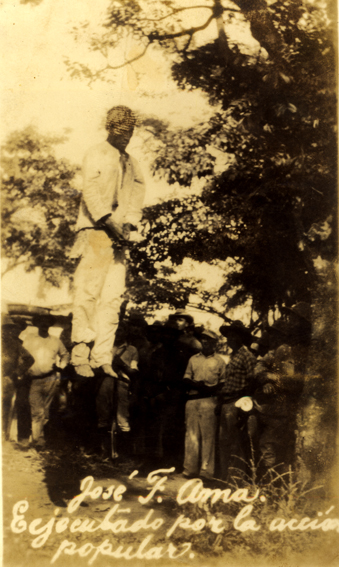
El Salvador campesino Jose Feliciano Ama was hanged in the town square of Izalco on this date in 1932 during a ferocious repression of the peasantry.
In an environment of desperate economic immiseration for nearly all Salvadorans below the landed oligarchy, the heavily indigenous western peasantry rebelled on January 22, 1932 — aided or led by the Communist Party.*
This fate of this rebellion might be inferred by its historiographical sobriquet, the Salvadoran peasant massacre — or simply la Matanza, the slaughter.
In numerical terms, it ran to well into the tens of thousands, maybe up to 40,000 — indiscriminately visited on peasants of originario complexion in the zone of rebellion, batches of them summarily shot into mass graves they’d been forced to dig for themselves.
In the Pipil town of Izalco, where coffee latifundias dominated the best agricultural land,* up to a quarter of the population was butchered. None of those put to la Matanza were more recognizable nor more vividly recalled than the local rebel leader Feliciano Ama English Wikipedia entry | Spanish), extrajudicially noosed in front of the Izalco church. Today a small plaque in this square honors him as a popular martyr.
It’s the old, old story: conniving war profiteer helps client get divorce, conniving war profiteer installs divorced client as mistress, rival lover also awaiting divorced client’s divorce shoots conniving war profiteer, rival lover winds up on Executed Today.
It’s the story of George Botts (hanged January 27, 1872) and D.C. Civil War gadabout Oliver “Pet” Halsted. Friends of the site Murder By Gaslight has the details.
Blood accumulates upon us. Verily, it does seem that the reins of justice have been loosely thrown to the devil, and that we are all driving at breakneck speed in the same direction.
On this date in 1866, four youths employed as teamsters in the Army corrals of Union-occupied Nashville were hanged for a brutal highway robbery/murder.
The victim was William Hefferman, a wealthy railway contractor. His assailants were George Crabb/Craft, James Lysaught, Thomas Perry/Ferry, and James Knight; Knight at 20 was the only one out of his teens. On the night of November 22, 1865, they held up Hefferman’s carriage. The situation turned deadly when Hefferman’s son-in-law, attempting to protect the old man from the blows of the assailants when he refused to give them any money, fired a shot that wounded Crabb — which led to a return shot that mortally wounded Hefferman. He succumbed to the wound a few days later.
This was the immediate, unsettled aftermath of the U.S. Civil War, occasion for a robust crime wave that held Middle Tennessee in terror. “Nashville is infested by bands of robbers and murderers,” complained the Ohio newspaper The Spirit of Democracy (Dec. 6, 1865). Hefferman’s murder would be one of the signal crimes of that interim and draw nationwide outrage — all of which helped the killers’ associates to shop them very speedily. The army’s drumhead court-martial was gaveled in within a week and the hoodlums were lucky to get that far. “Great excitement exists in the city,” a dispatch to the Daily Ohio Statesman (Nov. 28, 1865) reported. “The streets are thronged with men vowing vengeance and threatening lynch law. Tonight meetings are being held in each ward to form a citizen patrol. A spark may incite the crowd to mob law.”
As it was a military trial, the appeal went up the chain of command to U.S. President Andrew Johnson,* who denied it. However, such a proceeding would not have been licit under the imminent (April 1866) U.S. Supreme Court holding in Ex Parte Milligan — which held that military courts cannot try civilians wherever civilian courts are open.
It is their youth, their boyishness, that leaps off the page in the accounts of their last hours — such as this from the Cleveland Daily Leader of January 29:
The four Heffernan [sic] murderers were hung to-day, at thirteen minutes past twelve o’clock. Their real names are James Knight, Thomas Perry, George Crab and James Lysaught. Two had been in the rebel army.
Yesterday several orthodox ministers called, conversed and prayed with the prisoners, who exhibited some emotion. Afterward, Father Begrath, of the Catholic Church, was with them. They all professed the Roman Catholic faith. Knight and Perry were baptised. The other two had been baptised in infancy. The prisoners had previously shown great hardihood, singing such pieces as “Bold Jack Dunaho” and “Bingen on the Rhine.” The past two days had tamed them down, but they were still stolid, frivolous and careless, joking about their doom.
This morning, Perry’s brother brought him clothing. The parting scene between them was heart-rending, Perry giving way to tears and sobs. Colonel Innis provided the others with clothing. Lysaught said, at first, that he didn’t want any pants, as those he had on were good as gold to hang in. Crab was asked to tell who shot Hefferman. He replied, “That is not a fair question; I’ll never tell that in this world.”
Father Begrath came about ten o’clock to attend them in their last moments. Lysaught said he felt as gay as a lay. He said he had been badly treated, else he would be with his parents now. Father Begrath read a touching letter from Lysaught’s parents to the Bishop, asking him to have James’ grave marked that some day they might take the body away. He was earnestly exhorted to repentance, but he remained almost stolid. Some one in the room having a looking-glass, he jumped up, exclaiming, “By golly, I must look at my face once more.” Then turning to Crab, he remarked, “Look at yours — it is your last chance.”
Crab replied, “It aint any use.” Lysaught asked, laughingly, “afraid you’ll break the glass?” when all four seemed much tickled. Crab having eased Lysaught’s handkerchief, the latter playfully snatched it away, saying, “let me smell it everlasting.” Then, turning to Crab, said, “you’re enough to make a monkey grin.”
Perry was asked if he feared to die. He replied “I don’t dread it a bit. It’s best to take it easy, it’s got to come.”
Crab indicted the following letter to Byron Heston, Oswego, New York:
George Crab, the boy who used to run on the packet with you, in 1861, is about to be hung. He requests to be remembered, kindly, to yourself and family.
Perry took his brother aside at parting, and advised him never to indulge in sinful, lazy ways, never to swear, and to let alone whisky, cards and bad houses, “for the like of this has brought me to the gallows. I want you to take my body home and let mother see me. I am sorry she did not see me before I was hung. Tell her to meet me in a better world, as I am prepared to die. God bless you! Good-bye!”
When the priest left them for a few moments they began to chat and joke about the ropes that would hang them, the feeling of contrition being evanescent.
An immense crowd, numbering fifteen thousand persons, were on the ground. At twenty minutes past eleven, the prisoners were brought to the gallows, which they mounted with a firm step, and stood gazing around for nineteen minutes, while the charges and specifications and sentence were read. Perry composedly leaned against one of the uprights, and surveyed the crowd. Crabb took hold of the noose before him, and viewed it with a comic look, testing its strength with his thumb, and rubbing his head against the rope.
Knight buttoned his coat, chewing his cud of tobacco violently and showing nervousness. As his arms were bound he quivered a moment. During the prayer he knelt, bowing his head and holding his handkerchief to his nose, which was bleeding. His last words were: “I have no hard feelings against any one. I am going to a better world.” Lysaught took a farewell chew of tobacco, saying “Pretty rough, ain’t it?” He asked forgiveness of all whom he had injured, adding, “I am glad we had time for repentance; I am glad we were removed from the jail to the Penitentiary. If I had stayed at the jail I would have starved to death.” Crab also asked forgiveness for his misdeeds, and thanked Mr. Johnson, keeper of the Penitentiary, for his kindness. Just before the drop fell, he shrugged his shoulders and exclaimed, “It’s kind o’ cold.” A chum called on him on the platform, and was affectionately kissed by Knight and Crab; as he went down the steps, the former called out, “Take warning by this.”
Just before the drop fell, Perry held out his hat and said, “Jim Johnson give my brother that.”
At thirteen minutes after 12 o’clock the rope was cut, and the four bodies fell with a heavy thump. Lysaught’s neck was broken. The knot slipped with Knight and Crab, who died with many struggles and convulsive writhings. Perry died by strangulation, but did not move much.
After hanging twenty minutes the bodies were cut down and placed in common pauper coffins.
An early attempt was made to erect whisky, candy and apple stands among the crowd of spectators, but the military promptly interfered.
The bearing of the condemned showed that they had agreed to brave it out. Their highest estimation of conduct on such occasions seems to have been to die game. They certainly met death with as little show of fear as it possible to imagine in youths not out of their teens.
* By coincidence, Johnson had been the military governor of Tennessee during the war.
Danish scheming archbishop Didrik Slagheck was burned in Copenhagen on this date in 1522 — sacrificed to his sovereign’s convenience.
Slagheck rolled into Stockholm in 1517 in the train of the papal legate who had been vainly dispatched to calm tempers during the run-up to what became the Swedish War of Liberation.
That’s liberation from Denmark, the effective overlord via the Kalmar Union joining those two countries and Norway besides. In 1520, with ecclesiastical mediation a bust and Sweden restive, the Danish king Christian II invaded. Slagheck made his villainous historical reputation by opportunistically hitching on with the vengeful king, the same king who would execute him in the end.
Things went great for Slagheck at first: he helped queue up the enemies list for the victorious Christian’s demonstrative mass beheading, the Stockholm Massacre. And he got his 30 pieces of krona right away in the form of an archbishopric which had come open along with its former owner’s neck on the occasion of said massacre. Thereafter he commanded troops in the field during the rebellion of Gustav Vasa. By 1521 he’d been kicked upstairs,
promoted to the position of archbishop of Lund, then a Danish see, entering the cathedral at his installation on November 25th with great pageantry and to the sound of martial music. During the same autumn, however, a papal legation in Copenhagen had been investigating what had taken place in Stockholm after the coronation, and five days after his installation as archbishop Slagheck was summoned to give an account of the advice he had given and the manner in which he had acted. Christian II decided to abandon him in an attempt to clear his own reputation, and Slagheck was executed and burnt in Copenhagen on January 24th 1522. (Source)


 In an environment of desperate economic immiseration for nearly all Salvadorans below the landed oligarchy, the heavily indigenous western peasantry rebelled on January 22, 1932 —