1628: John Felton, assassin of the Duke of Buckingham

The rack, or question, to extort a confession from criminals, is a practice of a different nature: this being only used to compel a man to put himself upon his trial; that being a species of trial in itself. And the trial by rack is utterly unknown to the law of England; though once when the dukes of Exeter and Suffolk, and other ministers of Henry VI, had laid a design to introduce the civil law into this kingdom as the rule of government, for a beginning thereof they erected a rack for torture; which was called in derision the duke of Exeter’s daughter, and still remains in the tower of London: where it was occasionally used as an engine of state, not of law, more than once in the reign of queen Elizabeth but when, upon the assassination of Villiers duke of Buckingham by Felton, it was proposed in the privy council to put the assassin to the rack, in order to discover his accomplices; the judges, being consulted, declared unanimously, to their own honour and the honour of the English law, that no such proceeding was allowable by the laws of England.

William Blackstone, Commentaries on the Laws of England, vol. iv (via Harper’s)

Although the jurisprudence of 17th century England with its proscription of legal torture* still stacks up favorably next to that of Berkeley law professors, it certainly did not stand in the way of assassin John Felton‘s execution on this date in 1628.

Felton, an army officer passed over for promotion, stabbed to death nobby royal favorite George Villiers, Duke of Buckingham at Portsmouth — a private grievance fused to a widespread public one. Reams of laudatory verse churned out in the two months between crime and punishment suggest the popular opprobrium for the duke.**

Or you, late tongue-ty’d judges of the land,
Passe sentence on his act, whose valiant hand
Wrencht off your muzzels, and infranchiz’d all
Your shakl’d consciences from one man’s thrall?
But O! his countrie! what can you verdict on?
If guiltie; ’tis of your redemption.

Felton’s victim, the Duke of Buckingham — portrayed in 1625 by Rubens.

Villiers, “handsomest-bodied” scion of the minor gentry, had parlayed his comeliness into power as the favorite (and possibly the lover) of King James I. He had, as Alexandre Dumas put it in The Three Musketeers (in which adventure Buckingham is an important character) “lived one of those fabulous existences which survive, in the course of centuries, to astonish posterity.”†

Buckingham latched himself to the king’s 20-something son and heir Charles I and became a dominant influence in foreign policy as well as wildly unpopular in England. He raised Protestant hackles with Machiavellian statecraft like angling for a Spanish queen and aiding the French against the Huguenots, and since he exercised a share of the royal power he vigorously upheld the rights of the crown as against those of the commons. An opponent once compared him to Sejanus.

Indeed, Buckingham helped the youthful Charles, king since March of 1625, set the tetchy tone for his relationship with Parliament that would define his rule and ultimately cost the monarch his own head. When Parliament demanded Buckingham “be removed from intermeddling with the great affairs of State” as a condition for coughing up any more money, Charles haughtily dissolved Parliament rather than give up his favorite.

That forced the king into sketchy expedients like the “forced loan” and, when the money disputes continued after Buckingham’s death, the king’s eventual legislature-free Personal Rule that set up the Civil War.

So one can see how the sudden 1628 murder of this resented courtier, to whom was imputed every fault and abuse of Charles himself, would have been celebrated. “Honest Jack” — the assassin’s widely-honored nickname — was likewise credited with every perceived virtue of the Parliamentarian party. Juridically, the man was doomed — but in the popular eye,

[t]he passage of Felton to London, after the assassination, seemed a triumph. Now pitied, and now blessed, mothers held up their children to behold the saviour of the country; and an old woman exclaimed, as Felton passed her, with a scriptural allusion to his short stature, and the mightiness of Buckingham, “God bless thee, little David!” Felton was nearly sainted before he reached the metropolis. His health was the reigning toast among the republicans.

In fact, the man who had recently tutored future literary giant (and future Cromwellian agent) John Milton was sentenced by the Star Chamber have an ear cut off for drinking Felton’s health. (The sentence was remitted thanks to some pull with Archbishop William Laud.)

While he’s sometimes described — or dismissed — as merely a disgruntled careerist, the assassin’s own ideological commitment ought not be downplayed. Whatever Felton’s personal pique, the assassination was unambiguously political: our killer had returned from war wounded and melancholy and proceeded to marinate in the era’s anti-monarchical currents. In time, Felton came to understand — surely in concert with many of his countrymen now forgotten by time — that there was a greater good to be served by the sin of murder.

He had left behind in his trunk a few propositions that underscored his state of mind: “There is no alliance nearer to any one than his country” and “No law is more sacred than the safety and welfare of the commonwealth.” He justified himself at trial in similar terms, and did so without desiring to escape the extremities of the law that his crime demanded.

Felton had really expected to be killed in the act of the assassination himself. To that end, he had left a note pinned in his hat that is as good an elegy for him as any a republican ballad. “That man is cowardly and base and deserveth not the name of a gentleman that is not willing to sacrifice his life for the honor of his God, his king, and his country. Let no man commend me for doing it, but rather discommend themselves as to the cause of it, for if God had not taken away our hearts for our sins, he would not have gone so long unpunished.”

While Felton played his part in the generations-long struggle to subordinate king to parliament, the most immediate beneficiary of this affair was not so much the Commons as it was the noble rival who usurped the late Buckingham’s power — the Earl of Strafford.

* Certain though we are of the human rights commitment of Felton’s prosecutors, the man himself made sure of it by dint of a deft bit of interrogatory jujitsu. Menaced with the prospect of torture, he cheerfully resigned himself to it — “Yet this I must tell you by the way,” he added. “That if I be put upon the rack, I will accuse you, my Lord of Dorset, and none but yourself.”

That’s the way to convince judges not to torture you.

** An entirely less negative remembrance commemorates Buckingham and “accursed” Felton at the Portsmouth Cathedral.

† Felton also appears in The Three Musketeers, committing the murder of Buckingham at the instigation of the seductive fictional villain Milady de Winter just days before the musketeers execute Milady herself.

On this day..

1449: Ulugh Beg, astronomer prince

On this date in 1449, Timurid sultan and astronomer Ulugh Beg was beheaded at the order of his son.


Ulugh Beg and his famous astronomical observatory, depicted on a Soviet stamp.

Grandson of the conqueror Timur (Tamerlane), Ulugh Beg had hitched along on some of those legendary military campaigns.

As power passed to Ulugh Beg’s father Shah Rukh, our man settled in as governor of the silk road city of Samarkand, in modern Uzbekistan — and turned it into an intellectual capital of the empire.

A great patron of the sciences, Ulugh Beg was a brilliant astronomer in his own right, nailing NASA-quality precise calculations of heavenly bodies’ positions and the revolutions of the earth a century ahead of the likes of Copernicus.

An inscription on the madrasah he erected summed up the city’s philosophy under its philosopher-prince: “Pursuit of knowledge is the duty of each follower of Islam, man and woman.”

Wedding scientific genius to political power enabled Ulugh Beg to build a great observatory in Samarkand. Though this structure unfortunately did not outlive Ulugh Beg himself, it made Samarkand the world’s astronomical capital in the 1420s and 1430s.

But the flip side of wedding scientific genius to political power was that the guy had to govern — which wasn’t his strong suit. Within two years of his father’s 1447 death, Ulugh Beg had been overthrown by his own son* and summarily beheaded.

* The son became known as “Padarkush”, meaning “parricide” … and appropriately, he was overthrown by his own cousin within months.

On this day..

1440: Gilles de Rais, unholy

On this date in 1440, the wealthiest man in France, a noble who had once fought under Joan of Arc‘s banner, was hanged for an outlandishly demonic crime spree.


This dashing Gilles opposite Milla Jovovich in The Messenger; you’d never think he would sodomize hundreds of children.

Rivaling Hungarian blood-bather Erzsebet Bathory for the reputation of most bewitchingly depraved aristocratic sex-killer of early modern Europe, Gilles de Rais (or de Retz) hanged for abducting numberless legions of anonymous young commoners (boys, mostly) for rape and murder.

It’s a rap sheet trebly astounding given that a decade before, de Rais’s reputation for posterity would have figured to be his role as Saint Joan’s chief lieutenant when she raised the siege of Orleans, culminating with elevation to the rank of Marshall of France on the very day Charles VII was crowned in Reims. Talk about a fall from grace.

A 1440 investigation triggered by de Rais’s attack on a priest during an intra-aristocracy dispute turned up a Gacy‘s floorboards’ worth of Nantes-area kids allegedly disappeared into the Marechal’s creepy castle. Remarkably detailed trial records preserve a heartbreaking cavalcade of parents who entrusted their children to de Rais’s service or just sent them out one morning never to be heard from again. “It is notorious,” one added, “that infants are murdered in the said chateau.” (Many of these depositions and other original trial records can be read here.)

His servants and co-deviants Henriet and Pouitou admitted the most shocking stuff —

that de Rais then raped [the typical captive] as he was hanged from a hook by the neck. Before the child died, Gilles took him down, comforted him, repeated the act and either killed him himself or had him slain.

Poitou testified that the child victims were murdered sometimes by decapitating them, sometimes by cutting their throats, sometimes by dismembering them, sometimes by breaking their necks with a stick …

Gilles de Rais rarely left a child alive for more than one evening’s pleasure, Poitou claimed.

Now, it needs to be said that the servants were induced to these confessions by the threat of physical harm — and that when de Rais reversed his own denials he had likewise been menaced with torture. Nobody had been tortured, mind. But they had been given to understand that they would be corroborating the witnesses with self-incriminating statments, and we can do this the easy way or the hard way. In a world without dispositive forensics, confessions were the evidentiary gold standard … and torturing to obtain them was standard operating procedure.

It’s for that reason that there has also long persisted a revisionist thesis that de Rais was actually innocent, framed up by elite rivals who cannibalized the man’s estates. A 1992 “rehabilitation tribunal” re-tried the affair, and returned an acquittal.

Arguably, the populace — font of all those damning accusations — did likewise on the day de Rais hanged with his two servants. A crowd one might expect to be frenzied with rage actually sympathized with the doomed noble, even rescuing his hanged body from the fire. A monument his daughter put up became an unsanctioned popular pilgrimage site until it was destroyed during the French Revolution.

Whether as fact or fable, there’s something gorgeously baroque about de Rais’s dungeon mastering — especially when considered vis-a-vis his historical casting call opposite the abstemious Maid.

As a text for our latter-day edification, de Rais appears a carnivore devoured by his own appetites (and not only sexual: he also blew through the gargantuan family fortune). Reduced from hero to beast, he’s almost a literal werewolf or vampire; he’s often cast as such in video games and the like.

And he transfixes us because he personifies this uncanny bridge from the atomized digital age with its iconic serial killers, alone and psychologically deconstructed, back into the medieval — feudal, irrational, communal, violent and physical but also suffused with an omnipresent alien-to-us paranormal spirit world. It is enough to glance to experience the pull of the abyss gazing back.

Sabine Baring-Gould anticipated the modern afterlife of Gilles de Rais in the mid-19th century Book of Were-Wolves — which incorporated an extended account of de Rais’s trial into a wider narrative of folklore shapeshifting.

De Rais himself shapeshifts even within the brief arc of his dramatic trial: from indignant defendant into contrite supplicant, every drop sincere so far as one can perceive. His very prosecutors, indeed his very victims, wept for the fallen Marechal, and the “monster” reversed with this display his excommunication. (This may have been the part of the punishment de Rais feared most: again, we encounter the alien cosmology.)

“Nothing seems to me to be more beautiful –- and farthest away from our mentality of today — than the crowd of parents of the victims praying for this soul’s salvation,” one modern observed. “That is spiritual nobility.”

Agonizing ecstacist Georges Bataille wrote a whole book about de Rais, characteristically taken by the intersection of repugnance and transcendence. For Bataille, Christianity even reconciles our prisoner’s stupendous villainy with his unfeigned anticipation of spiritual salvation that “ultimately summarize the Christian situation.”

“Perhaps,” Bataille mused, “Christianity is even fundamentally the pressing demand for crime, the demand for the horror that in a sense it needs in order to forgive.”

A Few Books About Gilles de Rais

There are also several free public-domain books, such as Bluebeard: an account of Comorre the cursed and Gilles de Rais, with summaries of various tales and traditions and (already alluded to, the one with the original trial documents) Blue-beard, a contribution to history and folk-lore. Gilles de Rais is popularly, though I think not very persuasively, believed to have helped inspire the “Bluebeard” legend of the murderous aristocrat.

On this day..

330 B.C.E.: Philotas, Alexander the Great Companion

Around this time — October, or at any rate autumn — of 330 B.C.E., Alexander the Great authored “one of the two greatest crimes of his life”* with the execution of his comrade-in-arms Philotas.

Philotas was one of Alexander’s “companions”, the elite cavalry who joined Alexander personally in battle. He had fought by Alexander’s side in the epic Battle of Gaugamela, which brought down the Achaemenid Empire and opened Persia to the legendary conqueror.

A year later, Alexander, and therefore also those companions, were winding down campaign season all the way on the other side of the late empire they had so stunningly dismantled. It’s the region of Drangiana on the present-day Iran-Afghanistan frontier. The Macedonians would name the city Prophthasia, Anticipation, in recognition of their chief’s narrow escape; we know it today as Farah, Afghanistan.

Unlike many of the “companions” who joined the young Macedonian king, Philotas wasn’t a bosom buddy of Alexander.

He was, instead, a bit of a political appointee who owed his position to the fact that his father Parmenion, a great Macedonian general, had backed the disputed succession of Alexander. Parmenion continued as one of Alexander’s generals; his kid — not particularly popular of himself but nevertheless a loyal and competent officer — got a plum gig in Alexander’s vanguard.

In this capacity so close to the royal person, Philotas was warned by a conscientious slave of an assassination plot going against Alexander. And rather incredibly, he didn’t bother to pass it on.

When the slave realized, a couple of days on, that the conspiracy hadn’t been busted, he proceeded to tell somebody else … and Philotas had some explaining to do.

For posterity, it’s as open a question as it was then: Philotas initially convinced Alexander that he had merely considered the whole thing so insubstantial as not to merit the king’s attention — but by the next day, Alexander had better inclined himself to the more damning reading, that Philotas was perfectly amenable to seeing Alexander eliminated.** If that were the truth, it would herald a conflict that would soon come to define the Macedonian’s coruscating and paradoxical career: the army’s rising discontent with its march so far from home, and its leader’s ever more visible habit of arraying himself in the alien habits of oriental despotism.

Philotas got a “proper” if farcically rigged trial before fellow-generals who were all too happy to be rid of him, and was tortured into confessing. He was executed either by stoning (actually the traditional Macedonian execution method, even for the likes of generals) or spearing.

(The scene is dramatized in the 2004 Oliver Stone film Alexander; the relevant bit can be viewed here.)

Parmenion, a greater character than his son, would also pay the forfeit of his son’s alleged misprision.

At the time of Philotas’s execution, Parmenion was commanding a large army several days’ ride from Alexander. Fearing that the torture and execution of his last remaining son (the other two had also died on campaign) might inspire the august general to do something rash, Alexander dispatched a few trusted officers to outrace the news: they murdered an uncomprehending Parmenion as soon as they reached him. Whatever one makes of the child, the father’s loyalty both to Alexander and his predecessor Philip II had never previously been impeached in a long and brilliant career. Alexander ought to have counted himself fortunate to have avoided any wider disturbance in the army from the rough handling of this beloved general.

The whole affair was sufficiently distasteful that it remained a sensitive matter of state security hundreds of years and hundreds of miles distant: An Elizabethan play about Philotas by Samuel Daniel earned its author some uncomfortable official scrutiny for its perceived commentary on the contemporaneous execution of the Earl of Essex … the fallen courtier whose prosecution of a Jewish doctor arguably informed Shakespeare’s Merchant of Venice.

* The other — later and greater — crime was Alexander’s drunken murder of his friend and loyal commander Cleitus. (He’s the guy shown stabbing Parmenion to death in the clip from Alexander, a circumstance that plays better as drama than history.)

** It doesn’t help anyone’s fact-finding that the main alleged plotter committed suicide when they came to arrest him.

On this day..

1922: Emil Schutte

WEATHERSFORD, Conn., Oct. 24. — Grasping in his hand two pink roses which had been brought to his cell, and well nigh speechless with terror, Emil Schutte, triple slayer, former storekeeper and constable of Haddam, was hanged today at the State prison. His only utterance was, “Well, goodby,” as the death cap was drawn over his head.

Fort Worth Star-Telegram, Oct. 24, 1922


Our rose-clutching former storekeeper was a German immigrant with a famous temper who did well for himself in Middlesex and tyrannized his wife and his brood of seven sons.
The weakness of the “despotic patriarch” gambit lies in its tendency to incite the clan to vengeance.

And in this case, the clan had the goods on Emil Schutte.

In 1921, after Schutte threatened his wife with a gun, his sons protected the mother and shopped Schutte for four different shooting-arson murders: that of Dennis LeDuc, a former Schutte farmhand found burned to death on the property; and, that of the three-member Ball family, who were Schutte’s feuding family rivals.

Though evidence in the LeDuc case was too weak to try, the Ball case was more than worth its clutch of roses.

Emil’s son Julius Schutte testified that as a teenager, he had helped his father set fire to the Ball house early one morning in 1915. Emil Schutte shot them dead as the fire flushed them out of the house.

The deaths had initially been ruled accidental, but Julius’s testimony was powerfully corroborated when the Ball graves were unearthed to reveal spent bullets that time had insensibly coaxed out of the blistered cadavers.

So … pretty compelling evidence.

Here’s a three-part series on this locally notorious crime: I, II, III. Or to commemorate it in the flesh, drop by Middlesex’s “Cremation Hill”, which got its name from Schutte’s pyrotechnics.

On this day..

2003: Two Palestinian collaborators

On this date in 2003, Samer Ufi and Mohamed Faraj (some sources give the latter’s name as Suleiman) were publicly shot by masked al-Aqsa gunmen in the West Bank town of Tulkarem (or Tulkarm) for Israeli collaboration.

A videotape of the two admitting to supplying Israel information which led to militants’ assassination was played in the camp on the eve of their shooting. The dead men’s families contended that they had been tortured into the confession.

Tulkarem in 2003 was a place easy to feel under siege.

Recently prosperous, the fertile district close upon the Israeli border was suffering the effects of the ongoing Palestinian rising.

Tulkarem was in the process of being riven by Israel’s “apartheid wall”splintering communities and devastating a recently prosperous economy.

Isabel Kershner reports in Barrier: The Seam of the Israeli-Palestinian Conflict:

Some eighteen to twenty-two thousand Palestinian laborers from the Tulkarm district used to go and work in Israel every day. Now they are prevented by the security barrier that went up during 2003 … an eight-meter-high concrete wall complete with round gray watchtowers, built to prevent Palestinian snipers from shooting at passing cars on the Trans-Israel Highway that skirts Tulkarm to the west. Additional stretches of fence hermetically seal the surrounding villages off from Israel, as well as from some of their agricultural land.

Meanwhile, as elsewhere in the West Bank and Gaza, a a fast-growing list of assassinations struck militants in the community.

We don’t know in these parts whether the executed men truly were informers, but Israel is known to obtain many such targets by way of informers — often reluctant Palestinians it blackmails or bribes. Accused informers are regularly executed in the Palestinian territories.

“For myself, if I were Palestinian, I would hate them to death,” an Israeli intelligence advisor told the BBC of the collaborators recruited by Tel Aviv. “He is a traitor — I need him — but he’s a traitor”.

Part of the Themed Set: Illegitimate Power.

On this day..

1941: Forty-eight French hostages

On “a beautiful autumn day” this date in 1941, four dozen French leftists were executed by that country’s occupiers as punishment for the murder of a German officer.

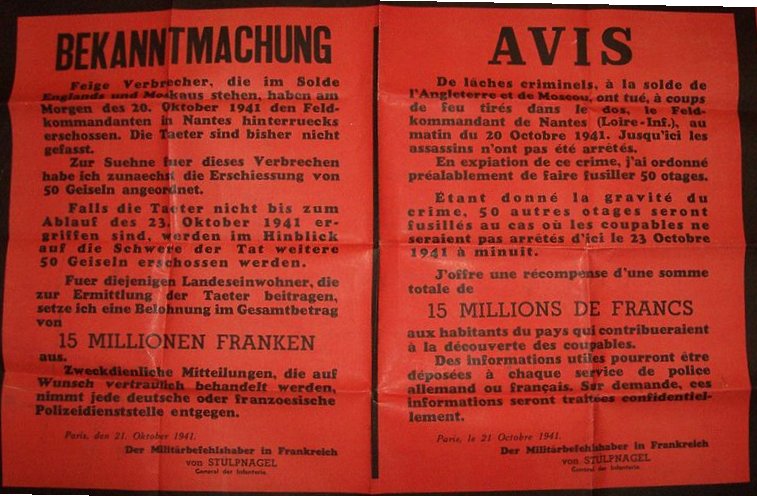
On October 20, 1941 — sixteen months into the German occupation — a pair of Communist commandos assassinated the Feldkommandant of Nantes, Lt. Col. Karl Hotz (French link).

News of this crime went straight to Adolf Hitler himself, who personally ordered a fearful reprisal.

The list of the executed hostages as published Oct. 23 in L’oeuvre

Accordingly, the collaborationist Petain government was induced to select 50 persons from among the ranks of detained German political prisoners. Pierre Pucheu, who would later be executed himself,* intentionally selected Communist types in an effort to confine the retaliation to fellow-travelers.

On this date, those 50 — well, 48, but who’s counting?; the numbering can get dodgy in these mass-execution scenarios — were put to death at three different locations: five at Fort Mont-Valerien; sixteen at Nantes; and most notoriously, 27 internees of Choisel (French link) at Chateaubriant.**

In three different batches of nine, the 27 reds and trade unionists were fusilladed into the ranks of Gallic martyrdom. They remain among the most emblematic French martyrs of the occupation; there’s a cours des 50-Otages named for them in Nantes, and various streets that bear individual victims’ names — such as Rue Jean-Pierre Timbaud in Paris. (Timbaud was a Communist steelworker.)


Monument to the martyrs of Chateaubriant. Image (c) Renaud Camus and used with permission.

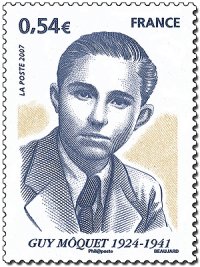
The youngest, 17-year-old Guy Moquet (you can find his name on the Paris Metro) was the son of an exiled Communist parliamentarian (French link).

He made headlines in 2009 when current French President Nicolas Sarkozy had added to the educational curriculum the reading of Moquet’s brave-but-sad last letter to his family: the decision drew some rather mean-tempered fire because of Moquet’s political persuasion. In the end, the text bore a fairly universal reading that could play inoffensively to posterity — like its postscript injunction,

“You who remain, be worthy of the 27 of us who are going to die!”

There’s a thorough roundup of the Oct. 22 executions (including poetic tribute) here.

* Vindicating Winston Churchill’s prophecy to the Times upon receiving news that “These cold-blooded executions of inocent people will only recoil upon the savages who order and execute them.” (Oct. 25, 1941, as cited in the The Churchill War Papers, vol. 3)

** Fifty more were supposed to be executed if the assassins weren’t promptly turned in, but that second batch never took place. (There was, however, a different batch of 50 executed on October 24 in retaliation for a different political assassination. Maybe they just all ran together.)

Part of the Themed Set: Illegitimate Power.

On this day..

1803: Thomas Russell, the man from God knows where

On this date in 1803, Irish revolutionary Thomas Russell was hanged at Ireland’s Downpatrick Gaol.

Russell was such a republican original gangster that as a young junior officer in the British army in the late 1780s, he refused to eat sugar because it was the product of the empire’s slave plantations. (Hardly a bygone issue.) And while his own family was Anglican, Russell was also a staunch supporter of the then-radical (to Anglicans) position of Catholic equality.

For Russell, this personal stuff was all most intently political. And his politics in no way ended with the dumbwaiter.

After leaving the army, he fell in with Irish separatists and in 1795 co-founded the United Irishmen movement, along with a lot of other guys who would wind up in these executioners’ annals. He joined Henry Joy McCracken, Wolfe Tone, and Samuel Neilson in a convocation of Celtic martyrs atop Belfast’s Cave Hill to pledge one another “never to desist in our effort until we had subverted the authority of England over our country and asserted her independence.”

Subversion was Russell’s game for the remaining years of his life; his Letter to the People of Ireland unveils a Tom Paine-like vision of a revolutionary world — a world that the ancien regime would remain violently vigilant against in the wake of the recent French example. Like many of the most dazzling egalitarian dreams of that insurrectionary moment at the end of the 18th century, it’s still never been realized.

Great pains have been taken to prevent the mass of mankind from interfering in political pursuits; force, and argument, and wit, and ridicule, and invective, have been used by the governing party, and with such success, that any of the lower, or even middle rank of society who engage in politics, have been, and are, considered not only as ridiculous but in some degree culpable … Those insolent enslavers of the human race, who wish to fetter the minds as well as the body, exclaim to the poor, ‘mind your looms, and your spades and ploughs; have you not the means of subsistence; can you not earn your bread … leave the government to wiser heads and to people who understand it, and interfere no more!’

-Russell, Letter to the People of Ireland

Russell actually spent most of his final decade imprisoned without trial while tragic Irish insurrections came and went. England finally released him to Hamburg in 1802, and as might be expected, Russell was so itchy by then to get back in the scrap that he immediately broke his parole to return to Ireland for the next available rising.

And as also might be expected, he showed more haste than discrimination in his project. Hey, he did vow “never to desist.”

He joined up with Robert Emmet‘s rebellion — another doomed patriot; Russell was his designated organizer of the north — but found little success canvassing for potential rebels and took the field on July 23, 1803 in a gesture of little more than hopeless romanticism. His band fell apart and fled without a shot fired.


Memorial plaque in Downpatrick commemorating Russell’s execution. (cc) image from Ardfern.

The British did what the British always did and hunted down the Irish rebel, while the Irish did what the Irish always did and stuffed his remains in a ballad.* It’s called “The Man from God Knows Where” — and God knows, two centuries later, where that man has gone.

Whiles I said “Please God” to his dying hope
And “Amen” to his dying prayer,
That the Wrong would cease and the Right prevail.
For the man that they hanged at Downpatrick Jail
Was the Man from God-knows-where!

Peter Linebaugh, author of the indispensable scaffold social history The London Hanged, surveyed Russell’s life and times on the occasion of his 200th death-day here

* Russell tried his own hand at verse, and some Jacobin lines in his hand helped to hang him, e.g.

Proud Bishops next we will translate
Among priest-crafted martyrs;
The guillotine on Peers shall wait,
And Knights we’ll hang in garters;
These Despots long have trod us down,
And Judges are their engines;
These wretched minions of a crown
Demand a people’s vengeance.

Part of the Themed Set: Illegitimate Power.

On this day..

2009: Four Tibetans

On this date in 2009, China executed four Tibetans widely considered political prisoners.

The previous year, widespread unrest over Chinese control had shaken the country, most notably riots in the capital, Lhasa that targeted Chinese persons and shops.

(There’s a BBC page preserving a good deal of the original coverage here.)

Loyak, one of those executed Oct. 20, 2009.

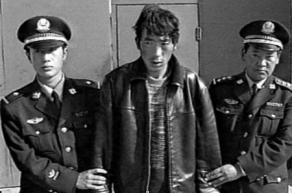
The two most prominent prisoners — in fact, the only two confirmed in some of the first media reports — were Lhasa residents Lobsang Gyaltsen and Loyak. A court spokesperson said both had been “given death penalties had committed extremely serious crimes and have to be executed to assuage the people’s anger.”

Specifically, both had been convicted of torching shops during the Lhasa riots, which arsons both led to deaths.

The other two executed, a woman named Penki (also for arson) and an unnamed man, received less comment, although they might have been executed despite having been condemned only to a “suspended” death sentence, which for China is generally no death sentence at all.

Executions in Tibet turn out to be relatively rare; these were the first known Tibetan executions since early 2003. Widely condemned abroad, this date’s events were barely or not at all reported internally by Chinese state media.

Part of the Themed Set: Illegitimate Power.

On this day..

1973: 14 during the Caravan of Death

Fourteen early-morning executions in Chile on this date in 1973 heralded the end of one of the Augusto Pinochet dictatorship’s most notorious human rights abuses: the Caravan of Death.

For this “caravan” picture not camel-borne spice traders but a helicoptering death squad. In the bloody aftermath of Pinochet’s September 11, 1973 coup against the elected socialist government, the new strongman’s buddy Gen. Sergio Arellano Stark took this evil-omened chopper on a south-to-north tour from prison to prison beginning September 30 — leaving its wares behind at each stop, in the form of spent shells and murdered men.


Arellano and Pinochet were all hugs hours before the caravan departed.

The intended consumer of this murderous spectacle, according to the human rights organization Memoria y Justicia, was as much the military itself as it was the political opposition. “One of the reasons,” said one officer at Arellano’s very first stop,

was to set a drastic precedent in order to terrorize the presumed willingness of the Chilean people to fight back. But without a doubt, it was also intended to instill fear and terror among the commanders. To prevent any military personnel, down to lowest ranking officers, from taking a false step: this could happen to you!

And indeed, several officers were also sacked along the way, a couple even imprisoned and tortured. Their lenient treatment of presumed subversives constituted “failure to fulfill military duties”: one can readily imagine the impression made upon junior officers in Pinochet’s armed forces.

Said subversives had it worst of all, of course.

These were people already in prison, many having voluntarily turned themselves in upon request after the coup; they were drug out of cells in the dark of night and machine-gunned, or worse. Close to 100 defenseless political detainees died this way over a three-week span.

The Caravan reached Antofagasta on October 18, where Gen. Arellano was received by the zone chief Gen. Joaquin Lagos.

Arellano’s unit did its dirty work overnight: the names of its 14 victims on this date’s early hours are recorded here. One was an 18-year-old student, one a 66-year-old “maritime worker”. Several were figures in local government.

Lagos was horrified the next morning when he discovered what his guests had been up to — and he immediately gave Pinochet his resignation.

I felt hurt, powerless and angry [Lagos later said] that a criminal action of this nature that had been committed in my jurisdictional zone and behind my back.

Lagos had the juice to make this sort of gesture without winding up in prison himself: indeed, he gave Pinochet his resignation (and the reason) personally.

Though Lagos has said that Pinochet seemed much more concerned about his (Lagos’s) attitude towards the atrocity than the atrocity itself, he (Lagos) also remembers Pinochet placing a call to Gen. Arellano and, not reaching him, leaving his nomadic deputy a message “not to do anything more.” The Caravan did stop on Oct. 22: maybe, Lagos’s resignation did the trick, at least to the extent one can attribute any cause to the cessation. This outcome will always rate a bullet point on the brief against the “superior orders” defense.

Relatively speaking, these unfortunates are only one puddle of blood among seas from the Pinochet years. Still, the Caravan of Death in particular was (and still is) a focus of the indictments handed down against him after the return of civilian government, thanks in no small part to Gen. Lagos’s willingness to go on the record about it — and as a result, many of the legal maneuvers around Pinochet in the last years of his life, both in Europe and Chile, concerned this horrible affair.

Pinochet finally died in December 2006 while under house arrest for two specific Caravan of Death murders. While alive, however, his legal team predictably attempted to blame local commanders for the Caravan’s atrocities; in response to this gambit, Lagos went public on television with his version (which human rights organizations also tend to credit) — along with horrifying descriptions (Spanish link) of the death squad’s activites that left him too “ashamed” to return the victims’ remains to their loved ones.

They were torn apart. They were no longer human bodies. I wanted to at least put the bodies back together again, to leave them more decent, but you couldn’t.

They cut eyes out with daggers. They broke their jaws and legs

They shot them to pieces, first the legs, then the sexual organs, then the heart, all with machine guns.


From an entire album that Dark Order devoted to the Pinochet dictatorship.

Part of the Themed Set: Illegitimate Power.

On this day..