Called Court on Philip, a negro slave of Henry Garrett, and formerly property of Major Thomas Johnston, of Louisa County, charged with murdering Alexander Hunter, of Augusta County, and wounding the wife of Samuel Henry.–Guilty and to be hanged on 16th April next at 10 o’clock a. m. His value is fixed at £65.
With Egyptian President Hosni Mubarak’s recent unwilling separation from power, we remember today how he got into power in the first place — for this was the execution date in 1982 for the assassins of his predecessor, Anwar Sadat.
Sadat led Egypt through the turbulent 1970s, fighting a war against Israel and then making peace with its Jewish neighbor to regain the Sinai, and generally proving himself more adept at the job than many had assumed.
But the secular dictatorship was increasingly afflicted by that then-emerging, now-familiar specter, Islamic fundamentalism — specifically aggrieved by those Camp David Accords, but also confronting Sadat’s neoliberal economic realignment and political disaffection.
At an October 6, 1981 military parade, Islambouli led an orchestrated hit, leaping from military vehicles to bombard the presidential dais with grenades and automatic weapon fire.
Sadat was dead before he reached the hospital, and his office assumed by his vice president — Hosni Mubarak.
Unsurprisingly, he played rough with the assassins.
A military tribunal ultimately convicted 22 people of participating in the plot, sentencing five to death. While the state press was obviously supportive of the verdict,
Many Egyptians interviewed by Reuters considered the death sentences fair. “It is up to President Mubarak now to show his people that terrorism is unacceptable in Egypt by approving the sentences”, a shopkeeper said.*
And Mubarak did … albeit carefully.
Five self-proclaimed Muslim fundamentalists convicted of assassinating President Sadat of Egypt were executed at dawn today hours after their plea for mercy had been rejected by President Mubarak.
The two assassins who had been in the Army were executed by firing squad and the others, civilians, were hanged at a remote military base outside Cairo …
News of the executions was carried briefly on Cairo radio, then dropped from subsequent broadcasts. The evening newspaper did the same, an indication that the authorities may be sensitive to possible public reaction, Muslim fundamentalism being widespread in all the Egyptian universities.**
The precaution was, perhaps, well-taken.
Muslim fundamentalism would gain steam in Egypt during the years ahead, drawing a severe state response.
Islambouli’s younger brother Showqi almost accomplished an all-in-the-family twin killing by coming within a whisker’s breadth of assassinating Mubarak in 1995. The family name is still honored in the breach by other Muslim militants: there’s an “al-Islambouli Brigades of al-Qaeda” in Pakistan and an “al-Islambouli Brigades” in Chechnya.
* London Times, March 8, 1982
** London Times, April 16, 1982 (under an April 15 dateline)
This date in 1647 marked the execution of five supposed witches in Trentino.
Secular and modernist as this grim site‘s curators confessedly stand, we have perhaps given too little credence to those devout officers of the law who labored in those years to uphold the throne of heaven besieged by Satan’s varied earthly minions.
Montague Summers
In an effort to balance the record, we present this date’s account as rendered by a guy who took the supernatural a bit more seriously: Montague Summers.
Summers is a weird figure, but if he wasn’t really a throwback believer in Rome’s phantasmagoric early modern theology, he was the century’s most sublime performance artist.
Converting to Catholicism as an Anglican deacon, he went about in spooky clerical robes although his ordination status remains unclear to this day, immersed his capacious mind in supernatural arcana, and penned voluptuously eloquent books credulously treating the spectral evidence another era had given against sorcerers, vampires, lycanthropes, and suchlike habitues of the Monster Manual.*
I have endeavoured to show the witch as she really was -– an evil liver: a social pest and parasite: the devotee of a loathly and obscene creed: an adept at poisoning, blackmail, and other creeping crimes: a member of a powerful secret organization inimical to Church and State: a blasphemer in word and deed, swaying the villagers by terror and superstition: a charlatan and a quack sometimes: a bawd: an abortionist: the dark counselor of lewd court ladies and adulterous gallants: a minister to vice and inconceivable corruption, battening upon the filth and foulest passions of the age.
Summers projected (perhaps intentionally) a mysterious and vaguely sinister persona and did not disdain to cultivate a friendship with nefarious occultist Aleister Crowley, his contemporary. There were even rumors of an unwholesome interest in pederasty.
We’re confident that none of this has done his sales a bit of harm. So who are we social pests and parasites of the blogosphere not to batten upon it ourselves?
The below is drawn from Summers’ The Geography of Witchcraft — and as the reader will perceive, Geography at least purports to treat the flying-off-to-infernal-orgy stock in trade of those bygone witch hunters as legitimate evidence of the lead crone’s “attendance at the Sabbat, sometimes, no doubt, an experience on the psychic plane, for she was undoubtedly a medium of unusual powers, and sometimes in actual fact.”
A typical case of Witchcraft, and one which owing to its prominence and the meticulous investigations of the authorities has luckily been reported in full, attracted considerable attention in the winter of 1646 and the following spring. It will, moreover, be found to present so many factors and features, which occur again and again in the contemporary trials of wellnigh every European country, that it may profitably be dealt with in some detail.
A certain old woman of Castelnovo, Maria Salvatori, nicknamed “la Mercuria,” who had long been suspected of sorcery, was arrested on 26 October, 1646, and formally examined. At first the two principal charges, sufficiently damning in themselves, seem to have been that at her communions she did not swallow the Sacred Host, but kept It in her mouth to spit It out secretly and reserve It for some abominable purpose, and also that by her ecbolic spells she had caused the young Marchesa Bevilacqua to miscarry in childbirth. She was again interrogated on 8 November and put to the torture of the cord when she accused Domenica, the widow of a certain Tomaso Camelli, and Domenica’s daughter, Lucia, the wife of Antonio Caveden, both of whom dwelt at the hamlet of Villa, of being rank witches. She also avowed she had taken a Host from her mouth to give to Lucia Caveden, who thereby confected a charm which caused the abortion of the Marcioness. She added that she had also bewitched Cristoforo Sparamani, the son of Cecilia Sparamani, and that a certain Delaito Cavaleri was a necromancer and a worshipper of Satan. A further interrogation followed on 15 November, as a result of which the court, consisting of Paride Madernino, delegate in all criminal and civil cases in the districts of Castelnovo and Castellano, and his assessor Giovanni Ropele, doctor utriusque iuris, promptly gave orders to GiuseppeCoriziano, “bargello di questa turia,” to arrest Domenica and Lucia. This was done, and on Saturday, 24 November, 1646, at Nogaredo, the proceedings against the witches were formally opened. “Processus Criminalis pro destructione lamiarum.” On 27 November Domenica Carnelli was questioned by the judges, but they got little enough out of her. Two days following Lucia Caveden was brought before the tribunal. She vehemently declared that the charges were all malice; the hag Salvatori was her enemy; and with many cries she called Heaven to witness her innocence, repeatedly exclaiming “per grazia del Signor Iddio no son una stria” But the next day she proved less firm and implicated yet another woman, Domenica Gratiadei, who was immediately thrown into prison, a number of suspicious objects being found in her house when it was closely searched by the officers. Certain pots of a dark unguent and a mysterious powder being produced in court, Lucia Caveden confessed that these were for the destruction of human life and cattle. Seeing that the game was up Domenica Gratiadei, upon being put to the torture, soon laid bare all the secrets of the infernal sisterhood. She had made this unguent with which she annointed herself to attend the Sabbat “trasformata in gatto,” she had cast the evil eye on Cristofero Sparamani, she had renounced her baptism, defiled the Blessed Sacrament, adored Satan with divine honours. The judges were filled with horror, and trembled at the hideous tale of diabolism these women poured forth. Cecilia Sparamani, a plain honest woman, was next summoned as a witness and told how her son fell into fits of no ordinary kind. The doctors had acknowledged their skill baffled, and in spite of the prayers of two Capuchin fathers and the exorcisms of Monsignore the Bishop of Brondolo, this preternatural sickness still persisted. She informed the court that as soon as summer came and the roads were passable she intended to take the boy to the shrine of S. Antony at Padua, to whom she had a special devotion.
On 18 December, 1646, Benvenuta, the daughter of Domenica Gratiadei, made a startling confession. She declared that she had been taken by her mother “as if in a dream” to a place where there was dancing and singing, where she had been welcomed by a large number of revellers, and especially by a young man, who having kissed and fondled her awhile afterwards had connexion with her. This was, her mother averred, Satan himself. When closely questioned as to these proceedings the girl could only reply: “Tutto mi sembra, come ho detto, un sogno: e parevami che sempre vi fosse il diavolo in forma di quel giovene.” It would seem from these very striking and significant words that the girl was a hypnotic subject, entirely under her mother’s control, and that on these occasions she passed into a semi-trance state. The case dragged on throughout the months of January and February, 1647. There were interminable interrogations, and a large number of persons were gradually implicated.
On 2 January 1647, Domenica Gratiadei gave a detailed description of the Sabbats she had attended. She and an old warlock named Santo Peterlino always led the coven. “The rest followed in the shape of cats; but the Devil went first of all.” They enjoyed banquets, dances, plays, music, songs, and afterwards all worshipped Satan, presenting him with Hosts which they kept from their last communion. Before attending the Sabbat she anointed herself with an unguent made of “the Blessed Sacrament, the blood of certain small animals, Holy Water, the fat of dead babies” which was mixed with horrible imprecations and blasphemies to confect the charm.
On 10 January, a strange figure, Maddalena Andrei, nicknamed “La Filosofa,” first appears in the case. She confessed that she had assisted in the making of the ointment and had also adored the Devil who frequently appeared to her, “brave, like a gallant captain, dressed all in red.” On 9 March, when Giuseppe Goriziano entered the cell of La Filosofa to summon her to court he found her lying dead upon the floor. The common people believed that she had been carried off by Satan, especially as the Archpriest of Villa, Don Giovanni Bragliardi, shrewdly suspecting that the unhappy woman had committed suicide, refused her sepulture in consecrated ground.
This long and complicated Witchcraft-trial at length came to an end in April 1647. The court was throned with an excited yet hushed crowd, when the judge Paride Madernino and his assessors the Counts of Lodrone and Castel-Romano delivered the sentences. Domenica Camelli, Lucia Caveden, Domenica Gratiadei, Catterina Baroni, Zinevra Chemola, Isabella and Plonia Gratiadei, and Valentina Andrei were condemned to death. Maria Salvatori, “la Mercuria,” and Maddalena Andrei, “la Filosofa” had expired in prison. The condemned were beheaded and their bodies burned. It would seem, however, that Isabella and Polonia Gratiadei and Valentina Andrei managed to escape and could not be traced. The execution of the rest took place on 14 April, 1647, when Leonard Oberrdorfer the common hangman carried out the judicial sentence.
The chief witches here naturally fall into four groups each constituted of one old and one young woman, Domenica Camelli and Lucia her daughter; Domenica Gratiadei and Benvenuta her daughter; Isabella Gratiadei and Plonia her daughter; Maddalena Andrei and her daughter Valentina. The chief of the coven was undoubtedly Domenica Gratiadei, whose vile confessions, a mixture of most horrid blasphemies and lewdest obscenity, convince her of being a wretch wholly devoted to evil, and an active propagandist of the Satanic cult. It was she who had debauched her own daughter to “the Devil,” that young man whose name and individuality do not appear, but who may be guessed to have been a noble of the district, using the witches for his own ends and, presumably, supplying them with money to carry out his dark designs. That the whole gang frequently attended the Sabbat, at which he was not unseldom present, there can, I think, be no question.
This case is recounted in much greater detail in Italian in this Google book; this page has another summary, also in Italian.
* “[I]n every way a ‘character,’ and in some sort a throwback to the Middle Ages,” the London Times blurbed Summers at his death (obituary in the Aug. 11, 1948 issue). But his “preoccupations with the supernatural, however, represented only one side of his nature. His solid services to learning lie rather in his copious editorial and critical work on the English Restoration drama — a field in which he possessed the most comprehensive and expert knowledge.”
For exemplars of the stuff more topical to this post, one can also peruse free online his The Vampire: His Kith and Kin and his translation of the notorious witch-persecution manual Malleus Maleficarum.
On this day in 1942, Sergeant Anton Schmid was executed for high treason. His crime: saving the lives of Jews in Nazi-occupied Vilna, Poland (now part of Lithuania and called Vilnius).
Schmid was born in Vienna and owned a radio shop there before he was drafted into the German Army following the Anschluss in 1938.
After Germany’s invasion of Russia in mid-1941, Schmid was put in charge of a unit in Vilna, tasked with collecting and reassigning soldiers who had been separated from their units. He witnessed the sufferings of the Jewish population in the Vilna Ghetto and was so horrified, he decided to take action.
Schmid used his position in the military to help Jews by employing them as workers for his unit, forging papers to get them out of prison and out of the ghetto, and using Army trucks to escort them away from the city.
At great personal risk, he would go into the ghetto to hand out food and warn the inhabitants when the Germans were planning roundups. In dire situations he would even hide people in his own apartment to protect them from the Nazis. He maintained close contact with Jewish resistance organizations and assisted their activities in a variety of ways.
According to one account by a Jewish woman who was herself killed later in 1942,
[Schmid] would mock the Jews and say how easily they could be fooled, and at the same time tried to find out what the Germans were planning. As soon as he learned something new, he would tell his Jews and order them to tell their friends so that they could hide until the situation stabilized … He negotiated on their behalf like a dedicated father, without fear of being punished if he was found out. He put them in his working place and provided them with food and drink. He gave them soup and bread. In short, in those chaotic days of massacres he managed to save dozens of Jews …
Although the Jewish Underground warned Schmid that his activities had become too widely known and he was in great danger, he refused to put a stop to his effort to save the Vilna Jews. In response to their concerns he reportedly said that if given a choice between “living as a murderer and dying as a rescuer,” he would choose to die.
He saved an estimated 250 to 300 people before his arrest in January or February 1942.
At his court-marshal, his attorney tried to say Schmid had taken the Jews out of the Vilna Ghetto because he thought they could better serve the Reich elsewhere. Schmid refused to allow this, however, openly proclaiming that he had been trying to save Jewish lives. He was convicted on February 25 and sentenced to die.
In a letter to his wife and daughter, just days before his death, he tried to explain himself:
Here there were a great many Jews who were being rounded up by the Lithuanian militia and shot to death in a meadow outside the city, groups of 2-3,000 at a time. On the way there, they were smashing children against trees and such like. You can imagine how I felt … You know how I am with my soft heart. I couldn’t think otherwise and helped them… This is a heavy blow for us, but please forgive me. I was just behaving like a human being and didn’t want to hurt anyone.
In 1967, twenty-five years after his death, Schmid was honored as a Righteous Gentile by Yad Vashem. His widow attended the ceremony on his behalf and accepted a medal reading “Whoever saves one life, saves the entire world.”
On this date in 1967, Aaron Mitchell was gassed in California on the authority of a governor holding his first elected office — Ronald Reagan, future U.S. president and emerging avatar of conservative white ressentiment in the turbulent 1960s.
It was only 23 days after California’s last previous execution, in January 1963, that Mitchell killed a white cop during a shootout occasioned by his abortive bar robbery. He’d been on death row fighting execution ever since, with a few dozen others who had been there even longer.
That gummed-up death penalty process, for which the Golden State is so well-known today, was most vividly symbolized at the time by the 12-year death row odyssey of Caryl Chessman.
And it had been among the many grievances catalyzing a conservative backlash against the civil rights movement, the Great Society, anti-war protesters, permissive social mores … the whole aspect of Sixties counterculture and American liberalism.
Ronald Reagan was born to wield the sword against it all. The sword, or some little cyanide pellets.
Reagan, a film actor, had cut his political teeth as a spokesman for General Electric and against commie plots like Medicare.
After famously backing the failed 1964 presidential bid of Barry Goldwater, Reagan emerged as the favored son of the New Right, and in his first foray into electoral politics, steamrolled over incumbent Democrat Edmund Brown in California’s 1966 gubernatorial election.
Reagan had an undoubted gift for packaging the sometimes unpalatable ennui of his potential constituencies into soundbites that respectable people could repeat in public, which talent proved essential to his bright political future.
“Why is it,” he demanded during the campaign, “that no street in our city is safe for women after dark?” (Los Angeles Times, September 21, 1966) Stung by Republican attacks on rising crime rates, Gov. Brown had vainly pushed a tough-on-crime platform of his own in 1966.
Too little. Too late.
“Mr. Reagan is outspokenly in favor of capital punishment and he has just been elected by a tremendous majority,” said Jesse James Gilbert, 41, who has languished on Death Row for two years.* “If the courts begin to reflect his thinking, he will be in a position to become the greatest butcher governor in history.”
–Los Angeles Times, Dec. 4, 1966
What a different world it was from today’s that a major paper unabashedly used a death row prisoner’s own voice for analytical comment. Still, that same article noted (not in Gilbert’s voice, but as a plain fact on the ground) that “even a single execution could endanger Reagan’s chances for reelection or stifle voices which are beginning to urge him to seek the Republican Presidential nomination in 1968 or 1972.” A different world indeed.
Reagan had outspokenly run on capital punishment, however, and there’s such a thing as feeding your base. He surely was not going to execute nobody.
Mitchell was the man in line, and he certainly fit that not-safe-to-walk-the-streets-at-night angle, if you catch the drift. In an Ebony (June 1967) profile of his last days, Mitchell emerges at once radicalized and resigned, his four years awaiting death spent “researching and studying the race problem.”
“Every negro ever convicted of killing a police officer has died in that gas chamber,” Mitchell said on the day of his death. “So what chance did I have?”**
When the aide in charge of the clemency application is overtly pro-Scrooge future Attorney General Edwin Meese … not much chance, no.
So on this date, and in spite of an energetic protest outside San Quentin, a suicide attempt inside it, an open line to the governor’s office just in case, and a hysterical mother (who fled Mitchell’s clemency session in tears two days before, complaining that it was “a sham hearing”), Mitchell became the 501st person put to death since the state moved all executions from county auspices into state prisons.†
The 502nd would not take place until another quarter-century had elapsed.
Cold comfort to Mitchell, but Reagan himself did not vindicate Jesse Gilbert’s worst fears, and did not present the execution rubber-stamp of a later political generation; for his time and place, being visibly willing to approve some executions amply proved his credentials. (Newsweek called the governor a “man of conviction” after the Mitchell execution. (Source) Mission accomplished.)
Reagan would stay the next death date on his watch, that of Daniel Allen Roberts, over questions of mental competency; later in 1967, he would do the same for Robert Lee Massie just hours ahead of execution so that Massie could testify in another trial, inadvertently providing a bullet point in the conservative critique of death penalty squeamishness.
And in the event, the Great Communicator would be spared any great need to answer for a significant slate of individual clemency decisions. It was judicial activity far more than executive reticence that stayed the hand of California’s executioner; only one more execution after Mitchell’s took place in all of the U.S. before the country slipped into a complete death penalty moratorium from which it would not emerge for another decade.
And when the Reagan-appointed California Chief Justice Donald Wright authored a 1972 opinion striking down that state’s death penalty laws, it emptied death row outright.‡ (Sparing, among over 100 others, Charles Manson and Sirhan Sirhan.)
Capital punishment is impermissibly cruel. It degrades and dehumanizes all who participate in its processes. It is unnecessary to any legitimate goal of the state and is incompatible with the dignity of man and the judicial process. Our conclusion that the death penalty may no longer be exacted in California consistently with article I, section 6, of our Constitution is not grounded in sympathy for those who would commit crimes of violence, but in concern for the society that diminishes itself whenever it takes the life of one of its members. Lord Chancellor Gardiner reminded the House of Lords, debating abolition of capital punishment in England: “When we abolished the punishment for treason that you should be hanged, and then cut down while still alive, and then disembowelled while still alive, and then quartered, we did not abolish that punishment because we sympathised with traitors, but because we took the view that it was a punishment no longer consistent with our self respect.”
That would not stand as the final word on capital punishment in California, but by the time other condemned prisoners had come to the end of their appeals, they were the concern of different governors.
Reagan left the California governor’s mansion in 1975 during the death penalty’s long hiatus; as U.S. president from 1981 to 1989, the death penalty was only just coming back online from that period, and that at the state level. Beyond platitudinous approval of the trend, Reagan never had to put his own signature on a federal death warrant.
So as it turned out, Aaron Mitchell was the first, last, and only man so distinguished.
And Reagan’s minuscule career execution count was hardly the anomaly that it might now appear. Prior to Reagan, the last Chief Executive who had actually entered the White House having previously forwarded any fellow to the executioner was … Dwight Eisenhower.
* Gilbert is the appellant in the 1967 U.S. Supreme Court decision Gilbert v. California, reversing his conviction because of a police lineup identification unconstitutionally obtained without his lawyer’s knowledge.
** The cop-killing Mitchell wasn’t getting any love from the beleaguered Brown administration, either; Brown almost had a shot to pull a Ricky Ray Rector with Mitchell during the campaign, but the prisoner won a judicial stay just 24 hours from execution in May 1966.
The now-former governor was quoted after Mitchell’s actual 1967 execution expressing general support for Reagan’s non-clemency in spite of Brown’s own philosophical opposition to capital punishment.
† A journalist who witnessed the gassing later described it as something less than a triumph of the killing arts.
as the gas hit him, his head immediately fell to his chest. Then his head came up and he looked directly into the window. For nearly seven minutes he sat up that way, with his chest heaving, saliva bubbling between his lips. He tucked his thumbs into his fists, and finally his head fell again … I believe he was aware many minutes … He appeared to be in great anguish
‡ “A mockery of the constitutional process,” fumed (pdf) Reagan, who claimed that Wright had told him he backed capital punishment. (See Governor Reagan: His Rise to Power)
On this date in 1705, another century’s supposed terrorist was hanged on Leith Sands with two of his “pirate” crew by a Scottish court “drunk with patriotic prejudice.”*
This execution took place in the feverish run-up to England and Scotland’s Acts of Union welding the neighboring realms into Great Britain in 1707.
Arising as it did from the same causes that animated that national marriage of convenience, Green’s execution also endangered it: Daniel Defoe, who was at this time a pro-Unionist mole (and prolific pamphleteer) for English pol Robert Harley, described this hanging as one of the six crises that had to be overcome en route to the Union.
A Man, A Plan, A Calamity
Panama.
That’s where it all started, for Green and Union alike.
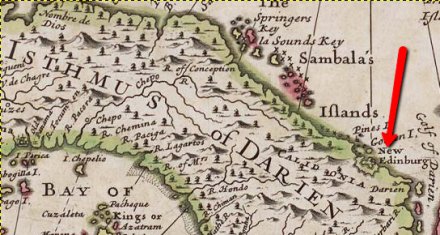
Mired in economic backwardness as neighboring European states carved up the world, Scotland made a bold, doomed bid for a chit in the empire game: the Darien scheme. One part visionary and (at least) two parts daft, this venture attempted to establish a Scottish colony on the Isthmus of Panama (aka the Isthmus of Darien) with a view to porting freight across the narrow strip of land separating Atlantic and Pacific, and dominating the dramatically more efficient east-west trade route that would result.
Students of the Panama Canal project will be aware that this malarial tropic would not be described as especially hospitable; to the natural disadvantages of the climate were added the political interpositions of England herself, whose hostility to the advent of her Caledonian neighbor as a New World rival was expressed in legislation choking the Darien adventure of foreign aid.
(Also a problem: Spain. The colony was abandoned at last under Spanish siege.)
So Scotland went it intrepidly, injudiciously alone in this last bid for real independent muscle in Europe. The hyperbole of the Isthmus’s publicists eventually sucked in 20 percent or more of the capital circulating in Scotland. And when Darien-dot-com went bust by 1700 at the cost of a couple thousand lives, it cratered the Scottish economy too. That set the stage for Edinburgh’s partnership in a different scheme: Great Britain.
Green with Envy
In the years following the Darien catastrophe, the Scottish corporation chartered to undertake it was still throwing stuff against the wall in the world trade game, trying to get something to stick to at least take the edge off the losses.
This company (theoretically a potential rival of England’s own East India Company) had suffered the further national indignity of having one of its ships, the Annandale, seized in the Thames for infringing the East India Company’s royal monopoly. Its appeals for redress falling on deaf ears, the Darien company apparently induced Scottish authorities to undertake the retaliatory seizure of an English merchant ship, the Worcester, that had the ill luck to weather a storm at the Firth of Forth.
Rumor soon connected this ship to another vanished Darien company vessel overdue from its return trip from the East Indies … and, as it quickly became understood by all right-thinking Scots, overtaken in the Indian Ocean by this same Worcester and its crew butchered.
Captain Thomas Green and his English crew were hailed before an Admiralty court** on piracy charges on this extremely fantastical connection in a virtual mob atmosphere.
It never was clearly established that an act of piracy had been committed as a distinct fact, but by putting certain circumstances together it was inferred that Green was guilty of piracy. The very shape in which the accusation is set forth, shows that the accusers could not point to the specific act of piracy which had been committed …
[There] was no specification as to the vessel taken, which might enable the accused to prove that it had not been taken; no names of parties murdered, who might be shown still to be alive; no ownership of cargo, which might admit of proof that the owner’s goods had arrived safe. As Green himself is made justly to say in the document published as his dying speech, “We are condemned as pirates and murderers on a coast far distant from this place — is there any of you who wants either a friend whom we have murdered, or whose goods we have taken?”
Worcester Sauce
The Worcester‘s Malabari cook provided a highly dubious charge — dubious, for he was not yet among the crew when it last called at the location he claimed the crime took place — of Green and crew hatchet-murdering approximately ten English-speaking mariners on an unnamed vessel off the Indian coast.
Upon this evidence, 14 or more members (the ready sources are a little loose on the total number) of the Worcester crew were condemned for piracy, and initially slated for three batches of hangings. Queen Anne‘s personal intervention managed a stay,
The Scottish Privy Council unto the very last hours debated what to do with the diplomatic appeals, with evidence forwarded from London to the effect that the crew these Worcester men had supposedly slaughtered were alive, their vessel having been hijacked in another place, by another man.
But a surging Scottish mob aggrieved by the preceding years’ misadventures and the impending shotgun marriage to Westminster rather than anything Green himself had really done was already engorged on the blood of the supposed English corsairs. Most of the Council thought better than to deny them their sacrifice.†
The Streets fill’d with Incredible Numbers of Men, Women and Children, calling for Justice upon those ENGLISH Murtherers. The Lord Chancellor Seafield‘s Coach happening to pass by, they stop’d it, broket he Sashes, haul’d him out, and oblig’d him to promise Execution should speedily be done before he could get from ’em … According to the Chancellors promise, soon after, on the same Day, being Wednesday, Captain Green, Madder [the mate], and Sympson [the gunner] were brought out, and convey’d to Execution, which was at Leith Road upon the Sands, and all the way was Huzza’d in Triumph as it were, and insulted with the sharpest and most bitter Invectives. Being come to the place of Execution, Good God! what a moving sight was it to see those Men stand upon the very Varge of Life, just launching in to Eternity, and at the same time see the whole Multitudet ransported with Joy!”
-From an anonymous Letter From Scotland To a Friend in London, quoted by James Kelly, “The Worcester Affair,” The Review of English Studies, Feb. 2000
In the event, these three were the only ones actually hanged; passions cooled enough for the other “pirates” to be quietly released.
But the wider, national passions unleashed by this date’s executions would long provide fodder for intemperate patriotic recrimination, and specifically anti-Unionist propaganda — on both sides of the border.
Competing propagandisticbroadsides framed and re-framed the events, as the affair of unscrupulous English buccaneers or perfidious highland barbarians. (Defoe, maneuvering for Union, wrote to chill such bad-for-business hostility: “Nothing could be more horrid, than that the Scots should Execute these Men on a meer Pique at the English Nation. Nothing can be more like it, than to conclude rashly, that it is so, and improve it on purpose to Exasperate our People against the Scots.” (Kelly))
And that, of course, is precisely the viewpoint that prevailed.
While the hemp neckties issued to Green et al this date threatened to (ahem) scotch the Union project, that very danger might have ultimately hastened its completion — as elites recognized, in Defoe’s words, that Union represented “the only way to preserve the publick Tranquillity, and prevent the certain Mischiefs that threatened the whole Body,” (Kelly, again) and rammed it through with dispatch.‡
‡ The ebb and flow of national resentment continued long after the Acts of Union, of course; continuing Scottish support for the restoration of the Stuart monarchy was one expression of Scottish nationalism and anti-Union sentiment.
“Four days” after an unspecified “early spring” date in George Orwell’s classic allegory of Soviet communism, Animal Farm, a show trial and mass execution of animals purporting to work for the book’s Trotsky figure signals the titular farm’s unmistakable collapse into dystopia.
The farm’s early cooperative elan soon shatters, with a pig bearing the unsubtle name of Napoleon becoming the revolution’s autocrat, and fostering a paranoid security climate against phantasmal plots by his fellow swine and onetime comrade, the exiled Snowball.
Napoleon ordered all the animals to assemble in the yard. When they were all gathered together, Napoleon emerged from the farmhouse, wearing both his medals (for he had recently awarded himself “Animal Hero, First Class”, and “Animal Hero, Second Class”), with his nine huge dogs frisking round him and uttering growls that sent shivers down all the animals’ spines. They all cowered silently in their places, seeming to know in advance that some terrible thing was about to happen.
Napoleon stood sternly surveying his audience; then he uttered a high-pitched whimper. Immediately the dogs bounded forward, seized four of the pigs by the ear and dragged them, squealing with pain and terror, to Napoleon’s feet.0 …
The four pigs waited, trembling, with guilt written on every line of their countenances. Napoleon now called upon them to confess their crimes. … Without any further prompting they confessed that they had been secretly in touch with Snowball ever since his expulsion, that they had collaborated with him in destroying the windmill, and that they had entered into an agreement with him to hand over Animal Farm to Mr. Frederick. They added that Snowball had privately admitted to them that he had been Jones’s secret agent for years past. When they had finished their confession, the dogs promptly tore their throats out, and in a terrible voice Napoleon demanded whether any other animal had anything to confess.
The three hens who had been the ringleaders in the attempted rebellion over the eggs now came forward and stated that Snowball had appeared to them in a dream and incited them to disobey Napoleon’s orders. They, too, were slaughtered. Then a goose came forward and confessed to having secreted six ears of corn during the last year’s harvest and eaten them in the night. Then a sheep confessed to having urinated in the drinking pool — urged to do this, so she said, by Snowball — and two other sheep confessed to having murdered an old ram, an especially devoted follower of Napoleon, by chasing him round and round a bonfire when he was suffering from a cough. They were all slain on the spot. And so the tale of confessions and executions went on, until there was a pile of corpses lying before Napoleon’s feet and the air was heavy with the smell of blood, which had been unknown there since the expulsion of Jones.
When it was all over, the remaining animals, except for the pigs and dogs, crept away in a body. They were shaken and miserable. They did not know which was more shocking — the treachery of the animals who had leagued themselves with Snowball, or the cruel retribution they had just witnessed. In the old days there had often been scenes of bloodshed equally terrible, but it seemed to all of them that it was far worse now that it was happening among themselves. Since Jones had left the farm, until today, no animal had killed another animal.
Animal Farm was published in 1945. In this 1954 British animated feature, the downer of an ending — with the corrupt pig rulers becoming literally indistinguishable from people — was dumped in favor of an ending where the animals revolt again.
On this date in 1868, on the eve of his rout at the hands of a British expeditionary force, the frustrated Emperor Tewodros II had hundreds of prisoners executed en masse.
Our setting is the 1868 British Expedition to Abyssinia, “one of the most expensive affairs of honour in history.” And it all got started from a bad experience with technical support.
Tewodros — generally known to the Europeans as Theodore — had risen from a humble station to the throne of Abyssinia, but by the 1860s held it but tenuously against various rival warlords. Tewodros lodged appeals for aid with a number of European powers, including the British, who evidently took the emperor’s letter for Queen Victoria and stuck it indefinitely in a file called “Pending”.
After two years without an answer, Tewodros took hostage the British consul Charles Duncan Cameron, a missionary named Henry Stern (whose unflattering report of Tewodros’s mean origins particularly enraged the monarch), and other Europeans.
Tewodros, perhaps, had depended on the notoriously treacherous Ethiopian highlands to protect him from any effective reprisal. But when the Brits decided in 1867 to let men with guns resolve the dispute, they spared no expense at all.
Months of planning and millions of pounds were poured into the operation, which landed 13,000 soldiers and 40,000 animals organized by the Bombay Army.
“For a total cost of about £9,000,000,” writes Harold Marcus in a biography of another former Tewodros hostage, the future Emperor Menelik II, “Napier set out to defeat a man who could muster only a few thousand troops and had long ago ceased to be Ethiopia’s leader in anything but title.”
The forces converged on Tewodros’s last stronghold, Magdala, with the mercurial king refusing repeated demands of the invader to release his European captives.
Angrily refusing, at least according to the accounts of the hostages who were the subject of all this … and whose accounts have just enough consciousness of the privilege their own skin has given them as they witness these bloodlettings.
On April 8, the king put to death seven of the native prisoners in his train. These prisoners comprised generally people on the political outs with Tewodros, adherents of once-rebellious chiefs and the families of those adherents. It was no mean thing to slaughter a few of them arbitrarily.
But much worse was to come the following day, when the hunted emperor espied the British advance guard reconnoitering his position.
According to a report by European hostage W.F. Prideaux in the May 21, 1868 London Times, the Emperor
had seen the British troops descending the Bashilo, and had remarked among them four elephants and some white animals, which we surmised to be Berbera sheep. A short time afterwards a friend of ours (for we had a few friends at Magdala) … implored us to keep within our tents, for the King was in a fearful passion, and was then issuing an order to kill all his native prisoners, who were confined in a few houses a couple of hundred yards off. The repeated discharge of firearms, which we heard soon afterwards, confirmed the sad story, and it was with many misgivings that we asked ourselves, “What next?” At dusk, however, the King returned, and we returned to our tents comparatively at our ease. From what I have heard it appears that the King rushed down mad with rage and arackee, and calling out one of the prisoners hacked him to pieces with his own sword. Another speedily met the same fate. The third was a boy about ten years of age. His youth and innocence (for it was his father who had been the offender) were no protection. He was mangled in the same way as the two others. The cutting and slashing went on in this manner for some time, when the King, finding this mode of execution too slow for his impatient spirit, ordered out the musketeers. The remainder were then quickly shot down, and thrown over the low cliff, the force of the shock in several cases opening the chains of the wretched victims. Those whose quivering limbs showed any signs of life were fired on from above till the murderous work was completed.
[W]e were suddenly startled by the sound of an intermittent musketry. … The rattle of musketry blended with the yells of despair, and the shouts of rage fell, however, with an ominous and appalling horror on our ears. “What is the matter?” I inquired of my neighbour. “Hist,” was the response, “the king is killing all the prisoners.” These terrible words diffused an aguish chill through my very heart. … The sun had already disappeared from the horizon, and twilight spread a dismal, dusky hue over the scene around, and still the firing continued unabated. With night it gradually diminished, and then only isolated shots reverberated across the panic-stricken camp.
The slaughter lasted about three hours, and during that interval three hundred and seven human beings* were, unwarned, and perhaps unprepared, hurled into eternity. Some of the prisoners did not unresistingly yield to their woeful doom. One, Immer Ali, a native of Ferga, near the Tzana Lake, formerly a chief of consideration in his province, in spite of hand and foot chains, with a convulsive grasp dragged his executioner towards the precipice over which he was to be hurled. The hangman, who dreaded the doom which he intended to inflict on his fellow man, shouted for help. On hearing the cry the tyrant, tiger-like, sprang forward and with his gory sword literally hacked the man to pieces.
And to hear Stern tell it, it was by dint of nothing but great fortune — or in his view, divine providence — that saved the British hostages from joining them.
One victim after another lay writhing and quivering in the last pangs at the foot of the dizzy precipice, and still the tyrant’s rage was un-appeased. “Bring the white men, and let their blood flow, mingled with that of my own subjects,” was the order that fell from his lips. Already, we were informed, whole bands of ruffians stood prepared to seize the intended prey, when several chiefs, no friends of the foreign captives, stepped forward, and requested that our execution might be deferred till next day. “Your Majesty,” they respectfully remarked, “the white men do not deserve the easy death of the sword and bullet; no, keep them till to-morrow, and then let the slow torture of a flaming hut put an end to their existence.” “You are right,” was the response.
Since the next day was Good Friday, the Christian Tewodros, “though a perfect fiend and coarse blasphemer, repaired, from a superstitious impulse, at a very early hour to church,” Stern says. The decisive British attack began later that day, and would end with the un-executed hostages liberated, and Tewodros taking his own life rather than fall captive.
* The provenance of the very precise figure of 307 is not apparent in Stern’s account; presumably, he knew through his friendly contacts (of from relieving the boredom of captivity in recreational head-counting) the overall number of prisoners beforehand.
On this day in 1943, a working-class German couple were executed for treason and sedition in Berlin, Germany: Otto and Elise Hampel’s reign of postcard-writing terror had finally come to its conclusion.
On the surface, the Hampels seemed like two very ordinary people. Elise had an elementary school education and worked as a domestic servant before she married Otto in 1935. Otto, a World War I veteran six years older than Elise, was a factory laborer.
Two of the treasonous postcards.
They lived modest, anonymous lives in Berlin and doubtless would have continued to do so if Elise’s brother, a soldier in the German Army, had not been killed in action in France in 1940.
Elise’s brother’s death was the catalyst for the Hampels’ tragically brave and utterly ineffectual two-year campaign of resistance against Hitler’s Germany.
Together the couple hand-wrote over 200 postcards and leaflets speaking out against the Nazi regime. The postcards urged people not to serve in the German Army, to refuse to donate to Nazi organizations, and generally do everything they could to resist the government. Otto and Elise scattered the cards in mailboxes, stairwells and other locations all over Berlin. The idea was that people would find the cards, read them and show them others, and thus the seed of rebellion would take root.
What actually happened was that almost all the cards were delivered to the authorities immediately. Nobody wanted to be caught in possession of such dangerous words.
Because of the sheer number of postcards and the long duration of their distribution, the Gestapo at first thought they were dealing with a much larger group of traitors. Doubtless they were frustrated that this riffraff, who couldn’t even write properly (the postcards were full of grammatical errors and misspellings), were able to evade them for so long. But the Hampels’ resistance activities eventually caught up with them.
They were unrepentant after their arrests in October 1942, and had little to say for themselves, beyond Otto’s statement that he was “happy” about protesting against Hitler. Roland Freisler‘s People’s Court duly condemned them to die for “preparation for high treason” and “demoralizing the troops.” They were executed by guillotine in the Plötzensee Prison.
For some reason, unlike their equally courageous, foolish and doomed counterparts in the White Rose, the Hampels’ story didn’t really catch on with historians.
They were saved from oblivion by the dangerously unstable, drug-addicted author Rudolf Ditzen, aka Hans Fallada, who came upon their Gestapo file after the war.
His 1947 novel, Every Man Dies Alone, written in just 24 days, is closely based on Elise and Otto’s story. This book was Fallada’s swan song; he died weeks before its publication. Titled Jeder stirbt für sich allein in Germany, it was not translated into English until 2009 — but it then became a runaway bestseller in the United States and (under the title Alone in Berlin) in Great Britain.
Anne may have become a target of her prominent husband’s enemies; she was first implicated for witchcraft in 1575 when her husband’s uncle dropped dead, clearing the way for Absalon to take his place as bishop.
While she repelled that round of allegations, Absalon himself soon followed his kin into the great hereafter, leaving his widow a bit shorter on political pull. She lived on as a near-hermit, forever shadowed by the intimation of infernal intercourse.
In 1590, Anne’s neighbors, and maid, accused her again; her fate was sealed when a forbidding storm broke during her trial. (So says Witch Hunts in the Western World)
Anne Pedersdotter’s execution has become a literary staple in Norway, with a (highly dramatized) play (available free online here) itself re-stylized into other notable cultural products — such as Danish director Carl Theodor Dreyer‘s 1943 Vredens Dag (Day of Wrath) …


 Schmid was born in Vienna and owned a radio shop there before he was drafted into the German Army following the
  It was only 23 days after California’s last previous execution, in January 1963, that