1638: Four Frenchmen in effigy

We have touched in the past on the odd practice of executing effigies of criminals, a custom for which France had a particular penchant.

On this date in 1638, mannequins of Andre Armand, Gabriel Bonnaud, Sebastien Mareschal, and Simon Armand were “hanged” for murder.

As described in this French text, proceedings were delayed when, the previous November, the wife and mother-in-law of one of the absconded offenders appealed the sentence in their own inimitable way: by vandalizing the mannequins.

Thanks to Sonechka for deciphering the archaic French.

On this day..

1632: Henri II de Montmorency

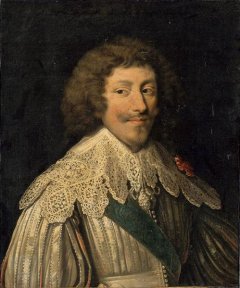
On this date in 1632, French noble Henri II de Montmorency was beheaded at Toulouse for rebellion against Louis XIII.

The lordly Montmorency (English Wikipedia page | French), sister to a famous knockout whom Henri IV wooed, was a Grand Admiral for his achievements knocking heads during the 1620s’ Huguenot rebellions. (It was Montmorency who, in the naval battle to capture Re Island, commanded the English ships controversially supplied by the Duke of Buckingham.)

His undoing? He hated Cardinal Richelieu‘s guts.

The red eminence had just attained his rank as Louis XIII’s consigliere, and set about using it to centralize the state in the king’s hands.

Toward that end, Richelieu pressed Montmorency to give up his “grand admiral” title, fearing that “grand” military generals running around the realm were liable to become a locus of sedition sooner or later. Similarly, Richelieu reduced Montmorency’s power as governor of Languedoc.* He wanted, altogether, fewer stumbling-blocks of leftover feudal authority laying about his absolute monarchy.

A seething Montmorency finally jumped — or was he pushed? — into outright rebellion in the party (French) of treacherous royal brother Gaston, duc d’Orleans. The rebel force barely materialized, and was easily beaten at Castelnauday.

Orleans fled the country, not half so committed to his revolt as Montmorency — who assailed the king’s lines practically alone. The latter, captured wounded on the battlefield, was attested to have given a ferocious account of himself in a hopeless cause: “seeing a single man charge through seven ranks and still fight at the seventh, he judged that that man could be only M. de Motmorency.”

Jolly good show, and all the more reason for Richelieu to take his head, to make an example of the man to other powerful men who demanded clemency for the rebellion as if it were Montmorency’s birthright. Richelieu would argue in his memoirs that this pitiless act to pacify the realm at the risk of his own popularity was the height of patriotism.


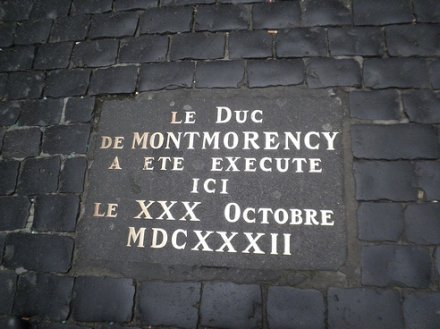
Plaque at the spot of Montmorency’s execution in Toulouse. Image (c) [Cova] and used with permission.

The Montmorency title eventually became that of the Dukes of Enghien, in which guise it’s associated with an altogether more famous execution.

* Among Montmorency’s other titles, less obnoxious to Richelieu, was viceroy of New France — that mysterious land across the Atlantic. There’s a Montmorency Falls in Quebec, named for him by Champlain.

On this day..

1634: Urbain Grandier, for the Loudon possessions

On this date in 1634, a Paris tribunal “declare[d] the said Urbain Grandier duly guilty of the crime of sorcery, evil spells, and the possession visited upon some Ursuline nuns of this town of Loudon and of other laywomen mentioned at the trial, together with other crimes resulting from the above. For redress of these, he has been condemned … to be taken to the Place of Saine-Croix of this said town, to be tied to a post on a pile of faggots that is to be built in the said Place. There his body is to be burned alive … and his ashes are to be scattered to the winds.”

The sentence was immediately enforced.

These Loudon possessions were a disgraceful carnival of simulated enspellment by the local Ursuline nuns engineered to destroy Grandier, a parish priest with a knack for acquiring enemies.

Alexandre Dumas, pere would write about Grandier in his Crimes Célèbres, and later in a stand-alone play. In Dumas’s rendering, Grandier arrived in Loudon as a handsome outsider, eloquent in the pulpit and doubly so in pursuit of a pretty girl,* as inexorable as Shylock in his victorious lawsuits against the local grandees.

Most recklessly of all, he made a foe of Cardinal Richelieu — snubbing him, opposing him politically, and (so it was alleged) authoring a scathing and anonymous lampoon of the Grey Eminence.

When Richelieu’s deputy came to town, the locals got the Ursuline nuns into their fits and got Grandier fast-tracked for hell.

The nuns put on a circus of frothing, profane, hip-thrusting demoniac possession accusing Grandier of bewitchment as they melodramatically underwent exorcism. (Fabulously attended, these public displays of possession and exorcism went on for several years after Grandier’s death as a perverse tourist attraction.)

Richelieu’s guy arranged to try Grandier in his own court (no appeal possible) and threatened to arrest for treason anyone who testified in his defense. In case that were insufficient advantage, a contract with Lucifer — a literal, signed document — was produced for the magistrates’ edification.


In fairness, this “contract” must have been a hell of a lot of fun to forge.

Heck, even nuns who tried to recant were turned away. Must be back under Lucifer’s influence!

Before proceeding to the stake, Grandier was subjected to one last “extraordinary” torture. His holy persecutors, “lest the Devils should have the power to resist the blows of a profane man, such as the hangman was, they themselves took the hammers and tortured the unhappy man” until the bone marrow leaked from his legs. Satan’s subcontractor suffered the blows without confessing or naming an accomplice.

In 1952, Aldous Huxley molded the horrible Grandier story into a non-fiction novel, The Devils of Loudun. Huxley’s take helped to popularize the tale — one that polemicists in the 17th century also recognized as an injustice — for the modern era of flesh minced by ideological madness.

From beginning to end, the trial proved a farce in which the condemnation of the accused was a foregone conclusion. By means of a series of trumped-up charges reinforced by an official philosophy and falsified theological dogmas, the resources of the state were mobilized to crush the offending individual. Huxley is not slow to point to the modern counterpart of such proceedings, notably in Fascist or Communist countries.

-Book review by S. van Dantzich, The Australian Quarterly, June 1954

Evidently, it struck a chord.

A 1971 cinematic adaptation of this book, The Devils, a captivating and sacrilegious tapestry of violent, sexual, and religious iconography, won critical praise and censor board bans, as well as an “X” rating in the United States. It’s hard to find, but worth the trouble.

Huxley’s book also formed the basis for an operatic interpretation, Die Teufel von Loudun (The Devils of Loudun)

* As we’ve seen, French priests making sexy time stood in danger from their game-less counterparts.

On this day..

1635: Domingos Fernandes Calabar, traitor?

On this date in 1635, Domingos Fernandes Calabar was garroted at Porto Calvo.

A mulatto plantation owner, Calabar (Portuguese Wikipedia page) did his patriotic duty according to the dictates of Brazil’s Portuguese colonizers when an expansionist Netherlands showed up hungry for a bite of Brazil.

But after rounding up a volunteer militia and helping repel Dutch incursions in 1630 and 1632, Calabar switched sides and joined Holland.

Why he switched sides remains permanently obscure. Popular explanations include: the seductions of Netherlander lucre (Calabar’s detractors like this one); a politically mature calculation that the Dutch would make more progressive colonizers than the Portuguese (this was Calabar’s own defense: “I spilled my blood for … the slavery of my homeland … With its actions, the Dutch have proven better than the Portuguese and Spanish”);* or … somewhere in between

He was rewarded for his devotion [to the Portuguese] by the contempt of his countrymen, who were envious of his prowess. Wounded by this conduct, he left the Portuguese and joined the Dutch.

Whatever the reason(s) for it, Calabar’s switch was efficacious: he knew the lay of the land, and he was vigorous in helping the Dutch foothold of “New Holland” expand. The Dutch commissioned him a Major, and he gained a reputation for his ambushes.

I never met a man so well-adapted to our purposes … the greatest damage he could cause to his countrymen, was his greatest joy.

-English mercenary in the Dutch service

The Portuguese official Matias de Albuquerque eventually turned the tables and captured Calabar in a Portuguese ambush. He not only had the disloyal subject strangled, but quartered the body for public display.

This gruesome warning against collaboration did not prevent New Holland from growing to around half the Brazilian territory … but since Brazilians don’t speak Dutch today, you might have an idea how this is going to end.

After “New Holland” was re-conquered and re-re-conquered, the Dutch Republic under Johan de Witt — preferring a commercial empire to a territorial one — gave up its untenable position in exchange for 63 tons of gold.

As the (eventual) winners of this imperial affray, the Portuguese wrote a distinctly unflattering history of Domingos Fernandes Calabar, the disreputable traitor. He’s a sort of Benedict Arnold character synonymous with disloyalty for any Brazilian schoolchild.

But other interpretations are available.

During Brazil’s Cold War military dictatorship, when traitorousness might seem downright reputable after all, the “official version” was slyly subverted in several different stage productions, the best-known of which is a musical called Calabar: In Praise of Treason.**

Most of the information about Calabar online is in Portuguese; for instance, biographies here and here.

* Let it not be implied that the Dutch were out for anything other than the plunder of empire themselves: Calabar’s own home region of Pernambuco was desirable precisely because of its sugar cane cultivation.

Incidentally, the vicissitudes of war enabled many African slaves to escape to Maroon communities like Palmares — just a few miles away from Porto Calvo.

** See Severino Jaão Albuquerque, “In Praise of Treason: Three Contemporary Versions of Calabar,” Hispania, Sept. 1991. “Less interested in settling the issue of Calabar’s martyrdom than in provoking serious debate about the meaning of loyalty and national identity in times of political repression and in the context of a dependent culture, these plays … bring to the fore the manifold ambiguities the colonized face reacting to the hegemonic rule of the colonizer.”

On this day..

1635: Francisco de Nava, precipitating a church-state conflict

[S]trife* [between Manila archbishop Hernando Guerrero and the Spanish governor Don Sebastián Hurtado de Corcuera] being greatly inflamed … became entangled with one of the most memorable disputes that have occurred in the islands — a necessary occasion for the sharpest encounter between the two jurisdictions, and one from which Don Fray Hernando Guerrero could not excuse himself, as it concerned the most sacred part of the ecclesiastical immunity. That was a matter in which the archbishop could not neglect to sally out with all his might, in order to comply with the obligation of a true prelate. The case was as follows: There was an artilleryman in Manila, named Francisco de Nava, who had a female slave with whom he had illicit communication, as came to the ears of the archbishop. The archbishop ordered him to remove from himself this occasion [for sin] by selling the slave-girl to another person; and had the latter placed, for that purpose, in the house of a lady who was related to Doña María de Francia, who became fond of her and arranged to buy her from the artilleryman. The latter was so beside himself over the loss of the said slave that he refused to sell her at any price, saying that he wished, on the contrary, to marry her. But Doña María de Francia so arranged matters that the slave was sold, and came into her possession with very slight effort. The artilleryman, grieved and regretful for what had happened, almost became mad, and, it having been given out that he was mad, certain violence was shown him; and on one occasion he had received a sound beating at the house of Doña María de Francia, because he had gone there to request that they should give him the slave, as he had resolved to make her his wife.

Aggrieved and rendered desperate in this way, he saw the girl pass one day in a carriage with Doña María de Francia. Going to her he asked her whether she knew him, who was her master. The slave answered him with some independence, whereupon he, blind with anger, drew his dagger in the middle of the street and killed her by stabbing her, before anyone could prevent it. All the people, both those in the carriage and those in the street, ran tumultuously [after him]; but the artilleryman escaped them all, and took refuge in the church of our convent in Manila. The governor heard of what had happened, and ordered Don Pedro de Corcuera, his nephew (who was then sargento-mayor of the camp), to take the artilleryman from the church, saying that he could not avail himself of the sanctuary of the church, as he had committed a treacherous act — although it was only a homicide, and the settlement of this question did not concern the governor. However, his action arose mainly from the anger that he felt that what had happened was in the presence of his nephew, Don Pedro de Corcuera — who, also being angered at what concerned his wife, made use of his commission with less prudence than he ought to exercise in executing such orders from his superiors. He caused the church and convent to be surrounded; and, going inside, examined everything, not excepting even the sacristy; and it is even said that he declared that, if he found the artilleryman there, he would take him out a prisoner. But not having been able to find him then, Don Pedro left the church and convent surrounded by a double guard. The governor added to that that he would not allow the religious to enter or leave, until he had hold of the refugee. The latter was finally found, and taken from the sacristy, and surrendered to the commander of artillery, in order that he might proceed with the trial as his competent judge; and he, either carried away by flattery, or in obedience to the commands of the governor, proceeded so hastily that in a very short time he condemned the artilleryman to death.

The archbishop’s provisor, Don Pedro Monroy,** bore himself on this occasion with the prudence that was fitting, and proceeded against the commander of artillery, requesting him to deliver his prisoner and return him to the church. Having been informed that the commander of artillery was a mere instrument, and that all his actions were according to the impulses of the governor, he sent three lay priests to the palace to intimate to the latter that the judge should deliver the refugee to him. The priests entered, without anyone hindering them; and finding that the governor had already retired, as it was then an advanced hour of the night, they started to withdraw in order to return next morning; but the soldiers of the guard would not permit them to leave, saying that such was the order of the governor.

The sentence against the artilleryman having been given — which it is said that the governor sent ready made out to the judge, to sign — they proceeded to execute it,† notwithstanding that the provisor proceeded to threaten censures, and to impose an interdict and suspension from religious functions [cessatio de divinis]. The governor ordered a gallows to be erected in front of the very church of St. Augustine, and the criminal was hanged thereon — to the contempt of the ecclesiastical immunity, for the [proper] place assigned for such punishments was very distant from there. The governor, seeing that the sentence was already executed, and that he had now obtained the chief object of his desire, wrote to the archbishop, requesting him to have the censures removed and the interdict raised, and the churches opened on the day of the nativity of our Lady. The archbishop, recognizing the duplicity of the governor, refused to answer that letter without first consulting the orders; and, after consulting with some of them, decided that he would not raise the interdict, since there was less inconvenience in having it imposed [even] on so festive a day, than there would be in his yielding on an occasion so inimical to the ecclesiastical immunity. However, the requests of the Recollect fathers of our father St. Augustine, who had charge of the advocacy of the nativity, had so much influence that the archbishop ordered the interdict to be removed, and it was done.


Manila’s historic St. Augustine church. (cc) image from Jun Acullador

The commander of artillery was condemned to some pecuniary fines, from which he appealed to the judge of appeals, who was the bishop of Camarines. The ecclesiastical judge refusing to admit the appeal, he threatened the royal aid of fuerza; and this question having been examined in the royal Audiencia (which at that time consisted of but the governor and only one auditor, Don Marcos Zapata), it was declared in his favor, and the appeal went to the bishop of Camarines. The latter — namely, Don Francisco Zamudio, of the order of our father St. Augustine, and a son of the province of Méjico — declared the commander of artillery to be free from the sentence given by the ecclesiastical judge. The trial of the commander of artillery had its second hearing. On that account there did not fail to result certain charges against the governor, such as his having ordered the secular priests to be detained in the guard-house; his declaration that he could not be excommunicated by anyone except the pope; and that if an order were given to him to arrest the pontiff, he would arrest him, and even drag him along by one foot (which he was proved to have said by several persons). The governor freed himself from all these charges by excuses in a manifesto which he published; but as it is not a part of my duty to examine their adequacy, I shall not do so. I shall refer the reader to the reply made to him by a learned ecclesiastic of the university of Méjico; for there is no liberty in Filipinas to enable any one to complain, or to speak his mind against what the government manipulates

The Philippine Islands, 1493-1898 — Volume 25 of 55

* “The underlying reason for this public dissension was racial,” says this source.

The rivalry between Spaniards born in the peninsula and those born in the colonies, the creoles or americanos, affected not only the clergy but also the lay population. The Augustinians, and the Hospitaller Orders of San Juan de Ojos, San Hipolito and Guadalupe, whose members were creoles, were opposed by the Carmelites and the apostolic colleges in that country. “While legally they [both factions] were on complete equality,” writes Dr. Domingo Abella, Philippine ecclesiastical historian, “class distinctions were apparently encouraged as much as possible by the Spanish colonial policy, because the principle of divide et impera of every aristocratic system was the leading idea for the permanent subjection of the colonies.”

The rivalry reached such an extent that in 1627 the Dominican Order in Mexico refused to admit creoles into its ranks, an act which the Spanish king disapproved. In the Philippines the situation had not openly reached that extreme. The insular hierarchy managed to keep the number of creoles, mestizos and indios who were embracing the religious life down to a minimum. But the racial discrimination rankled among those born in the colonies. Archbishop Guerrero and Bishop Zamudio were both Augustinians, but the former was a peninsular, while the latter was a creole, and this was probably the reason for their taking opposite sides.

** Later exiled to Formosa.

† A letter quoted elsewhere in the same text confirms “the execution of the sentence on the night of Thursday, September six”

On this day..

1630: John Billington, signer of the Mayflower Compact

On this date in 1630, Massachusetts’ Plymouth Colony held its first hanging — of a guy who’d come over on the Mayflower.

In this unfinished epic poem of the American experience by Stephen Vincent Benet, Billington is mourned at the foot of his gallows as “a man who came with the first and should have thriven.”

John Billington‘s John Hancock is on the Mayflower Compact, but he and his progeny had an ill reputation from the start.

Billington’s son almost torched the Mayflower while the pilgrims were still living in it; the old man himself achieved the distinction of “the first offence since our arrival … for his contempt of the captain’s lawful command with opprobrious speeches, for which he is adjudged to have his neck and heels tied together; but upon humbling himself and craving pardon, and it being the first offence, he is forgiven.”

(It wasn’t all bad. Another Billington kid gave the family name to an inland pond. (pdf))

Billington was condemned for shooting a neighbor.

This year John Billington the elder, one that came over with the first, was arraigned, and both by grand and petty jury found guilty of wilful murder, by plain and notorious evidence. And was for the same accordingly executed. This, as it was the first execution amongst them, so was it a matter of great sadness unto them. They used all due means about his trial and took the advice of Mr. Winthrop and other the ablest gentlemen in Bay of the Massachusetts, that were then newly come over, who concurred with them that he ought to die, and the land to be purged from blood. He and some of his had been often punished for miscarriages before, being one of the profanest families amongst them ; they came from London, and I know not by what friends shuffled into their company. His fact was that he waylaid a young man, one John Newcomen, about a former quarrel and shot him with a gun, whereof he died.
-Plymouth Gov. William Bradford (Source)

Billington is supposed to be a distant ancestor to American President James Garfield.

On this day..

1634: Anna Tait, “trublit in conscience”

(Thanks to historian and witchcraft expert Louise Yeoman for this guest post on an obscure and once-forgotten “witch” whose human tragedy all but leaps off the page. This post was originally an article prepared for the National Library’s now-defunct journal Quatro. Her work has appeared in many more high-falutin’ places than this here blog, and she is a co-creator of the Survey of Scottish Witchcraft.)

On the trail of Anna

If you look in Christina Larner’s Sourcebook of Scottish Witchcraft, you won’t find Anna Tait. That’s because she was one of many accused witches whose names were unknown to the compilers of the sourcebook. The details of Anna and almost a hundred others were recorded in a National Library of Scotland Advocates manuscript, which was overlooked many years ago when the huge edition of Scotland’s Privy Council records was in preparation. In the closing years of the last century, the editors of the Privy Council volumes carefully combed the holdings of the National Archives of Scotland for their material. What they didn’t realise was that a single volume of the Register of Commissions for the years 1630-42 had escaped them. In it were hundreds of records of Privy Council commissions to try criminal trials.

In it was Anna Tait.

I first came across Anna and Adv. Ms. 31.3.10 when my friend and fellow researcher Dr Michael Wasser of McGill University, Montreal showed it to me in the Library’s North Reading Room. Michael was (and still is) a historian of crimes of violence in 16th-17th century Scotland, and he was instantly aware of the significance of the manuscript. Almost the first thing he pointed out to me in it was a remarkable story of family tragedy. Out of hundreds of records, this one tale of domestic misery, horror and a woman’s life stood out. It stood out to the clerk who wrote the volume too. A commission is normally a bare record of who is accused of what crime and who is to try them. But the commission to try Anna contained harrowing detail. Almost straight away I agreed to transcribe her commission and to edit it for Scottish History Society. Why was it so remarkable?

Anna Tait ‘alias ‘Hononni’, was in the Scots of the original ‘thrie several times deprehendit putting violent hands to herself at her awne hous,’ in Haddington in 1634. In other words, she was caught trying to kill herself.

In 17th century terms suicide was one of the most heinous acts one could commit. It was like witchcraft, considered to be a particularly odious crime against God’s law and it was punishable by forfeiture of the entire goods of the victim and by a dishonourable burial in unconsecrated ground. What drove Anna to such terrible lengths?

The rest of the commission made the reasons clear. When Anna was apprehended for attempted suicide, she told a terrible tale of adultery, poisoning, domestic murder, unwanted pregnancy, botched home-abortion and death. Here is this part of the commission slightly adapted and with the spelling modernised.

She was for that cause, upon the 18th of December, taken and committed to ward within the tolbooth of the said burgh where being demanded and examined why she put hands to herself, she answered that the intolerable trouble of her mind, which she conceived for the murder of her first husband called John Coltart, nolt driver [cattle drover], and for the murder of her daughter, moved her thereto.

Confessing plainly that about 28 years ago, she being married to the said John, ane aged man, before the marriage she had sundry times committed fornication with William Johnston, her present husband, and that within the time of the marriage she had likewise committed adultery with him. To be quit of her first husband, she consulted with the Devil for his destruction, and that the Devil having directed her to make a drink of foxtrie leaves [foxglove leaves], she did the same, and gave it to her husband to drink who within three hours departed this life.

Concerning her daughter, she confessed that the daughter being with child, and she [Anna] having a purpose to murder the infant in the mother’s belly, at last she consulted with the Devil. He gave her direction to buy wine and to mix it with salt and give it to her daughter to drink, which she having drunken, she shortly thereafter departed this life.

So far, so sadly comprehensible, except for the inclusion of a character whose presence might seem unnecessary to modern readers — The Devil. The Commission finally proceeds ‘upon the 8th of December instant; she had carnal copulation with the Devil in her own bed, and that upon the 11th of December the Devil came to her bedside, gripped her by the hair of her head and did nip her cheek’. Suddenly a classic case of domestic murder and family tragedy is turned to that strangest of all 17th century phenomena to the modern mind: a witchcraft accusation. This was not just a case of three in a marriage, but three plus the Prince of Darkness. However, this wasn’t a strange notion to 17th century people. Where two, three or even just one person were engaged in works of wickedness, it went almost without saying that Satan was somehow present too. Anna was tried not as an adulteress or a murderer but as a witch – the commission was the licence to the magistrates of Haddington to try her, but where was her trial?

Records of such witchcraft trials held in local, rather than central, courts rarely survive. Whilst I was working on the commissions, I happened by chance to be helping someone with a totally different enquiry. Dr John McGavin was researching records of early modern Scottish drama. We discussed his research on poet and minister James Melville and Melville’s account of a dramatic performance in St Andrews. Hearing that John was soon going to be searching through the Haddington Burgh records in the National Register of Archives, I asked him if he would keep an eye out for Anna and any other witches he might happen to spot. To my delight, I soon had an e-mail from John telling me that her trial records were in the Haddington burgh court book.

Researching witchcraft cases can be an intense mixture of horror and delight for a historian. On the one hand to find unexpected light on a unique case is a matter for rejoicing. On the other hand, the details I found in the court book were even grimmer than those of her commission.

Anna had tried several times to hang herself using her own head-dress (her curch). When she was taken into custody, her suicidal behaviours became even more extreme. She attempted suicide again, both by trying to cut her own throat and then ‘when your hands were bound and your feet maid fast in the stocks, no other meanes being left to accomplish your devilishe designes, ye knocked your heid to the wall and stocks, wherby thinking to dispatch your self.’ The court book went into more detail, it claimed that Anna had sex with the Devil in the form of a black man and in the form of the wind and had made a covenant with him. Shape-shifting was a not uncommon piece of Scottish popular belief about Auld Nick, but on top of it were overlaid the sinister assumptions of European theories about demonic pact. One didn’t just meet the Devil according to the demonologists, one had sex with him, took his mark and swore one’s soul away to him. Anna was explicitly accused of all three actions.

The trial also gave more personal information about Anna to add to that from the commission. Taking both sources together we can say a little about her. She had married her first husband John Colthard, the cattle drover, 28 years ago at a place called ‘Furd Kirk’ in England in 1606. Cattle drovers went far afield in the course of their work and Anna had obviously travelled too. Interestingly enough she was accused of having made an appointment to meet the Devil at ‘Ellerslie’. The only places of this name are to be found over in the West of Scotland and not near her home in Lothian. Given 17th century spelling this may also have been the little Lanarkshire village of Elderslie, famed as the birthplace of William Wallace. Whichever it was, Anna’s world clearly stretched well beyond the confines of Haddington.

Age of marriage could be quite late in 17th century Scotland, so Anna was probably about or just under 50 years of age. Her second husband William Johnston was a miller who had lived at Winram, nearby Anna and her first husband. The proximity had assisted their illicit affair. Millers and cattle drovers could be prosperous members of an early modern community, so it is likely that Anna too had some standing in her community to keep up. She was probably very far from the stereotypical portrait of an accused witch as a poor begging woman going door to door looking for alms.

At sometime in her life Anna had acquired the alias ‘Hononni’, a Scottish variant of the English ‘Hey nonny no!’ a popular nonsense refrain in songs. It was an ironically jolly nickname for someone whose life was characterised by murder, tragedy and despair. We find the name of her beloved daughter too –- Elizabeth Johnston who died from the botched abortion. The records of this are chilling

The said Elizabeth, being as ye confessed with child (to whom, few but yourself knows and neither will ye reveal the truth of it), and apparently being loath to let it be known to whom the child belonged, she and ye sought all means to kill, to murther the child in her belly, that it might not come to light who was the father thereof, or how it was gotten, whether in adultery or incest, or what other unlawful way.

To that effect ye consulted with diverse of your confederates fra whom, ye got sundry feall [evil] counsel and by their advice, administered feall drinks to your daughter. But these not doing your turn and all other means failing you, ye went to your old maister the devil … who gave you advise to buy ane mutchkin of white wine, and mix a pint thereof with salt and minister the same unto your daughter, and it would do your turn. The which cruel and devilish counsel ye willingly obeyed and fetched the wine, mixt with the same with salt and gave it to your daughter to drink. By which she presently swelled and shortly thereafter both she and the child died.

In token wherof, you have confessed that the devil gave you as much money in true and real turners [small copper coins] as would buy the said mutchkin of wine and salt. And this deed only of all the devilish and abominable actions has most troubled you, and been the greatest cause of your desire to murder yourself.

In trying to cover up her daughter’s unwanted pregnancy, Anna ended up killing her child. Blaming herself for Elizabeth’s death, Anna no longer wanted to live. She tried repeatedly to kill herself. When it was put to her that the Devil had advised her do all this and that she had become a witch, it seems she barely bothered to defend herself. After all, even though she might have wanted to avoid the shameful death of being strangled and burned at the stake, at least it would have the virtue of ending her life. When the court asked whether she wanted anyone to speak in her defence, she answered ‘none but God in heaven’.

To modern eyes, Anna’s situation seems clear-cut. She had done some terrible things and for very understandable human reasons she wanted to die. Even in 21st century Scotland we would insist that, at the very least, Anna should go to jail for murdering her first husband and that she should be prevented from killing herself. Yet in 21st century Scotland, Anna would have been able to obtain a divorce from her first husband and her daughter would have been able to obtain an abortion (whatever you think of that). So the whole catalogue of tragedy might not have happened at all, or then again, perhaps it might. Was Anna a victim of a society which stacked the cards against women through its interpretation of the Bible or was she the sort of callous person who might have murdered a spouse despite all the advantages of a modern legal system? After all, the murders of spouses still occur. These are questions the historian can only raise and cannot answer.

Even in today’s society, however, a female criminal who had committed crimes of violence comparable to Anna’s would be unusual. To a 17th century society she was such a paragon of horror that the Devil had to be invoked to explain her conduct. In a society which stressed a woman’s subordination to her husband and saw her only rightful adult roles being those of a wife or a mother, Anna was a monster. To her community, she was not only an attempted self-murderer but also an adulteress and the unnatural murderer of her husband, daughter and unborn grandchild. By confessing to witchcraft, she had just about collected the set of the most appalling crimes a 17th century woman could commit. To be regarded with such horror in contemporary society, a woman would probably need to be accused of a string of serious offences against children or young people.

However Anna’s case also raises the question of her mental state and how issues of mental disturbance and suicidal urges were dealt with in her society. Such a suicidal defendant in a modern case might be found unfit to plead, but how did Anna’s contemporaries see her mental distress? Anna was ‘trublit in conscience’ and this points to the beliefs which probably helped to seal her fate. Despair as to whether one was part of the Calvinist ‘Elect’ or whether one was going to hell was a perfectly respectable state in Early Modern Scotland –- even to the extent of repeated suicidal impulses. This can be seen from the diaries, books, letters and sermons of radical Presbyterians and Covenanters. It was a very common phase of the Calvinist conversion experience of the 17th century. Demonic or even suicidal temptations were an almost a normal complication of the road to heaven. To despair over committing terrible sins worthy of hell-fire was not seen as being mentally unstable but as being eminently sane. Any reasonable Bible-believing person might think that way.

So Anna’s despair may have made her seem more culpable, rather than less culpable, to her interrogators whose beliefs would be that in her agony she had done utterly the wrong thing and turned in absolutely the wrong direction. She had, in their minds, turned to the Devil and not to God. Instead of despair proving to be a half-way stage for Anna on the road to conversion and eternal glory, Anna, it seemed by her confession, had failed to choose eternal life and had instead perversely chosen the ultimate dead-end: Hell. This was an offence made all the more horrible, as heaven in its Calvinist form, was no doubt being held out to her every Sabbath in their local church. Perhaps the reason it was necessary to punish the despairing so emphatically was pour encourager les autres; to make sure that when people experienced despair, they would in the Church’s eyes make the right choice: that they would resist the temptation and intensify their piety until the threat was overcome.

Faced with the reality of burning large numbers of accused witches amongst whom they found the suicidal and the mentally disturbed, later generations of Scottish Privy Councillors increasingly doubted the wisdom of this approach. In 1662 in the midst of a nation-wide witch-panic the council issued commissions under strict orders that to proceed with executing a convicted witch, it must be found that ‘At the tyme of their confessions they were of right judgement, nowayes distracted or under any earnest desyre to die’. Almost 30 years after Anna’s death, Scotland’s elite were becoming sensitive to the issue of attempted suicide by witch-confession and the mental state of the accused. It came much too late to affect Anna and because of her murder confession wouldn’t have saved her anyway, but it shows a little how things moved on even in that relatively short time frame. For Anna there could only be one ending — execution. Because she had confessed she was not burnt alive [burning alive tended to be reserved for those who died ‘impenitent’ ie. they refused to confess]. Her sentence was as follows:

It was given for doom [sentence] by the mouth of William Sinclair dempster [pronouncer of sentence] that the said Anna Tait should be taken, her hands bound behind her back and conveyed by William Allot, lockman [executioner] of Haddington to the ordinary place of execution, and there wirried [strangled] to the death at ane post and thereafter her body to be burnt in ashes, desuper act.

Note on sources

The commission for Anna’s trial is edited from Adv.Ms.31.3.10, f.102v. Her trial records may be found in National Archives of Scotland, Haddington Burgh Court Register B30/10/13, fos.24r-26v. A calendar of the witchcraft commissions in Adv. Ms 31.3.10 (including transcriptions of Anna Tait’s commission and her trial records) has been prepared by the author for Julian Goodare (ed.), Miscellany XIII, Scottish History Society, forthcoming.

On this day..

1635: Ivan Sulyma

On this date in 1635, Cossack commander Ivan Sulyma was put to death in Warsaw for razing the Kodak Fortress on the Dnieper River.

Sulyma‘s death, a footnote historically, unfolded in the rising action of Zaporozhian Cossacks‘ conflict with the Polish-Lithuanian empire then at the peak of its power.

Those famed corsairs of the steppes made their way in the world by plunder. The European powers at play around the Black Sea domains of the Zaporozhian host — Poland, Russia and the Ottoman Empire — each struggled to exploit Cossack raiders for their own ends of statecraft.

The Zaporozhian Cossacks, as portrayed by Ilya Repin

It was perhaps the misfortune of Poland to claim suzerainty during this unruly horde’s upswinging arc. The Poles endeavored to gather the Cossacks into the formal apparatus of the state, “registering” an elite corps of Cossacks inducted into the armed forces while reducing the remainder to peasantry.

The registry’s size and privileges became a permanent bone of contention, driving a cycle of uprisings through the 1620’s and 30’s that sapped Cossacks’ loyalty to the Polish crown.

Sulyma was a partisan of the militant unregistered Cossacks, fresh from war against the Ottomans. He returned to find that Poland had thrown up a fortress controlling the Dnieper, with an eye both to checking Cossack provocations against the now-peacable Turks, and to controlling internal Cossack disturbances.

Sulyma sacked the fortress, slaughtering its 200 inhabitants, but the disturbance was quickly put down and loyal registered Cossacks handed over the rebel. By the late 1630’s, Poland had imposed a peace of arms on the region … but hardly a secure one. As historian Orest Subtelny notes:

[E]ach successive uprising reflected the growing strength and military sophistication of the rebels. Their numbers grew, their tactics improved, and Cossack identification with the plight of the peasantry and the defense of Orthodoxy deepened. The decade-long Golden Peace merely masked a problem that was waiting to explode again.

It exploded in 1648. Where Sulyma had failed, Bohdan Khmelnytsky would succeed — breaking the Cossack lands permanently free of Poland.

Remembered to the modern state of Ukraine as a father of the country, Khmelnytsky’s immediate achievement was to rearrange the balance of power in Eastern Europe. Poland, ravaged by invading Swedes just as the Cossacks slipped away, fell into permanent decline — leaving a vacuum filled by Russia, which soon pulled the Cossacks into its orbit.

On this day..