1673: The effigy of Charles Alexis dit Dessessards

According to this registry of events in French Quebec before the English conquest, one Charles Alexis dit Dessessards was ordered broken on the wheel by Quebec’s high executioner on this date in 1673.

He had been convicted of murdering a fur-trapping buddy named Herme, and plundering his pelts.

In the terrifying words of the sentence, he was at 3 p.m. to have “arms and legs broken with four blows, then be strangled and thrown on a wheel to remain there until seven o’clock in the evening. His body will then be brought to the gallows, there to remain until entirely consumed” by the elements. On top of everything, he had a 200-livre fine to pay.

There was just one bit of good news for the murderer Charles Alexis dit Dessessards:

“Until the said Charles Alexis is apprehended, the aforesaid sentence will be executed upon his effigy.”

MARS

Le 6. — “Charles Alexis dit Dessessards, convaincu d avoir tué de guet-à-pens le nommé Herme, son camarade de voyage, et d’avoir volé ses hardes et pelleteries, sera conduit sur la grande place de cette vile (Québec), par l;exécuteur de la haute justice, un lundi, à trois heures après-midi, et là, sur un échafaud qui y sera dressé à cet effet, y aura les bras et les jambes rompues de quatre coups qu’il recevra vif; sera ensuite étranglé et jeté sur une roue pour y demeurer jusqu’à sept heures du soir. Son corps sera porté sur les fourches patibulaires pour y demeurer jusqu’à parfaite consommation. Condamne en outre à deux cents livres d’amende envers le Roy, à la restitution des choses volées et le surplus de ses biens confisqué. Et en attendant que le dit Charles Alexis soit appréhendé, sera exécuté en effigie aux fourches patibulaires, un lundi, à l’heure que dessus.

On this day..

1676: George Bromham and Dorothy Newman, on the Combe Gibbet

On this date in 1676, the Combe Gibbet was put to its first and only use.

Adulterous lovers George Bromham (or Broomham) and Dorothy Newman had been doomed by the Winchester Assize for murdering the wife and son of Bromham’s inconvenient marriage. “With a staff,” the trial record says. Ouch.

The two were sentenced to hang together “in chaynes near the place of the murder,” which demonstrative sentence required the erection of a brand-new purpose-built double gibbet just for the occasion, high atop Inkpen Beacon, the 975-foot hill overlooking the countryside.* After execution, they were taken down, laid out a nearby barn (inevitably to become known as “Gibbet Barn”), and then strapped back up on the double-gallows in chains for a few days.

Although this dreadful landmark has never been used again, it’s stood ever since. Or, technically, a succession of different versions have stood, but the point is that there’s still today a large, black execution device looming over scenic Berkshire. It’s a nice place for a walk. (pdf)

When next in West Berkshire, top your visit to the Combe Gibbet with a refreshing Gibbet Ale at Inkpen Common’s Crown and Garter Bed & Breakfast. (That’s where the Gibbet Barn used to be.)

The murder behind the gibbet was the the subject of a student film called Black Legend in 1948 — the first movie made by future legendary director John Schlesinger.

* Bromham was from Combe, and Newman from neighboring Inkpen, and the murder itself took place on the towns’ border. In the great tradition of municipal politics, there was a consequent dispute over the bill for setting up this gibbet; they were forced to split the bill.

On this day..

1678: Stephen Arrowsmith

(Thanks to Meaghan Good of the Charley Project for the guest post. -ed.)

On this day in 1678, one Stephen or Steven Arrowsmith was executed at Tyburn for the rape of a little girl the previous summer.

He was one of six people sentenced to hang that day, but four of them got reprieved. Arrowsmith and Nathaniel Russel, a convicted murderer, were the ones who had to swing.

The victim in Arrowsmith’s case, eight-year-old Elizabeth Hopkins, testified against her rapist in court, as did the child who walked in and saw Arrowsmith abusing the victim on July 7 of that year. Neither witness was properly sworn in. From the Old Bailey records:

The Girl that was ravished, being between 8 and 9, testified that he had had to do with her for half a year together every sunday, that she was hindred from crying the first time, by his stopping her mouth, and that he gave her money afterwards; and she never discovered it, till some of her friends observing her to go as if she were very sore, examined her, and by telling her she would be in danger of hanging in Hell, got her to confess, that the Prisoner was her fathers Prentice.

One Mrs. Cowel did testifie that upon observing her going, and other Circumstances, she did resolve to examine her, and made her confess, which she did, and being searched, was found shamefully abused, and sent to the Doctors to cure.

The like was attested by one Mrs. Sherwin, and by a Midwife, who said, she had got a very foul disease by it.

Arrowsmith’s defense was two-pronged:

  1. he hadn’t done it
  2. but if he had done it, Elizabeth had consented

The maid of the doctor who examined Elizabeth testified for the defense, saying she’d asked the victim why she hadn’t told anyone about the abuse, and Elizabeth answered that she took pleasure in it.

The jury was very reluctant to convict and, in fact, initially brought back a verdict of not guilty. And here the judge, a fellow with the Dickensian name Lord Chief Justice Scroggs,* decided to become the prosecutor.

He had had already expressed his own “great Detestation and abhorrence of so Horrid and Vile an offense,” and demanded to know why the jury had acquitted Arrowsmith.

One of the jurors, an apothecary, ventured that he personally believed Elizabeth had consented to intercourse. Scroggs reminded this person that she was under age and so the issue of her consent was irrelevant.

Other jury members said they were bothered by the fact that almost all the evidence was hearsay and the only direct witnesses, Elizabeth and her friend, had not been sworn. Testily, the judge replied that a rapist was not going to commit his crime in crowd of eyewitnesses, and the only reason the two girls had not been sworn was because of their youth, but if the jury wanted them sworn in he was prepared to do that. Then he sent them back to re-think their verdict.

To further complicate matters, during the second round of deliberations a thoughtless officer of the court, charged with looking after the two child witnesses, brought both girls to the jury to talk to them in private. When Scroggs found out he quickly put a stop to this and had the bailiff thrown in jail, and the jury (who swore that this hadn’t been their idea) was allowed to continue its deliberations. Jurors later said the unauthorized meeting had convinced them of the girls’ honesty, and they returned with a verdict of guilty.

Kind of like Twelve Angry Men in reverse.

“The Criminal Trial Before the Lawyers,” (pdf) a paper published in the University of Chicago Law Review in 1978, referenced the Arrowsmith case and Scroggs’s behavior. The paper’s author, John H. Langbein, tried to explain and defend the “judicial dominance” which might lead a modern reader to look askance at the fairness of the proceeding:

Hale’s treatise confirms this practice. “If the jurors by mistake or partiality give their verdict in court, yet they may rectify their verdict before it is recorded, or by advice of the court go together again and consider better of it, and alter what they have been delivered.” The tradition that the jury would lightly disclose the reasoning for a verdict became especially important in this situation, because it enabled the court to probe the basis of the profferred verdict, hence to identify the jury’s “mistake” and correct it. Thus, in the Arrowsmith case, the court discovered that the chemist’s opinion that an eight-year-old “could not be Ravished” had been influential, and the court refuted it…

Indeed, to this day in many countries, including the UK and the USA, a judge still has the right to overturn a jury’s decision if he or she feels the evidence did not support the verdict. This privilege is but rarely exercised.

At the gallows, just before his death, Arrowsmith wept and finally owned up to what he had done, saying he’d been a good person all his life until “Satan seduced him to this abominable wickedness.”

* Seen here in a more everyday juridical situation, Scroggs was also a figure in the “Popish Plot” anti-Catholic trials breaking out at this period.

On this day..

1678: William Staley, “the prologue to the bloody tragedy”

David’s mildness managed it so well,
The bad found no occasion to rebel.
But when to sin our biassed nature leans,
The careful devil is still at hand with means, [80]
And providently pimps for ill desires;
The good old cause, revived, a plot requires.
Plots, true or false, are necessary things,
To raise up commonwealths, and ruin kings.

-John Dryden’s Absalom and Achitophel, a Biblical allegory of the English political/religious scene in which the Popish Plot (“plots, true or false”) took place

On this date in 1678, a Catholic goldsmith was hanged and quartered for treason … a preposterous case that would preview the tragic main acts of the “Popish Plot”.

This 17th century anti-Catholic witch hunt traced to weird and unprincipled Anglican divine Titus Oates.

With his friend Israel Tonge, Oates in 1678 ginned up a fantastical Jesuit plot against the life of Charles II — which supposed conspiracy played insidiously to the realm’s age-old religious divisions, in a moment when a Catholic royal sibling stood next in line to the throne.

Indeed, Oates’s “revelations” would trigger the Exclusion Crisis, an unsuccessful parliamentary bid to balk the heir presumptive James (eventually James II) of his throne. Parliament, argued Henry Capell, “must quiet the minds of the people, as to their fears of Popery and the Succession.”

In Queen Elizabeth’s time there were conspiracies against her, when Mary Queen of Scots was taken off. In King James’s time, the Gunpowder-Treason. In the last King’s time, a horrid Rebellion, that ended in his murder; but here the Crown is under such a character as is more dangerous than all those; and from Popery came the notion of a standing Army and arbitrary power.

Oh, and London had just burned down within everyone’s living memory, an event popularly ascribed to a French Catholic conspiracy even into the 19th century.

There was an awful lot of latent (and not-so-latent) anti-Popery around for Oates to stir up, and he proved to have a gift for this demagoguery. (pdf) In late 1678, a magistrate investigating Oates’s claims, Edmund Berry Godfrey, was mysteriously murdered, and all hell broke loose: a political assassination could now be hung on the alleged Catholic conspiracy. In short order, alleged Catholic conspirators would themselves hang for it.

It was a full 9/12 mentality: people going about armed, loyalty oaths, rumors of French invasion or Guy Fawkes tunneling.

Oates, when feeling his, would have the juice to put peers of the realm on the scaffold … so what chance did poor William Staley have?

This patsy, no great ornament of the “plot”, was more an incidental (and expedient) casualty of the swelling paranoia. Overheard at a tavern chatting about the Protestant freak-out, in French (quelle horreur!), a couple of unscrupulous eavesdroppers shopped for treason when they couldn’t blackmail him.

The sovereign was supposed to have been characterized in this chat as “a great Persecutor or Tormentor of the people of God … And ([Staley] stretching forth his Arm, and then clapping his Hand on his Breast), speaking of His Sacred Majesty, said, I my self will kill him.” (Source) Whether a frustrated Catholic into his cups incautiously popping off, an innocent naif set up by reprobates, or a case of lost in translation, it seems safe to say that William Staley was no danger to the monarchy.

Staley, at any rate, denied having said anything of the sort all the few hours that remained to draw breath, which wasn’t many. It was a mere 12 days from the “treasonable” conversation on Nov. 14 to Staley’s execution.


Image from William Faithorne‘s 1681 (misdated) engraving depicting William Staley being drawn to execution.

With this hanging, and another (that of Edward Coleman) a week later, the Popish Plot persecutions were into full swing … three years of Stuart England McCarthyism that would claim at least 15 lives and end with Titus Oates imprisoned, whipped, and pilloried.

After the Orange Revolution chased the Catholic monarch out of England, Oates was released and pensioned: the incident long remained an ideological litmus test between proto-Whigs (pro-Oates, as he was a club wielded against the absolutist aspirations of Charles II and James II) and Tories (anti-Oates, for the same reason). Centuries later, one commenter could still remark, “There are three events in our history that may be regarded as the touchstone of party men: an English whig who asserts the reality of the Popish plot, an Irish Catholic who denies the massacre of 1641, a Scotch Jacobite who maintains the innocence of Queen Mary, must be considered as men beyond the reach of argument or reason.”

On this day..

1676: Anna Schmieg and Barbara Schleicher, Langenburg witches

On this date in 1676, the tiny German principality of Hohenlohe strangled and burned to death its last convicted “witches”.

This story is the subject of the recent book The Last Witch of Langenburg: Murder in a German Village by Thomas Robisheaux. (Interview with the author.)

Almost a full year had elapsed since Anna Fessler had received a few shrovetide cakes from the daughter of the neighboring millers.* Hours later, Fessler (who had delivered a child just a week before) took painfully ill and died in her bed.

The cakes led back to the miller’s wife Anna Schmieg, of course. But decades after the Thirty Years’ War, the whole witchcraft construct was on its way out. Robisheaux builds a powerful micro-history of the local magistrate’s painstaking effort to satisfy the era’s rigorous legal standards for witch-persecution.

These standards would soon break down entirely, but in the here and now (or there and then), the authorities had to establish Schmieg’s malevolent reputation, and figure out if there was sufficient evidence to license torture. There wasn’t, the legal doctors whom Hohenlohe consulted advised; Hohenlohe made up a justification to do it anyway.

Hey, times hadn’t changed that much. Maybe still haven’t.

Anyway, the torture did to a co-accused what torture usually does. That luckless itinerant local woman was named Barbara Schleicher: she’d been under a pall from the accusation of a previously-tortured “witch” in a nearby village a few years before, and with the requisite pressure she soon copped to everything. Schmieg denied and fought and repelled, but eventually she too broke down and made the fatal confession. So, on November 8, 1676, before a court constituted of local grandees,

Anna Elisabeth Schmieg and Barbara Schleicher had to confess one more time, openly and publicly.

This was the moment of danger. Were Anna now to curse the judges as she had cursed the executioner before she was tortured, “asking them to join her for God’s Judgment in the Valley of Jehosaphat,” the proceedings might break up. She could be tortured again, but the curse would have had a shocking effect and raised the question about whether an injustice was about to be committed.

Because of these dangers, instead of asking the women to speak for themselves, the county’s officer spoke for them, saying that the two poor sinners had freely confessed their crimes and were ready to be given over to justice. The scribe read of Anna’s use of witchcraft and murder, as well as her seduction by Satan. He pronounced that she had done so many evil things that she could not even remember them all. He then read out a list of Schleicher’s crimes, which included witchcraft, murdering two husbands, turning herself into a wolf, and attempting to commit suicide. Whoever these two poor sinners had been before that day, they were now publicly branded as witches, poisoners, and murderers.

Talk about speak now or forever hold your peace. For not raising a ruckus, the court threw a bone to the wicked and now-confessed hags and mitigated the sentence of tearing at their flesh with iron tongs followed by burning at the stake to tearing at their flesh with iron tongs followed by strangulation followed by burning at the stake.

Chief Justice Assum turned to the court assessors and asked them whether the sentence had been decided as the court scribe had read it. Together they replied yes. Assum then rose, broke the ceremonial staff in two, and threw the pieces to the floor. With this old legal gesture, the blood court was symbolically breaking its staff over the lives of the prisoners. Then he said, “God help their poor souls.” [Local Count] Heinrich Friedrich’s representative then asked that the executioner carry out the sentence. According to prescription, the command to the executioner was repeated three times. At the close the chief justice forbade everyone present, on penalty of bodily punishment, from seeking revenge for this act of justice. No one was to take up violence against the law or question what was being done. The court scribe repeated his admonition.

The executioner then led the women out of the court, across the drawbridge, and over into the market square, where they joined the procession that had assembled. Drummers beat out a cadence, schoolboys sang hymns, and the sober procession marched down Langenburg’s long main street and out the gate at the east end of the town.

Once past the town gate, Anna’s and Barbara’s expulsion from the community was complete. From many perspectives, as we have seen, Anna’s emotional world was not like our own. It would be wrong to assume that Anna and Barbara felt the same anxiety and fear that we would today as they climbed the “Path of Straw” to Gallows Hill. The belief that someone who received absolution before an execution, and who did not sin again by resisting, would go right to heaven may help explain why prisoners rarely resisted at this point. Most tried to meet their fate as best as they could. Considering the suffering of the last ten months, Anna may have welcomed her end. She and Schleicher may also have been fortified for the ordeal by wine. Prayer may have brought them solace. However she felt about her fate, no record mentions her resisting or cursing the executioner or members of the court.

The scene at the gallows must have been crowded. The execution was seen as an example, and it was considered essential that the Langenburg schoolchildren be let out of school to join the procession. There, with the rest of their neighbors, they would have watched Anna and Barbara torn with hot irons and then strangled with a rope. After the bodies were burned to ashes, the last ritual gesture was made. “Lord Chief Justice,” Master Endris asked, “Have I carried out the law?” To which Assum would have replied, “If you have executed what the law and the sentence require, then the law has been fulfilled.”

This verbal exchange was critical for the execution to have fulfilled its purpose. At this moment the law, formally in suspense since Anna’s arrest, had been restored. The breach in public order that had opened on Shrove Tuesday was now mended. Count Heinrich Friedrich had seen to it. The chief justice and the assessors filed back into town and into the courtroom. Once they took their seats, it was announced that justice had been done. A lavish feast awaited them.

Just stay away from the cakes.

* A delicious tradition. Here’s a recipe for vanilla-frosted custard-filled shrovetide buns, from Denmark. Deadly deadly Satanpoison is optional.

On this day..

1671: Zrinski and Frankopan, Croatian conspirators

He who dies honorably lives forever.

-Fran Frankopan

On this date in 1671, Croatian noble Fran Krsto Frankopan and his brother-in-law Petar Zrinski were beheaded by the Austrian empire at Wiener-Neustadt Prison.

The Zrinski-Frankopan Conspiracy — or Magnate Conspiracy — was the product of great powers chess in central Europe … and specifically, of the frustration of these lords in the frontier zone between the Austrian and the Ottoman Empires at being a sacrificial pawn.

Instead, they’d take control of their own destiny and be a self-sacrificial pawn.

Croatia and Hungary had been on the perimeter of Hapsburg authority for generations, and seen the rising Ottomans push well into Europe.

In the latest of innumerable wars, the Austrians had trounced the Ottomans, potentially (so the Croats and Hungarians thought) opening the door for reconquest of lost territory. Croatia in particular had been nibbled away by Ottoman incursions into a “remnant of a remnant.” Emperor Leopold I thought otherwise: he had Great Games to play in western Europe as well and didn’t find this an auspicious moment to go all in in the east.

Rather than following up his victory by trying to run the Turks out of their half of divided Hungary, or out of Transylvania, Leopold just cut an expedient peace on status quo ante terms quite a bit more favorable to Istanbul than the latter’s military position could demand.

The aggrieved nobles started looking around for foreign support to help Hungary break away.

This scheme never came to anything all that palpable, perhaps because the operation’s leading spirit Nikola Zrinski got himself killed by a wild boar on a hunt, and definitely because no other great powers wanted to get involved in the mess.

Zrinski (or Zrinyi) was also a noteworthy Croatian-Hungarian poet, as were the remaining conspirators.

The boar-slain’s younger brother Petar, his wife Katarina, and Katarina’s half-brother Fran Frankopan, also better litterateurs than conspirators, inherited the scheme’s leadership, and its penalty.


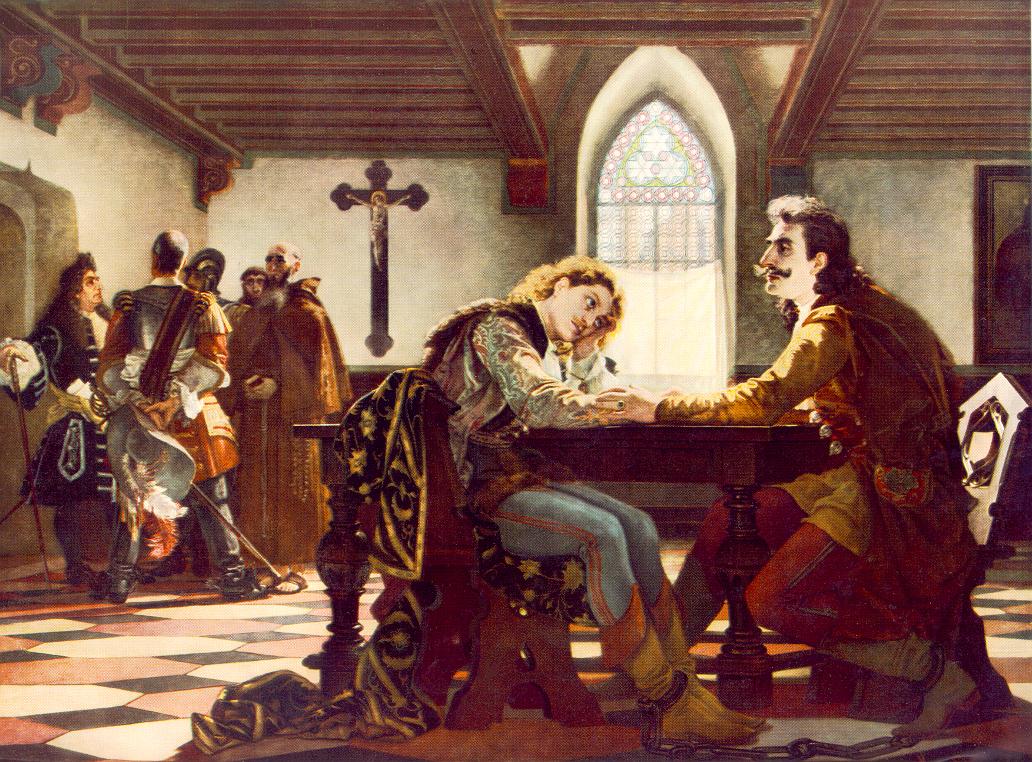
Zrinski and Frankopan in the Wiener-Neustadt Prison, by Viktor Madarasz (1864)

Royal vengeance against the plot shattered two mighty noble houses: the Zrinskis were all but destroyed by the seizure of their estates. The Frankopans — an ancient and far-flung family whose Italian Frangipani branch was even then about to yield a pope — were done as major players.

After these executions, anti-Hapsburg sentiment metastasized in Hungary into outright rebellion.

But in what was left of Croatia, the loss of the two largest landholders spelled the end of effective resistance until the era of 19th century romantic nationalism — when our day’s unfortunates were recovered as honored national heroes.

Zrinski and Frankopan are pictured on modern Croatia’s five-kuna bill, and were both reburied in Zagreb Cathedral after World War I finally claimed the Austrian Empire. (They also got memorial plaques in Wiener-Neustadt) Their mutual relation Katarina Zrinski, who avoided execution but was shut up in a convent, was a writer as well, and has ascended to the stars of founding patriotess, seemingly the go-to namesake for most any Croatian women’s civic organization. (Dudes honor the House of Zrinski by slapping the name onto sports clubs.)

On this day..

1674: Benjamin Gourd, the last bestiality execution

On this date in 1674, Benjamin Gourd (or Goad) was hanged for bestiality in Puritan Massachusetts.

Six New England colonists (pdf) had died for bestiality up through 1662, but the sentence was falling out of fashion.

Gourd, caught having his way with a mare “at noon day in an open yard” and within sight of the gallows, has the distinction of being the last colonist of the future United States put to death for fauna-philia. And even the jury that sentenced him was noticeably reluctant about dooming the 17-year-old.

Well, preacher Samuel Danforth wasn’t going to have any of this ungodly backsliding on Gourd’s ungodly backsliding.

Danforth’s The Cry of Sodom Enquired Into; Upon Occasion of the Arraignment and Condemnation of Benjamin Goad, for His Prodigious Villany (that’s a pdf of the full spiel; here’s a Cliff Notes version) is regarded as the first published “execution sermon” in American history.

the Earth groans under the burthen of such Wickedness. You pity his Youth and tender years, but I pray pity the holy Law of God, which is shamefully violated; pity the glorious Name of God, which is horribly profaned; pity the Land, which is fearfully polluted and defiled.

We think Corey Robin will recognize Danforth’s indictment of the youth’s “licentious liberty” obtained in defiance of an unnamed Master as the root of all his ruin, and any American with an AM radio dial will recognize the rest.

Being at length, by the good hand of God, brought under the Yoke of Government and Service, (which might have bridled and restrained him from such wickedness) he violently brake away from his Master, and with an high hand boldly and impudently, like a childe of Belial, shook off that Yoke of God, casting reproach and disgrace upon his Master. Having now obtained a licentious liberty, he grew so impudent in his wickedness, as to commit this horrid Villany in the sight of the Sun, and in the open field, even at Noon-day; proclaiming his sin like Sodom. Though he be a Youth in respect of years, yet he is grown old in wickedness, and ripe for Vengeance.

On this day..

1677: Thomas Sadler and William Johnson, mace thieves

On this date in 1677, Thomas Sadler and William Johnson were hanged at Tyburn for one of the most impudent burglaries in English history.

Thomas Sadler alias Clarke, William Johnson alias Trueman and Thomas Reneger … broke burglariously into the dwelling house of Heneage Lord Finch the Lord Chancellor of the said Lord the King and then and there stole and carried off a silver mace gilt gold worth one hundred pounds and two velvet purses imbroydered with gold and and silver and sett with pearles, worth forty pounds, of the goods and chattels of the said Lord the King.”

That’s right. They robbed the Lord Chancellor of his ceremonial mace while he slept, and a couple of embroidered ceremonial purses. (Representative pictures here.) The only reason they didn’t make off with the Great Seal of the Realm too was that the Chancellor had it under his pillow while he slept, for safekeeping. That’s some security.

The robbers, to their misfortune, were little better conscious of this crucial precaution.

They paraded through the darkened streets with mace poised on shoulder, a glorious revelry of knaves celebrating what they surely anticipated was the signal achievement of their lives — and the knell of their deaths.

Upon return to their lodging-house, and having no particular place to stash this hottest of loot, they just stuck it in a cabinet. There, the landlady ran across it while cleaning, and raised the alarum.

So Sadler and Johnson died for the astounding crime — Reneger, who didn’t, hadn’t been involved in a previous robbery that Sadler and Johnson committed, which might have helped mitigate his guilt — along with three distinctly undercard common criminals whom even the Newgate Ordinary scarcely noticed.

Johnson left a mournful little self-eulogy, many centuries since lost but preserved for us in that Ordinary’s evocative text.

Before his Tryal, having an excellent fancie, and a hand no less happy at Limning, he had drawn most lively on the wall of his Chamber in Newgate, a pair of Scales, and in one balance the Mace, and in the other Tyburn; the last much over weighing the first: But since his Condemnation, he drew in one Scale the Gallows, in the other a Crucifix; the first mounted up by the greater weight of the last, and these lines under-written, as I have been informed.

My Precious Lord, from all Transgressions free, Was pleas’d, in tender pity unto me, To undergo the Ignominious Tree.

I Suffer justly; but his Sacrifice, I trust, shall make my groveling Spirit rise, And from the Gibbet mount the glorious Skies.

On this day..

1677: Five witches at the Gallowgreen of Paisley

On this date in 1677, Janet Mathie, Bessie Weir, Margaret Jackson, John Stewart, and Marjory Craig were hanged for having bewitched a Sir George Maxwell of Pollok.

These unfortunates were “sacrificed on the altar of popular superstition”, in the words of a later broadside — one element of that superstition being the belief in the superordinary insight of the deaf-dumb.

God hath taken away the tongue and ear of the dumb, and hath given them a rich gift of knowledge in the room of it; and by this would teach all of us his goodness to his creatures, and that we should study humility and sobriety of mind.

This is a culture working with some embarrassingly primitive forensics to begin with.

So, when the Pollok lord started ailing, the indications by “a young deaf and dumb girl, of unknown origin,” to the effect that a local family was doing him mischief by stabbing a wax effigy, well, that was enough to open a case. When they found a wax effigy right where the girl pointed, “The prosecution wanted no stronger proof.”

So they got the 14-year-old daughter (she was spared execution this date) to confess, and tortured her brother into agreeing that the devil appeared as a cloven-hooved Negro, and our unnamed detective-girl miraculously found not one, not two, but three different effigies all attributed to the diabolical voodoo parties to cinch the condemnation.

It’s rather embarrassing what tripe did then and can still now pass for persuasive indicia of guilt among parties already committed to convicting someone. Like show trial victims, even the condemned were swept into the act of auto-denunciation — one final tenuous strand to link an outcast to her community, even from the stake. At least, some of them were.

John and Annabel exhorted their mother to confess, reminding her of all the meetings which she had had with the devil in her own house, and that “a summer’s day would not be sufficient to relate what passages had been between the devil and her.” But Jennet Mathie was a stern, brave, high-hearted Scotch woman, and would not seal her sorrow with a lie. “Nothing could prevail with her obdured and hardened heart,” so she and all, save young Annabel, were burnt; and when she was bound to the stake, the spectators saw after a while a black, pitchy ball foam out of her mouth, which, after the fire was kindled, grew to the size of a walnut, and flew out into sparks like squibs. This was the devil leaving her. As for Bessie Weir … the devil left her when she was executed, in the form of a raven; for so he owned and dishonoured his chosen ones.

“The dumbe girl, Jennet Douglas, now speaks well, and knows Latine, which she never learned, and discovers things past!” says Sinclair. But she still followed her old trade. She had mesmeric visions, and was evidently a “sensitive;” and some of the people believed in her, as inspired and divine, and some came, perhaps mockingly, to test her. (From E.L. Linton)

Sometimes, at least, these malevolent professional accusers get their comeuppance.

The dumb girl herself was afterwards carried before the great council at Edinburgh, imprisoned, scourged through the town, and then banished to “some forraigne Plantation,” whence she reappears no more to vex her generation. God forgive her! She has passed long years ago to her account, and may her guilty soul be saved, and all its burning blood-stains cleansed and assoilzed!

On this day..

1675: Samuel Guile, Puritan rapist

(Thanks to Meaghan Good of the Charley Project for the guest post. -ed.)

On this day in 1675, in the then-Puritan Massachusetts Bay Colony (now Essex County, Massachusetts), 27-year-old Samuel Guile was hanged for “violently and forcibly” raping Mary Ash on Christmas Day the previous year.

What little is known about the case comes from the Records of the Court of assistants of the colony of the Massachusetts bay, 1630-1692, which is available for free with Google Books.

Samuel Guile of Hauerill being Committed to Prison in order to his trial for Comitting a Rape was presented & Indicted by the Grand Jury, was brought from prison to the bar where holding up his hand was Indicted by the name of Samuel Guile for not hauving the feare of God before his eyes & being instigated by the divill did on or about the 25th day of December last in the woods violently and forcibly seize on & Comitt a rape on the body of Mary Ash the wife of John Ash of Amesbury Contrary to the peace of our Soueraigne Lord the King his Croune & dignity the lawes of God & of this jurisdiction — to which he pleaded not Guilty and put himself on God & country. After the Indictment and eudicenes were Read Comitted to the Jury & are on file with the Records of this Court the Jury brought in y’r verdict they found the prisoner at the barr Guilty & he accordingly had sentenc pronounct ag’ him yow Sam Guile are to Goe from hence to yo place from whence yo came & thence to yo place of execution & there be hang till yow be dead wch was accordingly donn 16 october 1675.

His estate paid six pounds, eighteen shillings in court costs and five pounds in damages to Mary.

Although rape was a capital crime, it was inconsistently punished in the Massachusetts Bay Colony. In 1680, five years after Guile swung, William Nelson was convicted of raping a girl under ten and he was only whipped.

Nearly forty years earlier, in 1642, Daniel Fairfield, John Hudson and Jenkin Davis were found guilty of gross immorality for molesting and raping two sisters over a period of years, starting when they weren’t even seven years old. The men confessed to everything but penetration, but the girls’ statements and a physical examination contradicted the suspects’ statements.

Governor John Winthrop was horrified and wrote at length about the case, calling it “a very foul sin.” Fairfield was whipped twice and had his nostrils slit, Hudson and Davis were also whipped and Davis had to wear a halter for life (like a scarlet letter, it would remind everyone of his crime), and all three men were fined heavily … but they were not executed.

One wonders, then, why Samuel Guile was. Did he have a bad reputation? Were Mary and John Ash prominent people? Or did the colonial court just decide they’d better exercise the law to its full extent for once?

On this day..