1675: Little John

On this date in 1675, an Indian (tribe uncertain insofar as I can ascertain) named Little John (or John Littlejohn) was publicly executed on Boston Common for murder.

Though the attributed crime was of a venial variety, the situation was conditioned by a dirty war of ethnic cleansing that had only just that summer eruptedKing Philip’s War.

Strained by a series of Native American raids, Little John — lying in jail for murder — apparently became a popular target of Bostonian fury, which was a very bad place to be. Just a few days before this execution, two accredited Indian envoys in the city had been hailed as King Philip’s warriors by two whites, and upon that “recognition” put to death.

Little John’s near-lyching and actual-hanging (“in a Manner so revolting that were the truth alone related the readers’ belief might be confounded”) comes to us from Narratives of The Indian Wars 1675-1699 (also available from Google books):

about the 10th of September, at nine O’clock at Night, there gathered together about forty Men (some of Note) and came to the House of Captain James Oliver; two or three of them went into the Entry to desire to speak with him, which was to desire him to be their Leader, and they should joyn together and go break open the Prison, and take one Indian out thence and Hang him: Captain Oliver hearing their Request, took his Cane and cudgelled them stoutly, and so for that Time dismist the Company; which had he but in the least countenanced, it might have been accompanied with ill Events in the End. Immediately Captain Oliver went and acquainted Mr. Ting his Neighbor, (a Justice of Peace) and they both went next Morning and acquainted the Governour, who thank’d Captain Oliver for what he had done last Night, but this rested not here; For the Commonalty were so enraged …

an Order was issued out for the Execution of that one (notorious above the rest) Indian, and accordingly he was led by a Rope about his Neck to the Gallows; when he came there, the Executioners (for there were many) flung one End over the Post, and so hoised him up like a Dog, three or four Times, he being yet half alive and half dead; then came an Indian, a Friend of his, and with his Knife made a Hole in his Breast to his Heart, and sucked out his Heart-Blood: Being asked his Reason therefore, his Answer, Umh, Umh nu, Me stronger as I was before, me be so strong as me and he too, he be ver strong Man fore he die.

Thus with the Dog-like Death (good enough) of one poor Heathen, was the Peoples Rage laid in some Measure, but in a short Time it began to work (not without Cause enough).

On this day..

1675: The murderers of John Sassamon, precipitating King Philip’s War

On this date in 1675, Puritan colonists’ hanging of three Wampanoag Indians helped trigger a brutal bout of ethnic cleansing, King Philip’s War.

The condemned men’s victim, Wassausmon — known by his Christian, Anglicized name of John Sassamon — was a converted Massachuseuk, briefly a Harvard attendee (1653)*, and eventually a translator for several tribes when dealing with the early settlers. Sassamon fought on the colonists’ side during the Pequot War, which has graced these pages before, and was generally seen as very sympathetic to the colonial cause, at one point becoming a schoolmaster at the inception of the towns of Natick and Ponkapoag.

After his work as a translator, Sassamon returned to the Puritan fold to become a minister in the Plymouth Colony.

Because of his high position in both the white and native worlds, though, he drew some resentment from both sides. It was Sassamon’s sense of loyalty to both sides of the growing tension between the natives and colonists that led to his demise.

King Philip (natively known as Metacomet) became head (Sachem) of the Wampanoag Confederacy in 1662 after his brother’s death.

Though initially trade-friendly with the burgeoning colonies to the north and east, the Wampanoag were also feeling the squeeze from the Iroqouis Confederation gaining power to the west. In 1671, the colonies presented the Wampanoag with an ultimatum: give up their arms and submit to English law, or be forced out.

The colonists had tried this tactic before with the Pequot (hence the Pequot War), Narragansett, and other native tribes with great success. As expected, Philip blinked, and the English moved in.

But the Sachem was predictably unhappy with the relationship. Three years later, he had assembled a band of warriors and was ready to, er, renegotiate.

Sassamon got wind of Philip’s planned attack on Plymouth Colony and warned its governor Josiah Winslow. Two months later, Sassamon was fished out from under the ice of Assawompset Pond.

With one witness claiming that a trio of King Philip’s men had knocked off the translator and dumped the corpse, the Puritans became convinced that Philip was already getting involved in their affairs.

In June 1675, four months after Sassamon’s body was found, a mixed jury of Indians and colonists convicted three Pokanoket Indians of murdering Sassamon, and on June 8, they were hanged.**

The executions helped bring tensions to the breaking point, and Philip decided it was his time.

On June 18, he launched an attack on homesteads in Swansea, and the war was on. The colonists struck back, laying siege to Mount Hope with the thought of gutting the insurgency by capturing its leader. That move failed, and King Philip escaped to recruit more tribes to his cause. Eventually, the forces included five major native tribes fighting colonists and two other major tribes.

Things got ugly fast: the conflict would become one of North America’s bloodiest colonial wars, and touch everyone who lived in the region. In September, the New England Confederation officially declared war on the Native Americans of the area.

After suffering months of casualties, the colonists finally gained a foothold in the conflict in December. By spring, King Philip’s War was in full swing, with atrocities happening on both sides. But the native forces were being worn down, and the colonists began clawing back. Despite rampant destruction of towns across the colonies (including complete abandonment of a dozen or more), the colonists had fortresses to retreat to and boats to resupply them; the natives needed to trade with the colonists to get their arms. The situation was unsustainable, and when Canadian supply lines fell through, King Philip’s adventure was over.

Persistent enemies of many of the raiding tribes, the Plymouth-allied Mohegans took the offensive and broke up Philip’s warrior bands, scattering them across the Northeast. By the following summer, the Narragansett were defeated and dispersed, and the colonists were granting amnesty to natives who surrendered and could document non-participation. (Others were not so lucky.) In July, King Philip himself was isolated and on the run, taking refuge in Mount Hope. It was there that John Alderman, a Native American, shot him on August 12, 1676.

Philip’s body was mutilated: he was quartered and beheaded, and his head was displayed in Plymouth Colony Fort for years to come.

After the war, Mary Rowlandson, who was taken captive by Philip’s men, wrote a memoir about her experience. Philip’s escapades were also later made into a play.

* Harvard, founded in 1636, started its “Indian Harvard” in 1655 which saw a total of five students: Caleb Cheeshahteamuck (Aquinnah Wampanoag) took a degree in 1665 and died of tuberculosis a year later; classmate Joel Iacoombs (Aquinnah Wampanoag) disappeared in a shipwreck off Nantucket before walking; John Wampus (Aquinnah Wampanoag) bailed after a year and went to sea; and Benjamin Larnell and an otherwise unnamed “Eleazer” caught smallpox and died the year they enrolled.

** One account reports that only two of the Indians died on the first drop; the third was spared by his rope breaking, and after confessing the guilt of all three, he was re-executed.

On this day..

1673: Thomas Cornell, on spectral evidence

(Thanks to Meaghan Good of the Charley Project for the guest post. -ed.)

On this day in 1673, alleged mother-slayer and arsonist Thomas Cornell was hanged in Portsmouth in the colony of Rhode Island.

The death of his elderly mother, Rebecca, and the subsequent homicide investigation have got to be one of the strangest murder stories in American colonial history.

The Cornells were a respectable and prosperous Quaker family, the ancestors of the man who founded Cornell University. (Their descendants also included Lizzie Borden of the “forty whacks” fame, but that’s another story.)

Rebecca, a 73-year-old widow, was the legal owner of the family’s hundred-acre spread by Narragansett Bay. Her oldest son, Thomas, and his wife and six children lived there with her, along with one lodger and one male servant, a Narragansett Indian named Wickopash.

Crowded as the house was, Rebecca had the master bedroom all to herself. It was well known that Rebecca and Thomas didn’t get along. For some time, both parties had been complaining bitterly about each other to anyone who would listen. Thomas resented the fact that, at 46, he was still financially dependent on his mother, who had made generous gifts from her late husband’s estate to her other children but not to him. Rebecca, for her part, said Thomas was “a Terror to her” and that she was neglected and had to fetch her own firewood.

None of her complaints were taken seriously until after her mysterious death, which is chronicled in Elaine Forman Crane’s 2002 book Killed Strangely: The Death of Rebecca Cornell.

Rebecca died on the evening of February 8, 1673.

That night, she refused to join the family for dinner because she didn’t like what was being served. After the meal was over, her grandson came to her room to check on her and found her charred body lying on the floor by the fireplace, burnt “to a cole.” She was recognizable only by her shoes.

Her death was originally ruled “an unhappie accident.”

It could have been spontaneous human combustion, but a more likely explanation is that embers from the fireplace or from the pipe Rebecca smoked landed on her dress.


An alleged victim of spontaneous human combustion.

No one heard her scream, no one smelled smoke, and somehow the fire didn’t spread to the rest of the house. No one seems to have suspected foul play at that time.

Two nights later, however, Rebecca’s younger brother, John Briggs, received a spiritual visitation from his sister as she slept. “See how I was burned with fire,” she said. He inferred that someone had intentionally burned her.

Briggs didn’t report his experience for a week, but when he did his account was taken seriously by the superstitious colonials. Rebecca’s body was exhumed and given a thorough inspection, and this time a wound was found on her upper abdomen. The authorities decided she had been stabbed by something like “the iron spyndell of a spinning whelle.” No murder weapon was ever produced, however.

Thomas quickly became the prime suspect: he was the last person to see Rebecca alive, and the whole town knew of the enmity between them. After Rebecca’s death, Thomas and his wife Sarah reportedly made some incredibly crass remarks; Sarah said her mother-in-law’s demise was “a wonderfull thing,” and Thomas said that his mother had always liked a good fire, and “God had answered her ends, for now shee had it.”

This hearsay was presented as evidence at Thomas’s trial, along with John Briggs’s dream.

Thomas was convicted and, although many of the townspeople had doubts about the verdict and death sentence, he chose not to appeal. He was hung before a crowd of over one thousand people.

Did Thomas Cornell murder his mother?

Certainly he wasn’t the only one who had the opportunity to do so; the house was full of people that night. In fact, a year after Thomas’s death, the servant Wickopash was tried as an accomplice to the murder. Nothing is known about the case against him, but he was acquitted.

In 1675, Rebecca’s son William tried to make a case against Thomas’s wife for the murder, but he failed to produce any witnesses or evidence against her.

Was this even a murder at all?

The fire, as noted above, could have been accidental; as for the “suspicious wound” the authorities found after they dug up the body, Rebecca could have stabbed herself in her struggles after her dress caught fire, or perhaps those who performed the exhumation saw only what they expected to see.

And there is yet a third possibility: prior to her death, Rebecca told her daughter she had contemplated suicide on several occasions, but her religious beliefs prohibited such action.

One final note: Thomas’s wife, Sarah, was pregnant at the time of his execution and later gave birth to a daughter.

She named the baby Innocent.

On this day..

1674: The Chevalier de Rohan and Franciscus van den Enden

On this date in 1674, the former Grand Huntsman of France was beheaded in Paris for conspiring to betray Normandy during the Franco-Dutch War.

Your basic debt-mired noble and court cad, the Chevalier de Rohan (French Wikipedia link) through an accomplice “intimated that Normandy was very much dispos’d to a revolt, & that if hee would send a fleet with 6 thousand men, & armes for twenty thousand, with necessaries for sieges & two million of livres, that there was a greate man who would engage himself upon the assurance of thirty thousand crownes pension …”

The correspondence was discovered and Rohan arrested, but his role in the plot was sufficiently anonymized that even an absolutist state didn’t have the goods to convict him. Meanwhile, Rohan’s accomplice was hunted to ground and killed in Rouen during the attempt to arrest him.

This left the authorities in the position, common to every cop show and not a few real-life cases, of requiring a confession from the accused to proceed at all. Rohan’s friends realized this too, and tried desperately to warn him against self-incrimination.

Persons attached to the chevalier de Rohan went every evening round the Bastile, crying through a speaking trumpet, “La Tuanderie is dead, and has said nothing;” but the chevalier did not hear them. The commissioners, not being able to get any thing from him, told him, “that the king knew all, that they had proofs, but only wished for his own confession, and that they were authorized to promise him pardon if he would declare the truth.” The chevalier, too credulous, confessed the whole. Then the perfidious commissioners changed their language. They said, “that with respect to the pardon, they could not answer for it: but that they had hopes of obtaining it, and would go and solicit it.” This they troubled themselves very little about; and condemned the criminal to lose his head. He was conducted on a platform to the scaffold, by means of a gallery raised to the height of the window of the armoury in the arsenal, which looks towards the little square at the end of the Rue des Tournelles. He was beheaded on November 27, 1674.

It is hoped that, should the reader ever become a person of police interest, s/he will recall from Rohan’s example that inspectors do not have suspects’ best interests in mind.

A couple of other nobles also lost their heads along with our chevalier.

Hanged for his trouble was Franciscus van den Enden (English Wikipedia page | Dutch), the elderly Dutchman — and accused Dutch agent — who recruited these toffs for the purpose of seizing Le Havre.

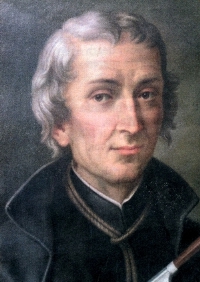
Van den Enden is an interesting, perhaps underappreciated, radical intellectual of secular-democratic persuasion (he attracted the suspicion of atheism, and his Vrye Politijke Stellingen made an unabashed case for democratic government). He’s best known for being a schoolmaster of philosopher Baruch Spinoza; W.N.A. Klever, in an October 1991 paper in the Journal of the History of Philosophy (“A New Source of Spinozism: Franciscus Van den Enden”) traces the connections between the philosophy of the master and that of the pupil and rather dramatically argues that

Van den Enden must be considered as a kind of “Proto-Spinoza.” … He was the hidden agent behind Spinoza’s genius … [t]he origin of Spinoza’s anomalous philosophy.

A variety of (untranslated) references to the “Proto-Spinoza” from 17th century correspondence are available here.

Those inclined more towards geopolitics than philosophy might enjoy Victor Magagna’s podcast lecture on the great-power calculus driving France’s conflict with the Netherlands — which, as we have noticed in these pages, claimed the life of the longtime Dutch leader Johan de Witt.

On this day..

1676: Col. Thomas Hansford, the first American independence martyr

Col. Thomas Hansford was hanged “a loyal subject and a lover of my country” on this date in 1676 — America’s first executed political martyr, since that “country” was not England, but Virginia.

Robert Beverly‘s 1705 History of Virginia recalls the genesis of that milestone dispute between settlers and mother England.

The occasion of this rebellion is not easy to be discovered: but ’tis certain there were many things that concurred towards it. For it cannot be imagined, that upon the instigation of two or three traders only, who aimed at a monopoly of the Indian trade, as some pretend to say, the whole country would have fallen into so much distraction; in which people did not only hazard their necks by rebellion, but endeavored to ruin a governor, whom they all entirely loved, and had unanimously chosen; a gentleman who had devoted his whole life and estate to the service of the country, and against whom in thirty-five years experience there had never been one single complaint. Neither can it be supposed, that upon so slight grounds, they would make choice of a leader they hardly knew, to oppose a gentleman that had been so long and so deservedly the darling of the people. So that in all probability there was something else in the wind, without which the body of the country had never been engaged in that insurrection.

Four things may be reckoned to have been the main ingredients towards this intestine commotion, viz., First, The extreme low price of tobacco, and the ill usage of the planters in the exchange of goods for it, which the country, with all their earnest endeavors, could not remedy. Secondly, The splitting the colony into proprieties, contrary to the original charters; and the extravagant taxes they were forced to undergo, to relieve themselves from those grants. Thirdly, The heavy restraints and burdens laid upon their trade by act of Parliament in England. Fourthly, The disturbance given by the Indians.

Tobacco aside, these are grievances straight from the next century’s Declaration of Independence at the outset of the (more successful) American Revolution:

cutting off our Trade with all parts of the world:

… imposing Taxes on us without our Consent:

endeavoured to bring on the inhabitants of our frontiers, the merciless Indian Savages whose known rule of warfare, is an undistinguished destruction of all ages, sexes and conditions.

So, tax revolt + political self-determination + impatience about arrangements with Indians who could be wiped out instead. Eventually, this would germinate a mighty empire.

In 1676, it germinated a colonial rebellion against the mighty empire — Bacon’s Rebellion, an unsuccessful rising that is easily read in retrospect as a prototype for the more illustrious revolt one century later.

The suppression of Bacon’s Rebellion also involved a rash of executions, which we’ve touched on before. King Charles II would complain that his Virginia governor’s severity “has taken more lives in that naked country than I have taken for the murder of my father.”

The man dignified to be the first of these executions — and therefore, if you like, the first man put to death in the service of American liberty — was actually nabbed by our historian’s father, also named Robert Beverly, “a parson calculated to the Lattitude of the Servis, which required descretion, Curage, & Celerity, as qualetys wholly subservant to military affares.” (source)

snapt up one Coll: Hansford, and his party … It is saide that Hansford, at (or a little before) the onslaut, had forsaken the Capitole of Marss, to pay his oblations in the Temple of Venus; which made him the easere preay to his enemies; but this I have onely upon report, and must not aver it upon my historicall reputation: But if it was soe, it was the last Sacryfize he ever after offered at the Shrine of that Luxurious Diety, for presently after that he came to Accomack, he had the ill luck to be the first Berginian borne that dyed upon a paire of Gallows. When that he came to the place of Execution (which was about a Mile removed from his prisson) he seemed very well resalved to undergo the utmost mallize of his not over kinde Destinie, onely Complaineing of the manner of his death: Being observed neather at the time of his tryall (which was by a Court Martiall) nor afterwards, to suplicate any other faviour, then that he might be shot like a Soulder, and not to be hang’d like a Dog. But it was tould him, that whwat he so passionately petitioned for could not be granted, in that he was not condem’d as he was merely a Soulder, but as a Rebell, taken in Arms against the King, whose Laws had ordained him that death. Dureing the short time he had to live, after his sentance, he approved to his best advantage for the well fare of his soule, by repentance and contrition for all his Sinns, in generall, excepting his Rebelellion, which he would not acknowledg; desireing the People, at the place of execution, to take notis that he dyed a Loyall Subject, and a lover of his Countrey; and that he had never taken up arms, but for the destruction of the Indians, who had murthered so many Christians.

(A modernized, and less atmospheric, version of the same passage can be read here.)

Hansford’s story and the larger one of Bacon’s Rebellion are treated at second hand in several public-domain histories available online — see here, here, and here.

It also seems that, besides being the first martyr to American liberty, Hansford also had the distinction of being the first native-born Virginian (white Virginian, we presume) ever executed.

On this day..

1679: St. David Lewis, the last Welsh martyr

On this date in 1679, the Jesuit David Lewis was hanged, drawn and quartered.

Lewis suffered just days after a fellow priest and fellow victim of Titus Oates’ “Popish Plot” concoctions, John Kemble.

Lewis was arrested at the Wales town of Llantarnam where he was Tad y Tlodion, “father of the poor”; hauled to London’s Newgate Prison, he was returned to Usk, also in Wales, for execution.

As with Kemble, Lewis “discover the plot I could not, as I knew of none; and conform I would not, for it was against my conscience.” Where terroristic plotting could not be established, taking Holy Orders in the church would do just as well.

Lewis is not actually the last Catholic martyr in Britain* — Oliver Plunkett earned that distinction in 1681 — but at this late date he goes down as the last Welsh martyr, which is also the title of an energetic Catholic blog all about the man and his milieu.

Seems that site has a virtual pilgrimage to go along with the annual meatspace tradition that takes place this year on Sunday, August 29. The faithful might also enjoy friendsofsaintdavidlewis.co.uk.

* An inventory of martyrs for the faith in the Isles is here.

On this day..

1679: St. John Kemble, 80-year-old priest

On this date in 1679, 80-year-old Catholic priest John Kemble was martyred for the faith at Hereford.

Kemble had been discreetly performing the offices of his faith — still illicit, but less liable to get you killed at this late date — for over five decades since ordination.

Unhappily, Titus Oates and his tall tales of a Popish Plot to assassinate King Charles II came along at the end of that run. In the ensuing anti-Catholic spasm, Kemble was one of the unlucky ones rousted.

Even in the hysteria of the times, nobody could make an actual conspiracy charge stick against this ancient cleric, but in the hands of a sufficiently hostile judiciary, his demonstrable exercise of the priesthood could be enough to make him a traitor. And at his age, the opportunity to buy his life at the cost of his conscience didn’t look the bargain:

According to the course of nature I have but a few years to live. It will be an advantage to suffer for my religion and therefore I will not abscond.

He got the mild consolation of hanging to death before the unpleasant drawing-and-quartering bits were executed upon him, and calmly puffed a pipe and shared a bowl of wine with the sympathetic representatives of the law before it all happened. As a result, Herefordshire long called the comforts enjoyed before a parting a “Kemble pipe” and “Kemble cup”.

He’s been elevated to sainthood on the strength of his posthumous miracles, like healing the jailer’s daughter of throat cancer; the holy man’s severed hand, held at St. Francis Xavier’s in Hereford, is supposed to have saved a man from death as recently as 1995.

(The rest of St. John Kemble reposes at Welsh Newton, and is venerated at an annual pilgrimage.)

Kemble was among the last of the Forty Martyrs of England to die for the Catholic faith; a fellow-inmate, David Lewis, paid his own penalty just five days later.

On this day..

1672: Cornelis and Johan de Witt lynched

Chapter 1. A Grateful People

On the 20th of August, 1672, the city of the Hague, always so lively, so neat, and so trim that one might believe every day to be Sunday, with its shady park, with its tall trees, spreading over its Gothic houses, with its canals like large mirrors, in which its steeples and its almost Eastern cupolas are reflected,–the city of the Hague, the capital of the Seven United Provinces, was swelling in all its arteries with a black and red stream of hurried, panting, and restless citizens, who, with their knives in their girdles, muskets on their shoulders, or sticks in their hands, were pushing on to the Buytenhof, a terrible prison, the grated windows of which are still shown, where, on the charge of attempted murder preferred against him by the surgeon Tyckelaer, Cornelius de Witt, the brother of the Grand Pensionary of Holland was confined.

the whole town was crowding towards the Buytenhof, to witness the departure of Cornelius de Witt from prison, as he was going to exile; and to see what traces the torture of the rack had left on the noble frame of the man who knew his Horace so well.

Yet all this multitude was not crowding to the Buytenhof with the innocent view of merely feasting their eyes with the spectacle; there were many who went there to play an active part in it, and to take upon themselves an office which they conceived had been badly filled,–that of the executioner.

There were, indeed, others with less hostile intentions. All that they cared for was the spectacle, always so attractive to the mob, whose instinctive pride is flattered by it,–the sight of greatness hurled down into the dust.

-Alexandre Dumas, pere, The Black Tulip

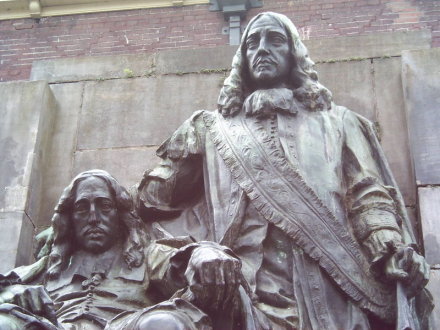
That ominous mob got its spectacle this date in 1672, lynching the Dutch Republic’s longtime de facto head of state, Johan de Witt along with his brother Cornelis/Cornelius.


A statue of Johan (standing) and Cornelis de Witt in their native Dordrecht.

The mercantile powerhouse that was the 17th century Dutch Republic was the stage for a long-running conflict between the Orange monarchists (hence the soccer uniforms) and the Republican merchant class.

With the sudden death of the young William II, Prince of Orange in 1650, leaving the (non-hereditary) executive office of stadtholder vacant, the Republicans became ascendant.

And the outstanding figure of the First Stadtholderless Period was Johan de Witt, scion of a Dordrecht merchant family powerful enough that William II had imprisoned de Witt’s own father during a power struggle.

Elevated in 1653 and at the tender age of 28 to the leadership position of Grand Pensionary, Johan de Witt’s “eloquence, sagacity and business talents” guided the Dutch ship of state for essentially the remainder of his life.

This was the apex of the Dutch Golden Age. The Dutch East India Company dominated Asian trade routes,* and the Low Countries’ culture thrived on the wealth: Rembrandt and Vermeer were at the height of their talents; Spinoza revolutionized philosophy; van Leeuwenhoek invented the microscope.

While all these guys were landing themselves in their respective canons, Johan de Witt was trying to keep the age Golden.

Having only relatively recently broken free of Spain, the small country was an up-and-comer on the horns of a serious security dilemma: its leading commercial position put it into maritime competition with England, while its continental location made it vulnerable to the enormous army of the neighboring continental hegemon, France. Ultimately, even with its trade wealth, it did not have the resources to keep up with both of western Europe’s leading powers.

For a generation, de Witt’s statecraft kept the men of the Low Countries out of that predicament, while his brother Cornelis chipped in with a couple of timely naval victories. (Actually authored by Michiel de Ruyter, but Cornelis rode shotgun.)

In 1654, Johan brought the First Anglo-Dutch War to a close, making with Oliver Cromwell a secret pact he was only too happy to enforce never to allow William II’s son, the eventual William III, to be named stadtholder. Reason being: William III was the grandson of the Stuart king Cromwell beheaded, Charles I, and thus a potential claimant to the English throne. Both Protestant Republics had a distinct interest in keeping this monarchist well away from power. (Both would be sorely disappointed.)

A decade and a Stuart Restoration later, de Witt maintained (mostly) Dutch dominance of the seas in the Second Anglo-Dutch War, then held off France (with the help of a timely alliance with the recent adversary, England) in the War of Devolution.

In each case, he kept at least one of England or France on the sideline, or in his own camp.

But the Third Anglo-Dutch War was the charm — as it was also the Franco-Dutch War, and therefore 1672 was Rampjaar: disaster year. While the Dutch were aces on the waves, a massive French invasion easily overwhelmed them on terra firma.

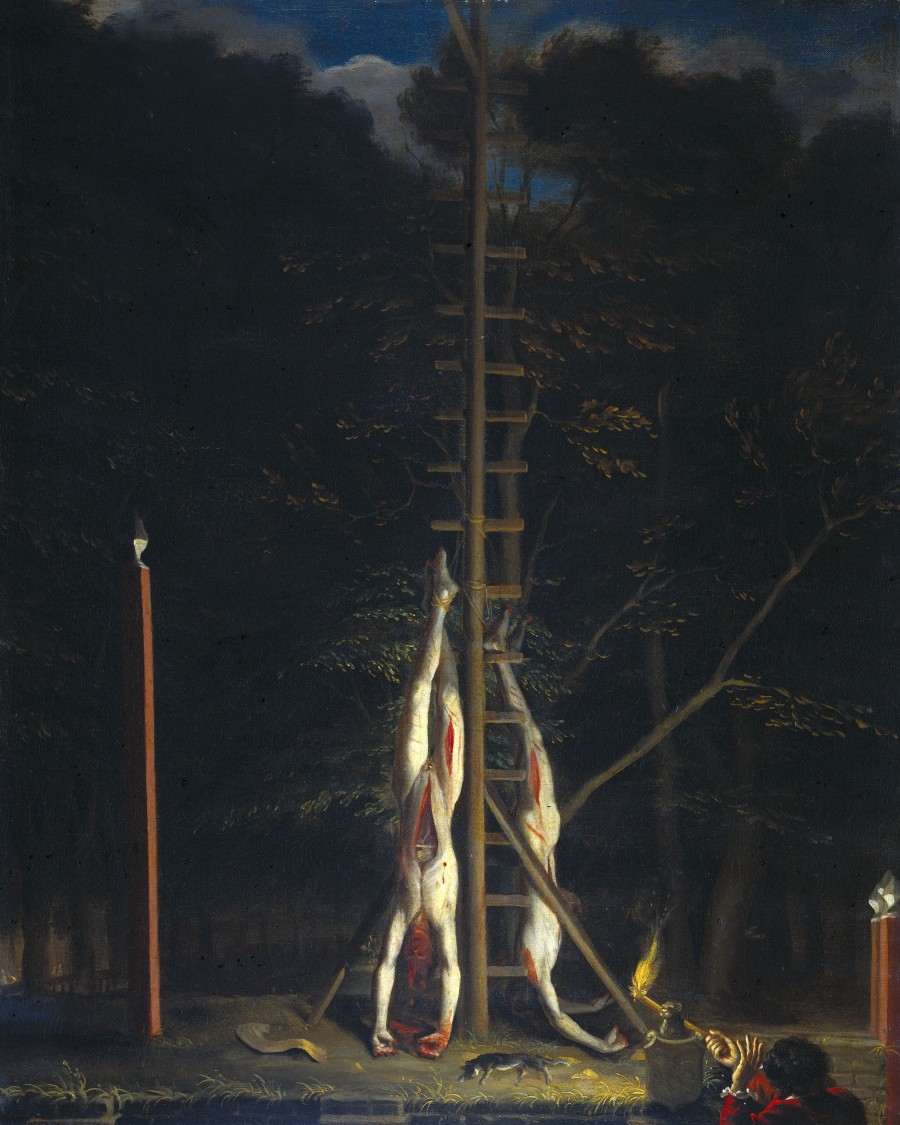
Detail view (click for the full image) of a grisly painting of the mutilated de Witt brothers strung up at The Hague. It’s attributed to Jan de Baen, who in better times took Johan de Witt’s portrait.

De Witt’s never-beloved mercantile oligarchy speedily collapsed with the military reverses, and the now all-grown-up William III was there to pick up the pieces to popular acclaim. Arrested for treason, Cornelis sustained torture without confessing, but when Johan visited him in prison — and William III incriminatingly withdrew the cavalry protecting the brothers — the mob quenched its fury with the de Witts’ blood.

every one of the miscreants, emboldened by his [Johan’s] fall, wanted to fire his gun at him, or strike him with blows of the sledge-hammer, or stab him with a knife or swords, every one wanted to draw a drop of blood from the fallen hero, and tear off a shred from his garments.

And after having mangled, and torn, and completely stripped the two brothers, the mob dragged their naked and bloody bodies to an extemporised gibbet, where amateur executioners hung them up by the feet.

Then came the most dastardly scoundrels of all, who not having dared to strike the living flesh, cut the dead in pieces, and then went about the town selling small slices of the bodies of John and Cornelius at ten sous a piece.

-Dumas

The word “ungrateful” comes to mind.

De Witt stood altogether on a lower plane than Cromwell. We regard him rather as a man of rare and singular talent, than as one of the chosen great ones of the earth, which Cromwell was. He stands far above the common run of men; and he was head and shoulders above nearly all the notable men of his time. He would have been greater if the movement of his limbs had been less burdened with the Dutch governing apparatus … He is not one whom the world can ever greatly admire or love.

History of the administration of John De Witt, grand pensionary of Holland, a Google books freebie.

(Here’s another, and here’s a 17th century volume de Witt himself coauthored.)

The rise of William III came with the decline of that Dutch Golden Age: the country fended off the immediate military threat, but it increasingly slipped behind its larger neighbors. Costly as was the Franco-Dutch War, it is a step on the path towards the present-day Europe, and this gives us enough excuse to notice that the Eurovision lead-in tune is actually from a Te Deum composed to mark its end.

But William’s own ascent to this wealthy sovereignty was just the beginning for him. Sixteen years later, the House of Orange’s champion vindicated Cromwell’s trepidation about him and gained a far more satisfactory position from which to do battle with his Gallic rival Louis XIV by stunningly overthrowing the Stuart dynasty and becoming King of England in the Glorious Revolution.**

* The Dutch remained the sole western contact of closed Japan until 1854, which is why Japan’s eventual period of scientific advancement became known as ‘Dutch Learning’.

** Albion did not forget the de Witts, either: according to this 1785 cant dictionary, the term “dewitted” had a 17th-18th century run in English to denote — well, exactly what happened to Cornelis and Johan.

On this day..

1676: Marie-Madeleine-Marguerite d’Aubray, Marquise de Brinvilliers

This date’s story is amply but succinctly conveyed by the public-domain entry in the 19th century tome Biography, or Third Division of the “English Encyclopedia”.

(Paragraph breaks have been added for readability.)


Brinvilliers, Marie Marguerite, Marquise de (English Wikipedia entry | French) who obtained infamy as a poisoner in the time of Louis XIV, was a daughter of the Dreux d’Aubrai, a lieutenant civil, or judge having a certain limited jurisdiction, at whose hands she received a careful education.

In 1651, whilst still very young, she became the wife of the Marquis de Brinvilliers, with whom she resided at her father’s house, in Paris. Her husband, who was the colonel of the Regiment de Normandie, entertained at his house a young officer of cavalry of the Regiment de Tracy, named Gaudin de Sainte-Croix, a native of Montauban, and the illegitimate member of an illustrious family. He was unprincipled enough to encourage the unlawful passion which the marchioness conceived for him; and her father, in consequence, procured in 1663 a lettre de cachet against Sainte-Croix, who underwent a year’s incarceration in the Bastille.

During his confinement he learned from a fellow-prisoner, an Italian named Exili, the art of preparing subtle poisons; a secret which, upon his enlargement, he communicated to his mistress, who determined to poison her father and the other members of her family. Having first wantonly essayed her art upon the patients of the Hotel-Dieu, she proceeded, with the aid of a servant named Jean Amelin, or La Chaussee, to take the lives of her father, her two brothers, and her sister.

This feat she accomplished gradually between the years 1666 and 1670. More than once she poisoned her husband; but Sainte-Croix, whose prudence shrank from the obligation of marrying the terrible widow, each time preserved the life of the Marquis by the administration of an antidote.

Sainte-Croix died suddenly in July, 1672, in the act, it is said, of compounding a subtle poison, against the effects of which he was left unprotected by the accidental fracture of a glass mask which he wore as a defence against the fumes of his deadly drugs.*

As no relative came forward to claim his property, it was taken possession of by the public authorities, who, instead of complying with the written instructions of Sainte-Croix,** dated May 25th, 1672, that a particular casket should be delivered to Madame de Brinvilliers, examined it, together with above thirty letters which he had received from her. There was also found a promise on her part to pay Sainte-Croix a sum of 30,000 libres, bearing the date of June 20th, 1670, eight days after the poisoning of the “lieutenant civil,” her father. The casket proved to be full of packets of various poisons, to each of which was affixed a label indicating the peculiar effects it was calculated to produce.

The Marchioness, fatally compromised by these and other circumstances, sought safety in flight, repairing first to England, then to Germany, and finally to Liege, where she was apprehended.

Being taken to Paris, she denied her guilt; but after her condemnation made a confession, in which, and in a kind of autobiography, she charged herself with more and greater horrors than had seemed possible to rumour or suspicion.


The Marquise de Brinvilliers, shortly before her execution, by Charles LeBrun

She was executed at seven o’clock on the evening of the 16th of July, 1676, being first beheaded and afterwards burnt. As her application and use of poison, which went by the name of poudre de succession, seemed to be growing prevalent, Louis XIV instituted a special court for the investigation and punishment of this species of crime.


This tale, uniting the attractions of bodice-ripper, true crime, and costume drama, has been adapted to stage and literature numerous times.

Alexandre Dumas pere, a true aficionado of historical crime and scandal, turned it into a much lengthier piece, from which we morbidly excerpt his description of the water torture the criminal endured prior to beheading — beginning with the sentence of the court.


“That by the finding of the court, d’Aubray de Brinvilliers is convicted of causing the death by poison of Maitre Dreux d’Aubray, her father, and of the two Maitres d’Aubray, her brothers, one a civil lieutenant, the other a councillor to the Parliament, also of attempting the life of Therese d’Aubray, her sister; in punishment whereof the court has condemned and does condemn the said d’Aubray de Brinvilliers to make the rightful atonement before the great gate of the church of Paris, whither she shall be conveyed in a tumbril, barefoot, a rope on her neck, holding in her hands a burning torch two pounds in weight; and there on her knees she shall say and declare that maliciously, with desire for revenge and seeking their goods, she did poison her father, cause to be poisoned her two brothers, and attempt the life of her sister, whereof she doth repent, asking pardon of God, of the king, and of the judges; and when this is done, she shall be conveyed and carried in the same tumbril to the Place de Greve of this town, there to have her head cut off on a scaffold to be set up for the purpose at that place; afterwards her body to be burnt and the ashes scattered; and first she is to be subjected to the question ordinary and extraordinary, that she may reveal the names of her accomplices. She is declared to be deprived of all successions from her said father, brothers, and sister, from the date of the several crimes; and all her goods are confiscated to the proper persons; and the sum of 4000 livres shall be paid out of her estate to the king, and 400 livres to the Church for prayers to be said on behalf of the poisoned persons; and all the costs shall be paid, including those of Amelin called Lachaussee. In Parliament, 16th July 1676.

The marquise heard her sentence without showing any sign of fear or weakness. When it was finished, she said to the registrar, “Will you, sir, be so kind as to read it again? I had not expected the tumbril, and I was so much struck by that that I lost the thread of what followed.”

The registrar read the sentence again. From that moment she was the property of the executioner, who approached her. She knew him by the cord he held in his hands, and extended her own, looking him over coolly from head to foot without a word. The judges then filed out, disclosing as they did so the various apparatus of the question. The marquise firmly gazed upon the racks and ghastly rings, on which so many had been stretched crying and screaming. She noticed the three buckets of water prepared for her, and turned to the registrar — for she would not address the executioner — saying, with a smile, “No doubt all this water is to drown me in? I hope you don’t suppose that a person of my size could swallow it all.” The executioner said not a word, but began taking off her cloak and all her other garments, until she was completely naked. He then led her up to the wall and made her sit on the rack of the ordinary question, two feet from the ground. There she was again asked to give the names of her accomplices, the composition of the poison and its antidote; but she made the same reply as to the doctor [namely, that she had no accomplices besides Sainte-Croix and did not know how to make the poison or its antidote], only adding, “If you do not believe me, you have my body in your hands, and you can torture me.”

The registrar signed to the executioner to do his duty. He first fastened the feet of the marquise to two rings close together fixed to a board; then making her lie down, he fastened her wrists to two other rings in the wall, distant about three feet from each other. The head was at the same height as the feet, and the body, held up on a trestle, described a half-curve, as though lying over a wheel. To increase the stretch of the limbs, the man gave two turns to a crank, which pushed the feet, at first about twelve inches from the rings, to a distance of six inches. And here we may leave our narrative to reproduce the official report.

“On the small trestle, while she was being stretched, she said several times, ‘My God! you are killing me! And I only spoke the truth.’

“The water was given: she turned and twisted, saying, ‘You are killing me!’


The torture of the Marquise de Brinvilliers. (Click for a larger image.)

“The water was again given.

“Admonished to name her accomplices, she said there was only one man, who had asked her for poison to get rid of his wife, but he was dead.

“The water was given; she moved a little, but would not say anything.

“Admonished to say why, if she had no accomplice, she had written from the Conciergerie to Penautier, begging him to do all he could for her, and to remember that his interests in this matter were the same as her own, she said that she never knew Penautier had had any understanding with Sainte-Croix about the poisons, and it would be a lie to say otherwise; but when a paper was found in Sainte-Croix’s box that concerned Penautier, she remembered how often she had seen him at the house, and thought it possible that the friendship might have included some business about the poisons; that, being in doubt on the point, she risked writing a letter as though she were sure, for by doing so she was not prejudicing her own case; for either Penautier was an accomplice of Sainte-Croix or he was not. If he was, he would suppose the marquise knew enough to accuse him, and would accordingly do his best to save her; if he was not, the letter was a letter wasted, and that was all.

“The water was again given; she turned and twisted much, but said that on this subject she had said all she possibly could; if she said anything else, it would be untrue.”

* According to Anne Somerset in The Affair of the Poisons: Murder, Infanticide, and Satanism at the Court of Louis XIV, this story of Sainte-Croix’s death by accidental exposure to his own toxins is “a myth” that developed in view of subsequent events.

“In fact,” writes Somerset, “his end was far more prosaic. He died after a long illness, having received the last rites and performed his final devotions with terrible piety.”

** Because Sainte-Croix died in debt, and his possessions were inventoried for his creditors.

On this day..

1671: Stenka Razin, Cossack rebel

On this date* in 1671, famed rebel Stepan (Stenka) Razin was publicly butchered in Moscow.


On that day, following four days of torture, he was led to an executioner’s scaffold in Red Square in the company of his younger brother, Frol. The list of Razin’s crimes and then his sentence were read out to him. The punishment was to be “an evil death befitting the wicked — by quartering.” According to eyewitness accounts, Razin then crossed himself and submitted to the executioner. Normally, death by quartering requires that the executioner first chop off the right arm of the convicted man at the elbow, then his left leg at the knee, then the left arm at the elbow, then the right leg at the knee, ending the whole gruesome process by decapitation. In the case of Razin, the executioner made only the first two cuts when, for some reason — perhaps for fear of Razin’s power over the assembled multitude — he was told to end it all and chop off the head. To complete the sentence, the executioner then went back and severed the remaining limbs of the already headless Razin. The limbs and the severed head were taken to Bolotnaia ploshchad’ across the Moscow River and displayed on spikes. The body was thrown to the dogs. Frol, who was supposed to be executed in a similar manner, began screaming his willingness to cooperate with the authorities midway through his brother’s execution. He was led back to prison, interrogated further, and executed on 26 May 1676.

Playing Robin Hood: The Legend as Performance in Five Centuries

Stenka Razin’s unpleasant end came with the consolation of a ticket to immortality as Russia’s go-to folklore bandit.

In life, Razin led the most renowned internal rising against the Romanovs, lasting from 1667 to 1671.

Marshaling the underclasses (literally, the “naked ones”: the Cossacks had class issues) in the semi-lawless southern reaches of the realm, Razin segued smoothly from from a career of brigandage into suzerainty over a quasi-state around the Volga with the help of a sympathetic peasant uprising.


Stepan Razin on the Volga (1918), by Boris Kustodiev.

Throw back a frosty glass of Stepan Razin beer, brewed in St. Petersburg since 1795.

Razin’s revolt had scope and duration enough to trounce a Persian expedition against him. He bestrode the Volga — sailed the Caspian — raided foreign lands — established a Cossack republic.

It was an impressive run while it lasted. But like most peasant revolts, it was ultimately on the receiving end of the trouncing.

Captured and hailed to Moscow for his demonstrative end, Razin’s story lives strong in Russian culture and folklore even though his body ended up in bits and pieces.

Razin is the subject, for instance, of the first Russian feature film, a 1908 silent.

According to the Russian Wikipedia, Razin was even the subject of the first foreign dissertation about a Russian figure.

During the late 19th century’s reactionary period, Boris Glazunov put Razin’s capture to symphony.

In the Soviet era, poet Yevgeny Yevtushenko wrote about Razin’s execution, and so did Dmitri Shostakovich.

Best-recognized and most universally beloved is the folk tune “Ponizovaya Volnitsa”, which celebrates Stenka and the mighty waterway that bore him to posterity, the Volga.

* June 6, 1671 per the Julian calendar. It was June 16 in those countries that had already adopted the Gregorian calendar.

On this day..