1836: Six Creek rebels, amid removal

We ask you how the Muscogee Nation came by this country? You came from the west and took the country from another people who were in possession. After living here a great many years, the people from over the big waters came in large vessels and took some of the country from you and set up their own government, and made laws, & made you obey them …

you must be sensible that it will be impossible for you to remain, for any length of time, in your present situation, as a distinct society or nation, within the limits of Georgia, or any other State. Such a community is incompatible with our system, and must yield to it. This truth is too striking and obvious not to be seen by all of you, surrounded as you are by the people of the several States. You must either cease to be a distinct community, and become, at no distant period, a part of the State within whose limits you are, or remove beyond the limits of any State …

Brothers, we now tell you, what we, in the name of your Father the President, want you to do. We want the country you now occupy. It is within the limits of Georgia and Alabama. These States insist upon having their lines cleared. The President will do this by giving you a better country, and will aid you in removing; protect you where you may go, against whites and all others, and give you a solemn guaranty in the title and occupancy of the new country which you may select … By deciding for yourselves, it may prevent others from deciding for you.

-U.S. federal communication to the Muscogee Creek chiefs, Dec. 9, 1824


Brothers, you have been deceived. A snake has been coiled in the shade, and you are running into his mouth … drunk with the fire of the pale-face. Brothers, the hunting grounds of our fathers have been stolen by our chief and sold to the pale-face, whose gold is in his pouch. Brothers, our grounds are gone, and the plow of the pale-face will soon upturn the bones of our fathers. Brothers, are you tame? Will you submit?

Opothle Yoholo

On this date in 1836, six Muscogee Creek rebels were hanged in Alabama as murderers.

This age of the bellicose Andrew Jackson comprised the peak years of America’s Indian Removal — a frightful term denoting the forcible expulsion of indigenous nations from America’s east to her frontier wastelands. This was the fate ordained for the Creek people of Alabama, just as it was with their “civilized tribes” brethren, the Choctaw of Mississippi and the Cherokee of Georgia and the Carolinas.

Jackson himself had tangled with the Creek during his career-making appearance as America’s up-and-coming caudillo in the War of 1812: the eponymous Fort Jackson in Alabama was the base from which the Tennessee militia captain had defeated rebellious natives in the 1813-1814 Creek War and forced upon them the Treaty of Fort Jackson.* “Numberless aggressions,” read that document, “had been committed [by the Creeks] against the peace, the property, and the lives of citizens of the United States.”

So small wonder that as President, Old Hickory — for whom Indian Removal was a signature policy — had no time for Creek appeals to Washington to uphold their treaty rights in Alabama and Georgia. Their defeat in 1814 had left the Creek polity a powerless dependency, whose rights and even survival extended precisely so far as the American government wished. With the shrunken remnant** of their ancestral lands increasingly sought by white settlers, all the pressure within Anglo America ran towards the ethnic cleansing option.

“Voluntary” emigration under steady white pressure gnawed away at Creek numbers in the Southeast for a decade or more preceding the events of this post, but there was always going to be a militant slice of the population for whom no inducement short of violence would suffice. In 1836, land incursions finally triggered a Creek revolt, and became the Second Creek War — Jackson’s justification at last for completing the long-sought elimination of the Creek in the East.†

“The Creek Indians, below the Federal Road, are all in arms and killing every white person they have fallen in with,” ran the May 12, 1836 Macon Messenger. Everything was in “confusion and disarray” — the fleeting advantage of initiative while Anglos mustered an overwhelming response.

Attacks on stagecoaches this same month “created a greater sensation throughout the country than any previous act of Indian hostility,” per this public domain history of Columbus, Ga. (The town abuts the Alabama border.)

Two stages carrying the United States mail, going from Columbus to Tuskegee, Ala., were attacked about eighteen miles from Columbus. The Indians killed Mr. Green, one of the drivers, and two horses, and robbed the mail. The next day a party of fifteen men started to come through to Columbus with two stages. Some of these men were passengers and others volunteers who accompanied the stages to assist in their protection.

It was for this raid that claimed Green’s life that Tuscoona Fixico and four others — never named in any source I have been able to find — were condemned to hang on Nov. 25, alongside a man named Chilancha for the unrelated killing of a man named Fannin during the uprising.

The Second Creek War went much the same way as the first, and proved those American diplomats prescient as to the inevitability of the conquered peoples’ fate. Today, the Poarch Creek — numbering barely 2,000 — are the only remaining band of Muscogee Creek in Alabama.

* It was from this engagement that Jackson proceeded to the famous Battle of New Orleans.

** In one vain bid to stanch the loss of Creek territory, the tribe — incensed by the Treaty of Indian Springs — had in 1821 enacted capital punishment for anyone who sold land to whites. It was on the strength of this statute that Creek assassins murdered/executed the collaborationist chief William McIntosh in 1825.

On this day..

1834: James Graves, Trail of Tears precursor

On this date in 1834, the Cherokee James Graves was hanged in Spring Place, Georgia, for murder. He’s the only person ever executed in Georgia’s Murray County.

But he was also a sad waymarker on the way to a much larger tragedy.

It happened that in 1834 the state of Georgia’s long-simmering conflict with the indigenous Cherokee nation was coming to a nasty head. In the infancy of the American Republic, it had made a pact placing the Cherokee under the protection of the United States.

By the 1820s, however, Cherokee land had been nibbled away and the white citizens of Georgia started clamoring for a proper ethnic cleansing: forcibly expelling the Cherokee to the western frontier.

The immediate territorial conflict became joined to a conflict over federal jurisdiction, because the Cherokee had their treaty with the United States (not with Georgia) and its terms were supposed to be guaranteed by Washington (not Milledgeville). As the Georgia legislature enacted laws stripping the Cherokee of land and self-rule, the Cherokee appealed in federal courts.

The Cherokee notched a major win in the 1832 Worcester v. Georgia, when the U.S. Supreme Court held that Indian affairs were the domain of the federal government and individual states had nothing to say in the matter.

But to give a sense of where the wind was blowing, this is the very decision about which U.S. President (and notorious Indian-killer) Andrew Jackson is supposed to have remarked, “John Marshall has made his decision; now let him enforce it.” The quote itself is probably apocryphal but the atmosphere of lawless confrontation was very real indeed.

James Graves was convicted by a Georgia jury in September 1834 of murdering a white man several years prior on Indian land … or rather, on what Georgia said was now no longer Indian land.

The Supreme Court directed Georgia to stay the hanging and appear at a January 1835 hearing.

Governor William Lumpkin* would have none of it. Grandstanding in a communique to an all but universally supportive legislature, he vowed to ignore the court’s order.

Any attempt to infringe the evident rights of the State, to govern its entire population, of whatever complexion, and punish all offences committed against its laws within those limits … I consider a direct usurpation of power. … Such attempts demand the determined resistance of the States … I shall wholly disregard all such unconstitutional requisitions, of whatever character or origin, and, to the utmost of my power, protect and defend the rights of the State, and use the means afforded me to maintain the laws and Constitution of the same. (Nov. 7, 1834)

Two weeks later, Georgia hung James Graves, stay or no stay. There would be no hearing in Washington that January.

“What is to be done with Georgia?” lamented the Nantucket Inquirer (Dec. 13, 1834). “Will another presidential proclamation, full of big words and bombastic threats, be issued against her, for having nullified the U.S. claim of sovereignty over the Indians, and for having hanged the copper-skinned citizen Graves, in defiance of the interdict of one of Gen. Jackson’s judges?”

They already knew the answer: “O, no! — Why? Van Buren counts upon the vote of Georgia at the next presidential election!” (Van Buren did not in fact carry Georgia.)

In 1835, the U.S. foisted a dubious new treaty on the Cherokee by getting a minority faction to sign off on Indian removal, and shortly thereafter forced the Cherokee west on the Trail of Tears.

* Lumpkin County, Georgia is named for him. That’s not too shabby, but he almost hit big-time when the city of Terminus proposed to rename itself Lumpkin. Lumpkin declined and the city is today known as Atlanta.

** Georgia conducted another execution, that of George Tassels, under similarly contested circumstances a few years before Graves.

On this day..

1833: Ira West Gardner, creepy stepfather

On this date in 1833, Ira West Gardner [Gardiner] hanged in Warren, Ohio — the only person ever executed in Trumbull County.

Gardner reads like the kind of rotter to inspire a Lifetime TV obsessed-stalker thriller: in the tiny township of Gustavus, he married a widow named Anna Buel[l] with a teenage daughter. Even the trial records are delicate on what transpired between young Maria and her stepfather — “for some reason, not very satisfactorily shown in the proof, she, for a short time before her death, evinced a strong desire to leave your roof, under circumstances which induced her friends to believe she was in fear of you.” The girl “was seen running from home disordered” and took refuge with a nearby farmer named Mills, where she turned up “barefooted, and without a handkerchief to put on her neck.” This was just two or three days before her murder on August 8, 1832; if the reader is getting a distinct whiff of sexual assault, well, one neighbor “told Gardner, that Maria had said, he had had criminal intercourse with her in a manner that would send him to the penitentiary.” Gardner denied it, but his obsessive behavior tells a different tale.

For Mills, Gardner showed the reasonable neighbor, and tried to persuade his absconded stepdaughter to return — but also agreed she was of age to go her own way if she preferred.

But to others, he made less compromising and much more sinister intimations, like “Maria has got to go home and live contented or I will be the death of her — I will have my revenge.” That’s actually less a sinister intimation than a highly specific threat.

Dad was able to put off his menacing aspect as a temporary fury that had come and gone, and he eventually negotiated with Maria via another neighbor, Bidwell, to allow her to return for her clothes. As soon as she got there, with Bidwell right there in the house too, Gardner suddenly produced a butcher’s knife and stabbed the unhappy object of his obsession in her chest and stomach. Though he was instantly subdued by Bidwell, the deed was done: Maria expired in ten painful minutes while Gardner ranted demonically to the arriving neighbors.

“I told you you had outwitted me last night, but that I would match you yet,” he said to one who had tried to reason with him. “I have done it, and got my revenge.” The killer was fixated on the idea of townsfolk who had lately tried to smooth out the situation as adversaries to “outwit”; to another he taunted, “I have now outgeneraled you as I told you I would — I did the deed, and did it effectually.”

(It was later found that this Scipio had also readied a pitchfork and an axe should he have the opportunity to chase after her.)

Per the history of Trumbull County written by Republican activist and suffragist Harriet Taylor Upton, Gardner

was escorted to the place of hanging by a great procession and band … people who had children away at school brought them home to witness the execution. We now wonder how these parents reasoned, but one of the young men who was thus brought many miles remembers that his father said he might never have another chance to see another hanging, and he was right. The children of the sixties were not like those of thirties, for the former always shivered as they passed the corner of South and Chestnut streets on the way to the cemetery, and dare not look towards the tree from which Gardner is supposed to have swung. Whether the tree was still standing at that time is not certain. Possibly children are like men and horses, less afraid where many people are congregated.

Sheriff Mygatt said that he did not believe he was going to be able to discharge his duty in the case of Gardner, but that he did work himself up to the point. He took the prisoner in his own carriage, led by Warren’s first band, which played a dire. The military organization formed a hollow square around the scaffold. Elder Mack, a Methodist minister, walked with Mr. Mygatt and the prisoner to the scaffold. A hymn was sung, in which the prisoner joined, and he was then swung to a great overhanging limb where he breathed his last.

“The young, beautiful & innocent Frances Maria Buel who was butchered by her stepfather” still has a marker in the East Gustavus Cemetery. Gardner rests in an unmarked grave.

On this day..

1834: Eliza Joyce, confessed poisoner

(Thanks to Meaghan Good of the Charley Project for the guest post. -ed.)

On this date in 1844, Eliza Joyce was hanged on the roof of Cobb Hall at Lincoln Castle for the murders by poison of her two daughters and her stepson.

She was the fifth and last woman to be publicly hanged at the castle during the 19th century, and she remains the last woman in England to be hanged for a crime she’s pleaded guilty to.

Eliza had married William Joyce, a gardener, in 1840. He had two children by his prior marriage, Emma and William Jr., and he and Eliza went on to have a daughter together, Ann.

However, Emma died suddenly in October 1841 and William took sick the following year. In September 1842 he was visited by a doctor, who prescribed medicine for him. Eliza went to the chemist’s … where she picked not that medication, but arsenic.

Her husband found out and took the poison back to the chemist’s, where they realized some of it was missing. By then William Jr.’s condition had worsened considerably and he was showing symptoms of arsenic poisoning. Before his death at Christmastime he gave a statement, confirming his stepmother had given him the arsenic. He was fifteen years old.

Early in 1843, Eliza’s baby daughter Ann also died. Eliza was charged with William Jr.’s murder, but the indictment was thrown out on a technicality. She was then re-charged with attempted murder, which at the time carried the same penalty: death. But at her trial she claimed William Jr.’s poisoning was accidental: she’d spilled some of the arsenic powder on the floor, she said, and picked it up with a spoon, and later without washing it she used the same spoon to give William his medication.

The jury bought the story and Eliza was freed in the summer of 1843.

However, in light of what had happened, her husband cast her out and she had to move into the workhouse.

Eventually, her conscience began to trouble her and she confessed she’d been guilty all along of William Jr.’s murder, and that she had also poisoned both Emma and Ann with laudanum.

When asked why she’d done such terrible things, she plaintively replied, “I don’t know, except I thought it was such a troublesome thing to bring a family of children into this troublesome world.”

By now fully resigned to her punishment, she offered no defense to the court and pleaded guilty to both girls’ murders. (She couldn’t be charged with her stepson’s murder a second time.) William Calcraft handled her execution, and (for once) he didn’t botch it; she died quickly and quietly.

The prisoner walked with tolerable firmness, being only occasionally supported; and once, when about midway on the platform, she paused for a second, and turned to take a parting glance at the sunny scenery by which she was surrounded, and, as if to bed a lingering farewell to the bright and glorious world which she had sacrificed: her face and features wore an aspect of ghastly agony which none can forget who gazed upon her. Having ascended to the top of the tower on which the scaffold was erected, her bonnet was removed, her arms pinioned, and the cap placed over her face. She then ascended the step of the gallows. The effect of her appearance on the immense crowd was awfully striking. In an instant, the hootings, bellowings, and imprecations, which ever distinguish such enormous assemblages, were hushed, and a profound stillness reigned throughout the living mass.

The Hull Packet and East Riding Times, Aug. 9, 1844

On this day..

1831: John Bell, age 14

Fourteen-year-old John Bell was hanged at Maidstone Prison on this date in 1831, for slashing the throat of a 13-year-old chum near Rochester in order to steal a pittance of poor relief that boy had received from a parish church. (The murder netted “three half-crowns, a shilling, and a six-pence” per the Aug. 6, 1831 Preston Chronicle, from which the facts of the case below are also drawn.)

Bell’s little(r) brother James gave the evidence that would hang John: that John spied Richard Taylor and on a lark announced that they would slay him for his pennies.

To this end John borrowed James’s knife, and before employing it to open Richard’s carotid artery, retired with Richard to a turnip-field where the blade pared a few snacks for greedy boys.

Then on the pretense of taking a shortcut home, James guided Richard into a woods where avarice guided his hand to a greater sin than turnip-theft. Showing a streak of the same ruthless acquisitiveness, 11-year-old James demanded half the proceeds lest he blab on his brother — leading John, whose situation was beginning to dawn upon him, to exclaim, “Torment will come upon me for this; I know I shall be hanged!”*

The hardihood which the culprit had displayed at his trial, and even when sentence was passed, deserted him as he entered his cell. He wept bitterly; and when his mother visited him on Sunday afternoon, [the day before the hanging -ed.] he acused her of being the cause of bringing him to his “present scrape.”

On Sunday evening, after the condemned sermon had been preached by the Rev. Chaplain, Bell made a full confession of his guilt. His statement did not materially differ from that which was given on the trial; but he added some particulars of the conduct of his victim before he murdered him, which make the blood run cold.

He said that when he sprung upon Taylor with the knife in his hand, the poor boy, aware of his murderous intention, fell upon his knees before him — offered him all the money he had, his knife, his cap, and whatever else he liked. Said he would love him during the whole of his life, and never tell what had happened to any human being. This pathetic appeal was lost on the murderer, and without making any answer to it, he struck the knife into his throat!”

At half-past 11 o’clock, the solemn peals of the prison bell announced the preparations for the execution. After the operation of pinioning, &c. had been completed, the culprit attended by the Chaplain, &c., walked steadily to the platform.

When he appeared there, he gazed steadily around him; but his eyes did not quail, nor was his cheek blanched. After the rope was adjusted round his neck, he exclaimed in a firm and loud tone of voice, “Lord have mercy upon us. Pray good Lord have mercy upon us. Lord have mercy upon us. All the people before me take warning by me!”

Having been asked if he had any thing farther to say, he repeated the same words, and added, “Lord have mercy upon my poor soul.”

At the appointed signal, the bolt was withdrawn, and in a minute or two the wretched malefactor ceased to exist.

The body is to be given over to the surgeons at Rochester for dissection.

The number of persons present could not be less than 8,000 or 9,000.

The jury did not even retire to come to its verdict, but it strongly endorsed commuting the consequent (mandatory) death sentence.


The Spectator editorialized for the occasion (and we draw this text from its reprint in the Standard of Aug. 8, 1831):

The boy Bell, whose conviction of the murder of little Taylor, near Chatham, we mentioned in our last number, was hanged on Monday, at Maidstone. Bell was only 14 years of age; and, from the utter neglect of his education, could hardly be regarded, even had he been much older, as an accountable being.

It does not appear, from any thing that transpired at the trial or after it, that he felt any greater qualm in killing Taylor, than he would have done in killing the rabbit to whose squeak the dying shriek of the child was, with horrid reality, compared by the brother of the slayer.

Was an untutored boy like this, with his chubby cheeks and flaxen locks, and every attribute of childhood, a proper subject for the halter and the dissecting-knife? Is it required that our code, like that of Moloch, should receive its sanction by the sacrifice of infants? Are our children and schoolboys already murderers in intention, that we should offer them such an example; or was it our grown-up men that we sought to deter from crime by so revolting a specimen of punishment?

Of all the legal tragedies that have been enacted for the last twenty years, there has been none so replete with horror.

And yet we are told therer wer multitudes assembled to behold it! And the masses that pressed forward to glut their eyes with the expiring convulsions of the miserable boy were angry because they had to wait from eight to eleven o’clock until their longing was satisfied!

* This quote is from the Liverpool Mercury of Aug. 5, 1831.

On this day..

1830: Charles Wall

(Thanks to Meaghan Good of the Charley Project for the guest post. -ed.)

On this date in 1830, Charles Wall was hanged at Worcester Prison for the murder of his fiancee’s daughter.

Wall’s fiancee, Mary Chance, lived in the town of Lye and had two illegitimate children. Wall was not their father and didn’t support them financially, but he seemed fond of them and was never known to mistreat them.

The oldest child, five-year-old Sally, vanished without a trace on May 16, 1830. Sally and her mother had gone out visiting with Wall, and that evening the little girl asked permission to go outside and play. She never returned, and her mother and Wall searched frantically for her until the wee hours, but to no avail.

Little Sally’s body wasn’t recovered until May 19; it was found at Old Swinford at the bottom of a limestone pit some 240 feet deep. She had died of a fractured skull. But did she fall … or was she pushed?

Several people reported having seen Wall alone with Sally the night of her disappearance. One witness picked him out of a lineup of more than a dozen men and said he’d seen Wall carrying Sally, who was sobbing and begging to be allowed to go home for her supper. Another witness saw Wall walking alone from the direction of the limestone pit at 9:00 that evening. Still a third witness said that on the morning of May 16, Wall had asked her some questions about which limestone pits in the area were being worked.

The inquest returned a verdict of willful murder against Wall and he was brought to trial. Nicola Sly’s A Grim Almanac of the Black Country notes,

For every witness called by the prosecution, the defense countered with a witness who had either seen Sally playing alone around the top of the unfenced mineshaft on the night of her disappearance, or who testified about the kindness shown by Wall to both of Mary Chance’s illegitimate children.

Mr. Justice Park told the jury that he personally could not see any possible motive that Wall might have for killing the little girl, reminding them that nobody had spoken of anything but kindness and fondness between Wall and his alleged victim.

He was convicted anyway, after only fifteen minutes’ deliberation on the part of the jury, but they recommended mercy. Wall’s death sentence was not respited, though. He was hanged two days later, still protesting his innocence.

On this day..

1830: George Cudmore, posthumous book-binding

George Cudmore was on March 25, 1830 executed at Devon County Gaol, the present-day site of Exeter Prison.

Wanting to run off with his mistress, Cudmore slipped his wife a lethal dose of the 19th century’s prolific domestic assassin, arsenic. But suspecting the foul play, the surgeon opened Grace Cudmore’s belly and found the incriminating powder. At trial, Cudmore was convicted of the murder while the mistress, Sarah Dunn, was acquitted — somewhat to her own surprise.

The man’s strange last request was for Dunn to witness his hanging — grandly justified as a means to scare straight his ex-lover’s amoral libido. (Dunn already had four children out of wedlock at this point.) Exeter’s Western Times (March 27, 1830) reported that the ghastly sight of her Cudmore’s strangling on the rope “sunk [Dunn] down, and violent hysterics deprived her for awhile, of any further consciousness.”

More strange by far than the man’s late turn to righteousness was the disposal of his remains.

Condemned to the post-mortem terror of dissection, part of Cudmore’s skin was flayed, tanned, and eventually used to cover a book — an 1852 edition of The Poetical Works of John Milton.


Did I request thee, Maker, from my clay
To mould me man? Did I solicit thee
From darkness to promote me?

Paradise Lost

On this day..

1830: William Banks, housebreaker

On this date in 1830, William Banks, the leader of a gang of West Moulsey robbers was hanged at London’s Horsemonger Lane Gaol.

Despite a freezing day and a ferocious northerly wind that newsmen enhanced “almost to a hurricane” (London Morning Chronicle, January 12, 1830), a vast concourse of onlookers turned out to witness the execution.

The case attracted such enormous public interest for the boldness of the thieves in plundering the home of a Rev. William Warrington and his wife. That couple “had just undressed for bed,” explain the newspapers (this the Dec. 30, 1829 London Morning Chronicle), “when they were alarmed by the sound of several footsteps walking towards the door of their room.”

Mr. Warrington grabbed for a pistol he kept at the ready as the gang barged into the room, but couldn’t get a shot away before both were seized, trussed up, and deposited in the cellar with two tied-up maids.

Having the place at their disposal now, the robbers made a leisurely search of chests, drawers, cupboards, and the like and loaded up the domestic valuables on one of the house’s own gigs, finally driving it off under the locomotion of one of the house’s own horses at about 4 in the morning.

Though widely reported at the time it happened — way back in November 1828 — there was no break in the case until a year later when a gang member in prison on an unrelated case started informing against them in exchange for a remittance of his own punishment.

The gang’s leader, our man William Banks, “had repeatedly sworn that he would not be taken alive,” the Morning Chronicle reported in its January 12, 1830 account of the hanging. But with a gun literally to his head, he thought better of resistance and surrendered with the accurate prophecy, “I am a dead man.”

Even in 1830, housebreaking was among the two hundred-odd non-homicide crimes eligible for a capital sentence by the terms of England’s Bloody Code; indeed, Frank McLynn observes that it “was treated particularly harshly, as it violated privacy and exposed householders to assault.”

Banks, “a dark but handsome and very muscular man” of 35, dismayed the chaplain with his indifference to his spiritual salvation — for “all he cared about hanging was the pain it would give him, for he knew nothing about a hereafter.”

England in the early 1830s abolished the death penalty for a number of property crimes, including (in 1833) housebreaking.

On this day..

1833: A 13-year-old slave girl

(Thanks to Meaghan Good of the Charley Project for the guest post. -ed.)

On Tuesday, the 23rd inst., Harriet, slave of JAMES H. SHEPPERD, JR., aged about 13 years, was convicted of the murder, by drowning, of a son of ALEXANDER McKENZIE, Esq., of Hardeman county; she was sentenced to be hung on the 23rd of August. The boy deceased, was aged about 5 years, and was drowned in a common flour barrel fixed in a spring near the residence of his father. (Source)

On this date in 1833, a thirteen-year-old slave girl was hanged for murder in Bolivar, Tennessee.

The teenager, called Harriet, belonged to James H. Shepperd, Jr. On some unspecified date, she drowned a five-year-old boy, the son of Alexander McKenzie, in a flour barrel near his home in Hardeman County.

A local news account noted, “The circumstances as detailed by the witnesses on the trial, show the transaction to have been one of the most wanton and aggravated murders, perhaps ever committed by a female so young, and created considerable excitement in the minds of a virtuous community.” Harriet was convicted on July 23 and executed exactly a month later.

Harriet was the youngest female ever legally executed in Tennessee. She was not, however, the youngest person in the state to meet with that fate. That honor goes to twelve-year-old Jesse Ward, also a slave, who was hanged for arson in Knoxville in 1809. He burned down his master’s house and several barns because he was angry at being whipped.

On this day..

1838: The slave Mary, the youngest executed by Missouri

(Thanks to Meaghan Good of the Charley Project for the guest post. -ed.)

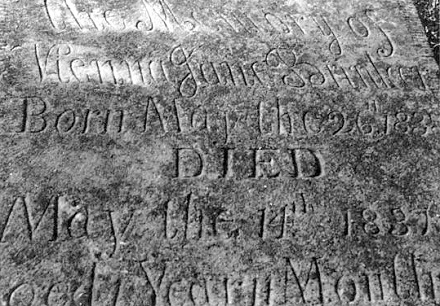
On this date in 1838, a teenage slave girl named Mary was hanged in Crawford County, Missouri. She had murdered Vienna Jane Brinker, a white child two weeks short of her second birthday.

Mary’s original owner was Abraham Brinker, Vienna Jane’s grandfather. Abraham was murdered by Indians southwest of Potosi in Washington County, Missouri in 1833. He died without a will and his widow, Fanny, and son, John, became administrators of his estate. John appropriated Mary for himself and eventually made her the babysitter for Vienna Jane, his daughter.

Mary, described as “shrewd” and “remarkably fond of children,” was “about thirteen” at the time she killed the toddler on May 14, 1837. That day Vienna Jane’s body was found in a stream on the Brinkers’ property. She’d been struck on the head and flung into the water, where she drowned.

Just why Mary committed the murder may never be known,* but she readily admitted killing Vienna Jane — at least, once Mary “was tied to a log” and interrogated with the sheriff, who “began to act as though he were going to whip Mary” — and her guilt was taken as given throughout her surprisingly protracted 15-month legal odyssey. The judge instructed Mary’s trial jury:

If the Jury shall find from the evidence that Mary, the accused person was under fourteen years when she committed the offense alleged in the indictment, then, unless they shall also find from the evidence that at the time when said offense was committed the said Mary had sufficient mind to know what act would be a crime or otherwise, they shall find for the defendant.

The jury found against her and sentenced her to death.

Mary’s lawyers — there were three of them — appealed on several grounds, but her age was not one of them. The appellate court granted her a second trial on a technicality, but she was convicted again and did not appeal further.

Writing of this case in her book Death Sentences in Missouri, 1803-2005, author Harriet Frazier remarks that “Mary remains the youngest known person ever put to death by the authority of the state of Missouri. It is no accident that she was a female and a slave.”

Willard Rand turned her case into a two-act play, The Trial of Mary, a Slave, which was performed in the Crawford County courthouse in 1990.

* This page on Brinker family history mentions speculation that Mary was revenging her own prospective sale, and/or that she might have had an illegitimate child by her master whom the family sold against Mary’s will.

On this day..