1845: Not William Weaver, defended by Abraham Lincoln

This date in 1845 was the appointed hanging of William Weaver, the first convicted murderer in Champaign County, Illinois.

While drunk, Weaver shot to death one David Hiltibrau and despite the able representation of one Abraham Lincoln was speedily convicted. (pdf)

Where the rail splitter failed, fortune prevailed.

“A few days — or nights rather — before that set for his execution,” we read,

a friendly auger passed to him afforded the means of escape. Just then delays were dangerous to poor drunken Bill Weaver, for Sheriff Lewis had the rope and scaffold ready, so he did not await a farewell word from friends, but sped away to the North, as the winds go. At that time the tangled forests and the untramped prairies afforded unexcelled means for seclusion and escape, and the condemned man, once a mile from town, might well bid farewell to every fear of being caught and hanged, as he doubtless did. Years afterward Weaver was heard from in far Northern Wisconsin, a useful, law-abiding citizen. No effort was ever made to bring him back from his delicious exile.

On this day..

1841: Marius Darmes, frustrated regicide

Louis-Philippe, the affable, ovate monarch of France’s bourgeoisie from 1830 until the revolutionary year of 1848, was a popular guy for radicals to take a shot at.

By one expansive reckoning, there were no fewer than 19 assassination attempts against the Pear King, and five executions of intended regicides.

This date in 1841 saw the beheading of one Ennemond Marius Darmès for attempting to gun down the French king the previous October.

There was no mystery as to the shooter’s identity; the enthusiastic regicide had overstuffed his weapon with powder, and when he took his potshot it simply blew up in his hands. “I had him!” Darmes fumed as he was being arrested. “I was sure of my aim!” The only guy he had actually injured was himself. (Source)

Though it didn’t harm the king, the alarming incident did help precipitate the fall of a precarious and self-dealing government led by Adolphe Thiers, whose most illustrious appearance in these executioners’ annals was yet thirty years away.

With Thiers out of the way and a foe more doctrinaire animating the government, the ensuing months’ investigation were dedicated to tracing a connection between Darmes and alleged co-conspirators among revolutionary Parisians … a lot increasingly disaffected by the July Monarchy’s extreme oligarchical outlook.

And in a performance familiar in our own day, the terroristic extremity provided convenient pretext upon which to shush the much wider portion of the populace dissatisfied with the state. You’re either with us or you’re against us!

These desperate assailants of the King’s life are goaded on by the more cautious and even more unprincipled party who assail his character [Louis-Philippe himself made this same claim -ed.] … It is impossible, indeed, to foresee what the secret arts of calumny and the secret daring of their bloodthirsty illuminati may not effect; but we may say, with hearty English respect, when we look out upon these dangers, “God save the King!” (London Times editorial, May 31, 1841)

Out of solidarity or pride of ownership, Darmes denied those connections all the way to the shadow of the blade: two men who went on trial for their lives with him were acquitted.

According to a report filed by the London Times‘ Paris correspondent (printed June 2, 1841),

At half-past 5 o’clock this morning he was called down from his cell to the greffe, where the fatal toilette was to be performed previous to the execution. He quietly submitted to the operation, and when it was over, he mounted with his confessor into a vehicle, commonly called ponier a salade, which is used for the conveyance of prisoners. This carriage, escorted by municipal guards, cuirassiers, and chasseurs, proceeded up the Rue de l’Ouest, Rue d’Enfer and the adjoining Boulevard, down to the Barriere St. Jacques, where the scaffold had been erected during the night. Few spectators were in attendance. At 5 o’clock all the avenues leading to the Barriere had been occupied by the military, all traffic interrupted, and the people, who had congregated near the scaffold, were driven back a considerable distance. After he had alighted from the carriage his sentence was again read to him. The clergyman then took leave of him, and he ascended the steps of the ladder with a steady pace, followed by the executioner’s aids. It was only when he reached the platform that he came within view of the people; his head was still covered with a black veil, and a white shirt enveloped his whole body down to the feet, which were bare. The executioner having placed him with his back to the guillotine, a dialogue appeared to pass between them; and, from the negative shake of the head which Darmes occasionally gave, it was supposed that the executioner had held out to him a hope of salvation if he would make revelations. The conversation occupied between three and four minutes; the aids then seized him, and having placed him with his face towards the knife removed the black veil from his eyes, and took off his shirt. The sight of the instrument of execution appeared to strike him with awe; he started, and, feeling rather unsteady of his legs, he made a stride in order to maintain his equilibrium, and then looked on with calmness, surrendered himself into the hands of the executioner, and an instant before the knife dropped he was heard to exclaim — Vive la France. The body and head were then placed in a basket, and conveyed to the cemetery of Mont-Parnasse, where they were interred in the enclosure exclusively reserved for regicides.

Our favorite part of that is that the cemetery had a special VIP section set aside for regicides. Only in France.


Francophones can enjoy this French-language report on the investigation.

On this day..

1843: Ewen Cameron, black bean leftover

On this date in 1843, a Mexican firing squad disposed of Texan commander Ewen Cameron.

A Scottish immigrant, Cameron arrived in Texas just as it broke free of Mexico. His reputation for martial prowess on the frontier earned him a newsman’s tribute as “the Bruce of the West.”

High praise indeed: but his end would better resemble Wallace.

Cameron hitched on to the ill-fated Mier Expedition plundering raid over the border.

He was among the men forced to participate in the Black Bean Lottery wherein 176 Texan prisoners picked beans from a pot to determine who would live and who would die. Cameron picked a white bean, saving his life … but only briefly.*

The verdict refused by Fortune was reinstated by the hands of men.

Abrasive characters like the Bruce are not so well appreciated across their respective frontiers, and Cameron had built some ill-will in the Mexican army with his intrepidity the previous year.

The officer thereby embarrassed, Antonio Canales, was loath to let this reviled prisoner escape his clutches, and urgently petitioned Santa Anna to dispose of him.

This was duly done at Perote Prison, where the other lottery survivors languished for months or years along with other captives of various Mexican-Texan skirmishes.

Cameron County, Texas (the state’s southernmost) is named for Ewen.

* According to this account, the Mexicans loaded the fatal black beans onto the top layers in an effort to get the officers (who drew first) to pick them. Cameron was wise to the scheme, and foiled it by thrusting his hand all the way into the pot.

On this day..

1849: Anna Koch of Appenzell

This date’s pastoral story of adolescent avarice — and impressive disobedience at the scaffold — comes to us from the tiniest of Swiss cantons,* as related in this public-domain text


Anna Maria Koch and Magdalene Fessler were girls — each about seventeen years of age — living in Gonten in the year 1849. On June 12 of that year the dead body of the latter was found lying in a ditch in one of the village pastures. There were upon it no marks of violence, and a coroner’s jury was led to conclude that the girl had come to her death by falling into the ditch in the dark. A little later, the discovery was made that on June 10 Anna Koch had sold to a silversmith in Gonten a chain, a locket, and a rosary. These articles on examination were proved to have belonged to Magdalene Fessler. Anna Koch was placed under arrest and asked to make explanation. The story related by her is as follows: –On the Sunday following Frohnleichnamsfest she met Jean-Baptiste Matezenauer, a young man of the village, and he gave her the articles of jewellery, saying that he had found them. He told her that she must sell the things and put the money in a bag which she was to hide in a field. She must then take with her a friend, stroll through the field and, as though by chance, spy the bag, pick it up and say, “Oh! I have found something!” With the money she was to buy a wedding dress, Matzenauer promising in a short time to marry her. Matzenauer was arrested and confronted with his accuser. He protested innocence, but the girl adhered to her story. She did even more, she enlarged upon it. She said that on the morning of Frohnleichnamsfest she had been in Matzenauer’s company; that he had then told her he meant to kill Magdalene Fessler in the afternoon, and had asked her to station herself in the field where the ditch was. This, she said, she had done, and that while there she saw Matzenauer drag thither the body of his victim. Despite the inherent improbability of her whole account, the girl vehemently reiterated it, each time challenging Matzenauer to a denial. At last the bewildered inquisitorial fathers before whom the examination was being conducted — perhaps with some recollection of the efficacy of torture in eliciting actionable testimony in the case of Landamman Suter — ordered Matzenauer to be brought under the lash. This was done, but without the hoped-for result. Matzenauer remained obdurate.

The case dragged on till November 13. It was then suddenly terminated by the confession of Anna Koch that she alone had planned and committed the murder. The details of the confession were substantially these: –She, a poor girl, had for a long time felt hurt in pride that she had not the money with which to provide herself the chains and trinkets commonly worn by the girls of her acquaintance. So keen was this feeling that finally she resolved to purchase a chain from one of the silversmiths of Gonten and trust to fortune to enable her to pay for it. She obtained the chain, but failing to pay for it by the time agreed on with the silversmith, was asked to return it. The necessity of doing so was fully impending when, on Frohnleichnamsfest, she met Magdalena Fessler in the churchyard, at the beginning of afternoon service. The latter had about her neck a beautiful chain, and Anna Koch, seeing it, was prompted to kill her, take the ornament, sell it, and with the money realised meet her own debt to the silversmith. She told her friend that she had lost her rosary, and asked her to go with her to find it. The two girls walked on together, soon passing into the field containing the ditch. As they were crossing the latter on a plank Anna Koch pushed Magdalene Fessler, causing her to lose her footing and fall into the water. She then jumped into the ditch herself, seized the head of her victim and, holding the mouth open with her fingers, kept the head under water until death ensued from strangulation. Having made her confession, Anna Koch asked that she might suffer the extreme penalty for her crime. Young people of her acquaintance petitioned the Great Council for a pardon. This was refused, the vote standing only six for pardon and ninety-six for punishment. Decree was then entered that the guilty one be beheaded on the block.

The day before that fixed for the execution (the latter being December 3) the condemned girl spent quietly in prayer and in communion with her confessor. She expressed herself as being entirely reconciled to her fate and, in fact, as anxious to meet it. But when led forth on the day of execution, her manner changed. The wild instincts of her Appenzell nature reasserted themselves. She declared that she could not and would not die, and with fierce cries drowned the voice of the officer who read her death-warrant before the people. The reading finished, four strong men seized the girl and bound her on a sled. Thus secured she was dragged to the headsman’s block in the market-place. But here a fresh difficulty was encountered. On being released from the sled her struggles were so frantic and determined that the executioner could not perform his task. After several vain attempts he sent the Reichsvogt (the same mediaeval official personage that had figured at the execution of Dr. Anton Leu and Landamman Suter) to report the situation of affairs to the Great Council and ask advice. The reply returned was that the headsman must do his duty. After an hour and a half of cries and resistance on the part of the condemned, her head was firmly secured to the block by the braids of her hair, and the fatal stroke given.


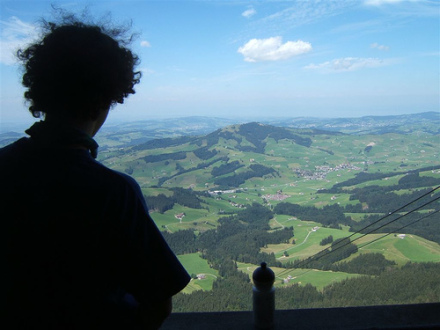
Gonten (it’s the long collection of buildings along the valley road, at the base of the slope) and environs. (cc) image from Michael Beat.

* Appenzell Innerrhoden is the smallest canton by population, and is larger by area only than the urban canton of Basel-City.

On this day..

1846: William Westwood, aka Jackey Jackey

On this date in 1846, the Australian outlaw William Westwood — better known as Jackey Jackey — was hanged with 11 others for a prison riot/escape attempt that claimed several guards’ lives.

“To the old hands,” relates George Boxall in this volume of bushranger folklore, “he was always the gentleman bushranger.”

More legends have collected round the name of Jackey Jackey than round that of any other of the bushrangers, and many of them are obviously variants of the stories told of the historical highwaymen of England. For instance, Jackey Jackey is said to have bailed up the carriage of the Commissary. When he discovered that the Commissary’s wife was inside he dismounted, opened the door and, sweeping the ground with his cabbage tree hat, as he bowed low before her, he invited her to favour him with a step on the green.* He rode incredible distances in incredibly short periods of time** … [and] never did anything mean or brutal or unworthy of a gentleman bushranger, until he was almost goaded to madness by the cruel discipline of Norfolk Island.

Transported to Australia at the age of 16, Jackey Jackey made that reputation with only a scant few months in the bush. The Victorian era was already underway in our young outlaw’s mother country; the day of the highwayman had long since given way to the day of romanticizing the highwayman.

Only on the empire’s distant fringes could the profession persist; there, men like our day’s principal self-consciously took their chivalrous forebears as their templates: Jackey Jackey thrashed a confederate who did violence to a woman, and threatened to murder the man if they should meet again.

Jackey Jackey had only a few months out in the bush in 1840-41 to trace the outlines of the gentleman bandit figure he aspired to. Caught in an inn in 1841, he spent the next several years exercising that other great craft of the folklore criminal: escape.

A cycle of jailbreaks, fleeting moments of liberty, recaptures, higher-security lockups, and increasingly desperate jailbreaks eventually landed at Norfolk Island, where “the treatment of the prisoners in the island was rigorous in the extreme, and may aptly be described as savage.” (Boxall, again)

Just a few years before Jackey Jackey’s death, they had been savage enough to provoke inmates desperate for the release of death to draw lots between the privileges of being murdered by a fellow-prisoner and hanging as that murderer.

Norfolk experimented with liberalizing its regimen in the early 1840s, but it was in rollback mode when our bushranger landed there. The steady removal of the minute privileges that make incarceration bearable — the right to grow a few potatoes; access to one’s own cooking tin and utensils — eventually triggered a similar suicidal mental break … but this time, on a riot scale.

Jackey Jackey made the following speech: “Now, men, I’ve made up my mind to bear this oppression no longer ; but, remember, I’m going to the gallows. If any man funks let him stand out. Those who wish to follow me, come on.”

A policeman named Morris was standing in the archway or entrance to the yard, Jackey Jackey rushed forward, struck him a fearful blow with an enormous bludgeon, and knocked him down. A large mob of the prisoners snatched up such weapons as came to their hands and followed him.

there were about eighteen hundred prisoners on the island, and of these, sixteen hundred were among the rioters. The soldiers numbered only about three hundred, but their discipline enabled them to overawe the vastly superior force, numerically, opposed to them. Perhaps the habits of obedience and submission, so long enforced on the prisoners, may have had some influence. Perhaps, even among this herd of desperate and reckless men, the sight of the soldiers standing firmly with their guns presented ready to fire may have instilled some fear. However this may have been, there was no fight. The rebels retired slowly and unwillingly to the Lumber Yard, where they permitted the soldiers to arrest them one after the other without making any show of defence until one thousand one hundred and ten of them were placed “on the chain.” Perhaps Jackey Jackey and the more violent of his followers may have thought that they had done sufficient to ensure them that death on the gallows which was the avowed object of their rising, while the majority had been so demoralised by official brutality as to be utterly indifferent as to what might become of them.

Twelve suffered death on the Norfolk Island gallows this date for the murder of the guard, with headline-grabber Jackey Jackey exonerating four of his fellow-sufferers in his dying statement.


The remains of the gallows area at the Norfolk Island gaol, gorgeously captured by Canberra photographer Allyeska. (Image used with permission.)

The bitter letter our despairing bushranger wrote to a gaol chaplain, meanwhile, could have been posted from many a modern penitentiary.

I was, like many others, driven to despair by the oppressive and tyrannical conduct of whose whose duty it was to prevent us from being treated in this way. Yet these men are courted by society; and the British Government, deceived by the interested representations of these men, ontinues to carry on a system that has and still continues to ruin the prospects of the souls and bodies of thousands of British subjects … instead of reforming the wretched man, under the present system, led by example on the one hand, and driven by despair and tyranny on the other, goes on from bad to worse, till at length he is ruined body and soul. Experience, dear bought experience, has taught me this. In all my career, I never was cruel I always felt keenly for the miseries of my fellow-creatures, and was ever ready to do all in my power to assist them to the utmost, yet my name will be handed down to posterity branded with the most opprobrious epithet that man can bestow. … this place is now worse than I can describe. Every species of petty tyranny … is put in force by the authorities. The men are half-starved, hard worked, and cruelly flogged. … Sir, out of the bitter cup of misery I have drunk from my sixteenth year ten long years and the sweetest draught is that which takes away the misery of living death; it is the friend that deceives no man; all will then be quiet no tyrant will there disturb my repose, I hope, William Westwood.†

(Boxall’s History of the Australian Bushrangers is available from archive.org here.)

* This legend is lifted wholesale from the c.v. of English highwayman Claude Duval.

** Warp-speed horsemanship features in many English outlaw legends, including those of Dick Turpin and the lesser-known John Nevison.

† Death as an escape from injustice and misery: another timeless theme.

On this day..

1846: The last civil executions in Portugal

Portugal has not carried out a civil (non-military, non-wartime) execution since hanging two murderers on this date in 1846.*

Despite some impressively sanguinary exercises of capital punishment in its history, the Iberian nation has been in the European vanguard of death penalty abolition.

Writing on what turned out to be the eve of Portugal’s landmark 1867 renunciation of the death penalty for criminal offenses, the 1866 report of Britain’s capital punishment commission observed:

The last execution which took place was at Lagos, on the 22nd of April 1846. And it is right to state also, that ever since the definitive re-establishment of a liberal government in this country, capital punishments have never been very numerous. Thus during the 13 years which elapsed between 1833 and 1846, inclusive, out of 99 culprits condemned to death there were only 32 executed, and the sentences of the remaining 67 were commuted.

[Portugal] is, then, the only [country] in Europe in which the punishment of death has been for the last 18 years de facto suppressed. Public opinion has gone before the law: and the law, in effacing this punishment from its provisions, far from being in anticipation of society, will not do more than give its sanction to a fact which has long been accepted by general feeling, and which at the present day it would be difficult to contravene. Even if the punishment of death were to remain inserted in the text of our penal legislation, I think I may with safety affirm it would be impossible to meet with a Minister of Justice who would venture to recommend the King to withhold the exercise of the Royal prerogative of pardon, and who would have the heart to order the timbers of a new scaffold to be again erected on the soil of Portugal.

Despite an abortive feint at backsliding during World War I, the popular sense of the issue does not seem to have changed much in the interim.

The tragedy of man, ‘a postponed dead body’ as Fernando Pessoa said, does not need an untimely exit from the stage. It is tense enough without an end that is artificial and planned by butchers, megalomaniacs, potentates, racisms, and orthodoxies. Therefore, being human, we demand unequivocally that all peoples should have a code of humanity. A code that for all citizens guarantees the right to die their own death.

-Portuguese writer Miguel Torga, at a 1967 colloquy marking the centennial of Portugal’s formal abolition of the death penalty for ordinary crimes.

* There are some scantily documented World War II treason executions; the death penalty was officially abolished for treason (the last capital crime on the books) in 1977.

On this day..

1845: John Tawell, the man in the Kwaker garb

On this date in 1845, John Tawell was publicly hanged in Aylesbury (while broadsheets were hawked beneath the scaffold to the crowd of thousands) for the murder of his mistress — making history as the first criminal apprehended with the use of the telegraph.

Tawell had had an interesting 60-plus years on the planet. He did well as a young banker on the make to avoid the halter for the capital crime of forging banknotes.*

In those sanguinary days of our penal code, this crime, if brought home, would have led to his certain condemntion and ignominious execution as a felon. The particulars of the affair were, however, suppressed as far as possible, on account of the insuperable disinclination of the bankers to be in any way instrumental in taking away human life.**

Clapped in irons and sent to Australia, he waxed wealthy — “by his fortunate, and, it is to be presumed, honest trading,” our wry biography remarks. (As a pharmacist. That’s what we in the biz call “foreshadowing.”)

Tawell returned to England in 1831, got Sarah Hart as a bit on the side (she’d initially been hired to nurse Tawell’s dying wife), and then married a respectable Quaker woman. To conceal the affair — or perhaps because the payola Tawell was obliged to send for the maintenance of his mistress and the kids he begat with her was chewing into his straitened finances — Tawell poisoned Hart on New Year’s Day 1845.

Unfortunately for him, he was noticed leaving the scene of the crime by a neighbor, who found the victim before she had even expired.

Tawell had hopped a slow train for London ahead of apprehension, but it transpired that the station had installed the newfangled telecommunications device, the telegraph, which was requisitioned to dispatch to Paddington station a famous missive.

A murder had just been committed at Salt Hill and the suspected murderer was seen to take a first class ticket to London by the train that left Slough at 7.42pm. He is in the garb of a Kwaker with a brown great coat on which reaches his feet. He is in the last compartment of the second first-class carriage.

(The telegraph didn’t have a “Q”, so they had to improvise a phonetic spelling. k l8r.)

(This landmark police event is not to be confused with the first use of wireless telegraphy to apprehend a criminal — the next century’s very similar philandering-apothecary-on-the-lam case of Dr. Crippen.)

Caught, convicted,† condemned. (And confessed, secretly, to the prison chaplain.) The usual. Botched strangulation hanging. Hardly unusual. Love triangle murder? Downright trite.

But still: Tawell’s strange and variegated life left a strange and variegated legacy. (pdf)

In Australia, the memory of Tawell lingered for many years after his death because considerable legal argument took place about the validity of the Crown’s hndling of his property there. The Governor, Sir William Denison, affixed the Great Seal of the colony to the grant documents on his own initiative, which creted a serious difference between him and his chief minister. Known as the “Great Seal case”, it dragged on for some 16 years before it was resolved. It provided a dramatic epilogue to Tawell’s activities.

John Tawell had pharmacy qualifications of a sort, and he was no better or worse than many of the doctors around Sydney at the time who had received no regular professional instruction. When Tawell ventured into competition with the medical establishment in the colony it was a huge gamble because until 1820 many government doctors saw private patients and had clerks to do their dispensing, usually from hospital stores. He showed that independent pharmacy could thrive away from the medical shadow, but the commercial nature of his success also showed that the founding of independent pharmacy in Australia occurred as a retailing activity rather than as a needed profession.

* As a teen, Tawell was friends with a Quaker linen-draper who was himself ultimately executed for forgery, Joseph Hunton.

** This claim for bankers’ gentility is advanced in the context of the story of a banker who in fact went on to commit murder. Aside from that obvious paradox, it will come as no surprise to any denizen of the post-bailout neoliberal era that bankers proved more than ready to involve themselves in human misery, sufficiently remunerative. If Tawell’s sweetheart plea bargain reveals anything about the financier class, it’s that bankers aren’t keen on precedents for taking away bankers’ lives.

† John Tawell’s trial lawyer, the eminent jurist and politician Sir Fitzroy Kelly, disputed the coroner’s poisoning conclusion by arguing that Sarah Hart might have just eaten too many apple seeds. (Prussic acid, aka hydrogen cyanide, does occur naturally in many fruits.)

This attempted Chewbacca defense earned the barrister the nickname “Apple-pip Kelly”. However, since the cutting-edge technology of the day was only telegraph and not Twitter, the case does not appear to have launched any of Apple-pip Kelly’s progeny into lucratively pointless careers as famous-for-being-famous socialites.

On this day..

1843: 17 who drew the black beans

This date in 1843 was a good one to just stick with the guacamole.

Though the Republic of Texas (it would join the United States in 1846) had won its independence from Mexico a few years before, hostilities between the two continued.

Skirmishes in the frontierlands at length triggered a Texan reprisal-slash-plundering expedition.

The officially independent Somervell Expedition of volunteer Texan militiamen captured a couple of Mexican towns, then disbanded to go home. Those members of it optimistic about their chances for more raiding set off for Ciudad Mier* — the Mier Expedition.

Their optimism was misplaced.

The Mier Expedition was a flop, and the irate Mexican President Santa Anna ordered the entire band shot to make an example. Anglo diplomatic wrangling got him to go down to shooting one tenth of the band.

Well, you’ve gotta pick that tenth somehow.

The Black Bean Lottery

So on this day, 176 potentially condemned men were made to draw a bean from a pot containing 159 white ones and 17 fatal black ones.

For the lucky 159, there was no rush quite like winning your life from a legume, as this survivors’ account describes:

I knew then that I was safe, and the revulsion of feeling was so great and rapid that I can compare it to nothing except the sudden lifting of an immense weight from off one’s shoulders. I felt as light as a feather.

The 17 for whom the cosmos had ordained frijoles negros took a quick leave of their companions, and were shot in two batches. (Here is a thorough discussion of the entire affair.)

It was a typically dicey death by musketry, with lots of people requiring multiple volleys. One of the 17, one James Shepherd, even survived the execution altogether by playing dead. (He fled during the night, but was later recaptured and [successfully] re-shot.)

The most hated man (by the Mexicans), Ewen Cameron, pulled white, but Santa Anna thought better of letting him draw air and had him separately executed a month later. The rest of the lottery’s “winners” languished in prisons and work camps for more than a year of continued Texas-Mexico hostility, until they were amnestied and released in September 1844 — many destined to renew hostilities in the imminent Mexican-American War.

That survivor quoted above, William “Bigfoot” Wallace, was one of those re-enlistees. His colorful career with the Texas Rangers earned him a minor star in the firmament of Americana; he appears in Larry McMurty’s Lonesome Dove prequel Dead Man’s Walk … only in that version, he gets cinematically black-beaned at the big moment, as in this clip from the miniseries of the same title.

* The town is latterly famous as a key transit point for arms smuggling to Fidel Castro to supply the Cuban Revolution.

On this day..

1842: Maketu Wharetotara, New Zealand’s first execution

On this date in 1842, New Zealand carried out its first official execution: the hanging of Maori teen Maketu Wharetotara for murdering five people.

The son of a Nga Puhi chief named Ruhe, Maketu took employment as a farmhand for a white household.

An ill-tempered white servant evidently offended him sufficiently to split the bugger’s skull with an axe … and since Maketu wasn’t the type to leave a job half-done, he went ahead and murdered the rest of the household, too.

European settlers, still a minority, initially worried that this outburst might herald the onset of a general native rising. The police magistrate even refused to apprehend the criminal, who had fled back to his people, for fear of triggering conflict.

But internal Maori politics would not let the boy off so lightly.

One of the household members he had murdered was a mixed-race granddaughter of another important Nga Puhi chief, which raised the specter of intertribal strife.

To pre-empt a possible bloodbath, Ruhe turned his own son over to the Europeans.

By British law, it was a pretty cut-and-dried case with a pretty predictable outcome which became, for the crown, a precedent establishing its authority over incidents of interracial violence.

(Maketu Wharetotara — baptized “Wiremu Kingi” by an Anglican minister on the morning of his execution — obtained his milestone status because another Maori minor who had previously been condemned to death died of dysentery before they could noose him.)

On this day..

1845: Lavinia Burnett and Crawford Burnett

On this date in 1845, husband-and-wife murderers Crawford and Lavinia Burnett (nee Sharp) danced a gallows jig built for two in Fayetteville, Arkansas.

The duo contrived with their son, John, to rob and murder a nearby recluse, Jonathan Selby, for the money he was thought to be hoarding.

The family the slays together, pays together.

Alas for mom, dad, and big brother, 15-year-old daughter Minerva shopped them.

John-boy was still on the lam at this time — he’d be caught soon, and hanged December 26 — but Lavinia and Crawford hanged together before a large crowd in the vicinity of the present-day Fayetteville National Cemetery.

It was the first recorded execution of a woman in Arkansas history, and would be the only such until the year 2000.

Among the ranks of the Burnetts’ illustrious if unsuccessful defense team was Isaac Murphy, who would go on to become a notable pro-Union pol during the Civil War (with a murky part in an infamous massacre of Confederate sympathizers), and subsequently became governor of the state during Reconstruction.

On this day..