1841: Archilla Smith, Trail of Tears Cherokee

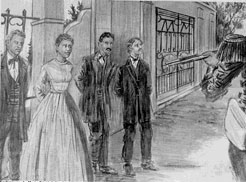
On this date in 1841, Archilla Smith was hanged over a tree branch in Cherokee Country (since the gallows hadn’t been delivered in time) for the murder of John MacIntosh.

Our narrative for this event is Indian Justice: A Cherokee Murder Trial at Tahlequah in 1840, a volume derived from the reports of 19th century poet John Howard Payne, who’s best known for writing “Home! Sweet Home!”.

Payne lived with the Cherokees in Georgia immediately preceding their forcible removal to Oklahoma along the Trial of Tears, and then repaired to Oklahoma with the evicted tribe. (Payne unsuccessfully lobbied the U.S. Congress against its removal policy.)

The procurement of Cherokee signatures on the treaty that gave legal cover to the tribe’s expulsion from Georgia was a source of bitter controversy … and a generation of internecine violence. Our principal for this date’s post, Archilla Smith, himself affixed an X-mark to this notorious document, and he was defended at the trial in question here by another signer, Stand Watie.

Payne’s book, however, does not much treat the political context of Indian removal, nor even read as something like a true crime book: the brawl between the killer and the victim, two aggressive men with a passing and private quarrel, is little more than the background fact; the question for the jury turned on little but the degree of wilfulness or intent in the fatal stab wound Smith dealt, and various witnesses describe the same scene of their melee with slight differences of shading.

Rather, it’s a courtroom drama, and an outsider’s sketch of Cherokee jurisprudence (amalgamating tribal and Anglo-Saxon practices) circa 1840. It’s also the first newspaper any Oklahoma trial.

There as no appearance of bitter feeling on either side. The accused and the judge and jury and spectators, all seemed in the best of humor with one another. The accused smoked much of the time; and his judge, and most of the jury, every now and then would get up and go across the log-court to him with “Arley, lend me your pipe;” and receive his pipe from his mouth (as is the Indian custom); and revel in the loan of a five minutes’ smoke. … The wife and handsome young daughter of the accused attended … His three young sons, one a boy about ten, — the others about twelve and fifteen, were in the court room nearly all the time, and often sat by their father’s side.

-Payne

At one point, the judge digresses into the ancient right of clan vengeance and dismisses it in view of the “improved” system. But Payne’s postscript notes that one of Smith’s own jurors (from the first jury) would himself be killed just days after the execution when the juror attempted to exact family retribution on a murderer who had been acquitted in court. This is the snapshot of an evolving society.

Archilla Smith’s first jury hung. The second jury tried to hang, but was forced by the judge to come to a conclusion. Finally, it convicted Smith on December 26, 1840. Smith took word of his fate evenly.

“You are every one of you old acquaintances of mine, Jurors,” he remarked after hearing his fate. “You have been several days engaged about my difficulty. But I have no hard thoughts against any one of you, Jurors, nor Judge, against you. I believe your object has been that my trial should be a fair one.”

Cherokee law required that after five days, the sentence be executed. Accordingly, the hanging was fixed for New Year’s Day at noon.

Because there was also no tribal prison, Smith was simply held under guard in a log hut, and was able to get around the new Cherokee capital of Tahlequah with those guards. In Payne’s narrative, this invites no trouble on the part of the prisoner, whose bonhommie even after his death sentence belies the ill-tempered knife-slayer described by court witnesses. (Though Smith did once try to bribe his guard to let him escape.)

Accordingly, on one of those five days between sentence and hanging, Archilla Smith and his friends simply rode up to the Cherokee Chief John Ross to appeal personally for a pardon. He’d obtained about two hundred signatures on a petition supporting such an act of clemency.

Nevertheless, Ross, a foe of the removal treaty and of Stand Watie,* told them that the matter was out of his hands … but Smith and his party still ate dinner at Ross’s home that evening and nothing untoward occurred. Open hospitality was a Cherokee custom, and Ross regularly entertained dozens of visitors at his two-and-a-half-story log house, “as many as the table can accommodate.”

When the hang-day finally came, two different men preached under the noose.

The first, an Anglo named Worcester, who issued a bog-standard 19th century Anglo hanging sermon in English:

Almighty God! We see before us an awful instance of thy power. May it eventuate in an equally impressive exemplification of thy love. May the bitter fruit of the one sin for which atonement is now about to be exacted, procure the pardon of many. May it not only produce sincere penitence and consequent acceptance with thee, in the unhappy sufferer who now stands upon the threshold of eternity, but operate as a warning to all who either witness or hear of his fate. May it show this people to what dreadful results intemperance may lead; and when they see that the great commandment ‘whoso sheddeth man’s blood, by man shall his blood be shed’ cannot be evaded; may it bring them to a salutary meditation through which all may be converted. In the name and through the meditation of our blessed Savior, we ask that the influences of the Holy Spirit may draw this blessing on the nation; and may the victim now offered up to the violated laws have cause to bless a doom, which if it awaken him to a proper knowledge of Thee and of himself will yet prove to him a happiness and a mercy into thy hands, oh blessed Savior, we commend his spirit.

The second gallows-preacher was a half-blood Protestant minister named Reverend Young Wolf — and this reverend had actually been the foreman of the jury which condemned Archilla Smith in the first place. Young Wolf preached in Cherokee, thus:

God of heaven! Creator of all things! Thou, who knowest our inmost thoughts I pray to thee have mercy on this man. He is standing on the threshold of death. He will presently leave this world to enter the world of spirits. Thou canst see into his heart. Thou art aware whether the charge for which he suffers is true or not. If he is guilty, I supplicate thee to forgive all his sins. Into thy hand we submit ourselves. We assemble together as a people to witness the death which our friend is about to suffer; and may it make us remember that we too, are born to die sooner or later, and prepare to meet thee in peace. May the view of thy power which we are now beholding, humble us before thee. May we continue humble. We are now about to part with our friend Archilla. We give him up to thee. May he receive thy pardon for his sins, that hereafter we may all come together again before thy throne and unite there in thy praise!

The doomed addressed the multitude last.

He, too, spoke in Cherokee, and the natives whom Payne spoke with were divided as to whether the “escapes” and “third time” which Smith mentioned referred to the two times that his juries refused to convict him, or to two previous, undetected crimes.

Friends, I will speak a few words. We are to part. You will presently behold how evil comes. I do not suffer under the decree of my Creator but by the law passed at Tahlequah. — Friends, you must take warning. — I think, perhaps, that my being hated has brought me to this. No man can hope every time to escape; and the third I have been overtaken by the law. But avoid such practices. — I suppose I was preordained to be executed in this manner. I am ready to die. I do not fear to die. I have a hope, there, to live in peace. (Tears now gushed from his eyes.) I should not have shed tears had not the women come here to see me. — I have no more to say.

* Ross and Watie were lead figures of the rival factions within the Cherokee polity, and they would be recognized as opposing chiefs by the Union and the Confederacy (respectively) during the coming U.S. Civil War. Stand Watie lives on in bar bets: he has the distinction of being the last Confederate general (and his First Indian Brigade the last Confederate force in the field) to surrender to the Union, on June 23, 1865.

On this day..

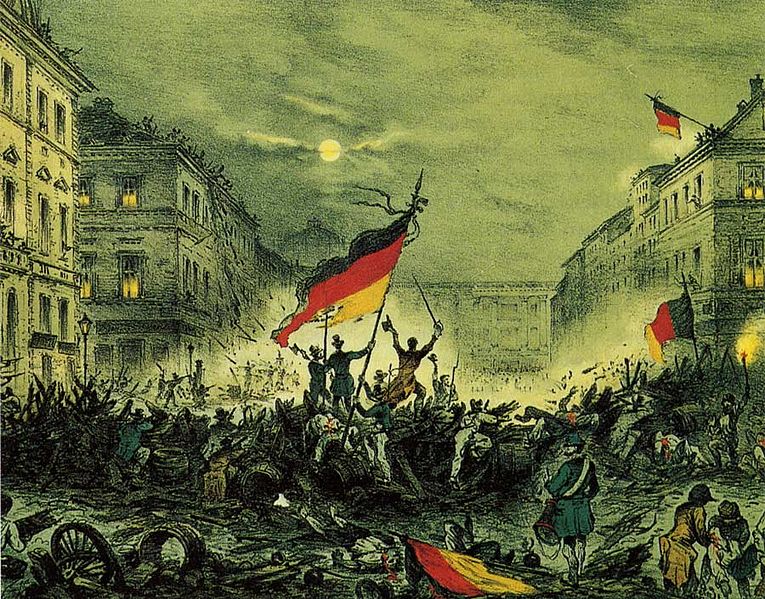
1848: Robert Blum, German democrat

On this date in 1848, a day short of his forty-second birthday, the German revolutionist Robert Blum was summarily shot in Vienna — a tragic victim of Germany’s Revolutions of 1848.

Marker at Robert Blum’s birthplace in Cologne reads “I die for the German liberty that I fought for. May the fatherland remember me.” (cc) image from Elke Wetzig.

Blum grew up in a penniless proletarian family but drifted into the literary set. He spent the 1830s penning liberal-minded plays, poetry, newspaper correspondence. He uncovered a magnetic personality and a gift for organization.

By the 1840s he was a — maybe the — preeminent left-liberal in the Kingdom of Saxony: pro-parliamentary democracy, anti-violence, for a wide grant of civil liberties and mass education.

The pressures, both liberal and radical, pushed to the brink the small realms in the German Confederation, as well as the neighboring Austrian Empire. Both struggled to handle even the liberals’ demands like expanding the franchise and freedom of the press, with old hereditary polities that might not be up to changing times. Germany, Marx and Engels wrote in the Communist Manifesto (1847), “is on the eve of a bourgeois revolution.”

Right on cue…

That pregnant year of 1848 found Blum in the Frankfurt parliament, and his neither-fish-nor-fowl leftism — a little too out there for mainstream liberals; a little too bourgeois for real radicals — made Blum the perfect pick for a solidarity mission.

When in September 1848 the Austrian army was defeated trying to crush a Hungarian rebellion, the Habsburg capital of Vienna took the example and mounted a revolution of its own, putting the government to flight.

Blum was sent as sympathetic delegate to this abortive Viennese commune, but found himself trapped in the city when the Austrian army encircled it in late October.

The Austrians, when they caught him, sent their own message back by denying him any form of deference for his parliamentary rank. Blum’s direct condemnation was a stark warning by the Habsburg state to agitators, but also to their putative brethren dreaming of a Greater Germany. Austria wasn’t buying what the Großdeutsche people were selling.


Detail view (click for the full image) of Carl Steffeck’s painting of Robert Blum’s execution. Here’s a YouTube recreation (in German).

Blum went on to a posthumous career as a star liberal martyr among the German circles who had use for such a character.

Blum’s seven-year-old son Hans grew up to follow his father’s literary footsteps … but from quite the other side of the aisle. He was a pro-Bismarck nationalist.

On this day..

1849: Ugo Bassi, nationalist priest

Measure thy life by loss instead of gain;
Not by the wine drunk, but the wine poured forth
For love’s strength standeth in love’s sacrifice;
And whoso suffers most hath most to give.

-From Harriet King‘s poem “Ugo Bassi’s Sermon in the Hospital”

On this date in 1849, the Garibaldian priest Ugo Bassi was shot in Bologna along with fellow-nationalist Count Livraghi.


Statue of Ugo Bassi at Bologna’s via Ugo Bassi.(cc) image from Biblioteca Salaborsa.

Detail view (click for full image) of Bassi and Livraghi being escorted to execution.

Bassi was a penniless Barnabite priest famous for his powerful oratory* and his national enthusiasms. He signed right up for Garibaldi‘s national movement in the heady liberal revolutions of 1848-49.

“Italy is here in our camp,” he would say of the Garibaldian forces readying their (ultimately unsuccessful) defense of the Roman Republic.** “Italy is Garibaldi; and so are we.”

Alas, in this engagement, Italy had a lot fewer guns than the French.

The new French ruler Napoleon III, who had himself been in youth a revolutionary carbonaro in Rome, saw foreign policy advantage in backing the exiled Papacy and overthrew the Republic.†

Garibaldi escaped to exile, but many of his subalterns did not. Bassi was captured unarmed — he didn’t even bear arms in battle — and Pius IX, once thought a fellow-traveler by the liberals, did not hesitate to hand him to the Austrians for punishment. The Habsburgs stood equally to lose from any gains of the Risorgimento, and accordingly gave Bassi a perfunctory military trial, then had him shot immediately in Bologna.

For crowning his open-hearted life with this sacrifice, Ugo Bassi instantly became, from that day to this, one of the best-honored Italian patriots.

He possessed at once the simplicity of a child, the faith of a martyr, the knowledge of a scholar, and the calm courage of a hero … If ever Italy comes to be united may God restore her the Voice of Ugo Bassi … The name of Ugo Bassi will be the watchword of the Italians on the day of vengeance!

Garibaldi

* Anecdote associated with Bassi once he came to firing up the Bolognese for Garibaldi: a poor girl who could give nothing to the cause spontaneously chopped off her own hair and handed it to him. This is the event depicted by Bassi’s fellow-Bolognese Napoleone Angiolini, Ugo Bassi sui gradini di San Petronio.

** Topical incidental: the Roman Republic lasted only a few months, but its constitution abolished the death penalty … so it can count as the first nation to abolish capital punishment in constitutional law.

† Earning Napoleon III the permanent wrath of Italian nationalists.

On this day..

1844: Gabriel de la Concepcion Valdes, “Placido”

On this date in 1844, Cuban poet Gabriel de la Concepcion Valdes was executed in Matanzas for conspiring to overthrow Spanish authority on the island.

His mother (who gave him up to an orphanage) was a Spanish dancer. His father (who adopted him back) was a “quadroon” barber. Valdes, aka Placido (Spanish link, which is true of most available online resources about him) grew up as a free mixed-race youth in a slave society.

This situated him in the privileged (relative to plantation slaves) but precarious position of the petty bourgeoisie, menaced not only by the prospect of economic reversal but by the vicissitudes of Spanish policy towards his caste — whose growth many colonial officials fretted warily.

Though Placido made his bread apprenticing as a print-maker and later making turquoise combs, he made his fame by dint of literary gift that was celebrated throughout Cuba and abroad. His “La siempreviva” won a literary competition when he was just 25, and led to an invitation to visit Spain (Placido declined it); the Cuban-born, naturalized Mexican poet Jose Maria Heredia visited Cuba in 1836 and made a point to look up Placido; and according to the out-of-print Cuba’s Romantic Poet: The Story of Placido by Frederick Stimson, the young Cuban was wildly popular with North American slavery abolitionists as well.

Placido is less well-remembered beyond his home island today, but arguably rates as Cuba’s most distinguished Romantic poet.

In the 1830s especially, when civil war in Spain put the reigning monarch on the liberal side, Placido was able to exploit the opening to write openly of Cuban political aspirations.

His La Sombra de Padilla, dedicated to Spain’s “wise and exalted Queen”, imagines one of Spain’s martyred comuneros charging him to venture his life for liberty against absolutism.

Better to fall prey to La Parca [the Grim Reaper]
Than to a despotic Monarca

But notwithstanding the war in Iberia, the exalted Queen still put Cuba under special (read: repressive) law. Placido’s prominence, having advocated for much more freedom than Cuba was slated to enjoy, subjected him to automatic Spanish suspicion as more authoritarian governance arrived in the 1840s.

The poet was arrested in the Conspiración de La Escalera (Conspiracy of the Ladder, so named for the structure its accused were tortured upon). This purported plot to raise a slave revolt may or may not (pdf) have really existed, but the crackdown it authorized sure did. Indeed, despite the “slave revolt” bogeyman, it was overwhelmingly free blacks whom the Spanish suppressed in this affair.

Gariel de la Concepcion Valdes, known as “Placido”, was shot with ten others, “miserable instruments of the most depraved machinations of immoral men, men who deserve the curse of the living and the opprobrium of generations to come,” just a week after his conviction.

The appointed lot has come upon me, mother,
The mournful ending of my years of strife,
This changing world I leave, and to another
In blood and terror goes my spirit’s life.

But thou, grief-smitten, cease thy mortal weeping
And let thy soul her wonted peace regain;
I fall for right, and thoughts of thee are sweeping
Across my lyre to wake its dying strains.

A strain of joy and gladness, free, unfailing
All glorious and holy, pure, divine,
And innocent, unconscious as the wailing
I uttered on my birth; and I resign

Even now, my life, even now descending slowly,
Faith’s mantle folds me to my slumbers holy.
Mother, farewell! God keep thee — and forever!

-Valdes, “Farewell to My Mother”

There are volumes of Placido’s poetry (in the original Spanish) freely available via public-domain Google books offerings here and here, with a short thumbnail biography here. For the nonfiction biographical exploration of Placido’s life, and detailed critical analysis of his poetry, this Vanderbilt master’s thesis (pdf) is highly recommended.

On this day..

1842: Charles Stoddart and Arthur Conolly, Great Game diplomats

On this date in 1842,* British diplomats Charles Stoddart and Arthur Conolly were summarily beheaded by a Central Asian potentate as London’s ill-chosen intervention in Afganistan came to a disastrous conclusion.

The backdrop is “the Great Game”,** the long-running chess match for supremacy in Central Asia between an expanding Russian Empire and Great Britain, with its imperial position in India.

Seeking to pre-empt a Russian move into Afghanistan, Britain invaded in 1839. This was the First Anglo-Afghan War: it would have, for the Brits, an inglorious end.

Our day’s featured principals were among the postscript casualties of that catastrophe, never-avenged losses for an empire that had overreached itself.

Stoddart, an intelligence officer, had been dispatched northward to the ancient silk road city of Bokhara intending enlist the allegiance, or at least the benign neutrality, of its emir, Nasrullah Khan. Today Uzbekistan’s fifth-largest city, Bokhara was then an independent state .

[I]n the nineteenth century, the executions carried out there with genuine cruelty, as well as the tales told by travelers gave the city a reputation of being a forbidden, closed, and hostile place. It was “despotic” Bukhara, and the Europeans projected onto it their own oriental fantasies: with citadel, dungeons, palaces, and city walls bolted shut at night, all helping to set the scene.

(Vibe on some the oriental fantasy in the 1911 volume The Emir of Bokhara and His Country, or this volume on Russian Central Asia, which by then included Bokhara.)


Scenic! Bukhara’s historic citadel, the Ark, where Stoddart (and later Conolly) were imprisoned (and later executed). (cc) image from elif ayse.

Into this scene, our Brit entered clumsily, immediately irritating the ruler he intended to supplicate. Reportedly (though the fact has been disputed), he was on the brink of execution when he acceded to save his life to Nasrullah’s formulaic offer of clemency in exchange for conversion to Islam.

In any event, Stoddart languished for years, alternately imprisoned and in the custody of the (better-received) Russian mission. Though the latter had also been charged by its sovereign to retrieve the ill-favored English emissary as a gesture of Great Powers goodwill (and to deprive England of any rationale for intervention that his captivity might offer), Stoddart seems to have been too stubbornly prideful to get out via St. Petersburg while the getting was good.

Instead, he waited on the arrival of countryman Arthur Conolly, who showed up in late 1841 on a mission to secure Stoddart’s release. But Stoddart’s situation little improved, considering Nasrullah Khan’s wary reaction to this second British interloper.

Word has it that the Bukharan prince was piqued that correspondence to him did not arrive over the signature of the British monarch herself, but merely some subcontinental subaltern — as well as, we might think understandably, suspicious at his guests’ motivations and mission.

The captor’s uncertain attitude towards his prisoners was resolved by Britain’s catastrophic loss of Kabul and the subsequent massacre of an entire 16,000-strong army as it attempted to retreat.

Seriously, the whole army. To a man. Except for one guy.


Remnants of an Army, by Elizabeth Butler, depicts the only British subject on retreat from Kabul to reach Jalalabad, William Brydon.

Battles don’t get much more decisive than that.†

Reasoning‡ that the routed British were now of no conceivable threat, nor his prisoners of any conceivable benefit, Nasrullah Khan now accused them of espionage and abused them with impunity.

The two were cast into an Indiana Jones-esque “bug pit,” an oubliette infested with … well, you know.§

Later, finding illicit writing materials secreted on his captives’ persons, the mercurial Nasrullah disposed of them outright.

their quarters were entered by several men, who stripped them, and carried them off to prison … In stripping Colonel Stoddart a lead pencil was found in the lining of his coat, and some papers in his waist. These were taken to the Ameer, who gave orders that Colonel Stoddart should be beaten with heavy sticks until he disclosed who brought the papers, and to whom he wrote. He was most violently beaten, but he revealed nothing; he was beaten repeatedly for two or three days. On Friday, the 8th or 9th (the 7th) of Jemmadee-ool-Eovel (17th of June), the Ameer gave orders that Colonel Stoddart should be killed in the presence of Captain Conolly, who was to be offered life if he would become a Mahomedan. In the afternoon they were taken outside the prison into the street, which is a kind of small square. Their hands were tied across in front. Many people assembled to behold the spectacle. Their graves were dug before their eyes. Colonel Stoddart exclaimed aloud at the cruelty and tyranny of the Ameer. His head was then cut off with a knife.

The chief executioner then turned to Captain Conolly, and said — “The Ameer spares your life if you will become a Mussulman.” Captain Conolly answered, “Colonel Stoddart has been a Mussulman for three years, and you have killed him, you killed Yoosoof too; I will not be a Mussulman, and I am ready to die.” Saying which he stretched forth his neck. His head was then cut off.

London Times, Aug. 22, 1843, reporting the testimony of a dubious local semi-ally

The veracity of this faint bulletin from a distant and inaccessible realm nevertheless remained in some doubt. Friends of the lost men, despairing of obtaining definitive word of their fate, commissioned a strange but courageous missionary named Joseph Wolff to brave his own sojourn to Bokhara to investigate.

Wolff barely escaped with his own life, but seemingly confirmed the sad story and published a Narrative of his travels in 1845 (Part 1, Part 2).

* The initially reported June 17 execution date was subsequently contested by Joseph Pierre Ferrier, who argued that the chronology instead pointed to the next Friday, June 24. The matter appears to me permanently unresolvable.

** Ironically, the sportive phrase “the Great Game” was itself attributed to Arthur Conolly for whom, in the end, events turned out to be quite other than playful.

† Britain recaptured Kabul in reprisal later in 1842, upon which pretext it was able to declare its honor vindicated and depart Kabul (sans massacre), ending the war. Certain latter-day occupations of that “graveyard of empires” might envy their forebear’s talent for declaring victory and leaving.

‡ Correctly. Nasrullah Khan faced no British reprisal for his treatment of Stoddart and Conolly, notwithstanding the attempt by some friends to use their sad fate as some sort of casus belli. This public domain book from 1845 bears a dedication to Queen Victoria in “hope of directing your Majesty’s attention to the cruel sufferings and alleged murder of two British officers … abandoned in an unaccountable manner, by your Majesty’s Government … [in circumstances] degrading to the British nation;” the same man had previously published an “Appeal to the British Nation” in an “endeavour to excite the public sympathy.” Sympathy or no, the two British officers stayed abandoned.

§ Bug tortureenhanced interrogation was actually authorized during the Bush administration for the insect-averse Abu Zubaydah. The gentleman approving that technique, Jay Bybee, is now a federal circuit judge.

On this day..

1845: Maria Trinidad Sanchez, Dominican Republic heroine

We’ve previously noted in these pages Francisco del Rosario Sanchez, one of the Dominican Republic’s founding heroes, who in 1861 was shot for propounding independence.

Martyrdom was the family business.

On February 27, 1845, his sister Maria Trinidad Sanchez (Spanish link) had been, well, shot for propounding independence. (More Spanish)

That date, February 27, also happens to be the Dominican Republic’s Independence Day celebration — because a year to the date before her death, Maria Sanchez, her brother, and others of the anti-colonial La Trinitaria proclaimed independence from a bloody 22-year Haitian occupation.

Maria Sanchez, together with another woman named Concepcion Bona, made the first Dominican Republic flag.


Sanchez and Bona’s original flag for the Dominican Republic.

This was all well and good, until the resulting head of state steered the Dominican Republic towards recolonization by Spain, as a hedge against reconquest by Haiti. La Trinitaria types took an understandably dim view of this gambit, so busting them up was part of the deal.

Many of the country’s founding heroes, including brother Francisco, were chased into exile; Maria was rounded up by the new government and tortured for information about the Trinitarian “plots” against the new regime. She refused to name any names, and was shot on the country’s first independence anniversary.

On this day..

1845: John Gordon, the last hanged in Rhode Island

Last year, the Rhode Island General Assembly approved a measure posthumously pardoning John Gordon — who on February 14, 1845 was the last man executed in that state.

Gordon’s hanging, for the murder of a prominent industrialist who had bad blood with Gordon’s brother, was long notorious in Rhode Island as one secured on highly uncertain evidence in an atmosphere of anti-Irish prejudice.

Executed Today is pleased to welcome on this occasion University of Rhode Island labor historian Scott Molloy, author of Irish Titan, Irish Toilers and a major advocate of the Gordon pardon.

ET: Can you set the scene — what’s going on in Rhode Island at this time, and what are the tensions surrounding Irish immigrants?

SM: Rhode Island was the site of the first factory in America in the 1790s, called Slater Mill. It really changed the face of Rhode Island and eventually the rest of the US.

In Rhode Island, curiously, as more and more people left the farms to work on the mills, they had an unusual requirement that really didn’t make any difference years earlier: in order to vote, you had to have so much land. (Specifically, $134 worth of land.)

By 1840, not only were the usual suspects not able to vote — women, people of color, Native Americans — 60% of native-born white male Rhode Islanders were also unable to vote. It meant that just a handful of people ruled the state, compared to the time of the American Revolution when just about every white male could vote. And immigrants in particular — and in those days, that was the Irish — were basically precluded from voting. You had a residency requirement, a property qualification. It made Rhode Island almost unique in New England, almost like a southern state.

A group of reformers came to the forefront, a guy named Thomas Wilson Dorr, a blueblood aristocrat, Harvard-educated, one of the best legal minds of the country. He threw his lot in with the reformers to try to get people the right to vote. It really polarized the state in 1842.

The Irish were sympathetic, but Irish priests tried to keep them out of it because they wanted to acclimate. But because a lot of the animosity toward people having the right to vote was directed at Irish immigrants. People blamed the Irish even though the Irish didn’t get particularly involved in the Dorr War.

Often times they got blamed for everything whether they did it or not. And of course we face the same situation with immigrants today.

What was the crime and how did the Gordons come to be the focus of the prosecution?

In 1843, a Yankee industrialist out in Cranston by the name of Amasa Sprague was found on New Year’s Eve 1843 bludgeoned to death in what today we might call a hate crime. He had a gold watch still on him, he had money in his poket, and he had been beaten to death.

Amasa Sprague was a very influential guy. His older brother who helped run the mill with him and was the US Senator from Rhode Island had the local city council lift the liquor license from the Gordon family’s business, which for all intents and purposes ended their livelihood. This was Nicholas Gordon’s shop: John Gordon had only just crossed over from Ireland.

When Sprague was found dead about six months after the license was lost, they focused on the Gordon family. The authorities formed a posse and they went after this Irish family.

Book CoverHow did anti-Irish sentiment manifest itself at trial?

The juries in all three trials had no Catholics and no Irish that I’m aware of. There was a lot of religious and socioeconomic animosity.

At the time, the Supreme Court of the state would sit in on the whole trial just because it was a capital trial, and the trial judge would say in the transcript — which is still available (pdf) — he basically says to the jury, if you find testimony that contradicts itself between a Yankee and an Irish witness, you should give the Yankee testimony more credence.

Doesn’t the fact that John Gordon’s brothers were not convicted militate against the notion of overwhelming anti-Irish prejudice?

You can’t go overboard on these things. The juries — all three of them — they found one Gordon innocent and in the other case they had a hung jury. I don’t want to say they were completely prejudiced, because they weren’t, but almost everything else in Rhode Island at that time was stacked up against them.

The earlier Irish who came in the 1820s and 1830s were a little bit better off, a little bit better-educated [compared to later Irish immigrants after the potato famine]. The animus against the Irish was still intense; the Irish were seen as criminal, unskilled, uneducated, ignorant. The Protestant majority at the time, mostly of English heritage, kind of brought that over with them even though they had been there for a long time.

So how did the legal proceedings play out?

They put two of the recently immigrated brothers up for conspiracy for murder, but not the oldest brother. So John Gordon and his brother William go on trial first.

The jury came back with a guilty verdict for John Gordon, who didn’t have much of an alibi, but a not guilty verdict for William, who did have an alibi. So you’ve got a conspiracy conviction with only one conviction.

Then they put Nicholas Gordon on trial, and the jury comes back deadlocked. His second trial is not going to be until the spring of 1845. In the interim, his brother John was to be hanged, Valentine‘s Day 1845 — rather than wait to see what happened at Nicholas Gordon’s trial and whether there even is a conspiracy.

The defense petitions the governor and the general assembly to hold off the execution until after the trial of the oldest brother. The governor washes his hands of it, and the general assembly votes very narrowly to go ahead with the execution.

So they hang him, and what’s interesting in that part of it is an itinerant, traveling Catholic priest — a guy named Father John Brady — hears John Gordon’s last confession.

Well, they invite the elite of providence inside the prison to watch the hanging. (There’s about 1,000 Irish outside the prison in support of John Gordon.) When they put the noose around his neck, the priest is with him, and the priest berates the elites and authorities, and he says, John, you are going before a just God who has seen way too many of your countrymen.

I always argue in my writings that this guy, he’s an immigrant, he’s uneducated, he’s just been in America for a few months. I just can’t believe that this guy would ever lie to the priest hearing his last confession, and the priest would never berate the elites unless he’d heard a confession of innocence.

After John Gordon’s hanging, his brother Nicholas goes on trial as planned, and they come back with another hung jury — this time, with a majority voting him as innocent. They were going to try him again except about 18 months later, Nicholas dies of natural causes.

I’ve seen a lot of people describe growing up hearing unambiguously that this was a wrongful execution. Is that how it was perceived right from the start? How universal was/is that perception?

There was such a collective feeling of guilt about this that in 1854, Rhode Island abolished the death penalty and John Gordon was the last person ever executed there.

There’s one flaw in the law. This was added late in the 20th century, that anyone convicted of killing a prison guard during an escape could still be killed. And there was an incident, I remember it as a kid maybe 30 years ago, but they still didn’t condemn even that person to death. But Rhode Island has never changed that.

None of us who ever testified ever said categorically that John Gordon was innocent, because we just can’t prove that. But we did say that he never got a fair trial, just like Sacco and Vanzetti in the 1920s.

We did in our research was come up with two or three suspects who had much better reason to assassinate Sprague. But there were no witnesses to the case. It was all circumstantial evidence. I have to say, every time I look at the case — there are some pieces of evidence that would make the Gordons look very guilty. There are other aspects of it that make them look very innocent. If it was in today’s world, the police would interrogate them as people of interest.

It’s not as cut-and-dried as some people make it. All I know is that they got an unfair trial.

Gordon was posthumously pardoned last year. How did that campaign get going, and how receptive were folks in the capitol?

The problem was a lot of people had forgotten the case. I had been writing for a number of years op-ed pieces in the Providence Journal, and mentioned John Gordon from time to time.

But it was an 80-year-old guy named Ken Dooley, and he grew up a couple miles from the murder site near Cranston, and he was a playwright. He came back home and remembered his grandmother singing some little ditty of a song 70 years ago saying something like “Poor Johnny Gordon”, and so he researched it, and he wrote a play.

And they put it on in Cranston, and over the couse of the month several thousand people saw it. A state representative, an Irish guy, saw the play four or five times and then introduced that into the general assembly trying to obtain a posthumous pardon — just to say that the evidence didn’t support the execution.

And Gov. Chaffee, who comes from an ancient Yankee family in Rhode Island, signed the damn thing. It was that play that this guy wrote and we were all amazed that this kind of came out of the blue. We held a lot of events around it — had church services, put up ceremonial headstones. I always tell people that I want this on my headstone: that I had a hand in getting John Gordon pardoned.


There are some excellent resources already available online concerning the Gordon case, including:

On this day..

1842: Stephen Brennan, desperate bushranger

From the 1908 History of the Australian Bushrangers:

Stephen Brennan was sent to the island for bushranging. He was tried there and found guilty of the murder of another convict. There had been no quarrel between the two men, who were as friendly as circumstances permitted under the rigid discipline, nevertheless Brennan suddenly struck Patrick Lynch a blow with a stone-breaker’s hammer, and then stabbed him with a knife. The murder was committed avowedly so that the perpetrator might be hung, and thus escape the harsh treatment he was subjected to, and it is not improbable that it was committed with the consent of the victim, for although there is no evidence of this in this case, it is well known that men had actually drawn lots in Norfolk Island, to decide which should murder the other and get hung for the crime.

This is a very compelling parable, but as a factual matter we’re not sure the basis of the word “avowedly” here; be that mutual lot-drawing trend as it may, the reporting accessible from the National Library of Australia archives suggests that Brennan mounted a vigorous defense, and continued to claim to the foot of the gallows that the homicide was strictly self-defense.

Incidents of “suicide by hangman” had been known among the prison population under the island’s rigorous recent commandant, Joseph Anderson.

But in the early 1840s, the once notoriously draconian penal colony was being run by noted reformer Alexander Maconochie, who relaxed prison discipline with mixed results. (Rougher varieties of discipline would be reimposed thereafter, contributing to the prison riot that resulted in the hanging of bushranger Jackey Jackey.)

On this day..

1843: Allen Mair, irate

(Thanks to Meaghan Good of the Charley Project for the guest post. -ed.)

On this day in 1843, 84-year-old Allan Mair was hung in Stirling, Scotland.

He was condemned for the murder of his wife. Mair is notable not only for being the oldest person ever executed in Scotland, but also for his unusually long, bitter scaffold speech, as recorded in Alex Young’s book The Encyclopaedia of Scottish Executions 1750 to 1963.

The meenister o’ the paarish invented lees against me. Folks, yin an’ a, mind I’m nae murderer, and I say as a dyin’ man who is about to pass into the presence o’ his Goad. I was condemned by the lees o’ the meenister, by the injustice of the Sheriff and Fiscal, and perjury of the witnesses. I trust for their conduct that a’ thae parties shall be overta’en by the vengeance of Goad, and sent into everlasting damnation. I curse them with the curses in the Hunner an’ Ninth Psalm: “Set thou a wicked man o’er them” — an haud on thee, hangman, till I’m dune — “An’ let Satan stand at their richt haun. Let their days be few, let their children be faitherless, let their weans be continually vagabonds”; and I curse them a —

At this point, the executioner drew the bolt, but Allen wasn’t done raging against the dying of the light. The old fella got his hands free and grabbed the rope, delaying his strangulation; the slipshod executioner had to fight off his prey’s clutches to hang him.

There’s an original broadside from this execution here.

On this day..

1844: The Bandiera brothers

On this date* in 1844, the Italian nationalists Attilio and Emilio Bandiera were shot with seven companions at Cosenza, Italy.

The Bandieras (English Wikipedia page | Italian) were Venetian officers in the Austrian navy — sons, indeed, of an admiral in that service.

Having been caught out in a mutinous agitation, the patriotic lads had been obliged to flee to Corfu (then under British administration)

But whispers soon reached them of a nascent rising in the Kingdom of the Two Sicilies, and they took a small party to the toe of the Italian boot looking to get in on the glory.

They didn’t find the rumored revolutionaries — just martyrdom.

Reprieves preserved eight of the seventeen death-sentenced for the escapade; shot along with the renowned national martyrs together crying “Viva l’Italia!” were Nicola Riccioti, Domenico Moro, Anarcharsis Narde, Giovanni Verenui, Giacomo Rocca, Francesco Berti, and Domenico Lapatelli. (London Times, Aug. 12, 1844)

Venice visitors can pay their respects to the two at the Church of San Giovanni e Paolo, where they’re buried.

* There are some citations for July 23 out there, but the numerical bulk of the sources, and those closest to the event itself, clearly prefer July 25. e.g., the London Times of Aug. 12, 1844 cites the Journal of the Two Sicilies in reporting July 25; as noted by Mazzini and Marx, then-exiled Italian risorgimento figure Giuseppe Mazzini, who corresponded ineffectually with the martyrs, published a poem for this anniversary date in the July 25, 1846 edition of the Northern Star:

And in distant years the story
Still shall our children tell
Of those who sleep in glory
At Cosenza where they fell.

On this day..