1916: James Connolly, socialist revolutionary

On this date in 1916, James Connolly was tied to a chair and executed by firing squad along with Sean Mac Diarmada.

James Connolly: Irish revolutionary.

Connolly was born to Irish immigrant parents in Scotland. His first experience in his ancestral home of Ireland was during his stint in the British Army where, stationed in and around Cork, he had the opportunity to witness firsthand both the poor treatment of the native Irish by the British forces as well as the grave disparities between the landowning and peasant classes. When he returned home to Scotland, he fell in with the socialist crowd and quickly rose through the ranks to become one of the movement’s leaders. He actively participated in socialist organizations in several countries and joined the ranks of the Industrial Workers of the World.

A variety of circumstances brought him back to Ireland, where he led Irish socialists in seeking rights for the working class, joining the Irish Transport and General Workers’ Union in 1912. He went on to head the union two years later when the General Secretary, “Big” Jim Larkin, left for a speaking tour. In this capacity, he found a crowd for his increasingly open talks of revolution. Frustrated by what he saw as the unwillingness of the bourgeois Irish Volunteers, Connolly spoke persistently about sacrificing his own life in the name of economic freedom for Ireland, starting The Workers’ Republic journal, then printing his treatise The Re-Conquest of Ireland in 1915. Connolly headed just one revolutionary faction in Ireland at the time. Not wishing to have their festivities spoiled by Connolly, the Irish Republican Brotherhood, another revolutionary paramilitary group, decided to invite him to their Easter party.

The General Post Office in Dublin after the uprising.

The Easter Rising, which had little support from the Irish public at the time, began on April 24, 1916. Connolly led the Dublin Brigrade, which held the Dublin General Post Office, and so was in essence a sort of Commander-in-Chief during the uprising. Six days later, the Easter Rising came to a close with a surrender to British troops; its leaders, who had issued a proclamation of Irish freedom, were quickly sentenced to death by firing squad in the courtyard of Kilmainham Gaol in Dublin.

Injured during the fighting, Connolly had only been given a few more days to live by the doctors that attended him at the Royal Hospital Kilmainham. Unable to stand on his own due to his injuries, he was tied to a chair in order to face the firing squad.

The rapidity and brutality of the executions shocked the Irish public and the conditions of Connolly’s death were most shocking of all. After the executions, the corpses of the 15 put to death (killed between May 3 and May 12) were placed into an unmarked mass grave. The Irish people, previously largely indifferent to the republican rantings of the revolutionaries, angrily regarded British action against the leaders of the Easter Rising, granting legitimacy to the rebellion.

The death of Connolly and the other leaders of the six-day siege presaged the final revolution that led to a free Irish state. Two of Connolly’s cohorts in the Easter campaign were Eamon de Valera and Michael Collins; within a half dozen years, the two* expanded revolutionary tactics through Sinn Fein that forced the British to the bargaining table, meetings that would give rise to the bitterly partitioned Ireland of today. Connolly is still regarded as one of the greatest Britons, though he spent his life fighting the British, and the Irish have celebrated his memory through several songs.

* While de Valera and Collins were regarded as the primary players in Irish statehood, the Easter Rising included dozens of revolutionaries who would spend their lives fighting for Irish independence.

On this day..

1915: Four French Corporals, for cowardice

On this date in 1915, four French corporals were shot at a farm in Suippes for refusing to advance out of their trenches through the carnage of a World War I no man’s land.

It was not only Corporals Theophile Maupas, Louis Lefoulon, Louis Girard and Lucien Lechat who had refused. The entire 21st Company of the 336th Infantry regiment, exhausted and already decimated by combat, was ordered over the trench at dawn on March 10.

Under withering machine gun fire, and with French artillery carelessly dropping shells just in front of their own lines, the 21st stayed put. Frantic to force the advance, the French commander ordered artillery to drive the troops ahead by shelling his own trenches — an order the artillerists refused to carry out unless someone put it in writing.*

In that slaughterhouse of trench warfare, insubordination in the ranks met stern reprisals. Generals with no strategy but to make mincemeat of their countrymen could not well abide the meat’s reluctance to be minced. Examples must be made, especially inasmuch as the impracticality of executing entire companies impressed even the brass.

On March 16, six corporals and 18 soldiers of the intransigent company faced military trial in the Suippes town hall; the four condemned were shot the next day and buried under dishonorable black crosses.

According to Shot At Dawn, a campaign for rehabilitating soldiers executed during World War I, France carried out some 600 military executions during those bloody years, more than any other country. A 1999 study numbered 550 French executions. In an essay in Handbook on Death and Dying, Prof. J. Robert Lilly suggests that many more “unofficial” executions may have taken place, especially during the war’s panicked opening stages.

Whatever their precise number, the shootings, around Europe, of hundreds of men for cowardice — most in obscurity, many chosen arbitrarily, some whose descendants still struggle for recognition to this day — is one of the enduring legacies of World War I: the collision of that most individual penalty with that most faceless and indiscriminate war. A witness to a different French military execution discomfitingly describes the near-total dehumanization of the victims:

The two condemned were tied up from head to toe like sausages. A thick bandage hid their faces. And, a horrible thing, on their chests a square of fabric was placed over their hearts. The unfortunate duo could not move. They had to be carried like two dummies on the open-backed lorry, which bore them to the rifle range. It is impossible to articulate the sinister impression the sight of those two living parcels made on me.

The padre mumbled some words and then went off to eat. Two six-strong platoons appeared, lined up with their backs to the firing posts. The guns lay on the ground. When the condemned had been attached, the men of the platoon who had not been able to see events, responding to a silent gesture, picked up their guns, abruptly turned about, aimed and opened fire. Then they turned their backs on the bodies and the sergeant ordered “Quick march!”

The men marched right passed them, without inspecting their weapons, without turning a head. No military compliments, no parade, no music, no march past; a hideous death without drums or trumpets.

The shootings this day became emblematic of those lost and obscured legions. The circumstances of the “crime” — the senselessness of the advance, the order to bombard their own troops, the fury of the reprisal — recommended it to novelist Humphrey Cobb, and subsequently to a young Stanley Kubrick who adapted a fictionalized form to the 1957 film Paths of Glory. (The title comes from this poem.)

In the film, three soldiers face a firing squad under circumstances very similar to this day’s backstory, including the detail of the general ordering his own men shelled (and that of the order being refused). Kubrick renders the insanity of the resulting court-martial against hapless soldiers each of whom did little but what anyone in their situation would have done, with one of their officers, Kirk Douglas, mounting a vain defense.

This day’s executions, as with many of the others carried out across Europe in those years, sparked a long campaign for posthumous exoneration, in this case led by Maupas’ widow. In 1934, a French panel did exonerate them — awarding the surviving widows a symbolic one franc apiece.

Maupas himself was reinterred in a cemetery in Sartilly, where a monument was erected in honor of the four; just last year, opposite the courthouse where the Frenchmen were condemned, a life-sized white stone sculpture was dedicated, showing Maupas, Girard, Lechat and Lefoulon on their execution posts just after they have been shot.

The surety of the corporals’ posthumous exoneration contrasts intriguingly with the rigor of their sentence and points to the complex and shifting terms upon which the First World War entered subsequent national consciousness in France (and elsewhere) — the never-definitive story of the individual’s right place amid social structures hopelessly beyond individual control.

The history of the struggle over these men’s memory is extensively covered on this French website and the French blog Monuments aux morts pacifistes. The affair also has its own entry on the French wikipedia.

* Wisely.

On this day..

1919: Felipe Angeles

On this date in 1919, Mexican hero General Felipe Angeles was shot at dawn in Chihuahua, hours after a military tribunal condemned him for rebellion.

Angeles, a humane and cosmopolitan socialist, had tacked a unique course through the dangerous Mexican Revolution. The career artillerist’s military counsel was a high card in the hands of the revolutionaries, and helped to make the coruscating career of Pancho Villa. Crucially, Angeles advised Villa to seize the mines of Zacatecas, dealing a mortal blow to the putschist Huerta government by throttling its currency at the source.

But that brilliant maneuver countermanded an order of the Revolution’s moderate political face, Venustiano Carranza, and both personality conflicts and support for more radically redistributionist measures soon sundered the Villa factions’ alliance with Carranza.

Angeles hitched his destiny to Pancho Villa and is historically recalled as the “angelic” opposite number to the famed guerrilla’s other top military henchman, the murderous Roberto Fierro. The three lend themselves almost implausibly to allegorical literature — “the decisive biographical proof of Villa’s duality … found in the two men closest to him, equidistant and extreme extensions of his nature.” (Enrique Krauze)

Angeles aimed, perhaps, at a statesmanship that might have remembered him the father of his country.

‘It was the recurrent dream of the impotent revolutionary intellectual: to play Plato to some powerful but pliant popular caudillo.’ This may well be an accurate analysis of Angeles, who probably had ambitions to be president of Mexico, with Villa as the power behind the throne but based in Chihuahua, allowing Angeles free rein to implement radical reforms in the capital

… Angeles probably saw Villa as a tabula rasa on which he could imprint his ideology. The problem was that Villa had no taste for abstract thought; as [John] Reed remarked ironically: ‘You had to be a philosopher to explain anything to Villa.’

To the grief of both, Villa neglected Angeles’ expertise when the Villists faced Carranzo at arms. Against advice, Villa abandoned Mexico City, failed to attack when the constitutionalists were tenuous, then spurned guerrilla operations for a frontal assault into the teeth of a foe with numerical superiority and lethal tactical advances culled from the slaughterhouse of World War I.

All was postscript after the Battle of Celaya — Villa maintaining for a few years as a bandit force and famously raiding New Mexico while his strategist drifted into exile in Texas before returning to Mexico on a quixotic peacemaking mission that led him instead to a show trial.

Angeles’ end came with the all the dignity of his romantic age. Before his judges — before all the world — he gave “full and clear expositions of his history and his ideas about everything from politics to ontology. It was clear that he knew this was his end, and he seems to have written a kind of intellectual memoir in the protracted answers … he was not defeated morally so much as physically.”

Angeles himself arranged particulars of his own execution with the Carranza men detailed to shoot him. He enjoys posthumous esteem commensurate with his qualities in life:

On this day..

1910: Hawley Harvey Crippen

On this date in 1910, the notorious wife-murdering doctor Hawley Harvey Crippen was hanged at London’s Pentonville Prison.

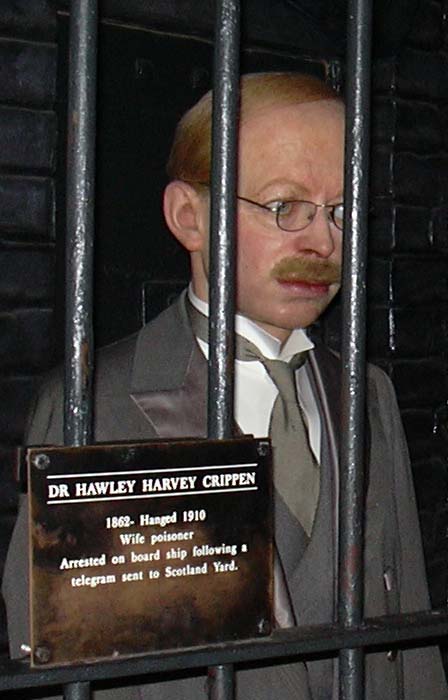
The sensational trial, which saw the American-born homeopath convicted for dismembering his shrewish and unfaithful wife Cora in an attempt to take up with his young mistress, fitted Crippen for both a noose and a likeness at Madame Tussaud’s. (More trial background here.) It has also made his case twice a landmark in the history of crime and technology: once at the time of his arrest, and again just last month as of this writing.

The core of a case a jury found so open-and-shut as to require just 27 minutes to convict was the poorly explained disappearance of Crippen’s wife, followed by the discovery of a considerably mutilated female corpse under the Crippens’ home.

Although much of the crown’s evidence was speculative and circumstantial — to say nothing of the bodice-ripping gossip of nymphomania and infidelity — a corpse under the floorboards tends to be a compelling circumstance to a jury.

Presumably that anticipation prompted Crippen to flee the Scotland Yard investigation with his mistress Ethel le Neve under assumed names on an ocean liner bound for Canada. The case made criminological history as the first use of wireless communication to apprehend a suspect when the ship’s alert captain telegraphed Crippen’s presence to land as the ship steamed away — enabling a policeman to board a faster boat and arrest the pair as they docked in Quebec.

In the century since Crippen went to the gallows still maintaining his innocence, the case has endured in popular notoriety. The killer’s life has been novelized, meditated upon and borrowed for fiction, offering a draught of inspiration to Alfred Hitchcock along the way.

Books inspired by the Crippen case …

Given his suspicious behavior, scant had been the credence given Crippen’s protestation of innocence.

Until now.

In a meeting of Edwardian crime and cutting-edge technology, two scientists from Crippen’s home state of Michigan stunningly announced in October that DNA testing proves the body was not Cora Crippen after all.

If true, it would appear to void Crippen’s conviction in its particulars without quite exonerating the hanged man from the natural question: whose was the corpse? The manufacture of clothes on the body dated it to the Crippens’ occupancy of the house.

One of Crippen’s modern sleuths, in a wholly speculative vein, thinks it might harken to an altogether different sort of crime: a botched back-alley abortion, just the sort of thing a financially struggling physician might have been involved in.

Maybe.

But if the test invites a modern investigator to look 97 years backwards, it also suggests a posture of epistemological humility. It’s just possible that the light this test casts on our own time is as searching as that it shines on 1910.

The Prejudice of Science

The Crippen case was a classic 19th century-style detective job — the inspector who made the arrest cut his teeth as a younger man on a Jack the Ripper murder — but it took place on the brink of a revolution in forensic science.

Just a few years before, fingerprinting had been embraced by British and American law enforcement and begun its march towards total institutionalization. On the heels of fingerprinting came a multiplicity of biometric approaches to crime scenes — hair and fiber analysis, blood typology, and most recently and dramatically, DNA.

And they, in turn, have brought a rising faith in science to adjudicate the law.

While the “CSI Effect” — jurors’ expectation of case-breaking scientific evidence — conventionally plays as a hindrance for prosecutors who usually have no such thing, the excess deference given to less-than-conclusive forensic evidence can likewise cut against the defense. Evidence mishandled at crime labs, even cooked outright, factors into numerous recent post-conviction exonerations. The once ironclad credibility of fingerprint evidence has itself been undermined by subsequent forensic advances.

In short, for all its undoubted contributions to criminal justice, forensic science packs along its own set of pitfalls, caveats and blinders reflexively privileging evidence of the laboratory.

This is not a reflex to indulge uncritically. History grants the benefit of hindsight, but rarely the luxury of certitude.

A waxwork Dr. Crippen at Madame Tussaud’s. Image used with permission.

So if the prospect of Crippen’s innocence intrigues, that unexplained body — that sudden flight for Canada — that (permanent) failure of Cora Crippen to resurface — nevertheless remain. They might lead us to question our implicit faith in the finality of DNA’s verdict on history rather than the other way around.

Are we certain that an unbroken line of blood relations really connects Cora Crippen to the modern DNA donors of her “family”?

Are we certain that a reliable chain of custody has preserved the original tissue samples unsullied across a century?

And if we are certain, what do we make of that body after all?

It is humans who must ultimately interpret and contextualize even the firmest forensic science. Whatever we might believe of Dr. Crippen we retain the burden of that belief, with all its intrinsic potential for grievous wrong.

The tales Hawley Crippen has yet to unfold from the grave might or might not shed still another different light on our understanding of what happened at 39 Hilldrop Crescent a century ago.

The gentleman’s place as a continuing attraction at Madame Tussaud’s, however, seems assured.

On this day..

1915: Joe Hill

On this date in 1915, songwriter, poet and labor activist Joe Hill was shot in Utah for the murder of a local butcher.

Even before his execution, the Swedish immigrant was widely thought to have been railroaded for his IWW affiliation.

Though state authorities had little use for the worldwide clemency bid whose backers included U.S. President Woodrow Wilson — powerless to intervene officially, since the execution was a state matter — Hill walked spryly into his martyrdom. The strange post-mortem career of his totemic ashes is the least of the ways Hill lives on.

His dauntless last message to fellow Wobbly Bill Haywood — “Don’t waste any time mourning. Organize.” — is a permanent fixture on pins and placards among every stripe of left activist. The songs he wrote remain in print — and in performance.

And the Depression-era tribute ballad “I Dreamed I Saw Joe Hill Last Night” can seamlessly serenade ripped-from-the-headlines footage, as a Paul Robeson rendition does in these clips of 1998 protests against then-New York City Mayor Rudy Giuliani.

On this day..

1911: Charles Justice

On this date in 1911, Charles Justice was electrocuted by the State of Ohio.

It was an ironic end, since when serving an earlier stint in the state penitentiary shortly after the electric chair was introduced, Justice had hit upon the idea of metal clamps in place of leather straps to more securely hold down the chair’s clientele and avoid burnt flesh.

The improvement, duly implemented, was there awaiting its creator.

On this day..

1914: Carl Hans Lody

On this date in 1914, German spy Carl Hans Lody was put to death in the Tower of London during the opening months of World War I.

Lody‘s was the first execution in the Tower since its heyday as the chopping-block of disfavored nobility had passed in the mid-18th century. Times had changed by the era of trench warfare: Lody was not beheaded, but shot inside a wooden shed erected for the purpose in the Tower yard. Ten more German spies, who seem to have had a harder go of infiltrating Britain than their English counterparts had in Germany, would suffer the same fate by war’s end.

A Berlin-born naval officer, Lody had no experience spying but was tapped for the job because he had traveled abroad and spoke English well enough to pass for an American tourist. He was dead scarcely three months after he entered the Isles, though his work may have helped a U-boat sink a British warship.

According to A.W. Brian Simpson in Domestic and International Trials 1700-2000, the case was a legal landmark as the first espionage trial in England held partly in camera — outside the public view. The outcome, however, was a foregone conclusion, and Lody himself didn’t bother to contest his guilt — seemingly fixated on going to his grave with nothing short of the utmost in romantic gentlemanly decorum.

Part of the Themed Set: Spies.

On this day..