1933: John Fleming, not taking it too hard

(Thanks to Robert Elder of Last Words of the Executed — the blog, and the book — for the guest post. This post originally appeared on the Last Words blog. Fans of this here site are highly likely to enjoy following Elder’s own pithy, almanac-style collection of last words on the scaffold. -ed.)

I’m sorry to have caused all this trouble. You seem to be taking harder than I do.

— John Fleming, convicted of murder, hanging, California
Executed November 17, 1933

Prior resident of Folsom and San Quentin prisons for robbery and assault charges, John Fleming murdered Amos Leece at a gas-station and road house when a prostitute named Peggy O’Day (aka Leonora Smith) made derogatory remarks to Leece after he refused to buy her a drink. Leece left the station to crank his car but not before he called O’Day “a cheap, chippy whore.” Fleming then confronted Leece, demanding that he apologize and then shot him three times when he refused.

On this day..

1933: Dallas Egan, dancing

On this date in 1933, Dallas Egan hanged at California’s San Quentin Prison — and pretty much nobody was happier about it than Dallas Egan.

A cynic might attribute the puckish jig he reputedly danced en route to the gallows to the liberal allotment of whiskey, straight he had swallowed at the sufferance of Gov. “Sunny Jim” Rolph* — “all the whiskey he can safely stand up under.” It was just the governor’s way of saying thanks to the murderer for going so easy on the justice system.

Barely a year before, Egan and three accomplices robbed a Los Angeles jewelry store when, mid-robbery, an old fella with a hearing deficiency paused at the store window to check his pocketwatch against the wares n display — one of those little accidental moments that make up a life, or in this case, a death. Two deaths, actually. Egan shot the misfortunate William Kirkpatrick dead when the man didn’t respond to an order the robber shouted. “I gave the man full warning,” Egan explained.

But Egan didn’t mean to minimize his guilt; he was fully committed from the time of his capture to get himself the noose.

“I don’t know whether or not I’m insane,” he mused to the court when an attorney tried to secure a sanity hearing for him (per this Los Angeles Times profile). “We’re all a little crazy; even you, Judge. But I don’t want nine years’ punishment, or 20 years. I want to pay in full!” In later months he would write the governor and the Supreme Court insisting on his just deserts and washing his hands of any appeal or clemency effort on his behalf.

Egan’s last morning, Oct. 20, 1933, began with a good breakfast, some final sips of whiskey and a cigar “tilted at a ridiculous angle,” according to one witness. The previous night he’d played a record of “Ida, Sweet as Apple Cider” over and over in his cell, telling guards: “I’ll dance out to that tune.” (Some newspapers misquoted this statement with the more formal “I want to dance out to the gallows.”)

When the hour came, he really did dance an Irish jig as he entered the death chamber handcuffed between guards. He then walked up the 13 steps, energetically and alone. Offering no final words, he plunged through the trapdoor.

Rolph’s generosity toward Egan resulted in a two-day controversy. Some Bay Area preachers chided him for it, but Rolph had the last word: “We would be pretty small when we sent a man into eternity if we could not grant his last request.”

“>Los Angeles Times, January 23, 2011

* Rolph would die in office of a heart attack the following June. He was a one-term governor but has a bit of notoriety for publicly applauding a 1933 lynching in San Jose.

On this day..

1937: Panfiliya Tanailidi, Azerbaijani actress

On this date in 1937, Azerbaijani actress Panfiliya Tanailidi (various other transliterations are possible) was purged during Stalin’s terror.

Born in a tsarist governorate to Greek emigres, Tanailidi (English Wikipedia entry | Azerbaijani) was treading the Caucasus boards as a teenager in the pregnant century’s first decade.

She became an accomplished stage and screen actress, starring in 1930s silents Ismet and Almaz.

Come the Stalin years when any pretext was enough to destroy a body, the pretext against Tanailidi was apparently her affiliations with an Iran then taking a concerted anti-Soviet line: the actress had toured Iran in 1917 and had friends like Govhar Aliyeva who had fled the Soviet Union for Iran. This was more than enough to cast the pall of espionage about her.

On this day..

1937: Lev Karakhan, Marina Semyonova’s husband

On this date in 1937, the dancer Marina Semyonova lost her husband to the Great Purge.

Semyonova was perhaps the premier Soviet ballerina in the interwar era before the ascent of Maya Plitsetskaya* but artistic genius conferred no safety from the purges.

Least of all was that so for family members who happened to be that choicest of Stalin’s prey, an Old Bolshevik.

Semyonova’s husband Lev Karakhan (English Wikipedia entry | Russian) was an Armenian revolutionary and former Menshevik who joined the Bolsheviks before the October Revolution. He spent the 1920s and 1930s in various foreign policy roles, right up until the end: just a few months before his death, he had been the USSR’s ambassador to Turkey, when he received that ominous recall.

He even gave his name to a 1919 “Karakhan Manifesto”, which was Moscow’s attempt to get friendly with China.

Its author was more successful getting friendly with the Bolshoi’s prima ballerina around 1930, when both were married to other people. Their affair turned civil marriage without hampering the career of either partner; indeed, Semyonova had the honor and terror of accepting the Order of the Red Banner from Stalin’s own hands in June 1937, just a month after her husband had been arrested.

Semyonova just continued performing, because what choice did one have? She only recently died, in 2010, just shy of her 102nd birthday — as one of the legends of her craft.

* Maya Plisetskaya was also touched by Stalin’s terror: in 1937, when Maya was only 11, her father was disappeared into the gulag and killed; her mother was arrested shortly after and survived a forced labor camp in Kazakhstan.

On this day..

1935: Tully McQuate, “If I hang, I hang”

On this date in 1935, one of the all-time great names in American gallows history hanged at California’s Folsom Prison for one of the all-time crimes of ingratitude.

Tully McQuate (or Tulley, or Tullie; the name means “peaceful”) entered the annals of criminology via a sack of dismembered human remains discovered in San Diego’s harbor in 1934.

These gory parts turned out upon examination to have formerly constituted a well-to-do 74-year-old widow named Ellen Straw. Mrs. Straw, it transpired, had taken a shine to an Ohio-born drifter thirty years her junior after hiring him to do her yard work, and finally invited said McQuate to live with her.

Period reportage describes her as his “benefactress” but it appears the favors were reciprocal.

“She took a liking to me and I took a liking to her,” he explained in a matter-of-fact confession. (Los Angeles Times, May 28, 1934)

She took me into her home and we got along pretty well for about a year. Then she began to get jealous of me and we began to quarrel.

One night we went down to a mission — neither of us was very religious, but we used to get a kick out of it. We quarreled on the way home. She went to her room and I went to mine. She kept on quarreling with me — I could hear her through the wall.

Finally I got up to get a drink of water. I found a clawhammer that I had been using around the house. I took it and went in and hit her over the head with it. I guess I hit her twice. [The court would find that he hit her six or seven times. -ed.]

I never had any intention of killing her, but when I saw she was dead, I just covered her up and went back to bed.

“Well, if it’s done, it’s done,” I said to myself. I knew it was all up with me then. I knew they would find me some time. But I didn’t care. When I lost my family I had nothing left to care about. [McQuate’s wife had divorced him years before. -ed.]

I left the body there for six days. I never did see her face again. Then I decided I’d better get rid of it, so I took the knife and a saw — I couldn’t get the body into the sack.

McQuate projects a pragmatic matter-of-factness about the situation that’s equal parts disarming and blood-chilling. One can at least say for him that he faced the consequence with the same equanimity.

Well, I guess my time has come. I’ve confessed — told the whole truth — and I’ll plead guilty. There’s no use putting the State to the expense of a trial. I’ve paid taxes myself.

McQuate was as good as his word. Indeed, when the legal proceedings required two days — perhaps anticipating appeal avenues, the District Attorney successfully insisted that McQuate, who had intended to represent himself, must have an attorney in a death penalty case — the murderer griped on the second day, “It’s so foolish. I did it; let ’em sentence me and get it over with. If I hang, I hang.” (Los Angeles Times, June 5, 1934)

On this day..

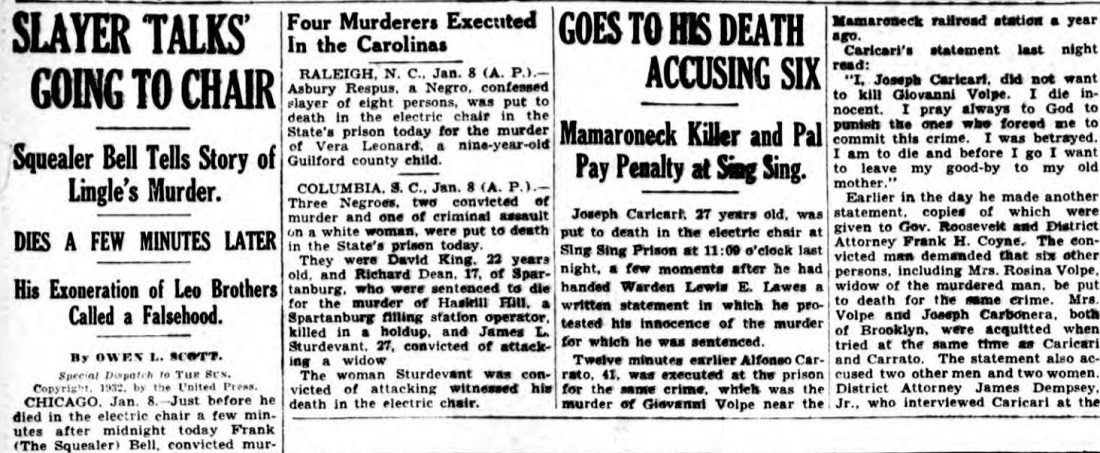
1932: Asbury Respus, North Carolina serial killer

(Thanks to Meaghan Good of the Charley Project for the guest post. -ed.)

On this date in North Carolina, a middle-aged man named Asbury Respus was executed for the murder of nine-year-old Vera DeWitt Leonard.

And that wasn’t all: though virtually forgotten today, Respus was a serial killer with eight confessed murders to his name.

He claimed that he fell from a barn rafter as a youth and was never quite the same after that, being prone to “spells” of homicidal rage. This story may well have been true; he had a noticeable indentation in his skull.

According to Respus’s confession, he killed his first and second victims in Northampton County in the early 1900s. Their names were Lizzie Banks, whom he shot, and Zenie Britt, whom he beat to death with a stick. The third victim was Becky Storr, killed in Boydton, Virginia around 1910; she too had been bludgeoned with a stick.

These early murders are attested only by Respus’s own confession; the first verifiable homicide by his hand took place in 1912. Sentenced to 15 years for manslaughter in the shooting death of a Northampton County man named Ed D. Wynne, Respus escaped from a road gang in 1916 and began life as a drifter.

They can’t have hunted this fugitive very hard. He never went far, always staying in the vicinity of Greensboro, North Carolina.

All four victims prior to his incarceration had been African Americans, as was Respus himself. On January 14, 1918, Respus crossed the color line to axe to death a 56-year-old white woman named Jennie Brown in her home, which he then burned to the ground. So thoroughly did his arson consume the premises that no evidence of a crime remained … leaving Respus free to continue his murder spree. From here on out, by whatever happenstance, all victims were white.

On July 22, 1920, he came across a little boy named Robert Neal Osborne and drowned him in a stream, just for kicks. Again he got lucky: little Robert’s death was recorded as accidental. On July 17, 1925, he murdered 80-year-old widow Eunice Stephenson by striking her on the head and hanging her body from a ceiling beam. This homicide was recognized as such but went unsolved for years.

Vera Leonard was Respus’s youngest female victim and his undoing. Respus may have killed her with rape on his mind. As it was, he went with his old standby, a blunt instrument to the head; afterwards, he burned her body “to a char.” He did not blame his “homicidal spells” for Vera’s murder but instead said he’d been out of his mind on drugs.

Respus expressed gratitude that he was going to his death. “I’d rather he dead and in heaven,” he said, “than here on earth being tormented to death.”


It was a busy day for U.S. executioners. Headlines from the Jan. 8, 1932 edition of the New York Sun.

On this day..

1938: Anna Marie Hahn, serial poisoner

On this date in 1938, serial poisoner Anna Marie Hahn was electrocuted in Ohio.

The Bavarian-born immigrant had arrived to Cincinnati espoused to a young telegraph operator. Hahn herself tried her hand at a bakery but soon tired of the tedium of honest work and set herself up better in the lucrative business of elder abuse.

Using an ancient ploy still effective to this day, the “plump and pretty” young woman flitted about the German emigre circles of Cincinnati advertising herself as a live-in caretaker for senior citizens. Once retained, she was in a position to price-gouge for her “services”, pilfer from the estate, and even to so insiniuate herself into her clients’ good graces as to enter their wills. Her first victim, Ernest Kohler, actually left her a boarding house: pretty good work compared to rolling out dough before the sun came up.

Using a variety of poisons,** Hahn killed off five known victims during the Great Depression, making off with tens of thousands of dollars in the process that she largely squandered on gambling.*

The first woman to die in Ohio’s electric chair, Hahn was reportedly stoic until her last hours. Then, overcome by desperation, she slid into a state of collapse and even at the last moments of life bawled “incoherent” pleas to a warden who of course had no authority to help her. Robert Elder of Last Words of the Executed (both blog and book) — quotes her frightful last words thus:

Good-bye all of you and God bless you … Mr. Woodard [the warden], don’t do this to me. Think of my boy. Can’t you think of my baby? Isn’t there anybody who will help me? Is nobody going to help me?

* One clever fellow, George Heiss, escaped her clutches when he grew suspicious of a mug of beer she presented him; when Hahn refused to sample it herself, he sacked her — but he did not report her.

** Her husband tipped police off by reporting that she had a bottle in the house literally labeled “poison”. (It was croton oil.)

On this day..

1936: Ramiro Ledesma Ramos, Falangist

Falangist politician Ramiro Ledesma Ramos was executed on this date in 1936, during the Spanish Civil War.

Ledesma (English Wikipedia entry | Spanish) launched the first fascist publication in Spain as a perspicacious 25-year-old admirer of Mussolini and Hitler.*

La Conquista del Estado — the expressive title was cloned from Curzio Malaparte‘s Italian fascist magazine — positioned Ramos as one of the leading apostles of the right in early 1930s Spain. Despite his youth, he’s been credited by later observers as one of the clearest, earliest intellectual exponents of fascism in Spain. Ledesma affiliated from the start with the Falangist movement Jose Primo de Rivera, and personally signed off on the party’s yoke-and-arrows logo and its motto “¡Arriba España!”

Spain’s Republican government had him detained in Madrid with the outbreak of the Spanish Civil War in July 1936. With the fascist armies closing in on Madrid in late October, Ledesma was among dozens of political prisoners taken out and shot without trial at the cemetery of Aravaca.

* His philo-Hitlerism allegedly led Ledesma to imitate the Fuhrer’s flopover coiffure.

On this day..

1939: Operation Tannenberg public mass executions begin

This photo (from the German Bundesarchiv) captures an SS execution of Poles in Kornik just weeks into the German occupation of Poland in 1939, fruit of a pre-planned Nazi project to secure the new territory as lebensraum.

Operation Tannenberg (English Wikipedia entry | German | Polish) could be seen as a vanguard for the mind-boggling exterminations to come in subsequent years, cementing the army’s commitment to a campaign that extended well beyond territorial conquest. Alexander Rossino examines this understudied segment of World War II in Hitler Strikes Poland: Blitzkrieg, Ideology, and Atrocity and contends that “the unlimited, almost nihilistic violence of the Wehrmacht” emerges first in these initial weeks of the Polish campaign, which proved a “transitional conflict” pivoting towards the more notorious atrocities to come. “The invasion of Poland thus occupies a crucial place in the history of Nazi Germany’s descent into mass murder and genocide.”

Drawn up by Hitler, Himmler, and Heydrich and officially authorized on August 25, a week before Germany invaded Poland, Tannenberg intended to destroy Poland’s elites — from intelligentsia and nobility down to community priests and teachers, and the politically active across the spectrum from Communist to monarchist. The hope was to leave the subject nation supine, incapable of challenging Berlin’s designs on her future. Estimates I have seen vary widely but tens of thousands of Poles (with a liberal portion of Polish Jews) were shot by SS Einsatzgruppen units under Tannenberg even by the end of 1939, and kilings continued apace thereafter. Though not the literal first Operation Tannenberg Killings, the October 20-23 period marked the first public mass executions; a Polish-language list of the incidents and victims involved is available here.

The very name Tannenberg is a nationalist allusion to Germany’s time-immemorial rivalry with Poland; the original Battle of Tannenberg saw the rising Polish-Lithuanian empire defeat the Teutonic Knights, essentially breaking the latter as a European power. This defeat resonated in 20th century German national mythology not unlike the Battle of Kosovo for Serbia; in 1914, Field Marshal Paul von Hindenburg made himself a household name by smashing the Russians in a battle vaguely in the vicinity, and cannily christened it, too, the Battle of Tannenberg. (The Germans put up a monument to it which they felt obliged to tear down later in the war as they were being driven out of Poland.)

On this day..

1938: Ivan Stepanovich Razukhin


Soviet NKVD execution form records that Ivan Stepanovich Razukhin was shot by Lt. A.R. Polikarpov on October 9, 1938. From Zek: The Soviet Slave-Labor Empire and Its Successors, 1917-2000.

On this day..