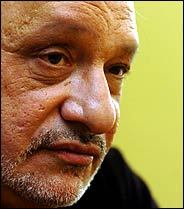
1939: Evgeny Miller, White Russian

On this date in 1938, former tsarist Gen. Evgeny Miller was executed in Moscow, having been brazenly kidnapped by the Soviet NKVD from exile in France.

Miller opposed the 1917 Russian Revolutions (both of them) and ended up on the wrong side of the ensuing civil war as Aleksandr Kolchak‘s man in Archangel.

There, Miller (he was half-German) was the beneficiary of the Entente powers’ anti-Soviet incursion of British, French, American and Canadian troops.

These powers soon found that their respective peoples, wearied by the late world war, had little appetite for spilling more blood in the service of enthroning a Romanov, and cut bait in 1920.

Miller wisely did likewise, and watched the great workers’ and peasants’ republic take shape from the safety of Paris — where, in the 1930s, he chaired the anti-communist Russian All-Military Union (ROVS).

Soviet intelligence had infiltrated this body, however, and hatched a bold plot* to shanghai Miller and smuggle him out of the country in order to cause ROVS leadership to pass to the Soviets’ own agent, Nikolai Skoblin. Although they got Miller, they didn’t quite pull off the putsch, since the wary general had left behind a note outlining his suspicions of Skoblin in the event foul play should befall him.

Imprisoned at Lubyanka, Miller was personally interrogated by NKVD boss Nikolai Yezhov, but according to Vladislav Goldin and John Long,

little or nothing of what Miller had to report about the recent activities of the ROVS was unknown to the NKVD … the leaders of the NKVD found themselves saddled with a prominent prisoner of no significant value to Soviet intelligence and from whose capture, at the same time, nothing useful could be derived by way of publicity or propaganda.

…

The fall of Ezhov sealed the doom of General Miller, whose abduction had from the outset been his inspiration. In these circumstances, given his continuing uselessness to the NKVD, Miller’s elimination became an inevitable element in Commissar Beria‘s liquidation of the so-called Ezhovshchina, an operation which lasted from late 1938 through at least 1940. Although part of this undertaking involved the release of up to 200,000 of Ezhov’s prisoners, no such option was available in the case of General Miller for whose disappearance the Soviet government had consistently denied any responsibility. Accordingly, on 11 May 1939, after more than nineteen months of agonizing solitary confinement, Commissar Beria, with no viable alternative, ordered the trial and execution of the long-suffering General Miller in a process, ironically, that was fully implemented in less than twenty-four hours.

…

[it was] an ill-conceived, poorly executed and totally unnecessary adventure that, in the end, failed to benefit any of its apparent perpetrators.**

Skoblin, for his part, fled, disappearing to a still-unknown fate. His wife, Nadezhda Plevitskaya, copped a 20-year sentence for helping arrange the kidnapping, and died in prison.

They may not have gotten ROVS, but at least they made celluloid. Skoblin’s shadowy activities in France in this period are the inspiration for the 2004 French film Triple Agent.

* Georgy Kosenko, who we’ve previously met in these pages, helped orchestrate the kidnapping. (Times being dangerous as they were, the wheel of Red Terror turned against Kosenko so quickly that Miller actually outlived him.)

** Goldin, Vladislav I. and Long, John W. “Resistance and Retribution: The Life and Fate of General E.K. Miller”, Revolutionary Russia, 12:2 (1999), pp. 19-40.

On this day..

1939: Mikayil Mushfig, Azerbaijani poet

On this date in 1939, Azerbaijani poet Mikayil Mushfig was shot during Stalin’s purges.

The 30-year-old former schoolteacher was a socialist enthusiast as a youth in the 1920s; his work celebrated officially sanctioned subjects like virtuous peasants and workers, and modernization of the alphabet.

How far to go to put aside the backward old ways? Poets debated in verse whether the traditional instrument tar ought to be banned.

[O]ne poet, Suleyman Rustam, wrote, “Stop tar, stop tar, You’re not loved by proletar!” Another poet, Mikayil Mushfig, countered, “Sing tar, sing tar! Who can forget you!”

The tar wasn’t banned, but Mushfig’s enthusiasm for the Soviet project was deemed (however genuine) insufficient, “petit-bourgeois”.

The nightingale is sorrowing near the rose,
Though autumn comes-it lingers to depart,
Life, life! This cry of longing ever grows:
With love, with burning passion how to part?

With feelings new, you string your singing lute
My youthful pen, now just about to start!
O friends, give answer to my pain acute:
With this great seething fire flame, how to part?

Here‘s a pdf of some Mushfig poetry in Azerbaijani.

On this day..

1939: Stanislav Kosior, Vlas Chubar and Pavel Postyshev

On this date in 1939, a couple of “New Bolsheviks” recently flying high after helping purge the Old Bolsheviks had their own reversals of fate culminate with a bullet to the head.

Stanislav Kosior* (or Kossior), a Pole who ran the Ukrainian Communist Party for much of the 1930’s, and Vlas Chubar, a Ukrainian politburo member who had once served as Prime Minister, were shot this day along with Pavel Postyshev,** once Stalin’s personal representative to the Ukraine.

Left to right: Kosior, Chubar, and Postyshev — the first and last on post-rehabilitation Soviet stamps.

Though these obviously died because of parochial party politics under the terrifying reign of Stalin — and all were accordingly rehabilitated after Stalin’s death — posterity has another bone to pick with them: the Ukrainian famine known as the Holodomor.

Their portfolios included carrying out the forced collectivization to which the famine is generally attributed. Participation was strongly encouraged.

“Join the collective farm or else off to the Solovets Islands.”

–Chubar

It was a grim time: starving peasnts dared not touch collectivized foodstuffs slated for use elsewhere on pain of execution themselves.† (Kosior won the Order of Lenin for his achievements in agriculture.) These Soviet VIPs themselves faced very similar pressure to implement Moscow policy and party line with exactitude … and very similar consequences for any perceived failure. (Kosior, too steely to succumb to torture, finally broke when his captors raped his teenage daughter in front of him.)

State organs adapted to the fall of these powerful men with Orwellian aplomb. “Radio Kosior” was renamed “Radio Kiev” overnight with its namesake’s arrest. Secret police chief Lavrenty Beria personally expropriated Chubar’s dacha. And

there is an account of a case in the Ukraine in which fifty students were charged with forming an organization to assassinate Kossior, who had been named as one of the senior intended victims in the great Moscow Trials. A year’s work on this case, which was a structure of great intricacy, had been performed by the interrogators. In 1938, however, it became known that Kossior himself had been arrested as a Trotskyite. Everyone thought that the students would be released. But a new interrogation immediately started, and they were beaten up for having lied to the NKVD. After a few days, the stool pigeons in the cells let them know what they were supposed to confess this time. It was to change their deposition, putting the name of Kaganovich for that of Kossior. The NKVD could not face the trouble of constructing a completely new fabrication. Finally everything was in order, and the students were sent off to labor camps.

A Ukrainian court recently named Kosior, Chubar and Postyshev among eight individuals personally responsible for the Holodomor.

* When Kosior was assigned to Moscow in 1938, he was replaced in the Ukraine by a good friend: future Soviet Premier Nikita Khrushchev. (According to Nikita’s son.) To judge by the ferocity and extent of the purges Khrushchev oversaw, he took to heart the lesson from his predecessors’ fall.

** But on the plus side, Russians’ and eastern Slavs’ (continuing) tradition of putting up New Year’s trees in at least partly attributable (Russian link) to a Postyshev epistle to Pravda in 1935 calling for same. (The New Year’s yolka was a religious/tsarist tradition that had been discontinued after the Russian Revolution, but like many such cultural artifacts proved amenable — with Postyshev’s nudging — to secular/Communist reappropriation.)

† The nature of the Holodomor is the subject of furious present-day wrangling: can the mass starvation accurately be classed as a “genocide”? Especially given that such a finding could expose Russia and/or Russians to legal liability, there’s something of a difference of opinion on the matter between Kiev and Moscow.

On this day..

1939: Howard Long, New Hampshire’s most recent hanging

As of today, it’s been 70 years since the U.S. state of New Hampshire carried out an execution, despite maintaining a death penalty statute almost continuously since.

“Craving for boys,” Long was condemned for molesting and beating to death a 10-year-old in 1937, evidently his second molestation/murder: in the first, he reportedly drove around for 10 hours with his prisoner before plucking up the heart to do the thing, the sort of mental picture to cast a child murder victim of a wannabe-serial killer in the unexpected aspect of boredom.

Long’s execution in the bicentennial of New Hampshire’s first legal hangings was itself the first in 21 years in the Granite State. Although a handful of cases since have potentially fit the steadily narrowing set of death penalty circumstances, none has actually come so far as the gallows (or, today, theoretically, lethal injection) before taking one of the many possible exits — plea bargain, sentence reduction, premature death — from the capital punishment system.

New Hampshire’s present-day death row consists of only one person, and earlier this year its legislature actually voted to abolish the death penalty, a measure spearheaded by State Rep. Renny Cushing, who is the son of a murder victim.* The measure was vetoed by Gov. John Lynch.

* Full disclosure: also a personal friend. Cushing founded Murder Victims Families for Human Rights (MVFHR).

On this day..

1939: Three Men For Murder, But Not Isidore Zimmerman

On this date in 1937, Isidore “Beansy” Zimmerman spent the day preparing for death in New York’s electric chair … but was spared by an 11th-hour clemency from New York Governor Herbert Lehman.

Here’s the scene, as laid in the anti-death penalty tome of wrongful convictions In Spite of Innocence:

As dawn broke over Sing Sing Prison, Beansy Zimmerman had every reason to think it would be his last day.

Zimmerman numbly went through the pre-execution rituals. The last meal (choose whatever you want), and music (you get to choose that, too) played on the wind-up phonograph. The barber shaves your scalp so the electrodes can fit snugly against your bare skin. The tailor slits one of your trouser legs for another electrode. Officials treat you with unaccustomed politeness. A final family visit — how do you say good-bye when you know it is forever? What should your last words be? Beansy’s mother stayed away, unable to face such finality.

Two hours before execution, Gov. Lehman commuted his sentence.

In this blog, we lay aside each story day by day, but for those affected, it’s rarely so easy — which is why the mothers of the five men condemned today put in their personal clemency appeals to the governor.

For Zimmerman and a fellow “accomplice” named Philip Chaleff whose respective roles in a robbery/murder were doubted, it had the desired effect. (Dominick Guariglia, Arthur Friedman and Joseph O’Loughlin weren’t so lucky.)

Chaleff, a diabetic being kept alive just for execution, soon succumbed. For Zimmerman, the execution that did not happen was to define the rest of his 66 years. He was alive, but to what end?

“I wasn’t dead, no,” he remembered. “But every day from now on they’d bury me a little more.”

Zimmerman fought, by becoming a skilled jailhouse lawyer and in 1962 finally winning exoneration from the New York Supreme Court, which held that the testimony against him had been perjured with the connivance of the prosecutor.

He’d spent nearly a quarter-century in prison. Now, he was just another ex-con scrabbling after dead-end employment.

For years thereafter, Zimmerman fought for a special bill that would allow him to sue the Empire State for wrongful imprisonment, finally winning approval in 1981.

His suit asked for $10 million. The judge reckoned Zimmerman’s time and trouble were worth a tenth of that.

Expenses deducted, Zimmerman walked away with $660,000 — that, and sweet vindication.

Fourteen weeks later, he dropped dead of a heart attack.

On this day..

1939: The 18 corpses of the rebellion

On this date in 1939, 18 junior officers of the Thai military were shot in Bangkok.

Ostensibly condemned for being part of a coup plot to depose the adolescent King Ananda Mahidol in favor of his abdicated predecessor Prajadhipok, they were in reality the casualties of a purge by the Field Marshal-turned-Prime Minister Phibun Songkhram.

It’s alternatively transliterated “Phibun Songkhram” or “Pibunsonggram”, and familiarly abbreviated to “Por”, but by any name he dominated Thai politics for a generation.

One of the military leaders of the bloodless 1932 Siamese Revolution that made the country a constitutional rather than an absolute monarchy, Phibun had in 1938 muscled his way to the Prime Ministership.

Beset by assassination attempts linked to royal revanchists to whose purposes the young turk’s programme was deeply inimical, Phibun determined to break the back of monarchism en route to a modernized, militaristic nationalism (pdf) that would be right at home in the imminent world war.*

As 1939 opens, we join the narrative of Paul Handley’s The King Never Smiles:

Phibun swept the capital and arrested 50 royals, nobles, and soldiers in the clique of his People’s Party rival Colonel Song Suradej for plotting his overthrow …

Whatever the truth behind the cabal, its quashing came to represent the final victory of the 1932 revolutionists and the constitutionalists over the monarchists. To mark it, Phibun commissioned a huge monument to the constitution, later called Democracy Monument, in the middle of the city’s main thoroughfare, Rajadamnoen (“royal progress”) Avenue.


The Democracy Monument in Bangkok.

The eighteen officers who took it in the shorts on this date were not joined by condemned VIPs like royal blood Prince Rangsit, who copped a commutation. It’s widely thought now that the “Songsuradet Rebellion” — or aptly-named “Rebellion of 18 Corpses” — was trumped-up, if not an phantasm altogether.

The Democracy Monument was not the only bulwark of Thai nationalism thrown up by Phibun in the year between the “conspirators'” January arrest and their deaths this day.**

He dropped the old absolutist name “Siam” in favor of the more nationalistic “Thailand” in June of that year; made the date of the 1932 revolution a national holiday; stripped the language of class-distinctive structures; and pressed irredentist claims against neighboring French colonies.

And if the royal house was efficiently marginalized by Phibun, it would yet develop in the latter part of the century into one of the region’s weightiest political entities† … intertwined with the Thai military Phibun helped hoist to pride of place, a formula that has left coups and unstable governments a presistent feature of the political landscape down to the present day.

* And subsequently, too. Despite aligning with the Axis powers during World War II, Phibun was a feted anti-Communist dictator as Washington started counting dominoes in Southeast Asia in the 1950’s.

** The Wikipedia page for the rebellion claims that the executions were carried out in batches of four per day. A New York Times report of December 6, 1939 said that all 18 had been executed the previous day.

† The current King Bhumibol Adulyadej, who coincidentally turns 81 today, is the world’s longest-reigning monarch as of this writing … with no shortage of concern about the conflict his passing may unstop.

On this day..

1939: Nine Czech students

Today is International Students’ Day and a public holiday in the Czech Republic and in Slovakia thanks to the martyrdom of nine at the hands of the Nazi occupation forces this day in 1939.

The previous fall, Hitler had cowed the allied powers into ceding the mountainous Czechoslovakian Sudetenland to the Third Reich in order to avert war — leading to Neville Chamberlain‘s famously mistaken “peace in our time” speech.

In March 1939, Germany reneged its part of the bargain and gobbled up Bohemia and Moravia, essentially the modern Czech Republic.

That this would collapse Chamberlain’s vision of peace and set Europe’s powers on the road to war with Berlin was cold comfort to the occupied Czechs. They had their own problems.

On October 28, youth demonstrations in Prague against the occupation resulted in the shooting of Charles University medical student Jan Opletal

Two weeks later he succumbed to the injury, and his funeral turned into an anti-occupation riot forcibly quashed by German arms. According to the London Times account:

On November 17 at 3 a.m., the Gestapo entered all students’ colleges, men’s and women’s, without allowing them to dress, tied the students in groups of three, and dragged them away … Between 3 o’clock and 8 o’clock in the morning the Gestapo visited students’ homes and lodgings. Those opposing arrests and parents who withheld information were immediately shot at, and the wounded were refused attention. The Gestapo broke into high schools as well as into the university …

The prisoners were taken to the Ruzyn barracks and to the Sparta football stadium, where cold water was flung over them and were made to wait until the evening. Then, in the barrack yard, 124 students and teachers* were shot before their fellow-students, the first nine being presidents of students’ associations, including the brilliant young sociologist Dr. Matoushek [English Wikipedia entry | Czech], son of a former Minister of Commerce.

Universities in the cities were declared closed for three years; they would not in fact re-open until after the war.

The day, subsequently memorialized as den boje studentu za svobodu a demokracii (Day of the Students’ Fight for Freedom and Democracy), entered Czech history a second time a half-century later. A student protest at Opletal’s grave on this date in 1989 helped catalyze the Velvet Revolution that toppled Czechoslovakia’s Communist government.

* The larger figure was circulated in the days following by Czech sources. It is not clear to me whether that number proved unfounded, or whether subsequent memorials simply came to focus on the leading nine — whose executions are certain, and were even announced by German communique.

On this day..

1939: Georgy Nikolayevich Kosenko (aka Kislov), NKVD spy

(Thanks to Dmitri Minaev of De Rebus Antiquis Et Novis for the guest post.)

One thing about the first years of Soviet history that always puzzled me is how the Bolsheviks managed to create a wide and reliable network of foreign intelligence and counter-intelligence so fast. Below is a history of life and death of a typical spy from the early Soviet years.

Georgy Nikolayevich Kosenko was born on 12 May 1901 in Stavropol. He was a smart schoolboy. Foreign languages, especially French, were among his favorite subjects. He graduated from school when the Russian Civil War began and his parents became active Bolsheviks.

Stavropol was a region of fierce struggle between the Whites and the Reds. On the one hand, the anti-Bolshevik Volunteer Army had good support in Southern Russia, but on the other hand, the factory workers who concentrated in the cities tended to support the Bolsheviks.

Georgy’s father participated in the revolt in Stavropol and in 1918 he was executed by the Whites. Georgy’s sister was a Bolshevik since 1914 and actively worked for the revolutionary underground. Soon after the death of their father she too was caught and hanged. I don’t know what was her crime, but most probably it was sabotage.

So, choosing sides in the civil war was not difficult for young Georgy. In 1920 he became a secret agent of Cheka in Stavropol; in 1921 he joined the RCP(b) (Russian Communist Party, bolsheviks) and became a private in the OGPU military detachment. From 1924 he was a full-fledged officer of OGPU (the new name of Cheka) and continued his work in Stavropol and other cities: Novorossiysk, Vladikavkaz, Rostov, Sverdlovsk and Moscow.

A Lethal Career

In 1933 the Foreign department of OGPU noticed the young officer with good command of French and offered him a post in Soviet foreign intelligence. On 30 April 1933 he was appointed the deputy of the chief agent of OGPU in Kharbin in Manchuria, then occupied by the Japanese. According to the usual practice of the OGPU, he received false documents and became Georgy Nikolayevich Kislov. He became the secretary of the Soviet embassy in Kharbin. In June 1935 he was promoted to the chief agent and, automatically, to the vice-consul of the USSR.

Anti-communist forces were still active in Siberia in the 1930s and the main task of Soviet agents in Kharbin was identifying organized groups of Whites. There was a large colony of Russian emigrants in Manchuria and many of them eagerly helped the anti-Soviet fighters. By the end of 1935 Kosenko-Kislov and his colleagues had identified about 180 members of this movement. The gathered information helped to intercept three armed groups on the border of the USSR. Another important target of Soviet counter-intelligence was Japanese spies. Kosenko identified about 300 of them. He also helped to prevent an operation of Japanese saboteurs who planned to destroy a railroad tunnel.

In the end of 1935 Kosenko fell ill and was evacuated to Moscow. Having spent some months in a hospital he got better and in May was sent to Paris.

The French Connection

France played a crucial role in international politics and the main goal of Soviet intelligence was to learn more about the position of the French government toward Germany and USSR. The network led by Kosenko received information from government sources, from the president’s office and from the French army and intelligence. They also gathered important information on new models of tanks, aeroplanes and handguns.

Another target of Soviet intelligence was the so called Russian All-Military Union (ROVS, Rossiyskiy Obshche-Voinskiy Soyuz). This organization united the soldiers and officers of the Russian army who were forced to leave Russia in 1920 but who still hoped to return. The organization was then headed by General Yevgeny Miller. NKVD thought that if they could make Miller disappear, the leadership would go to General Skoblin, who was an agent of Soviet intelligence. Miller was kidnapped to the USSR in an operation assisted by Alexander Orlov — remember that name — the head of Soviet intelligence in Spain and by Georgy Kosenko.

Kosenko was awarded the order of the Red Banner — but the most important operation of his life was still to come.

Another anti-Soviet organization also located in Paris was the international secretariat of the Fourth International, founded by Leo Trotsky. The secretariat was managed by Leo Sedov, Trotsky’s son. An agent of Soviet intelligence, Mark Zborovsky, became Sedov’s personal secretary and transferred to NKVD the letters of Trotsky and Sedov. In August 1936 Sedov left Paris and left all his papers to Zborovsky. Zborovsky got access to the list of Trotsky’s correspondents in many countries and immediately sent it to NKVD. He also informed Soviet intelligence that Trotsky sent a large part of his personal archive to the Institute of Historical Research in Paris. Stalin ordered the archive captured. A special NKVD group headed by Yakov Serebryansky was sent to Paris and Kosenko organized the operation. On 6-7 November 1936 Kosenko received the archive — about 80 kilograms of documents, articles and letters — and sent it to Moscow with the diplomatic mail.

In February 1937 Kosenko received a report from Mark Zborovsky that Sedov had asked Zborovsky to organize Stalin’s assassination. When Kosenko sent this information to Moscow, Stalin was infuriated and ordered Trotsky and his top aides killed. Among other operations to this end, Moscow sent Trotsky’s eventual murderer Ramon Mercader from Spain to France. Kosenko had to help him to enter the circle of Trotsky’s close friends.

Although this intrigue turned out to be a success, it would claim Kosenko’s life before Trotsky’s.

Purged

In July 1938, Kosenko’s Spanish opposite number and sometime collaborator Alexander Orlov fled to the USA, guaranteeing his own safety (and that of the mother he left in the USSR) by threatening to reveal Soviet intelligence secrets if pursued. Orlov sent a letter to Trotsky warning him that a Soviet agent named Mark had penetrated his son’s circle, and that the NKVD was preparing the assassination of Trotsky at the hands of either Mark or an unknown Spaniard. (Trotsky thought the tip was a provocation, and fatefully ignored it.)

Stalin went mad. He ordered the new head of NKVD Lavrentiy Beria to punish all spies involved in the debacle. Kosenko was one of them. In November 1938 Kosenko received an order to return to Moscow and on 27 December he was put to the same jail where General Miller was still imprisoned. Kosenko was accused of participation in a counter-revolutionary organization and on 20 February he was sentenced to death. That same night of 20-21 February 1939 he was shot and his body was buried in an tomb without any name or date.

So, this story does not answer the question I asked in the beginning, but rather dismisses it by proving that the Soviet intelligence network was wide but far from reliable and that eventually these spies either eagerly got rid of each other or simply fled as far as they could.

On this day..