1946: Damian Kratzenberg, Luxembourg Nazi

Luxembourg Nazi Damian Kratzenberg was shot as a World War II collaborator on this date in 1946.

Kratzenberg (English Wikipedia entry | German | Luxembourgish), an ethnic German and unabashed Germanophile, was a schoolteacher who became in the 1930s a prominent public advocate for Luxembourg’s adherence to the Third Reich. He would eventually found a domestic Nazi collaborator organ, Volksdeutsche Bewegung and though it soon saw its desired German occupation its efforts to propagandize for a voluntary Luxembourgish embrace of Berlin were unavailing.

Kratzenberg fled for Germany when Luxembourg was liberated in September 1944, but he gave away his hiding-place in a letter to his daughter, resulting in his capture.

He was the brother of sculptor Albert Kratzenberg

On this day..

1946: Hong Sa-ik, a Korean general in the Japanese army

Hong Sa-ik, an ethnic Korean officer of the Imperial Japanese Army, was hanged in Manila on this date in 1946 for war crimes against captured prisoners in the Philippines.

Korea surrendered her diplomatic sovereignty to Japan in 1905 when our man Hong was just 16; five years later, Japan annexed Korea outright. These were events that would move many years of violent hostility on the peninsula and shape the progress of Hong’s life and death.

However many and well-remembered are martyrs in resistance, there are always many who would sooner go along with events. Hong was in this agreeable latter camp; when Japan shuttered the Korean military academy he was attending, he simply transferred to the Japanese one. When Japan took over his homeland, he declined his Korean classmates’ entreaties to put his combat training at the service of an underground resistance.

Instead, Hong rose through Japan’s ranks to the position (late in World War II) of lieutenant general and supervisor of all the POW camps in the Philippines — whose conduct rated a sore Allied grievance as the war came to a close.

Hong was prosecuted by the United States as a Class B war criminal, and was the highest-ranking Korean officer to be executed for war crimes in the postwar period.

On this day..

1942: Tom Williams, IRA martyr

Irish revolutionary Tom Williams was hanged at Belfast’s Crumlin Road Gaol on this date in 1942.

A plaque at 46 Bombay Street in Belfast marks the home Tom Williams shared with his grandmother.

The 19-year-old Belfast Catholic had been the chief of a six-man Irish Republican Army team that mounted an Easter Sunday attack intended to divert Northern Ireland’s Royal Ulster Constabulary from preventing Republican marches to commemorate the Easter Rising. The attack killed an RUC officer, and all six IRA men were arrested and sentenced to death.

As the acknowledged leader, Williams alone paid that forfeit; the five others all had their sentences commuted. (Notably, their number included 21-year-old Joe Cahill, who was destined for an illustrious career in the movement; he would go on to co-found the Provisional IRA in 1969, and to become a prominent exponent of the peace process in the 1990s.)

“Tom Williams walked to that scaffold without a tremor in his body. The only people who were shaking were us and the hangman,” his priest said later that day. “I’ve one other thing to say to you. Don’t pray for Tom Williams, pray to him, for at this moment Tom is a saint in heaven.”

That’s about the size of Williams’s place in the Republican memory. After the prison was closed, Williams was reburied with honors (Gerry Adams attended) in 2000. He’s commemorated in a ballad.

Tom Williams (Irish republican) from REBELS OF IRELAND on Vimeo.

On this day..

1945: Seven German POWs

On this date in 1945, the U.S. Army hanged seven German submariners for their “traitor slaying” of a Werner Dreschler at the Arizona POW camp they all inhabited.

Their victim Werner Drechsler had been captured when his U-Boat was sunk of the Azores. Having no great love for the Nazi government which had tossed his father in a concentration camp, Drechsler willingly went to work for the Americans as a mole in the POW camps, scavenging his captive countrymen for whatever particles of actionable intelligence they might be willing to blab to a fellow prisoner.

Parked in Fort Meade, Maryland, Dreschler’s war figured to be long over. However, a careless (or worse?) March 1944 transfer to a different POW camp at Papago Park, Arizona put the turncoat into a prisoner pool that included his former U-Boat mates, and these men knew that Dreschler was “a dog who had broken his oath.”

Mere hours after his arrival to Papago Park, a drumhead court had convened to “try” Drechsler in absentia and when his fellow Kriegsmariners doomed him a traitor, he was attacked, beaten senseless, and then hanged in a prison shower.

Helmut Carl Fischer, Fritz Franke, Gunther Kulsen, Heinrich Ludwig, Bernhard Reyak, Otto Stengel, and Rolf Wizuy, were sentenced on March 15, 1944 for carrying out this murder, and all owned the deed upon their honor as Germans and soldiers.*

Still, they outlived the war — cynically dangled, Richard Whittingham argues in Martial Justice: The Last Mass Execution in the United States, as bargaining chips to protect American POWs in Berlin’s hands, and then cynically released to the executioner when the Third Reich’s disappearance dissipated their value as prisoner swap currency. (Seven different German POWs had been executed earlier that same summer.) It was the least the U.S. military could do after having more or less tossed poor Drechsler into a pit of crocodiles.

“The trap was sprung on the first man at 12:10, and the last man went to his death at 2:48 a.m.,” read the bulletin in the Fort Leavenworth News, army paper at the Kansas penitentiary where our day’s principals paid their forfeit. (Via) “A new system for mass hangings has been devised at the institution which saved more than an hour in the procedure.”

But mass hangings too were going out of fashion faster than Hitlerism, and this great leap forward in the executioner’s efficiency has never since been required again at Fort Leavenworth.

* It wasn’t necessarily a given that duty to German martial orders would cut no ice with the western Allies.

On this day..

1943: Gunnar Eilifsen, good cop

Policeman Gunnar Eilifsen on this date in 1943 achieved the undesirable distinction of becoming the first person executed under the auspices of Norway’s World War II collaborationist Quisling government.

As an officer in Oslo, Eilifsen got himself in hot water with the Reichskommissar Josef Terboven when he supported several constables’ refusal to arrest girls who shirked the national labor conscription.

Terboven’s orders-must-be-followed jag was excessive even by the standards of a fascist puppet state, and a court told him to get lost. So, Terboven “appealed” by keeping Eilifsen in custody until later that day, when he arranged a do-over proceeding with handpicked judges and no defense.

The disobedient cop was shot the next sunrise. Three days later the dubious execution was retroactively legalized by a law subjecting the police to the military code, a measure sometimes sarcastically dubbed the “”Lex Eilifsen”.

On this day..

1944: Lucien Natanson

Erwin Lucien NAUM-NATANSON, born in Bucharest (Romania), on April 5th, 1921, merchant, son of Julien and Jeanne SCHWARTZ, husband of Jeanine Hélène PROVOST, living in La Paute, killed in La Paute, on August 14th, 1944, around 21 o’clock.

The excerpt above from a report of judges and doctors of Le Bourg-d’Oisans on the executions inflicted by a German column in August 1944 comes from a family page compiled by a cousin of Lucien Natanson. Twenty-three years old and Jewish, Natanson had spent the war years laying low with his family in southeastern France until … well … read on.

On this day..

1944: Eliga Brinson and Willie Smith, American rapists abroad

Privates Eliga Brinson (of Tallahassee, Florida) and Willie Smith (of Birmingham, Alabama) were hanged on this date in 1944 at Shepton Mallet prison.

The two U.S. servicemen had ambushed and raped 16-year-old Dorothy Holmes in Gloucestershire that April. Tried and sentenced by the U.S. military, their hangings occurred over 100 years after Great Britain abolished the death penalty for rape.

On this day..

1941: Sheyna Gram and the Jews of Preili

(Thanks to Meaghan Good of the Charley Project for the guest post. -ed.)

On this date in 1941, less than two months after Germany invaded the Soviet Union, fifteen-year-old Sheyna Gram and her parents and younger brother were murdered, together with approximately 1,500 Jewish people from the town of Preili in the occupied Latvian SSR. Nearly the entire Jewish population of Preili was wiped out by the ever-diligent Einsatzgruppen.

During World War II the Nazi death squads moved from town to town in Poland and Eastern Europe. They had one job and they performed it very well, slaughtering Jews and other “undesirables” by their thousands, most notably at Babi Yar outside of Kiev in Ukraine, where 33,771 people were killed in two days.

Preili, one of the oldest Jewish settlements in Latvia, was a much smaller community than Kiev; when the German invasion began, it had a population of less than two thousand, around half of whom were Jewish.

Latvia as a whole had a prewar Jewish population of just under 100,000. Only a few thousand of them survived, mostly those who were evacuated deep into Soviet territory and beyond the reach of the Wehrmacht. Of all the Jews in Preili, only six survived the war.

Preili was no different than any of the other Soviet Jewish communities wiped out in the Holocaust, but we know details about what happened there because Sheyna Gram left a diary behind. She chronicled the day-to-day events of the German occupation from June 22, the day the Nazis invaded the USSR, until August 8, the day before she and her family were killed.

Shortly after the war, noted Soviet journalists Ilya Ehrenburg and Vasily Grossman traveled all around the USSR, interviewing people and collecting eyewitness testimonies, letters, diaries, and other documents to bear witness to the Soviet Jewish experience during the German occupation. The result, titled The Complete Black Book of Russian Jewry, was the first major documentary work on the Holocaust. However, it wasn’t actually published until 1993, and even then it was nowhere near “complete.” In 2008, Indiana University Press translated and published The Unknown Black Book: The Holocaust in the German-Occupied Soviet Territories, which consists of accounts and documents that didn’t make it into the first Black Book; the second book is nearly as long as the first.

Among the documents included in the second volume is Sheyna Gram’s diary, translated from Yiddish. It somehow survived the war even though its author had not, and even seventy-plus years later, Sheyna has not been forgotten. Several books about the Holocaust in Latvia have referenced her diary, comparing its writer to Anne Frank, and at least one play based on the diary was performed in Latvia in around 2012.

Per The Unknown Black Book, the Gram family consisted of Itzik, a 60-year-old tailor, his 52-year-old wife, and their four children: sons Gutman, 18, and Leyba, 12, and daughters Freya, 20, and Sheyna. Evidence in the diary suggests they were not a particularly observant Jewish family.

The Unknown Black Book reports that Gutman survived the war, serving in the Red Army, but Yad Vashem’s Central Database of Shoah Victims has a page of testimony for him stating he was killed in military service. Although Mrs. Gram is unnamed in The Unknown Black Book, a search of the Database of Shoah Victims turns up a Sara Gram née Zangvil who lived in Preili and was the right age. The same person, Shmuel Latvinskiy, submitted Sara and Gutman Gram’s testimonies, and Sheyna’s as well; he names himself as Sara Gram’s nephew, Gutman’s cousin, and Sheyna’s relative, making it all but certain that Sara Gram was Sheyna’s mother.

What little information is available about Sheyna indicates she was an ordinary enough teenager. She was a good student, “an intelligent girl of good spiritual development,” and had just finished the sixth grade at school when war broke out. She started her diary that very day with a few sentences, and wrote entries regularly until her death:

June 22. At twelve o’clock, the radio announced, “Germany has declared war on the USSR. At four o’clock this morning, German aircraft bombed several Russian cities.”

Toward evening, I went to Ribenishki [seven kilometers from Preili]. I sit by the radio all the time until midnight. They tell you how to protect yourself from an air raid.

The next day, Sheyna recorded that Daugavpils* had been bombed and “a state of siege has been declared.” Wanting to do her part to help with the war effort, she signed herself up for first aid lessons. “New people are coming into town all the time,” she wrote. “Each person has something new to report. The Germans are successfully advancing.” Over the following days there was an 8:00 p.m. curfew and various new rules: radios were confiscated, freedom of assembly was curtailed, and windows had to be covered.

By July 2, the Germans had arrived in Preili. The following day Sheyna wrote,

The first day went quietly. On the second day, the Germans smashed the shops and looted everything. They broke into the synagogue, hauled out the Torah scrolls, and trampled on them. In other streets, they go on various sorts of rampages. […] We are living in a state of great fear. Many Germans have stopped in our town. There are some proper gentlemen among them as well. They keep on reassuring us that they are not going to touch the workers. A decree is published that Jews and Russians do not have the right to fly their national flags. Walking on the street is permitted until 10:00 p.m., but no one dares poke their head out the door.

As per standard operating procedure, the Nazis ordered Jews to wear a six-pointed yellow star, “twelve centimeters wide and long. Men are to wear it on their backs, their chests, and their legs, just above the knee. Women will wear them on their chests and on their backs.” For the rest of the month, Jews were regularly rounded up for forced labor. Sheyna was assigned to a work party cutting peat; roll call was at five in the morning and work didn’t stop until 7:00 p.m.

Except when she was working, she didn’t leave home. She whiled away the empty hours sleeping, studying Russian, reading back issues of the Jewish magazine Yidishe bilder, and writing in her diary.

On July 27, she wrote:

This is a bloody Sunday for the Latvian Jewish people.

Morning. All the Jews in Dvinskaya Street are ordered to put on their best clothes, take some provisions with them, and go out into the street. Searches of the homes are carried out. At twelve o’clock, all the Jews are herded into the synagogue. One group of young Jews is sent to dig graves behind the cemetery. Then the Jews of two more streets are driven into the synagogue.

It is 3:30 in the afternoon. All the Jews are chased out beyond the cemetery and shot there. All 250 Jews: men, women, and children.

This is terrible. We did not expect things to end this way. The handful of survivors expects death at any moment.

Iossif Rotchko’s untranslated book about the Holocaust in Latvia describes in detail what happened that terrible day. According to his account, the killers were not German but Latvian, local collaborators, and he names names:

The unfortunate [Jews] were ordered to stop at a stone quarry. They were ordered to take off their clothes and remain in underclothes, then they were led to the edge of the pit by groups of 8-10 persons. The executioners killed them by firing at their backs, as if they were afraid to look in their eyes a final time. After all, they were neighbors. The killers were conducted to the killing ground by carts driven by the farmers I. Prikulis, J. Litaunieks, as well as others…

Whomever the perpetrators were, this was the first such massacre Sheyna was personally affected by, although she’d probably heard rumors of others. One of her friends had been among the victims, and she was understandably terrified. “We look at each other,” she wrote, “and are amazed that we are still alive.”

On July 30, she reported that the Germans had said “they are not going to touch the Jews again. They are satisfied with the 250.” She was skeptical, however, writing the next day:

Every day there are new persecutions, and there is no end in sight. We have lived this long, but we do not know whether or not we will manage to survive. They send Jewish girls to clean freed-up Jewish apartments for those who have been killing them. They do not take me. But when they clean out the apartment of my murdered friend Mery Plagova, which they are preparing for a police officer, I go. I gather up her photos and keep them with me. I cannot believe that my friends the Plagovas are dead.

The Jewish holiday of Tisha B’av on August 3 found the young diarist still contemplative.

I have never fasted on this day or ever fasted at all. Today, however, a week after the great catastrophe, after that bloody Sunday, when so many innocent victims fell, I have decided, keeping it a secret from the authorities, of course, to fast the entire day. At 1:30, they come to see me and register me for the peat work. Mama orders me to eat something, otherwise I will not be able to work. I obey her. Then they change the list and send my little brother instead of me.

Three days later the Gram family was ordered out of their apartment, but “there are no apartments to move to. It is as though we are living up in the air … Yet another commission comes and decides that we can stay where we are.”

August 8 was her last entry:

The peasants say that lots of airplanes flew over during the night. At seven o’clock we go to wash the floors of the police station. The boss is in a bad mood today. It rains the entire time. At twelve o’clock they arrest three Jewish representatives. They demand that they send thirty people out to work. Twenty-one turn up, leaving nine short. The commandant demands the nine; otherwise things will go badly. The nine have hidden themselves. We are all dreadfully worried.

Rain the entire day. They want to select nine other Jews, but he insists only on the ones from before. From the moment, the representatives are under arrest. No one knows when our sufferings will end. I feel as though the next awful thing is getting closer and closer to me.

Her intuition was right: the next day, the 1,500 Jews from Preili and the surrounding area were murdered in the Jewish cemetery, among them Sheyna, Itzik, Sara and Leyba Gram. The Unknown Black Book notes that Freya Gram survived for another week: she was “kept back after work that day by the commandant, who, when he had had his fill of her, had her killed on August 16.”

A memorial with Latvian, Hebrew and English text, marks the spot where the Preili Jews died. It was funded by David Silberman, a Holocaust survivor from Preili, and dedicated on August 8, 2004, sixty years almost to the day after the massacre. The central obelisk has a quote from Sheyna Gram’s diary, and buried beneath it is an urn with a list of the names of the victims, pieced together by the aforementioned Shmuel Latvinskiy, who wrote pages of testimony for the Gram family. Additional photos of the memorial can be seen at the bottom of this page.

* Sheyna calls this city by its Yiddish name, Dvinsk. An 832-page list of Jewish people from Daugavpils who died in the Holocaust can be found here.

On this day..

1942: Six German saboteurs

Seventy-five years ago today, six German saboteurs were electrocuted in a Washington, D.C. jail … a failed World War II operation that bequeathed its target nation a controversial legal landmark.

On June 13 of 1942 — just eight weeks before they faced the electric chair — Herbert Hans Haupt, Heinrich Heinck, Edward Kerling, Herman Neubauer, Richard Quirin and Werner Thiel, all of them German nationals who had returned to the Fatherland after previous emigration to the U.S., were dropped by U-Boats along with two other men, Ernest Peter Burger and George John Dasch, in two quartets on the eastern fringe of Long Island and the Florida coast.

“Operation Pastorius” to sabotage war industries on the U.S. mainland would never even have time to get its land legs; spied in Long Island by a Coast Guard watchman whom they clumsily attempted to bribe, the agents scattered themselves to New York and Chicago. Burger and Dasch — who for this reason were not in the end electrocuted* — had their reservations about the Third Reich to begin with and guessed after the Coast Guard encounter where this fiasco was heading. They rang up the gobsmacked FBI to shop themselves and their comrades, enabling the feds to pick up the other six men in short order.

The eventual fate of the Nazi saboteurs is no surprise, but the means to obtain it was controversial then and remains so to this day.

On a substantive level, the Germans had landed in uniform for the explicit purpose of asserting POW status were they to be apprehended immediately; this didn’t cut much ice since all had then discarded their uniforms and attempted to melt away in the U.S. Attorney General Francis Biddle successfully cited the American Revolution precedent of John Andre, whom patriots hanged as a spy after detaining him out of uniform behind their lines. That they hadn’t yet done anything yet was a bit beside the point.**

Much thornier was U.S. President Franklin Delano Roosevelt’s order to try the Germans using a seven-member military tribunal that he conjured for this purpose, and seemingly with the objective of assuring the harshest possible sentence. (Bear in mind that these events transpired only months after Pearl Harbor.) Such a commission is explicitly anticipated by the U.S. Articles of War† whose 81st and 82nd provisions the saboteurs were charged with violating:

ART. 81. RELIEVING, CORRESPONDENCE WITH, OR AIDING THE ENEMY. — Whosoever relieves or attempts to relieve the enemy with arms, ammunition, supplies, money, or other thing, or knowingly harbors or protects or holds correspondence with or gives intelligence to the enemy, either directly or indirectly, shall suffer death or such other punishment as a court-martial or military commission may direct.

ART. 82. SPIES. — Any person who in time of war shall be found lurking or acting as a spy in or about any of the fortifications, posts, quarters, or encampments of any of the armies of the United States, or elsewhere, shall be tried by a general court-martial or by a military commission, and shall, on conviction thereof, suffer death.

However, the military commission did not seem very well in keeping with the American preference for regular jurisdictions as expressed by Ex parte Milligan, the post-Civil War decision forbidding the use of military courts anywhere that civilian courts are functioning.‡ The signal Milligan precedent formed the basis of a furious objection by Army defense lawyer (and future Secretary of War) Kenneth Royall, who fought his clients’ hopeless corner so vigorously that the doomed men signed a letter praising his efforts. (“unbiased, better than we could expect and probably risking the indignation of public opinion.”)

Already recessed for the summer, the Supreme Court hastily reconvened to cut this Gordian knot: the only forum of judicial review the case would ever receive. Its decision, Ex parte Quirin — titled after one of the defendants — spurned Royall’s Milligan claim and upheld Roosevelt’s statutory authority to determine this case for a military tribunal by a unanimous vote.

The court’s common front concealed a variety of stances on the reach of executive authority. While the whole court agreed that “Congress has explicitly provided … that military tribunals shall have jurisdiction to try offenses against the law of war in appropriate cases,” a concurring memorandum by Justice Robert H. Jackson — later famous for his role prosecuting the Nuremberg trials — proposed to carry the argument well beyond this point. Jackson claimed in a concurrence that he would eventually withdraw that “the Court’s decision of the question whether it complied with the Articles of War is uncalled for … it is well within the war powers of the President to create a non-statutory military tribunal of the sort here in question.” This was by no means the consensus of his colleagues.

The later publication of a “Soliloquy” memorandum by one such colleague, Felix Frankfurter, throws a less than dispassionate light on deliberations. Writing to smooth over internal disputes between the blackrobes, Justice Frankfurter shows himself personally hostile to the Germans — “You’ve done enough mischief already without leaving the seeds of a bitter conflict involving the President, the courts and Congress after your bodies will be rotting in lime,” he chides them in his own voice. “That disposes of you scoundrels.” In the end, the court took his advice to sidestep the potentially deep jurisdictional question.

But that question has not been left rotting in footnotes (they never are). Quirin in general and Jackson’s expansive claims of executive power in particular have been relied upon by 21st century Presidents to justify muscular and controversial innovations like the Guantanamo Bay prison and the drone war.

A few books about Operation Pastorius and Ex parte Quirin

Pierce O’Donnell, author of In Time of War: Hitler’s Terrorist Attack on America, discussed his book on C-SPAN here.

Jurisprudence is not the only artifact of the Nazi saboteurs’ failed infiltration.

Bizarrely, a tributary slab “in memory of agents of the German Abwehr” was discovered in 2006 illicitly placed on National Park Service land in southeast Washington DC, the same vicinity where the saboteurs had been secretly buried after their electrocution. There it had seemingly reposed some twenty-odd years, unknown but to its devotees … who if the stone’s carvings are to be credited must consist of the heirs of the (defunct since 1983) National Socialist White People’s Party, also known as the American Nazi Party.

* They would be condemned to death along with the rest, but Roosevelt commuted their sentences: a fine boon but far short of the outright pardons they had been promised for their cooperation. In 1948, President Truman had Burger and Dasch deported to Germany, where many saw them as traitors.

** After unsuccessfully attempting to trade Andre for Benedict Arnold, whose defection Andre had facilitated, and whom the American revolutionaries would have much preferred to Andre for a hanging.

† Enacted by Congress in 1920, these Articles of War are no longer operative in the U.S.: they were replaced by the Uniform Code of Military Justice in 1951.

‡ Haupt and Burger were also U.S. citizens, further complicating the commission’s suspension of their constitutional habeas corpus rights.

On this day..

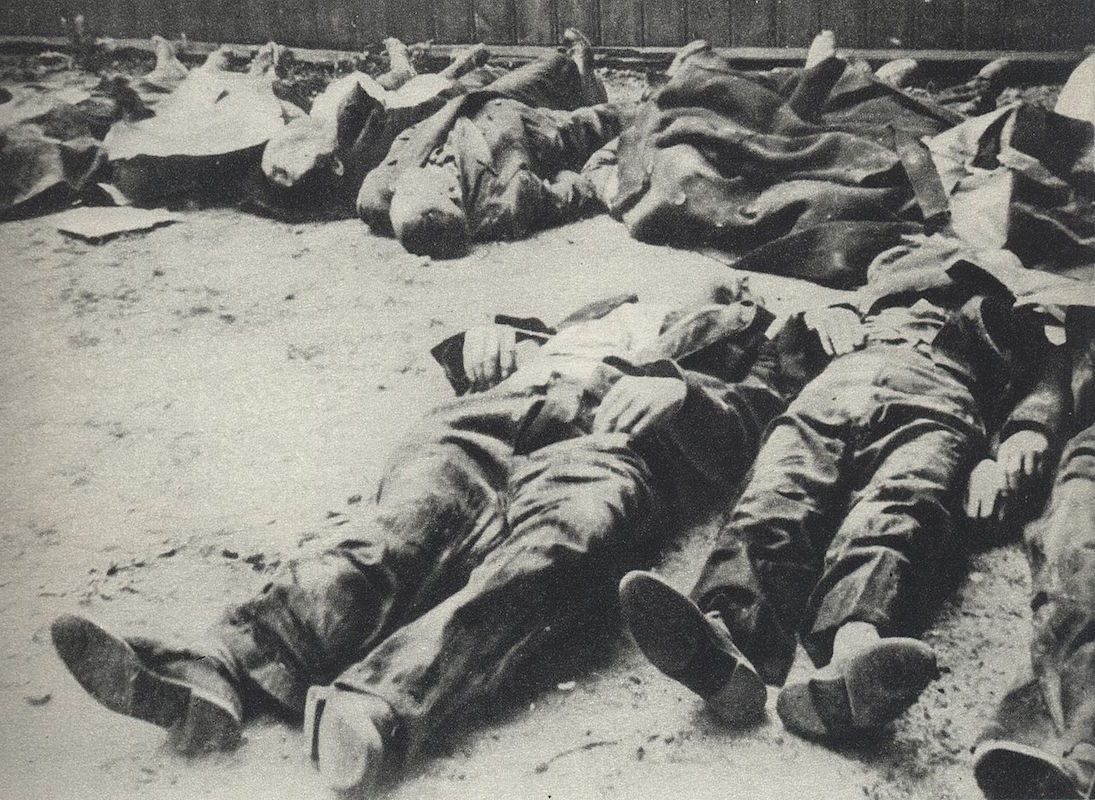
1944: The Wola Massacre begins, during the Warsaw Uprising

On this date in 1944, a weeklong German slaughter of Polish civilians and resistance fighters began in the Wola district of the capital city Warsaw.

The Wola Massacre marked the start of the Reich’s counterattack against the Warsaw Uprising, the heroic and suicidal rising mounted by the Polish Home Army as the Red Army’s summer offensive brought it to the banks of the Vistula.

Aiming to claim some foothold upon which to influence events in the soon-to-be Soviet-occupied Poland, the Home Army enjoyed initial success in the first days of August. But German reserves from the Replacement Army — the vehicle by which the Valkyrie plotters had attempted their coup against Hitler just days before, and now as a consequence answering directly to Heinrich Himmler — were quick to the scene and would turn back the rising in weeks of bloody urban warfare. Himmler’s authority in crushing the Warsaw Uprising would also allow him to give rein to his SS for a campaign of atrocities intended to cow the populace into speedy submission.

Himmler wasn’t a battlefield commander, of course. Chief on the scene would be Erich von dem Bach-Zelewski; for this purpose he would enlist some of the more notorious units on the eastern front, such as the lawless Sonderbataillon Dirlewanger and the “Russian National Liberation Army” of Bronislav Kaminski. They were just the types to implement Himmler’s brutal orders* for a city they were soon to lose anyway:

  1. Captured insurrectionists shall be killed whether or not they fight in accordance with the Hague Convention.
  2. The non-fighting part of the population, women, children, shall also be killed.
  3. The whole city shall be razed to the ground, i.e. its buildings, streets, facilities, and everything within its borders.

The outcome rates as perhaps the largest battlefield massacre of World War II.

On August 5, Bach-Zelewski’s forces began a coordinated push into the western suburb of Wola. Himmler’s orders were implemented immediately, as attested by numerous civilian witnesses and lucky survivors:

I lived in the Wola district at No. 8, Elekcyjna Street. At 10 a.m. on Aug. 5, 1944 a detachment of SS-men and Vlassov’s men entered. They drove us from the cellars and brought us near the Sowinski Park at Ulrychow. They shot at us when we passed. My wife was killed on the spot: our child was wounded and cried for his mother. Soon a Ukrainian approached and killed my two-year-old child like a dog; then he approached me together with some Germans and stood on my chest to see whether I was alive or not – I shammed dead, lest I should be killed too. One of the murderers took my watch; I heard him reloading his gun. I thought he would finish me off, but he went on further, thinking I was dead. I lay thus from 10 a.m. until 9 p.m. pretending to be dead, and witnessing further atrocities. During that time I saw further groups being driven out and shot near the place where I lay. The huge heap of corpses grew still bigger. Those who gave any sign of life were shot. I was buried under other corpses and nea rly suffocated. The executions lasted until 5 p.m. At 9 p.m. a group of Poles came to take the corpses away. I gave them a sign that I was alive. They helped me to get up and I regained sufficient strength to carry with them the body of my wife and child to the Sowinski Park, where they took all the dead. After this sad duty had been performed they took me to St. Laurence’s Church at Wola, where I remained till next day. I cannot state the exact number of the victims, but I estimate that those among whom I lay amounted to some 3,000 (three thousand). I met a friend in the church who had gone through the same experience as I, having lost a boy of 8, who had been wounded and died calling for his father. I am still in hospital and the image of death is constantly before my eyes.

And another:

On August 5, 1944, between 12 and 2 p.m., I saw from a window on the first floor of Wola Hospital Germans dragging women out of the cellars of No. 28, Plocka Street. They shot them in the courtyard with machine-guns. Almost at the same time, I saw in the courtyard of No. 30, Plocka Street the hands of more then 20 people raised and visible over the fence (the people themselves could not be seen). After a volley of shots these hands fell down: this was another of the executions in Wola.

And the agonizing testimony of Wanda Lurie:

I stayed in the cellar of No. 18 until August 5, when, between 11 and 12 noon, the Germans ordered all of us to get out, and marched us to Wolska Street. This march was carried out in dreadful haste and panic. My husband was absent, taking an active part in the Rising, and I was alone with my three children, aged 4, 6 and 12, and in the last month of pregnancy. I delayed my departure, hoping they would allow me to remain, and left the cellar at the very last moment. All the inhabitants of our house had already been escorted to the “Ursus” works in Wolska Street at the corner of Skierniewicka Street, and I too was ordered to go there. I went alone, accompanied only by my three children. It was difficult to pass, the road being full of wire, cable, remains of barricades, corpses, and rubble. Houses were burning on both sides of the street; I reached the “Ursus” work’s with great difficulty. Shots, cries, supplications and groans could be heard from the factory yard. We had no doubt that this was a place for mass executions.

The people who stood at the entrance were led, no, pushed in, not all at once but in groups of 20. A boy of twelve, seeing the bodies of his parents and of his little brother through the half-open entrance door, fell in a fit and began to shriek. The Germans and Vlassov‘s men beat him and pushed him back, while he was endeavouring to get inside. He called for his father and his mother. We all knew what awaited us here; there was no possibility of escape or of buying one’s life; there was a crowd of Germans, Ukrainians (Vlassov’s men), and cars. I came last and kept in the background, continuing to let the others pass, in the hope that they would not kill a pregnant woman, but I was driven in with the last lot. In the yard I saw heaps of corpses 3 feet high, in several places. The whole right and left side of the big yard (the first yard) was strewn with bodies. We were led through the second. There were about 20 people in our group, mostly children of 10 to 12. There were children without parents, and also a paralysed old woman whose son-in-law had been carrying her all the time on his back. At her side was her daughter with two children of 4 and 7. They were all killed. The old woman was literally killed on her son-in-law’s back, and he along with her. We were called out in groups of four and led to the end of the second yard to a pile of bodies. When the four reached this point, the Germans shot them through the backs of their heads with revolvers. The victims fell on the heap, and others came. Seeing what was to be their fate, some attempted to escape; they cried, begged, and prayed for mercy. I was in the last group of four. I begged the Vlassov’s men around me to save me and the children, and they asked if I had anything with which to buy my life. I had a large amount of gold with me and gave it them. They took it all and wanted to lead me away, but the German supervising the execution would not allow them to do so, and when I begged him to let me go he pushed me off, shouting “Quicker!” I fell when he pushed me. He also hit and pushed my elder boy, shouting “hurry up, you Polish bandit”. Thus I came to the place of execution, in the last group of four, with my three children. I held my two younger children by one hand, and my elder boy by the other. The children were crying and praying. The elder boy, seeing the mass of bodies, cried out: “they are going to kill us” and called for his father. The first shot hit him, the second me; the next two killed the two younger children. I fell on my right side. The shot was not fatal. The bullet penetrated the back of my head from the right side and went out through my cheek. I spat out several teeth; I felt the left side of my body growing numb, but I was still conscious and saw everything that was going on around me.

I witnessed other executions, lying there among the dead. More groups of men were led in. I heard cries, supplications, moaning, and shots. The bodies of these men fell on me. I was covered by four bodies. Then I again saw a group of women and children; thus it went on with group after group until late in the evening. It was already quite, quite dark when the executions stopped. In the intervals between the shootings the murderers walked on the corpses, kicked them, and turned them over, finishing off those who still gave any sign of life, and stealing valuables.

German soldiers too recorded wholesale executions in their diaries and correspondence; while the accounts above are all specifically attributable to the 5th of August, those that follow are undated snapshots of environment:

Policemen with rifles under their arms trudged along. All of the police from occupied Poland came together there to show off their bravery and also to enrich themselves on the side. I did not see this activity, but others did. They saw how these policemen executed those from the procession who could not keep up, those who were sick and lagging behind, and right in front of their compatriots. What was particularly troubling about this misery is that unlike in Russia what was occurring was not a matter of a completely poor, and in any event already moaning, mass of people; rather these were people of our own social class, women in fur coats, cute children who up until two days before had been fully cared for. This memory has always caused me anguish during my short stopovers in Warsaw: the look from so many hostile eyes, people of our culture, who knew exactly what I knew. For that reason I was always glad never to have been deployed in the West. And now I stood beside these people in bitter agony, and I was shocked.

Now we arrived at the command post of the SS-commander. There were two buses parked on the right side of the street. We reported to the SS-commander, a medium-built stringent man with a sharply chiseled face. With a cold glance at the procession of women and children that was passing no farther than 10 meters from us, he said, “You see, this is our biggest problem. These refugees! I don’t have enough ammunition to kill them all!” He said this quietly and with a remorseful shrug of the shoulders, this elegant officer with the Iron Cross and pleasant manners. Meanwhile tears fell down my cheeks. What kind of human being was he?

Hans Thieme

And another:

Before each daily operation I reported to the SS commander. During one visit I witnessed an event, which sickened me to my very core. The SS officer’s office was on the upper floor of a building and had a balcony that overlooked a large courtyard. The SS had lined up near a wall about 40 or so Polish men, women, and children of all ages. I distinctly recall a young woman holding hands with two small children. It was clear to me what was about to happen. I confronted the SS commander as to why these people were about to be shot. His reply was that they were being executed as a reprisal for the Germans that had been killed in the Uprising. He informed me that it was also none of my concern. Shortly, thereafter the hostages were shot before my eyes. I was disgusted by what I had witnessed and after 60 years later it still haunts me.

Eberhard Schmalz

And another:

I was setting explosives under big doors, somewhere in Old Town. From inside we heard Nicht schiessen! Nicht schiessen! (Don’t shoot! Don’t shoot!). The doors opened and a nurse appeared with a tiny white flag. We went inside with fixed bayonets. A huge hall with beds and mattresses on the floor. Wounded were everywhere. Besides Poles there were also wounded Germans. They begged the SS-men not to kill the Poles. A Polish officer, a doctor and 15 Polish Red Cross nurses surrendered the military hospital to us. The Dirlewangerers were following us. I hid one of the nurses behind the doors and managed to lock them. I heard after the war that she has survived. The SS-men killed all the wounded. They were breaking their heads with rifle butts. The wounded Germans were screaming and crying in despair. After that, the Dirlewangerers ran after the nurses; they were ripping clothes off them. We were driven out for guard duty. We heard women screaming. In the evening, on Adolph Hitler’s Square [now Pilsudzki Square] there was a roar as loud as during boxing fights. So I and my friend climbed the wall to see what was happening there. Soldiers of all units: Wehrmacht, SS, Kaminski’s Cossacks, boys from Hitlerjugend; whistles, exhortations. Dirlewanger stood with his men and laughed. The nurses from the hospital were rushed through the square, naked with hands on their heads. Blood ran down their legs. The doctor was dragged behind them with a noose on his neck. He wore a rag, red maybe from blood and a thorn crown on top of the head. All were lead to the gallows where a few bodies were hanging already. When they were hanging one of the nurses, Dirlewanger kicked the bricks she was standing on.

Mathias Schenk

A much larger catalogue of atrocity accounts awaits at warsawuprising.org.

The massacre at Wola would run on to about the 13th at which point Bach-Zelewski abated the civilian massacre order as counterproductive: too many soldier-hours needed for focused bloodbaths were being squandered orchestrating gratuitous ones. Nevertheless, weeks of hard urban warfare lay ahead, and policy continued to embrace the summary execution of captured fighters and of all fighting-age men, resistance or no. Some 200,000 civilians are thought to have died during the Warsaw Uprising.

One legacy was eerily and unknowingly captured by a LIFE magazine photographer in 1948, of a young girl in a school for disturbed children in Poland. Her face a scramble of innocence and madness as it peers into the lens, she illustrates her “home” as an incoherent chalk vortex. It wasn’t known until many years after this photo became emblematic of a generation wracked by horror, but “Tereska” — Teresa Adwentowska — was an orphaned survivor of Wola.

* Per Bach-Zelewski’s evidence to the Nuremberg tribunal. By dint of cooperation, he saved his own life from the Nuremberg gallows.

On this day..