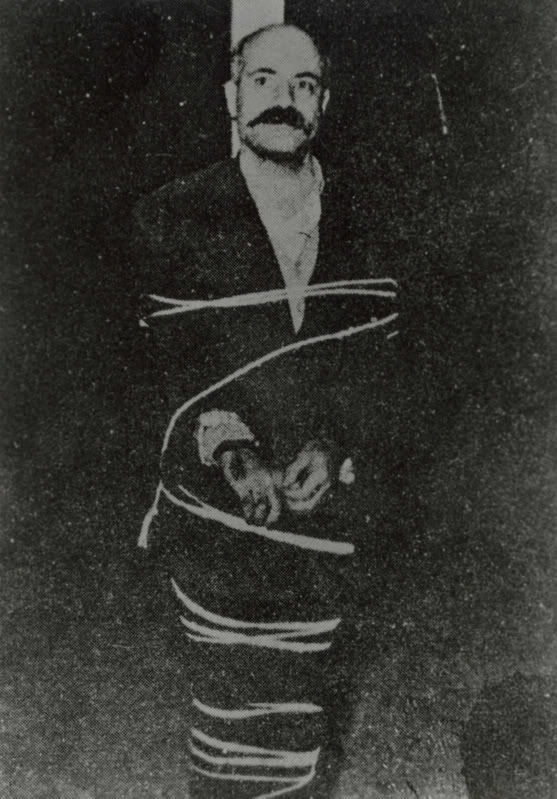
1950: Eugene LaMoore, the last hanged in Alaska

Thanks to Melissa S. Green for giving Executed Today permission to reprint this summary of Alaska’s last execution. It appeared as a section of Green’s longer history of the death penalty in the state, first published here.

For the first (proper, juridical) execution in Alaska, see here. -ed.


Austin Nelson and Eugene LaMoore, both black, were separately convicted and executed for the same crime, the December 1946 murder of a 52-year-old (white) Juneau storekeeper named Jim Ellen. Ellen’s store had also been robbed. Ellen had immigrated to the U.S. from Greece as a boy in 1909. He was a World War I veteran who held memberships in the American Legion and the Juneau Elks Lodge.

Austin Nelson, a 24-year-old who did odd jobs around Juneau, was arrested for the murder after a check written by him to Jim Ellen was found on the store counter following the robbery/murder. He was represented at trial by Henry Roden and Joseph A. McLean. Nelson was convicted on circumstantial evidence, including that of a witness who reported seeing him in the victim’s store on the night of the murder. No one witnessed the actual murder, nor was a murder weapon found, not even the straight-edged razor witnesses testified that Nelson had once owned. Nelson lacked money to pay for an appeal and there was no provision for a public attorney in post-conviction proceedings, His execution was set for July 1, 1947.

Eugene LaMoore, a 42-year-old fisherman with a Tlingit wife and two children, was originally an alibi witness at Nelson’s trial. He testified that he had spent much of the evening with Nelson on the night of the murder, including along the avenue where the victim’s store was located. LaMoore’s credibility with the jury was apparently eroded when he initially denied a felony robbery conviction of twenty years before. Although LaMoore returned to the stand the following day to correct his testimony, he was arrested by U.S. Marshal William Mahoney on a charge of perjury and held on a bond of $10,000 — a high bond in 1947 — which LaMoore could not pay. He was held in a cell in the federal jail, shackled in leg irons and, later, in a ball and chain. He was repeatedly questioned by the local FBI agent and other local law enforcement authorities about the murder of Jim Ellen. Shortly before Nelson’s scheduled execution, Nelson was brought to visit LaMoore in his cell. According to later testimony by LaMoore, Nelson pled with LaMoore to help save his life.

On July 1, 1947, the date of Nelson’s scheduled execution, LaMoore signed a typed confession stating that he had participated in a robbery of Jim Ellen’s store with Austin Nelson and that Nelson had killed Ellen during the robbery.

LaMoore was charged with first degree murder. Nelson’s execution was delayed because he was now considered a material witness against LaMoore.

LaMoore was represented at trial by Henry Roden and Joseph A. McLean, the same court-appointed attorneys who had represented Nelson. The only significant evidence offered at trial to suggest LaMoore’s involvement in the murder was the typed confession he had signed while in jail. At trial, LaMoore retracted the confession, stating it had been made on the advice of a prominent Juneau attorney, Herbert W. Faulkner, who had been persuaded by Deputy Marshal Walter Hellan to come and talk with him (LaMoore had had no lawyer at the time).

LaMoore testified that Faulkner agreed to advise him, though Faulkner denied having done anything except typing up what LaMoore wanted to say in the confession. LaMoore also stated that the confession had been prompted by a desire — especially after Nelson’s visit to his cell — to delay Nelson’s execution. Despite his retraction and the lack of other significant evidence, LaMoore was convicted by the jury and sentenced to death.

Nelson, who had been kept alive during LaMoore’s trial but was never called to testify, was executed on March 1, 1948, a month after LaMoore’s trial ended. LaMoore was executed on April 14, 1950 after an unsuccessful appeal. He reportedly took 13 minutes to die.

His was the last execution to be held in Alaska.

Sources:

Lerman, Averil. (1994). “Death’s double standard: Territorial Alaska’s experience with capital punishment showed race and money mattered.” We Alaskans [Sunday magazine of the Anchorage Daily News], May 1, 1994.

Lerman, Averill. (1998). “Capital Punishment in Territorial Alaska: The Last Three Executions.” Frame of Reference [Alaska Humanities Forum] 9(1): 6-9, 16-19, April 1998.

On this day..

1951: Harley LaMarr, dutiful son

On February 12, 1950, Buffalo socialite Marion Little Frisbee* was discovered in a frozen ditch in a suburb 12 miles outside the city, a .32-20 rifle bullet through her left temple.

Within 24 hours, a 19-year-old Native American** youth named Harley LaMarr had been caught at a boarding-house and copped to the crime.

While the coroner did report an “attempt at criminal assault,” the motive for Frisbee’s abduction/murder had been robbery. Harley LaMarr needed money because his mother, Amelia Palwodzinski, had had a fight with her second husband the month before. In the course of that fight, she planted a butcher’s knife in the man’s chest.

As Amelia went off to serve a 30-year stretch for manslaughter, she made her boy Harley promise to give the victim a decent burial. Harley had no money: he did have a .32-20. He took it to a tony part of town and waited for an opportunity.

Marion Frisbee’s purse netted him about $6. He didn’t bother taking her diamond ring because, he said, he just wanted cash for the funeral. Harley insisted the gun went off by accident: the jury in a four-day trial that April didn’t buy it.

The day before Harley LaMarr’s electrocution at Sing Sing on January 11, 1951, the Empire State’s prison officers brought his mother from Bedford Hills a few miles down the road to death row for one last goodbye with her tragically dutiful son.

The youth met with his mother for 20 minutes after authorities brought her from Bedford Hills.

They spoke together in low tones. The woman took a long last look at her son and walked away from the visiting cage dry-eyed.

“Thank you for coming, ma,” the youth called after her. (Source (pdf))

* No relation to the flying-disc fortune; that “Frisbee” was only trademarked in 1958. Marion Frisbee was just the wife of a local salesman with the Queen City Pure Water Company.

** Amelia was white; Harley’s father was Native American.

On this day..

1955: Six Beria men

On this date in 1955, eight former officials of the Georgia — the country Georgia — secret police were tried publicly in Tbilisi, and six* of them convicted and promptly shot.

Officially, they were in the dock post-Stalin for their various depredations during the late ascendancy of the notorious Lavrentiy Beria. (Both Beria and Stalin himself were native Georgians.)

All their frightening offices for the NKVD had been re-branded, post-Stalin, as counterrevolutionary and terroristic, the same sort of chilling police-state lingo they used to turn against enemies back in their day.

A.N. Rapava, for instance

… was Deputy Head of the NKVD in Georgia. In July 1945, he received the rank of Lt. General. From late 1938 until 1948, he was the Head of NKVD/NKGB/MGB** in Georgia when he was removed under a cloud. (Source)

Georgia’s Stalin-era apparatchiks had vicious infighting, aggravated by a growing rift between Stalin and Beria late in Stalin’s life. (Indeed, if you like some hypotheses, this was why it was late in Stalin’s life: Beria might have poisoned off Uncle Joe to protect himself from purging.)

Rapava was a Beria man, but when Stalin swept his own people into place† in the late 1940s to early 1950s, a Stalin guy named N.M. Rukhadze arrested and replaced Rapava.

A few weeks before Stalin died, when the biography of Beria is thick with curious maneuverings, Beria got Rukhadze replaced; once Stalin kicked off, Beria was free to flat-out arrest Rukhadze.

It was a bit of an irony that when the post-Stalin Bolsheviks came round to mop up in Georgia, the rivals Rapava and Rukhadze had to stand in the dock together, both allegedly part of Beria’s organization. It would have been a bit inconvenient to detail how it was Beria himself who ordered Rukhadze’s arrest.

The others who shared their fate:

  • A.S. Khazani, NKVD political department officer who wrote a book with the title The Moral Outlook of a Soviet Man
  • N.A. Krimian, who served in the NKVD in Georgia and later in Ukraine, where he orchestrated the execution of political prisoners ahead of the invading Germans in World War II
  • K.S. Savitsky, NKVD Georgia official
  • Sh.O. Tsereteli, a tsarist officer turned Bolshevik and a Beria ally dating back to the early 1920s

All were shot for the victims of the Georgian purges they had conducted. A translator and a bodyguard were also convicted at the same trial, drawing prison sentences.

* Evidently, the official press initially reported only five executions.

** NKVD, NKGB and MGB is for our thumbnail essentially the same state security entity under various names and reorganizations from the 1930s to the 1950s. It became in the last analysis the KGB.

† See, for example, the Mingrelian Affair.

On this day..

1959: Harvey Glatman, signature killer

On this date in 1959, serial sex killer Harvey Glatman was gassed in San Quentin.

The dweeby, jug-eared TV repairman manifested an early kinky streak when his parents discovered the rope burns he’d given himself practicing autoerotic asphyxiation.

In time, he would do it without that important prefix.

Paroled from Sing Sing for teenage molestation convictions, Glatman moved west — to Denver, and then to Los Angeles, spending several years in monklike isolation from the opposite sex.

“Then,” writes Carlton Smith in a book about the BTK killer, “one sweltering afternoon in July 1957, the dam broke.”*

Glatman began trolling the City of Angels’ famous seedy underbelly for young women to model for “detective magazines” shoots — an understood euphemism for snapping illicit bondage pics. This excellent cover not only enabled him to have his victims willingly put themselves at his mercy in private, it enabled him to take their pictures as trophies.

They were images of Glatman’s detailed methodology of murder, which showed a sequence of terror by re-creating the entire psychological arc of the crime. He first photographed each victim with a look of innocence on her face as if she were truly enjoying a modeling session. The next series represented a sadist’s view of a sexually terrorized victim with the impending horror of a slow and painful death etched across her face. The final frame depicted the victim’s position that Glatman himself had arranged after he strangled her.

-Robert Keppel, Signature Killers


Photos Glatman took of two of his victims, models Judy Ann Dull (top) and Ruth Mercado (bottom). Images via Murderpedia’s collection, at least one of which is very distinctly NSFW. Murderpedia also has, as per usual, a detailed writeup of the Glatman case.

Glatman killed two women this way and a third via a lonely-hearts club meeting,** while losing a few targets along the way who were put off by his aspect or wily enough to demand a male escort for the photography sessions.

He was only stopped in 1958 when a police officer chanced to encounter him while attempting the more daring enterprise of roadside kidnapping. The perp was only 30 years old at the time, a frightening mixture of predatory calculation and homicidal lust: if not for this fortuitous early detection, it’s not too hard to imagine 1957-58 Glatman standing at the outset of a serial rape-murder spree of Bundyesque dimensions.

Unlike that later conniving, spotlight-hogging monster, Glatman post-arrest retreated quickly back to reclusion. He made only a token effort to deny his crimes; as soon as detectives tricked him (by pretending they had it already) into coming clean about a hidden toolbox full of incriminating evidence, the confessions started gushing out of him — another dam burst. He was begging detectives for death well before trial and willingly pled guilty to speed his own steps to San Quentin’s gas chamber. It took less than a year, time Glatman mostly spent in self-imposed isolation from the society of the inmates and guards around him in prison.

“It’s better this way,” he once said near the end, of his imminent date with those noxious fumes. “I knew this is the way it would be.”

Glatman’s LAPD interrogator, legendary detective Pierce Brooks, would later serve as a consultant for the made-for-TV Dragnet 1966 movie. In that film, the serial kidnapper, bondage-photographer, and murderer of young models, “Don Negler”, is conned by police into revealing the location of his incriminating toolbox — just like Glatman was.

The full film is available on YouTube; the interrogation sequence begins about 1:23:56. It clinches with the nebbishy “Negler’s” pathetic self-explanation.

Negler: The reason I killed those girls is they asked me to. (pause) They did; all of ’em.

Joe Friday: They asked you to.

Negler: Sure. They said they’d rather be dead than be with me.

* Glatman is also a suspect in a never-solved Colorado murder from 1954. So maybe that dam had a few leaks.

** The personal-ad gambit led the press to start nicknaming Glatman the “Lonely-Hearts Killer,” which appellation was of course already spoken for.

On this day..

1952: Chester Gregg

On this date in 1952, 58-year-old Chester Gregg nonchalantly died in Ohio’s electric chair for killing his wife the previous year.

Gregg shotgunned Alma Colliday Gregg, his estranged spouse and the head of the “lonely hearts” club through which the pair oiginally met, in her Kenton apartment after she filed for divorce.

As that killing made him a two-timer — he’d been paroled from a 1927 murder rap in Kentucky; the daughter of that victim petitioned unsuccessfully to attend Gregg’s execution — his clemency prospects were remote.

Although he’s of no known relationship to the namesake of the landmark Gregg decision returning death penalty to the U.S. in 1976, Chester has managed to find his way into the news of late.

Apparently, he was acquainted with an Ohio child named Jay Chapman (newspaper reports have termed Gregg Chapman’s “childhood friend”, but Chapman would only have been about 13 at this time: we intend no derogation to intergenerational friendship in saying that this is not the connotation of “childhood friend”). And Chapman would go on, as Oklahoma’s medical examiner in the 1970s, to play a subtle but important role in the modern death penalty: he invented the “traditional” lethal injection three-drug cocktail.

Dr. Chapman, who at least has the comfort of not having the lethal needle named after him a la Joseph Guillotin, knocked out the standard sodium thiopental-pancuronium bromide-potassium chloride sequence at the request of legislators looking for a less unpleasant alternative to that ubiquitous 20th century contraption, the electric chair. (That’s also how Gregg was put to death.)

But apparently, Chapman assumed that trained medical personnel who knew how to administer IVs and measure drugs would be conducting the procedure.

In fact, as executions “medicalized”, professional medical associations like the AMA barred members from participating as a breach of professional ethics. More recently, supply interruptions for lethal drugs have made a mess of the entire process. The upshot has been some high-profile botches — including Ohio itself outright failing in a recent lethal injection attempt — necessitating a 20072008 U.S. execution moratorium to sort out legal challenges to the needle.

It’s a far cry from Chapman’s vision of a litigation-proof method: “We felt that by going with this type of regimen, no one could suggest that it was cruel and unusual because people undergo this very protocol every day for anesthetic for surgery world-round,” he said in 2009.

The doctor’s own interest in the subject was merely instrumental: fewer appeals avenues mean more executions. “I’m an eye for an eye person,” Chapman told the London Guardian.* “The lethal injection is too easy for some of them.”

For that reason, Chapman is quite alright with the switch his home state an others have recently made to conducting lethal injections with only a single massive overdose of a single drug, either sodium thiopental or pentobarbital. Whatever gets the case out of courts, and onto the gurney.

As for the ghost of Chester Gregg, he really doesn’t enter the picture either way.

“It’s a totally separate thing,” Chapman said of his executed former neighbor. “It’s just an experience I had along the way.”

* There are some May 2010 photos of Chapman in the Guardian magazine archive.

On this day..

1954: George Robertson, the last hanged in Edinburgh

This date in 1954 marked the last execution in the city of Edinburgh.

By the jaw-droppingly horrific murder he committed, George Robertson certainly earned the distinction.

Not actually topical save to George Robertson’s milestone as Edinburgh’s literal last drop; this Last Drop Pub is at the city’s Grassmarket where historic public hangings (long gone by Robertson’s day) were conducted. Image (c) Sh0rty and used with permission.

His ex-wife, Elizabeth McGarry, had recently kicked him out of the house after an attempted reunion led right back to the prolific domestic abuse that had ended their marriage in the first place. She was an unwed, unemployed mother of two teenage children, but anything beats being tied up and threatened with a hatchet.

Mother and children — 18-year-old son George Jr., and 16-year-old daughter Jean — lived in waking terror of the vengeful ex-patriarch; in the days before restraining orders, they kept doors constantly bolted and jammed with chairs under the doorknobs, and a poker within reach whenever possible.

According to this retrospective — and read the whole thing for a slasher film in prose — the estranged George managed to get into the house on the night of February 28, 1954, while everyone was asleep.

He summoned his former spouse to the kitchen and knifed her to death, then attacked young George Jr. when he arrived, too. Then he mounted the stairs — where Jean was desperately trying to escape out a window — carrying

the blood-drenched body of his ex-wife, a gaping hole in her stomach and a white handkerchief stuffed in her mouth, hands bound together.

George Alexander Robertson was just in the midst of trussing up Jean and stabbing her to death when the mangled George Jr. distracted the killer by reviving well enough to burst out onto the balcony and into the public quadrangle below. There, he

threw himself through a neighbour’s kitchen window, where he begged for help.

Following him, just yards behind, enraged and still clutching his knife, came his father.

The Hay family, whose quiet home was now about to become a murder scene, cowered in terror as blow after blow rained down on the terrified teen as he screamed for help.

Defenceless against his father’s brutality, young George finally slumped to the floor, dying.

Job done, his father threw his body over his shoulder and strolled home leaving a bloody trail across Tron Square.


View Larger Map

The savage “brainstorm” to which he would later attribute this wild spree must have been abating. As he returned to his former domicile, he didn’t bother finishing off Jean, but stuck his head in the kitchen gas oven, where responding police found him.

The obviously unbalanced paterfamilias attempted to plead guilty to avoid the spectacle of the trial (no dice: two days of horror from the witness box riveted the city) and did not attempt to fight the inevitable sentence once imposed. He was dead within 15 weeks of the bloodbath, at the skillful hands of Albert Pierrepoint.

Only three other Scottish executions anywhere — two in Glasgow, and one final hanging in Aberdeen — followed it before death penalty abolition.

On this day..

1953: 32 merciful Soviet soldiers

(Thanks to Meaghan Good of the Charley Project for the guest post. -ed.)

In June 1953, some discontented young citizens of Magdeburg, East Germany revolted and began demonstrating against the repressive Communist regime. On June 17, in the spirit of totalitarian governments everywhere, the authorities ordered a platoon of soldiers to open fire on a crowd of protesters.

Incredibly, the soldiers refused.

Every one of them vanished shortly thereafter, never to be seen again.

It was long assumed that the entire platoon had been executed for insubordination. This wasn’t confirmed until 1998, however. Four years previously, Magdeburg construction workers digging the foundation for a new building accidentally unearthed a mass grave containing 32 bullet-riddled skeletons. From the condition of the remains, authorities determined the victims — all of them young men — had died sometime between 1945 and 1960.

They could have been the missing Soviet platoon, but they could also have been prisoners executed by the Gestapo mopping up in May 1945, just before the Germans fled the city in advance of the Red Army.

As Jessica Snyder Sachs noted in her 2001 book Corpse: Nature, Forensics, and the Struggle to Pinpoint Time of Death, the victims all had extensive tooth decay and no sign of dental work, which was consistent with Russia but not central Europe. This was hardly conclusive, however.

To solve the mystery, investigators turned to Reinhard Szibor, a biologist at the nearby Otto von Guericke University.

Szibor had helped in criminal cases before and was famous for using pollen to link suspects to crime scenes. Pollen clings to people’s hair, skin and clothes and is, of course, also inhaled. The stuff is nearly indestructible and will remain long after human remains have disintegrated. Authorities hoped Szibor could use pollen samples from the mass grave to determine what time of year the victims died.

Discover Magazine explains how he did it: Szibor rinsed out the skulls’ nasal cavities, had a look, and found pollen from lime trees, plantains and rye, all of which release their pollen during June and July. In other words, the Magdeburg victims had died during the summer months, the time when the Soviet platoon was reportedly executed, and not in the springtime when the Nazis retreated from the city.

Though we still don’t know the precise date of their deaths, and likely never will, the soldiers who paid for their humanity with their lives had finally been identified.

Die Lösung (The Solution)

After the uprising of the 17th of June
The Secretary of the Writers’ Union
Had leaflets distributed in the Stalinallee
Stating that the people
Had forfeited the confidence of the government
And could win it back only
By redoubled efforts. Would it not be easier
In that case for the government
To dissolve the people
And elect another?

-Bertold Brecht

On this day..

1958: Khosrow Roozbeh

On this date in 1958, Iranian communist Khosro(w) Roozbeh was shot in Qezel Qal’eh prison.

“A popular teacher at the Military Academy, Rouzbeh was the author of a number of pamphlets on chess, artillery warfare, and, together with Ovanessian, the country’s first political lexicon,” blurbs Tortured Confessions: Prisons and Public Recantations in Modern Iran.

He was also not only a communist, but a radical within the context of Iran’s communist Tudeh Party.

After the 1953 CIA-backed coup restored the Shah of Iran, his government persecuted Tudeh activists as a fifth column.

Thousands were arrested, and brutally tortured into betraying their comrades. While most weren’t put to death, Roozbeh was both a true militant — he opposed moderates’ attempt to make common cause with the liberal Mossadegh government that the Shah had deposed — and the organizer of a network of military infiltrators. The British embassy called him the “Red Pimpernel” for his uncanny talent for slipping traps and getting about in disguise. But that act never has a long shelf-life.

Roozbeh was finally winged in a 1957 shootout and taken into custody, where he was tortured into his own confessions (e.g., that he had assassinated Tudeh members who were too willing about their police collaboration). After spending his last night on this planet putting NaNoWriMo to shame by cranking out a 70-page political manifesto, he’s supposed to have met his executioners defiant to the last, refusing a blindfold and crying “Long Live the Tudeh Party of Iran! Long Live Communism! Fire!”

But the volley that silenced Roozbeh’s cry can be seen in retrospect to mark the definitive elimination of communism from Iran’s political stage, the piece de resistance for SAVAK’s campaign of suppression.

After Roozbeh, Tudeh slipped into irrelevancy (Spanish link) … leaving little but the outsized myth of its most renowned martyr.

On this day..

1956: Andreas Dimitriou and Michalis Karaolis, the first EOKA men hanged

On this date in 1956, the British hanged two members of Cyprus’s nationalist resistance underground, the EOKA


Andreas Dimitriou (left) and Michalis Karaolis.

Michalis Karaolis murdered a local constable; Andreas Dimitriou (or Demetriou) hadn’t managed to kill his target, and only injured the British intelligence agent he shot. This, however, occurred two days after the enactment of draconian emergency regulations to counteract EOKA terrorism, under which merely possessing a firearm could be a hanging offense, never mind discharging it into someone.

The two of them weren’t connected to one another save in their common support for expelling the British from the Mediterranean island and reuniting it to the Greek mainland. It was a longtime, long-frustrated Hellenic dream.

Great Britain, even while the death penalty was eroding domestically, spurned international appeals for clemency — the Greek government made history by filing the first state-vs.-state petition to the European Commission of Human Rights a few days before the execution — reckoning that its credibility as a hard line against terrorism was at stake.

In Nicosia, where the hangings took place, schools were shuttered, armed paratroopers patrolled streets barred to traffic, and newspapers operated under a censor’s requirement not to inflame the populace.

In Athens, beyond the reach of the crown, the soundness of this policy was unpleasantly confirmed. Seven deaths and hundreds of injuries resulted from the ensuing brickbats with police. (The mayor of Athens personally smashed up a tributary plaque to Queen Elizabeth II.) And in retaliation, the EOKA subsequently executed two British soldiers it had captured, Gordon Hill and Ronnie Shilton … although British skepticism over this claim required an additional statement clarifying the matter.

On this day..

1954: Michael Manning, the last hanged in Ireland

On this date in 1954, Michael Manning was hanged for the drunken rape-murder of an elderly nurse. It was the last execution in the Republic of Ireland.

Less than 40 years before the modern Irish state had been born in a bloody civil war, notorious for its many executions.

But once Ireland had the stability to draw a line under political executions in the early 1920s, it proved to have scant appetite for capital punishment. Indeed, a provision abolishing it altogether had even been considered for Ireland’s 1922 constitution.

Although Mountjoy Prison had murder hangings in the mid-1920s, which was the style at the time, even by the 1930s actual executions had receded into oddity status: only four men and one woman were hanged in that entire decade. They even had to keep importing British hangman Tom Pierrepoint, and later his famous nephew Albert Pierrepoint, to carry them out. That can’t have helped the popularity of the enterprise.

There was a brief death penalty recrudescence during the war years, and that was pretty much it. Michael Manning’s milestone execution (also in Mountjoy Prison, also conducted by Albert Pierrepoint) was the first one since 1948 … and the last one ever since.

Ireland repealed the death penalty for ordinary crimes in 1964, and has since abolished it for everything else. That constitutional prohibition on the death penalty that Ireland didn’t enact in 1922 was in 2001 adopted after all in what is now a very staunchly abolitionist Ireland.

On this day..