1962: The only hangings in independent Cyprus

Three Men Hanged in Cyprus
From the London Times, June 14, 1962

NICOSIA, June 13

Three Greek Cypriots found Guilty of murder were hanged before dawn at Nicosia Central Prison today, the first capital sentences to be carried out in Cyprus since independence in August, 1960. Their fate had been in the balance until 11 o’clock last night, when Mr. Glafcos Clerides, the acting President, announced that after considering all the circumstances, he had decided not to grant a suspension of the executions.

The three men were Hambis Zacharia, Michael Hiletikos, and Lazaris Demetriou. Zacharia was convicted of killing a man with an axe in a Limassol vineyard in September, 1958. The other two were jointly convicted of the murder of a man outside a Limassol cabaret last year.

Last night Mr. Rauf Denktash [the future president of Northern Cyprus -ed.], the Turkish advocate who appeared for Zacharia, had filed a petition in the High Court seeking a declaration that the execution warrant issued by the acting President was illegal and ultra vires, and a declaration that the superintendent of prisons was not legally appointed and could not carry out the executions. The petition was heard in the chamber of Mr. Justice Vassiliades and adjourned for a full court hearing, but this morning was withdrawn.

The English-language Cyprus Mail this morning commends the courage of the acting President and points out that the House of Representatives has power to amend the law if it wishes to abolish capital punishment. It adds that such action is unlikely to be publicly welcomed in view of the number of murders in the republic in recent months.

Despite the correspondent’s confidence in the endurance of the gallows, these first executions for independent Cyprus were also its last executions: no further hangings occurred before Cyprus abolished the death penalty for ordinary crimes in 1983, and for all crimes in 2002.

On this day..

1962: Kelly Moss, restless of spirit

On this date in 1962, J. Kelly Moss went to the Kentucky electric chair in Kentucky for murder.

A lifelong criminal whose offenses ran more to the impulsive than the diabolical, Moss was arrested 10 or more times from 1950 to 1953, according to an Evansville (Ind.) Courier and Press profile. “Kelly Moss, when he was sober, was a real gentle person,” the former police chief of Henderson, Ky. told reporters decades later. “My recollection is that he was a real good man. But when he got drunk, he was a holy terror. When (Moss) was coming at you, he looked like a raging bull. When you got a call to Kelly’s house, you sent every car you had.”

His stepfather Charles Abbitt unfortunately didn’t have all those cars.

When Moss, fresh out of his latest prison stint on a robbery charge, showed up at Abbitt’s Henderson home blind drunk and in need of fare for the cab that had just delivered him. The cab driver gave up and left while Moss wailed on the door; what happened in the next 90 minutes or so must be guessed at, but Moss’s mother returned from church to find her husband’s mangled remains. “His face was pulverized by blows, and many of his ribs had been broken,” according to the Henderson Gleaner.

Moss apparently hadn’t realized just how much damage he’d done in his raging-bull mode; when arrested later, he was shocked to discover himself a murderer. “We had a little fight but I certainly didn’t intend to kill him. This is the worst thing I have ever had happen to me. This means a long term for me.”

Actually, the term was not so long — although Moss did his level best to extend it.

Leveling himself up into a skilled jailhouse lawyer, he papered Kentucky courts with relentless self-prepared writs that protracted the short lease on life his murder conviction offered. (He helped other prisoners file their appeals, too.) Outliving his victim by four-plus years was making good time by his era’s standards.

“The restless spirit of Kelly Moss was stilled just after midnight this morning,” the Gleaner reported on March 2, 1962. He wasn’t reconciled to the electric chair, and the device almost choked on him: Moss was the last person executed in Kentucky prior to the death penalty’s long 1960s-1970s lull in America. Kentucky’s next, and last, electrocution would not take place until 1997.

On this day..

1968: Two Jordanians, a sergeant and a civilian

Soldier and Civilian Hanged By Jordan as Spies for Israel

AMMAN, Jordan, Feb. 29 — Two Jordanians, an army sergeant and a civilian, were publicly hanged at dawn today after having been convicted by a military tribunal on charges of spying for Israel.

The authorities said they had been caught in April, 1966, when the civilian, Mahmoud el-Haihi, 30 years old, was crossing into Jordan from Israel near his home in Tulkarm. He was said to have been carrying a message and money from Israeli military intelligence officer to Sgt. Fawzi Abdullah, 32, also from the Tulkarm area.

The death sentence was pronounced in January, 1967, and approved last month by King Hussein.

-New York Times, March 1, 1968

On this day..

1965: Kenneth Roraback and Rocky Versace, Vietnam War POWs

According to a UPI wire story from Saigon which ran in American newspapers beginning Monday, September 27,

The Viet Cong said they executed two American prisoners Sunday … Although the broadcast did not say so, the executions apparently were in retaliation for the deaths Thursday of three anti-American demonstrators. The demonstrators were convicted by a military tribunal of engaging in terrorist activities and put before a firing squad in a soccer stadium at Da Nang.

An earlier execution of a Viet Cong terrorist by the government June 24 brought an announcement from the Communists that they had executed Sgt. Harold G. Bennet[t], a captive from Arkansas.

The two men shot on September 26 — whose names are garbled in the initial news report, since “the names were received phonetically” — were Sgt. Kenneth Mills Roraback and Capt. Humbert Roque “Rocky” Versace.

In 2002, Versace would be posthumously awarded the Congressional Medal of Honor — the first Vietnam War soldier so decorated on grounds of unwavering defiance as a POW.

On this day..

1963: Jorge del Carmen Valenzuela Torres, Chacal de Nahueltoro

On this date in 1963, Jorge del Carmen Valenzuela Torres — better known as Chacal de Nahueltoro — was shot at Chillan for murder.

Perhaps Chile’s most recognizable mass-murderer (in the nonpolitical category) the drink-addled young peasant one summer’s afternoon in 1960 took a scythe to his 38-year-old inamorata — and slaughtered all of her five children besides. (None of the children were Valenzuela’s own.)

The horrifying crime became grist for an acclaimed movie, but “the Jackal” was also noted for his dramatic personal turnaround during the two-plus years he spent awaiting his firing squad. In one of those paradoxes of the poor, Valenzuela was a man whose world cared for him only once he was condemned to death: he learned to read and write in prison and embraced spiritual counseling that made the fellow in front of the guns an altogether different creature from the homicidal brute.

While this rebirth made the execution itself controversial, it has also amazingly helped to elevate Valenzuela into the ranks of Latin America’s criminal folk saints. His tomb in San Carlos is crowded with votive offerings in thanksgiving for his intercessions.

(The actor who played Valenzuela in that film later collaborated on a 2005 documentary Bajo el Sur: Tras la Huella de un Asesino Milagroso — exploring the popular devotions that have arisen around his character’s real-life inspiration.)

For murderabilia that pairs with a juicy cut of meat, don’t miss out on Botalcura Winery’s blood-red Chacal de Nahueltoro merlot.

On this day..

1969: Alexandre Banza, Central African Republic politician

On this date in 1969, the Central African Republic’s dictator Jean-Bedel Bokassa had his number two condemned for plotting against him, and summarily shot.

Back on New Year’s Eve of 1965, Alexandre Banza had been on the same team as Bokassa in the conspiring business — achieving a rapid promotion from Captain when he leveraged his command of the Camp Kassai military base in support of Bokassa’s successful coup against his (Bokassa’s) cousin, David Dacko.

This was a great career move for Captain Banza, who speedily became Colonel Banza and the Minister of State and Minister of Finance to boot. But it wasn’t long before this made man looked to Bokassa like his main threat.

Notorious for his vanity — a few years after the events of this post, Bokassa, an unabashed admirer of Napoleon, would proclaim himself Emperor of the “Central African Empire” — the chief looked askance at his finance minister’s willingness to challenge Bokassa’s profligacy. Over the year or two prior to Banza’s execution, Bokassa maneuvered to push him away from power … and Banza maneuvered to create a power base for himself from which to launch his own putsch.

In the end it was Camp Kassai that played the decisive role once again. The guy with Banza’s old job as camp commandant, one Lt. Jean-Claude Mandaba, was supposed to be in on the plan, but on the eve of the intended April 9, 1969 coup, he tipped off Bokassa.

“The following afternoon Banza arrived at Camp Kassai with plans for the coup in his pocket,” writes Brian Titley in his Dark Age: The Political Odyssey of Emperor Bokassa:

As he stepped from his car, Mandaba and a couple of soldiers grabbed him. So fiercely did he struggle to escape that the soldiers had to break one of his arms before overpowering him. The ambushers then tied him up, stuffed him the trunk of a Mercedes, and took him to meet the man he had sought to depose. … [Bokassa] was jubilant at the sight of his former companion-in-arms being brought to him in chains. Banza was in poor shape after the journey to Berengo, but his torments were only beginning. Bokassa launched the interrogation by beating the prisoner almost senseless with his ever-present walking stick.

Bokassa was only narrowly dissuaded from thrashing this turncoat to death on the spot, and instead consented to a pro forma military tribunal — although rumors of the pre-death punishment visited on Banza once he was captured have muddied the waters quite a bit. Banza was reportedly hailed before the Cabinet and personally brutalized by Bokassa; Le Monde even reported that he’d been outright killed in this meeting and dragged through the streets by soldiers.

Bokassa was deposed by the French in 1979,* and condemned to death in absentia the following year. The former strongman voluntarily returned from exile in 1986 to face trial for a variety of abuses during his reign; his treatment of Alexandre Banza — and that of Banza’s family, a number of whom were arrested and some “disappeared” — formed part of the very extensive charge sheet. Though sentenced to death himself in that trial, Bokassa’s sentence was eventually commuted. The ex-emperor lived out his last years in a private home of his former capital.

* France’s “last colonial expedition,” in the words of one of her diplomats.

On this day..

1960: Anthony Miller, the last hanged at Barlinnie

On this date in 1960, 19-year-old Anthony Miller became the 10th and last person executed at Scotland’s Barlinnie Prison.*

Miller worked in a team with a 16-year-old accomplice in a “queer-rolling” racket: the younger James Denovan would lure a mark with the promise of an assignation, then Miller would jump him and turn a 2-against-1 robbery. Artless, but effective.

With such a crude m.o., it’s no wonder Miller and Denovan beat a man all the way to death in the course of one of their shake-downs. Since he was a minor, Denovan drew a prison term. Miller … not so lucky. His plaintive last words, “Please, Mister …” form the title of a play about his life written by Patrick Harkins.

Tour Barlinnie’s capital punishment environs with one of its old death-watch officers in this David Graham Scott short film, “Hanging With Frank”:

David Graham Scott was good enough to share some firsthand recollections of the film’s title character Frank McKue, and the process of producing “Hanging With Frank”.

Frank McKue was an extremely likeable chap with a very dark sense of humour. Definitely my type of guy. Used to have a drink with him at his local pub in Edinburgh called ‘The Diggers Arms’ (called as such because local gravediggers would drink there) . The sound of the trapdoor swinging open that you hear in the film is actually the door to the beer cellar crashing open in the pub which I recorded as a foley. Frank said it was almost the exact sound! Since the trapdoor in the execution chamber at Barlinnie Prison was shored up and unable to open when we visited it seemed a logical idea to use this nice little soundbite.

Incidentally, the prison that we were filming was still (and still is) very much in operation. There are some shots where you can see prisoners moving about in the upper galleries. It’s Barlinnie Prison in Glasgow, Scotland and dates from the Victorian era. Frank worked there in the 50s as a prison officer who occasionally did deathwatch details. That involved sitting with the condemned man on his last nights and drinking tea, engaging him in conversation and playing draughts [checkers in the U.S.].

Frank showed how the prison officer’s escorting the condemned man would walk a few paces across the gallery and through the doors into the execution chamber.

They’d stand on planks placed over the trapdoors …

… and hold onto safety ropes dangling from the ceiling to stop them from falling down with the prisoner. There had been various instances in the past of prison guards and assistant executioners falling through the trapdoors with the condemned man.

The deathwatch officers would sit with the condemned prisoner at all times after sentence was pronounced. Cups of tea, mingled with small-talk and endless games of draughts and they just chatted away about everything ‘except the obvious’! Their job on the morning of the execution was to escort the condemned man out of his cell (which was actually two normal sized cells knocked into one) and into the execution chamber just a few paces across the gallery in D-Hall of the prison. They steadied the man as the executioner led the way onto the scaffold and the assistant helped buckle his wrists and feet with leather straps when they reached the correct position on the trapdoors. A signal from the assistant to the executioner sent the man on his downward journey to the basement below where the mortuary slab awaited.
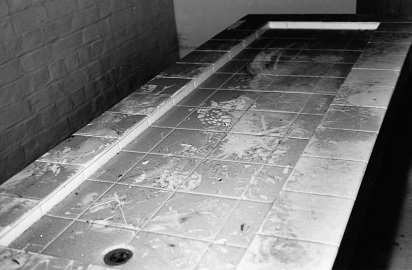
The positioning of the noose was crucial for a clean break between the 2nd and 3rd vertebrae The rope always did a quarter turn to throw back the head and cleanly sever the spinal column at those points and the hangman treated the affair with diligence and extreme reverence. Frank would then often sit with the executioner and assistants as they had their breakfast and left the executed man dangling for a full hour. The prisoner was then pulled back up, the noose removed and then he was lowered back down with other ropes to the basement room again where he was stripped and laid on the mortuary slab. The body ‘belonged to the state so it was buried within the prison grounds’ and no relative was allowed to visit the grave site or send flowers.

I storyboarded much of the film due to the restrictions of time, the nature of the equipment we were using and, of course, the mood I was trying to evoke. I also used black and white, grainy, light-sensitive film stock to try and get the feel of the execution facility in its heyday of the 1950s. If I had more money and time I would have made this film about 10 minutes longer but alas it was not to be. There was always the odd event that we shot spur-of-the-moment. Like when I noticed a butterfly trying to escape from the window of the execution chamber. In this space it took on quite a metaphorical aspect as it struggled desperately and futilely against the glass. Strangely, there was a large group of them roosting on the ceiling. I’ve never seen such a thing in my life and have no idea why they were acting like this. There were also mounds of pigeon droppings too which we tried to avoid as best we could (it can be quite toxic when breathed in). There’s a very brief shot in the film of two pigeon chicks which were nested snugly within a cavity of the execution beam … another bizarre metaphor about death and resurrection, I guess.

When we visited there were major renovations taking place within D-Hall and, as we see in the film, the condemned cell and execution chamber were torn apart. Even the grave sites were not spared. Drainage for the new toilets being built (this was the end of the notorious slop-out era) actually passed through the graves of the executed men. Indignity upon indignity heaped upon these pathetic corpses with each flush of the toilet. The graves had been marked with initials to denote where each of the murderers lay but these had been removed at some point as if to completely erase any trace of them. Frank knew exactly where each lay though and reeled them off one by one. He told me about the way the coffins were designed with a hinged flap over the face of the dead man. Once sealed in the coffin with quicklime scattered over him, Frank would open the flap and add water over the face of the executed prisoner to hasten the destruction of the body. The grave was then filled back in. One of the graves was forever sinking and had to be refilled with ashes from the boiler house on a regular basis. It was the grave of James Robertson, a former policeman who had run over and killed his lover in 1950. He was duly executed for the cold-blooded murder but it was as if his body was restless in the grave the way the tarmac kept on sinking down. In refilling the grave Frank told me that the body seemed to be miraculously well preserved and that somehow the quicklime designed to dissolve it had had the very opposite effect! The prisoners on that grave-filling detail were often terrified and were offered extra perks like cigarettes to make it a bit easier for them. To this very day that same grave is still sinking for some odd reason … the depression in the tarmac can be clearly seen in the film.

There were many stories that Frank related to me about his good friend Albert Pierrepoint, who he befriended during his time at Barlinnie Prison. Pierrepoint was the famous British state executioner at that time and conducted various executions throughout the entire United Kingdom. Frank kept up his friendship with Albert way after capital punishment was abolished and used to visit his pub in Manchester called ‘Help the Poor Struggler’. At his home in the west side of Edinburgh, Frank proudly showed me his various bits of execution related paraphernalia.

One of the prize exhibits was an engraved glass from the Albert’s pub. There was also an amazingly detailed scaled down model of the Delaware gallows which his retired carpenter friend and fellow execution enthusiast, Sudsy, had made for him. Frank showed me with great relish how this unique hanging apparatus would operate. It was obvious that he wanted more than mere models to play with and his real ambition was to be the British state executioner. He had contacted the British Home Office to put his name down as one of the persons willing to train as a state executioner should capital punishment come back. There was no way he’d be getting that job at the time I met him though as he’d already undergone a major operation and had a pig’s heart valve sewn into him. I felt guilty asking Frank to climb the rungs of the ladder into the beam room for a third take, I recall. He was happy to do it but breathless by the end! I thought how awful it would have been, and ironic, if he’d died within this space he loved so much.

But it seems that within the film Frank does fulfill the dual role of hangman and condemned man. The two aspects merged into one at the crowning moment as he puts the bag over his own head — a touch that I thought might be ridiculous at first but somehow does work quite well in the finished film.

Alas for Frank the calling to be a state executioner never came to happen and he died in 2008 from heart complications. Hanging with Frank will remain his legacy, however. A film as much a character study as it is a piece of history. [See more movie stills here -ed.]

I made this film with very little funding indeed and despite its receiving various accolades over the years the government funded film agency in Scotland at the time, The Scottish Film Council, refused to send it to film festivals as it was deemed distasteful. My work has frequently led me to being despised by the powers that be in the largely straight-laced documentary scene … I must be doing something right I suppose!

* Not to be confused with the last executed in Scotland full stop. Miller was the second-last in Scotland.

On this day..

1965: Andrew Pixley

On this date in 1965, Andrew Pixley was gassed in Wyoming for butchering the two young daughters of a vacationing Illinois judge.

A 21-year-old high school dropout with a few petty thefts to his name, Pixley on the night of August 5-6, 1964 broke into the Jackson hotel room occupied by 12-year-old Debbie McAuliffe, her 8-year-old sister Cindy, and 6-year-old Susan.

Their parents were relaxing in the hotel lounge at the time, but would return to a nightmare scene: Debbie dead in her bed, beaten to death with a rock; Cindy, strangled; and this slight stranger drunk or insensible lying on the floor of their room covered in their daughters’ gore. Both girls also appeared to have been sexually assaulted. (Somehow, the youngest daughter was not attacked.)

Judge Robert McAuliffe seized the stranger, while police — and soon behind them, an angry mob calling for Judge Lynch — followed his wife’s screams to the scene.

“It was the most horrible thing I’ve ever seen,” Teton County attorney Floyd King later said. Pixley claimed that the night’s events were a blank in his mind.

Remembered for this one night of madness as one of Wyoming’s most brutal criminals, Andrew Pixley reputedly still haunts Wyoming’s Old Frontier Prison, and gives tour guides at facility (it’s a museum now) the heebie-jeebies.

On this day..

1964: Glen Sabre Valance, the last hanged in South Australia

On this date in 1964, Glen Sabre Valance became the last person hanged in South Australia.

Born Paul Fraser, he jazzed up the handle by cribbing the surname of the title outlaw from the 1962 John Ford Western The Man Who Shot Liberty Valance.

Like that Lee Marvin cutthroat, “Glen Valance” was destined to live a brutal life with a violent end.

In the early morning of 16 June 1964, the 21-year-old Valance broke into the home of his former employer, Richard Strang. He had a standing dispute with the Bordertown farmer over wages but his real grudge ran deeper than that. Strang had bemusedly read the sensitive youth’s diary to other farmhands weeks before, resulting in an altercation — and, after Valance drove off with some of his effects, a police report and an arrest.

Valance nursed “bad thoughts” against his tormenter, he muttered to his family. They turned out worse than anyone could have expected: bad enough to justify his adopted alias.

As Strang and his wife dozed in bed, Valance leveled his rifle at the hated ex-boss, and leveled the score. Then he seized the waking Suzanne Strang and raped her there in the bed sodden with the gore of her husband’s warm corpse.

As Valance hightailed it out of Kooroon Station, Suzanne Strang phoned police — and the resulting roadblocks snared the murderer that very day, with the murder weapon right there in the passenger seat … actually riding shotgun. Valance mounted an unsuccessful insanity defense.

In 2011, Lillian Clavell — ten years old at the time of her half-brother’s execution — published a book, A Tormented Soul: The Tragic Life of Glen Sabre Valance, the Last Man to be Hanged in South Australia.

In it, a Clavell still affectionate for her big brother points to their savagely abusive mother as the root cause of the adult Paul/Glen’s horrific crime. (Lillian says that her father shielded her from the worst of any domestic violence, but Paul had no father in his life and no such protection.)

I know she burnt his hands on the stove. I know she put his face through a window. Once she held a knife to his throat and said she’d kill him if he ever stole anything from the cupboard again. I believe that (abuse) led very much to his crime.

Valance was hanged in an unused guard tower (the “Hanging Tower”) of Adelaide Gaol. The facility is unused today, but the date November 24, 1964 and the letters GSV still remain printed on the brick wall.

On this day..

1964: Louis Drouin and Marcel Numa, Jeune Haiti

On this date in 1964, the last two members of a noble and doomed rebel movement against Papa Doc Duvalier were shot in a repellent carnival outside the Haitian capital’s national cemetery.

Thirteen young Haitian expatriates had alit from sea, Granma-like, early that August of 1964, weeks after Duvalier was “elected” President-for-Life with an entirely plausible 99.9% of the vote.*

Taking to heart Machiavelli‘s maxim that it is better for a sovereign to be feared than loved, Papa Doc buttressed his rule with a vicious paramilitary force. Some 30,000 Haitians are thought to have been murdered during his 14-year reign, and many thousands of others fled into exile.

The Cuban example — a few plucky armed men in the mountain somehow toppling the ancien regime — must have inspired the U.S. exiles of the so-called Jeune Haiti. Certainly they did not want for the guerrilla’s raw courage and hardiness. In some alternate history their tramping through southern Haiti’s hills under the barrage of Hurricane Cleo is the stuff schoolchildren recite.

But in our world the rising Jeune Haiti hoped to spark did not materialize. Port-au-Prince brandished horrific reprisals against the rebels’ non-combatant family members in the city of Jeremie, and the men themselves were simply picked off in ones and twos in the bush. The last Jeune Haiti members still at liberty were killed in late October, leaving only the two whom the government had managed to capture. Papa Doc had evil plans for Marcel Numa and Louis Drouin.**

On November 12, a Thursday, government offices shuttered for the grotesque holiday, and schools were ordered to bring their pupils to this special lesson of the dictatorship. “No force will stop the invincible march of the Duvalierist revolution,” read a leaflet distributed at the execution. “It carries the strength of a torrent.” (Source)

Under the eyes of this curious throng and the whirr of cameras, Numa and Drouin were lashed to pine poles by the Tonton Macoutes. Un-blindfolded, they received the whispered last rites of a Catholic priest, and then were shot dead by a firing detail.

When the men’s bodies slide down the poles, Numa’s arms end up slightly above his shoulders and Drouin’s below his. Their heads return to an upright position above their kneeling bodies, until a soldier in camouflage walks over and delivers the final coup de grace, after which their heads slump forward and their bodies slide further toward the bottom of the pole. Blood spills out of Numa’s mouth. Drouin’s glasses fall to the ground, pieces of blood and brain matter clouding the cracked lenses.

The next day, Le Matin, the country’s national newspaper, described the stunned-looking crowd as “feverish, communicating in a mutual patriotic exaltation to curse adventurism and brigandage.”

“The government pamphlets circulating in Port-au-Prince last week left little to the imagination,” reported the November 27, 1964, edition of the American newsweekly Time. “‘Dr. Francois Duvalier will fulfill his sacrosanct mission. He has crushed and will always crush the attempts of the opposition. Think well, renegades. Here is the fate awaiting you and your kind.'”

* Actually a bit of a setback for Duvalier after winning every single vote (finaly tally of 1,320,748 to 0) in his 1961 “re-election”.

** Drouin, who was wounded in a battle and captured for that reason, openly lamented at his execution his failure to commit suicide.

On this day..
