1969: Liu Shaoqi dies under torture

At 6:45 a.m. on this date in 1969, the Chinese Marxist statesman and intellectual Liu Shaoqi passed away secretly in a room of the Kaifeng Municipal Revolutionary Committee building.

He had not been executed in the literal sense. But his death was the mere bodily consequence of an Orwellian civic annihilation: the onetime President of China, fallen to unperson. Like the Man in the Iron Mask, his identity was secret from his own guards (and later from the crematorium workers who disposed of the remains); his own children did not learn of his death until 1972.

A Communist revolutionary from student days in the early 1920s, Liu was among the first to publicly turn against Mao’s Great Leap Forward. In 1959 Liu succeeded Mao as President of the People’s Republic of China, and led the walkback from the Great Leap’s destructive stab at modernization.

A years-long factional struggle within the Chinese Communist Party would ensue, pitting Maoists against a more reform-minded clique.

Liu and the reformers got the worst of it in the 1960s. Mao and Maoists seized power back in the 1966 Cultural Revolution, and purged Liu as a “capitalist roader” — “China’s Khrushchev” ran one denunciation.

The renegade, hidden traitor and scab Liu Shaoqi and other sham Marxists and political swindlers … dished up the theory of taking the electronics industry as the center … They also said, “The development of a modern electronics industry will bring about a leap forward in our industry, and it will be a starting point for a new industrial revolution in the history of China.” This is a reactionary principle for opposing the principle of taking steel as the key link.*

Liu endured months of frightful public harassment leading up to his September 1967 arrest: there were episodes when Mao’s “Red Guards” broke into his official residence and even plastered Liu’s own walls with anti-Liu placards,** as well as “struggling against” campaigns with mobs of anti-Liu demonstrators hurling abuse while Liu was made to stand in a pose of contrition. The formal allegations, for whatever such things are worth, were that Liu worked as a World War II traitor for the Americans, Japanese, and/or nationalists.†

Liu was badly mistreated in custody, possibly as a way to kill him off extrajudicially or just for the sadistic pleasure of bringing one who once stood so high to the depths of literally wallowing in his own shit. By summer 1968 Liu was suffering from pneumonia, cankered with bedsores, and could only be fed through a nasal tube. His neglectful medical care gradually wasted him to death.

Mao himself died in 1976. A reformist and onetime Liu ally, Deng Xiaoping, eventually emerged as China’s post-Mao leader. Soon thereafter the Chinese Communist Party officially rehabilitated Liu and declared several of his writings, so recently forbidden, to be “Marxist works of great significance.” He has remained an official hero, and political martyr, ever since.

* 1971 salvo quoted in Lowell Dittmer, “Death and Transfiguration: Liu Shaoqi’s Rehabilitation and Contemporary Chinese Politics,” The Journal of Asian Studies, May 1981.

** “The Kuomintang vilified me for years but never used such language,” recalled Liu’s wife — who survived a decade in prison herself after her husband’s fall.

† Mao’s widow would later admit that thousands of people were detailed to comb through the records of the Japanese occupation in search of anything prejudicial to Liu.

On this day..

1964: Eric Edgar Cooke, the Night Caller

On this date in 1964, Western Australia conducted its last hanging — that of Eric Edgar Cooke.

Cooke was one of Australia’s worst serial killers, and also one of its strangest: the eight homicides were almost unpatterned save for their rage.

A harelipped, bullied youth turned delinquent turned small-time criminal — he had numerous arrests to his name for theft, for vandalism, for torching a church that rejected his choir audition, for auto theft and for being a peeping tom — Cooke busted out of obscurity and into nightmares on the night of Australia Day 1963 when he gunned down five random people in Perth‘s comfortable suburbs. But even by then he had already been stabbing and shooting at people, and menacing them with cars.

Cooke’s Australia Day spree comprised four distinct incidents united to one another and to Cooke’s previous patterns by little but a lust for the hunt: his sole methodology was opportunism. Cooke shot a couple parked in a car (they survived), then an accountant through his apartment window (not so lucky); then, Cooke murdered a young man asleep on an open veranda, and rang the doorbell of another house to lure a fifth victim (both of these men also died).

As he’d been previously arrested on the strength of his fingerprints, Cooke had taken the precaution to wear gloves, leaving police a very cold trail indeed. The shock of the one night’s carnage multiplied as weeks, and then months, elapsed with no arrest. Thirty thousand men were fingerprinted in a futile fishing expedition.

An isolated western city in the midst of a transformative population boom, Perth learned mistrust from Eric Edgar Cooke. Of course that can’t literally be true; Perth was half a million people strong by this time. But in the civic memory Cooke’s Australia Day signposts an innocence lost. Estelle Blackburn in her Broken Lives depicts Cooke as the baleful spirit come to scourge Perth’s newly, complacently prosperous. (See this pdf.) It was

[t]he small city … [that] had ways of a friendly, easy going big country town where people left their doors unlocked and their car keys in the ignition of open cars. They trusted each other. He turned it into a city of suspicion and terror. For the first time people started locking the doors of their homes and cars, stopped going out at night and slept with guns or any weapons they could find under their pillows.

There’s a kernel of truth in this cliche, for Cooke liberally exploited Perthians’ inattention to security. When finally arrested in August of 1963 after he shot an 18-year-old babysitter, his confession explained that thanks to car owners’ habit of just leaving the keys in the ignition, he had frequently stolen vehicles parked for the night, used them in hit-and-runs or other crimes, and returned them before morning … the owners very often none the wiser.

Cooke had, meanwhile, also strangled a social worker in the Perth suburbs in February 1963, and stabbed to death a South Perth beautician during a home invasion robbery back in 1959. He proved to have a photographic memory of his misdeeds, and could detail exactly the objects he had stolen in hundreds of long-past burglaries. He copped in all to eight murders and 14 attempted murders.

With such evidence from Cooke’s own mouth his barristers had little choice but to pursue an insanity defense. This didn’t fly with the courts, but neither too did Cooke’s more embarrassing admissions to two murders for which two other men were already imprisoned. (Officially, the crown only credited him with six of his eight kills.) A “villainous unscrupulous liar” he was called for those claims; Darryl Beamish and John Button each served many more years in prison for these two disputed murders; with Blackburn’s help, they were both formally vindicated in the 2000s.

On this day..

1968: Pierre Mulele, hoodwinked

On this date in 1968,* Congolese revolutionary Pierre Mulele was shot by firing squad in Kinshasa.

The anti-colonialist (French link) Mulele served as Minister of Education in the leftist government of Patrice Lumumba, overturned by a western-backed coup in 1961.

Trained up in Maoist doctrine in China, Mulele took to the country to launch a strange insurrection from Kwilu, then fled to neighboring Republic of the Congo (aka Congo-Brazzaville, after its capital city) when that project collapsed.

Mulele was lured back to his home Congo in late September of 1968 under an amnesty extended by the Mobutu regime.

In retrospect, it might have been better not to trust Mobutu.

Foreign Minister Justin Bomboko … personally escorted the former rebel across the Congo River from the neighboring Congo Brazzaville, while Mobutu was on a private visit to Morocco. On his arrival, Mulele was feted over champagne and caviar. But Mobutu had hardly returned to Kinshasa when he announced that Mulele was not covered by the amnesty and that he would be tried as a war criminal.

He got a 15-hour military trial on October 8, with execution the very next day. Though the press reports aver merely that he was shot, Michela Wrong’s In the Footsteps of Mr. Kurtz: Living on the Brink of Disaster in Mobutu’s Congo** reports a quite more grisly spectacle.

tortured to death by soldiers. His eyes were pulled from their sockets, his genitals ripped off, his limbs amputated one by one as he slowly expired. What remained was dumped in the river.

That sounds … unsanitary.

As a result of this state perfidy — “an act of kidnapping and of international piracy” against an “authentic heir to the ideal which inspired Patrice Lumumba,” in the undiplomatic official statement† — Congo-Brazzaville broke off diplomatic relations with Congo-Kinshasa.

* Some sources have Mulele’s execution on Oct. 3, but the contemporary newspaper reports make clear that Mulele was tried on the 8th and shot on the 9th. Oct. 3 appears to be the date Mobutu publicly announced that Mulele would not be covered by amnesty.

** This site has been in the footsteps of Mr. Kurtz as well.

† London Times, Oct. 10, 1968.

On this day..

1960: Manfred Smolka, East German border guard

On this date in 1960, Manfred Smolka was guillotined in Leipzig.

Smolka was among three million East Germans or more who escaped over the border to West Germany in the 16 years after the defeat of the Nazis divided the country.

In the earliest years, people sluiced over the long border just anywhere. By Smolka’s time, that perimeter was buffered by an “internal border” that made it difficult for ordinary people to approach near enough to West Germany to escape. Consequently, most emigration by the the late 1950s occurred in the divided city of Berlin — a flow that East Germany would finally stanch in 1961 with the ultimate in immigration reform, the Berlin Wall.


One of the Cold War’s iconic photographs: East Berlin border guard Conrad Schumann leaps over the barbed-wire barrier into West Berlin on Aug. 15, 1961, just days after construction of the Berlin Wall began.

Like that more famous later escapee, Manfred Smolka (German link, as are most that follow) was a border guard; indeed, he was an officer. That gave him the ability, in 1958, to be far enough within the “internal border” to defect into West Germany

The very next year, he arranged to meet his abandoned wife and daughter on the Bavaria-Thuringia frontier to smuggle them over, too. Alas, it was a trap (pdf) laid by the feared East German secret police, the Stasi.


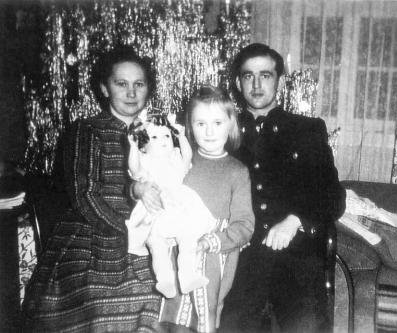
Happier times: Manfred Smolka with his wife and child.

According to press reports, Smolka was actually on West German soil when the Stasi men captured him.* (The Stasi were often up for a bit of kidnapping.)

West Germans were outraged by Smolka’s capture and subsequent death sentence for “military espionage,” but the case was deemed an apt one for the education of East Germany’s border security agents.

Only with post-Cold War German reunification could his family examine his file. “I am innocent, I can prove it a hundred times,” they read in the last letter the onetime defector wrote to his family — a letter which had never been delivered. “You need not be ashamed of me.” In 1993, a reunified, post-Cold War Germany officially agreed and posthumously rehabilitated Manfred Smolka.

There’s a few minutes of documentary video about him, in German, here.

* By a July 5, 1960 account in the London Times, Smolka was shot at and wounded as he crossed into East Germany but still managed to “crawl” back to West Germany — where his pursuers did not fear to follow him.

On this day..

1969: Lee Soogeun, North Korean defector

On this date in 1969, alleged North Korean operative Lee Soogeun (other transliterations exist for his given name, such as Soo Keun or Soo-geun) was hanged at a Seoul prison for espionage.

A North Korean party elite, Lee was the Vice President of the North Korean Central News Agency.

On March 22, at the Military Armistice Commission meetings at the border outpost of Panmunjom, Lee suddenly leapt into a UN official’s vehicle and escaped over the frontier.

The high-profile defector got a hero’s welcome in the South. (A U.S. Army captain also copped a medal for helping him escape.)

Lee hit the lecture circuit critically discussing the situation north of the 38th parallel, and worked as an analyst for South Korean intelligence.

However, the KCIA also had Lee under surveillance, and came to believe that he was actually gathering intelligence to send to the north. Realizing his predicament, Lee fled with his niece for Cambodia. They were captured en route in Vietnam.

South Korea’s Truth and Reconciliation Commission has, while stopping short of exonerating Lee, ruled his confinement illegal, and the self-incriminating statements he made in that environment insufficient evidence, and urged his case be re-tried. Lee’s niece served 20 years of a life sentence as his accomplice, but was released in 1989 and eventually won a 6.8 billion won wrongful imprisonment suit.

On this day..

1963: Oleg Penkovsky, Cuban Missile Crisis spy

It is 50 years today since Soviet military intelligence officer Oleg Penkovsky was executed for spying for the Americans.

Penkovsky, whose father died fighting for the anti-communist Whites during the Russian Civil War, lived up to his western handlers’ HERO codename by tipping the Soviets’ operational plans for missile deployment in Cuba — helping precipitate the Cuban Missile Crisis.

This speech inaugurated some of the darkest days of the Cold War … but they were probably even worse for Oleg Penkovsky, who was arrested just hours before Kennedy delivered it. He might have been shopped by a U.S. intelligence mole working for Moscow.

Penkovsky and his British contact, businessman Greville Wynne, faced a public show trial in May 1963 — resulting in the spy’s prompt execution. (Wynne got a prison sentence, and was later exchanged back to the West for Portland Spy Ring principal Gordon Lonsdale.)

The late spy’s journal was published in 1965 as The Penkovsky Papers. A variety of documents from Penkovsky’s CIA case file are available on the spy agency’s own site.

As befits the shadow world of espionage, Penkovsky’s activities and motivations are still disputed to this day. While some consider him among the most valuable/damaging spies in the Cold War, former MI5 officer Peter Wright claimed that Penkovsky was a loyal Moscow agent all along actually trafficking disinformation — and that he was not executed at all but cashiered to a comfortable secret retirement after his show trial “condemnation.”

But here’s the conventional take:

On this day..

1963: Victor Feguer, by the feds

This date marks half a century since the hanging of Victor Feguer — the last man executed by the federal government in the 20th century. (And the last executed in the state of Iowa, period.)

A drifter holing up at a Dubuque, Iowa, boarding house, Feguer phoned up a random doctor claiming a woman needed medical attention.

Think about that the next time someone gets nostalgic for house calls.

Dr. Edward Bartels showed up only to be kidnapped by Feguer, and eventually murdered in Illinois. Feguer was picked up in Alabama, trying to sell the doctor’s stolen car; his motive for the whole affair was just to get whatever drugs the luckless physician had with him.

The cross-state crime spree put Feguer’s case in the hands of the feds. (It was not, however, a “Lindbergh Law” case, since Feguer was on the hook for capital murder independent of the kidnapping.)

Although Feguer spent his prison time at the federal lockup in Fort Leavenworth, Kansas, he was transported back to Iowa for execution — because that state’s penitentiary had a gallows available.

Iowa still had a death penalty on the books at this time, but it had a death penalty abolitionist for a chief executive; just two years hence, that Gov. Harold Hughes set his pen to the Hawkeye State’s death penalty abolition bill. Iowa hasn’t hanged, shot, electrocuted, poisoned, or otherwise judicially executed anyone since.

It was U.S. President John F. Kennedy, however, who had Victor Feguer’s life in his hands. Despite Gov. Hughes’s support for clemency, Kennedy turned the kidnapper down flat.

Feguer’s last meal, oddly, was a single olive. He tucked the olive’s pit into the new suit he wore to his dawn hanging.

As the death penalty waned into a formal abeyance in the 1970s in the U.S., the federal government stopped executing people for a long, long time. (And stopped hanging people altogether.) The next time a human being was put to death under federal auspices was 38 years later: Oklahoma City bomber Tim McVeigh.

On this day..

1968: Veyusile Qoba, the last of the Langa Six

On this date in 1968, the black South African revolutionary Veyusile Qoba was hanged for his role in the murder of a policeman six years before.

Four men before him had gone to the gallows the previous Halloween for this crime; a fifth hanged separately for a different policeman’s killing late in 1967. Together with Qoba, they constituted the “Langa Six”.

The color line, of course, was the beef of the Six — and not only that, but the divide within the anti-resistance movement between the African National Congress (ANC) and the Pan Africanist Congress (PAC).

The Langa Six belonged to the latter entity’s military wing, Poqo (later to develop into the Azania People’s Liberation Army, but we’ll use the period-appropriate original nomenclature here). After police response to a PAC-organized 1960 protest against South Africa’s notorious racial passes turned into the Sharpeville Massacre,* Poqo girded for violent struggle against a violent state.

With the alleged slogan “one settler, one bullet,”** Poqo mounted an aggressive terrorist campaign that did not scruple to target white civilians, or black civilians perceived as collaborators. (The ANC’s simultaneous Nelson Mandela-led terrorist campaign had a more selective attitude.)

And this, in turn, spurred a further crackdown, as Pretoria banned both the ANC and PAC, and enacted a Sabotage Act — the law under which Nelson Mandea was jailed for life.

Poqo and PAC operatives were likewise arrested by the thousands in the troubled 1960s.

In March 1962, five of the Langa Six attacked police vehicles in the Cape Town suburb, killing a police Sgt. Moyi.

According to [policeman] Basson, some 50 Bantu attacked his vehicle when he tried to start the engine … he found that one of the petrol bombs set the vehicle alight and they were compelled to jump out — they were dragged out of the vehicle. It was at this stage that Sgt Moyi was set upon, pulled to the ground, and stabbed to death. Det-Sgt Josiah Moss was also injured and knocked unconscious but owing to that he fortunately escaped with his life. (Source)

(South Africa’s post-apartheid Truth & Reconciliation Commission found that this event was an impromptu, local ambush, rather than a centrally-planned operation.)

* The date of that massacre, March 21, is now honored as Human Rights Day in South Africa; it’s also the United Nations’ International Day for the Elimination of Racial Discrimination.

** As Sartre put it in his notes to Fanon’s 1961 Wretched of the Earth, “to shoot down a European is to kill two birds with one stone, to destroy an oppressor and the man he oppresses at the same time: there remain a dead man, and a free man.” PAC spokespeople have denied that “one settler, one bullet” was an actual party slogan or policy, however.

On this day..

1964: Preap In, Khmer Serei operative

“It was at that point that I began to hate Sihanouk.”

-Khmer writer Soth Polin on Preap In’s treatment

On this date in 1964, Cambodian dissident Preap In was shot in Trapeang Kraleung … an execution so public that every cinema-goer in the country would witness it.

This is the Cambodia of Narodom Sihanouk — “a libertine and a francophile, a filmmaker and a painter, a serial husband and father and philanderer, a cherubic but ruthless god-king,” in the words of one obituary when he died late last year.

Plucked from the distant branches of the royal family tree and set up on the throne as an 18-year-old French puppet in 1941, Sihanouk cast a long shadow over his country for the balance of his long life. He surprised his colonial overseers by agitating, successfully, for independence, adding to his regal stature the laurels of national patrimony.

He would in 1955 abdicate the throne — settling for “Prince Sihanouk” — to operate as a conventional politician. One who was the father of his country and the shadow-king. Needless to say, Sihanouk dominated the ensuing era of Cambodian politics.

That politics makes for dizzying reading. At one level, Sihanouk was basically an autocrat with a fairly corrupt developing state. But his statecrafting finesse elevated him far above the bog-standard Cold War dictator. Sihanouk dextrously played the French off against the Americans, East off against West, and shifted the tone of his domestic governance from socialism to Buddhism to nationalism with everything in between. He was a consummate survivor steering a small state on an independent course through the dangers of Cold War ideologies and allegiances.

In 1963-64, Sihanouk’s relations with the United States were on the outs.* Although Sihanouk was also a rival of the late Vietnamese ruler Ngo Dinh Diem, he can’t have welcomed that man’s ouster and execution with the blessing of the superpower sitting right next door with so much megatonnage.

A natural suspicion, only heightened by known CIA patronage of the Khmer Serei (“Free Khmer”), right-wing but anti-monarchist guerrillas led by a longtime Sihanouk foe named Son Ngoc Thanh.

Long story short, Sihanouk as part of his geopolitical machinations had been firing demands at the Americans that they prevail upon their Southeast Asian clientele to put the screws to the Khmer Serei — who used extraterritorial bases to send radio broadcasts into Cambodia. In late 1963, the young engineering student Preap In, who had become a Khmer Serei operative, slipped back into Cambodia with a safe conduct from his uncle In Tam.

Though he would later help to overthrow it, In Tam was a powerful political figure in Sihanouk’s state, at this time governor of Takeo. But he was setting up his nephew or else someone else was, and the “safe conduct” proved an utter sham.

On November 19, at a special national congress, Sihanouk announced the arrest of the two Khmer Serei operatives, Saing San and Preap In … After several conversations with officials in Takeo, In and Saing San had been arrested peremptorily, brought to Phnom Penh under guard, and put on display in cages at the national congress. Facing the prisoners and surrounded by thousands of supporters, Sihanouk denied making any special arrangements with them, and the congress soon became an impromptu judicial hearing. Sihanouk asked both men to admit that the Americans were aiding Son Ngoc Thanh and providing the Khmer Serei with radio transmitters. Saing San said yes to both questions and was immediately released. Preap In, apparently in shock, stared straight to the front, refusing to answer. Sihanouk then demanded that he be subjected to the “will of the congress.” Hundreds of spectators stormed the cage where Preap In stood in silence, bombarding him with rubber sandals, debris, and abuse until he was hustled away to face trial at the hands of a military court. (Source)

Sihanouk’s official version: Preap In “spontaneously confessed” to treason.

Sihanouk not only advanced the public shooting of the young Khmer Serei, but he ordered it filmed; the graphic 15-minute newsreel was played before feature attractions in cinemas throughout Cambodia for weeks to come, while still shots of the execution were distributed on propaganda posters.

Authoritarian Sihanouk may have been, but theatrical bloodletting wasn’t otherwise known as his style. Preap In’s lasciviously rough treatment stood out for its novelty and revolted many Cambodians; David Chandler would remark that this event “frequently surfaced in the 1980s when informants sought to date the beginning of Sihanouk’s decline.” Despite that onetime multimedia exposure, if the video or still images from it are accessible online I have not found them. This still image from a (I believe) Sihanouk-era firing squad execution is the best I’ve got, but as my Khmer is a little rusty, I’m at a loss to identify the unfortunate fellow on the post.

* For the view from Washington, see this contemporaneous CIA analysis, a FOIA’ed pdf.

On this day..

1969: Joseph Blƶsche, Der SS-Mann

On this date in 1969, Joseph Blƶsche was executed in Leipzig, German Democratic Republic, for his part in the Holocaust.


Blƶsche (far right) chills out at the Warsaw Ghetto with, among others, Jurgen Stroop (fourth from right, in profile).

Blƶsche (English Wikipedia entry | German) was an SS Rottenführer and a Nazi Party member whose particular contribution to deporting Jews from the Warsaw Ghetto to Treblinka was fitting in some opportunistic rape, typically followed with summary murder. The ghetto’s wards called him “Frankenstein”.

Blƶsche was eventually captured by the Red Army, which you’d think might augur ill for his survival prospects. However, with the aid of a horrible accident he suffered in a postwar labor camp that helpfully disfigured his face, Blƶsche managed to fade quietly into East German society, wed, and raise a family.

He would need that facial anonymity, because the un-disfigured version is there full-frontal gazing over his submachine gun in one of the war’s most iconic and chilling images — snapped for the benefit of the Stroop report documenting the ghetto’s liquidation.


An SS trooper, eventually identified as Joseph Blƶsche, looms over a frightened Jewish boy in the Warsaw Ghetto. (The child might be one of Artur Dab Siemiatek, Levi Zelinwarger, Israel Rondel, or Tsvi Nussbaum)

This photo was published in the U.S. in Life magazine on November 28, 1960. The terrible image haunted Holocaust survivor Peter Fischl into writing his poem “The Little Polish Boy”.

Blƶsche’s luck ran out when his name came up in a West German war crimes trial in 1961; East Germany’s follow-up eventually zeroed in on the man, and he was convicted in April 1969 for directly killing up to 2,000 people, and participating in deportations that killed 300,000 more. He was executed in Leipzig with a single shot to the neck.

Joseph Blƶsche is the subject of the German documentary Der SS-Mann (there’s also a book of the same title).

On this day..