1983: Maurice Bishop, Prime Minister of Grenada

On this date in 1983, Grenadian Prime Minister Maurice Bishop was shot with seven supporters during the chaotic struggle of power that precipitated a U.S. invasion.

The charismatic Bishop grew up on the small British Commonwealth island in the south Caribbean, attended the London School of Economics, and became the leader of the Marxist New Jewel Movement.

In 1979, Bishop and the NJM overthrew the paranormal government of Eric Gairy (he’s famous for his controversial judging in the wild 1970 Miss World pageant).

Leftist governments in the hemisphere were just the sort of thing to irk the Yankee hegemon. Collaboration with Cuba and Nicaragua to build an airstrip on Grenada … could that open the door for Soviet air support when the Sandinistas invaded Harlingen, Texas?

Ironically, it would be an intra-party Communist coup against the fellow-Communist Bishop that provided the pretext for said hegemon to stanch this existential threat.

A deputy, one Bernard Coard, ousted Bishop in October 1983, apparently a factional dispute in the NJM along ideological lines. Bishop broke out of house arrest and led a march on Coard’s position on this date, contesting his control of the government; the march was broken up and its leadership collared — and, later that day, disposed of.

The Reagan administration didn’t care two figs about Maurice Bishop, but a scene of general chaos offered it all the pretext necessary* to invade on Oct. 25. To save from the red menace, oh, let’s say, a few American med students, plus a little thing called the free world.

Whew!

Years later, that provocative airstrip bears Maurice Bishop’s name.

Audio of several Bishop speeches can be had here; others can be found on YouTube.

* Another possible precipitating factor: a U.S. Marines barracks in Lebanon was spectacularly bombed by terrorists on Oct. 23, 1983, forcing (eventually) American withdrawal. The New Jewel Movement turned out to be an opponent more in Washington’s wheelhouse.

On this day..

1987: Mehdi Hashemi, Iran-Contra whistleblower

On this date in 1987,* Iranian cleric and revolutionary official Mehdi Hashemi was secretly executed … seemingly, for leaking the Iran-Contra scandal.

Hashemi was an O.G. of the Iranian Revolution, imprisoned by the notorious secret police SAVAK** and freed when the Shah’s government collapsed in 1979.

Hashemi had a series of posts in the revolutionary state generally relating to exporting the revolution, and under the aegis of Ayatollah Montazeri, who in the late 1980s was the heir apparent of Ayatollah Khomeini for leadership in the Islamic Republic.

Montazeri was a rival of parliamentarian Akbar Hashemi Rafsanjani,† and further to that rivalry the Montazeri faction leaked embarrassing information about Rafsanjani’s dealings with the United States.

The Great Satan’s disreputable Middle East policy entailed playing both sides of the destructive Iran-Iraq War — arming Saddam Hussein‘s Iraq, while also making secret weapons sales through Israel to Iran despite a supposed arms embargo, thereby obtaining the release of American hostages in Lebanon.

This is the “Iran” half of the Iran-Contra scandal … which became the Iran-Contra scandal when Hashemi publicly exposed the existence of secret Iranian-American contacts to the Lebanese magazine Ash-Shiraa.

The immediate motivations appear murky even to specialists, of whom this writer is not one … but whatever they were, the leak backfired — as so often is the case — on the whistleblower himself.

While the authors of the covert policy in each country emerged stronger, Hashemi was arrested just before the story broke publicly and “persuaded” (with 75 lashes!) into one of those Soviet-style auto-denunciations, which was broadcast on Iranian TV.

Hashemi’s self-flagellation, as characterized here, runs thus:

Deviation is my ultimate sin. This is why I now stand before you. I began my career with minor infractions, gradually strayed from the correct path, continued with larger mistakes, then to major sins, and ultimately to the worst sin possible — that of heresy, apostasy, and treason against the Imam, the Community, Islam, and the Islamic Revolution. I have to ask myself what was the root cause of my downfall? …

(His answer: “carnal instincts”.)

I now realize that despicable sinners like myself had no business inside the heir-designate’s office. I thank God that I have been removed from that office …

I would like to plead with my former colleagues and friends who shared my deviant ideas to return to the correct path, relinquish their false notions, reform themselves, unite against imperialism, and overcome the carnal instincts that can lead them toward having relations with Satan and his representatives.

He was tried on a basket of nasty charges including “corruption on earth,” murder, kidnapping, plotting against the government … and, because state authority is not immune to irony, arms struggling.

Hashemi’s patron Ayatollah Montazeri worked unavailingly behind the scenes to save his man; Hashemi’s judge noted in his memoirs that the execution was carried out before the sentence went public, specifically to prevent Montazeri throwing his weight around to stop it.

But that weight would dwindle near to nothing in the months ahead, as the case opened a schism between Montazeri and the Iranian leadership.

After publicly calling for greater political openness, and criticizing a horrifying 1988 mass execution, Montazeri was officially demoted from the designated successor position in favor of Ayatollah Khamenei — who did indeed succeed to the Supreme Leader job, and holds it to this day.

Montazeri remained a frequent internal critic (and, for a time, political prisoner) of the Iranian government during the 1990s and 2000s; by the time of his December 2009 funeral, he was an emblem for the embattled Iranian reform movement.

* The execution was reported by Iranian radio as having taken place at dawn that same day, but opposition organizations immediately charged that it had actually been carried out some days before. (See New York Times, Sep. 29, 1987) If the matter has been definitively resolved, I have not been able to document it.

** For murdering a pro-regime theologian who dissed the Khomeini-backed book The Immortal Martyr, which recast Shi’a martyr Husayn Ali as a revolutionary inspiration for modern times.

† Rafsanjani also has a son named Mehdi Hashemi Rafsanjani — who is not to be confused with the subject of this post.

On this day..

1983: Jimmy Lee Gray, drunk-gassed

Just after midnight on this date in 1983, Jimmy Lee Gray gruesomely paid with his life in the Mississippi gas chamber for raping and murdering a three-year-old.

Mississippi’s gas chamber had had a checkered history since its first usage in 1955, and with America just emerging from a long lull in executions, Jimmy Lee Gray was its first client in 19 years.

“Sumbitch took a little three-year-old girl out into the bush and he raped her,” executioner T. Barry Bruce would later explain of the man’s crime. “Then he tried to shove her panties down her throat with a stick, then he pushed her head into a little crick full of running shit and then he broke her neck. So yeah, I feel real sorry for Jimmy Lee.”

Gray was on parole at the time for the 1968 murder of his teenage sweetheart, so no — nobody felt all that sorry for Jimmy Lee, not even his mom.

But the reason that questions about the affair were being directed at the executioner (usually a party as silent in these matters as he is implacable) was that Jimmy Lee Gray’s had been drunk on the job — and the execution was a notorious horrorshow.

“Gasping” or “moaning” a recorded eleven times, Gray convulsed wildly in the Parchman death chair, slamming his unrestrained head “with enough force to shake the chamber” against a metal pole that some user interface genius had positioned right behind the death chair. The witness room was cleared eight minutes into the affair, with Gray still thrashing about.

Though the Magnolia State contended that Gray was clinically dead within two minutes, that head-smashing act disturbed everyone.

As a result, for the third time in a half-century, Mississippi switched to a newer and supposedly more humane method for killing people — adopting lethal injection for anyone sentenced to death after July 1, 1984. (Three more prisoners already condemned under the old sentencing guidelines would die in the gas chamber in the late eighties, however.)

Actual executions in the U.S. were still novel enough in the early 1980s that Gray’s made national news — albeit distinctly second fiddle to the tense Cold War escalation occasioned by the September 1 Soviet downing of Korean Air Lines flight 007.

On this day..

1986: Vice-President Paulo Correia and five others

On this date in 1986, six people were executed by firing squad for attempting a coup in the West African state of Guinea-Bissau.

Correia, an ethnic Balanta war hero, was an African Party for the Independence of Guinea and Cape Verde (PAIGC) activist from the days of Portuguese colonial control — which only ended in 1974.

He was among the revolutionary council that governed the country after Joao Bernardo (Nino) Vieira‘s 1980 coup d’etat.*

This latter strongman was finally assassinated in 2009, but in the interim he was one of the world’s most plotted-against heads of state — in no small part because he came from a tiny ethnic group, and had a fraught relationship with military brass from the plurality (but not majority) Balanta. Vieira needed Balanta officers like Correia to keep the army on his team. Balanta officers like Correia had to wonder whether they needed Vieira.

Correia had perhaps been involved in a 1982 coup attempt that got a tank commander executed, but such was the danger to Vieira of alienating the Balanta (and Correia’s personal following in the military) that rather than face prosecution, he was simply shifted from Minister of the Armed Forces to the less martial post of Minister of Rural Development in the aftermath. Two years later, still trying to keep his treacherous officer inside the tent pissing out, Vieira took him on as Vice-President.

Despite these relative concessions, however, neither Correia nor his fellow military men were thwarted in their drive to augment their power, and in November I985 they planned to overthrow the regime and to install Correia as President and [Balanta lawyer] Viriato Pan as Vice-President. Correia and about one dozen Balanta were immediately arrested before their coup could be implemented; a total of 53 accused conspirators were later convicted, including Correia and Pan, who were both executed along with four others in July 1986.**

“This event,” reports Human Rights Library, “is vividly remembered in Bissau, where rumor has it that Correia’s eyes were gouged out before he was shot. True or not, this belief is clear evidence of the gruesome reputation of the security forces.”

* Just a captain at the time of the 1980 coup, Correia was a colonel at the time of his execution.

** Joshua B. Forrest, “Guinea-Bissau since Independence: A Decade of Domestic Power Struggles,” The Journal of Modern African Studies, March 1987.

On this day..

1989: Arnaldo Ochoa and Tony de la Guardia

In the predawn hours this date in 1989, Cuban Gen. Arnaldo Ochoa was shot in a pasture at a West Havana military base along with Col. Antonio “Tony” de la Guardia and Captains Antonio PadrĂ³n and Jorge Martinez — all convicted of treason against the Cuban Revolution because of drug trafficking.

Before his abrupt fall just weeks before this date, Arnaldo Ochoa was one of the shining stars of Castro’s Cuba.

One of the Sierra Maestre guerrillas, Ochoa had fought with Che Guevara in the Battle of Santa Clara that toppled the Batista regime.

In the decades that followed, he rose to become one of the most powerful officers in Cuba, serving in Venezuela, Angola, Ethiopia.

But in early June 1989, and shortly after a Mikhail Gorbachev state visit to Cuba delivered the bad news that the crumbling Soviet Union would be withdrawing its subsidies to Havana, Ochoa and State Security officer Tony de la Guardia* were suddenly busted for running a drug-smuggling operation — essentially conspiring with the Colombian Medellion cartel to exploit Cuba’s position on the most direct routes to Florida, and corruptly skimming the proceeds in the process.

There seems to be little doubt among those in the know that they were doing exactly that, but endless speculation about what else they were up to — what the executions were really about.

There is the year, to begin with, which is why we’ve mentioned Gorbachev; Castro was hostile to the Soviet leader’s glasnost reforms, and could read well enough the dangerous direction of change in eastern Europe. He wanted Gorbachev to put the brakes on.

Ochoa was seen as a charismatic figure of a more liberal outlook and close to Russian officers to boot, and one school of thought has it that he therefore looked like the sort of man who might be able to mount a coup or serve as the KGB’s catspaw if it came to regime change.

Whether or not Ochoa was targeted on that basis, Castro surely did not regret during those dangerous transitional years as Russian patronage slipped away the salutary effect this day’s doings would have had on any other potential aspirants for his job.

That consideration, whether it was primary or tertiary, probably helps explain the purge’s old-school show trial vibe. On television, Ochoa confessed to it all, and assured the court,

If I receive this sentence, which might be execution … my last thought will be of Fidel, for the great revolution he has given our people.

(Although what that thought would have been is a different matter. After falling out with Ochoa over military operations in Angola, the Cuban dictator had bugged his general’s environs and thereby eavesdropped on numerous of caustic remarks about himself.)

The drug charges, too, point the way towards plausible hidden agendas.

Fidel and Raul generally took a cautious approach to the drug business — hardly virginal, but reputedly avoiding particularly egregious entanglements lest they gift-wrap the hostile Yankees a pretext for invading. (Given what happened to Panama later in this eventful year, that would have been a reasonable concern.)

At the same time, it’s all but inconceivable that they were taken completely unawares by “revelations” that their aides were up to something shady.

So the hypotheses in this area run the gamut from: Ochoa and de la Guardia taking an authorized but circumscribed covert operation and avariciously expanding it beyond any possible license; to, everyone at the top being up to his eyeballs and Ochoa and de la Guardia eliminated when it became expedient to bury their firsthand knowledge of Fidel’s firsthand knowledge. Timing, again, is suggestive; with the coming withdrawal of Soviet protection, this might have been seen in Havana a prudent moment to trim sails on narcotics transshipment.

Whatever Arnaldo Ochoa and Tony de la Guardia may have known or sensed about the wheels-within-wheels of Havana politics, they took it to their grave 21 years ago today. Perennial declarations of the Castros’ imminent fall have made the rounds ever since, but until that old stopped clock manages to tell the right time, it’s likely that the rest of us will have to content ourselves with guesswork.

* De la Guardia was a friend of the writer Gabriel Garcia Marquez. In this very year, Marquez dedicated The General in his Labyrinth to the soon-to-be-disgraced colonel.

Speaking of de la Guardia literary connections: Tony’s daughter, Ileana, has also published a book.

On this day..

1983: Phillipa Mdluli, enterprising businesswoman

It was this date in 1983 that the last hanging (so far) in Swaziland took place — that of 48-year-old Phillipa Mdluli, for ritually killing the daughter of one of her restaurant’s employees.

The True Crime Library’s archive of worldwide hangings reports that

after the girl, Thuli Mabaso, was slaughtered, her body parts were removed and served up in Mdluli’s restaurant, where the bodies of small girls were considered by the customers to be a great delicacy.

It may be no coincidence that this last hanging occurred during the run-up to parliamentary elections later that year, and while executive power in this absolute monarchy had devolved to a fractious regency following the death of the previous king.

When the heir to Swazi throne came of age as Mswati III in 1986, he became known both for clemency and for centralizing power in his own person. Between those two phenomena, there’s not much room for politicians to productively demagogue the issue. And with a population barely north of one million, there are only so many cannibal restauranteurs.

Despite the death penalty’s long abeyance in the small kingdom, Swaziland has been obstinate about not repealing the statute; in 2008, it voted against a UN death penalty moratorium resolution despite the fact that it functionally had a quarter-century moratorium of its own at that point.

But Swaziland does still have prisoners on death row. In an apparent show of empty juridical saber-rattling, Swaziland made a very public international search in the late 1990s for a new “hangperson” (“Women are welcome … I therefore advise them to try their luck”).

On this day..

1989: Sean Patrick Flanagan, self-hating gay man

On this date in 1989, Sean Patrick Flanagan was executed for murdering two gay men in Nevada.

The ex-Marine been picked up for jaywalking in California, when he went and confessed to the slightly more problematic offense of murder. This is why you should never say anything to police when arrested.

But Flanagan had a whole confessional, expiation thing going on. Besides admitting to strangling two older men with “the thought that I would be doing some good for our society,” he dropped his appeals and volunteered for execution.

I’m just as wicked and nasty as Ted Bundy. I believe if I had not been arrested, I would have ended up being another Ted Bundy against homosexuals.

Flanagan

As is so often the case, the hatred that drove Flanagan to murder was actually directed inward — since the killer himself was also gay. Characterizing his own execution as “proper and just” and staying nose-deep in the Bible until injection time was all part of his uncertain journey of redeeming or defining or accepting himself.

The subsequent headlines were all about how Flanagan checked out of this world telling prosecutor and execution witness Dan Seaton, “I love you.”

“‘He means it in terms of Christian love and forgiveness,” Seaton explained later. No gay stuff.

On this day..

1981: Botak Chin, gangster

(Thanks to Sarah Chan for the guest post, originally published last year as part of a longer article in Klue, 5 Most Infamous Pudu Jail Inmates. -ed.)

Botak Chin, real name Wong Swee Chin, was one of Malaysia’s most wanted criminals.

His first taste of the underworld was when he joined Gang 306, participating in his first armed robbery in April 19, 1969. He was caught once and sentenced to seven years in jail after committing eight robberies.

When he got out, he did try to make a decent living as a vegetable trader but found the earnings to be pitiful. He eventually went on to form his own gang with Ng Cheng Wong, Beh Kok Chin and Teh Bok Lay — robbing banks, running illegal gambling dens and initiating gang wars (with the Lima Jari Gunung gang).

It all went downhill for Botak Chin when they tried to assassinate assistant police commissioner S. Kulasingam, and failed. His attempt spurred the formation of The Dirty Dozen: 12 policemen who established a force to specifically capture Botak Chin. This lead to his arrest in February 1976 after a shoot-out where he was shot six times but survived.

Thrown into Pudu Jail under the Internal Security Act, he attempted escape in 1981 but failed. He was finally hung to death on 11 June 1981.

A movie on his life was in production, directed by Dain Said (who also directed Dukun, about Mona Fandey). No updates on how that’s going …

On this day..

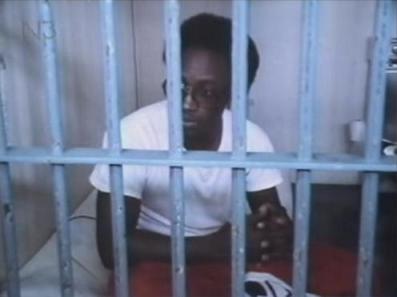
1987: Edward Earl Johnson, “I guess nobody is going to call”

On this date in 1987, murmuring “I guess nobody is going to call,”* Edward Earl Johnson was gassed for capital murder in Mississippi’s Parchman Farm prison.

Don Cabana, the prison warden who oversaw Johnson’s gassing, eventually resigned over his misgivings about carrying out executions and wrote this book about it.

Johnson was convicted of raping a white woman and killing the policeman who answered her distress call. These are no-nos for a young person of color in the South.

Johnson fought his execution for eight years on death row, insisting on his innocence even on his last walk to the gas chamber.

And the case against him looks pretty thin — supported, as these things so often are, mostly by a highly suspect confession Johnson miraculously coughed up when he was out on a drive with John Law. (This led the victim, who knew Johnson and had excluded him as the attacker, to decide he did it after all.)

Needless to say, Johnson’s state-appointed public defender was unable to make the most of these gaping lacunae in the state’s case.

Years later, the prison warden Don Cabana — who was on this date overseeing his very first execution, and was deeply shaken by it — recalled his charge’s fearful situation in testimony to the Minnesota legislature:

He insisted to the very end, somewhat oddly, that he did not commit the crime … my experience with condemned prisoners was always that once strapped to the chair, they came around somehow with something, if only something simple as “Tell the victim’s family I’m sorry,” “Tell my mother I’m sorry,” something that indicated something bad had happened, I was there and I was part of it.

But not so with this young man. When I performed my ritualistic function of asking if he had a final public statement, this young man looked me in the eye with tears streaming down his cheeks, and he said: “Warden, you’re about to become a murderer. I did not kill that policeman, and dear God, I can’t make anyone believe me.”

This is a musty old case by now, but with the growing awareness of false confessions as a contributing factor in wrongful convictions, it may soon come in for a long-overdue re-examination.

Johnson, unfortunately, does not have any prospect of an a-ha forensic science win. However, as with Cameron Todd Willingham‘s case, there’s simply no balance of evidence that should point a fair-minded present-day observer to a conviction beyond reasonable doubt, and a good deal that points to an affirmative conclusion of innocence.

As the (admittedly partisan) Wrongful Conviction: International Perspectives on Miscarriages of Justice sums up,

[t]he murder weapon was never connected to Johnson; indeed, no physical evidence linked Johnson to the crime. The case against Johnson is weakened by his claim of inadequate counsel, his immediate recantation of his confession, and his claim that his confession was produced under threat of death. Also, after Johnson’s execution, a young woman came forward claiming to have been with Johnson on the night of the murder, and claiming also that she had come forward during the investigation but was rebuffed by police.

Edward Earl Johnson is the subject of the riveting BBC documentary Fourteen Days in May.

* Quoted in the New York Times, May 21, 1987.

On this day..

1985: Mohammed Munir, Indonesian Communist

On this date in 1985, the onetime General Secretary of the Indonesian Communist Party (PKI) was suddenly executed for subversion.

Not to be confused with Egyptian pop singer Mohamed Mounir.

Though the date here says 1985, Munir was actually a very late casualty of the 1960s: specifically, the murky attempted “coup” of 1965 whose authorship the army quickly ascribed to the Communists and on that doubtful basis unleashed a ferocious bloodletting in 1965-66.*

Along with the hundreds of thousands of leftists slaughtered — many in Muslim sectarian violence, as distinct from being specifically hunted down by the army — some 200,000 wound up in prison.

According to a U.S. Department of Defense publication, Low-Intensity Conflict in the Third World (pdf),

the vast majority [of those 200,000 prisoners] were gradually released and rehabilitated during the first seven to 10 years of President Suharto’s New Order. By the mid-1970s, although Western sources could not agree on the remaining number, probably no more than 30,000 people remained in custody; but their living conditions and situations were often extremely bad. In the late 1970s, responding to the Carter administration, Vatican, The Hague, and Amnesty International remonstrances, the Suharto government implemented a series of staged, publicized releases of remaining PKI prisoners. All told, between 25,000 and 30,000 were released between 1977 and the early 1980s. In the early 1980s, most western sources estimated that no more than 5,000 hard-core PKI and other radical personnel remained in custody.

As the former head of the PKI-affiliated trade union SOBSI, Munir was “radical personnel” in the eyes of the Suharto dictatorship.

He’d been condemned on subversion charges in 1973, but the government had simply left that sort of people to rot in prison. (It had been five years between Munir’s arrest and his trial in the first place; clearly, nobody in Jakarta thought him a clear and present danger.)

According to this doctoral thesis,

On 14 May 1985 he was taken from his cell, and without explanation, shot. On 19 July 1985 there were further executions of Rustomo, Gatot, Lestario and Djoko Untung — all former senior members of the PKI in East Java. It was unclear whether the government had other agendas, or if the condemned had simply come to the end of a long, tedious and inhumane process … What the imprisonments and executions did, however, was to illustrate the continued power and convenience of state violence and anti-communism.

That “convenient” anti-communism helped clamp down on internal dissension.

The official campaigns made reformist sentiment in the civil service and the pro-democracy aspirations of students synonymous with communism. The fear generated served as a warning to progressive elements within the bureaucracy not to tamper … It was, in effect, a warning to all sections of society not to challenge the relationship between the ruler and the ruled.

* With the blessing of the West, naturally.

On this day..