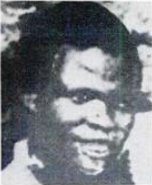
1985: Marvin Francois, back to Africa

On this date in 1985, Florida electrocuted Marvin Francois (to the disappointment of this unknown anti-death penalty protester).

Francois’s last statement, via Last Words of the Executed:

“I am as a grain of sand on the beach of the black race. The black race has lost its pride and dignity and is slowly dying from within and without. My death ends my tears, and the fortune of watching my race slowly die. If there is such a thing as an Antichrist, it ain’t one man, but the whole white race.”

Francois had donned a mask and, with a couple of confederates, stuck up a drug house in 1977.

The mask slipped, exposing Francois’s face — and the home invaders decided to murder the eight prisoners to keep them from making the ID. All were shot in the head execution-style.

Somehow, two survived to identify Marvin Francois. It was an easy conviction. (A confederate, Beauford White, was executed for the same crime in 1987.)

Once the death sentence was on the books, appellate attorneys developed a genuinely sympathetic profile of Francois’s background, if not his crime. A federal appeals court on the day before Marvin Francois died could not help but agree that

[t]he proffered evidence shows that Francois was the product of a sordid and impoverished childhood environment. His parents were not married. His father was a habitual heroin addict who never worked, who brought other addicts into the home for the ingestion of heroin in front of Francois when a child, and who beat Francois because he would not fight with other children when he was a boy. Francois’ mother often worked as a prostitute and was of little benefit to Francois during his childhood. She married but Francois’ step-father abused him. Francois grew up as a child of the street. At the same time he was smart, and although not finishing school, he obtained his G.E.D.

The behavioral scientists in their affidavits posit that “… some offenders, like Marvin Francois, are themselves victims of circumstances that shape their lives in ways beyond their deliberate control.” They suggest that given Francois’ chaotic antisocial upbringing, “clear mitigation of punishment compellingly surfaces.”

Nevertheless, the panel concluded that, given the extent of the crime (and his existing history of violence), all this sob-story stuff “would not have affected the sentencing outcome in this case had it been submitted to the jury.”

That was that.

It was a touching parting for at least one good friend on death row with him. “We wanted to send him out on a high,” a fellow-prisoner later remembered of sharing a last cigarette with Francois while imagining it a joint. “It took a little out of me when they killed him. I’d grown real attached to him.”

According to David von Drehle’s Among the Lowest of the Dead, that disattachment was rather unusually distant: Marvin Francois’s final resting place is … the sea off Dakar, Senegal.

Francois had asked that his ashes be scattered in Africa. Susan Cary, the longtime activist … was determined that this last wish would be honored. But it was one thing to find bus fare for a condemned man’s family, and quite another to raise the money for a trip to Africa. Cary collected the cremated remains of Marvin Francois and put them in a shoebox in her closet, where they sat for two years while she tried to figure out how to get them across the ocean.

In 1987, Michael Radelet, Cary’s frend and fellow activist, announced that he was going to Senegal to visit a relative. Take Marvin, Cary suggested. Radelet was game, but there were rules — human remains can’t just be toted from country to country. Uncertain as to the relevant legalities, Radelet contacted John Conyers, a prominent black congressman from Detroit; Conyers strongly opposed the death penalty, he was well known in Africa, and he had offered more than once to help Florida’s anti-death penalty crusaders any way he could. The congressman pulled the right strings, and shortly before his trip Radelete received an official letter announcing that the Senegalese government would be happy to welcome “Brother Marvin” home.

… Radelet had a darkly comic view of the world. Traipsing around Senegal, shoebox in hand, he would place the box on the opposite chair at restauants and say things like “Marvin, would you like some water?” On sightseeing jaunts, he would take snapshots of the shoebox in front of important buildings and picturesque vistas. Finally, Radelet carried the box to a bluff outside Dakar, a lovely spot with the city in the distance and the Atlantic spread out below. He took one more snapshot – “Marvin at the seashore” — then opened the box and sprinkled the ashes on the sun glittered waves. As he gazed into the oceanic expanse, it occurred to him that this very water might have rocked and sloshed all the way from Florida; now, the waves lapped the shores of Africa, bearing the remains of Marvin Francois to his dreamland.

The aforementioned Michael Radelet — now at Colorado University, not Florida — holding forth on more up-to-date death penalty trends:

On this day..

1989: Kehar Singh and Satwant Singh, assassins of Indira Gandhi

On this date in 1989, the last hangings at Delhi’s Tihar Jail dispatched two Sikhs for the assassination of Indira Gandhi.

Indira Gandhi (no relation to Mahatma Gandhi) was the daughter and political heir of Jawaharlal Nehru and one of the postwar world’s more remarkable political biographies.

Never averse to breaking a few eggs, Gandhi led her country (sometimes autocratically) for four terms from 1966 to 1984, sandwiched around a stint under a legal cloud for political corruption.

She backed East Pakistan’s breakaway from India’s neighbor and rival, but also negotiated a Kashmir settlement with her Pakistani opposite number; oversaw the Green Revolution; pushed ahead with a nuclear weapons program; maneuvered between American and Soviet foreign policy.

The omelet that cost her life was the June 1984 Operation Blue Star, when she had the Indian military storm a Sikh shrine that armed militants had turned into a virtual fortress, even using tanks and artillery in the shrine’s residential area.

Although the operation “worked,” hundreds — maybe a thousand or more — lost their lives and the shrine itself suffered heavy damage.

Sikhs were incensed — including, apparently, Beant Singh and Satwant Singh, two Sikh bodyguards of the Prime Minister who probably ought to have been reassigned. Maybe that’s just hindsight speaking, after they took the opportunity afforded by an escort assignment on Halloween 1984 to suddenly gun down their charge.

Beant Singh was shot down on the spot by other guards, but Satwant Singh was arrested.

He and Beant Singh’s uncle and alleged inciter Kehar Singh would later stand trial for their lives — but not before the assassination triggered an apparently government-blessed four-day anti-Sikh pogrom. The disturbing orchestration and four-figure body count of this infamous affair remain sensitive subjects on the subcontinent to this day, especially insofar as nobody has ever been punished for it.

The accused assassins were not so lucky — although they were more than content to accept martyrdom for avenging Operation Blue Star.

I have no hatred for any Hindu, Muslim, Christian, neither hatred for any religion. After my Shaheedi, let no Sikh throw any rock at any Hindu. I am not in favor of any retaliation or bloodshed over my Shaheedi. If we do create bloodshed, then there is no difference between us and Rajiv Gandhi. I am proud of the task that I did! I do ardas in front of Waheguru! If I am blessed with a human life, then give me a death of the brave when I am hanged. Forget one life, if I could I would give up a thousand lives to kill dushts like Indira Gandhi, and laugh as I become Shaheed by hanging.

Satwant Singh in court

The killers were then and are still held in high regard by many Sikhs. (Satwant’s fiancee even married his picture.)

Indira Gandhi’s son Rajiv Gandhi followed her as head of state — and followed her fate when he was assassinated by Tamil terrorists in 1991. The Nehru-Gandhi family remains a powerful force in Indian politics.

On this day..

1988: Adrian Lim and his two wives

On this date in 1988, a trio that had once formed an abusive family were all hanged in Singapore for their shocking ritual murders.


Top to bottom: Lim, Tan Mui Choo, and Hoe Kah Hong.

The Toa Payoh murders stunned Singapore in early 1981, when the brutalized bodies of a nine-year-old girl and a ten-year-old boy turned up in that district of the city-state.

A literal trail of blood led police from the second victim to a nearby seventh-floor flat cohabitated by a self-proclaimed spirit medium named Adrian Lim and his “holy wives” Tan Mui Choo and Hoe Kah Hong. In the apartment was a bevy skin-crawling incriminating evidence, like papers with the victims’ names written down, hairs later matched to the kids, and spatters of blood.

So this wasn’t a case so much for crime scene investigators as for psychologists.

Eschewing the forgettable life of a mere cable TV bill collector, a thirtysomething Adrian Lim had cultivated a side business in quack spiritualism in the early Seventies. He soon found this rewarding scam, in which troubled bar hostesses seeking personal guidance could be induced to pay him for a holistic regimen of eggs, needles, prayer to miscellaneous deities, and (often as not) sex with their “healer”, sufficient to support his lifestyle without further remuneration from the broadcast industry, so he went full time. And then he went right around the bend.

Even as a 9-to-5 desk jockey, Lim had already reeled in one depressed young woman as his live-in lover and business partner and willing enabler of Lim’s carnal con artistry. Lim did not scruple to pimp her out as a prostitute. This was Tan Mui Choo. (Click here for an interesting profile of a nun who counseled Tan Mui Choo, and later many other condemned prisoners, on death row.)

Hoe Kah Hong fell into Lim’s clutches a few years later, and although it was that young woman’s own mother who brought her in for Lim’s hocus-pocus, the charismatic witch doctor soon turned her against her family and moved her into the place, too. He eliminated Hoe’s husband by conning him into an electroshock treatment that Lim used to shock him dead.

This twisted family’s run of good luck and absurdly gullible customers came to an end late in 1980, when a cosmetics salesgirl whom Lim had drugged and raped (sometimes the spirits need a chemical assist with these things) started blackmailing him — and shopped him when he didn’t pay enough.

Under a pending sex-assault investigation, Lim conceived some bizarre plan to draw police attention away (or induce the goddess Kali to help him out of the pickle) by … murdering children. Makes sense, right?

It made enough sense to his holy wives to get them to help drug little Agnes Ng Siew Hock on January 24, 1981, help Adrian Lim rape her, help smother her with pillows, and help smear her blood on the apartment’s little sacrificial shrine. Two weeks later, they did much the same (less the rape) to Ghazali bin Marzuki. They were taken into custody the very next day.

While there’s little doubt about whether, the little matter of why was the topic on all Singapore’s lips.

In an eight-week trial that kept the public riveted with the ghastly and/or ludicrous particulars of the medium’s operation, dueling psychiatrists went front and center and measured out competing takes on the prisoners’ respective culpability. In he end, the draught was half-full for all three.

The trial’s “gruesome accounts of sexual perversion, the drinking of human blood, spirit possession, exorcism and indiscriminate cruelty” (Singapore Straits Times) made Lim a Bundy-esque object of public hatred; even others condemned to death refused to associate with him. He was the subject of the first feature-length domestic Singaporean film in English, 1992’s The Medium.

On this day..

1985: Benjamin Moloise, revolutionary poet

On this date in 1985, poet Benjamin Moloise was hanged in Pretoria for murdering a (black) policeman in apartheid South Africa.

Moloise’s controversial execution occurred in the context of violent resistance to apartheid in South Africa’s black townships and an ultimately fatal crisis for the apartheid state.

The black majority, long treated as second-class citizens by the white powers-that-be, turned to increasingly confrontational tactics aiming to break official power at the township level. Attacks on black officials and police officers who administered state authority at that level were part and parcel.

Moloise was convicted in a plot to kill such an officer in 1983. (The African National Congress claimed responsibility for the killing, and said that Moloise wasn’t involved.)

His hanging approached as the township rising grew into a mass movement that the hardline government of P.W. Botha answered mostly with force* — so, little surprise that Botha spurned both American and Soviet entreaties not to hang Moloise and little surprise that the execution further escalated racial violence.

Furious black protesters rioted in downtown Johannesburg itself, which (like much of white South Africa) had theretofore remained mostly immune to the violence gripping the townships. Here’s a French news report on Moloise’s execution and its aftermath.

All of which dovetailed with a dramatic fall in South Africa’s international position, vividly symbolized by the months-long collapse of the rand — which bled about three-quarters of its value in 1985. International outrage at the blood shed to enforce South Africa’s color line subjected it to a cascade of diplomatic and economic sanctions in the mid-1980s.

Apartheid went out with the Cold War at the end of the decade — vindicating Moloise’s poetic final message, subsequently a staple message at anti-apartheid rallies.

I am proud to be what I am …
The storm of oppression will be followed
By the rain of my blood

I am proud to give my life

My one solitary life.

* It had implemented a state of emergency that very summer. At the same time, Botha pursued tweaks around the edges of apartheid to preserve it: weeding out “petty apartheid” provocations like whites-only/coloreds-only facilities, and implementing a new constitution with a tricameral, race-based parliament.

Part of the Themed Set: Illegitimate Power.

On this day..

1983: Aleksandr Kravchenko, in Chikatilo’s place

On this date in 1983, Aleksandr Kravchenko was executed in the Soviet Union.

Kravchenko attempted to rape and then brutally strangled to death nine-year-old Lena Zakotnova in December 1978, dumping her body in a nearby river.

Oh … wait, no. That turned out to have been done by later-infamous serial killer Andrei Chikatilo: actually, Zakotnova was Chikatilo’s very first victim.

Sorry about beating that confession out of you, Sasha.

As for Russia’s present-day criminal justice system, there’s no more death penalty. But, “if a person ends up in a police cell as a suspect, he will find himself in court no matter what, and the court will find him guilty, guaranteed. And everyone knows it … you’ll end up in court, then straight to jail. The machine works automatically. It happens all the time.”

On this day..

1986: Jerome Bowden

A quarter-century ago this date, a “scared” mentally disabled prisoner named Jerome Bowden was electrocuted in Georgia for a crime many think he did not commit.

Bowden drew a death sentence for a robbery-murder on the strength of two very suspect pieces of evidence:

  • the accusation of a juvenile co-defendant who might well have been the real murderer; and
  • a signed confession Bowden could barely understand

While present-day DNA exonerations are fortunately forcing reconsideration of the ubiquitous problem of false confessions, Bowden’s was understandably doubted even before his execution.

Asked to explain his signature on a document obviously beyond his capacity to compose himself, he gave a confused answer that seemed to indicate he’d been led to sign it by a suggestion that it would keep him out of the electric chair.

“Detective Myles had told me this here … Had told me about could help me, that he could, you know, which I knew that confessing to something you didn’t take part in was-if you confess to something that you didn’t do, as if you did it, because you are saying that you did.”

(This remark inspires us to re-issue our occasional reminder: do not talk to the police.)

Bowden’s assent to this fatal “admission” sadly evokes the characteristic eagerness to please one often encounters in the developmentally disabled — sometimes, as with Joe Arridy, to their own destruction.

It’s noticeable, too, in Bowden’s incongruously ingratiating last statements, recordings of which were taken and subsequently leaked publicly. This and others are available at SoundPortraits.org.*

[audio:Jerome_Bowden_last_statement.mp3] [audio:Jerome_Bowden_last_statement_addendum.mp3]

Bowden had been evaluated with an I.Q. of 59 at the age of 14, the examiner reporting him “functioning at the lower limits of mild retardation. He has little or no insight into his situation … He is easily distracted and has a tendency to act on impulse regardless of the consequences.”

And even though the authorities hustled through a test the day before his execution that reckoned Bowden with an I.Q. of 65 — still solidly below the conventional threshold for mental disability, but good enough for the Georgia Board of Pardons and Paroles — the whole affair shook the state. It “unsettled more than a few persons in government and law enforcement,” the Atlanta Constitution later editorialized.

Its [the state’s] reasoning was grievously faulty. Whether Bowden understood his fate or not, whether he knew right from wrong — he was indisputably handicapped …

Most states have progressed beyond the dated right-wrong standard in weighing such cases … and ask: Could the defendant help himself? There is compelling evidence that Bowden could not …

brute whimsy was given full sway. For the state of Georgia, it was a willful lapse of decency.

Atlanta Constitution, July 1, 1986 editorial**

This lapse of decency rippled over the months ahead until Georgia in 1988 became the first state to enact a law barring the execution of the mentally disabled.

Maryland followed suit the next year, but the U.S. Supreme Court held in the 1989 decision Penry v. Lynaugh that executing such prisoners did not constitute “cruel and unusual punishment”.

While that decision was reversed in 2002, the putative ban on executing the mentally disabled in the United States remains very far from a bright line. It’s up to the states themselves to decide who falls under that definition,† and at least some have given ample indication that they’re prepared to exploit any expediency necessary to get a fellow onto death row, or keep him there. Earlier this very week, Texas (of course) put to death a man of dubious competence, Milton Mathis, essentially by cherry-picking its data and having federal appellate review barred on a technicality.

A quarter-century on, those ripples started by Jerome Bowden still have a way to go.

* We’ve previously featured another recording in this set of a particularly frightful botched electrocution.

** Both Constitution quotes, and the childhood IQ examiner quote, as cited in Robert Perske’s Unequal Justice?.

† As an irony of its early adoption, Georgia later found itself with an unusually stingy legal standard for protecting disabled defendants from the death penalty.

On this day..

1988: Stanislaw Czabanski, the last in Poland

On this date in 1988, in its last full year of Communist rule, Poland carried out its last hanging.

Stanislaw Czabanski, who killed a woman in Tarnow, was hanged in Krakow’s Montelupich Prison.

According to this 1996 survey of worldwide death penalty trends by British death penalty abolitionist Peter Hodgkinson,

In Poland, courts of regular jurisdiction rendered altogether 318 final death sentences between 1956 and 1988 (the last full year of communist rule), that is, on average, 10 death sentences per year … Seven death penalty sentences were passed on average each year in the 1960s; this number almost doubled in the 1970s. The decade of the 1980s was marked by the emergence of Solidarity, the first independent civic body ever in existence in a communist country, by the imposition of Martial Law in December of 1981, and by the repressive political climate in the subsequent years. However, one notices a pronounced decrease in the number of death sentences compared to the previous decade. Altogether sixty such sentences were passed between 1980 and 1988, an average of 7.7 per year … Jaruzelski‘s military regime used more carrots than sticks when dealing with the political opposition.

The contemporary artistic reflection of elites’ growing concern over capital punishment was the 1989 Krzysztof Kieslowski flick critiquing the death penalty in his Dekalog series.

Though Poland continued to hand out death sentences until the mid-Nineties, a moratorium on actual executions took hold.

One can, of course, never say what shall be for all time; while death penalty abolition was a condition for Poland’s European Union membership, the conservative-nationalist Kaczynski brothers have openly mooted reintroducing capital punishment.

On this day..

1984: Ronald Clark O’Bryan, candyman

Halloween lovers can thank Ronald Clark O’Bryan, executed just after midnight on this date in 1984,* for a major buzzkill.

O’Bryan spiked his own kids’ Halloween Pixy Stix with cyanide in an effort to kill off the urchins and collect the insurance. His 8-year-old son died.

Although O’Bryan was after his own kids, he might have given some out to the neighbors as well.

Nobody else died, or even got sick, but this was the era of the after-school special and satanic hysteria, so this pedestrian malefactor’s incidental connection to Halloween — after all, he could have just poisoned the kids’ Cheerios instead — metastasized into baseless urban legends of Stephen King villains spiking candy corn with rat poison and candy apples with razor blades.**

“The crime changed the way Texas youngsters, particularly those in the Houston area, celebrate Halloween,” the A.P. reported. “Some neighborhoods informally banned distribution of candy.”

Some nutbar kills his offspring for the insurance money back in the Ford administration, and that’s why you’re still getting crayons in your pillowcase sack. Crayons.

Siouxsie and the Banshees turned this creeper scenario to good effect in the 1986 song “Candyman”.

Beware the masked pretender
He always lies, this candyman
Those lips conspire in treachery
To strike in cloak and dagger, see!

Apparently you can lay a Rice Krispies treat at his grave in Forest Park East Cemetery.

* There are some reports out there of a March 30 execution, but newspaper accounts do appear to confirm that O’Bryan was put to death in the early moments of March 31, a Saturday.

** O’Bryan’s prosecuting attorney also still hates Halloween.

On this day..

1984: Maqbool Bhat, for Kashmir

On this date in 1984, India hanged Kashmiri nationalist Maqbool Bhat.

A terrorist to his enemies and a freedom fighter to his friends, Bhat was born in the Kashmir region back when it “was ruled by the Dogra Family and the entire Kashmiri nation was living a life of slavery.”

When Bhat was a nine-year-old child, the prince of Jammu and Kashmir inked a bitterly controversial accession of his domain to the foundling independent nation of India. Kashmir has been hitched to the adjective “troubled” ever since.

The broader Kashmir region remains a warren of competing claims among Pakistan, India, and China. Bhat operated not for any of these governments, but for Kashmiri independence … and since he came of age in the revolutionary twilight of colonialism, he did not shy from putting the fight in freedom fighter. Bhat was an early exponent of an armed independence struggle.

Both India and Pakistan proscribed as terrorist Bhat’s Jammu and Kashmir National Liberation Front (forerunner of the still-extant JKLF, which is the same acronym less the middle letter); both those longtime subcontinent antagonists arrested Bhat at different times for subversive activities. The most notable: Bhat engineered an airplane hijacking in 1971 to push his cause onto the world’s front pages.

But the hostage-taking game came a-cropper for the Kashmiri rebel.

Languishing under a dormant death sentence for the 1968 murder of an Indian policeman,* Bhat unexpectedly became the focus of his fellow-travelers’ revolutionary ardor: in Birmingham, England, Kashmiri activists kidnapped Indian diplomat Ravindra Mhatre in an attempt to force a hostage exchange.

When Delhi refused to deal, the captors executed Mhatre. Within days, India traded tit for tat by stringing up Bhat — a man who in life had been known for his boast that “nobody has the rope which can hang men.”

They may not have got their man, but they sure got a martyr.

Five years after Bhat’s execution, Kashmir finally broke into armed revolt — Bhat’s very own project, and one that has claimed tens of thousands of lives in the succeeding years.

That movement repeatedly demands the return of Bhat’s remains for burial. It annually marks this anniversary of his martyrdom with tributes and strikes.

* Bhat’s partisans insist that he was wrongly accused.

Update: Reprint of a 1984 article, “The last days of Maqbool Butt”

On this day..

1981: Cipriano, Eugenio, and Ventura García-Marín Thompson

In the early morning hours this date in 1981, three young Jehovah’s Witnesses were hailed out of their cells at Havana’s La Cabaña Fortress, and apparently executed.

Cipriano, Eugenio and Ventura Garcia-Marin Thompson were three of eight Cuban Witnesses who attempted to claim asylum at the Vatican embassy in early December. After a few hours’ standoff, elite government anti-terrorism troops simply broke in and seized them.

(Rome still catches flak (Spanish link) for its failure to maintain a bigger diplomatic ruckus about this violation of its diplomatic prerogatives; the raid may in fact have been green-lighted by a Vatican embassy official.)

You’ll find this tale most commonly expounded on anti-Castro sites, such as this pdf from the Cuba Archive:

The three brothers were taken to Villa Marista headquarters and told by prosecutor Carlos Amat that they had been “tried and sentenced to death.” They were taken from their prison cells in early morning hours of January 2, 1981, and presumably executed, the others were sentenced to long prison terms.

An Interior Ministry official who defected in 1992 reported that their fate had been decided in “an extremely summary process.” The family was denied the remains of the three brothers for burial. The mother was sentenced to 20 years in prison for protesting the executions and served ten years after her mental health deteriorated.

Sources: Testimony of Margarita Marin Thompson (mother) in Ricardo Bofill, Diario Las Américas, September 9, 1997. Pablo Alfonso. El Nuevo Herald, 31 October 1997, p. 6A. Valladares, 1985, p. 416. Amnesty International Annual Report 1983, p. 130. Nuestra Cuba, 1998, p. 3. Reader’s Digest, October 1998, p. 83. Montaner, 1984, p. 267. Cuban American National Foundation, The Quilt of Fidel Castro’s Genocide, 1994. Reinaldo Bragado, 1998, p. 5. Instituto de la Memoria Histórica Cubana contra el Totalitarismo, 2002, p. 35. Fuentes 2002, p.s 102-104. Juan O. Tamayo, “Ex-Cuban prosecutor’s role in rights panel criticized,” The Miami Herald, April 16, 1998. Circuito Sur, July 2002, p. 35, and http://members.aol.com/aguadacuba/cs/datafusi/vaticano.htm.

On this day..