1934: John and Betty Stam, China missionaries

On this date in 1934, Chinese Communists beheaded John and Betty Stam in the Anhui province town of Miaoshu.

The Stams had settled as China Inland Mission proselytizers in the town of Jingde (at their time generally rendered as “Tsingteh”). Betty Stam (nee Scott) had grown up in China, the daughter of a Presbyterian missionary. John was a New Jersey native who had graduated Moody Bible Institute in 1932. They had a three-month-old daughter named Helen Priscilla.

On December 6, 1934, Communist rebels in China’s long-running civil war entered Jingde and seized the foreign family. According to a tribute page kept by a great-nephew of the, John wrote a short note that evening.

Tsingteh, An.
Dec. 6, 1934

China Inland Mission, Shanghai

Dear Brethren,

My wife, baby and myself are today in the hands of the Communists in the city of Tsingteh. Their demand is twenty thousand dollars for our release.

All our possessions and stores are in their hands, but we praise God for peace in our hearts and a meal tonight. God grant you wisdom in what you do, and us fortitude, courage and peace of heart. He is able-and a wonderful Friend in such a time.

Things happened so quickly this a.m. They were in the city just a few hours after the ever-persistent rumors really became alarming, so that we could not prepare to leave in time. We were just too late.

The Lord bless and guide you, and as for us, may God be glorified whether by life or by death.

In Him,
John C. Stam

The author of John and Betty Stam: Missonary Martyr summarizes his subjects’ “inspiring and instructive story” in a blog post here.

A foreboding message, but Christian evangelizing in China had often proved dangerous to its practitioners.

The next day they were marched 12 miles to Miaoshu where they stopped for the night. Facing martyrdom, the couple stowed their daughter away like Moses, hidden in a sleeping bag with John’s last missive and ten dollars that might serve to care for her.

Miraculously, Helen Priscilla would be overlooked when the Stams’ captors came for them on December 8 and marched them through Miaoshu. It’s said that one Chinese vendor made bold to object, and was added to the doomed party for his trouble. At the end of the march, John was forced to his knees and beheaded before his companions’ eyes; Betty and the shopkeep followed him.

Little Helen survived her parents’ ordeal. A Chinese evangelist named Lo found the girl and carried her 100 miles to a mission hospital. She was taken in from there by Betty’s parents and eventually adopted by Betty’s sister and raised in the Philippines before returning to the United States.

Back in China, another missionary, Frank Houghton, was moved by the sacrifice of the Stams to compose a hymn, “Thou Who Wast Rich Beyond All Splendour” (set to an old French canticle, Quelle est cette odeur agréable?).

On this day..

1886: Twenty-two Uganda Martyrs

(Thanks to Meaghan Good of the Charley Project for the guest post. -ed.)

On this date in 1886, thirteen Catholic men and boys, as well as nine Anglican Christians, were burned alive in Buganda, a kingdom in modern-day Uganda. Most of them pages at the royal court, they had been martyred for their faith.

The kingdom of Buganda came in contact with Europeans in the 1860s; Arab traders had been doing business there a few decades before that. Christian missionaries arrived in Buganda in 1879. In the next few years many court officials converted.

King Muteesa I tolerated Muslims, Catholics and Protestants and played them off against other for political gain, but his sixteen-year-old son, Mwanga II, who ascended the throne in 1884, was a different story altogether. He saw Christianity as a serious threat to his authority and cracked down on its influence.

Mwanga expelled many missionaries ordered converts to renounce their faith on pain of death. He had James Hannington, the Anglican Bishop of Eastern Equatorial Africa, executed in October 1885.

Between 1885 and 1887, Mwanga ordered the deaths of 45 Christian men (22 Catholics and 23 Anglicans). Collectively they are known as the Martyrs of Uganda. Most of them were young. (One of the boys who would die on this day was all of fourteen years old.)

Joseph Mukasa was the first of the Martyrs to die. A page and personal attendant to King Muteesa, he became majordomo after Mwanga took the throne, and had permission to criticize the king. He had converted to Roman Catholicism in 1882. Mukasa had strongly urged Mwanga to spare Bishop Hannington’s life.

For his pains, Mukasa was himself executed and his body burned only two weeks after Hannington. The chief page, Charles Lwanga, became majordomo in his place.

That very same day, Lwanga went and got himself baptized. He was a Catholic catechist, and he anticipated the cup he was about to quaff. The Dictionary of African Christian Biography records:

The following day, the king assembled all the pages and demanded under pain of death that they confess their Christian allegiance. All of them, Catholic and Anglican, except for three, did so. Mwanga was baffled by the solidarity and constancy of the young Christians, but hesitated to carry out his threat to kill them all. Several times in early December the king attempted to intimidate his pages, in spite of visits from the Catholic and Anglican missionaries. On one occasion, Lwanga exclaimed that, so far from helping the white men to take over the kingdom, he was ready to lay down his life for the king.

After the fire in the royal palace on February 22, 1886, Mwanga moved the court temporarily to his hunting lodge at Munyonyo on the shore of Lake Victoria. Here Lwanga continued to protect the pages … and to prepare them for possible martyrdom. By this time, Mwanga had obtained the consent of his chiefs for a massacre of the Christians. Meanwhile, Lwanga himself baptized five of the most promising catechumens. On May 26 … the pages entered the royal courtyard to receive judgement. Once again, they were called upon to confess their faith. This they did, declaring that they were ready to die rather than to deny it. Mwanga ordered them all, sixteen Catholics and ten Anglicans, to be burnt alive at Namugongo.

Several of the condemned were killed before the main event. The oldest, Matthias Kalema, aged about fifty, was dismembered alive and pieces of him were roasted before his eyes. He died slowly and horribly over the course of three days, finally expiring on May 30. Three others collapsed during the march to the execution site in Namugongo and were killed on the spot.

One of them, however, was inexplicably spared at the last possible moment. Denis Kamyuka was pulled away from the fire by some of the soldiers. It’s worth noting that Kamyuka appears to have been among the youngest of the group, around thirteen or fourteen; perhaps his executioners took pity on him for this reason. It is from his testimony that we know the details of what happened to his friends.

Everyone prayed and recited the catechism on the way to their deaths. Each of the pages were bound and wrapped up in reeds before being placed alive in the bonfire. The exception was Mbaaga Tuzinde, the son of the chief executioner; his father, who had pleaded for him to renounce his religion and offered to hide him, ordered that he be clubbed to death before being put into the flames.

Charles Lwanga, their leader, was burned separately from the others and was allowed to arrange his own pyre. As the executioners taunted him he said, “It is as if you are pouring water on me.”

In 1888, Christian and Muslim converts deposed King Mwanga in a British-backed uprising and put his brother on the throne in his place. Mwanga got his crown back in 1889 after he agreed to turn partial control of Buganda to the British East Africa Company. In 1897, however, he declared war on the British and attacked them. Trounced within weeks, Mwanga fled the country and was deposed in absentia. He returned with an army, but was defeated again, this time for good, and exiled to the Seychelles. In the final years of his short life he converted to Anglicanism. He died in 1903, aged 35.

The 22 Catholic converts who were martyred in Uganda during Mwanga II’s reign were beatified in 1920. Denis Kamyuka was present at the ceremony.

The site where the Uganda Martyrs were burned is now a holy shrine, a 33-acre site marked by a distinctive conical building. Every year on this date, pilgrims come there to commemorate Uganda Martyrs Day.


Re-creation of the burning on-site at the shrine. (cc) image from Christian von Schack.

On this day..

1762: Francois Rochette and the Grenier brothes, the last Huguenot martyrs in France

In September 1761, a man named Francois Rochette was detained in Toulouse, France, having been arrested traversing the nearby countryside on suspicion of being one of that area’s robbers.

Rochette was not a robber.

He was much, much worse: a Huguenot minister.

Interrogation soon made the situation clear. Technically, his heretical calling could subject Rochette to the death penalty, but the authorities weren’t going to be unreasonable about this — and “as Rochette was not surprised in the exercise of his function, he might easily have escaped by concealing his profession. Those, who interrogated him went even so far as to point out to him this means of acquittal.”

Every legal regime needs a bit of discretion, a bit of look-the-other-wayism, lest the letter of the law excite a judicial slaughter that public sentiment could never support.

Francois Rochette wasn’t interested in signing himself off a clerk or a cloth-merchant and being on his cagey way. He would not elide his calling: would not abet an other-way look.

Rochette’s obstinately overt Protestantism and the prospect of juridical proceedings against him put the whole city on edge. Catholics and Huguenots armed themselves, bracing for a horrid St. Bartholomew’s Day replay. Three brothers named Grenier hastened to Toulouse to aid their fellow-Huguenots, and were arrested; miraculously, the feared citywide bloodbath never quite materialized.

But now Francois Rochette and his Grenier backers would stand trial, in an environment where authorities were disposed to view their offense as one not merely of wrongthink but of stirring up a civic disturbance and endangering the city itself. They were accordingly condemned to death by a now-stringent court for their literally dangerous heresy on February 18, 1762.

That night, the Huguenots’ last on earth, inevitably featured a visitation of Catholic priests come to save their souls.

“It is for your salvation,” said they, “that we are here.” The answer of one of the prisoners was, “If you were at Geneva, ready to die in your bed (for no one is slain there on account of his religion), would you be pleased if four ministers came, under the pretence of zeal, to persecute you until your last breath? Do not, then unto others that which you would not wish to be done unto yourselves.”

This is from the public-domain History of the Protestants of France, to whom we turn the fatal narration.

On the 19th of February, at two o’clock in the afternoon, the mournful procession started on its way. Rochette was, according to the terms of the sentence, bare-headed, bare-footed, with a halter hung about his neck, from which, before and behind, labels were suspended, with these words, Minister of the pretended Reformed religion.

When the array passed before the church of Saint Etienne, an attempt was made to force him, in pursuance of the terms of the Parliament’s condemnation, to kneel with a torch of yellow wax in his hand, and to ask pardon of God, the king, and justice, for all his crimes and misdeeds.

Rochette stepped down from the tumbril, and instead of abjuring or making a confession which his heart denied, he pronounced on his knees the following words: “I beseech God to pardon me for all my sins, and I firmly believe that they have been washed away by the blood of Jesus Christ, who has redeemed us so dearly. I have no pardon to ask of the king, whom I have ever honoured as the Lord’s annointed, and loved as the father of my native land; I have ever been a good and faithful subject, and of this I believe my judges to be convinced. I have always preached to my flock patience, obedience, and submission; and my sermons, which you possess, are summed up in these words: ‘Fear God, honour the king.’ If I have contravened the law touching religious assemblies, it was by God’s commandments I contravened them; God must be obeyed before men. As for justice and the law, I am guilty of no offence against them, and I pray God may pardon my judges.”

Every door, balcony, window, roof, and approach near to the place of execution, was covered with spectators. “Toulouse,” says Count de Gebelin, an eye-witness, who related these circumstances, “Toulouse, that city drunk with the blood of martyrs, seemed a Protestant town. People asked what was the creed of these heretics; and when they heard our martyrs speak of Jesus Christ and of his death, every one was surprised and afflicted. They were infinitely touched, also, with the lofty, yet mild bearing of the three brothers, which compelled their admiration almost as much as the inexpressible serenity of the minister, whose graceful and spiritual physiognomy, whose words full of firmness and courage, and whose youth, filled every beholder with interest, knowing, as all did, that he only died because he disdained to save his life by a lie.”

Rochette was executed first. He exhorted his companions until the end, and sang the canticle of the Protestant martyrs: This is the blessed day. “Die a Catholic,” said the executioner, moved with pity. “Judge which is the better religion,” replied Rochette, “that which persecutes, or that which is persecuted.”

The youngest of the thre brothers (he was only twenty-two years of age), hid his face in his hands to shut out this tragic scene. The two others contemplated it with calmness. As they were gentlemen, their sentence was, to be beheaded. Tyembraced each other, recommending their souls to God. The eldest offered his head to the axe first. When it came to the turn of the last, the executioner said: “You have seen your brothers die; change, lest you perish like them.” “Do thy duty,” said the martyr, and his head rolled upon the scaffold.

Count de Gebelin adds, as he concludes his recital: “Everyone present returned home in silence, in a state of consternation, and unable to persuade themselves that there could be such courage and such cruelty in the world; and I, who describe it, cannot refrain from tears of joy and sadness, as I contemplate their blessed lot, and that our church should be still capable of affording examples of piety and firmness that will compare with the most illustrious monuments of the primitive church.”

It was only days later — March 10, 1762 — that Toulouse followed up this example of piety and firmness by breaking Jean Calas on the wheel in another prosecution of a Huguenot driven by sectarian sentiment (albeit not directly for heresy, in the Calas case).

Backlash against the Calas case, led by Voltaire, helped put to the fore the long-percolating Enlightenment values of tolerance. Official persecution of Protestants slackened greatly in the years to come and never again rose to a death penalty situation; the whole policy was officially revoked in 1787.

On this day..

Feast Day of St. Jude

This is the feast date (in Christianity’s western tradition) of Saint Jude.

Possibly one of the bit players among Jesus’s original 12 apostles — “Jude”/”Judah”/”Judas” was a common name among first-century Israelites, so there’s some confusion about the identities among various texts talking about various (?) Judes — St. Jude is aptly-for-this-blog considered the patron saint of “lost causes” or “situations despaired of”.

He’s traditionally supposed to have knocked around the eastern Mediterranean after the Nazarene‘s crucifixion, introducing Christianity (along with St. Bartholomew) to Armenia, which eventually became the first officially Christian kingdom. (Jude is also a patron saint of Armenia; his other patronage gigs include the Philippines, the Chicago Police Department, a a Brazilian football club, and countless hospitals.)

Despite making so many sad songs better, Jude was eventually martyred, possibly in Armenia, allegedly by halberd; as a consequence, that sinuous poleaxe is Jude’s iconographic symbol on the relatively rare occasions when he’s artistically depicted. It’s also something you can buy in pendant form: come on … embrace The Halberd. But again, there are different versions as to who martyred Jude and where, and considerable confusion over how many Judes those versions might be conflating.

At any rate, for those up against the executioner and despairing of any but the most improbable deliverance, St. Jude is your man.

There’s even St. Jude software which prevents execution … of rootkit exploits.

I, Francis Steinernherz, will be the first noble of my profession, where I shall have despatched one more knight of the Empire.”

“Thou hast been ever in my service, hast thou not?” demanded De Hagenbach.

“Under what other master,” replied the executioner, “could I have enjoyed such constant practice? I have executed your decrees on condemned sinners since I could swing a scourge, lift a crow-bar, or wield this trusty weapon; and who can say I even failed of my first blow, or needed to deal a second? The term of the Hospital, and his famous assistants, Petit Andre, and Trois Eschelles, are novices compared with me in the use of the noble and knightly sword. Marry, I should be ashamed to match myself with them in the field practice with bowstring and dagger, these are no feats worthy of a Christian man who would rise to honor and nobility.”

“Thou art a fellow of excellent address, and I do not deny it,” replied De Hagenbach. “But it cannot be — I trust it can — not be — that when noble blood is becoming scarce in the land, and proud churls are lording it over knights and barons, I myself should have caused so much to be spilled?”

“I will number the patients to your excellency by name and title,” said Francis, drawing out a scroll of parchment, and reading with a commentary as he went on, — ” There was Count William of Elvershoe — he was my assay-piece, a sweet youth, and died most like a Christian.”

“I remember — he was indeed a most smart youth, and courted my mistress,” said Sir Archibald.

“He died on St. Jude’s, in the year of grace 1455,” said the executioner.

-Sir Walter Scott, Anne of Geierstein

On this day..

1865: Paul Bogle

On this date in 1865, Baptist deacon Paul Bogle was hanged at the Morant Bay courthouse for his part in that locale’s eponymous rebellion.


Third World’s “1865 (96 degrees in the shade)” celebrates Paul Bogle: “Today I stand here a victim the truth is I’ll never die”

Bogle helped lead of the protests-cum-riots that became that rebellion.

Baptists played an essential role in the affair, which has led some to call it the “Native Baptist War”. And indeed, Baptism had long intertwined with underclass resistance: Jamaica’s most famous slave rebel, Samuel Sharpe, was also a Baptist deacon. A previous royal governor in Jamaica had once warned that “the worst evil which hangs with a menacing aspect over the destinies of this island is the influence exercised with baneful effect by the majority of Baptist missionaries.”

From the standpoint of the powerful in Jamaica and Britain, 1865 would vindicate that warning.

A (white) Baptist missionary named Edward Underhill had penned a January 1865 letter bemoaning the miserable condition of most Jamaicans and starkly disputing received wisdom that blacks were just too lazy to work: “The simple fact is, there is not sufficient employment for the people; there is neither work for them, nor the capital to employ them.” (Underhill later wrote a book on the events, The tragedy of Morant Bay, a narrative of the distrubances in the Island of Jamaica in 1865.)

Underhill’s letter got into public circulation and as a result there were a number of “Underhill meetings” perhaps comprising an “Underhill movement” on the island in 1865 — essentially a going social campaign that rooted deeply in Jamaica’s native Baptist communities. Though “native Baptists” is a vague term, it distinguishes not only black from white but, in the words of Mary Turner, a whole “proliferation of sects in which the slaves developed religious forms, more or less Christian in content that reflected their needs more closely than the orthodox churches, black or white.”

William Gordon had switched his religious allegiance to native Baptist and was known to speak at Underhill meetings: that’s part of what got him hanged.

Likewise, our day’s focus, Paul Bogle, was a native Baptist minister, in the St. Thomas-in-the-East parish — and it was the protest of Bogle and his supporters against an unjust prosecution that started the whole rebellion off.


Statue of a militant Paul Bogle (that’s a sword in his hands) outside the Morant Bay courthouse where all the trouble started. (cc) image from dubdem sound systems.

There was, accordingly, an immediate reward out on Bogle’s head, and an immediate demonization in the respectable English press. There, he was “the notorious Paul Bogle,” in the words of one letter to the editor (London Times, Nov. 18 1865), in whose Baptist chapel rebellious “panthers” wantonly “drank rum mixed with gunpowder and the brains of their victims.”

By the time that letter had been dispatched, Bogle’s purported orgies had long since been interrupted: captured by Maroons, he was delivered to custody, instantly tried, an hanged that very day in a batch of 18 rebels.

A horror to Victorian planters, Bogle has won the reverence of posterity as a freedom fighter and national hero.


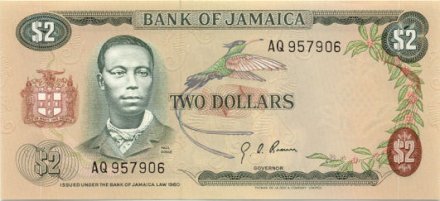
Paul Bogle on the (now out-of-circulation) Jamaican two-dollar bill.

On this day..

1895: The Vegetarian perpetrators of the Kucheng Massacre

On the morning of September 17, 1895, in the presence of the British and American consuls, seven perpetrators of a Chinese massacre of western Christian missionaries were beheaded at Foochow.

Anticipating the better-known Boxer Rebellion by four years, the Kucheng Massacre (there are many other transliterations of “Kucheng”) was likewise a response to the Celestial Empire’s frustrating second-class status as against European interlopers.

Christian missionaries had been a point of friction in China for decades. Though their rights to proselytize had been guaranteed in a hated treaty dictated to China by force of arms, they often met resentment or worse on the ground.

“You bring incense in one hand, a spear in the other;” one evangelist reported being told: that is, however honorable the immediate intentions of many individual missionaries, their presence looked like a stalking horse for less reputable western interventions like the opium trade. (That’s how it looked to many Chinese. Professional western diplomats themselves found the impolitic preachers a hindrance to their statecraft, according to Ian Welch’s 2006 paper “Missionaries, Murder and Diplomacy in Late 19th Century China: A Case Study” (pdf).*)

On August 1, 1895, these frustrations unleashed a river of blood at the village of Huashan in Gutian County, where a Buddhist secret society — known as “Vegetarians” in the western press for their characteristic dietary vow — fell upon a group of vacationing British Anglican missionaries still abed at dawn and ruthlessly slaughtered eleven of them. (There are some 1890s books paying tribute to the fallen available online: Robert and Louisa Stewart: In Life and in Death, and The sister martyrs of Ku Cheng : Memoir and Letters of Eleanor and Elizabeth Saunders (“Nellie” and “Topsie”) of Melbourne.)

“The attack came,” said a physician from a nearby town who was summoned to the bloody scene, “like a thunderbolt from a clear sky, not one of the victims having received the slightest intimation of the intended assault.”

Word of the carnage struck western powers with similar force.

Incensed newspaper-readers literally demanded** gunboat diplomacy, and literally got it, especially when Chinese authorities drug their feet on the condign punishment the missionaries’ countrymen were clamoring for.

All this put British diplomacy on a sticky wicket, which Welch (pdf) deals with in detail. To satisfy the domestic audience, the government had to be seen to be taking a hard line on avenging the outrages; at the same time, London was wise to the Chinese state’s shakiness and wary that a “barbarous holocaust” perpetrated against the Vegetarians would trigger a mass backlash and bring the whole thing down.

An obdurate Chinese viceroy impeded the quick resolution everyone was after by making inflammatory public proclamations against Christians, and releasing without explanation six of the thirteen men who had initially been condemned to death in the month of August. The seven who were executed on this date were therefore only the vanguard of 26 humans ultimately put to death for their involvement in the atrocity.

Some of the execution photographs that follow are Mature Content. They’re obtained via Visual Cultures in East Asia; some also available at USC Digital Library.


Raids and investigations to bring the Vegetarian movement to heel continued for several months thereafter, and the whole affair ultimately was quelled without doing any of the wider damage that might have been feared — not even to missionaries who continued pouring into China.

And that, effectively, kicked the can down the road on the anti-foreigner sentiments afoot in the land … sentiments that would find much costlier expression a few years later when another secret society kicked off the Boxer Rebellion.

* I’ve relied heavily on Welch for this post. He’s also collected a massive trove (over 1,200 pages) of primary documents from this incident available in a series of pdfs (some quite large) from the Australian National University website:

** This was not universally so. The wife of missionary Stephen Livingston Baldwin, who knew some of the victims of the attack, urged a “charitable” response and sensitivity that “the Chinese feel that all the world is against them, and they are not far from right.” (New York Times, Aug. 10, 1895) In letters responding to intemperate coverage elsewhere, she acidly compared (pdf) western editorialists’ high dudgeon to their look-forward-not-back dismissal of recent stateside anti-Chinese violence.

It was ten years yesterday since more Chinese were killed, and burned alive and left to die wounded, in one hour, at Rock Springs, Wyoming (the very same Territory in which the recent massacre occurred) than have been Americans and English in China in the thirty-four years I have personally known that land, being a resident there twenty years and closely connected with it ever since. Ten years yesterday since that awful Rock Springs massacre, and up to date no one arrested, much less punished! The anti-Chinese papers of the town and neighbourhood gloating over the awful details and assuring all that there would be “no Congressional investigation,” and no waste of “enterprising newspaper eloquence” over the woes of the Chinese, “though their blood flow like rivers, as they had no votes and no friends.” In less than four weeks after the Ku-Cheng massacre, arrest, investigation and execution have all taken place for the Ku-Cheng massacre. Would that our colored, red and yellow brethren, so helpless in our so-called civilized and Christian land, had some power behind them to bestir Ministers Plenipotentiary, wave flags, and run gunboats to the front, to bully, if necessary, our pusillanimous Government into some sort of civilization — I will not say Christian justice!

On this day..

Feast Day of St. Euphemia

This is the feast date of early Christian martyr St. Euphemia.

Euphemia the “All-Praised” (that’s an Eastern construction; both east and west honor her martyrdom on September 16) died in the Asia Minor city of Chalcedon around 307. That would place her at the tail end of the Diocletianic persecutions, the part that actually came after said Diocletian retired to his cabbages and left the care and feeding of the eastern empire to Galerius.

Euphemia is said to have been the daughter of a senator, but went off and took vows of chastity and avoided sacrificing to Ares. Like many early martyrs, she is supposed to have survived various creative Roman execution attempts thanks to angelic protection, before the pagans just gave up and pitched her into the arena for the classic Christians-vs.-Lions showdown.

Euphemia would be credited with a supernatural intervention of her own a century and a half after her death.

The 451 Council of Chalcedon, meeting at a cathedral consecrated to St. Euphemia in her native city, featured orthodox Christianity attempting to bring to heel the “heresies” disputing the eminently disputable nature of Christ.

God + man? How does that work?

Monophysites, a substantial minority in the east at that time, took the position that Christ had only one single nature, rather than the view still mainstream to Christianity that Christ had both divine and human natures simultaneously. Among well-educated people sensitive to historicity, it’s the sign of a gross prejudice towards the secular and the modern to consider it absurd that humans spent decades at one another’s throats over this sort of hairsplitting, but seriously … humans spent decades at one another’s throats over this sort of hairsplitting.

But memo to Monophysites: do not get Saint Euphemia involved unless you’re ready for a faceful of hypostasis all up in your christology.

The story goes that at Chalcedon, two quarrelsome prelates representing the orthodox and Monophysite positions submitted the matter to the holy martyr’s adjudication by each leaving an apologia in her tomb. Three days of fasting and praying later, they opened the tomb and found the orthodox manifesto in Euphemia’s right hand, and the heretical manifesto at her feet. As the synod gloated to the (very orthodox) Pope Leo I,

it was God who worked, and the triumphant Euphemia who crowned the meeting as for a bridal, and who, taking our definition of the Faith as her own confession, presented it to her Bridegroom by our most religious Emperor and Christ-loving Empress, appeasing all the tumult of opponents and establishing our confession of the Truth as acceptable to Him, and with hand and tongue setting her seal to the votes of us all in proclamation thereof.

Euphemia’s relics today rest in Rovinj, Croatia, and are not available for settling metaphysical debates.

On this day..

1680: A Madrid auto de fe

On this date in 1680, the Spanish capital of Madrid celebrated an enormous auto de fe, culminating with 18 executions plus eight people posthumously burned and 22 fugitives “executed” in effigy. (Source of the numbers)

This signal event needed every drop of sunlight from the long summer’s day. Staged for the appearance of the royal family itself, it likewise pulled in every available case from around Spain: the regional cities shipped their apostates and heretics to Madrid to dignify the main event with a suitable quantity of prey.

It began with a morning ceremonial procession of prisoners, nearly a hundred — every source seems to have a slightly different figure — in the traditional Inquisitorial manner. This account comes from an English contemporary, as reprinted in Human Judgment: The Eye of the Beholder. (Note: paragraph breaks added, and ubiquitous capitalization of nouns removed, for better readability.)

A scaffold, fifty feet in length, was erected in the Square, which was raised to the same height with the balcony made for the King to sit in. At the end, and along the whole breadth of the scaffold, at the right of the King’s balcony, an amphitheatre was raised, to which they ascend by twenty-five or thirty steps; and this was appointed for the Council of the Inquisition, and the other Councils of Spain. Above these steps, and under a canopy, the Grand Inquisitor’s rostrum was placed so that he was raised much higher than the King’s balcony. At the left of the scaffold and balcony, a second amphitheatre was erected of the same extent with the former, for the criminals to stand in.

A month after proclamation had been made of the Act of Faith, the ceremony opened with a procession [on June 29], which proceeded from St. Mary’s church in the following order. The march was preceded by an hundred coal merchants, all arm’d with pikes and muskets; these people furnishing the wood with which the criminals are burnt. They were followed by Dominicans, before whom a white cross was carried. Then came the Duke of Medina-Celi, carrying the Standard of the Inquisition. Afterwards was brought forwards a green cross covered with black crepe; which was followed by several grandees and other persons of quality, who were familiars of the Inquisition. The march was clos’d by fifty guards belonging to the Inquisition, clothed with black and white garments and commanded by the Marquis of Povar, hereditary Protector of the Inquisition.

The procession having marched in this order before the palace, proceeded afterwards to the square, where the standard and the green cross were placed on the scaffold, where none but the Dominicans stayed, the rest being retired. These friars spent part of the night in singing of psalms, and several Masses were celebrated on the altar from daybreak to six in the morning. An hour after, the King and Queen of Spain, the Queen-Mother, and all the ladies of quality, appeared in the balconies.

At eight o’clock the procession began, in like manner as the day before, with the company of coal merchants, who placed themselves on the left of the King’s balcony, his guards standing on his right (the rest of the balconies and scaffolds being fill’d by the embassadors, the nobility and gentry).

Afterwards came thirty men, carrying images made in pasteboard, as big as life. Some of these represented those who were dead in prison, whose bones were also brought in trunks, with flames painted round them; and the rest of the figures represented those who having escaped the hands of the Inquisition, were outlaws. These figures were placed at one end of the amphitheatre.

After these there came twelve men and women, with ropes about their necks and torches in their hands, with pasteboard caps three feet high, on which their crimes were written, or represented, in different manners. These were followed by fifty others, having torches also in their hands and cloathed with a yellow sanbenito or great coat without sleeves, with a large St. Andrew’s cross, of a red colour, before and behind.


Detail view (click for the full image) of a Goya painting of Inquisition prisoners in the sambenito.

These were criminals who (this being the first time of their imprisonment) had repented of their crimes; these are usually condemned either to some years imprisonment or to wear the sanbenito, which is looked upon to be the greatest disgrace that can happen to a family. Each of the criminals were led by two familiars of the Inquisition.

Next came twenty more criminals, of both sexes, who had relapsed thrice into their former errors and were condemn’d to the flames. Those who had given some tokens of repentance were to be strangled before they were burnt; but for the rest, for having persisted obstinately in their errors, were to be burnt alive. These wore linen sanbenitos, having devils and flames painted on them, and caps after the same manner: five or six among them, who were more obstinate than the rest, were gagged to prevent their uttering any blasphemous tenets. Such as were condemned to die were surrounded, besides the two familiars, with four or five monks, who were preparing them for death as they went along.

[skipping the seating arrangements … ]

About twelve o’clock they began to read the sentence of the condemned criminals. That of the criminals who died in prison, or were outlaws, was first read. Their figures in pasteboard were carried up into a little scaffold and put into small cages made for that purpose. They then went on to read the sentences to each criminal, who thereupon were put into the said cages one by one in order for all men to know them. The whole ceremony lasted till nine at night; and when they had finished the celebration of the Mass the King withdrew and the criminals who had been condemn’d to be burnt were delivered over to the secular arm, and being mounted upon asses were carried through the gate called Foncaral, and at midnight near this place were all executed.


Francisco Ricci‘s grand painting of the Madrid auto de fe represents events from throughout the day simultaneously. Image from Wikimedia Commons.

As best I can determine, two condemned people bought their lives with last-second conversions, leaving 18 to die for Judaizing … or, in one case, for converting to Islam. It will suffice to say that a very large, very ornate, and very long ceremony unfolded, and that at the end of it the flames consumed a number of people (and even more mannequins) associated with the Abrahamic faith.

“These punishments,” observed a French diplomat who witnessed the proceedings, “do not significantly diminish the number of Jews in Spain and above all in Madrid where, while some are punished with great severity, one sees several others employed in finance, esteemed and respected though known to be of Jewish origin.” Actual eliminationist Jew-hunting was so 1492.

Great as were these astounding spectacles, their day was passing. In fact, this was it — the long, sweltering, tiresomely gaudy day that it passed.

Spain in 1680 was in the grip of plague, famine, and deflation; though there’s value to the state in the distraction of a circus, there’s also the very substantial cost of putting the bloody thing on, especially on such a scale, especially when you’re going to let off most of the victims but not until you sock them away in prison and feed them for months or years until the next auto.

It seems that by the 17th century this end-zone spike of the Inquisition had become quite an encumbrance: procedures required the Inquisition to dispose of certain cases in autos de fe, which, because they had to be put on just so, were increasingly rare, and clogged up gaol cells in the meanwhile. There’s a reason besides spectacle that all the rest of Spain gratefully dumped its religious criminals on Madrid on this date.

The model just wasn’t sustainable.

Over the 1680s, practical pushback reconfigured the venerable ritual into something less burdensome to the public purse. This date’s event was very far from the last auto de fe in Spain, but it’s seen as the last of the classic, public-festival spectaculars evoked by the term. They would, in the future, become (mostly) smaller, (usually) shorter, and (somewhat) less garish affairs conducted not on public plazas but on church grounds, and with most cases of reconciliation simply handled quickly, quietly, and locally.

On this day..

1905: Chief Zacharias Kukuri

On this date in 1905, in the midst of Germany’s genocidal destruction of the Herero people in its Southwest Africa colony (present-day Namibia), the Otjosazu chief Sacharias Kamaituara Kukuri was hanged in Windhoek.

More than half the Herero population perished following an abortive attempt to resist German colonization during this unfortunately little-remembered period, perhaps the very first of the 20th century’s ample store of genocides.

Our man’s execution occurred at the moment of a policy pivot: after the horrific extermination policy initially practiced by General Lothar von Trotha, Germany’s Herero policy was “moderating”. Von Trotha’s extermination order had been officially reversed by Berlin; by November of 1905, the murderous general would be recalled to Germany. Instead, they’d be collecting the Herero into concentration camps.

It was into the Windhoek camp that Kukuri arrived as the wounded prisoner of a German ambush.


The concentration camp under the walls of Windhoek’s Alte Feste (Old Fort). Today, the fort is a museum … and the camp, forgotten, is the grounds of a high school. (Source)

Of course, it goes without saying that, even if state policy no longer aimed officially at racial annihilation, the system of concentration camps continued the de facto genocide: the systematic destruction of Herero life in order to incorporate the population as a subject proletariat (enlightened self-interest — the colony’s “economic future would be completely destroyed by the extermination of the indispensable labor power” — is what finally trumped von Trotha). At the same time, camps structured a punitive neglect of Herero living conditions, a years-long “period of suffering” in which Herero died of overwork, malnutrition, disease and neglect as surety against any future resistance. Courts-martial of fighting-age men alleged to have had some hand in resisting by arms the German onslaught completed the salutary lesson.

Missionary sources provide us with eyewitness accounts of conditions in the camps. Missionaries stationed in the Herero Konzentrationslager reported to their superiors in Germany on the extensive and unchecked rape, beatings and execution of surrendered Herero by German soldiers. Missionary Kuhlmann spoke of the delight of settler women witnessing the drawn-out public hangings of captured Herero in Windhoek. At one such hanging, a drooling Herero fighting for his life was berated” ‘You swine, wipe your muzzle’. (pdf source)

Kukuri fell into this last category.

His fate is especially poignant for us (and, convenient to date) thanks to the memoirs of Friedrich Meier, one of the many German Christian missionaries who had poured into Namibia ever since it became a German colony. As Meier’s account of swapping Biblical allusions with Kukuri in the shadow of the latter’s gallows underscores, these missionaries had achieved some inroads.

I did not see the slightest trace of fear on him, instead it was as if he were going to a wedding. ‘Muhonge’, he said at one stage, ‘oami otja Elias mohamakuao na je otjinga me keende kejuru metemba,’ i.e. ‘Muhonge, like Elias, I too travel to heaven in a waggon.’

Having arrived at the execution site, I noticed how he kept looking at the gallows, at which preparations were still taking place. I feared for his tranquility and asked him to stop looking at it. ‘Muhonge,’ he said to me, ‘I hear everything, why should I not look at it? For is it not “my wood” [my cross]?’

When we finally stood underneath the gallows, we prayed together that beautiful song: ‘So then take my hand and lead me.’

German:

English:

Possibly he noticed that I was worried about him. Anyway when I was finished he said, ‘It would appear that you still fear that I am afraid, but have I not told you: “When a father calls his child, does that child then fear to go to him?” Give my wife, who is in Okahandja, my greetings and tell her that I have died in the faith of the lord Jesus, so too tell my children if you should ever see them.’ I asked him again to be infatuated with the lord Jesus. ‘Lord Jesus, you help me,’ with this, after he had given me his hand, he climbed up the ladder. Soon the noose was laid around his neck. And then — never will I forget that moment — the unheard-of happened, as he fell the noose slipped and the wretch fell to the ground. He lost consciousness for a moment, so too, the observers were dumbstruck. Today I still see how his eyes sought me out. Soon, however, two soldiers were there, they lifted him up, and then a little to the side, on orders of the major who led the proceedings, he was shot.

Kukuri’s grave can still be seen at the Gammans cemetery (German link) in Windhoek.

His memory as an emblem of Herero dignity under persecution also remains in present-day Namibia.

Anette Hoffmann (in “The Merits and Predicaments of Opacity: Poetic Strategies of Evasion and Resistance” for the fall 2007 Research in African Literatures) relates a later “praise poem” for 1959 Herero martyrs, whose allusion to the hanged chief (as “Hauzeo”) emphasizes his agency, rather than his victimhood.

For he as the son of the chief Kukuri and must die since Samuel Maherero had escaped to Botswana. They said that if they kill him, then that could serve as a symbol that they had exterminated the sovereignity of the Herero … he was taken to a tree near the White’s cemetery in Otjomuise, which is still here today. I can show you his grave. He is still there until now, near the railway line to Aris … when he was taken to the tree, the tree of Hauzeu, as you hear about it, it was said: now you will be hanged to die. Heavily wounded as he was, he had a rope around his neck and was hanged. However, his weight broke the rope. Then the Germans said he was innocent and had to be released. But he himself insisted to be hanged again … [he said] “I have come to see the children of Tjamuaha’s house, those left in the camps of enslavement: to see them with my own eyes … this is why I have come: take me up the tree.” They did and he died. He lies at Hauzeu’s tree. He had given himself to be hanged.

On this day..

1972: Evelyn Anderson and Beatrice Kosin, missionaries

On this date in 1972, Vietnamese communists in Laos summarily executed two American missionaries.


Evelyn Anderson (top) and Beatrice Kosin

Evelyn Anderson and Beatrice Kosin were nurses dispatched to southeast Asia with the Christian Missions of Many Lands, which does what it says on the tin.

On Oct. 27, 1972, North Vietnamese communists seized the town of Ban Kengkok, near Savannakhet.

Though several other western missionaries escaped, and were evacuated by helicopter, Anderson and Kosin were captured and tied up in a hut.

A mission to extricate them was scratched — allegedly from on high because the ongoing secret negotiations between the U.S. and North Vietnam on ending the war had just reached a turning point. Someone evidently felt this a skirmish across the border concerning (and possibly killing) good Christian heartland girls might prove politically inflammatory at this delicate moment.*

So it didn’t happen, and that October 1972 diplomatic breakthrough eventually formed the basis of the Paris Peace Accords, publicly unveiled in January 1973, that set the framework for American withdrawal and gave Henry Kissinger his controversial Nobel Peace Prize.

This was all very nice — but also very far from Anderson and Kosin, who were left to swallow to the dregs their sacrificial draught.

A coded message sent early on Nov. 2, 1972 (American radio operators intercepted it) ordered their immediate execution, and the directive was accomplished without delicacy: the hut they were held in was simply torched, with them still inside.

* Also notice that this is days before the U.S. presidential election.

On this day..