1440: Gilles de Rais, unholy

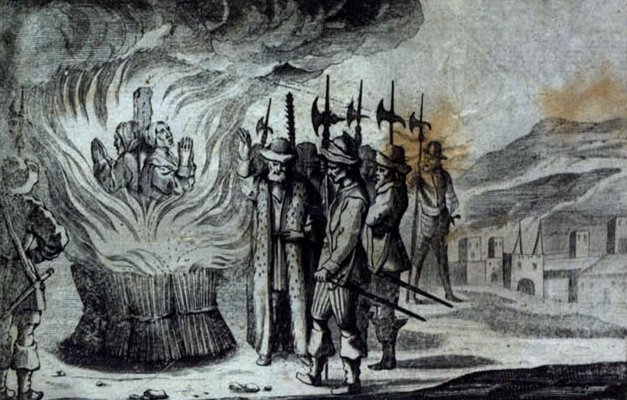
On this date in 1440, the wealthiest man in France, a noble who had once fought under Joan of Arc‘s banner, was hanged for an outlandishly demonic crime spree.


This dashing Gilles opposite Milla Jovovich in The Messenger; you’d never think he would sodomize hundreds of children.

Rivaling Hungarian blood-bather Erzsebet Bathory for the reputation of most bewitchingly depraved aristocratic sex-killer of early modern Europe, Gilles de Rais (or de Retz) hanged for abducting numberless legions of anonymous young commoners (boys, mostly) for rape and murder.

It’s a rap sheet trebly astounding given that a decade before, de Rais’s reputation for posterity would have figured to be his role as Saint Joan’s chief lieutenant when she raised the siege of Orleans, culminating with elevation to the rank of Marshall of France on the very day Charles VII was crowned in Reims. Talk about a fall from grace.

A 1440 investigation triggered by de Rais’s attack on a priest during an intra-aristocracy dispute turned up a Gacy‘s floorboards’ worth of Nantes-area kids allegedly disappeared into the Marechal’s creepy castle. Remarkably detailed trial records preserve a heartbreaking cavalcade of parents who entrusted their children to de Rais’s service or just sent them out one morning never to be heard from again. “It is notorious,” one added, “that infants are murdered in the said chateau.” (Many of these depositions and other original trial records can be read here.)

His servants and co-deviants Henriet and Pouitou admitted the most shocking stuff —

that de Rais then raped [the typical captive] as he was hanged from a hook by the neck. Before the child died, Gilles took him down, comforted him, repeated the act and either killed him himself or had him slain.

Poitou testified that the child victims were murdered sometimes by decapitating them, sometimes by cutting their throats, sometimes by dismembering them, sometimes by breaking their necks with a stick …

Gilles de Rais rarely left a child alive for more than one evening’s pleasure, Poitou claimed.

Now, it needs to be said that the servants were induced to these confessions by the threat of physical harm — and that when de Rais reversed his own denials he had likewise been menaced with torture. Nobody had been tortured, mind. But they had been given to understand that they would be corroborating the witnesses with self-incriminating statments, and we can do this the easy way or the hard way. In a world without dispositive forensics, confessions were the evidentiary gold standard … and torturing to obtain them was standard operating procedure.

It’s for that reason that there has also long persisted a revisionist thesis that de Rais was actually innocent, framed up by elite rivals who cannibalized the man’s estates. A 1992 “rehabilitation tribunal” re-tried the affair, and returned an acquittal.

Arguably, the populace — font of all those damning accusations — did likewise on the day de Rais hanged with his two servants. A crowd one might expect to be frenzied with rage actually sympathized with the doomed noble, even rescuing his hanged body from the fire. A monument his daughter put up became an unsanctioned popular pilgrimage site until it was destroyed during the French Revolution.

Whether as fact or fable, there’s something gorgeously baroque about de Rais’s dungeon mastering — especially when considered vis-a-vis his historical casting call opposite the abstemious Maid.

As a text for our latter-day edification, de Rais appears a carnivore devoured by his own appetites (and not only sexual: he also blew through the gargantuan family fortune). Reduced from hero to beast, he’s almost a literal werewolf or vampire; he’s often cast as such in video games and the like.

And he transfixes us because he personifies this uncanny bridge from the atomized digital age with its iconic serial killers, alone and psychologically deconstructed, back into the medieval — feudal, irrational, communal, violent and physical but also suffused with an omnipresent alien-to-us paranormal spirit world. It is enough to glance to experience the pull of the abyss gazing back.

Sabine Baring-Gould anticipated the modern afterlife of Gilles de Rais in the mid-19th century Book of Were-Wolves — which incorporated an extended account of de Rais’s trial into a wider narrative of folklore shapeshifting.

De Rais himself shapeshifts even within the brief arc of his dramatic trial: from indignant defendant into contrite supplicant, every drop sincere so far as one can perceive. His very prosecutors, indeed his very victims, wept for the fallen Marechal, and the “monster” reversed with this display his excommunication. (This may have been the part of the punishment de Rais feared most: again, we encounter the alien cosmology.)

“Nothing seems to me to be more beautiful –- and farthest away from our mentality of today — than the crowd of parents of the victims praying for this soul’s salvation,” one modern observed. “That is spiritual nobility.”

Agonizing ecstacist Georges Bataille wrote a whole book about de Rais, characteristically taken by the intersection of repugnance and transcendence. For Bataille, Christianity even reconciles our prisoner’s stupendous villainy with his unfeigned anticipation of spiritual salvation that “ultimately summarize the Christian situation.”

“Perhaps,” Bataille mused, “Christianity is even fundamentally the pressing demand for crime, the demand for the horror that in a sense it needs in order to forgive.”

A Few Books About Gilles de Rais

There are also several free public-domain books, such as Bluebeard: an account of Comorre the cursed and Gilles de Rais, with summaries of various tales and traditions and (already alluded to, the one with the original trial documents) Blue-beard, a contribution to history and folk-lore. Gilles de Rais is popularly, though I think not very persuasively, believed to have helped inspire the “Bluebeard” legend of the murderous aristocrat.

On this day..

Feast Day of Saint Denis, cephalophore

October 9 marks the feast date of the early Christian martyr Saint Denis.

Guess how he died:


(cc) image from minifig of the saint’s statue at Notre Dame.

When this missionary bishop to Paris got the Roman chop* for his conversions sometime after 250, he scooped up his own severed noggin and carried it to his preferred burial spot.

Upon that eventual pilgrimage site would spring up a medieval basilica whose 12th century renovation turned it into a pioneer of Gothic architecture.

(Denis is also sort of the namesake for the Parisian hill Montmarte where he’s supposed to have been put to death: “mountain of Mars” in heathen times, it Christianized to mons martyrium, “Martyrs’ Mountain”.)

While many Christian martyrs carry the instruments of their martyrdom in iconography, and a few others roll with the bits of severed flesh exacted by those martyrdoms, Denis is only the most notable of an entire designated sub-class who carry their own heads: cephalophores.

This subject, seemingly tailor-made for a They Might Be Giants song, finally got one in 2011: “You Probably Get That A Lot”.


A most profane footnote was appended to our holy man’s legend during the French Revolution.

Journalist Camille Desmoulins once recklessly sneered of Robespierre‘s vain lieutenant Saint-Just, “He carries his head like a sacred host.”

Saint-Just is supposed to have retorted upon hearing the slight, “I’ll make him carry his like Saint Denis.” He did it, too.

* Two companions, Rusticus and Eleutherius, were doing the same conversions and suffered the same execution. Nobody named cathedrals after them.

On this day..

1541: Cristóvão da Gama, Portuguese crusader in Ethiopia

On this date in 1541, Cristóvão da Gama — “the most chivalrous soldier of a chivalrous age” — was beheaded in Ethiopia.

This moment was the apex of Lisbon’s empire-building, most vividly symbolized by Cristovao’s famous dad, explorer Vasco de Gama. In the Age of Discovery, Caravels bore Portuguese colors from Brazil to Japan.

Alas, Portugal’s global maritime empire of coastal colonies and remote ports was immediately menaced by rival powers like the also at-its-apex Ottoman Empire.

Young Cristovao would be ground up in this conflict whose mixture of geopolitics and sectarianism overtly smacked of those old-time Crusades.

After a jaunt to India in the train of his older brother, appointed the Portuguese governor of India, Cristavao was sidetracked on a return voyage for an intervention on the Christian side in a raging local war. For Europeans who for generations had trafficked in the vague and fantastical rumors of mythical Abyssinian ruler “Prester John”, putting a thumb on the scale for Ethiopian Christians against the rampant Arabs must have been nigh irresistible.

Let’s listen in.

Joao III and his government, faced with mounting debts as the costs of military operations in the East steadily grew, were now forced to re-evaluate their global commitments … the new viceroy, Estevao da Gama, was ordered to destroy the Turkish fleet in Suez …

Estevao da Gama’s raid into the Red Sea became one of the best remembered episodes in the history of the Portuguese Estado da India. The fleet assembled at Massawa on the African shore and then proceeded to Suakin which was burnt and plundered. Part of the fleet then returned to Massawa while the rest sailed on to Suez where the Turkish ships proved to be securely based and inaccessible. On the shore of Sinai, as close to Jerusalem as the Portuguese were ever to come, Estevao da Gama enacted some of the rituals of crusading chivalary and made a number of knights before returning to Massawa. Meanwhile, Dom Joao de Castro, who accompanied the expedition, used the time to produce his famous guide to the Red Sea, the Roteiro do Mar Roxo, complete with the meticulous drawings of the ports and anchorages, a masterpiece of Portuguese Renaissance geography and science.


One of Joao de Castro’s drawings. (Source, a Portuguese pdf)

Meanwhile the Portuguese at Massawa had suffered extreme privations and a hundred of them had deserted, having been persuaded by [untrustworthy Potuguese-descended Ethiopian ambassador Joao] Bermudes of the richness and wealth of the interior. Their fate was to be captured and massacred by Ahmed Gran. Estevao da Gama now dispatched a force of four hundred soldiers under the command of his brother, Cristovao da Gama, into the interior to assist the Ethiopian king. Cristovao da Gama advanced from the coast with a force much the same size as that which Cortez had led into Mexico in 1519. He had with him horses, arquebuses and eight small cannon. His first objective was to link up with the fugitive Ethiopian king and his followers, but da Gama got separated from his supplies and was forced to fight a superior Somali force supported by Turkish mercenaries. The result was catastrophe. The small Portuguese army was badly mauled and da Gama himself fled wounded from the battlefield and was taken prisoner.

The capture of the viceroy’s brother, son of the great admiral, carried with it huge importance for the Turks. After being ritually humiliated (his beard being set on fire and his face buffeted with the shoes of his negro servant) Cristovao da Gama was beheaded.* For the Portuguese this was a disaster, the symbolic significance of which far transcended the military consequences of the defeat. However, the Christian church had long experience of turning catastrophe into triumph and, soon after the news of Cristovao da Gama’s death reached the outside world, rumours of miracles began to circulate.** Da Gama became one of the first martyrs of the new church overseas which in a hundred years of expansion had had all too few heroic deeds to celebrate.

After the death of their commander fewer than two hundred of the original army survived, but they were able to meet up with the Christian Ethiopian forces and, when the next campaigning season started in 1542, the combined army inflicted a heavy defeat on the Muslims, a defeat which took on a decisive complexion when it was realised that the leader of the jihad, Ahmed Gran, had been killed in the battle.

Da Gama’s expedition had been mounted from the resources of the official empire and had been commanded by one of the leading fidalgos of the Estado da India. However, few of da Gama’s soldiers returned to India Instead they settled in Ethiopia and married Ethiopian women, establishing a ‘Portuguese’ community that mirrored the ‘Portuguese’ communities in Aythia, Bengal, Kongo and elsewhere where soldiers had offered their military expertise to local rulers an had been content to settle and make their fortures far removed from the jurisdiction of the Portuguese Crown.

Although da Gama’s own end was unfortunate, his surviving force’s exploits on a side badly pressed could arguably be considered the decisive factor enabling Christianity to survive in Ethiopia’s highlands interior. Prester John would have been proud.

* “I write what I heard, it may well be that it was thus, for all that is barbarous and cruel about the Moorish king can be believed. The body, after death, was dismembered and sent to various places … because once when Granha was speaking with Dom Christovao, he asked him: ‘If you had me in your power, as I have you, what would you do to me?’ Dom Christovao, with great resolution and freedom replied, ‘If I had you in my power, I would have you killed, the head I would send to one place and the quarters I would distribute to other places’ (naming them, but I do not recall them). And Granha, they say that it was because he heard this, scattered the body to various places.”

** “Directly they cut off his head, God worked a great and manifest miracle through it, which was, that in the place where they slew him a fountain of running water gushed out, which had never been seen before: its water, through the goodness and power of God, gives sight to the blind, and cures those ill of other diseases. It appears that this miracle is like the one that God did in Rome for His Apostle St. Paul. The remains of the body of D. Christovao smell sweetly, giving forth so delightful an odour, that it seems rather of heaven than of earth.”

On this day..

1655: Massacre of Waldensians

On this date in 1655, Catholic forces under the Duke of Savoy carried out a notorious massacre of Waldensians* in the Piedmont.

This interesting, excommunicate sect had persisted for centuries in those hard-to-reach places in Alpine foothills, intermittently ignored and hunted. After Martin Luther, many Protestants inclined to see them as a proto-Reformation movement, or even a counter-papal apostolic succession reaching back to ancient Christianity.

At any rate, they sure weren’t Catholic.

And our friend the Duke decided — perhaps piqued by the murder of a missionary Catholic priest, or for whatever other reason — to mount one of those heresy-extirpating sorties and make them Catholic in 1655.

On April 17, the Marquis of Pianezza appeared with an overwhelming force of mixed Piedmontese, French, and Irish** troops. They conducted a few skirmishes, then made nice with the Waldensian civic leaders and induced them to quartering their troops temporarily further to some expedient pretext.

Alas! alas! these poor people were undone. They had received under their roof the executioners of themselves and their families. The first two days, the 22d and 23d of April, passed in peace, the soldiers sitting at the same table, sleeping under the same roof, and conversing freely with their destined victims …

At last the blow fell like a thunderbolt. At four of the clock on the morning of the 24th April the signal was given from the Castle of La Torre. But who shall describe the scenes that followed? On the instant a thousand assassins began the work of death …

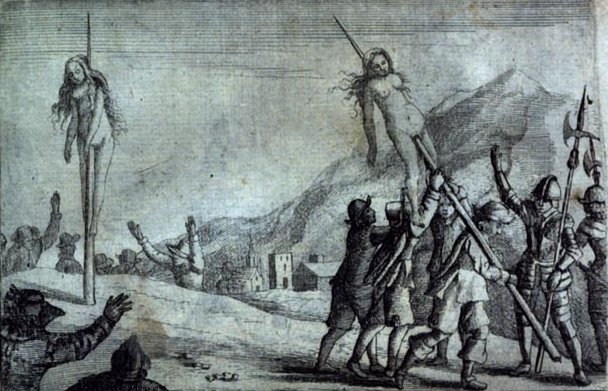
Little children were torn from the arms of their mothers, and dashed against the rocks; or, more horrible still, they were held betwixt two soldiers, who, unmoved by their piteous cries and the sight of their quivering limbs, tore them up into two halves. Their bodies were then thrown on the highways and the fields. Sick persons and old people, men and women, were burned alive in their own houses; some were hacked in pieces; some were bound up in the form of a ball, and precipitated over the rocks or rolled down the mountains … Some were slowly dismembered, and fire applied to the wounds to staunch the bleeding and prolong their sufferings; some were flayed alive; some roasted alive; others were disembowelled; some were horribly and shamefully mutilated, and of others the flesh and brains were boiled and actually eaten by these cannibals.

Source, whose atrocity accounts channel those in this French tome

Without doubting the capacity of man’s inhumanity to man, the cannibalism charge reminds that we’re dealing with propaganda alongside historiography. And what great propaganda — like, babies-torn-from-incubators great.

Thumbnails (click for a larger, disturbing view) of selected images of this date’s atrocities from Samuel Morland’s The History of the Evangelical Churches of the Valleys of Piedmont

And there’s little doubt as to the overall savagery of the affair, which could well have become the opening salvo in a full-scale sectarian cleansing campaign. (A later addendum to Foxe’s Book of Martyrs narrates the ensuing Piedmontese armed struggle, petering out before any definitive resolution in the field.)

Outrage at this hecatomb spread in Protestant Europe — which would also refer to the day’s doings as the “Bloody Easter,” since it corresponded with the eve of that celebration as reckoned by the Julian Calendar (source).

It was felt especially in Protectorate England, which intervened diplomatically.

A “day of solemn fasting and humiliation” was promulgated in Albion, along with collections for the relief of the survivors. Oliver Cromwell personally put £2,000 into the kitty.

More importantly, he dispatched diplomat Samuel Morland† to force the House of Savoy to lay off the persecution; in fact, he threatened to disrupt high statecraft between England and France unless the French twisted arms on behalf of the Waldensians.

Written correspondence for Morland’s diplomatic tour addressed to Louis XIV of France and various other continental potentates, as well as a fiery bit of oratory that Morland delivered to Savoy, all seem to have originated from the pen of Republican scribbler John Milton — the future author of Paradise Lost.‡

Milton, for whom the whole thing was more than just a day job, was further moved to put his umbrage at the slaughter into sonnet form:

Avenge O Lord thy slaughter’d Saints, whose bones
Lie scatter’d on the Alpine mountains cold,
Ev’n them who kept thy truth so pure of old
When all our Fathers worship’t Stocks and Stones,

Forget not: in thy book record their groanes
Who were thy Sheep and in their antient Fold
Slayn by the bloody Piemontese that roll’d
Mother with Infant down the Rocks. Their moans

The Vales redoubl’d to the Hills, and they
To Heav’n. Their martyr’d blood and ashes sow
O’re all th’ Italian fields where still doth sway

The triple Tyrant: that from these may grow
A hunder’d-fold, who having learnt thy way
Early may fly the Babylonian wo.

* The Waldensians in question here are interchangeably known as the Vaudois for their geographic region, actually above the Piedmont and abutting the Swiss region also known as Vaud. (These pages have visited the latter.)

** Fresh from being on the receiving end of another infamous massacre.

† Morland is more regarded for his post-Restoration labors as an inventor; he created an early calculator and internal combustion engine.

‡ The speech in particular is not definitively attributed; see Robert Fallon, “Milton in Government: Denmark and Savoy,” Milton Quarterly, May 1989.

On this day..

1244: Two hundred-plus Cathars at Montsegur

On this date in 1244, over two hundred Cathar heretics submitted themselves to the stake rather than submit to the Catholic church.

Though not literally the last of the Cathars, that outlawed dualistic sect in the south of France whose extirpation occupied the papacy for much of the 13th century, this date was the last great stand and the signature massacre of the Albigensian Crusade. Afterwards, only minor outposts and isolated individuals would remain available for mop-up duty.

Heretical holdouts, fleeing a malevolent Inquisition established in the Languedoc by victorious Catholic armies, holed up at a few Cathar strongholds of which the most impressive was the mountain citadel of Montsegur.


The spectacular attraction of Montsegur tourists see today is not the legendary Cathar castle — which was razed by its conquerors — but a subsequent rebuild. (cc) image from SarahLouiseHathaway

Finally in 1243-1244, a massive Catholic army invested Montsegur; one can’t help but compare this hopeless confederation of fearless zealouts ranged against the mighty temporal powers to the Jews at Masada — and as with Masada, it were death to succumb to the besiegers.

When Montsegur finally surrendered, two hundred-some — the reported counts differ slightly — were burned at the stake for refusing to renounce their faith; many of them had actually taken sacred vows in the days before Montsegur fell.

They were Nazis, Dude?

The National Socialists’ weird quest to outrace Indiana Jones for mystical artifacts also brought the swastika to Montsegur, under the direction of the occult medievalist Otto Rahn.

Rahn thought the Holy Grail may have been secreted at Montsegur under Cathar protection, a half-literal, half-metaphorical secret goblet carrying the heretics’ forbidden gnostic wisdom from the day of Mani.

(Other Nazis, allegedly including Heinrich Himmler himself, favored the similar-sounding Spanish fortress of Montserrat. Dan Brown prefers the Knights Templar, who could have laid their gauntlets on the cup of Christ when a few Cathars allegedly slipped through Montsegur’s encirclement carrying some unidentified mysterious secret.)

On this day..

277: Mani, dualist

It was perhaps on this date, that the prophet Mani — he of Manichaeism — underwent his Passion at the hands of the Sassanid Empire in a Gundeshapur prison.

The actual date of this event is an Aramaic (lunar) date whose year is unrecorded, so it attaches only uncertainly to the Julian calendar. (2 March 274 is another possibility, as are other dates in the mid-270s.)

Perhaps more to the point for this blog is that Mani’s “crucifixion” as celebrated by his followers was a literary exultation: the 60-year-old died in prison after 26 days in chains, maybe even sooner than his captors had intended. After Mani “rose [from his body] to the residences of his greatness [in] the heights, and he met his shape,” the Sassanids decapitated the corpse to make the whole scene more properly resemble the awful majesty of an offended sovereign.

But even as merely a metaphorical “execution,” Mani’s martyrdom merits mention.

Born into a Judaic-Christian sect, Mani (also known as Manes) experienced a conversion, went east for enlightenment, and returned with a syncretic theology of a good spirit world and an evil material one — and east-meets-west twist, in other words, on gnosticism, rooted in both Christianity and Buddhism. (And Zoroastrianism, dominant in Persia at this time — to Mani’s ultimate grief.)

This seems like the sort of thing that someone ought to have revived in California in the 1970’s.


Shrine of Mani as Buddha in Quanzhou, China.

Alas, though it once spanned the Eurasian landmass all the way to China, Manichaeism today is extinct except for its linguistic remnant … the word “manichean”.

Most of us won’t do so well as to thrust our fame into the dictionary, but Mani’s shape-in-the-heights can’t be altogether satisfied with this word’s connotation of jejune, black-and-white dualism — as in a “Manichean struggle with a single overarching enemy called terrorism”.

The man wrote his own holy book, after all, and it’s a bit more elegant than the likes of neoconservative foreign policy.

the first precept for hearers is this: …they shall not kill …, [and] they shall forgive those creatures who provide them with meat for food so that they do not kill them as if they were evil people. But dead flesh of any animals, wherever they obtain it, be it dead or slaughtered, they may eat …

And the second precept for hearers is that they shall not be false and they shall not be unjust to one another … he shall walk in truth. And a hearer shall love [another] hearer in the same way one loves one’s own brother and relatives, for they are children of the living family and the world of light.

And the third precept is that they shall not slander anybody and not be false witnesses against anybody of what they have not seen and not make an oath in falsehood in any matter …

From the Shabuhragan (pdf)

Now is that so bad?

Manichaeism found favor (though not a conversion) with the broad-minded and long-reigning king Shapur I. (Shapur is most famous in the West as the Persian ruler who captured the Roman emperor Valerian.)

But one of Shapur’s less impressive heirs was persuaded by the sectarian Zoroastrian priesthood — for whom the Manicheans were an upstart rival — to bust Mani.

It seems they were able to make use of the prophet’s distaste for war to question his patriotism. Some things never change.

The founder’s laying down his life hardly slowed the faith’s growth; instead, it prospered as one of the more successful entrants in the confusing late-antiquity hustle and bustle of competing cults. Dualism was a hot mystical trend literally from ocean to ocean, and nobody proselytized it like Mani’s followers.

“In its Manichaean form,” observes Johannes van Oort, “Gnosticism once was a real world religion.”

Had it stayed that way, there’d be endowed chairs of Manichean gnosticism at every university and politicians conspicuously rubbing shoulders with Manichean clergy and Major League sluggers with WWMD bracelets. Instead, it’s a metonym for naivete. Them’s the breaks.

In the West, at least, the lost sect’s unflattering reputation comes by way of no less a personage than St. Augustine of Hippo.

You know what they say about the zeal of converts? Well, Augustine used to know Manichaeism from the inside.


St. Augustine Sacrificing to a Manichaean Idol, 15th century painting by an unknown Flemish master.

After spending his twenties as an enthusiastic Manichean, the future Church Father (re)converted to orthodox* Christianity and turned on his former philosophy with vehemence.

His Confessions denounces a Manichean bishop with whom he once had an unsatisfying audience — “Faustus by name, a great snare of the devil.” That association might very well be the etymological root of that great literary devil-bargainer Dr. Faust.

One could, at the minimum, follow a thread from Augustine’s establishment anti-dualism to the Middle Ages practice of calling any dualistic heresy — Bogomilism, Catharism, whatever — “Manichean”, and the intertwining of those forbidden gnostic traditions with Christendom’s devil mythology.


Medieval image of St. Augustine confounding devilish heresies.

At the same time, Augustine’s philosophy draws much of its enduring appeal from that very dualism, absorbed at such a formative age that the writer late into life was still repelling Christian colleagues’ accusations of immutable Manichaeism — “like an Ethiopian can not change his skin, nor the leopard his spots.” Augustine’s City of God proceeds from opposing that virtuous spiritual metropolis to the corruption of the City of Man.**

Moreover, Johannes van Oort concludes,

Nowhere in the early church before 400 does there appear to be such a tender and appealing piety, along with such a prominent place given to the Christ, except for Augustine and the Manichaean writings … In some essential features of Augustine’s spirituality we may perceive one of the most important channels through which the Gnostic religion of Manichaeism has exercised a lasting influence on western culture.

* Manichaeism, at least in the North African context where Augustine engaged it, is probably best thought of as one of the competing strands within the Christian community rather than a rival religious edifice. (Gnosticism’s capacity to syncretize with varying spiritual traditions has always been essential to its appeal.) Manicheans themselves insisted that they were secta, within Christianity, not schisma, like the pagans.

** Augustine had particular cause to be down on the prospects of the City of Man: at the time of writing, Rome had just been sacked by the Visigoths.

On this day..

1554: David van der Leyen and Levina Ghyselius, Anabaptist martyrs

On this date in 1554, Anabaptists David van der Leyen and Levina Ghyselius were burned at the stake in Ghent.*

Looks like it hurt.


In the year 1554, there was imprisoned at Ghent, in Flanders, for following Christ and living according to God’s commandments, a young brother named David, who, when examined, freely confessed his faith. Being asked what he thought of the sacrament, David said, that he considered it nothing else than idolatry. Then a priest said to him, “Friend, you err greatly, that you so readily confess your faith, for it will cost you your life, if you do not change your mind in time.” Thereupon David sweetly replied, “I am ready to shed my blood for the name of Christ, even though it should be here in this place; for God is my salvation, who will keep me, and preserve me from all evil.” The priest said, “It will not be as good as though you were put to death secretly here in this place; but you will be burnt publicly at the stake, for an everlasting reproach.” He was then brought into the court, where he was condemned to death, and his sentence was read, namely, that he had fallen from the true faith into heresy, and was therefore, according to the imperial edict, sentenced to be strangled and burned. David said, “No one will ever be able to prove by the Scriptures, that the faith for which I must now die is heresy.”

There was also sentenced to death with him a woman named Levina, who rather forsook, not only her six dear children, but also her temporal life, than her dear Lord and Bridegroom Jesus Christ. Arriving on the scaffold, David attempted to kneel down in order to offer up his prayer to God, but he was prevented, and they were immediately driven away to the stakes, standing at which, David said to Levina, “Rejoice, dear sister; for what we suffer here is not to be compared with the eternal good that awaits us.” (Rom. 8:18) When about to offer up their sacrifice, both exclaimed, “Father, into thy hands do we commend our spirits.” A little bag of gunpowder was tied to each of them, whereupon they were strangled and burned. But there happened a manifest miracle of God; for though they were completely burned, and the fire was as good as extinguished, David was seen to move his head, so that the people exclaimed, “He still lives.” The executioner seized the fork, and thrust it three times into his bowels, so that the blood flowed out; yet even after this he was still seen to move, hence, the executioner threw a chain around his neck, and bound him to the stake, and thus broke his neck.

Thus these two valiantly fought their way through, firmly trusting in God, who did not let them be confounded, since they had firmly built their building upon the only foundation; wherefore they shall never perish, but abide forever.

Martyrs Mirror

* The very birthplace of the then-sitting Holy Roman Emperor, Charles V.

On this day..

250: Pope St. Fabian

This date in 250 is the feast day and traditional martyrdom date for Pope (and Saint) Fabian(us).

“They say,” quoth ecclesiastical historian Eusebius, “that Fabianus having come, after the death of Anteros, with others from the country, was staying at Rome, and that while there he was chosen to the office through a most wonderful manifestation of divine and heavenly grace.”

For when all the brethren had assembled to select by vote him who should succeed to the episcopate of the church, several renowned and honorable men were in the minds of many, but Fabianus, although present, was in the mind of none. But they relate that suddenly a dove flying down lighted on his head, resembling the descent of the Holy Spirit on the Saviour in the form of a dove.

Thereupon all the people, as if moved by one Divine Spirit, with all eagerness and unanimity cried out that he was worthy, and without delay they took him and placed him upon the episcopal seat.

Fabian seems to have been a competent administrator and had the luxury of occupying St. Peter‘s throne during the lull in persecutions under the Roman Emperor Philip the Arab. If you like the highly speculative hypothesis that Philip was not merely sympathetic to Christians but actually a Christian himself,* then Pope Fabian is probably the guy who baptized him.

But uneasy is the head that wears the crown, and never more so than during Rome’s Third Century Crisis.

In due time, the ambitious Senator Decius toppled Philip, and implemented loyalty oathssacrifices to Roman’s pagan divinities.

Sacrifices, or else.

Fabian paid the piper for those years on easy street with Philip by refusing to make the requisite sacrifices and delivering himself to a demonstrative** martyrdom in January 250. A Greek epitaph — “Fabian, bishop and martyr” — has been discovered in the catacombs.

With the surly Decius hovering around to lop off the next Roman head bold enough to submit to a bishop’s cap, the papacy stood vacant for more than a year before (with Decius out of town on campaign — for good, as it turned out) said papacy made up for lost time when it was claimed by two men set at loggerheads by the persecutions themselves: the little-known caretaker Cornelius (the Church’s official successor) and Novatian (the schismatic antipope).

The always recommended History of Rome podcast deals with this period in episode 110.

* If Philip the Arab was Christian, then he would displace Constantine the Great as the realm’s first Christian ruler; the faithful might regard the transfer of that distinction as a downgrade.

** Edward Gibbon, much less impressed than the Church with Decius’s severity, notes that

[t]he martyrs, devoted to immediate execution by the Roman magistrates, appear to have been selected from the most opposite extremes. They were either bishops and presbyters, the persons the most distinguished among the Christians by their rank and influence, and whose example might strike terror into the whole sect; or else they were the meanest and most abject among them, particularly those of the servile condition, whose lives were esteemed of little value …

On this day..

1896: Fred Behme, evangelical Methodist

On this date in 1896, McLeansboro, Ill. hosted its only hanging.

German emigre Fred Behme was settled into married life when he converted from Catholicism to Methodism.

Unfortunately — so Behme saw it — his wife Mary didn’t hew to the old cuius region, eius religio principle where the man of the house was concerned, and stuck with the bishop of Rome for the salvation of her immortal soul.

And there’s just something about the zeal of a convert.

Fred Behme’s domestic missionary work grew more violent (pdf), and eventually his battered spouse moved out; when Fred coaxed her back, and found out that she’d baptized their infant son into idolatrous Catholicism while living apart from him, he chose Easter Sunday to commit what one newspaper called “one of the most hideous and blood-thirsty crimes that ever stained the good name and honor of McLeansboro”: Fred got the other kids out of the house, he attacked Mary with an axe,

drug her by the hair into the yard, and beat in the side of her head. He covered the body with corn fodder. He then took the little boy [whom Mary had baptized] to the barn and hanged him by the neck until he died. (Source)

Though the hanging was invitation-only, it was visible from McLeansboro’s public square and large crowds gathered to witness the hirsute Protestant check out with a short speech in German.

Wikipedia alleges (without a clear source indication) that one G. Phil Hanna was among this multitude, and that seeing Behme strangle to death on an inexpertly deployed rope launched a lifelong interest in the hangman’s craft that would culminate when Hanna pinch-hit on the execution team that carried out America’s last public hanging 40 years later. Others of less august accomplishment no less vividly recalled their (and their town’s) one-time walk through the valley of death.


The family that prays together … (The perp is the bearded man; the victims are the woman seated next to him, and the child in her lap.)

On this day..

1539: Don Carlos Ometochtzin, Aztec heretic

On this date in 1539, the Spanish Inquisition had Aztec noble Don Carlos Ometochtzin (or Don Carlos Chichimecatecuhi, or Don Carlos Ahuachpitzactzin) burned at the stake for reverting to the pre-Columbian indigenous religion.

Just another Mesoamerican depredation?

Surprisingly, this execution stands out as an exception in the first generations of its conquest. It even cost the first bishop of Mexico, Juan de Zumarraga, a reprimand for his excess severity. Why?

Certainly any European Christian would have had trouble with the Inquisition if, like Don Carlos (Spanish Wikipedia entry | English), he had been caught with idols of Xipe Totec in his place.

But it was precisely the point that these weren’t Europeans. In 16th century “New Spain,” syncretisms of Christianity and the native Mexican cults still in living memory were the norm, a scenario recalling early Christianity co-opting the pagan rites it supplanted.*


Respect Xipe Totec’s authoritah!

And that created for the Spanish a problem: how stringently to insist upon an alien orthodoxy for its new subjects? The problem was pragmatic at least as much as it was theological, because the business of winning converts for Christ had to coexist with the business of running an empire. No sense provoking civil war just because the newest souls in the fold don’t have the Te Deum down; Cortes himself, in his initial conquest, had prohibited human sacrifice but not risked closing native temples.* That wasn’t done until 1525.

Over the 1530’s, a campaign unfolded to pare down the many holdover native behaviors — polygamy, idolatry — and cement Christianity. Of particular concern were the “converted” elites who had both means (their social position) and motive (privileges lost to the Spanish) to use nostalgia for the old ways to make trouble.

So, a powerful indigenous priest who “converted” and then went about preaching heretically was investigated by Zumarraga, wielding the Inquisitorial authority, in 1536.

But even that didn’t draw a death sentence.

In Zumarraga’s 19 Inquisitorial trials involving at least 75 suspects, the one and only instance of an Indian being “relaxed” to the secular authorities for execution came in 1539, when Zumarraga was tipped that the hereditary ruler of one of the Aztec Triple Alliance‘s principal city-states was a secret idolator, and a public declaimer of treasonable utterances like this:

Who are those that undo us and disturb us and live on us and we have them on our backs and they subjugate us? … no one shall equal us, that this is our land, and our treasure and our jewel, and our possession, and the Dominion is ours and belongs to us.

Don Carlos was ultimately acquitted of the idolatry stuff, but convicted of heretical dogmatizing.

So far, so good, right? Executions for heresy might be horrible in general, but if you live in a world where they’re routine, surely having your colonial satrap out there calling the empire parasitical, and telling the unwashed masses to go ahead and take multiple wives (Aztec elites seem to have been especially piqued by the lifestyle austerity preached by Franciscan missionaries) is the sort of thing that’ll get you burned at the stake.** And there were plenty more like him out there.

But though the Christianizing campaign of the 1530’s would continue in many forms for decades still to come, the bloodletting which Don Carlos figured to presage was abruptly canceled.

According to Patricia Lopes Don’s “Franciscans, Indian Sorcerers, and the Inquisition in New Spain, 1536–1543,” in Journal of World History, Vol. 17, No. 1,

[a] holocaust was most probably at hand in the spring of 1540. However, when the Council of the Indies in Spain learned of Don Carlos’s execution, they reprimanded Zumárraga, sent a visitador, an inspector-auditor, to New Spain to take away the bishop’s inquisitorial powers, and left him in a state of some humiliation until his death in 1548. All indications were that they feared further such executions would lead to widespread indigenous rebellion in New Spain. As was the case with the Muslims in the Old World, although orthodox Christianity was central to the concept of Spain and the monarchy, when the imperial Spanish needed to choose between religious orthodoxy and the security of the state, they could learn very quickly to be flexible and politique, yet express their concerns in judicious language. In a letter of 22 November 1540, Francisco de Nava, bishop of Seville, explained to Zumárraga that while he understood that he had executed Don Carlos “in the belief that burning would put fear into others and make an example of him,” the Indians, he suggested, “might be more persuaded with love than with rigor.”

When the Inquisition was formally instituted in New Spain in 1571, the native populace was explicitly outside its jurisdiction: its job was to monitor the European population for covert Protestants, Muslims, and Jews.

Although this development has to count as a break for the locals, it’s interesting to note that the theological superstructure of the Spanish policy tension between religious conformity and practical colonialism turned at least in part on a condescending dispute over the “capacity” of Indians to truly become Christian. In that dispute, Zumarraga and his Franciscan order were the ones who thought more highly of the indigenous “capacity”, as against the more skeptical Dominicans; the logical consequence of the Franciscan position was to impose upon those capacious natives the fullest severity of God’s law.

* Though not to be underestimated is the persistence within the citadel of Christendom of everyday folk beliefs, and occasional social movements, at odds with ecclesiastical dogma.

** Treasonous quote and details about the investigation and trial from Richard E. Greenleaf, “Persistence of Native Values: The Inquisition and the Indians of Colonial Mexico”, The Americas, Vol. 50, No. 3 (Jan., 1994)

On this day..