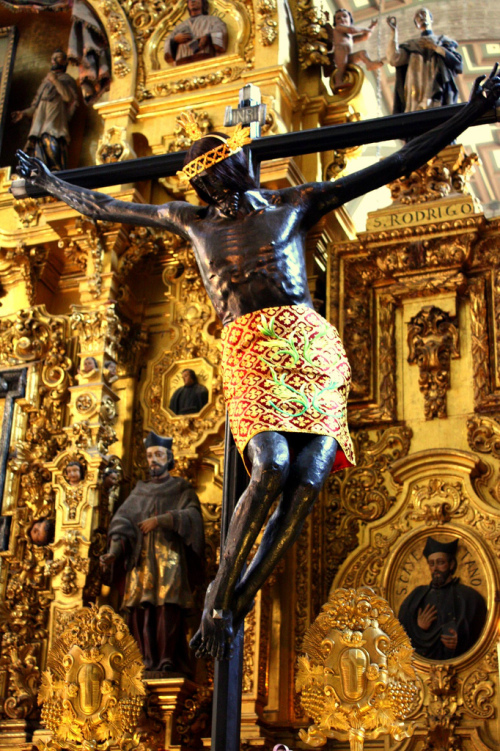
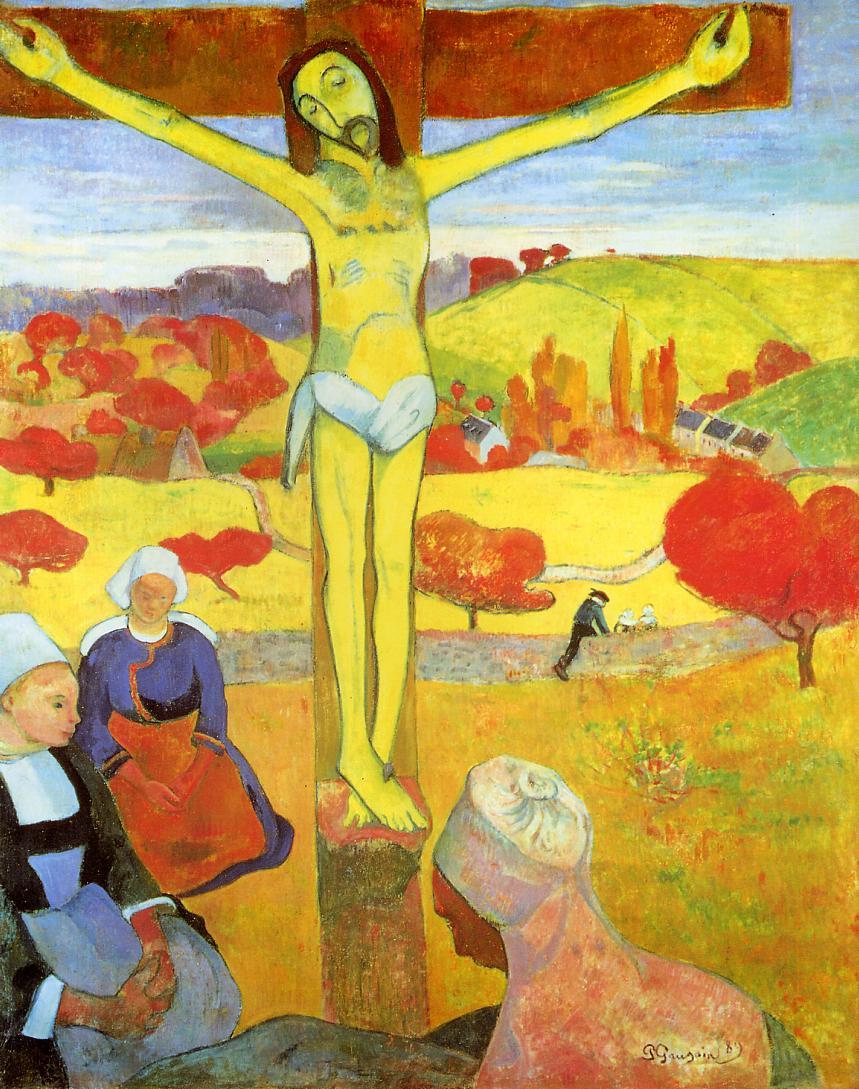
Feast Day of St. Cecilia, patron of music

This is the feast day of the early Christian saint Cecilia.

There’s more than serendipity in that name’s pop culture connection: Cecilia is the patron saint of music for the rather slight reason that her heart sung only for God even when she was forced to marry the pagan Valerian. Seriously, Christianity didn’t have any early martyr with a stronger biographical context for a portfolio as significant as music?*

Being the go-to divine intermediary for something this big made Cece a popular saint centuries after her martyrdom, supposed to be either later in the 2nd century or early in the 3rd. (As with many other martyrs’ legends, Cecilia survives several executions before the Romans finally manage to cut her head off.)

Musician and songwriter Paul Simon knew enough St. Cecilia lore to explicitly use her in her musical-patronage role in a different song, “The Coast” (lyrics). The song “Cecilia” deepens immensely if it’s understood as mixed frustration and exaltation with the minstrel’s inconstant artistic muse.

Nor would that be the only 20th century musical homage for this accessible saint. In a more traditional vein, Benjamin Britten set to music a W.H. Auden poem about Cecilia, creating the Hymn to St. Cecilia.

Blessed Cecilia, appear in visions
To all musicians, appear and inspire:
Translated Daughter, come down and startle
Composing mortals with immortal fire.

Fans of classical music should hit YouTube for Handel’s Ode for St. Cecilia’s Day, which appropriately premiered on this date in 1739. Here’s a nibble:

* So far as we know, blogging remains a niche of divine patronage as-yet unfilled. We propose to accept the protection of the patron saint of lost causes.

On this day..

1936: The Sacred Heart, by Spanish leftists

On this date in 1936, anticlerical leftists in the Spanish Civil War allegedly subjected a monumental statue of Christ to a ritual “execution”.


“This picture, taken by a Paramount News-reel representative and received by air from Madrid yesterday, illustrates an outrage which has no parallel in the photographs published by “The Daily Mail” of the Spanish Reds’ war on religion. It shows a Communist firing squad aiming at the colossal Monument of the Sacred Heart on the Cerro de los Angeles, a hill a few miles south of Madrid which is regarded as the exact centre of Spain.” (Source)

This outstandingly incendiary image made for great recruiting for the Francoist enemies of the “firing squad” and gave credence to a “crusade” lexicology that insured the devout would break overwhelmingly against the Republic. (Nearly 7,000 men and women in religious orders whose deaths during the war are charged to the Republican account also helped.)

Maybe that was inevitable, anyway.

George Orwell, the English leftist who volunteered for the Spanish Republicans, noted in his Homage to Catalonia that

the people in this part of Spain must be genuinely without religious feeling — religious feeling, I mean, in the orthodox sense. It is curious that all the time I was in Spain I never once saw a person cross himself; yet you would think such a movement would become instinctive, revolution or no revolution. Obviously the Spanish Church will come back (as the saying goes, night and the Jesuits always return), but there is no doubt that at the outbreak of the revolution it collapsed and was smashed up to an extent that would be unthinkable even for the moribund C. of E. in like circumstances. To the Spanish people, at any rate in Catalonia and Aragon, the Church was a racket pure and simple. And possibly Christian belief was replaced to some extent by Anarchism, whose influence is widely spread and which undoubtedly has a religious tinge.

Be that as it may, Republican types suspected photographic fakery.

Just like its inspiration is reported to have done, this statue survived its “execution” in fine shapewas resurrected by public subscription, and can still be seen at Cerro de los Angeles outside Madrid.


The “executed” statue today. (cc) image from bigchus.

On this day..

Feast Day of the Holy Maccabees

This is the feast date, in both the Orthodox and Catholic traditions, of the Woman with Seven Sons — each of whom is supposed to have been put to death for refusing to break the Mosaic law by eating pork.

Although they are Jewish martyrs more than a century before Christ, they are revered most especially by the Christian faith that elbowed Judaism aside. Their story comes from 2 Maccabees, a “deuterocanonical” text that is part of the Old Testament but not part of the Hebrew Bible — for reasons having to do with the contingent process of formulating the canon.* (Short explanation | Long explanation)

Whether sent from the Lord or not, this story features the righteous resistance of the faithful family against Antiochus IV Epiphanes, ruler of the Seleucid Empire, which was one of the successor Hellenistic states to Alexander the Great’s conquests.

In 2 Maccabees (and also in 1 Maccabees, which covers the same period, though not this specific martyrdom), Antiochus IV is making an unwelcome pro-heathen intervention in a Jewish civil war on the side of the hellenizers as against the hidebound traditionalists. This comes to attempting “to compel the Jews to depart from the laws of their fathers, and not to live after the laws of God: And to pollute also the temple in Jerusalem, and to call it the temple of Jupiter Olympius.” (2 Maccabees 6:1-2; this chapter features a Whitman’s sampler of other faithful traditionalists slaughtered for various forms of adherence to the Law.)

Same deal with the dietary laws, whose countermanding edict Antiochus (being a wicked heathen king) is pleased to enforce by the most ghastly tortures.

Here’s the description of the martyrdom from 2 Maccabees chapter 7:

Das Martyrium der sieben Makkabaer, by Antonio Ciseri, in an aptly classical setting.

1: It came to pass also, that seven brethren with their mother were taken, and compelled by the king against the law to taste swine’s flesh, and were tormented with scourges and whips.
2: But one of them that spake first said thus, What wouldest thou ask or learn of us? we are ready to die, rather than to transgress the laws of our fathers.
3: Then the king, being in a rage, commanded pans and caldrons to be made hot:
4: Which forthwith being heated, he commanded to cut out the tongue of him that spake first, and to cut off the utmost parts of his body, the rest of his brethren and his mother looking on.
5: Now when he was thus maimed in all his members, he commanded him being yet alive to be brought to the fire, and to be fried in the pan: and as the vapour of the pan was for a good space dispersed, they exhorted one another with the mother to die manfully, saying thus,
6: The Lord God looketh upon us, and in truth hath comfort in us, as Moses in his song, which witnessed to their faces, declared, saying, And he shall be comforted in his servants.
7: So when the first was dead after this number, they brought the second to make him a mocking stock: and when they had pulled off the skin of his head with the hair, they asked him, Wilt thou eat, before thou be punished throughout every member of thy body?
8: But he answered in his own language, and said, No. Wherefore he also received the next torment in order, as the former did.
9: And when he was at the last gasp, he said, Thou like a fury takest us out of this present life, but the King of the world shall raise us up, who have died for his laws, unto everlasting life.
10: After him was the third made a mocking stock: and when he was required, he put out his tongue, and that right soon, holding forth his hands manfully.
11: And said courageously, These I had from heaven; and for his laws I despise them; and from him I hope to receive them again.
12: Insomuch that the king, and they that were with him, marvelled at the young man’s courage, for that he nothing regarded the pains.
13: Now when this man was dead also, they tormented and mangled the fourth in like manner.
14: So when he was ready to die he said thus, It is good, being put to death by men, to look for hope from God to be raised up again by him: as for thee, thou shalt have no resurrection to life.
15: Afterward they brought the fifth also, and mangled him.
16: Then looked he unto the king, and said, Thou hast power over men, thou art corruptible, thou doest what thou wilt; yet think not that our nation is forsaken of God;
17: But abide a while, and behold his great power, how he will torment thee and thy seed.
18: After him also they brought the sixth, who being ready to die said, Be not deceived without cause: for we suffer these things for ourselves, having sinned against our God: therefore marvellous things are done unto us.
19: But think not thou, that takest in hand to strive against God, that thou shalt escape unpunished.
20: But the mother was marvellous above all, and worthy of honourable memory: for when she saw her seven sons slain within the space of one day, she bare it with a good courage, because of the hope that she had in the Lord.
21: Yea, she exhorted every one of them in her own language, filled with courageous spirits; and stirring up her womanish thoughts with a manly stomach, she said unto them,
22: I cannot tell how ye came into my womb: for I neither gave you breath nor life, neither was it I that formed the members of every one of you;
23: But doubtless the Creator of the world, who formed the generation of man, and found out the beginning of all things, will also of his own mercy give you breath and life again, as ye now regard not your own selves for his laws’ sake.
24: Now Antiochus, thinking himself despised, and suspecting it to be a reproachful speech, whilst the youngest was yet alive, did not only exhort him by words, but also assured him with oaths, that he would make him both a rich and a happy man, if he would turn from the laws of his fathers; and that also he would take him for his friend, and trust him with affairs.
25: But when the young man would in no case hearken unto him, the king called his mother, and exhorted her that she would counsel the young man to save his life.
26: And when he had exhorted her with many words, she promised him that she would counsel her son.
27: But she bowing herself toward him, laughing the cruel tyrant to scorn, spake in her country language on this manner; O my son, have pity upon me that bare thee nine months in my womb, and gave thee such three years, and nourished thee, and brought thee up unto this age, and endured the troubles of education.
28: I beseech thee, my son, look upon the heaven and the earth, and all that is therein, and consider that God made them of things that were not; and so was mankind made likewise.
29: Fear not this tormentor, but, being worthy of thy brethren, take thy death that I may receive thee again in mercy with thy brethren.
30: Whiles she was yet speaking these words, the young man said, Whom wait ye for? I will not obey the king’s commandment: but I will obey the commandment of the law that was given unto our fathers by Moses.
31: And thou, that hast been the author of all mischief against the Hebrews, shalt not escape the hands of God.
32: For we suffer because of our sins.
33: And though the living Lord be angry with us a little while for our chastening and correction, yet shall he be at one again with his servants.
34: But thou, O godless man, and of all other most wicked, be not lifted up without a cause, nor puffed up with uncertain hopes, lifting up thy hand against the servants of God:
35: For thou hast not yet escaped the judgment of Almighty God, who seeth all things.
36: For our brethren, who now have suffered a short pain, are dead under God’s covenant of everlasting life: but thou, through the judgment of God, shalt receive just punishment for thy pride.
37: But I, as my brethren, offer up my body and life for the laws of our fathers, beseeching God that he would speedily be merciful unto our nation; and that thou by torments and plagues mayest confess, that he alone is God;
38: And that in me and my brethren the wrath of the Almighty, which is justly brought upon our nation, may cease.
39: Than the king’ being in a rage, handed him worse than all the rest, and took it grievously that he was mocked.
40: So this man died undefiled, and put his whole trust in the Lord.
41: Last of all after the sons the mother died.
42: Let this be enough now to have spoken concerning the idolatrous feasts, and the extreme tortures.

The upshot of the Maccabees texts is the revolt of Judas Maccabeus against the Seleucids, the episode that gives us Hanukkah, when that “temple of Jupiter Olympius” was rededicated back to YHWH.

And though not specifically because of the Holy Maccabees, the start of that revolt is the very next thing to occur in the text,** at the start of chapter 8:

1: Then Judas Maccabeus, and they that were with him, went privily into the towns, and called their kinsfolks together, and took unto them all such as continued in the Jews’ religion, and assembled about six thousand men.
2: And they called upon the Lord, that he would look upon the people that was trodden down of all; and also pity the temple profaned of ungodly men.
3: And that he would have compassion upon the city, sore defaced, and ready to be made even with the ground; and hear the blood that cried unto him,
4: And remember the wicked slaughter of harmless infants, and the blasphemies committed against his name; and that he would shew his hatred against the wicked.

And then, of course, it’s the good guys’ turn to start killing.

* It is worth noting that deuterocanonical books aren’t part of the Old Testament for most Protestants; Martin Luther declared himself “so great an enemy to the second book of the Maccabees, and to Esther, that I wish they had not come to us at all, for they have too many heathen unnaturalities.”

** The book’s chronology is scarcely rigorous, but if the episode is considered historical, it would have occurred in 167 B.C.E. (the year the Maccabean revolt began) or the few years before, reaching back to Antiochus’s anti-Mosaic injunctions c. 175 B.C.E.

On this day..

Jesus of Nazareth, King of the Jews

Images of the Crucifixion


(Thanks to Jeffrey Fisher [jeffreyfisher at me.com] for the guest post.)

On Good Friday every year,* Christians around the world commemorate the death by crucifixion of Jesus of Nazareth, rabbi, prophet, Son of God, Son of Man, messiah, and all-around trouble-maker.

The truth is that very little is known of Jesus’ life and teachings from verifiable accounts, but this has not stopped generation after generation of Christians from telling his story, beginning with Jesus’ semi-official biographers, the evangelists of the New Testament. Almost everything we know about the life and teachings of the physical human being Jesus are in those writings, which do not portray him always in compatible ways, and which are almost entirely unconfirmed by any external source. The Roman historian Tacitus mentions (with disdain if not disgust) Jesus’ cult following, as does the Jewish historian and philosopher Josephus, but neither gives us anything to work with as historians (or, for that matter, as theologians). For the record, Suetonius and Pliny also talk about Christians, but these piecemeal sources tell us much more about Roman perceptions of Christians than about Christ and his teachings, or even necessarily Christian beliefs and practices.

What, then, can we reasonably say about Jesus?

It is almost impossible to find universal agreement around anything more than a few basics, including most importantly Jesus’ crucifixion. The Gospels narrate it; Paul the Apostle (who never met Jesus in the flesh, as it were) hangs his theology on it, together with the equally important resurrection; and no contemporary sources (Christian or otherwise) dispute it.

But it’s when we ask why Jesus was crucified that things start to get interesting.

What did he do? The two men he is traditionally said to have been crucified with are commonly understood to be “robbers,” but that they were common criminals is highly unlikely. Crucifixion is a horrible death designed to make a very public statement about the crucified, the sort of thing you use on gladiator-slave rebels like Spartacus, not on pickpockets and roustabouts. The Greek term used for these two men (lestai) is consistent with the description of the released Barabbas as one who had participated in rebellious activities, whose “criminality” was related to his revolutionary business. Moreover, the name “Barabbas” means literally “son of the father,” a purely symbolic and surely entirely fictional name, and that the people choose to have him released indicates their affinity for him as a thorn in the side of the Romans. He is thus contrasted with Jesus, the other son of the father, the peaceful (apocalyptic) revolutionary.

So Jesus would have been crucified as a political criminal, a rebel. This would make sense of accounts of his having been identified by the Romans as “Iesus Nazarenus Rex Iudaeorum”: “Jesus of Nazareth, King of the Jews.” Anyone claiming to be king (and “son of God” was a Jewish way of talking about the king of Israel recorded clearly in Psalm 2), would, if taken seriously, be understood as challenging Roman authority.

Insofar as Jesus seems to have been deliberately poking the Romans’ local running dogs, the Sadducees and the Temple priests, his seizure and termination were surely inevitable. If his teaching is as opposed to violence and unconcerned with “politics” as it seems to have been, it’s hard to believe the Romans would have noticed him without some prodding, this coming not from the “crowd,” but from the leadership (who in Mark and Matthew incite the crowd). Indeed, the priests and scribes look for ways to arrest him when the crowds are not around, because they fear a riot.

If we take the Gospel of Mark at all seriously, Jesus was preaching a new kingdom of God, an apocalyptic redemption of the people of the earth by God’s direct intervention (and with Jesus as the sacrificial pesach lamb). If we take the Gospel of Luke seriously, Jesus spoke in a classic prophetic mode, calling people — Jew and Gentile both — to care for the oppressed of the earth, the poor and the hungry and the helpless. Both Jesuses called for people to be better to each other, to love each other, and indeed to love each other when love was, according to common sense, the foolish thing.

Why would this get you executed?

Well, in itself, it wouldn’t. But the Gospel of Mark tells us of Jesus speaking with a man who realizes that all the animal sacrifices in the world don’t amount to a hill of beans (in that crazy world). When love counts more than sacrifice, we are undermining the Temple. When we go into the Temple, start knocking things over, and say it’s become about robbing the poor and not about loving God and one’s neighbor, we are undermining the Temple. And to undermine the Temple’s authority is also to undermine Rome’s authority, and Rome’s cash flow.

Jesus, like the Essenes he may or may not have associated with, was a purist.

The Temple was full of collaborators and exploiters, the kind seen before in the history of Israel (and berated by prophets like Isaiah and Amos), the kind hated also by the Dead Sea community of apocalyptic purists awaiting a final showdown between God and evil (i.e., the Roman Empire and their local potentates, the Temple authorities).

Jesus, like other Jewish prophets before him, thought that Judaism was about something. That it was somehow about justice and not just about following rules or waiting around for things to get better: that it was about our making the world a better place, and not just making our own lives better.

Start talking that way and get people on your side, and you’re fairly likely to get killed, even twenty centuries later.

* Though the actual date (even the year) of the execution marked by the movable feast of Good Friday is fundamentally unknowable, there are some present-day astronomer types who’d like to sell you April 3, 33 A.D.

On this day..

1985: Stephen Morin, serial killer convert

On this date in 1985, Texas executed serial killer Stephen Morin for murdering and robbing Carrie Marie Scott in 1981 — one of at least three, and up to thirty, of his victims, most of whom were (unlike Scott) abducted for rape and kindred brutalizing.

Just the sixth person executed in Texas under its modern death penalty regime, Morin was an IV drug addict.

Death chamber technicians required 40-plus minutes to bore through the resultant scar tissue well enough to poison Morin. He’s been a bullet point on the anti-lethal injection brief ever since. (Oddly, Morin’s execution is not on this list of recent botches.)

But Morin’s most prominent afterlife is a very different object lesson: not medical ethics, but spiritual warfare.

It seems the last woman he kidnapped, Margy Mayfield, survived the encounter by converting the desperate fugitive to evangelical Christianity; this story is still stocked and sold by Focus on the Family. This is Mayfield’s own account of their meeting.

[audio:http://withusisgod.org/wp-content/uploads/audio/margy-mayfield.mp3]

To judge by his last statement, Morin took his conversion to the gurney.

But others who knew Morin better in life (and, creepily, helped him soundproof his murder-mobile) … are a bit more skeptical about him.

On this day..

1771: Green Tea Hag, the beginning of Dutch Learning

The typical turning-point execution features an illustrious protagonist upon the scaffold: a royal dethroned, a politician overthrown, a revolutionary laid low.

On this day in 1771, an obscure woman executed for everyday crimes launched a new era in Japan.

The Kyoto resident, nicknamed “Aochababa” — roughly translated as the Green Tea Hag — sparked a scientific revolution that would span decades, push Japan into its own Age of Reason called Dutch Learning, and keep an island nation astride goings-on from thousands of miles away in spite of isolationist practices.

The Tokugawa Shogunate, which ruled Japan from the early 1600s through the mid-1800s, was widely regarded as anti-Western for closing down trade with several European nations.

Concerned with what it saw as colonial aspirations in the Americas, the Shogunate clamped down on Catholic missionaries from Spain and Portugal. Starting in the 1630s, the island nation officially enacted the Seclusion Laws, which effectively allowed trade only with China, Korea, and the Netherlands; contact with the last was only legitimated through the Dutch trading outpost in Dejima, an isolated island with strictly controlled access.* Because of these limitations, Japan became a repository of non-Christian Dutch paraphernalia.**

The execution of Aochababa itself is practically forgotten: she was hanged in Kyoto’s Kozukappara (the present day Arakawa ward) in Meiwa 8, the second year of a 15-year drought gripping Japan. Her crime is unknown, and her execution would have been as un-noteworthy as dozens of others that year had her body not been secured for science.

However, under the reign of (though little due to) Shogun Tokugawa Ieharu, Dutch influence was increasing dramatically in Japan.

As a result, Aochababa’s corpse was brought to a medical facility, where Sugita Genpaku, Maeno Ryotaku, Nakagawa Jun’an, Toyo Yamawaki, and others performed and viewed an autopsy. Their medical training was Chinese; their medical texts were a mixture of Chinese and Dutch; as Genpaku reports in his later book Rangaku Kotohajime:†

Ryotaku opened the book and explained according to what he had learned in Nagasaki the various organs such as the lung called “long” in Dutch, the heart called “hart,” the stomach called “maag” and the spleen called “milt.” They looked so different from the pictures in the Chinese anatomical books that many of us felt rather dubious of their truths before we should actually observe the real organs.

Comparing the things we saw with the pictures in the Dutch book Ryotaku and I had with us, we were amazed at their perfect agreement. There was no such divisions either as the six lobes and two auricles of the lungs or the three left lobes and two right lobes of the liver mentioned in old medical books. Also, the positions and the forms of the intestines and the stomach were very different from the traditional descriptions.

After the dissection was over, we were tempted to examine the forms of the bones too, and picked up some of the sun bleached bones scattered around the ground. We found that they were nothing like those described in the old books, but were exactly as represented in the Dutch book. We were completely amazed.

In short, their medical results matched those of the Dutch and flew in the face of a millennium of Chinese anatomical teachings.

Genpaku was intrigued. As he tells it (40-some years after the fact), Ryotaku, Jun’an, and he immediately laid down a plan to translate the Dutch text into Japanese.

The process was a slog. Lacking a dictionary or translator for anatomical studies, the team — bolstered by the Shogun physician Katsuragawa Hoshu — was forced to reverse-engineer the Dutch language using a short phrase book, occasional contacts with the Dutch themselves, and a host of educated guesses based on the anatomical features they were attempting to describe. In addition to the problems of simple translations — turning a language with definite and indefinite articles into one with no such concept — many anatomical features had never been named in Japanese before; Genpaku and his collaborators invented dozens of words just to get by. A brief history is given here.

Finally, in 1774, Kaitai ShinshoThe New Book of Anatomy — based mostly on the Dutch book Ontleedkundige Tafelen (itself a translation from German), was published, the first translation of a Western text into Japanese. The book was four volumes (three of text, one of illustrations) and scribed in a Chinese-based writing style known as Kanbun.‡


An image (more can be seen here) from the 1774 Japanese anatomy treatise.

Topical historical literature, recommendation via Reddit.

The translation was the first in a long line of texts that the Japanese would eventually use to quietly capture the technology of the West.§

Genpaku was at the forefront of Dutch Learning, and his second masterwork, Rangaku Kotohajime (“Beginnings of Dutch Learning”), published in 1815, provides a thorough description of the events which led to these advances in science and medicine in Japan.

It would be 80 years before the United States Navy forced its way into Japanese harbors and used gunship diplomacy to end Japan’s seclusion. During that time, the Japanese reproduced everything from telescopes to automata to steam engines using borrowed texts and dissection of imported goods. Dutch Learning kept Japan abreast scientific advancements even while it maintained its isolation.

The enduring legacy of Dutch Learning was the late-19th century Meiji Restoration, wherein a Japan now officially opened swiftly modernized efficiently enough to trounce Russia in the Russo-Japanese War at the end of the century.

A fairly complete description of the evolution of Japan under Dutch Learning is given in Wakabayashi’s Modern Japanese Thought and De Bray et al‘s Sources of Japanese Tradition (Vol 2).

Today, many of the Dutch words imported to describe new objects, anatomical and otherwise, remain in the Japanese language as a testament to Dutch Learning. Sugita Genpaku is also the namesake of a modern-day attempt to translate texts to Japanese. And Toyo Yamawaki, through his help with dissections of the era, prompted an interesting ritual of memorializing cadaver donors in medical schools. For physical specimens, a museum with sections devoted to Dutch Learning can also be visited at Nakatsu.

* The Dutch were allowed to stay because they weren’t Catholic. The Shogun also enacted laws forbidding missionaries and Christian prosteletyzing, as well as officially outlawing the practice of Christianity; however, an underground group of Christians remained in the country.

** Initially, all foreign texts were outlawed. However, beginning with Shogun Tokugawa Yoshimune, Dutch texts were allowed into the country, generating a new wave of books that were, for several decades, largely illegible to their owners. To go with the anti-Christian theme, however, the Japanese authorities continued to blot out all Christian references.

† Translation by Ryozo Matsumoto, available here.

Kanbun is a mapping of Chinese ideograms and writing style into Japanese-comprehensible language using classic symbolic meanings (a standardized shape to represent a tree) and sound equivalents (using the same standard shape to represent the the sound of the word “tree” rather than its meaning), as well as sentence structure and purpose markings. Using this style, direct Chinese-to-Japense translation is possible, but the onus is on the author to properly annotate the text.

§ Strangely, there is as yet no Dutch-Japanese dictionary in print.

On this day..

1529: Ludwig Haetzer, Anabaptist

On this date in 1529, Biblical translator Ludwig Hätzer (or Haetzer, or Hetzer) had his head lopped off with a sword in the town square Konstanz (Constance) where he had first been ordained a priest. The charge against him was adultery … but his real crime was his Protestant radicalism.

Haetzer, a Hebrew scholar, was of that first generation of church reformers who pushed dangerously beyond the reforms intended by more respectable types like Luther and Zwingli.

The latter actually took Haetzer under his wing in 1523 for his erudite denunciation of religious imagery, and tapped him to help translate the Old Testament.

But Haetzer started rolling with wilder-eyed types like Michael Sattler and getting thrown out of cities and the like. The young priest’s own thinking evolved over the 1520s towards a rejection of infant baptism, and sacraments, and marriage.

There was also a sect among them the members of which wished, together with all things else, to have their wives in common; but they were soon suppressed by the other Brethren of the community, and driven out. Many inculpated Hut and Hätzer as leaders of this sect. If this be true, these men at all events atoned for their sin.

According to Alcohol: A Social and Cultural History, Haetzer was even the first divine to publicly denounce boozing — in a German treatise available free online, On Evangelical Drinking.

He wasn’t opposed to all corporal diversions, however.

Protestant authorities in Constance arrested him for living in sin with Anna Regel.

After his execution for sexual impropriety, anti-Trinitarian writings were discovered and judiciously destroyed; this biography claims that some Unitarians view him as their proto-martyr.

On this day..

1532: Solomon Molcho

(Thanks to Jonathan Shipley of A Writer’s Desk for the guest post. -ed.)

Solomon Molcho, a Portuguese mystic, burned at the stake on this date in 1532 for apostasy.

Solomon Molcho’s Shel Silverstein-esque stylized signature. You can see his robe in Prague, or here.

He was in Regensberg, Germany with Jewish messianic adventurer David Reubeni meeting with Emperor Charles V hoping to persuade the ruler of the Holy Roman Empire to arm Marranos (Sephardic Jews forced to adopt Christianity) against the Turkish onslaught.

Charles imprisoned them both, turning them over to the Inquisition in Mantau, Italy. Reubeni died in prison, possibly poisoned. Molcho, who chose at the stake not to return to Christianity, burned.

Molcho’s life ended in flame but started in the warm bosom of the high echelons of Portuguese society. Born Christian to Marrano parents around 1500, Molcho held the post of royal secretary in the high court of Portuguese justice.

That is, until Reubeni visited Portugal on a political mission.

Enamored with Reubeni, who claimed to be a prince descended from the tribe of Reuben, and who had gained favor with Pope Clement VII, Molcho wanted to join Reubeni in the adventurer’s travels. Reubeni refused. Molcho circumcised himself in hopes of gaining Reubeni’s favor. It was all for naught, and so Reubeni emigrated to Turkey.

Soon Molcho was wandering through the Land of Israel, a preacher who predicted the Messianic Kingdom would come in 1540. He, too, gained favor with Pope Clement VII and, after studying the Kabbalah, predicted natural disasters like a flood in Rome in 1530 and an earthquake in Portugal in 1531. After those predictions, and dabbling in strange experiments, Molcho claimed himself to be a precursor to the coming Messiah, if not the Messiah himself.

This troubled many. Now traveling with Reubeni — one a Kabbalist mystical messianic preacher, the other a peripatetic Jewish dwarf — they sermonized, and allied themselves, where they could.

But not with the emperor.

Molcho, in the provincial capital of Mantua, south of Lake Garda in the Po plain, was given one last opportunity to convert back to Catholicism. Asking instead for a martyr’s death, Molcho got it.

On this day..

1864: Hong Tianguifu, in the Taiping Rebellion

On this date in 1864, the sins of the father were visited upon the son when the Qing Dynasty dealt a coup de grace in what is perhaps history’s bloodiest civil war, executing the luckless teenager to whom leadership of the Taiping Rebellion had fallen.

Strangely little-known, the Taiping Rebellion shook the weakened Chinese state through the middle of the 19th century, nearly to its very foundations.

From 1851 until the 1864 death of its queer leader figure, prophetic Christian convert Hong Xiuquan, it maintained its own state in southern China, the Taiping Heavenly Kingdom.

China’s defeat in the First Opium War in the 1840’s set the stage for Hong Xiuquan’s movement, and not only geopolitically: western powers had pried open the Orient to proselytizers as well as poppies, and though Christianity would find a rough go of it in China, it did win over Hong.

Fired by his supposed divine vision, Hong’s Heavenly Kingdom conquered the Yangtze Valley and much of the south, with an outlook radically progressive as against the hidebound Qing: egalitarian land distribution and gender equity (the Kingdom’s administrative acumen is less generously accounted). Naturally, the “real” Christian missionaries abhorred it, which sincere theology happily comported with the policy of their national statesmen who abhorred the Taiping’s encumbrance upon the opium trade.

This illustrated podcast does creditable coverage of the Qing’s twilight century; from about 14:17, it covers Hong Xiuquan and the Taiping Rebellion specifically.

The rebellion waxed while the Qing lost a second Opium War to the west, but a Taiping bid to capture Shanghai fell short in 1860. By this time, westerners had the Qing by the short-and-curlies and were not eager to see the client dynasty they had so painstakingly browbeaten supplanted by a bunch of millenarian Levellers without the common courtesy to promulgate smack; accordingly, China’s recent Opium War antagonists now helped China field the forces necessary to suppress the rebellion.

Charles George Gordon, a British evangelical Christian himself destined for eventual beheading, even led the pacification force swaggeringly branded the “Ever Victorious Army“.

We’ve reached the end here and only just met our day’s principal, the son and heir who at 15 was handed the helm of the collapsing state by his visionary father. (Hong Xiuquan conveniently proceeded to kick the bucket just before the Qing finished off the rebellion.)

Officially the second (and obviously the last) ruler of the Heavenly Kingdom, Hong Tianguifu had no juice with his military or administration, and no time to enjoy the more prosaic perquisites of regal authority, but was available as the object of official vengeance. (Thanks, dad.)


Less exalted Taiping Rebellion prisoners, from here (click through the pages for a detailed history of the rebellion).

The Taiping Rebellion features in the 2007 Chinese flick Tau ming chong (The Warlods), which represents a Qing-Taiping battle in the fine cinematic bloodbath below. Some 20 to 30 million people are thought to have perished in this civil war, which was also one of the last significant conflicts fought primarily with blades rather than bullets.

On this day..

2009: Khristian Oliver, Bible basher

(Thanks to John Temple, author of The Last Lawyer: The Fight to Save Death Row Inmates and journalism professor at West Virginia University, for the guest post. -ed.)

Barring a last-minute stay of execution, Khristian Oliver will be put to death late this afternoon.

(Update: Khristian Oliver has indeed been executed as scheduled. His likeness lives on in an altarpiece made by his father, an artist.)

In 1998, Oliver, now 32, shot and killed a man whose home he was burglarizing. Oliver’s guilt isn’t being questioned. The argument his attorneys and supporters are using to stave off his upcoming execution has to do with how the jurors in his case handled his sentencing.

An Oct. 15 story in The Guardian described the scene in the jury room this way:

A clutch of jurors huddled in the corner with one reading aloud from the Book of Numbers: “The murderer shall surely be put to death” and “The revenger of blood himself shall slay the murderer.”

Another juror highlighted passages which she showed to a fellow juror: “And if he smite him with an instrument of iron, the murderer shall surely be put to death.” (Apparently one of the same passages, Numbers 35:16, in fuller context.)

Juries debating this most difficult decision often reach for Biblical guidance, and there are no shortage of verses that relate to capital punishment, including the famous “eye for an eye” passage(s). Courts have ruled this improper, not because the Bible is a religious document, but because it is extrinsic evidence, meaning it was not properly introduced as evidence.

The same issue arose in the central case in my new book, The Last Lawyer: The Fight to Save Death Row Inmates.

To write the book, I shadowed a North Carolina legal team for four and a half years as they fought to overturn the death sentence of a man named Bo Jones. The attorneys crisscrossed the back roads of North Carolina to track down and interview most of the jurors from the trial, two of whom chased them off their property. In the end, the attorneys found one woman who claimed that a Baptist minister on the jury had brought a Bible into the room and quoted passages from it.

In the end, this claim didn’t help Bo Jones. A federal appeals judge threw it out, saying his lawyers hadn’t proved that the Bible-quoting had influenced the jury’s verdict. But Jones’s attorneys had plenty of other arguments up their sleeves, while Oliver’s supporters seem to be putting most of their emphasis on the Bible argument.

It remains to be seen whether this will bewas not enough to spare his life.

Update: Prolific death penalty defense attorney David R. Dow (author of Autobiography of an Execution) on his client, Khristian Oliver.


On this day..